
LAB Using a potato to illustrate cell membrane
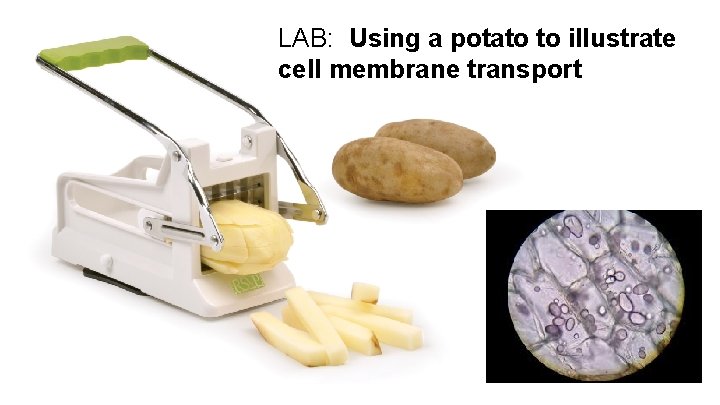
LAB: Using a potato to illustrate cell membrane transport
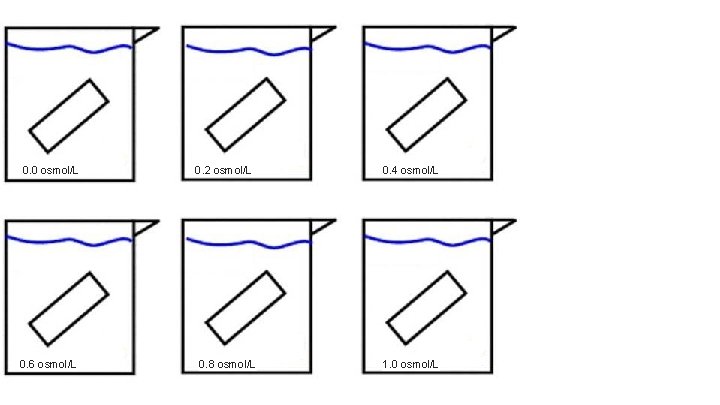
0. 0 osmol/L 0. 6 osmol/L 0. 2 osmol/L 0. 8 osmol/L 0. 4 osmol/L 1. 0 osmol/L
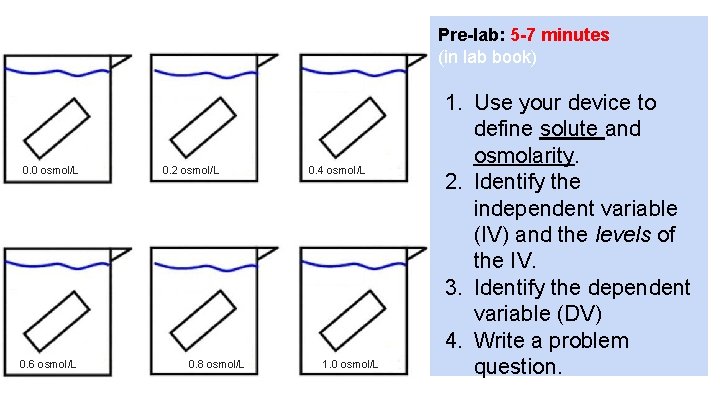
Pre-lab: 5 -7 minutes (in lab book) 0. 0 osmol/L 0. 6 osmol/L 0. 2 osmol/L 0. 8 osmol/L 0. 4 osmol/L 1. 0 osmol/L 1. Use your device to define solute and osmolarity. 2. Identify the independent variable (IV) and the levels of the IV. 3. Identify the dependent variable (DV) 4. Write a problem question.
Debrief ● ● ● Solute: Osmolarity: IV: levels of the IV. IV (and why △) Problem question
Grab a whiteboard and as a table group, draw what you agree to be the predicted graph for the potato lab results. Consider: ● IV on X axis ● DV on Y axis ● How will you differentiate an increase in from a decrease in the DV?
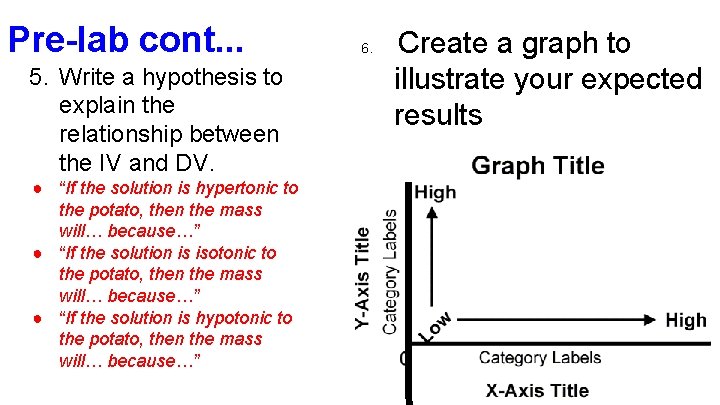
Pre-lab cont. . . 5. Write a hypothesis to explain the relationship between the IV and DV. ● “If the solution is hypertonic to the potato, then the mass will… because…” ● “If the solution is isotonic to the potato, then the mass will… because…” ● “If the solution is hypotonic to the potato, then the mass will… because…” 6. Create a graph to illustrate your expected results
Are the following controlled variables? 1. Using the same size beaker? 2. Having consistent room temperature? 3. Stirring all solutions equally? 4. Using the same potato source? 5. Keeping the potato the same size and shape? 6. Using the same gram scale for all measurements?
Validity Measures vs. Controlled Variables Good Lab Practices Using consistency in tools or lab technique to ensure measurements are consistent across trials COMMON STUDENT MISCONCEPTION… Controlled Variable A variable that might impact the responding variable if not held constant

Pre-lab cont. . . 7. Identify three good lab practices 7. Create a table that: ○ lists three controlled variables ○ explains why each variable must be controlled ○ explains how each variable can be controlled
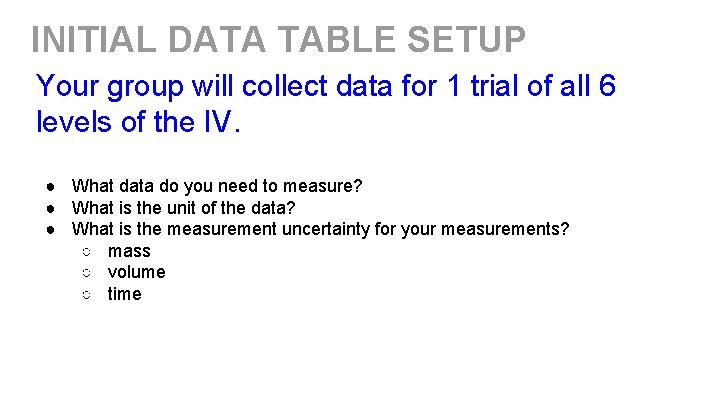
INITIAL DATA TABLE SETUP Your group will collect data for 1 trial of all 6 levels of the IV. ● What data do you need to measure? ● What is the unit of the data? ● What is the measurement uncertainty for your measurements? ○ mass ○ volume ○ time
Stop pre-lab
Day 1 Your group will collect data for 1 trial of all 6 levels of the IV.
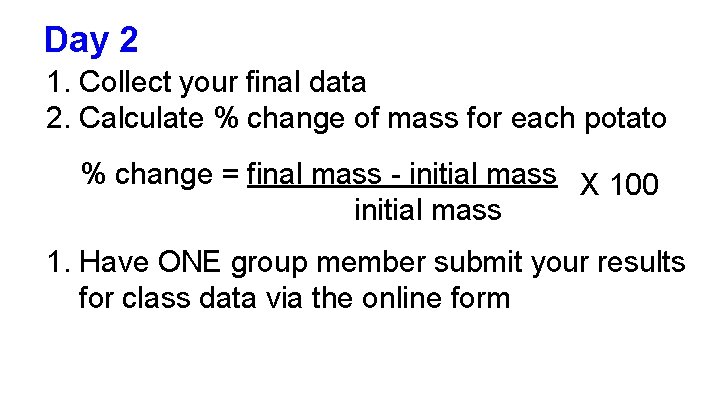
Day 2 1. Collect your final data 2. Calculate % change of mass for each potato % change = final mass - initial mass X 100 initial mass 1. Have ONE group member submit your results for class data via the online form
Analysis 1. Calculate mean percent change for class data (show worked example for one level) 2. In lab book, graph mean percent change results (use at least a half page). Be sure to use the right type of graph!

Determining Osmolarity Create a line of best fit on the graph to show the trend in the % change of mass. Use the graph to estimate the molarity of the potato. Highlight your estimate in your lab book.

Stop Analysis pt 1
Standard Deviation 1. Compare your standard deviation calculations with others at your table group. Everyone should have the same number! 2. Add the standard deviations to your graph by drawings lines up (+1 SD) and down (-1 SD) from each point in the graph.
Graphing in Excel ● Attempt an Excel graph with error bars ● Follow these directions ● Come tomorrow with a printed version in lab book ● DO NOT just print someone else’s version. You need to learn how to do this.
Analysis Questions 1. Determination of osmolarity of the potato. 2. Explain how you determined the potato osmolarity. 3. Explain what why there is a positive % change in mass in some solutions. 4. Explain what why there is a negative % change in mass in some solutions. 5. Explain what the standard deviation of each level represents.
- Slides: 19