
LAB Techniques Measurement Tools Skills aka what youll
LAB Techniques Measurement, Tools, Skills aka: what you’ll be doing in the lab ALL year long I will become familiar with lab tools, techniques, and terms.
Measurement • In science, we use the metric system. – Don’t Forget! “Inches” is a swear word. Don’t use it in this classroom. • We will use measurements to find the mass, volume, and length of various objects. I will become familiar with lab tools, techniques, and terms.
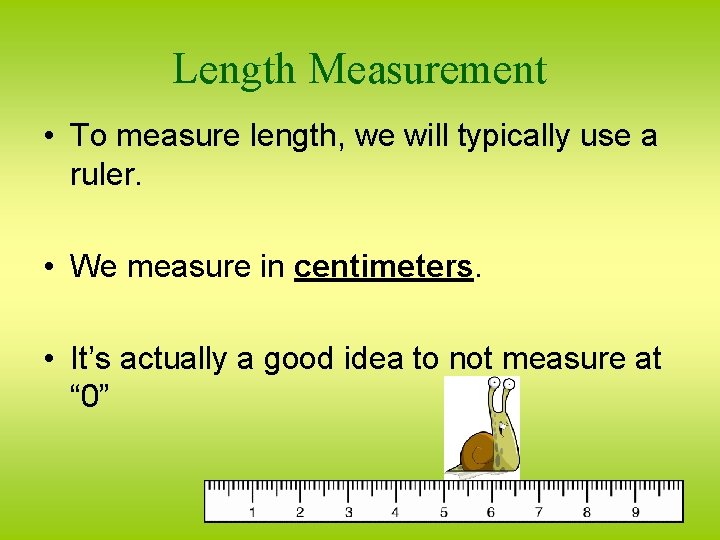
Length Measurement • To measure length, we will typically use a ruler. • We measure in centimeters. • It’s actually a good idea to not measure at “ 0”
Volume Measurement • To measure the volume of something solid: – L x W x H – measure in “cm” – volume units are cm 3 I will become familiar with lab tools, techniques, and terms.
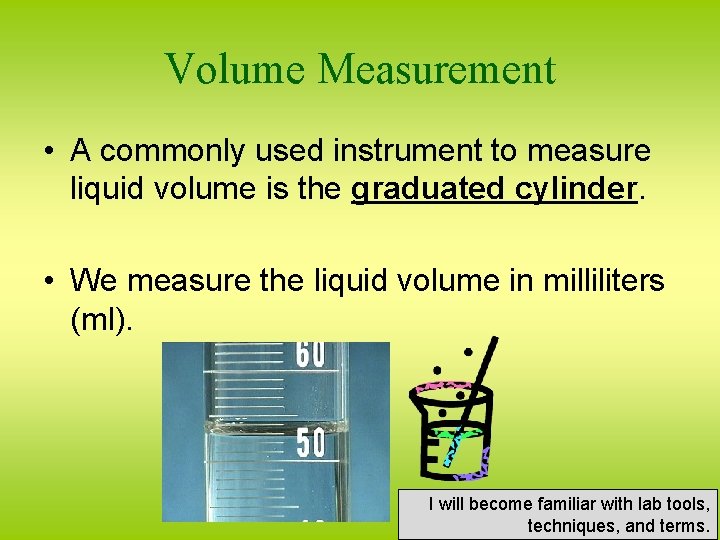
Volume Measurement • A commonly used instrument to measure liquid volume is the graduated cylinder. • We measure the liquid volume in milliliters (ml). I will become familiar with lab tools, techniques, and terms.
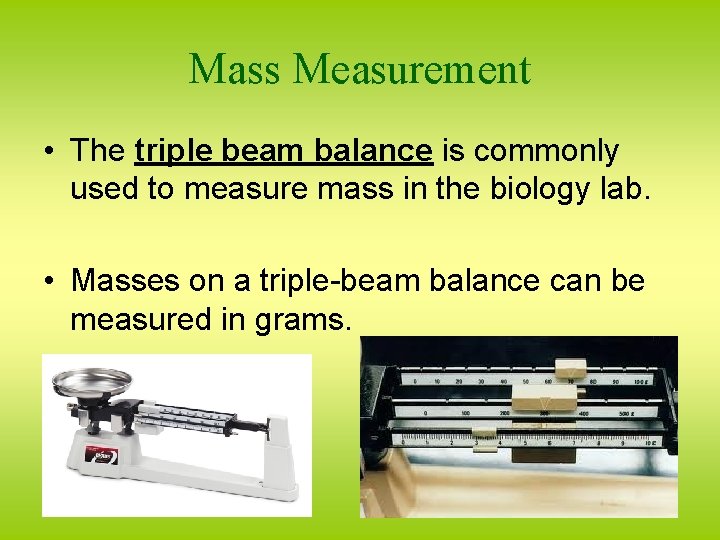
Mass Measurement • The triple beam balance is commonly used to measure mass in the biology lab. • Masses on a triple-beam balance can be measured in grams.
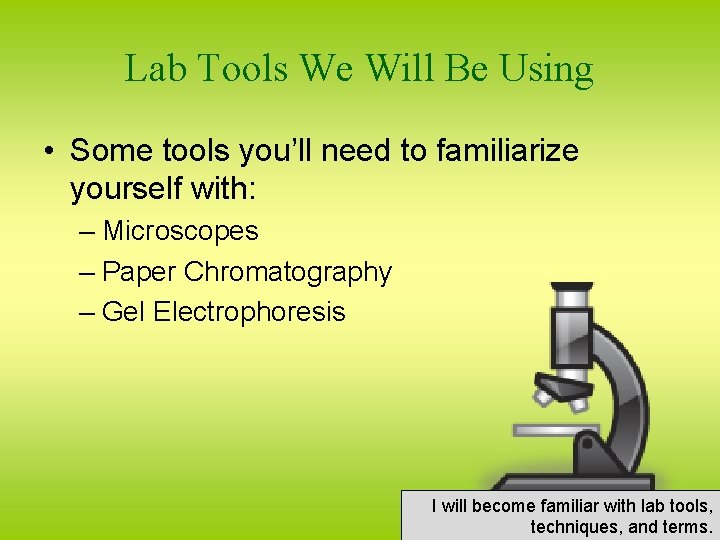
Lab Tools We Will Be Using • Some tools you’ll need to familiarize yourself with: – Microscopes – Paper Chromatography – Gel Electrophoresis I will become familiar with lab tools, techniques, and terms.
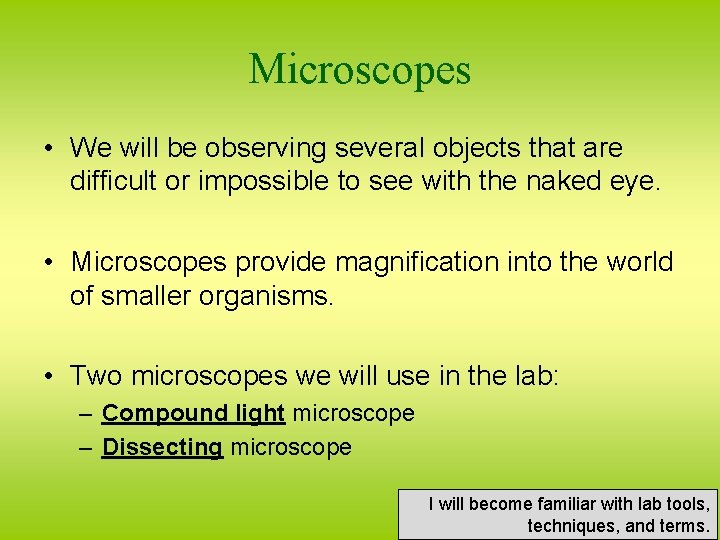
Microscopes • We will be observing several objects that are difficult or impossible to see with the naked eye. • Microscopes provide magnification into the world of smaller organisms. • Two microscopes we will use in the lab: – Compound light microscope – Dissecting microscope I will become familiar with lab tools, techniques, and terms.
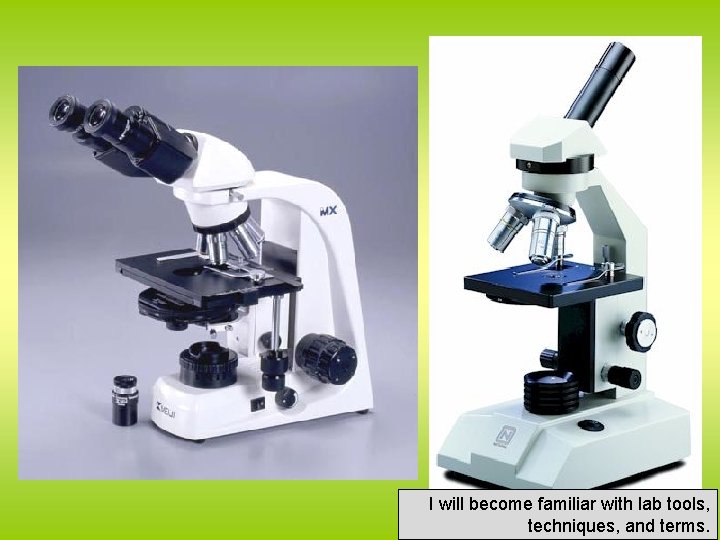
I will become familiar with lab tools, techniques, and terms.
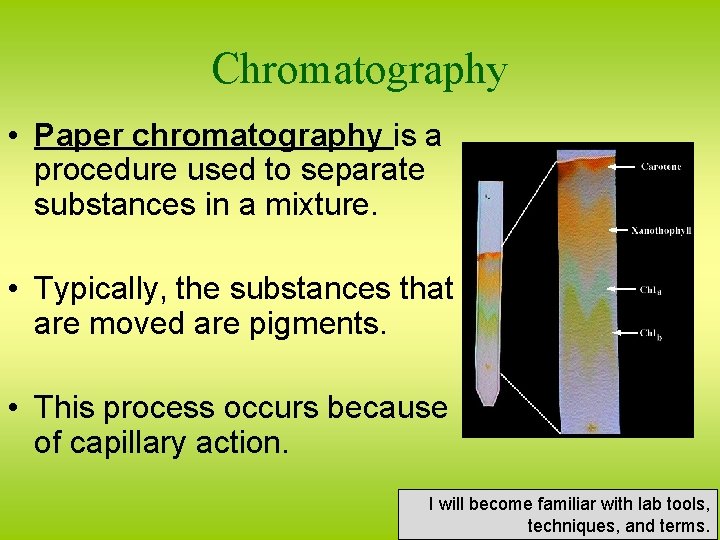
Chromatography • Paper chromatography is a procedure used to separate substances in a mixture. • Typically, the substances that are moved are pigments. • This process occurs because of capillary action. I will become familiar with lab tools, techniques, and terms.
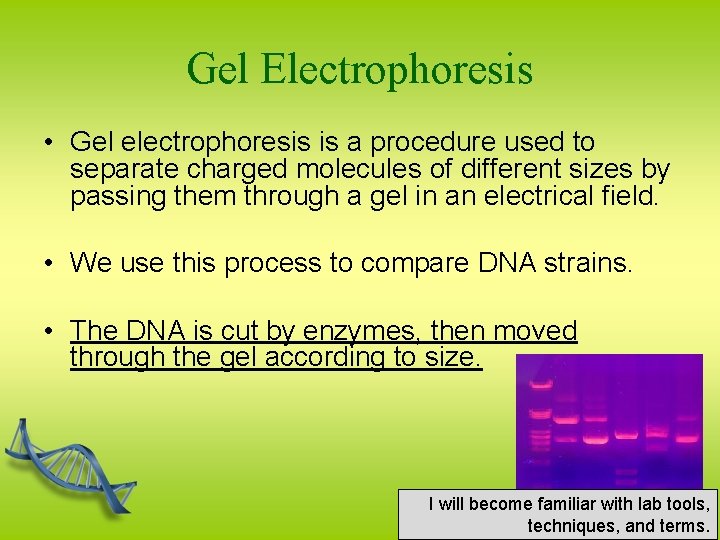
Gel Electrophoresis • Gel electrophoresis is a procedure used to separate charged molecules of different sizes by passing them through a gel in an electrical field. • We use this process to compare DNA strains. • The DNA is cut by enzymes, then moved through the gel according to size. I will become familiar with lab tools, techniques, and terms.
Laboratory Skills • When you’re in the lab, besides using tools, you’ll also need to practice appropriate skills. This year, we will focus on using and understanding: – Indicators – Dichotomous Keys – Dissection Techniques I will become familiar with lab tools, techniques, and terms.
Indicators • Indicators are substances which are used to provide information about the classification of a particular substance. • Some commonly used indicators in the living environment/biology lab include: – Litmus (p. H) paper – finds p. H – Lugol's (iodine) solution – starch detection – Benedict's solution – sugar detection I will become familiar with lab tools, techniques, and terms.
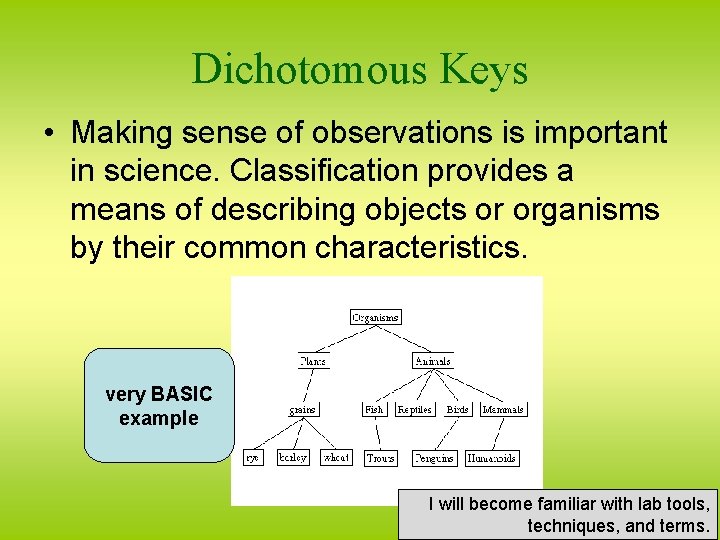
Dichotomous Keys • Making sense of observations is important in science. Classification provides a means of describing objects or organisms by their common characteristics. very BASIC example I will become familiar with lab tools, techniques, and terms.
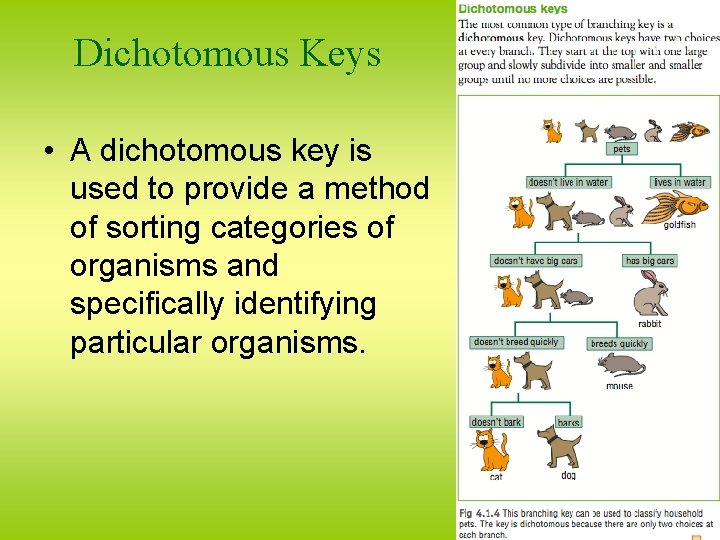
Dichotomous Keys • A dichotomous key is used to provide a method of sorting categories of organisms and specifically identifying particular organisms.
Dissection Techniques • The dissection of representative plant and dissection animal specimens is a required skill for the living environment/biology course. • Dissection provides information about the internal and external characteristics of a specimen in a direct manner which other techniques can not directly provide. I will become familiar with lab tools, techniques, and terms.
Dissection Techniques • Specimens we’ll be looking at include: – Flowers – Frogs – Fetal Pigs or Rats I will become familiar with lab tools, techniques, and terms.
- Slides: 17