
Lab Safety Unit 1 Lesson 3 Lab Safety

Lab Safety Unit 1 Lesson 3
Lab Safety Learning Objectives: Students will be able to: ● ● ● Discuss the major lab safety rules we must follow and why we follow them. Describe the different pieces of personal protective equipment and how to use them. Learn the location and proper use of the lab safety equipment in the lab.
Lab Safety Core Vocabulary: • Eyewash Station • MSDS • Fire Blanket • PPE • Fire Extinguisher • Safety goggles • Fire triangle • Safety Shower • Lab coat
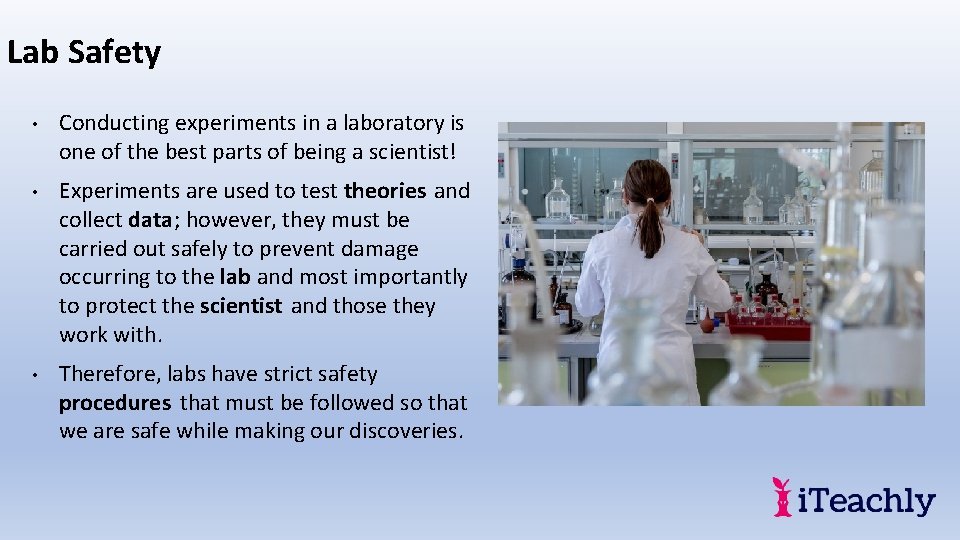
Lab Safety • Conducting experiments in a laboratory is one of the best parts of being a scientist! • Experiments are used to test theories and collect data; however, they must be carried out safely to prevent damage occurring to the lab and most importantly to protect the scientist and those they work with. • Therefore, labs have strict safety procedures that must be followed so that we are safe while making our discoveries.
Lab Safety What is Laboratory Safety (Lab Safety)? • Laboratory Safety refers to the rules and safety guidelines that anyone working in a laboratory must follow. • Most of the lab safety procedures you learn at school are also followed in university and workplace settings.
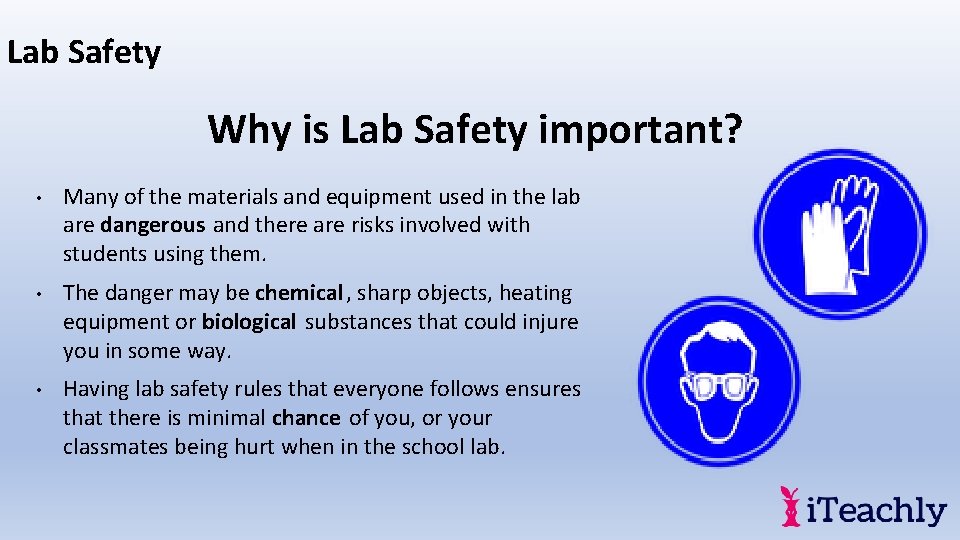
Lab Safety Why is Lab Safety important? • Many of the materials and equipment used in the lab are dangerous and there are risks involved with students using them. • The danger may be chemical, sharp objects, heating equipment or biological substances that could injure you in some way. • Having lab safety rules that everyone follows ensures that there is minimal chance of you, or your classmates being hurt when in the school lab.
Lab Safety 1. Be Responsible! • Being able to conduct experiments in the lab is a privilege and should be taken seriously. • Always think your actions through and be on your best classroom behavior. • Practical jokes could lead to your or your classmates getting hurt.
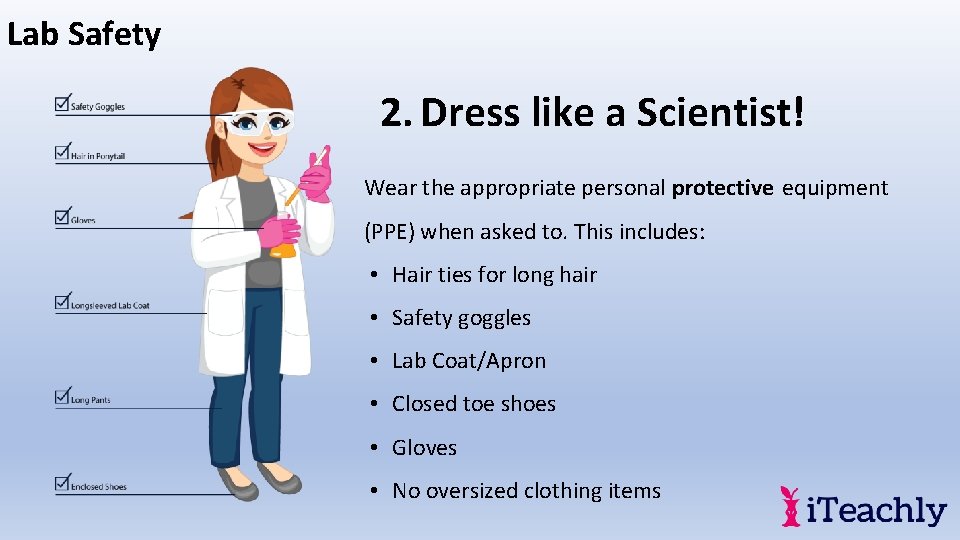
Lab Safety 2. Dress like a Scientist! Wear the appropriate personal protective equipment (PPE) when asked to. This includes: • Hair ties for long hair • Safety goggles • Lab Coat/Apron • Closed toe shoes • Gloves • No oversized clothing items
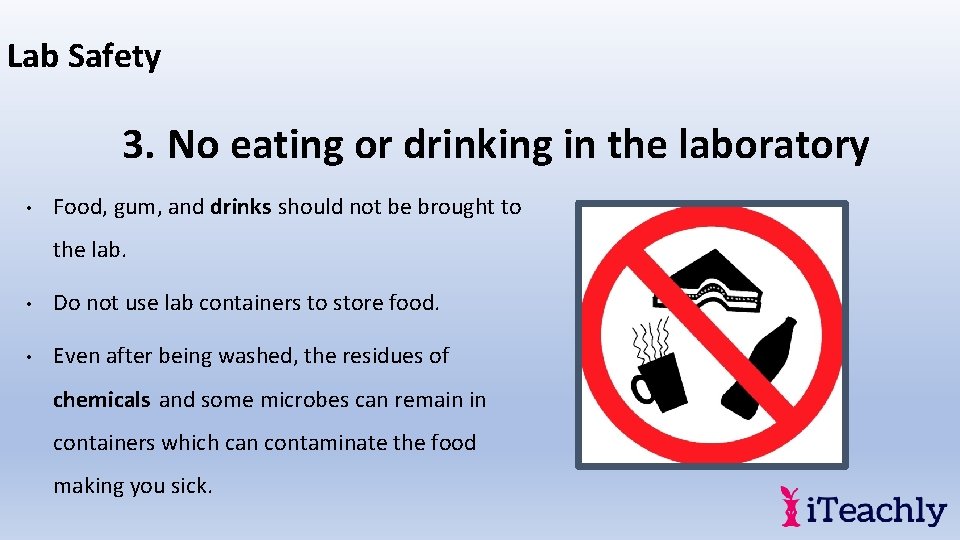
Lab Safety 3. No eating or drinking in the laboratory • Food, gum, and drinks should not be brought to the lab. • Do not use lab containers to store food. • Even after being washed, the residues of chemicals and some microbes can remain in containers which can contaminate the food making you sick.
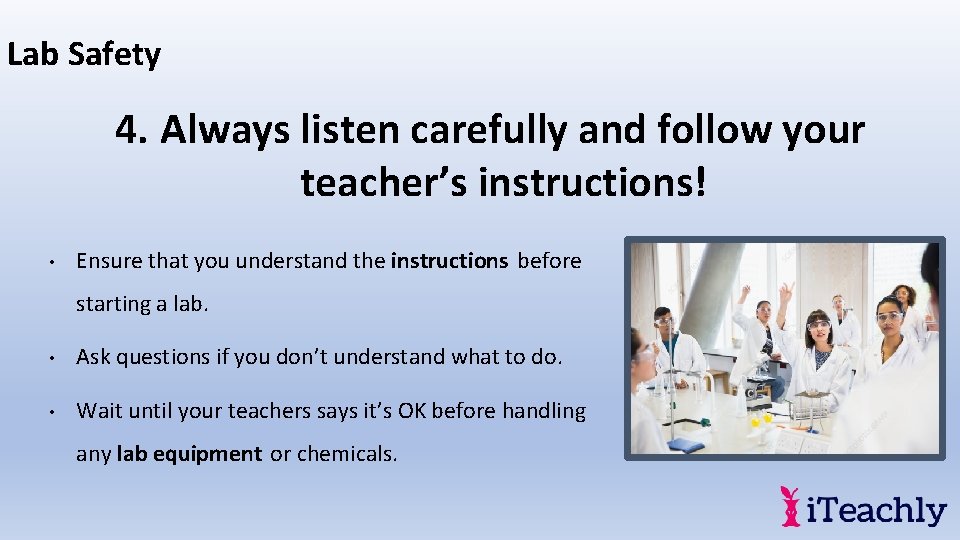
Lab Safety 4. Always listen carefully and follow your teacher’s instructions! • Ensure that you understand the instructions before starting a lab. • Ask questions if you don’t understand what to do. • Wait until your teachers says it’s OK before handling any lab equipment or chemicals.

Lab Safety 4. Always listen carefully and follow your teacher’s instructions! • Once the lab has begun, ensure that you follow each step of the instructions carefully, e. g. , only mix chemicals which you are told to mix and heat objects which should be heated.

Lab Safety 5. Keep your space organized • Your workspace should be tidy. • Anything you do not need to help you carry out your lab (e. g. backpacks, lunch boxes, purses, devices, water bottles, or books) should be put on a shelf or left in the classroom away from your workspace.
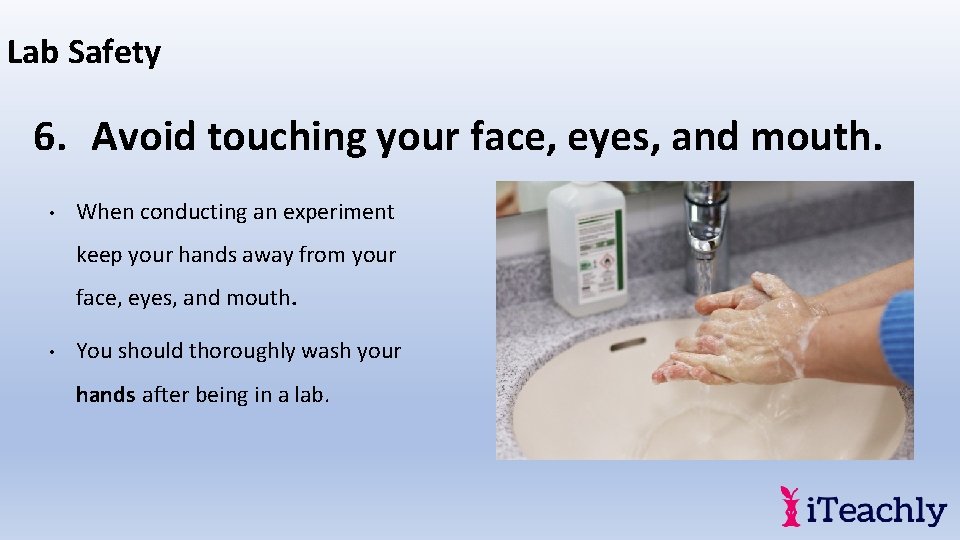
Lab Safety 6. Avoid touching your face, eyes, and mouth. • When conducting an experiment keep your hands away from your face, eyes, and mouth. • You should thoroughly wash your hands after being in a lab.
Lab Safety 7. Notify your teacher of any accidents or mistakes immediately. • Accidents and mistakes do happen in the lab. When they do, let your teacher know immediately, so that they can direct you how best to fix it. • If the accident involves injury to yourself or someone near you, acting quickly is essential as it can reduce the chance of long-term or even permanent damage.
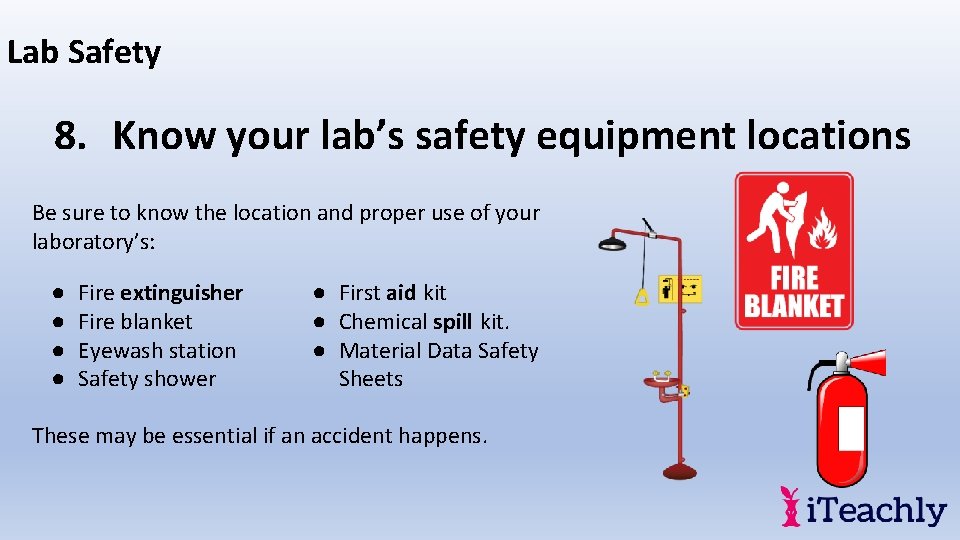
Lab Safety 8. Know your lab’s safety equipment locations Be sure to know the location and proper use of your laboratory’s: ● ● Fire extinguisher Fire blanket Eyewash station Safety shower ● First aid kit ● Chemical spill kit. ● Material Data Safety Sheets These may be essential if an accident happens.
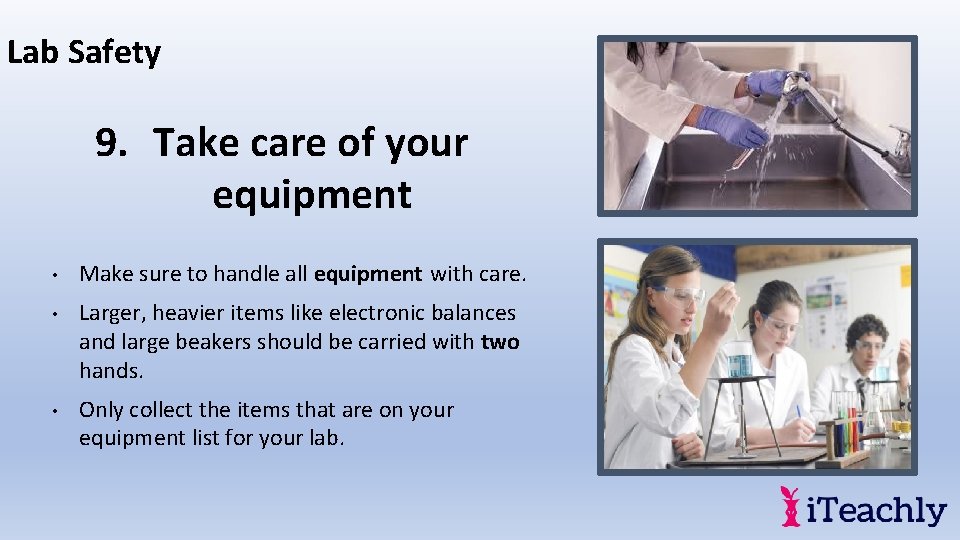
Lab Safety 9. Take care of your equipment • Make sure to handle all equipment with care. • Larger, heavier items like electronic balances and large beakers should be carried with two hands. • Only collect the items that are on your equipment list for your lab.
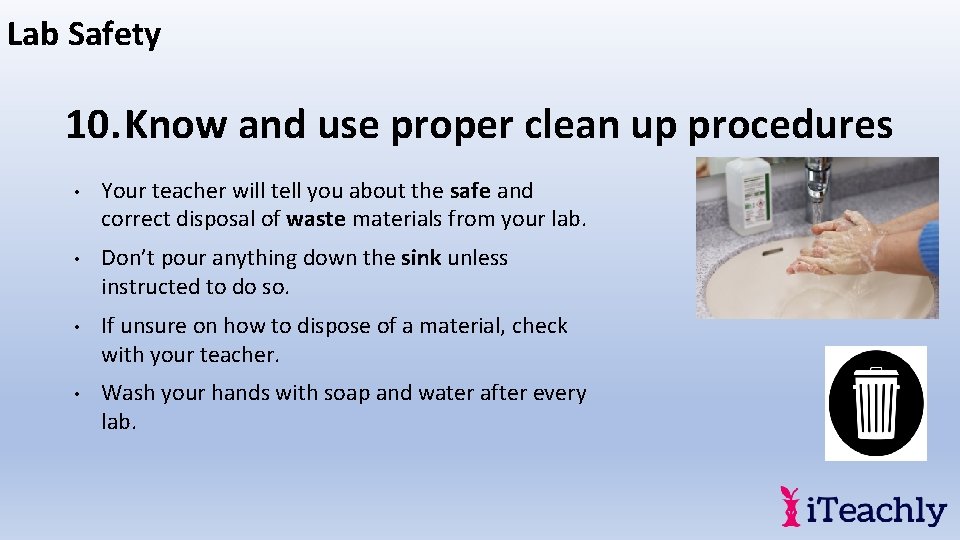
Lab Safety 10. Know and use proper clean up procedures • Your teacher will tell you about the safe and correct disposal of waste materials from your lab. • Don’t pour anything down the sink unless instructed to do so. • If unsure on how to dispose of a material, check with your teacher. • Wash your hands with soap and water after every lab.
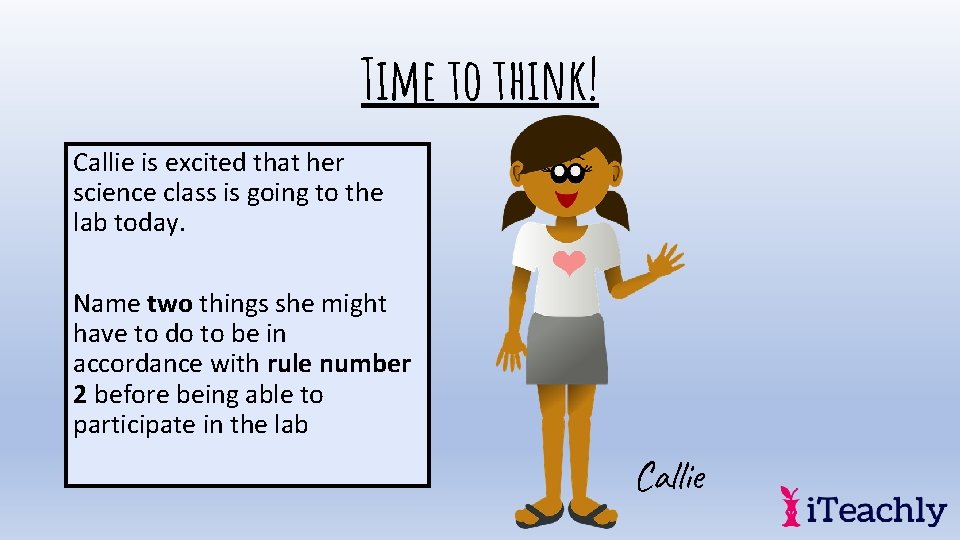
Time to think! Callie is excited that her science class is going to the lab today. Name two things she might have to do to be in accordance with rule number 2 before being able to participate in the lab Callie
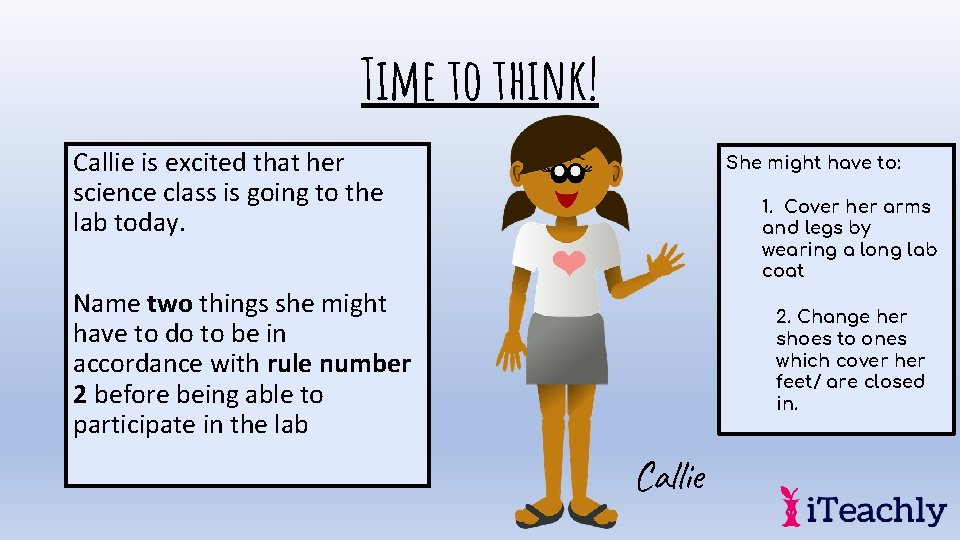
Time to think! Callie is excited that her science class is going to the lab today. She might have to: 1. Cover her arms and legs by wearing a long lab coat Name two things she might have to do to be in accordance with rule number 2 before being able to participate in the lab 2. Change her shoes to ones which cover her feet/ are closed in. Callie
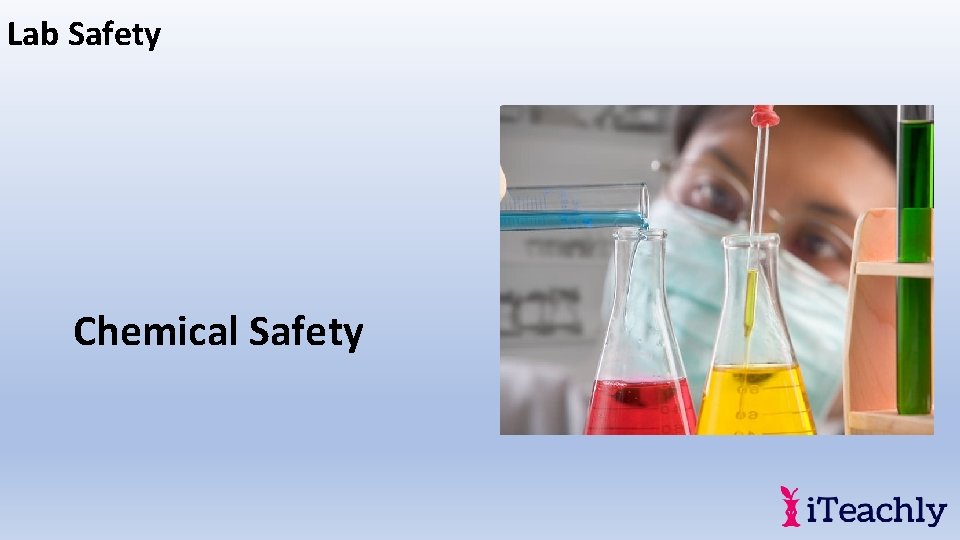
Lab Safety Chemical Safety
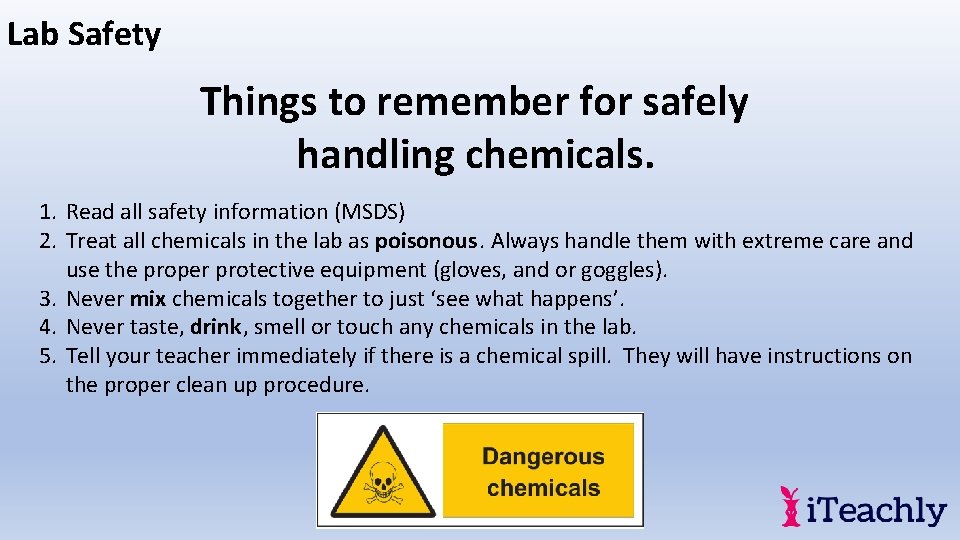
Lab Safety Things to remember for safely handling chemicals. 1. Read all safety information (MSDS) 2. Treat all chemicals in the lab as poisonous. Always handle them with extreme care and use the proper protective equipment (gloves, and or goggles). 3. Never mix chemicals together to just ‘see what happens’. 4. Never taste, drink, smell or touch any chemicals in the lab. 5. Tell your teacher immediately if there is a chemical spill. They will have instructions on the proper clean up procedure.
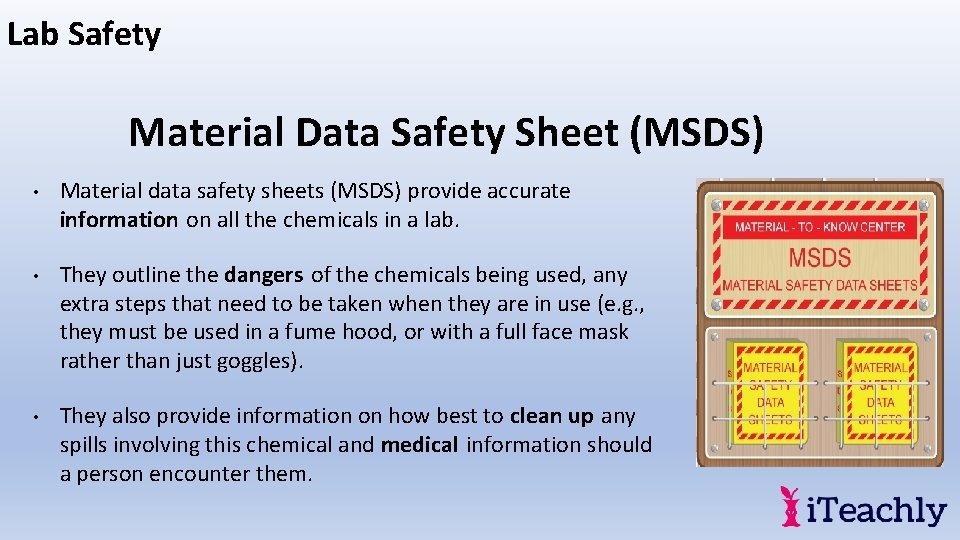
Lab Safety Material Data Safety Sheet (MSDS) • Material data safety sheets (MSDS) provide accurate information on all the chemicals in a lab. • They outline the dangers of the chemicals being used, any extra steps that need to be taken when they are in use (e. g. , they must be used in a fume hood, or with a full face mask rather than just goggles). • They also provide information on how best to clean up any spills involving this chemical and medical information should a person encounter them.
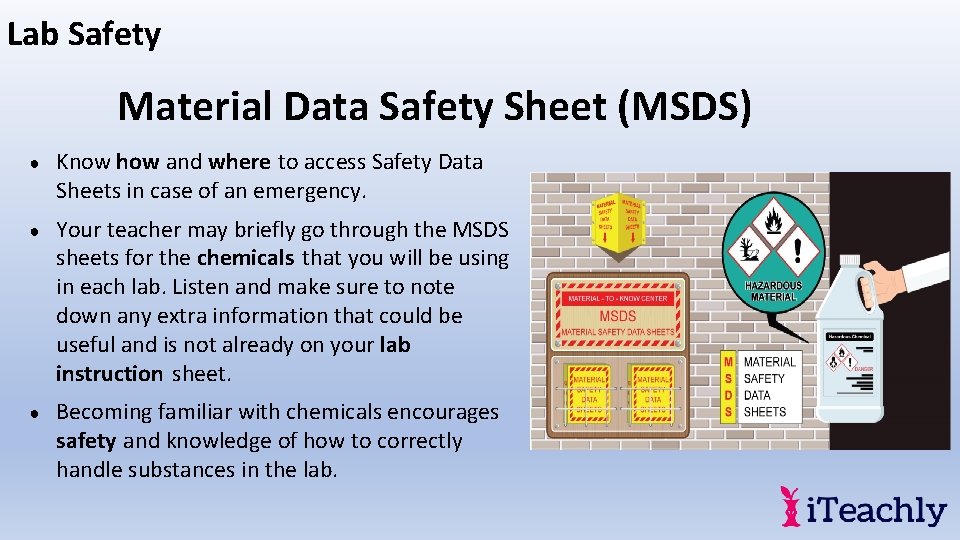
Lab Safety Material Data Safety Sheet (MSDS) ● Know how and where to access Safety Data Sheets in case of an emergency. ● Your teacher may briefly go through the MSDS sheets for the chemicals that you will be using in each lab. Listen and make sure to note down any extra information that could be useful and is not already on your lab instruction sheet. ● Becoming familiar with chemicals encourages safety and knowledge of how to correctly handle substances in the lab.
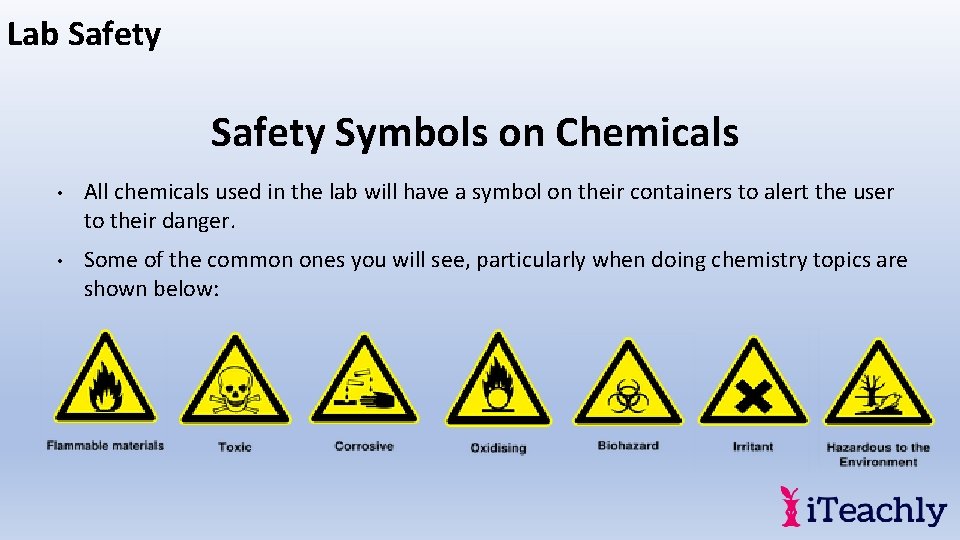
Lab Safety Symbols on Chemicals • All chemicals used in the lab will have a symbol on their containers to alert the user to their danger. • Some of the common ones you will see, particularly when doing chemistry topics are shown below:
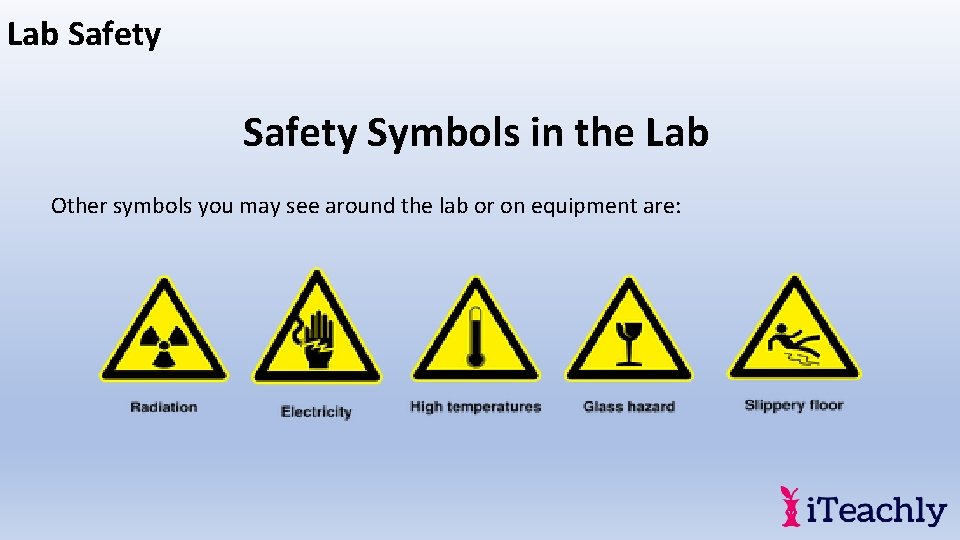
Lab Safety Symbols in the Lab Other symbols you may see around the lab or on equipment are:
Lab Safety First Aid Procedures Accidents in the lab are serious and should be addressed quickly to ensure there is minimal damage to the person/people/ equipment involved.
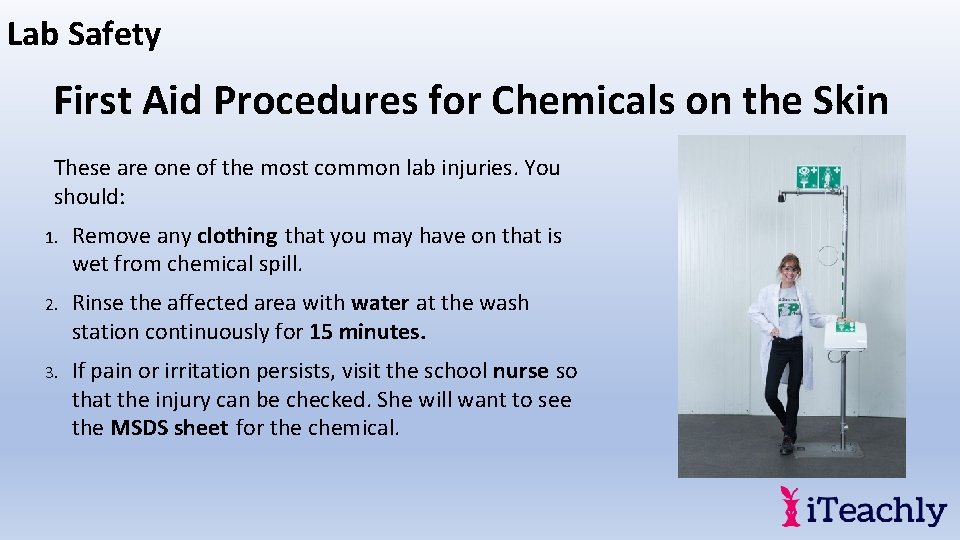
Lab Safety First Aid Procedures for Chemicals on the Skin These are one of the most common lab injuries. You should: 1. Remove any clothing that you may have on that is wet from chemical spill. 2. Rinse the affected area with water at the wash station continuously for 15 minutes. 3. If pain or irritation persists, visit the school nurse so that the injury can be checked. She will want to see the MSDS sheet for the chemical.
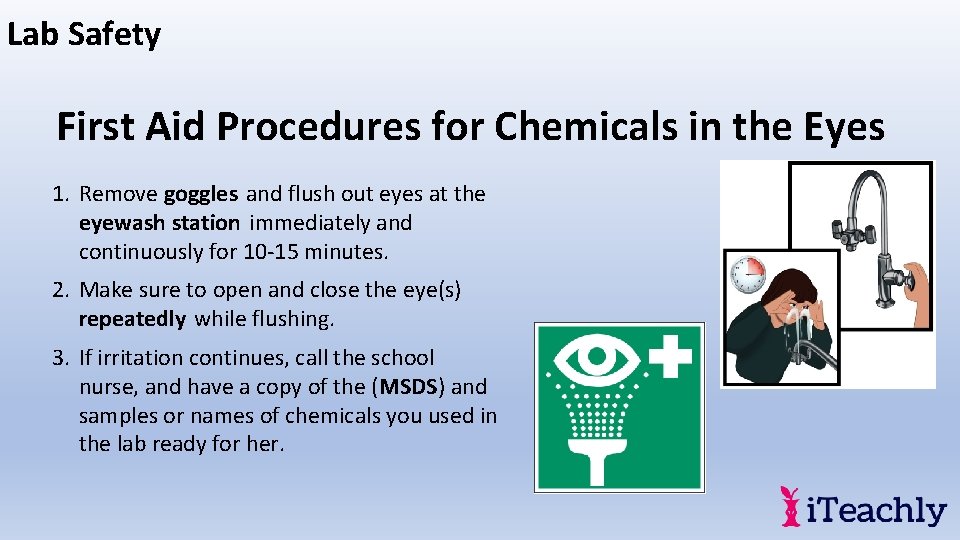
Lab Safety First Aid Procedures for Chemicals in the Eyes 1. Remove goggles and flush out eyes at the eyewash station immediately and continuously for 10 -15 minutes. 2. Make sure to open and close the eye(s) repeatedly while flushing. 3. If irritation continues, call the school nurse, and have a copy of the (MSDS) and samples or names of chemicals you used in the lab ready for her.
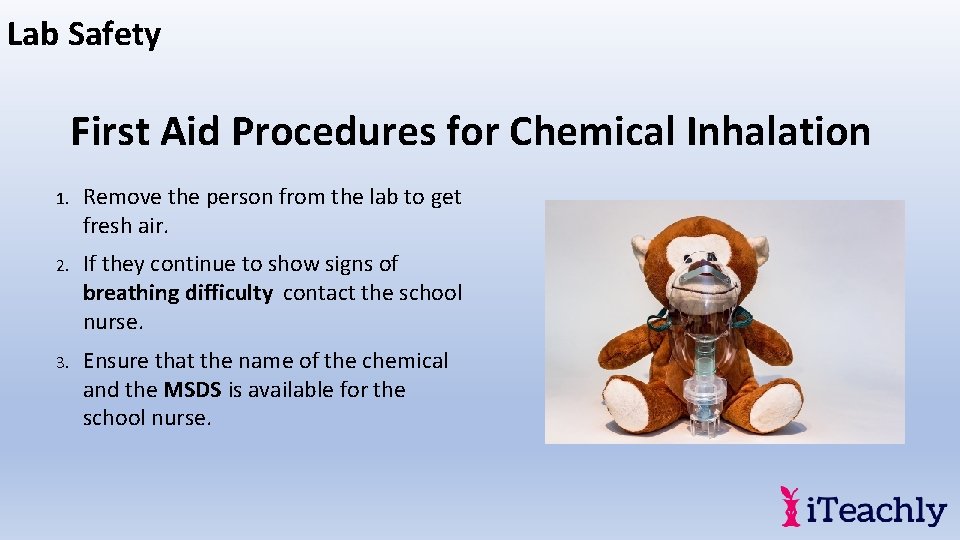
Lab Safety First Aid Procedures for Chemical Inhalation 1. Remove the person from the lab to get fresh air. 2. If they continue to show signs of breathing difficulty contact the school nurse. 3. Ensure that the name of the chemical and the MSDS is available for the school nurse.
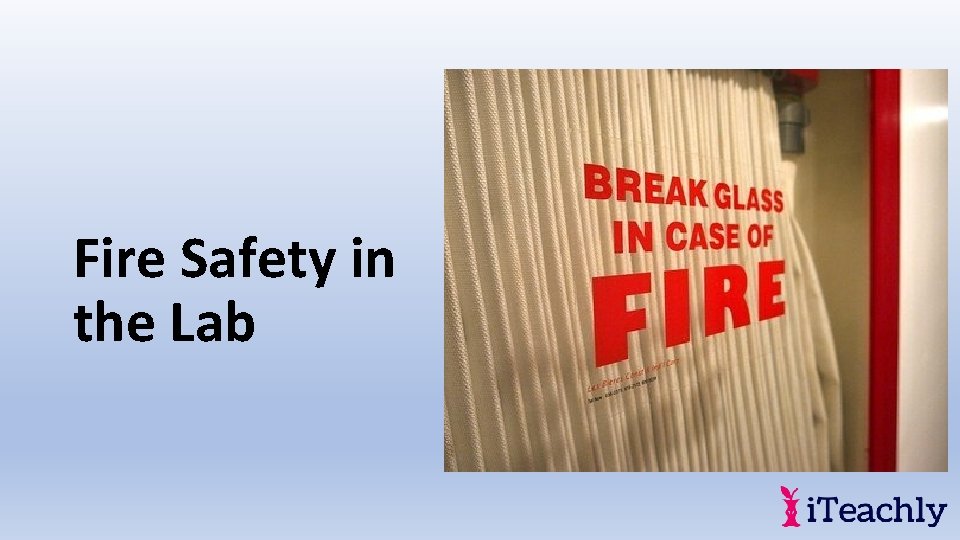
Fire Safety in the Lab
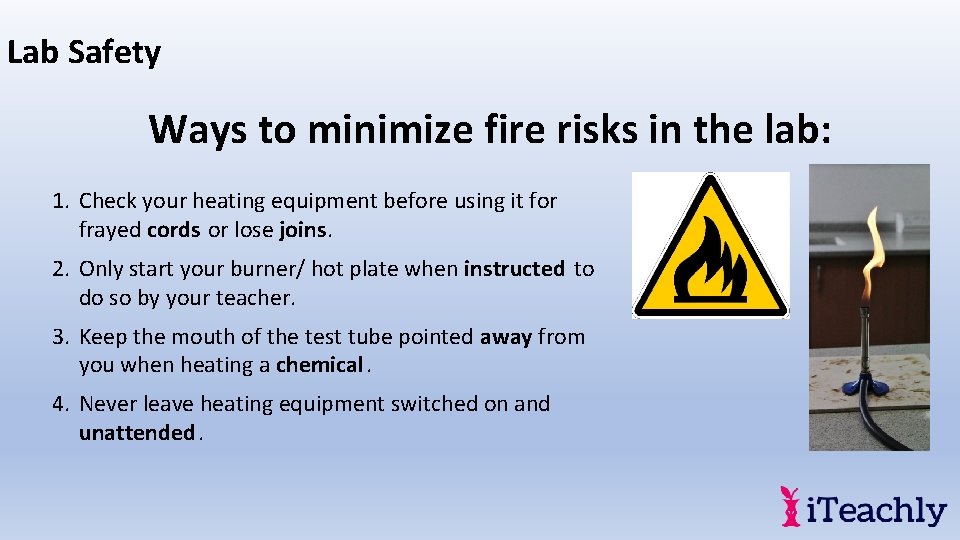
Lab Safety Ways to minimize fire risks in the lab: 1. Check your heating equipment before using it for frayed cords or lose joins. 2. Only start your burner/ hot plate when instructed to do so by your teacher. 3. Keep the mouth of the test tube pointed away from you when heating a chemical. 4. Never leave heating equipment switched on and unattended.
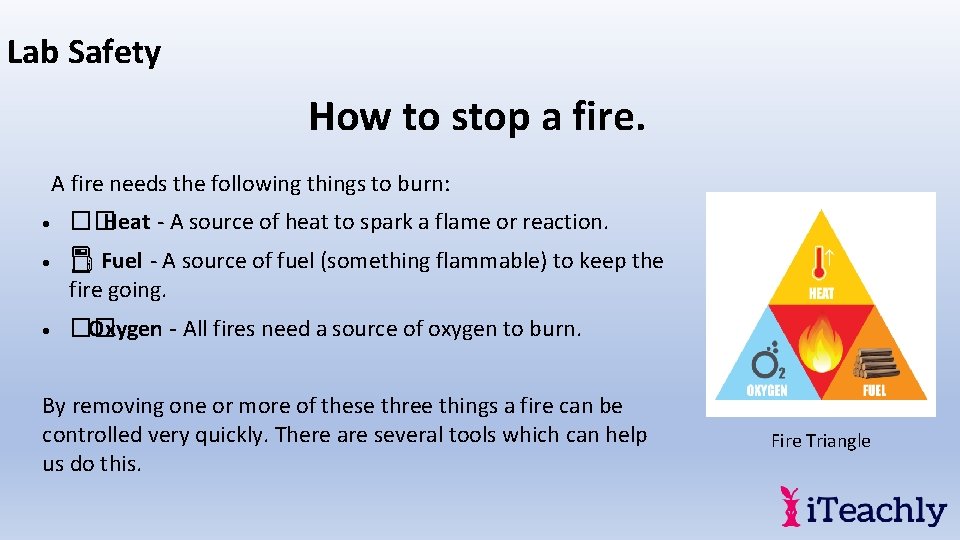
Lab Safety How to stop a fire. A fire needs the following things to burn: �� Heat - A source of heat to spark a flame or reaction. ⛽ Fuel - A source of fuel (something flammable) to keep the fire going. �� Oxygen - All fires need a source of oxygen to burn. By removing one or more of these three things a fire can be controlled very quickly. There are several tools which can help us do this. Fire Triangle
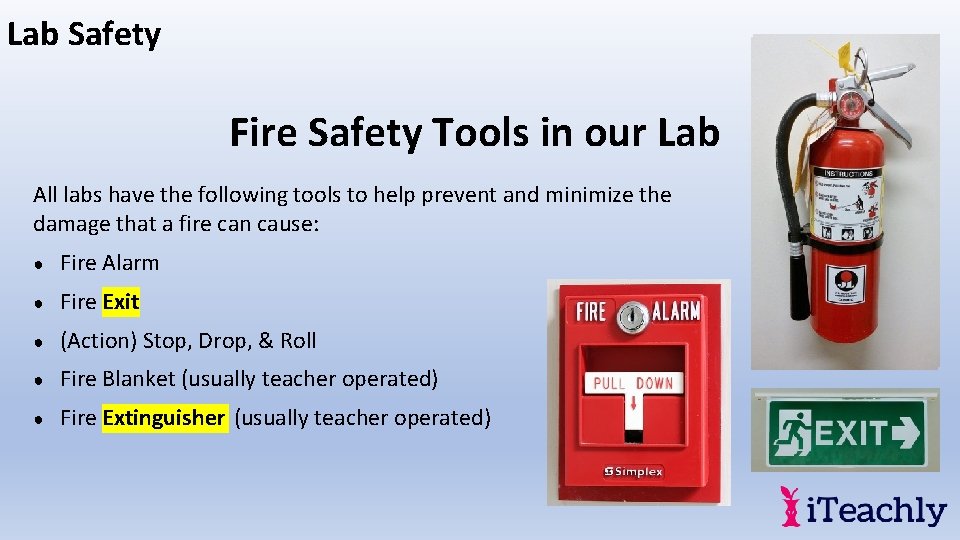
Lab Safety Fire Safety Tools in our Lab All labs have the following tools to help prevent and minimize the damage that a fire can cause: ● Fire Alarm ● Fire Exit ● (Action) Stop, Drop, & Roll ● Fire Blanket (usually teacher operated) ● Fire Extinguisher (usually teacher operated)
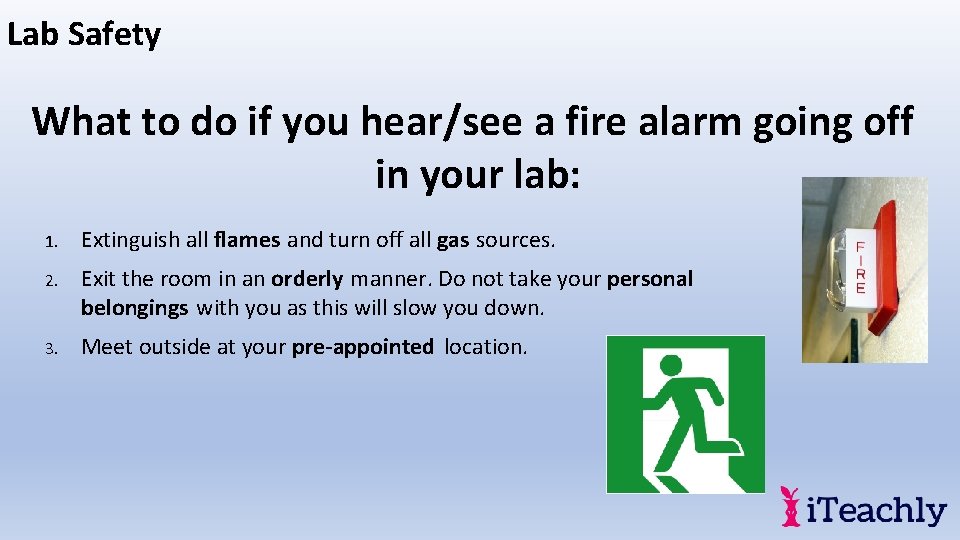
Lab Safety What to do if you hear/see a fire alarm going off in your lab: 1. Extinguish all flames and turn off all gas sources. 2. Exit the room in an orderly manner. Do not take your personal belongings with you as this will slow you down. 3. Meet outside at your pre-appointed location.
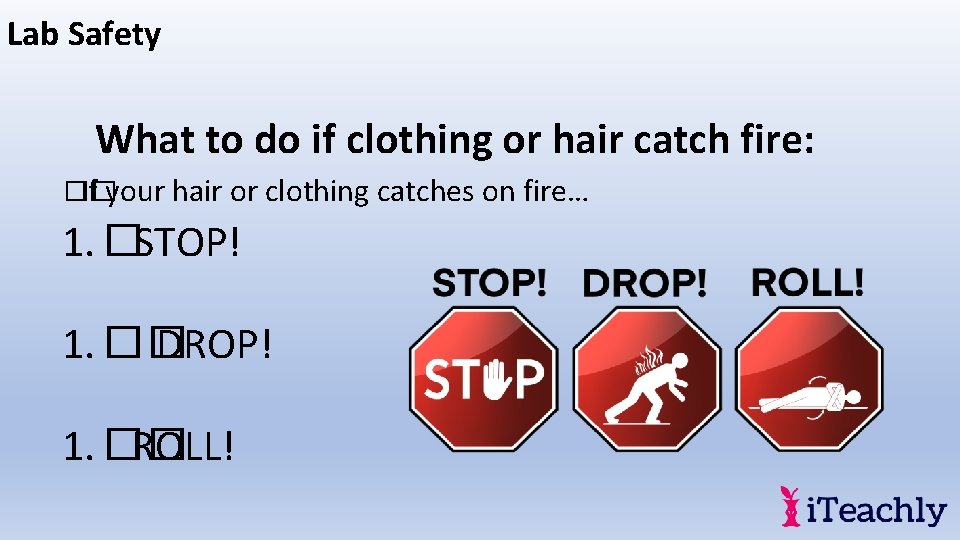
Lab Safety What to do if clothing or hair catch fire: �� If your hair or clothing catches on fire… 1. �STOP! 1. �� DROP! 1. �� ROLL!
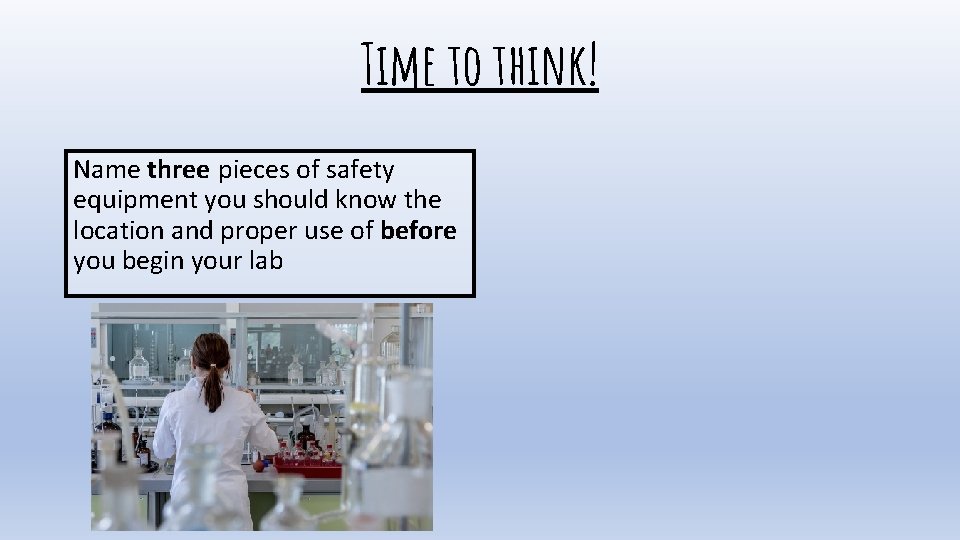
Time to think! Name three pieces of safety equipment you should know the location and proper use of before you begin your lab
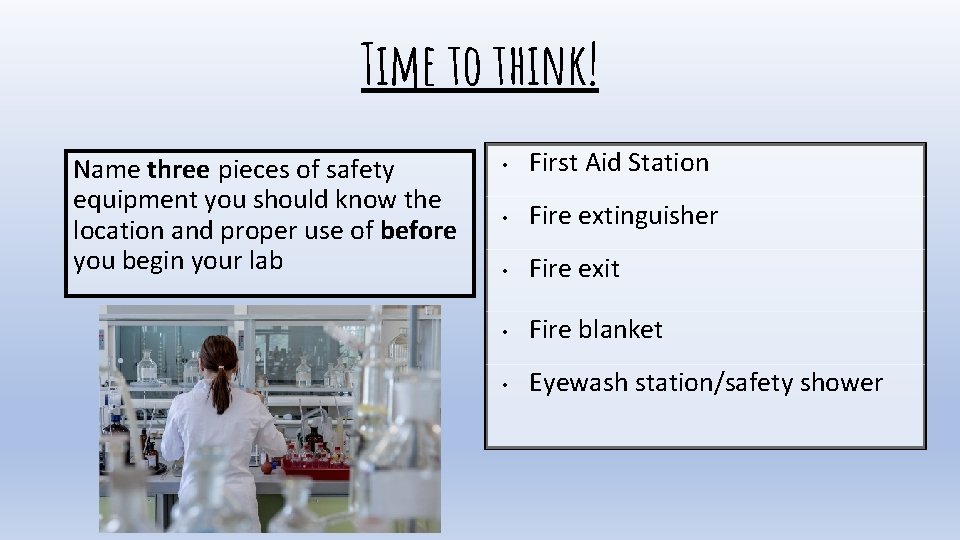
Time to think! Name three pieces of safety equipment you should know the location and proper use of before you begin your lab • First Aid Station • Fire extinguisher • Fire exit • Fire blanket • Eyewash station/safety shower
- Slides: 37