
Lab Safety Student Activities for Personal and Environmental
Lab Safety Student Activities for Personal and Environmental Safety Donna R. Sterling George Mason University dsterlin@gmu. edu
Why is safety important? • Safety of all people • students • teachers, parents, janitors • Safety for the environment • You might be sued
How can you protect yourself legally? Teachers need to have a: • Consistent, on-going record that documents an emphasis on safety.
How do you establish a safety record? • Create evidence of your emphasis on safety that you can document.
What is evidence of safety that you can document? l Real concrete examples • List of rules • Test over rules • ? Safety Test Safety Rules 1. 2. 3.
Safety Rules • • Written list – by adults Consensus - higher is better • class • grade/subject level • department • school district Safet y
List of Rules • 2 copies - teacher and student • go over list with students • list signed and dated by both • student and • parent/guardian • front and back of • one page • no cut off section for signatures Safety Rules • teacher must keep a signed copy
Documentation l What if the student forges the signature? • Show of dishonesty by student l How long should you keep a signed copy? • For greatest protection, the teacher should keep a signed copy of the rules for seven years.
Test over Rules Must Pass Practical questions • Location of Safety Equipment • Operation of Safety Equipment • Location of School Nurse • Knowledge of Safe Procedures • safe equipment handling • chemical disposal

Enforce Rules! • One of the most common problems
What eye protection is legally required? • safety goggles • not safety glasses or spectacles • Can you wear contact lenses in lab? • contact lenses do not increase risk • use same protective goggles Safety in Academic Chemistry Laboratories, 1995, ACS

Eye Wash l In case of exposure, how long do you flush eyes with water? • a minimum of 15 minutes l How often do you test an eye wash? • weekly - to verify operation and flush lines
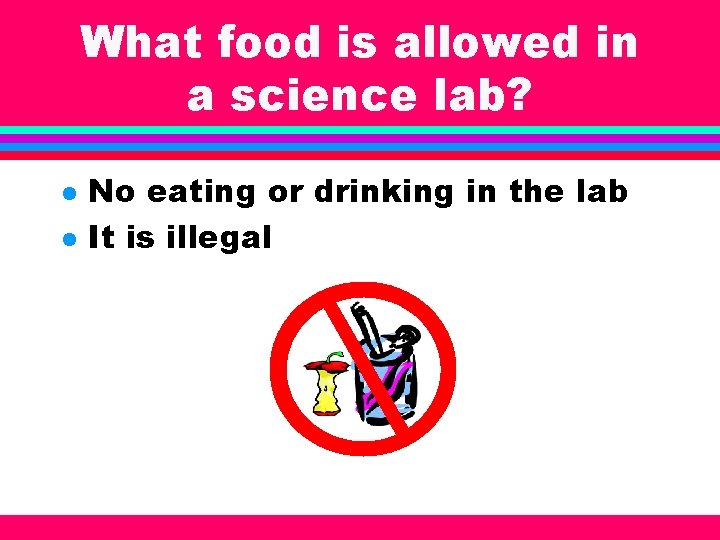
What food is allowed in a science lab? l l No eating or drinking in the lab It is illegal
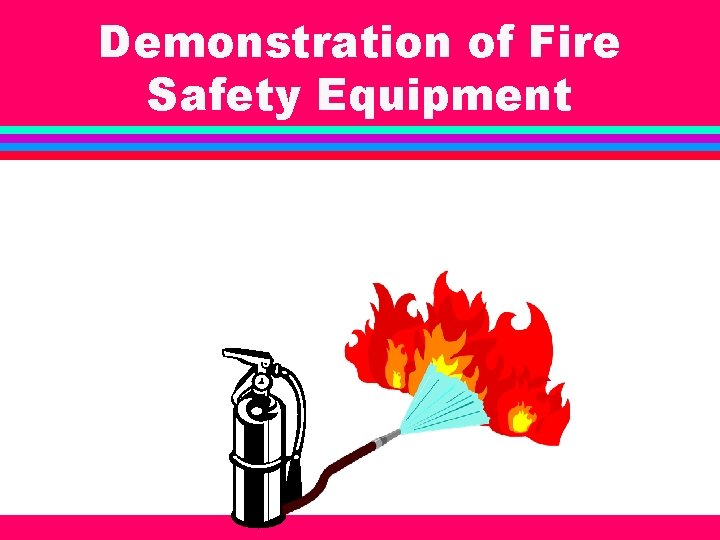
Demonstration of Fire Safety Equipment
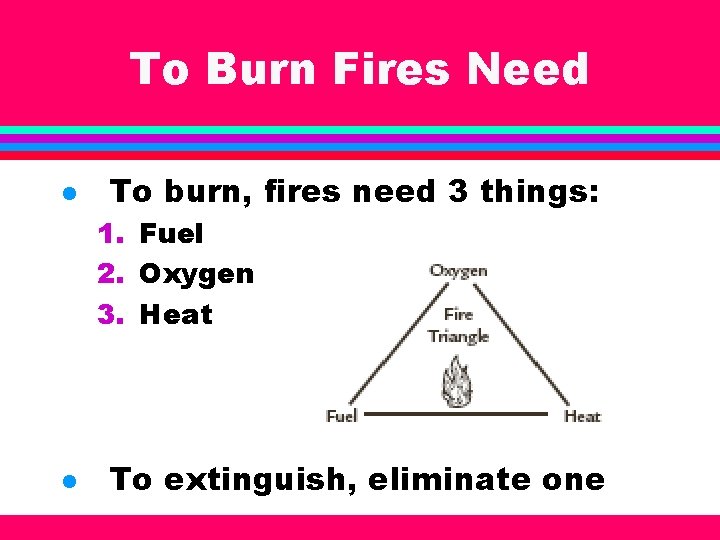
To Burn Fires Need l To burn, fires need 3 things: 1. Fuel 2. Oxygen 3. Heat l To extinguish, eliminate one
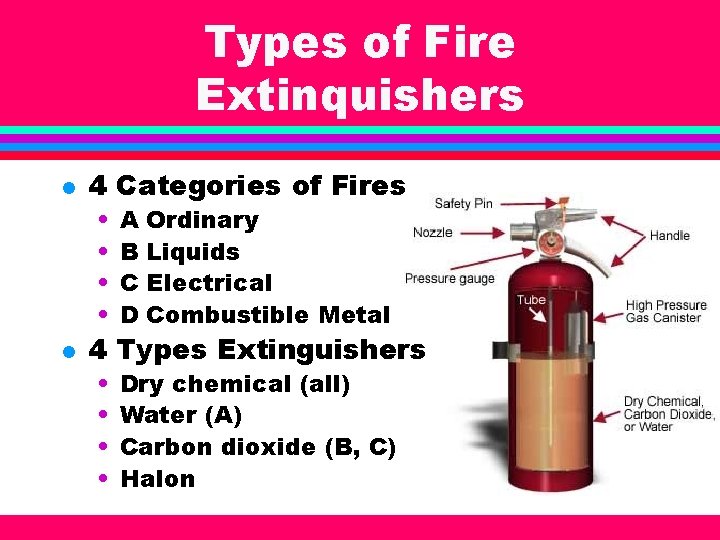
Types of Fire Extinquishers l l 4 Categories of Fires • • A B C D • • Dry chemical (all) Water (A) Carbon dioxide (B, C) Halon Ordinary Liquids Electrical Combustible Metal 4 Types Extinguishers
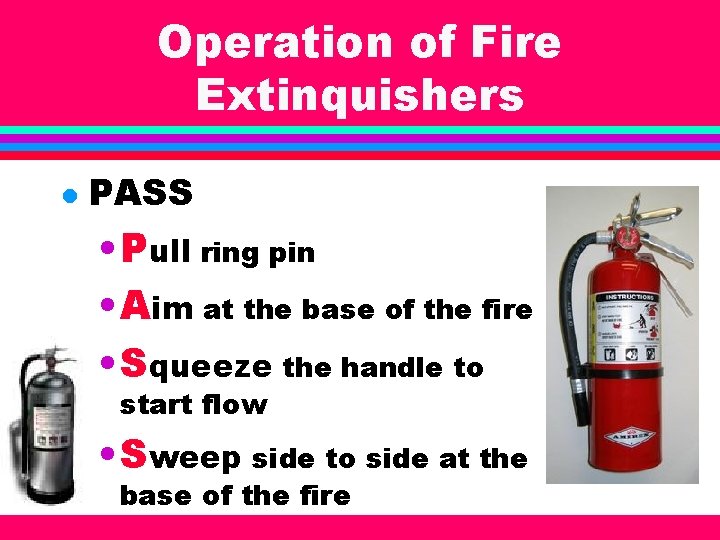
Operation of Fire Extinquishers l PASS • Pull ring pin • Aim at the base of the fire • Squeeze the handle to start flow • Sweep side to side at the base of the fire
Fire Extinguisher Video 1. Escape and double click on URL 2. Click on stop preview, then click on start video
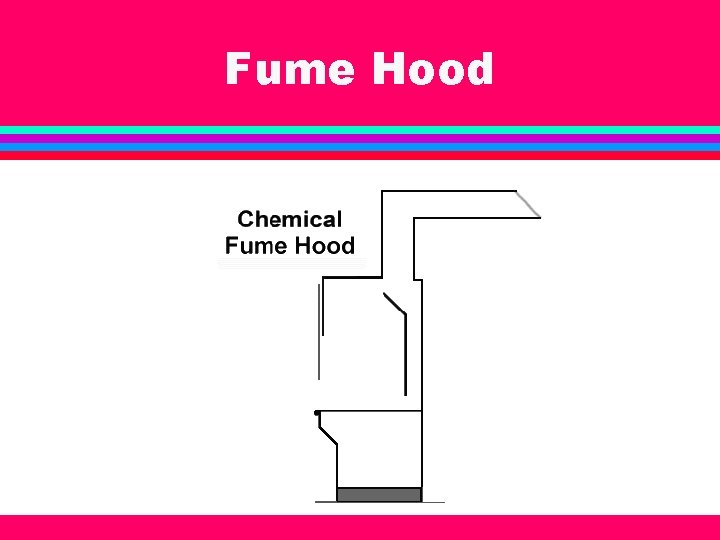
Fume Hood
Fume Hoods l When not using the hood, what position do you keep the sash (window)? • closed l When you are actively using the hood, how high do you raise the sash? • 10 -15 cm
What safety activities can you do with students? • • Make a long list of activities. Which of these activities can you easily document?
Lab Demonstrations on Safety • Eyes • Cow eyes and 18 M H 2 SO 4 – demo • 0 -30 seconds – damage immediately • Egg whites and 6 M HCl • Clothes • Read labels • Fabric and 6 M HCl • Water, acid, base – look the same • p. H paper - smell
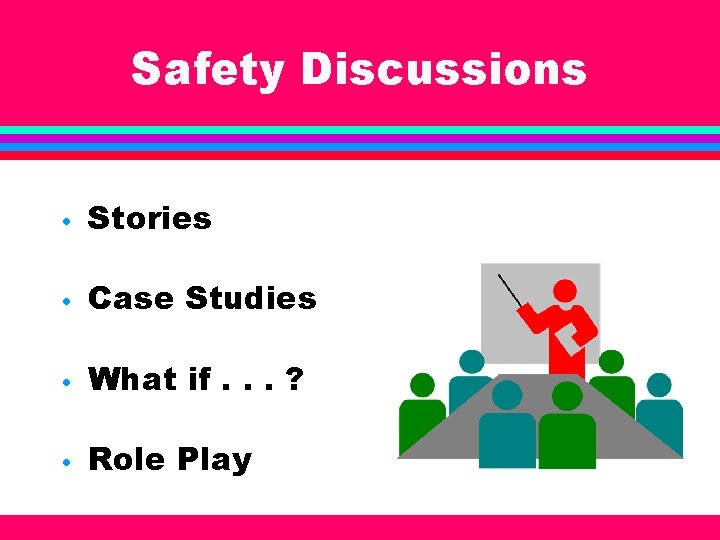
Safety Discussions • Stories • Case Studies • What if. . . ? • Role Play
Videos on Safety videos can be purchased from Flinn Scientific and other companies http: //www. flinnsci. com/video. asp
Posters on Safety • Displayed in Lab • commercial • student created
Writing • Student generated • questions - quizzes • poems - index cards • stories - book • articles - newsletter
Before Each Lab • Demonstrate Equipment • Discuss Procedures • Discuss Hazards • Review Disposal of Materials
Testing • Test on Safety • Quiz Before Lab • safety question • Midterm and Final • safety question
Safety for Living • Earth Science • Biology • Chemistry • Physics • hurricanes and earthquakes • communicable diseases • chemical handling • electrical safety
Teacher Safety Issues • Create a trail of evidence showing an on-going emphasis on safety that you can document for your own protection.
Safety Rules and Regulations
Occupational Safety and Health Administration (OSHA) • OSHA 1910. 1450 (Laboratory Standard) Section D(6) • School laboratories should include “protective apparel compatible with the required degree of protection for substances being handled”.

American National Standards Institute (ANSI) • • ANSI is a nonprofit group that publishes standards for equipment for industry. It is not a federal agency. Eye Protection ANSI Z 87. 1 -1989 One of many standards for goggle lenses. • Lenses shall resist impact from a 25. 4 mm diameter steel ball dropped from 127 cm. • What are ANSI approved goggles?
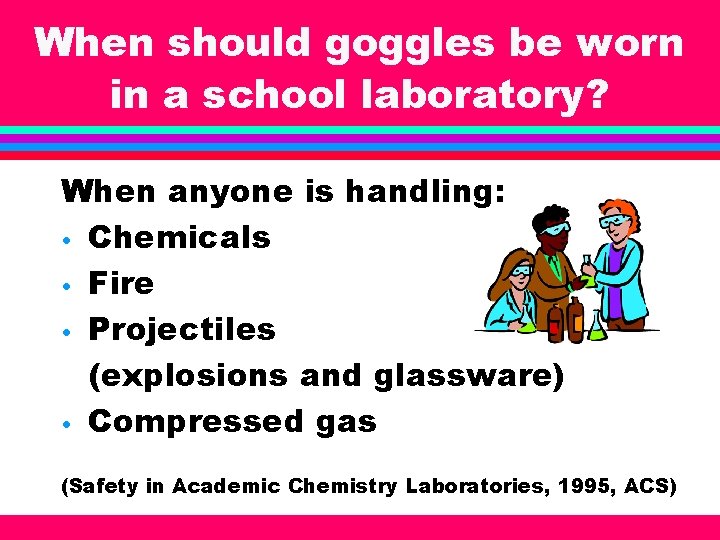
When should goggles be worn in a school laboratory? When anyone is handling: • Chemicals • Fire • Projectiles (explosions and glassware) • Compressed gas (Safety in Academic Chemistry Laboratories, 1995, ACS)
Eye Protection • • “It is universally agreed that the use of proper eye protection is required of everyone who enter a chemical work area. ” “All person in the laboratory including visitors must wear safety goggles (not safety glasses or spectacles)…” (Safety in Academic Chemistry Laboratories, 1995, ACS)
When can contact lenses be worn in a laboratory? • “Contact lenses can be worn in most work environments provided the same approved eye protection is worn as required of other workers in the area. ” • (Safety in Academic Chemistry Laboratories, 1995, ACS)
Hazard Communication Standards “Right to Know Laws” • A person has the “right to know” about all hazards they are exposed to in the workplace. • 6 components of law (federal & state)
Right to Know Law • 6 components of law (federal & state) • Material Safety Data Sheets (MSDS) • primary source of communication • Hazardous Materials List • Inventory of Hazardous Materials • name, quantity, and location • Notification • MSDS and training • Training • how to read labels, how to handle safely, and emergency procedures • Labeling of Hazardous Materials
MSDS • Material Safety Data Sheet • Required list of information about a chemical including physical and chemical characteristics, fire and explosion hazards, lethal dose, etc • Must be available for every chemical in the laboratory • Store MSDSs in alphabetical order in an obvious, convenient location • Provided by suppliers, also online
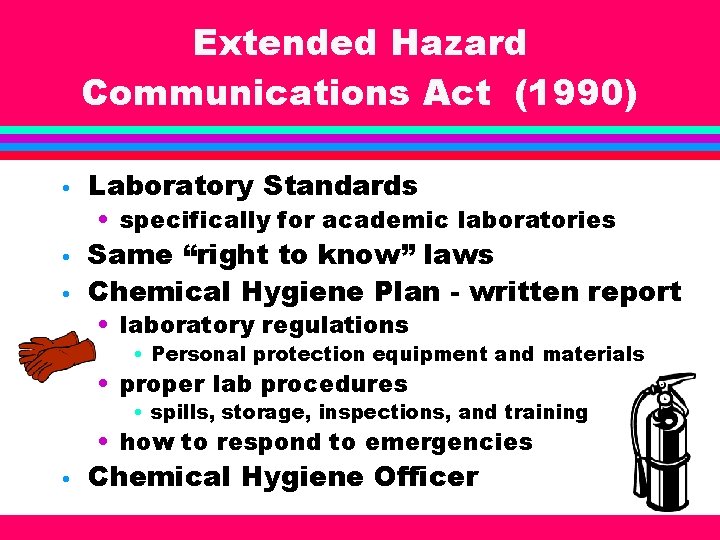
Extended Hazard Communications Act (1990) • Laboratory Standards • Same “right to know” laws Chemical Hygiene Plan - written report • • specifically for academic laboratories • laboratory regulations • Personal protection equipment and materials • proper lab procedures • spills, storage, inspections, and training • how to respond to emergencies • Chemical Hygiene Officer

Virginia Occupational Safety and Health (VOSH) Virginia requires: • Chemical Labeling • MSDS • Written Inventory • Chemical Hygiene Plan • Training
- Slides: 41