
Lab Safety Plan Process Step 1 What are
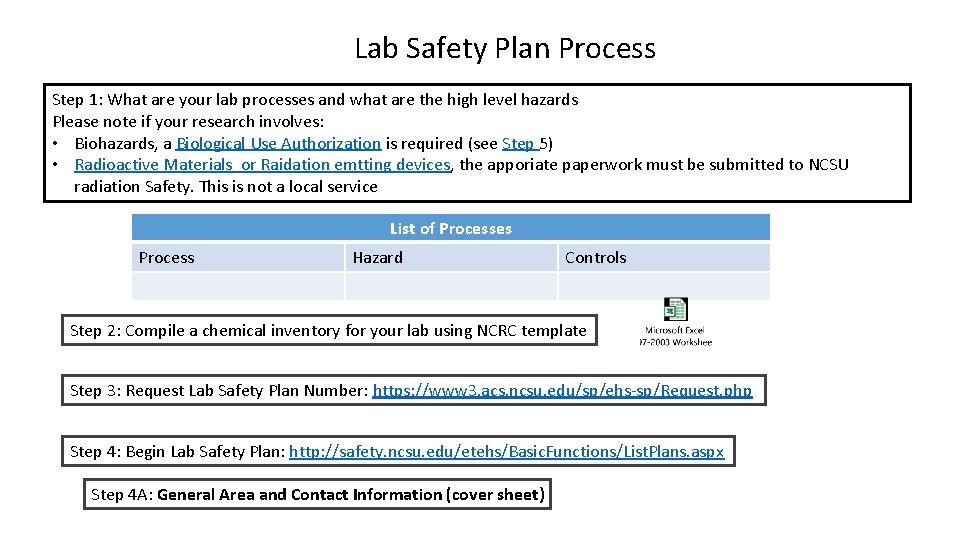
Lab Safety Plan Process Step 1: What are your lab processes and what are the high level hazards Please note if your research involves: • Biohazards, a Biological Use Authorization is required (see Step 5) • Radioactive Materials or Raidation emtting devices, the apporiate paperwork must be submitted to NCSU radiation Safety. This is not a local service List of Processes Process Hazard Controls Step 2: Compile a chemical inventory for your lab using NCRC template Step 3: Request Lab Safety Plan Number: https: //www 3. acs. ncsu. edu/sp/ehs-sp/Request. php Step 4: Begin Lab Safety Plan: http: //safety. ncsu. edu/etehs/Basic. Functions/List. Plans. aspx Step 4 A: General Area and Contact Information (cover sheet)
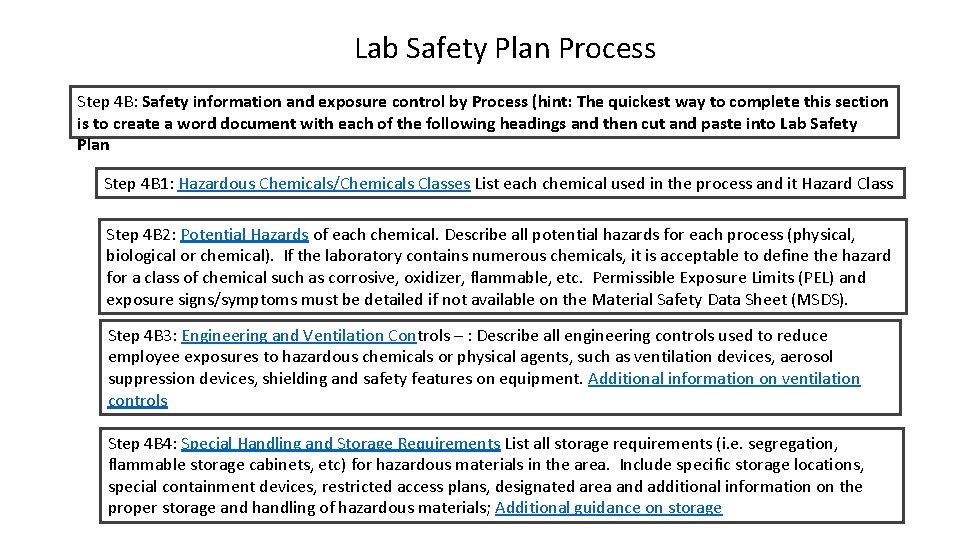
Lab Safety Plan Process Step 4 B: Safety information and exposure control by Process (hint: The quickest way to complete this section is to create a word document with each of the following headings and then cut and paste into Lab Safety Plan Step 4 B 1: Hazardous Chemicals/Chemicals Classes List each chemical used in the process and it Hazard Class Step 4 B 2: Potential Hazards of each chemical. Describe all potential hazards for each process (physical, biological or chemical). If the laboratory contains numerous chemicals, it is acceptable to define the hazard for a class of chemical such as corrosive, oxidizer, flammable, etc. Permissible Exposure Limits (PEL) and exposure signs/symptoms must be detailed if not available on the Material Safety Data Sheet (MSDS). Step 4 B 3: Engineering and Ventilation Controls – : Describe all engineering controls used to reduce employee exposures to hazardous chemicals or physical agents, such as ventilation devices, aerosol suppression devices, shielding and safety features on equipment. Additional information on ventilation controls Step 4 B 4: Special Handling and Storage Requirements List all storage requirements (i. e. segregation, flammable storage cabinets, etc) for hazardous materials in the area. Include specific storage locations, special containment devices, restricted access plans, designated area and additional information on the proper storage and handling of hazardous materials; Additional guidance on storage
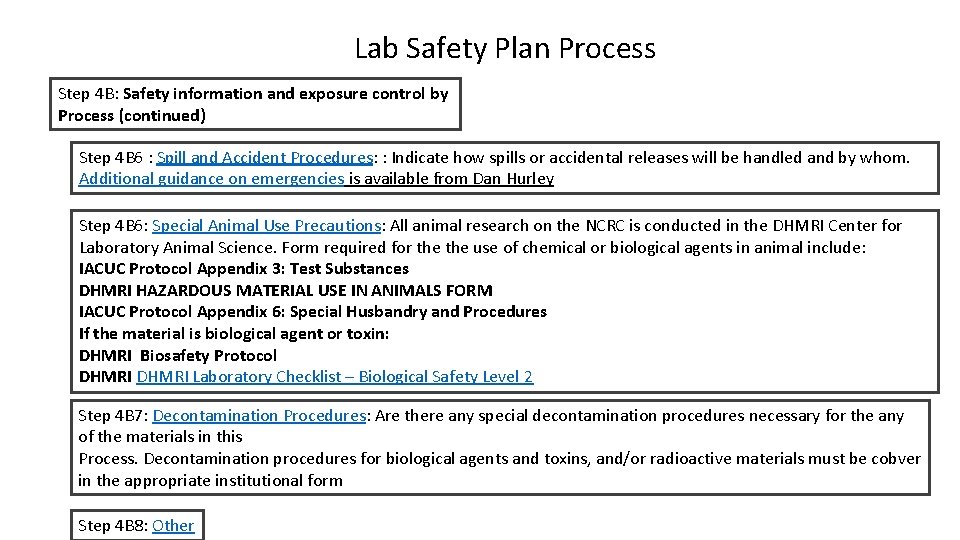
Lab Safety Plan Process Step 4 B: Safety information and exposure control by Process (continued) Step 4 B 6 : Spill and Accident Procedures: : Indicate how spills or accidental releases will be handled and by whom. Additional guidance on emergencies is available from Dan Hurley Step 4 B 6: Special Animal Use Precautions: All animal research on the NCRC is conducted in the DHMRI Center for Laboratory Animal Science. Form required for the use of chemical or biological agents in animal include: IACUC Protocol Appendix 3: Test Substances DHMRI HAZARDOUS MATERIAL USE IN ANIMALS FORM IACUC Protocol Appendix 6: Special Husbandry and Procedures If the material is biological agent or toxin: DHMRI Biosafety Protocol DHMRI Laboratory Checklist – Biological Safety Level 2 Step 4 B 7: Decontamination Procedures: Are there any special decontamination procedures necessary for the any of the materials in this Process. Decontamination procedures for biological agents and toxins, and/or radioactive materials must be cobver in the appropriate institutional form Step 4 B 8: Other
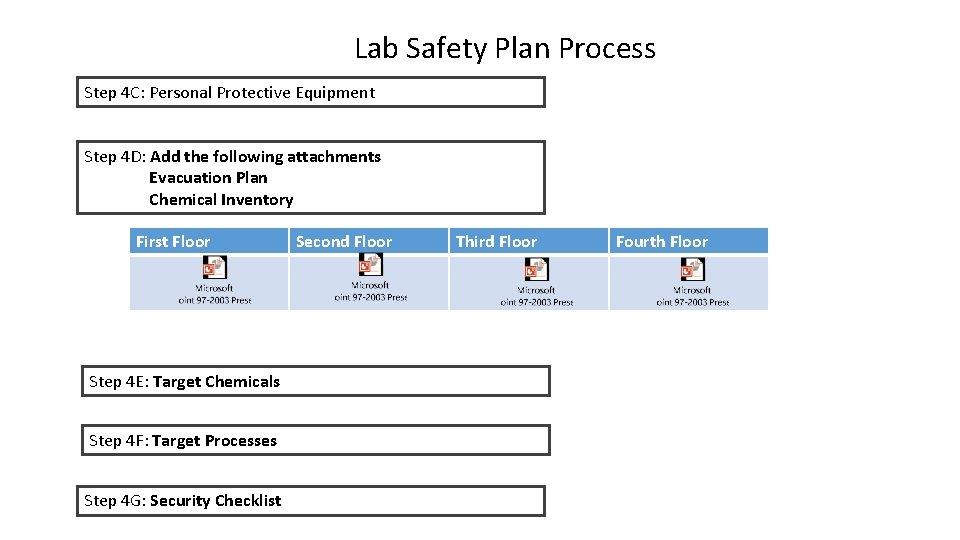
Lab Safety Plan Process Step 4 C: Personal Protective Equipment Step 4 D: Add the following attachments Evacuation Plan Chemical Inventory First Floor Step 4 E: Target Chemicals Step 4 F: Target Processes Step 4 G: Security Checklist Second Floor Third Floor Fourth Floor

Lab Safety Plan Process Step 4 H: FINAL SIGNATURE Step 4 H 1: SUPERVISOR'S SELF-ASSESSMENT CHECKLIST CERTIFICATION I am the responsible principal investigator/supervisor for this area(s)and have completed the annual selfaudit checklist Click here for self assessment Step 4 H 2: REQUIRED WASTE MINIMIZATION CERTIFICATION I have made a good faith effort to minimize my waste generation and select the best waste management method that is available to me. Step 4 H 3: LABORATORY CHEMICAL INVENTORY DECLARATION I am the responsible principal investigator/supervisor/manager for this facility and attest the chemical inventory provided is a good faith effort for accuracy and completeness at the time of submission.
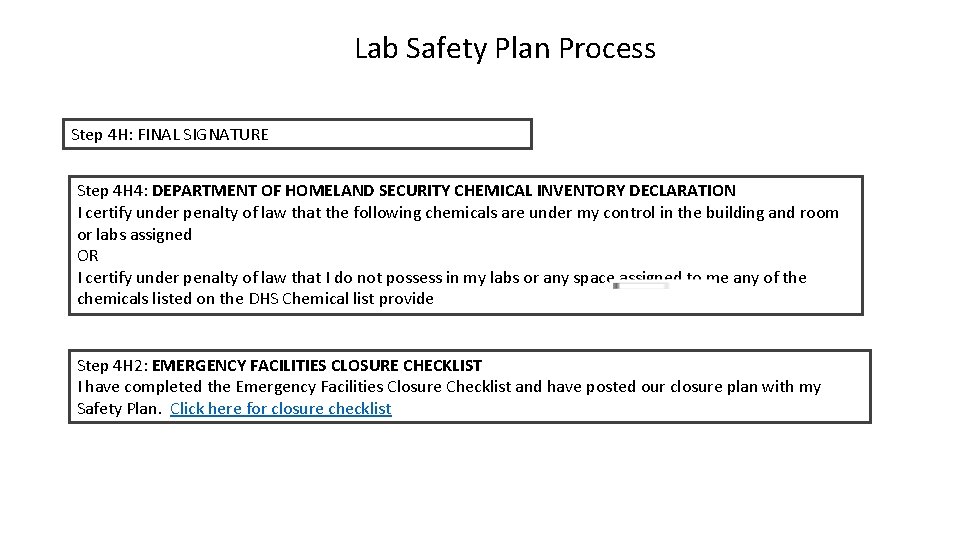
Lab Safety Plan Process Step 4 H: FINAL SIGNATURE Step 4 H 4: DEPARTMENT OF HOMELAND SECURITY CHEMICAL INVENTORY DECLARATION I certify under penalty of law that the following chemicals are under my control in the building and room or labs assigned OR I certify under penalty of law that I do not possess in my labs or any space assigned to me any of the chemicals listed on the DHS Chemical list provide Step 4 H 2: EMERGENCY FACILITIES CLOSURE CHECKLIST I have completed the Emergency Facilities Closure Checklist and have posted our closure plan with my Safety Plan. Click here for closure checklist
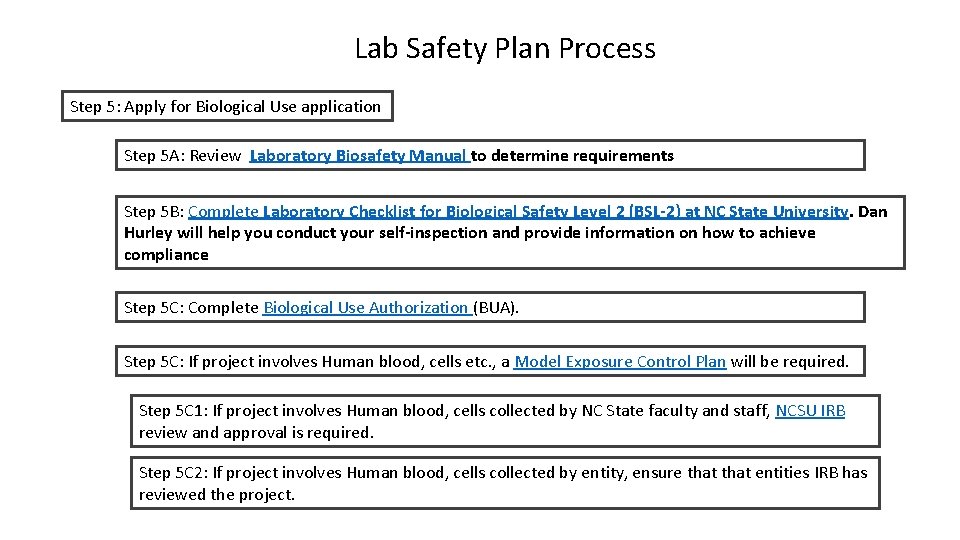
Lab Safety Plan Process Step 5: Apply for Biological Use application Step 5 A: Review Laboratory Biosafety Manual to determine requirements Step 5 B: Complete Laboratory Checklist for Biological Safety Level 2 (BSL-2) at NC State University. Dan Hurley will help you conduct your self-inspection and provide information on how to achieve compliance Step 5 C: Complete Biological Use Authorization (BUA). Step 5 C: If project involves Human blood, cells etc. , a Model Exposure Control Plan will be required. Step 5 C 1: If project involves Human blood, cells collected by NC State faculty and staff, NCSU IRB review and approval is required. Step 5 C 2: If project involves Human blood, cells collected by entity, ensure that entities IRB has reviewed the project.
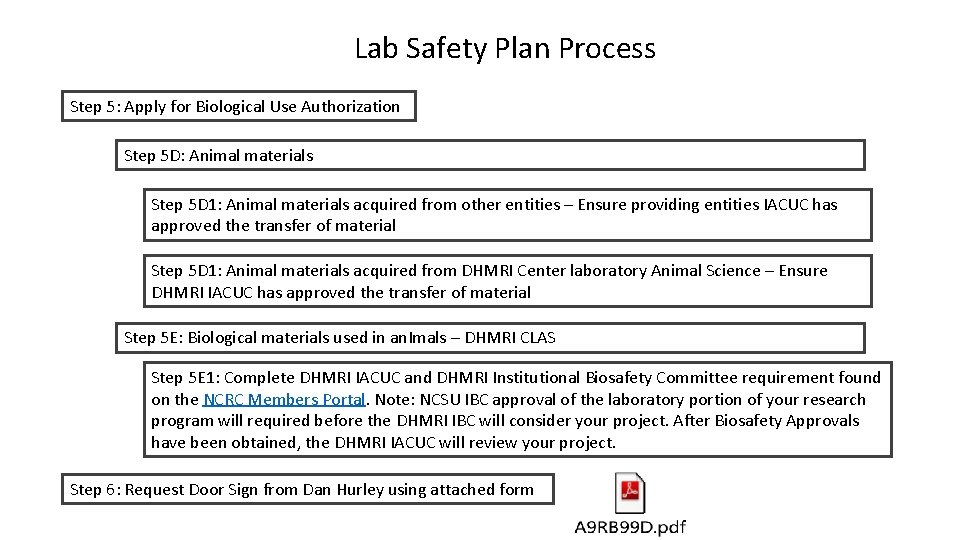
Lab Safety Plan Process Step 5: Apply for Biological Use Authorization Step 5 D: Animal materials Step 5 D 1: Animal materials acquired from other entities – Ensure providing entities IACUC has approved the transfer of material Step 5 D 1: Animal materials acquired from DHMRI Center laboratory Animal Science – Ensure DHMRI IACUC has approved the transfer of material Step 5 E: Biological materials used in an. Imals – DHMRI CLAS Step 5 E 1: Complete DHMRI IACUC and DHMRI Institutional Biosafety Committee requirement found on the NCRC Members Portal. Note: NCSU IBC approval of the laboratory portion of your research program will required before the DHMRI IBC will consider your project. After Biosafety Approvals have been obtained, the DHMRI IACUC will review your project. Step 6: Request Door Sign from Dan Hurley using attached form
- Slides: 8