
LAB SAFETY By sisca yuliasary S P Lab
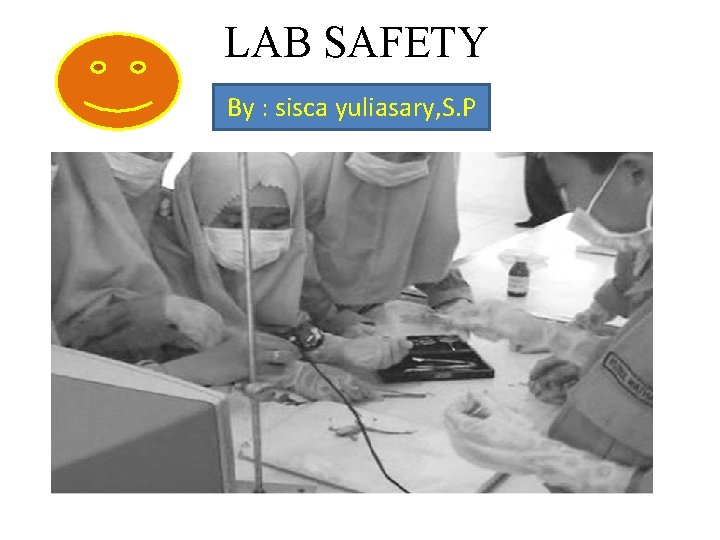
LAB SAFETY By : sisca yuliasary, S. P .
Lab safety has to do with how can work safely in science laboratories. • Doing an experiment can be very interesting, but sometimes it can cause danger
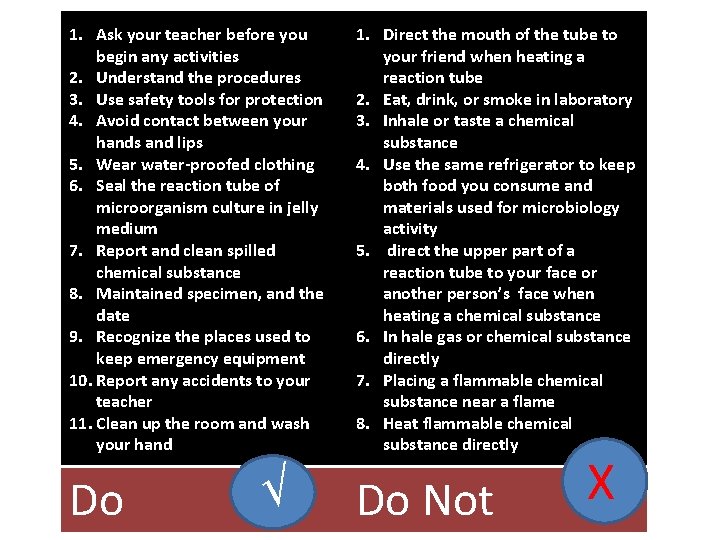
1. Ask your teacher before you begin any activities 2. Understand the procedures 3. Use safety tools for protection 4. Avoid contact between your hands and lips 5. Wear water-proofed clothing 6. Seal the reaction tube of microorganism culture in jelly medium 7. Report and clean spilled chemical substance 8. Maintained specimen, and the date 9. Recognize the places used to keep emergency equipment 10. Report any accidents to your teacher 11. Clean up the room and wash your hand Do √ 1. Direct the mouth of the tube to your friend when heating a reaction tube 2. Eat, drink, or smoke in laboratory 3. Inhale or taste a chemical substance 4. Use the same refrigerator to keep both food you consume and materials used for microbiology activity 5. direct the upper part of a reaction tube to your face or another person’s face when heating a chemical substance 6. In hale gas or chemical substance directly 7. Placing a flammable chemical substance near a flame 8. Heat flammable chemical substance directly Do Not X
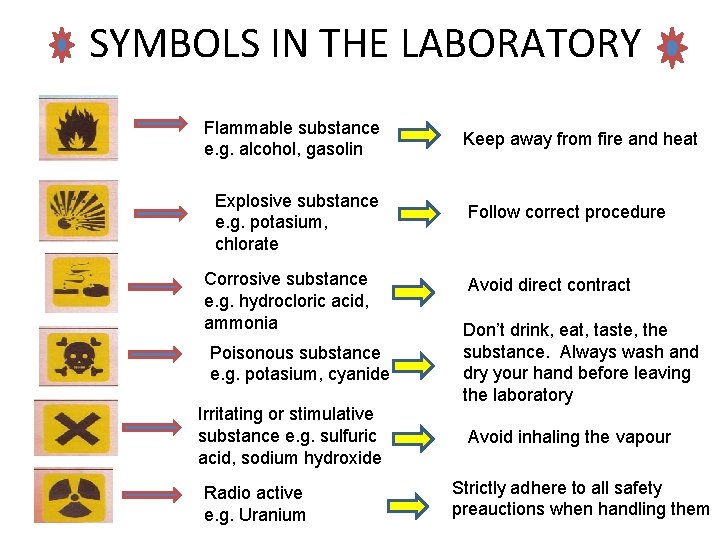
SYMBOLS IN THE LABORATORY Flammable substance e. g. alcohol, gasolin Explosive substance e. g. potasium, chlorate Corrosive substance e. g. hydrocloric acid, ammonia Poisonous substance e. g. potasium, cyanide Irritating or stimulative substance e. g. sulfuric acid, sodium hydroxide Radio active e. g. Uranium Keep away from fire and heat Follow correct procedure Avoid direct contract Don’t drink, eat, taste, the substance. Always wash and dry your hand before leaving the laboratory Avoid inhaling the vapour Strictly adhere to all safety preauctions when handling them
Here are some ways for treating the lab wastes that you should follow 1. What to do with liquid and gas waste. This kind of waste must be dissolved. Add a large amount of water to liquid waste before disposal 2. What to do with paper, wood and flammable materials. Burn this kind of waste. 3. What to do with decays of plants and animals. Bury them. But make sure you don’t bury them near a water source. 4. What to do with solid waste. Collect this kind of waste. The solid waste should be collected separately for recycling. 5. What to do with dangerous chemicals. Eliminate them by means of chemical reaction, neutralization and dissolution.
Here are some rules for you to follow • To avoid mistakes in taking and using chemical substance, bottles have to be labeled • Chemical substance may affect the quality of other chemicals, therefore, chemical substances must not be mixed, and must be stored separately • Storage location of chemical substance must be easily reached from any other places • Chemical substance must be stored in places bellow eye level • Eating is not allowed at the laboratory. Your hands should be thoroughly washed and dried before you leave the laboratory • Bottles of chemical substances are labeled with particular symbols to identify hazards cause by the substance.
Thanks guy’s
- Slides: 7