
Lab Report How To Lab Reports n Organization
Lab Report How To
Lab Reports n Organization – n n Title Page, Results , Calculations, and Discussion/Conclusion, References, Format Double spaced, 11 -12 point font n No personal pronouns – no “I”, “we” “she” “he” n Values and equations should be properly superscript or subscript IE C 2 O 4 should be written as C 2 O 4 n
Title (Cover Page) n Title header (clear and large), name, the date, class section, lab partners, and lab TA
Results n Usually will have Raw Data Table (will be on pbworks, the numbers you will be analyzing) n Calculated Data Table: Your data you calculated via excel for each class member n Figures: Usually graph or histogram form n
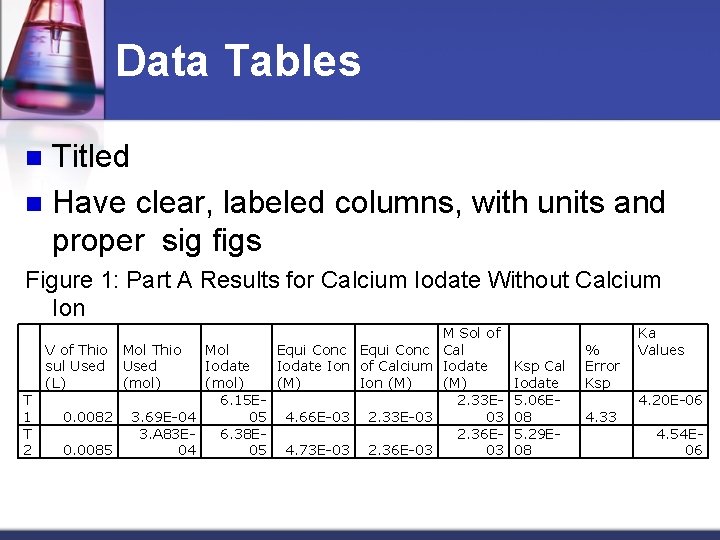
Data Tables Titled n Have clear, labeled columns, with units and proper sig figs n Figure 1: Part A Results for Calcium Iodate Without Calcium Ion T 1 T 2 V of Thio sul Used (L) 0. 0082 0. 0085 Mol Thio Used (mol) Mol Equi Conc Iodate Ion of Calcium (mol) (M) Ion (M) 6. 15 E 3. 69 E-04 05 4. 66 E-03 2. 33 E-03 3. A 83 E 6. 38 E 04 05 4. 73 E-03 2. 36 E-03 M Sol of Cal Iodate (M) 2. 33 E 03 2. 36 E 03 Ksp Cal Iodate 5. 06 E 08 5. 29 E 08 % Error Ksp 4. 33 Ka Values 4. 20 E-06 4. 54 E 06
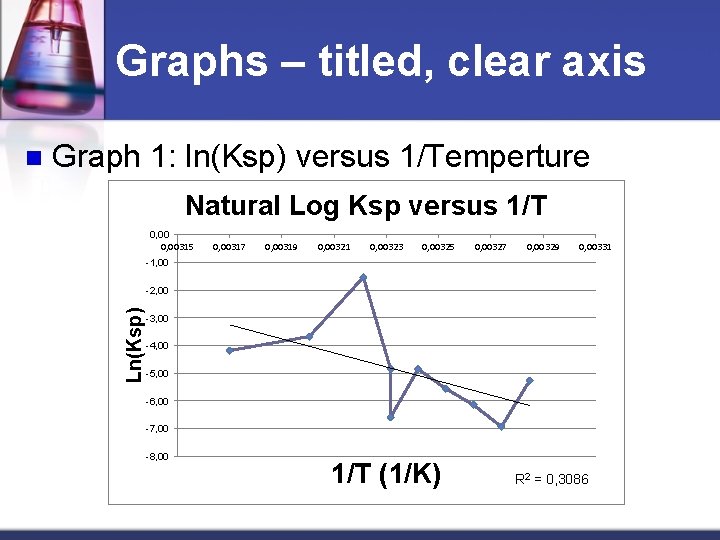
Graphs – titled, clear axis Graph 1: ln(Ksp) versus 1/Temperture Natural Log Ksp versus 1/T 0, 00315 0, 00317 0, 00319 0, 00321 0, 00323 0, 00325 0, 00327 0, 00329 0, 00331 -1, 00 -2, 00 Ln(Ksp) n -3, 00 -4, 00 -5, 00 -6, 00 -7, 00 -8, 00 1/T (1/K) R 2 = 0, 3086
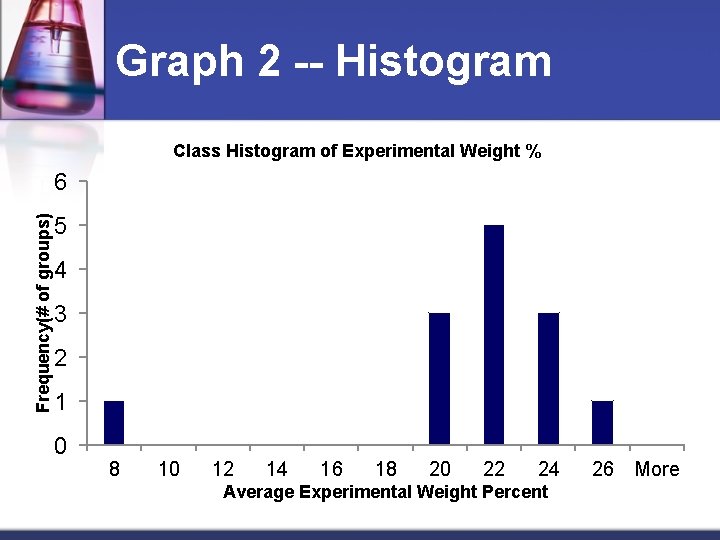
Graph 2 -- Histogram Class Histogram of Experimental Weight % Frequency(# of groups) 6 5 4 3 2 1 0 8 10 12 14 16 18 20 22 24 Average Experimental Weight Percent 26 More
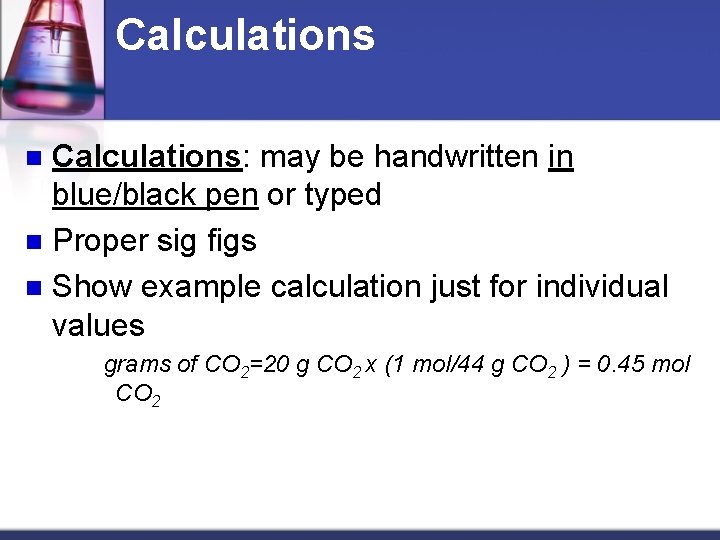
Calculations: may be handwritten in blue/black pen or typed n Proper sig figs n Show example calculation just for individual values n grams of CO 2=20 g CO 2 x (1 mol/44 g CO 2 ) = 0. 45 mol CO 2
Discussion/Conclusion 1 page double spaced n Keep it short, concise, to the point n Highlight specific trends that strongly supports your analysis n Clearly state your quantitative data that you are observing. n
What to consider in your lab report n n Compare expected results with those obtained. Analyze experimental error n n Relate results to your experimental objective(s) and theories. n n how significantly did one aspect of your experiment affect your results, and why? Compare your results to similar investigations. n n precision and accuracy and how errors affected your results Compare between class data or other sources Analyze the strengths and limitations of your experimental design. n What can be improved to reflect theoretical background?
Reference Keep a consistent and clear format, usually MLA is best n Always will have reference – cite your blue manual and lab handouts and other sources used. n
- Slides: 11