
LAB Macromolecule Virtual Lab HONORS BIOLOGY UNIT 1

LAB: Macromolecule Virtual Lab HONORS BIOLOGY: UNIT 1 GRADING RUBRIC TOTAL POINTS = 60 http: //faculty. kirkwood. edu/apeterk/learningobjects/biologylabs. htm

Background: The most common organic compounds found in living organisms are lipids, carbohydrates, proteins, and nucleic acids. Common foods, which often consist of plant materials or substances derived from animals, are also combinations of these organic compounds. Substances called indicators can be used to test for the presence of organic compounds. An indicator is a substance that changes color in the presence of a particular compound. In this investigation, you will use several indicators to test for the presence of lipids, carbohydrates, and proteins in various foods.
CARBOHYDRATES Scroll down to the bottom and click on Carbohydrate 1. What are some examples of carbohydrates? Examples of sugars are glucose, sucrose, maltose, etc. Polysaccharides include storage carbohydrates such as plant and animal starches, and structural carbohydrates like cellulose (plant fiber) and chitin (insect skeletons). 2 POINTS
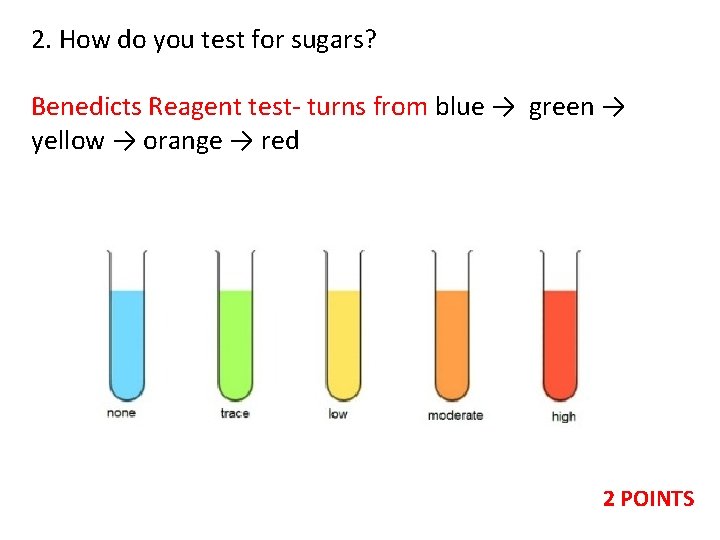
2. How do you test for sugars? Benedicts Reagent test- turns from blue → green → yellow → orange → red 2 POINTS
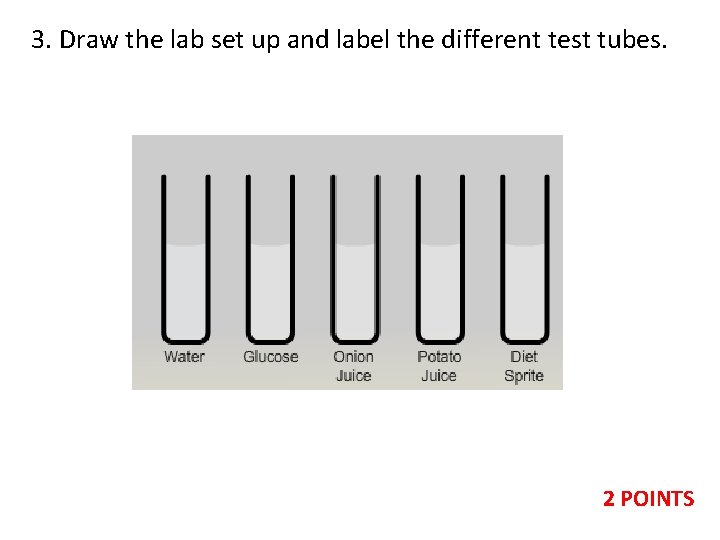
3. Draw the lab set up and label the different test tubes. 2 POINTS
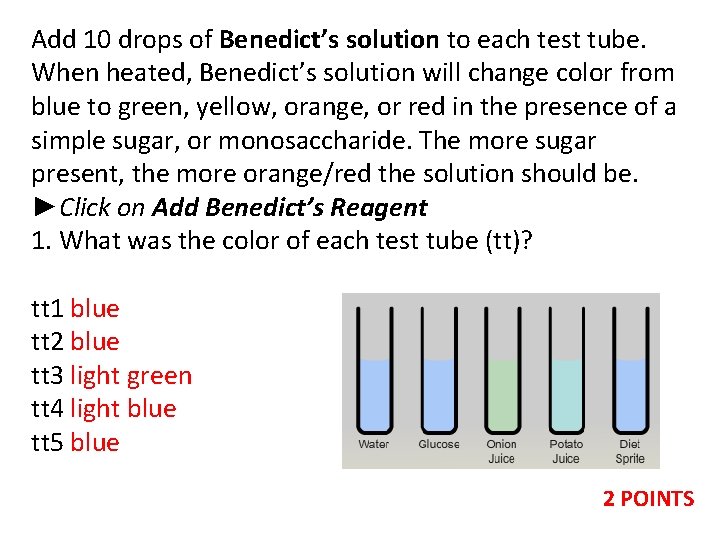
Add 10 drops of Benedict’s solution to each test tube. When heated, Benedict’s solution will change color from blue to green, yellow, orange, or red in the presence of a simple sugar, or monosaccharide. The more sugar present, the more orange/red the solution should be. ►Click on Add Benedict’s Reagent 1. What was the color of each test tube (tt)? tt 1 blue tt 2 blue tt 3 light green tt 4 light blue tt 5 blue 2 POINTS
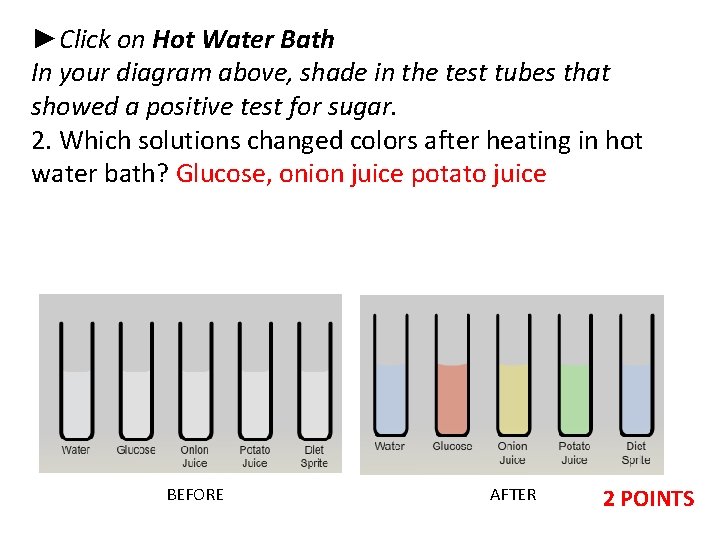
►Click on Hot Water Bath In your diagram above, shade in the test tubes that showed a positive test for sugar. 2. Which solutions changed colors after heating in hot water bath? Glucose, onion juice potato juice BEFORE AFTER 2 POINTS
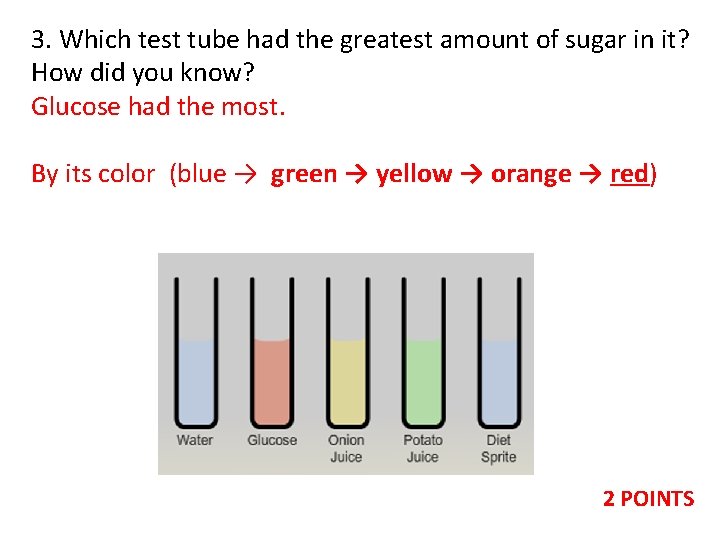
3. Which test tube had the greatest amount of sugar in it? How did you know? Glucose had the most. By its color (blue → green → yellow → orange → red) 2 POINTS
Add 5 drops of iodine solution to iodine each test tube. Iodine will change color from yellow-brown to blue-black in the presence of starch. ►Click on the scroll down bar on the right hand side and go to starches 1. What chemical is being added to the test tubes? Iodine (Lugols) 2 POINTS
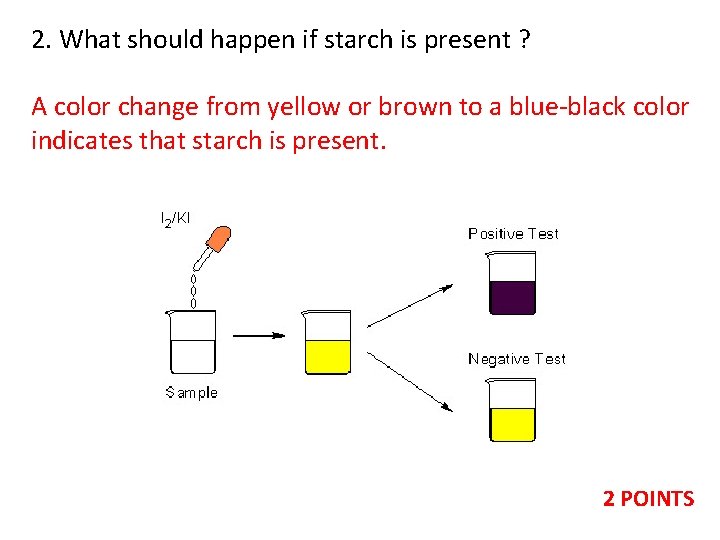
2. What should happen if starch is present ? A color change from yellow or brown to a blue-black color indicates that starch is present. 2 POINTS
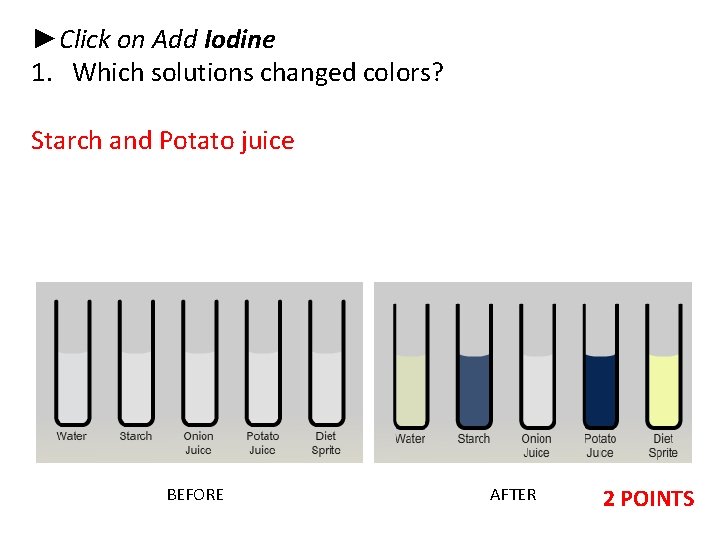
►Click on Add Iodine 1. Which solutions changed colors? Starch and Potato juice BEFORE AFTER 2 POINTS
PROTEINS Add 5 drops of biuret reagent to each test tube. Biuret reagent changes color from yellow to blue-violet in the presence of protein. ►Click on the tab marked protein 1. What are the building blocks that make up proteins? Amino acids 2 POINTS
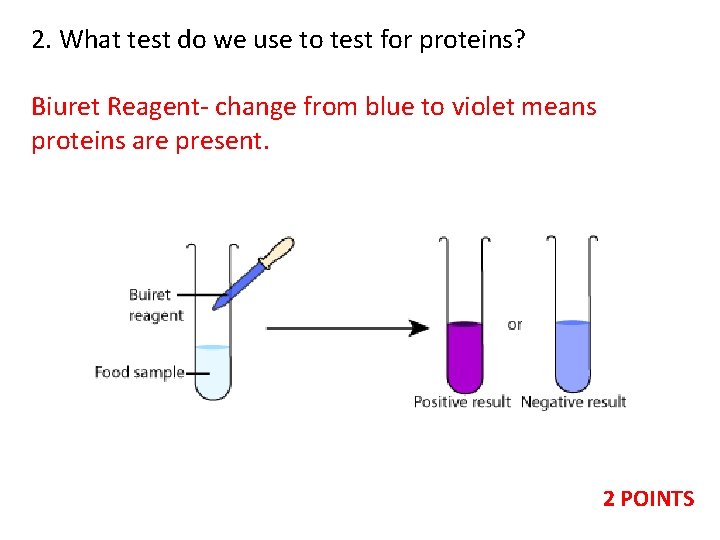
2. What test do we use to test for proteins? Biuret Reagent- change from blue to violet means proteins are present. 2 POINTS
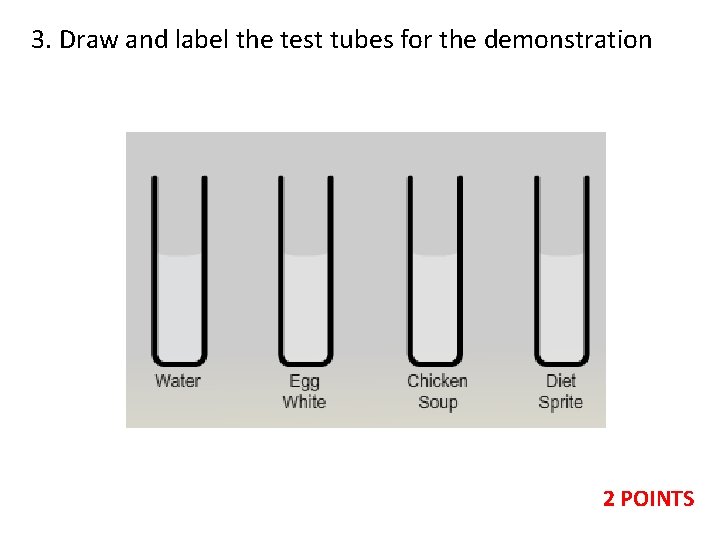
3. Draw and label the test tubes for the demonstration 2 POINTS
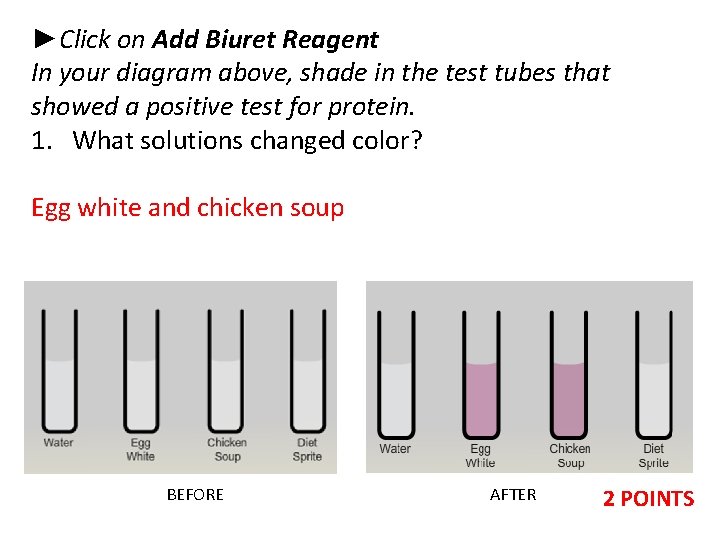
►Click on Add Biuret Reagent In your diagram above, shade in the test tubes that showed a positive test for protein. 1. What solutions changed color? Egg white and chicken soup BEFORE AFTER 2 POINTS
2. What does it mean? It means that proteins are present 2 POINTS
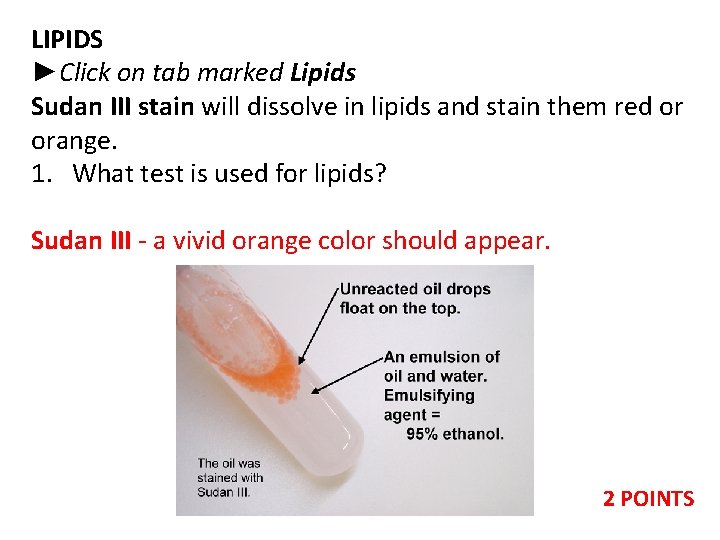
LIPIDS ►Click on tab marked Lipids Sudan III stain will dissolve in lipids and stain them red or orange. 1. What test is used for lipids? Sudan III - a vivid orange color should appear. 2 POINTS
2. How does it work? As fat content increases, the intensity of the dye (Sudan III) also increases - a vivid orange color should appear. 2 POINTS
3. What color do the solutions change if lipids are present? Vivid orange 2 POINTS

►Click on add Sudan III 1. What solutions changed colors? Margarine, cream, and coconut 2 POINTS
2. What does this mean? It means that Margarine, cream, and coconut contain lipids 2 POINTS
EVERYDAY FOODS ►Click on the tab marked Everyday Foods Run the tests on each of the everyday foods. In the data table below. Record the color of the test tube AFTER the test was run, and place a check mark in the boxes that showed a positive test. For the other foods in the data table, predict which tests would you expect the food to test positive for and what color results you would get.
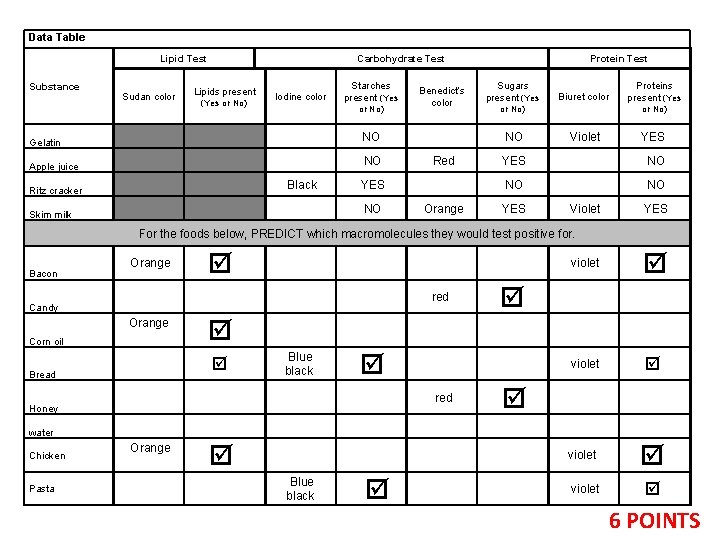
Data Table Lipid Test Substance Gelatin Apple juice Ritz cracker Skim milk Carbohydrate Test Lipids present Sudan color (Yes or No) Iodine color Starches present (Yes or No) Benedict’s color Protein Test Sugars present (Yes Biuret color or No) Proteins present (Yes or No) NO Violet YES NO Red YES NO Black YES NO NO Orange YES Violet YES For the foods below, PREDICT which macromolecules they would test positive for. Bacon Candy Corn oil Bread Honey water Chicken Pasta violet red Orange Blue black violet red Orange violet Blue black violet Orange 6 POINTS
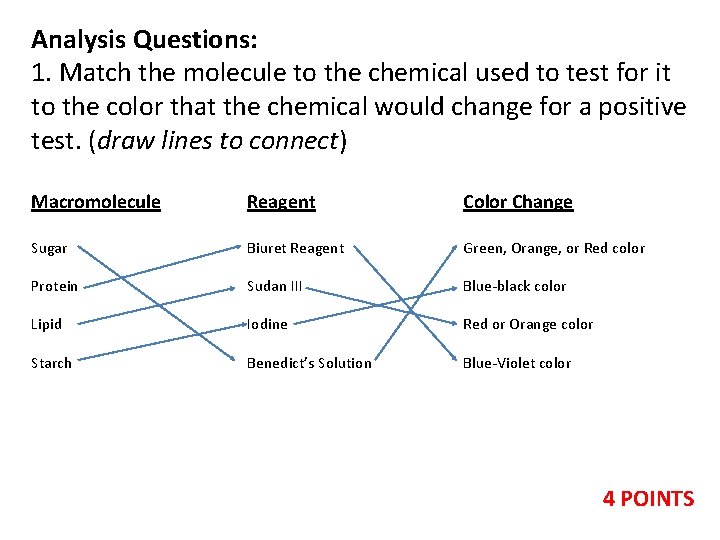
Analysis Questions: 1. Match the molecule to the chemical used to test for it to the color that the chemical would change for a positive test. (draw lines to connect) Macromolecule Reagent Color Change Sugar Biuret Reagent Green, Orange, or Red color Protein Sudan III Blue-black color Lipid Iodine Red or Orange color Starch Benedict’s Solution Blue-Violet color 4 POINTS
2. Which substances contained a protein? Gelatin and skim milk Predictions: Bacon, bread, chicken, and pasta 1 POINTS
3. Which substances contained lipids? Margarine, cream, and coconut Predictions: Bacon, corn oil, bread, and chicken 1 POINTS
4. Which substance contained sugars? Apple juice and skim milk Predictions: Candy and honey 1 POINTS
5. Which substances contained complex (large) carbohydrates? Starch and Potato juice Ritz cracker and skim milk Predictions: Bread and pasta 1 POINTS

6. How are the reagents useful in determining which macromolecules are present? A color change indicates the presence of different substances. In some cases the color can vary indicating the amount of the substance present 2 POINTS
7. A very thin slice is removed from a peanut and treated with Sudan III stain. Then a drop of Biuret reagent is added to the peanut slice. When you examine the peanut slice under a microscope, patches of red (organge) and blue-violet are visible. What conclusions can you draw from your examination? It means lipids and proteins are present. 2 POINTS

8. A cracker crushed in water will test positive with iodine but negative with benedict’s solution. A cracker crushed in water has another chemical called amylase added to it. After a few minutes, this cracker tests negative with iodine and positive with benedict’s solution. Explain what happened. When amylase (an enzyme) was added it broke down the starch (complex carbohydrate) into a simple sugar. Now only sugar is present 2 POINTS

9. Whole milk does not have any of the fat removed from it that skim milk does. What changes would you expect in tests run on whole milk compared to the results received from skim milk? When tested with Sudan III for lipids, the color should be more intense orange. It will also still test positive for proteins 2 POINTS
TOTAL POINTS = 60
- Slides: 33