
Lab Intro Lab 1 Celestial Sphere Planispheres Tiffany
Lab Intro & Lab 1: Celestial Sphere & Planispheres Tiffany Pewett pewett@astro. gsu. edu 25 Park Place, 625 E
General Lab Info • If you don’t already have the book you need to get one and make sure you bring it to each lab. • Please do all labs in pencils, scratched out pen is hard to grade. • Put your name and preferred email address on the first lab. • Do your own work!
Lab Points • 11 labs total, lowest lab is dropped, each worth 10 points = 100 points • Observatory project: 10 points • Lab 24 (“Moon Project”): 20 points • Total points= 130 • This means each lab is worth ~7. 5% of your lab grade so it is in your best interest to attend every lab.
Observatory Project • Lab 28 in your book, make sure you take this lab with you. • Visit any observatory, get a signature from the astronomer on duty, ask questions to fill in your report. • Reports must be written in FULL sentences for full 10 points.
Lab 24: Observing the Phases of the Moon • Take pictures of the Moon at each of the 7 main phases (not including New Moon). • At least 1 must in the daytime. • Build the gradient and use it to measure Moon altitude in each picture. • Fill out remaining info and answer the questions at the end. • Due on the last day of lab.
Extra Credit • There is enough extra credit offered to make up one full lab. • 4 points to attend an HLCO Open House. • 3 points to visit a 2 nd (different) observatory. • 2 points for building your gradient and bringing it to lab early. • 1 point for bringing in an early Moon picture.
Lab Information • All the information you might need about the lab can be found at my lab website. • If you need help with something that is not there you are more than welcome to email me or stop by my office during office hours.
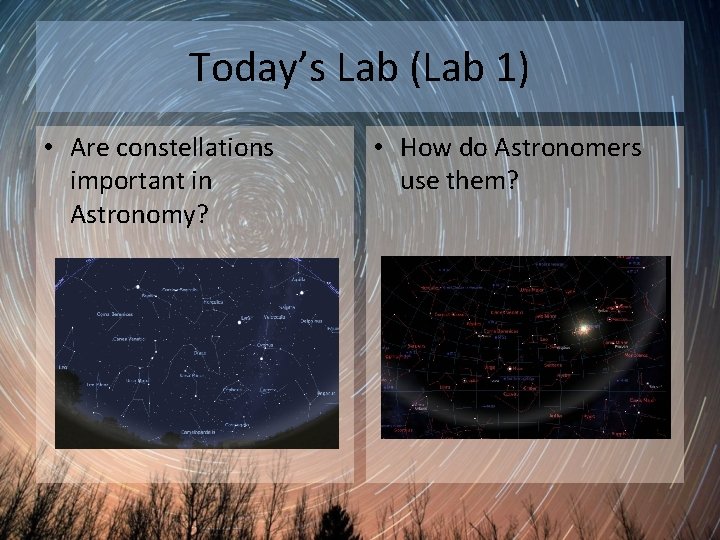
Today’s Lab (Lab 1) • Are constellations important in Astronomy? • How do Astronomers use them?
Celestial Coordinates • Right Ascension (RA) – East-West coordinates on the sky. – Measured in units of time (Hours: Minutes: Sec. ) • Declination (Dec) – North (+), South (-) coordinates on the sky. – Measured in units of angle (Degrees: Arcminutes: Arcseconds or °: ’: ”) • Origin is at RA=00 h: 00 m: 00 s, Dec=00°: 00’: 00”
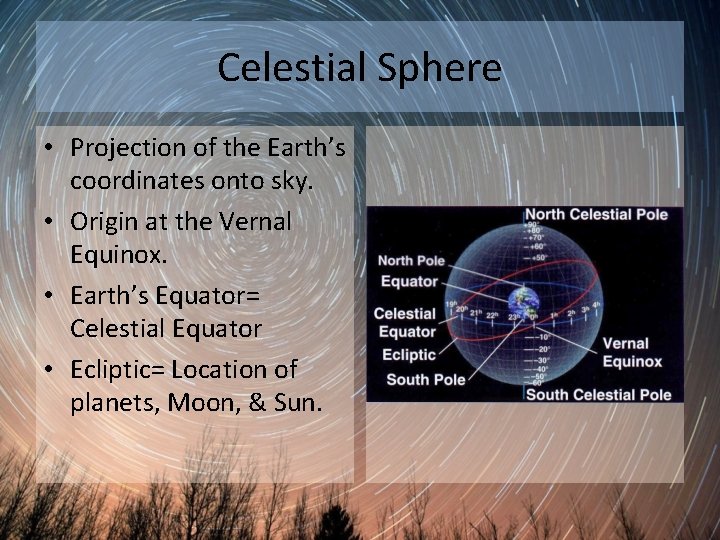
Celestial Sphere • Projection of the Earth’s coordinates onto sky. • Origin at the Vernal Equinox. • Earth’s Equator= Celestial Equator • Ecliptic= Location of planets, Moon, & Sun.
Current Planet Positions • • • Mercury: RA= 21 H: 46 M, Dec= -14°: 18’ Venus: RA= 18 H: 58 M, Dec= -15°: 46’ Mars: RA= 13 H: 23 M, Dec= -06°: 06’ Jupiter: RA= 06 H: 56 M, Dec= 23°: 00’ Saturn: RA= 15 H: 22 M, Dec= -16°: 10’
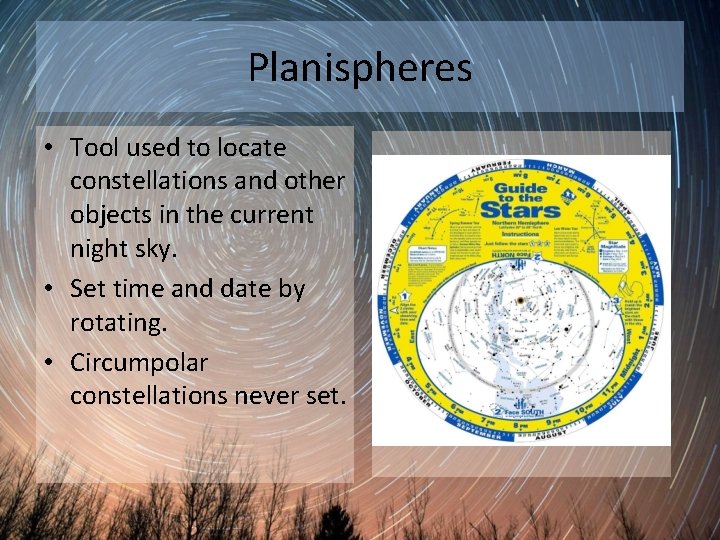
Planispheres • Tool used to locate constellations and other objects in the current night sky. • Set time and date by rotating. • Circumpolar constellations never set.
- Slides: 12