
Lab Animals Introduction Laboratory animal medicine is the
Lab Animals
Introduction Laboratory animal medicine is the specialty field within veterinary medicine that is concerned with the diagnosis, treatment, and prevention of diseases in animals used in research, testing, and teaching. Ø Laboratory animal science is the body of scientific and technical information, skills and techniques that apply to laboratory animal care and use Ø This includes husbandry, nutrition, behavior, health, production and management of laboratory animals Ø
Laboratory animals Human beings use animals for a wide variety of purposes, including research. Ø The approximately 260 million people in the United States keep about 60 million cats and about 52 million dogs as pets. Including birds and horses, just these types of American pets total nearly 130 million. Ø More than five billion animals are consumed each year as food. Ø It’s estimated that about 17 million animals are used for biomedical research annually. Ø
WHY USE ANIMALS? In research, animals are used to learn more about biological systems and the illnesses that afflict human beings and other animals. They serve as surrogates for humans in obtaining information that cannot be gained in any other way. Ø Some animals have biological similarities to humans that make them particularly good models for specific diseases such as rats for cancer, rabbits for atherosclerosis and nonhuman primates for polio. Ø

Laboratory Animal Testing What’s animal testing? Ø Animals used in Lab. Facilities* Ø Test’s performed on some of the animals* Ø Places where experiments take place* Ø Standards and Restrictions
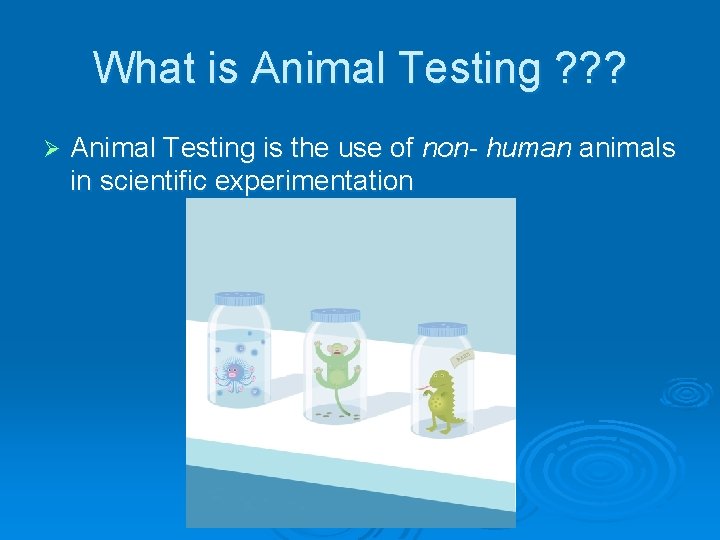
What is Animal Testing ? ? ? Ø Animal Testing is the use of non- human animals in scientific experimentation
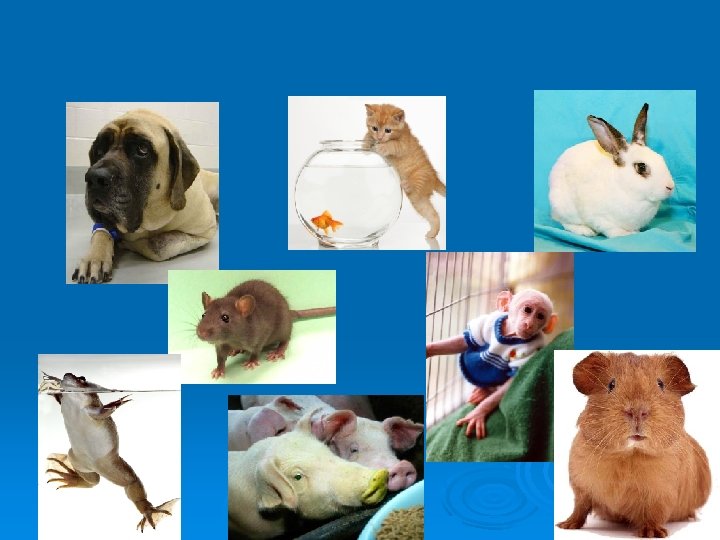
What kind of animal are used? Ø Small Animal (dogs, cats) Ø Large Animal (pigs, sheep, goats, etc) Ø Exotic Animal (ferrets, nonhuman primates, guinea pig, rabbits, mice, snakes, geckos, etc) Ø Avian (chickens, pigeons, songbirds, etc) Ø Wildlife (armadillos, owls, bats, etc) Ø Aquatic (zebrafish, frogs, goldfish, etc)
WHAT ARE THE MOST COMMONLY USED ANIMAL MODELS? Ø Animal: Cat System/Condition: Auditory Why Is It Studied? : Like humans, cats have very well-developed hearing systems and brain mechanisms for hearing. They can be trained to respond to many behavioral cues given through auditory stimuli. Cats also experience naturally occurring hearing defects and are susceptible to environmentally induced defects, as are humans. (Taken from Unit II, Chapter 2, of the Rx for Science Literacy teacher manual. )
WHAT ARE THE MOST COMMONLY USED ANIMAL MODELS? Ø Animal: Primate System/Condition: Immune Why Is It Studied? : Primates possess striking immunological similarities to humans. They are susceptible to similar diseases and often react to the same infectious agents as humans.
WHAT ARE THE MOST COMMONLY USED ANIMAL MODELS? Ø Animal: Dog System/Condition: Cardiovascular Why Is It Studied? : A dog’s cardiovascular system is structured quite similarly to humans. They suffer from many inherited cardiovascular defects that affect humans. Since they possess inherited defects nearly identical to those seen in humans, hematology, the study of the blood, is also practiced using dogs. Ø System/Condition: Endocrine Why Is It Studied? : Dogs naturally experience diabetes like humans. Diabetes can also be easily induced in dogs to aid research. In addition, dogs share other diabetesinduced deficits such as glaucoma, that occur in humans.
WHAT ARE THE MOST COMMONLY USED ANIMAL MODELS? Ø Animal: Mouse System/Condition: Aging Why Is It Studied? : Mice age 30 times more rapidly than humans, with several body systems declining with age in the same manner as those systems do in humans. Genetic composition and environmental conditions can be precisely and easily duplicated and controlled — a vital consideration in interpreting data.
WHAT ARE THE MOST COMMONLY USED ANIMAL MODELS? Ø Animal: Rat System/Condition: Aging Why Is It Studied? : Rats are available in a number of purpose-bred strains and have been the focus of intensive physiological and biochemical research. Rats show major, spontaneously developing and age-related damage in most major systems of the body that commonly are seen in humans. However, in rats these deficits occur faster and are easily studied during a rat’s lifetime.
WHICH ANIMALS ARE STUDIED FOR THEIR UNIQUE CHARACTERISTICS? Ø Organism: Armadillo System Studied: Reproduction, Developmental biology What is Studied & Why: Armadillos can give birth up to three years after fertilization. They experience delayed implantation of the fertilized ovum and give birth to identical quadruplets. Their low body temperature allows leprosy to grow. Human Counterpart: Twinning, menopause, infertility, leprosy
WHICH ANIMALS ARE STUDIED FOR THEIR UNIQUE CHARACTERISTICS? Ø Organism: Ferret System Studied: Immune system What is Studied & Why: Both ferrets and humans are affected by closely related bacteria. Human Counterpart: Gastritis and stomach ulcers
WHICH ANIMALS ARE STUDIED FOR THEIR UNIQUE CHARACTERISTICS? Ø Organism: Seal System Studied: Respiratory and Nervous systems What is Studied & Why: Young seals exhibit similar characteristics to humans when they hold their breath for long dives or when sleeping under water. Human Counterpart: Sudden infant death syndrome (SIDS)
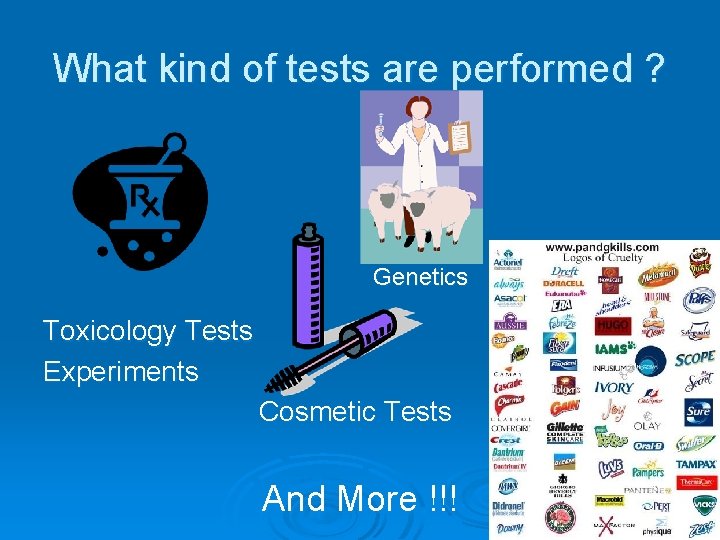
What kind of tests are performed ? Genetics Toxicology Tests Experiments Cosmetic Tests And More !!!
What are some places that perform these Experiments? Ø Universities Ø Pharmaceutical Companies Ø Commercial Facilities Ø Farms Ø Medical Schools- Vet Tech Institute Ø Defense Establishments
Federal Requirements for Animal Testing: Ø Several federal laws require that the public be protected from hazardous products. To ensure this, federal regulations exist to implement these laws. These regulations require animal testing, either explicitly or implicitly. There are four principal federal agencies involved in administering these regulations: Ø Pages 14 -26 Laboratory Animal book
Food and Drug Administration (FDA): Ø The FDA is responsible for administering statutes regulating human and animal food and drugs, medical devices, biological products, cosmetics, color additives and radiological products. The FDA requires that laboratory animal tests be conducted for prescription and over-the-counter drugs before they can be tested in humans
Environmental Protection Agency (EPA): The EPA uses data derived from animal tests and other sources to identify and regulate substances in the environment, such as air or water pollutants and wastes, that might be hazardous to humans and animals.
Consumer Product Safety Commission (CPSC): The CPSC relies on animal data in identifying and regulating risks to consumers from household and other products.
Occupational Safety and Health Administration (OSHA): Ø OSHA uses data from animal tests and other sources to set regulations that protect workers in the workplace
In 1984, representatives from all federal agencies that use or fund biomedical research developed a set of principles that underpin the current system of federal regulations. These include requirements that: -procedures involving animals be relevant to human or animal health; -the minimum number of animals be used to obtain valid results; -alternatives to animals be considered; -animal pain or distress be avoided or minimized; -living conditions for animals be appropriate for their species; -research scientists and those caring for the animals be properly trained and qualified.
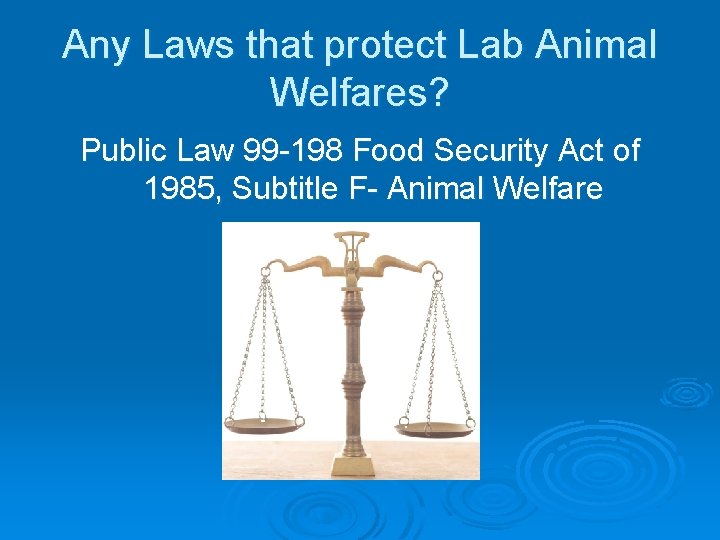
Any Laws that protect Lab Animal Welfares? Public Law 99 -198 Food Security Act of 1985, Subtitle F- Animal Welfare
Public Law 99 -198 Food Security Act of 1985, Subtitle F- Animal Welfare Ø Passed December 23, 1985 Ø Animal Testing Importance Ø Regulations for Laboratories using animals for experimental use Ø Technological Development*
Food Security Act of 1985: Animal Testing Importance Ø Animal Testing is important in the advancement and educational purpose of scientific development of cures and treatment for animal & human diseases
Food Security Act of 1985: Regulations for Lab. Animal Testing Ø Ø Ø Humane handling, care, treatment, & transportation of animals by dealers, research facilities & exhibitors [including general care such as feeding, watering, sanitation, ventilation, shelter from extremes weather & temps, adequate vet. Care, & separation by species where the Secretary finds necessary for humane handling care, or treatment of animals] Provide exercise for K 9 s Provide adequate physical environment to promote psychological well being of non human primates Minimize pain & distress to the animal during experiments & consider alternatives to any procedure likely to produce pain to or distress in an experimental animal A DVM should be consulted in the planning of procedures with the use of: tranquilizers, analgesics, anesthesia for pre- or post- surgical care by lab workers, in accordance with established vet. Medical & nursing procedures The withholding of tranquilizers, anesthesia, analgesia, or euthanasia when scientifically necessary shall continue for only the necessary period of time
Food Security Act of 1985 Regulations of Lab. Animals Ø No animal should be used in more than 1 major operative experiment from which it is allowed to recover except in case of “scientific necessity” or circumstances determined by USDA Ø Such exception has to be detailed & explained in a report & filed with the Institutional Animal Care Committee
Food Security Act of 1985 Technological Development Methods of testing w/o the requirement of animals are being & continue to be developed l Faster l Less expensive l More accurate than animal testing l Further opportunities exist for the development of these methods of testing Ø The less they replicate experiments on animals, Federal funds can be used more productively Ø

Animal Welfare Act (AWA): The AWA was enacted into law in 1966 and has been amended by the U. S. Congress several times, most recently in 1991. The act applies to all public and private research facilities in this country.
USDA licensing, reporting and inspection requirements: All research facilities covered by the law must be registered with the USDA and comply with the USDA animal welfare regulations. Each facility must report to the USDA annually, verifying compliance and indicating the number and species of animals used. The USDA is required to inspect each facility at least once a year on an unannounced basis to ensure compliance with these standards. More frequent unscheduled inspections are made if significant deficiencies are identified. If the USDA inspectors find violations of any part of the act, they will allow the facility a limited time to correct them. If the violations are not corrected, the USDA can levy a fine against the institution or close the facility.
Animal Care and Use Committee: The 1985 amendments to the AWA required all research facilities to establish an Institutional Animal Care and Use Committee (IACUC) that is responsible for reviewing and approving procedures involving animals before they take place and for inspecting facilities twice a year for compliance with the AWA.

Texas Medical Center
Laboratory Animal Medicine High demand Ø Diverse jobs Ø Good pay Ø Flexible hours Ø Specialty Boards (not required/encouraged) Ø l Ø American College of Laboratory Animal Medicine (ACLAM) American Association for Laboratory Animal Practitioners (ASLAP)
Tour in a Lab Facility Ø http: //www. youtube. com/watch? v=SGy 1 Q HPyvt. M
Who takes care of animals used in research? Animals used in biomedical research are taken care of by technicians, who act somewhat like nurses in a hospital setting. Ø They check on each animal’s health daily, and they control the animal’s environment. Ø They are responsible for making sure the research animals are comfortable. This may mean monitoring heat and humidity, noise, light and the use of chemicals and detergents. Ø Some technicians also take blood samples and X-rays, give medications or otherapy, assist in surgery and provide care after surgery. Ø
Most animal care technicians are trained in twoyear or four-year college programs, and many research institutions have in-service training. In addition, the American Association for Laboratory Animal Science (AALAS) ensures high quality standards in animal care by certifying technician candidates at three levels. Ø The technicians are supervised by a veterinarian who, in most cases, specializes in laboratory animal medicine or a related area. Ø

Ø Videos on careers
M. D. Anderson Ø Req #: mdac-00024132 Job Title: Research Asst II Job Category: Research Sub Category: Research Department: Surgical Oncology - Research Salary: $27200. 00 - $40800. 00 Employment Status: Full Time Work Week: Varied Shift: Days Scope: Responsible for performing technical laboratory duties in accordance with specific research protocols. Will be responsible for care and handling of small animals and their environment in accordance with institutional, USDA, AAALAC, and NIH accreditation standards of operating procedure. Conducts experiments in the area of therapeutic, as well, as extended animal husbandry of mice and rats to be used in these experiments. Discusses goals of each project with MDACC investigators and receives verbal and/or written instructions from them on how to conduct an assay or experiment to achieve the goals of the project.
Organisms in Space
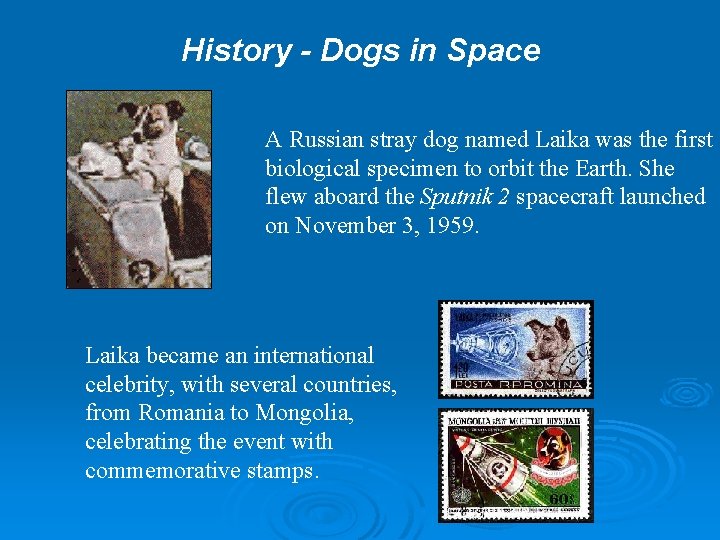
History - Dogs in Space A Russian stray dog named Laika was the first biological specimen to orbit the Earth. She flew aboard the Sputnik 2 spacecraft launched on November 3, 1959. Laika became an international celebrity, with several countries, from Romania to Mongolia, celebrating the event with commemorative stamps.
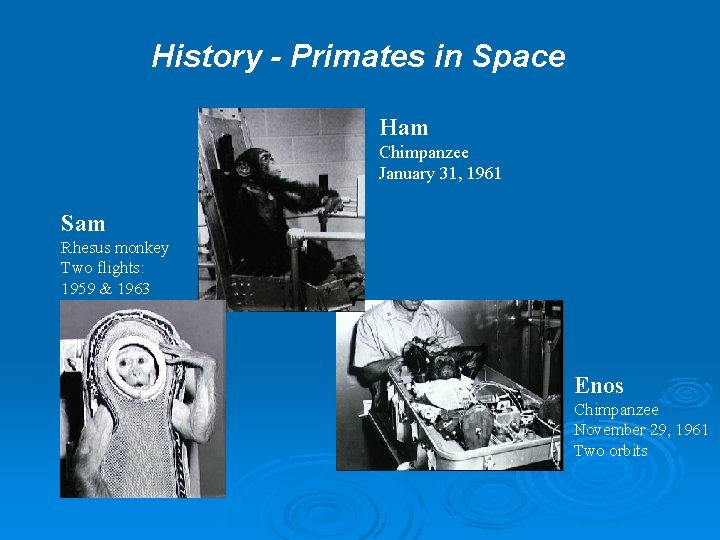
History - Primates in Space Ham Chimpanzee January 31, 1961 Sam Rhesus monkey Two flights: 1959 & 1963 Enos Chimpanzee November 29, 1961 Two orbits
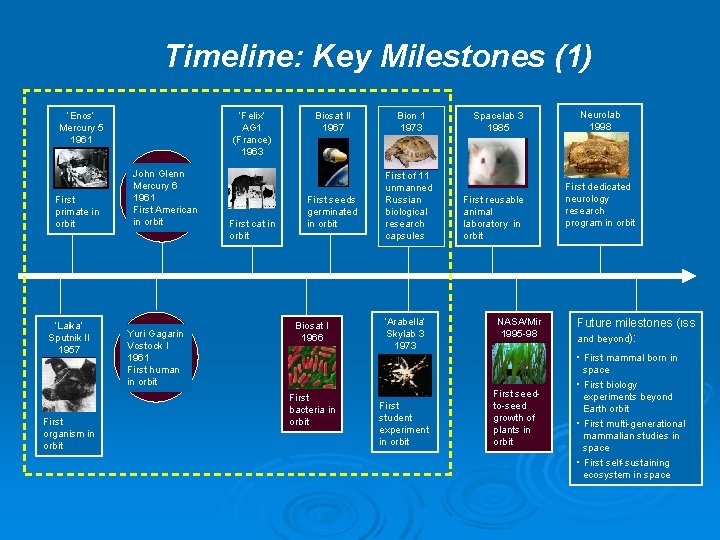
Timeline: Key Milestones (1) ‘Enos’ Mercury 5 1961 First primate in orbit ‘Laika’ Sputnik II 1957 First organism in orbit ‘Felix’ AG 1 (France) 1963 John Glenn Mercury 6 1961 First American in orbit Yuri Gagarin Vostock I 1961 First human in orbit First cat in orbit Biosat II 1967 First seeds germinated in orbit Biosat I 1966 First bacteria in orbit Bion 1 1973 First of 11 unmanned Russian biological research capsules ‘Arabella’ Skylab 3 1973 First student experiment in orbit Spacelab 3 1985 First reusable animal laboratory in orbit NASA/Mir 1995 -98 First seedto-seed growth of plants in orbit Neurolab 1998 First dedicated neurology research program in orbit Future milestones (ISS and beyond): • First mammal born in space • First biology experiments beyond Earth orbit • First multi-generational mammalian studies in space • First self-sustaining ecosystem in space
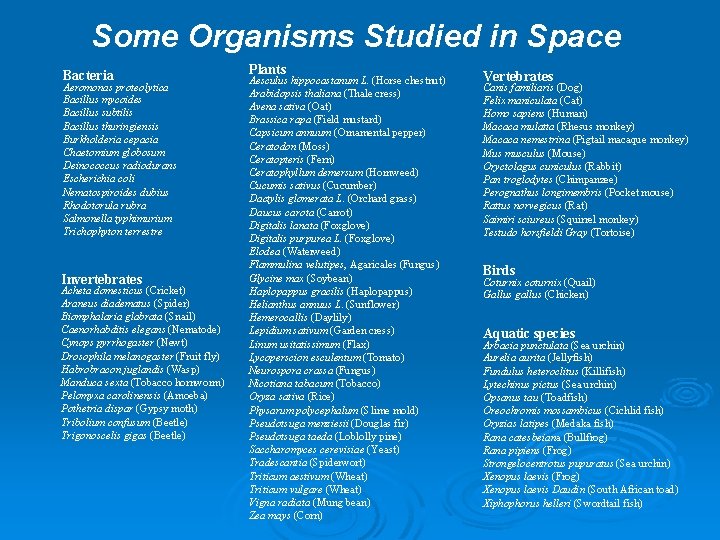
Some Organisms Studied in Space Bacteria Aeromonas proteolytica Bacillus mycoides Bacillus subtilis Bacillus thuringiensis Burkholderia cepacia Chaetomium globosum Deinococcus radiodurans Escherichia coli Nematospiroides dubius Rhodotorula rubra Salmonella typhimurium Trichophyton terrestre Invertebrates Acheta domesticus (Cricket) Araneus diadematus (Spider) Biomphalaria glabrata (Snail) Caenorhabditis elegans (Nematode) Cynops pyrrhogaster (Newt) Drosophila melanogaster (Fruit fly) Habrobracon juglandis (Wasp) Manduca sexta (Tobacco hornworm) Pelomyxa carolinensis (Amoeba) Pothetria dispar (Gypsy moth) Tribolium confusum (Beetle) Trigonoscelis gigas (Beetle) Plants Aesculus hippocastanum L. (Horse chestnut) Arabidopsis thaliana (Thale cress) Avena sativa (Oat) Brassica rapa (Field mustard) Capsicum annuum (Ornamental pepper) Ceratodon (Moss) Ceratopteris (Fern) Ceratophyllum demersum (Hornweed) Cucumis sativus (Cucumber) Dactylis glomerata L. (Orchard grass) Daucus carota (Carrot) Digitalis lanata (Foxglove) Digitalis purpurea L. (Foxglove) Elodea (Waterweed) Flammulina velutipes, Agaricales (Fungus) Glycine max (Soybean) Haplopappus gracilis (Haplopappus) Helianthus annuus L. (Sunflower) Hemerocallis (Daylily) Lepidium sativum (Garden cress) Linum usitatissimum (Flax) Lycoperscion esculentum (Tomato) Neurospora crassa (Fungus) Nicotiana tabacum (Tobacco) Oryza sativa (Rice) Physarum polycephalum (Slime mold) Pseudotsuga menziesii (Douglas fir) Pseudotsuga taeda (Loblolly pine) Saccharomyces cerevisiae (Yeast) Tradescantia (Spiderwort) Triticum aestivum (Wheat) Triticum vulgare (Wheat) Vigna radiata (Mung bean) Zea mays (Corn) Vertebrates Canis familiaris (Dog) Felix maniculata (Cat) Homo sapiens (Human) Macaca mulatta (Rhesus monkey) Macaca nemestrina (Pigtail macaque monkey) Mus musculus (Mouse) Oryctolagus cuniculus (Rabbit) Pan troglodytes (Chimpanzee) Perognathus longimembris (Pocket mouse) Rattus norvegicus (Rat) Saimiri sciureus (Squirrel monkey) Testudo horsfieldi Gray (Tortoise) Birds Coturnix coturnix (Quail) Gallus gallus (Chicken) Aquatic species Arbacia punctulata (Sea urchin) Aurelia aurita (Jellyfish) Fundulus heteroclitus (Killifish) Lytechinus pictus (Sea urchin) Opsanus tau (Toadfish) Oreochromis mossambicus (Cichlid fish) Oryzias latipes (Medaka fish) Rana catesbeiana (Bullfrog) Rana pipiens (Frog) Strongelocentrotus pupuratus (Sea urchin) Xenopus laevis (Frog) Xenopus laevis Daudin (South African toad) Xiphophorus helleri (Swordtail fish)
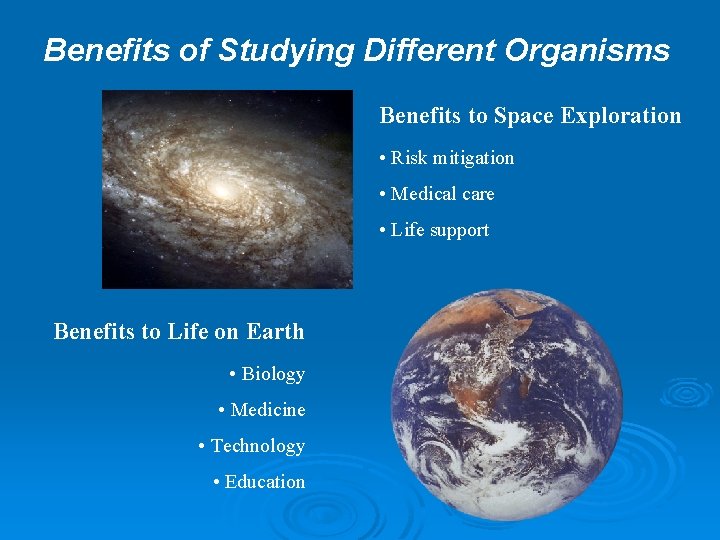
Benefits of Studying Different Organisms Benefits to Space Exploration • Risk mitigation • Medical care • Life support Benefits to Life on Earth • Biology • Medicine • Technology • Education
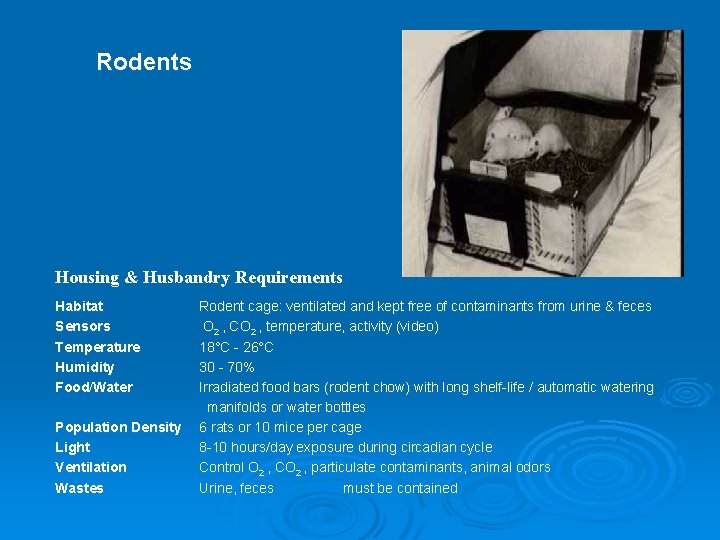
Rodents Housing & Husbandry Requirements Habitat Sensors Temperature Humidity Food/Water Population Density Light Ventilation Wastes Rodent cage: ventilated and kept free of contaminants from urine & feces O 2 , CO 2 , temperature, activity (video) 18°C - 26°C 30 - 70% Irradiated food bars (rodent chow) with long shelf-life / automatic watering manifolds or water bottles 6 rats or 10 mice per cage 8 -10 hours/day exposure during circadian cycle Control O 2 , CO 2 , particulate contaminants, animal odors Urine, feces must be contained
Finding a Training Program Ø Visit the AALAS website http: //www. aalas. org/index. aspx Ø Visit the ASLAP web site http: //www. aslap. org/One. Page. php Ø Visit the ACLAM web site http: //www. aclam. org/education/training/location. html Ø Talk to a lab animal vet Ø Do an externship…more info later.
- Slides: 48