
Lab Activity 6 A Peroxide Value Determination B
Lab Activity 6 A) Peroxide Value Determination B) Formation of Acrolein C) Saponification IUG, Spring 2014 Dr. Tarek Zaida 1
A) Peroxide Value Determination • Peroxide value is the concentration of (‐O‐O‐) groups in edible oils, • It is a measurement of the decomposition of the product and in many countries, official standards specify a maximum peroxide number beyond which the oil is unfit for human consumption. • Formation of peroxide during storage of oil or fat may occur after few weeks to several months according to the conditions of storage 2

• The peroxide number is therefore measured by oil manufacturers during production and after storage to check its preservation. • International standards use a redox titration in non‐aqueous media, results are generally expressed in μg of peroxide (or active oxygen) per gram of product but mmoles/kg or meq of O 2/kg are also used. 3
• Formation of peroxide during storage of oil or fat may occur after few weeks to several months according to the conditions of storage • Peroxide value is determined volumetrically • Reaction of KI in acid solution with the bound oxygen followed by titration of the liberated I 2 with sodium thiosulfate. • Chloroform is used as a solvent. • Fresh oil has peroxide value below 10 meq/kg. • Rancid taste often begins to develop when the peroxide value is between 20 & 40 meq/kg 4
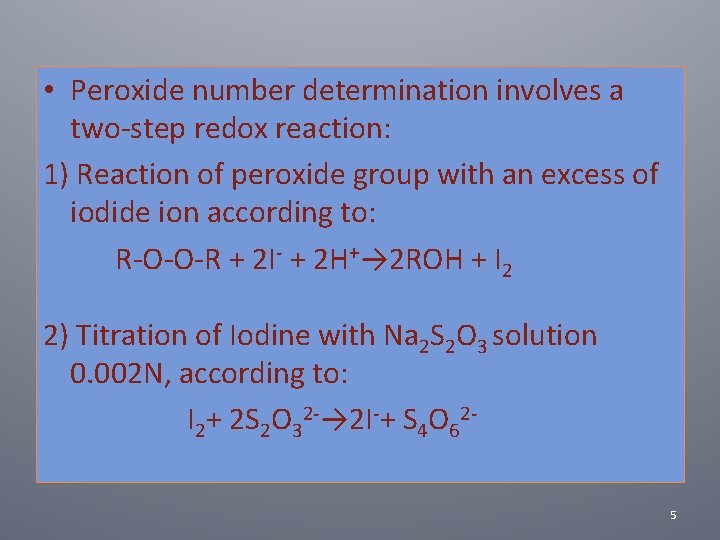
• Peroxide number determination involves a two‐step redox reaction: 1) Reaction of peroxide group with an excess of iodide ion according to: R‐O‐O‐R + 2 I‐ + 2 H+→ 2 ROH + I 2 2) Titration of Iodine with Na 2 S 2 O 3 solution 0. 002 N, according to: I 2+ 2 S 2 O 32‐→ 2 I‐+ S 4 O 62‐ 5
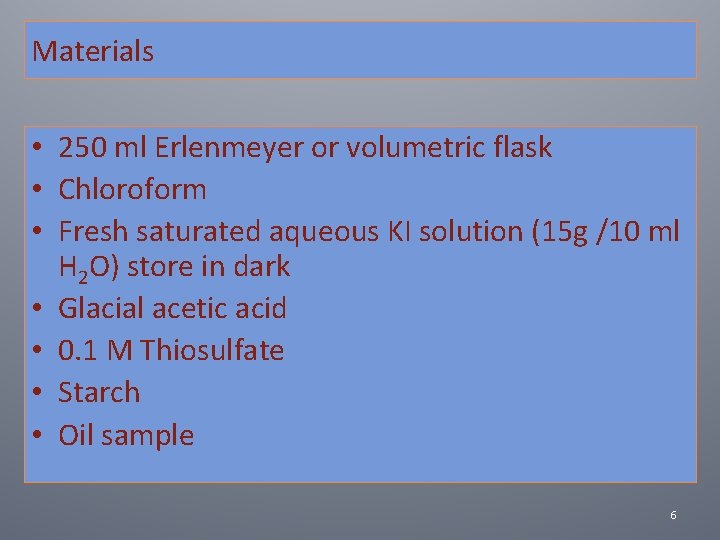
Materials • 250 ml Erlenmeyer or volumetric flask • Chloroform • Fresh saturated aqueous KI solution (15 g /10 ml H 2 O) store in dark • Glacial acetic acid • 0. 1 M Thiosulfate • Starch • Oil sample 6
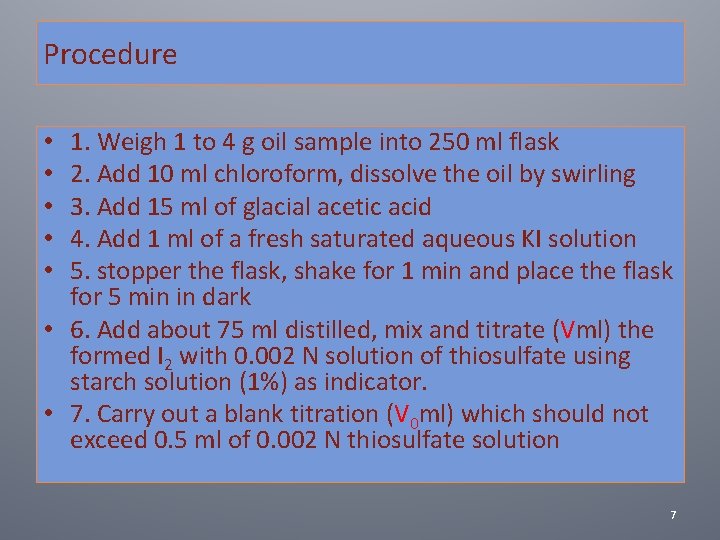
Procedure 1. Weigh 1 to 4 g oil sample into 250 ml flask 2. Add 10 ml chloroform, dissolve the oil by swirling 3. Add 15 ml of glacial acetic acid 4. Add 1 ml of a fresh saturated aqueous KI solution 5. stopper the flask, shake for 1 min and place the flask for 5 min in dark • 6. Add about 75 ml distilled, mix and titrate (Vml) the formed I 2 with 0. 002 N solution of thiosulfate using starch solution (1%) as indicator. • 7. Carry out a blank titration (V 0 ml) which should not exceed 0. 5 ml of 0. 002 N thiosulfate solution • • • 7
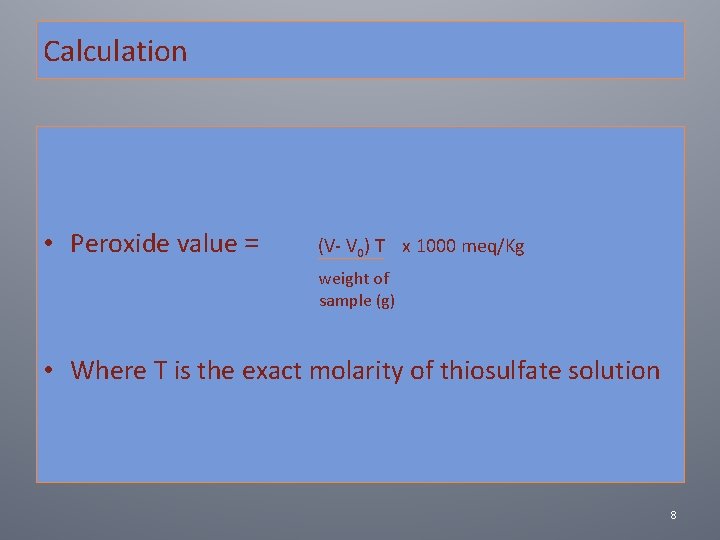
Calculation • Peroxide value = (V‐ V 0) T x 1000 meq/Kg weight of sample (g) • Where T is the exact molarity of thiosulfate solution 8
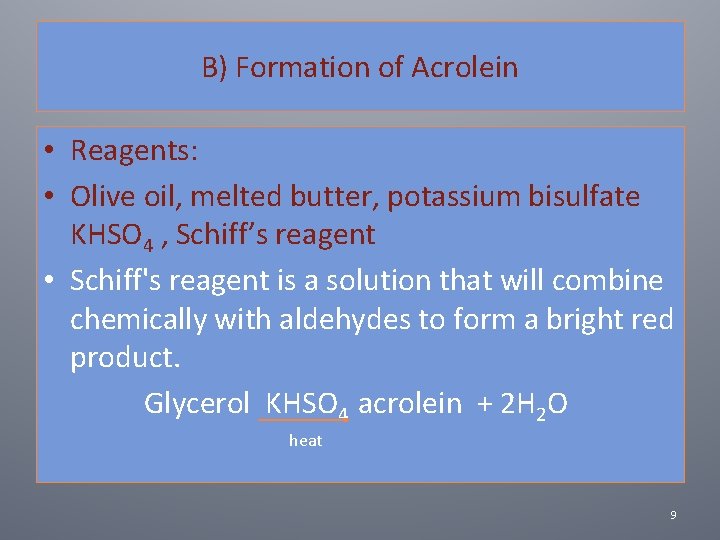
B) Formation of Acrolein • Reagents: • Olive oil, melted butter, potassium bisulfate KHSO 4 , Schiff’s reagent • Schiff's reagent is a solution that will combine chemically with aldehydes to form a bright red product. Glycerol KHSO 4 acrolein + 2 H 2 O heat 9
Procedure • 1. Place about 1 g powdered KHSO 4 in a clean test tube. • 2. add 3 – 4 drops of olive oil (0. 5 g melted butter) on the salt and heat. • 3. Note the irritating odor of acrolein aldehyde or aldehyde which will color a filter paper moistened with Schiff’s reagent bright red 10
C) Saponification (Formation of a soluble soap & insoluble soap) • Reagents Olive oil, cow fat, 5% KOH solt. 2% Mg. SO 4 solt. 11
Procedure • 1. add 10 ml of olive oil or 10 g of cow fat in a 250 ml beaker • 2. add 50 ml KOH solt. • 3. add 150 ml dist. Water • 4. Hydrolyze the lipids by heating the beaker nearly the boiling point for 3 – 5 min • 5. Transfer a few amount of the beaker content into about 30 ml of dist. Water. 12
• 6. Observe if any saponificaton has occurred (indicated by the complete solubility of the solution when fall into a dist. Water). • 7. To form insoluble soap, add a few mls of 2% Mg. SO 4 solution to the soap solution, while precipitate indicate formation of magnesium salts of fatty acids (insoluble soap). 13
- Slides: 13