
Lab Activity 5 Lipids IUG Spring 2014 Dr
Lab Activity 5 Lipids IUG, Spring 2014 Dr. Tarek Zaida 1
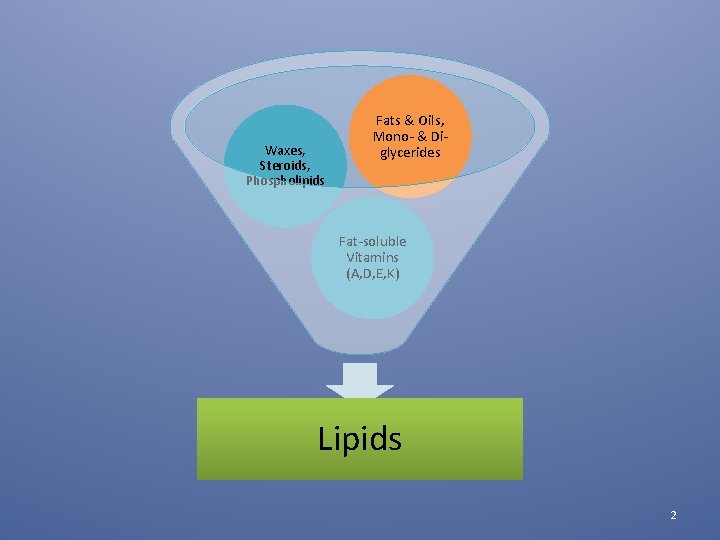
Waxes, Steroids, Phospholipids Fats & Oils, Mono- & Diglycerides Fat-soluble Vitamins (A, D, E, K) Lipids 2
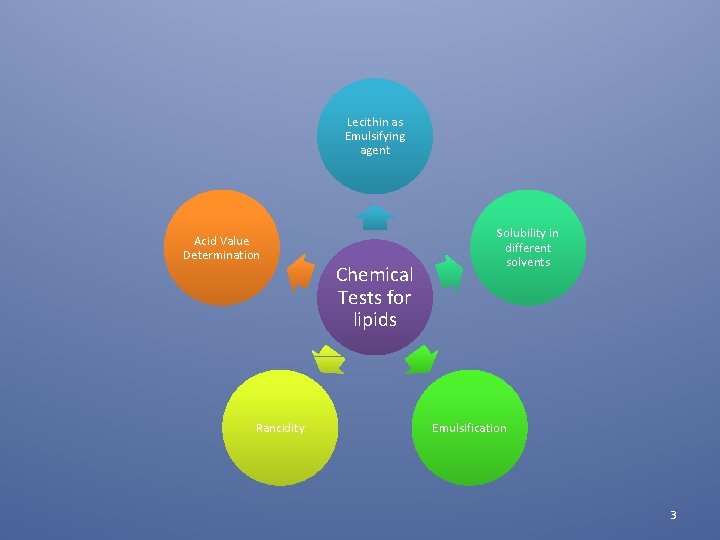
Lecithin as Emulsifying agent Acid Value Determination Rancidity Chemical Tests for lipids Solubility in different solvents Emulsification 3
1. Solubility in Polar and Non-polar Solvents • Reagents • Olive oil (vegetable oil), butter (animal fat), • stearic acid (saturated fatty acid), oleic acid (unsaturated fatty acid), • Solvents: dilute acid and alkali solutions, cold alcohol, hot alcohol, benzene, chloroform, ether and carbon tetrachloride. • • Procedure 1. Add a few drops of the liquid fat or 0. 5 g of the solid fat in labeled test tubes. 2. To each test tube add a 5 ml of solvent and write down your observations. 3. Repeat the experiment with a different solvent and make your observations. 4
2. Emulsification Reagents • Neutral olive oil, 0. 5 % Na 2 C 03, Rancid olive oil Procedure 1. Shake up a drop of neutral olive oil with a little water in a test tube, the fat becomes finally divided forming an emulsion, upon standing fat separates and rises to the top. 2. To 5 ml water in a test tube add 2 to 3 drops of 0. 5 percent Na 2 CO 3. Introduce a drop of neutral olive oil and shake, the emulsion is not permanent and is not so transitory. 3. Repeat step 2 using rancid olive oil. In this case the alkali combines with the free fatty acids to form soap and the soap being an emulsifying agent, it emulsifies the fat. 5
3. Lecithin as Emulsifying Agent • Lecithin (phosphatidyl choline) is present in nerve, brain and other tissues of animals, plants. • Egg yolk contains lecithin. • Lecithin has a polar head (ionic) and 2 nonpolar hydrocarbon tails (fatty acid units) which make it an excellent emulsifying agent. 6
Procedure • A. Preparation of lecithin: - Place an egg yolk in a 250 ml Erlenmeyer flask, add 50 ml of ether, shake vigorously. - Filter the mixture through a dry paper into a beaker and evaporate the ether on a steamheated sand bath or water-bath. - Cool the solution, then add about 25 ml of acetone, stir until the precipitate clumps and sticks to the beaker, then pour off the acetone. 7
- Transfer ½ of the precipitate to a test tube, add 1 ml of water and 1 ml of vegetable oil, stopper the tube and shake very vigorously. - Repeat the above step in another test tube but without lecithin. Compare the two test tubes. After 5 min - Make your comments 8
4. Rancidity • • • Reagents Fresh olive oil, rancid olive oil, oleic acid, litmus paper 9
Procedure • Try the reaction of fresh olive oil, oleic acid to litmus paper. • Repeat the test with rancid oil. What is the reaction of a fresh lipid and that of rancid lipid? 10
5. Acid Value (free fatty acids) Determination • Acid value is a measure of the extent to which the glycerides have been hydrolyzed by a lipase action. Hydrolysis is accelerated by heat and light. • Acid value is an index of the efficiency of oil refining during which the free fatty acids are removed and the acid value falls to very low values. • Rancidity is usually accompanied by formation of free fatty acids (indication of a deterioration of oils in storage conditions) 11
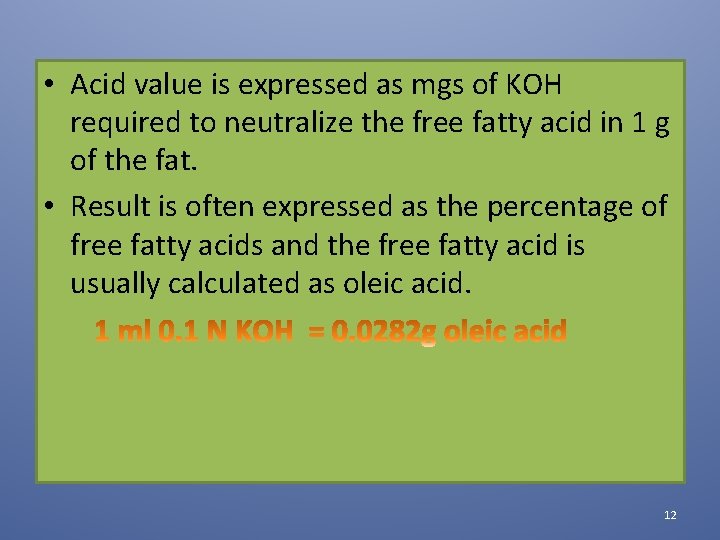
• Acid value is expressed as mgs of KOH required to neutralize the free fatty acid in 1 g of the fat. • Result is often expressed as the percentage of free fatty acids and the free fatty acid is usually calculated as oleic acid. 12
Materials • • Oil sample, 0. 1 N KOH 1% phenolphthalein solution Ether Ethanol 250 Erlenmeyer flask burette 13
Procedure 1. Mix 25 ml of ether with 25 ml of ethanol, and 1 -2 drops phenolphthalein in an erlenmeyer flask 2. Neutralize the mixture with 0. 1 N KOH 3. Dissolve 25 g of the oil in the mixed neutral solvent. 4. Titrate with 0. 1 N KOH, shaking constantly until pink color which persists for 15 sec. Calculate the acid value and the percentage of free fatty acid in the tested sample. 14
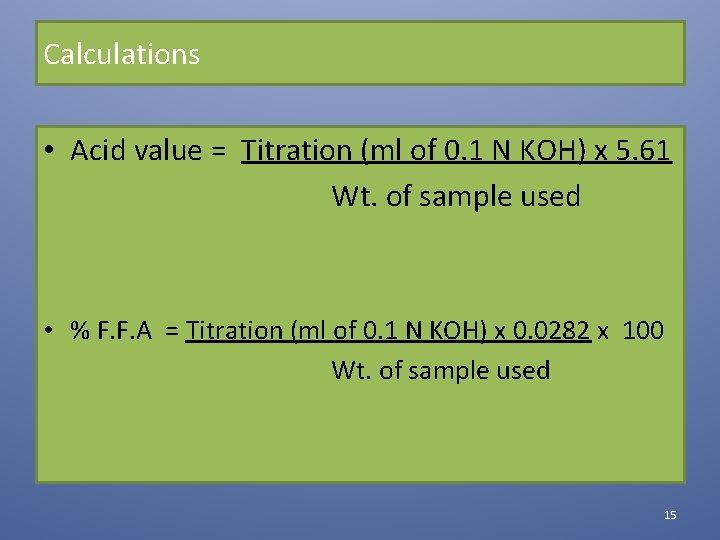
Calculations • Acid value = Titration (ml of 0. 1 N KOH) x 5. 61 Wt. of sample used • % F. F. A = Titration (ml of 0. 1 N KOH) x 0. 0282 x 100 Wt. of sample used 15
- Slides: 15