
Lab Activity 4 A Extraction Determination of Crude
Lab Activity 4 A. Extraction & Determination of Crude Fat from Plant or Animal Tissues B. Determination of Dry Matter and Moisture Content In Plant Materials C. Determination of dry matter & Moisture in Meat IUG, Fall 2012 Dr. Tarek Zaida 1
A. Extraction & Determination of Crude Fat from Plant or Animal Tissues • A Soxhlet extractor is a piece of laboratory apparatus invented in 1879 by Franz von Soxhlet. • It was originally designed for the extraction of a lipid from a solid material. • However, a Soxhlet extractor is not limited to the extraction of lipids. • Typically, a Soxhlet extraction is only required where the desired compound has a limited solubility in a solvent, and the impurity is insoluble in that solvent. • If the desired compound has a significant solubility in a solvent then a simple filtration can be used to separate the compound from the insoluble substance. 2
3
4
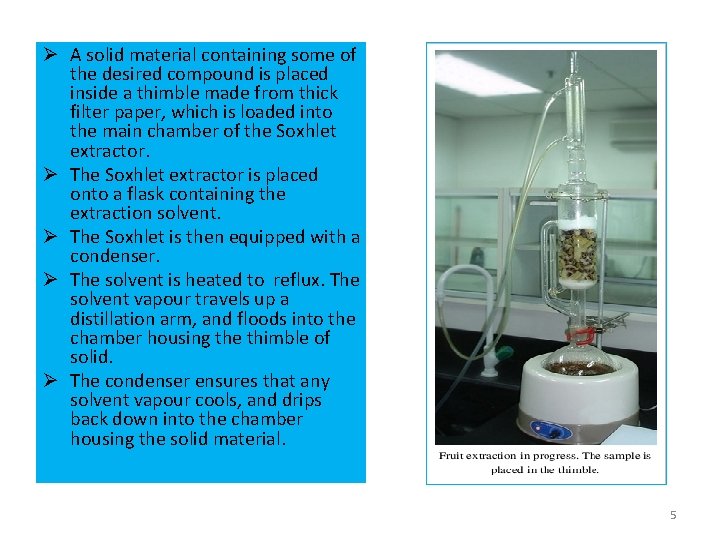
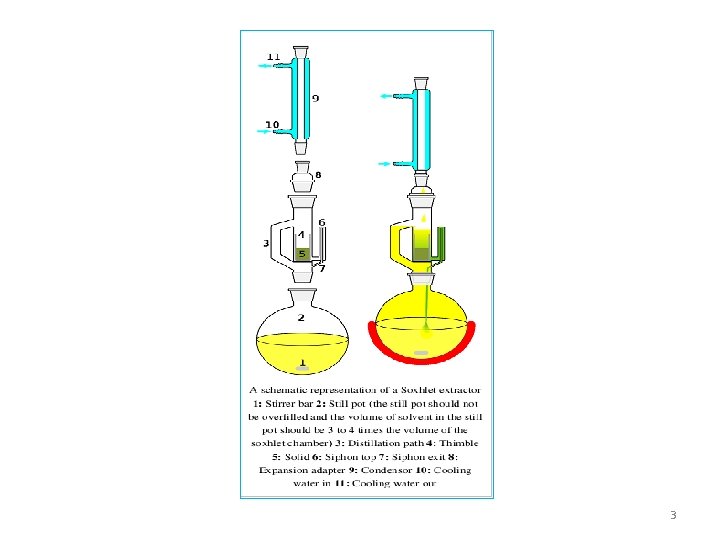
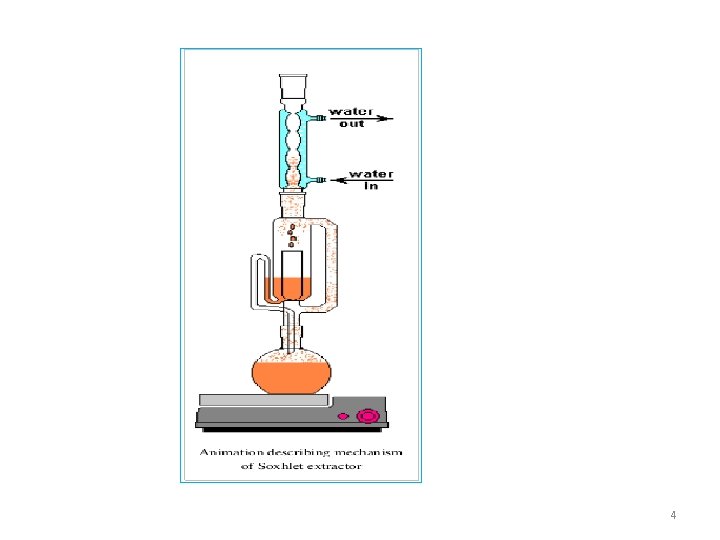
Ø A solid material containing some of the desired compound is placed inside a thimble made from thick filter paper, which is loaded into the main chamber of the Soxhlet extractor. Ø The Soxhlet extractor is placed onto a flask containing the extraction solvent. Ø The Soxhlet is then equipped with a condenser. Ø The solvent is heated to reflux. The solvent vapour travels up a distillation arm, and floods into the chamber housing the thimble of solid. Ø The condenser ensures that any solvent vapour cools, and drips back down into the chamber housing the solid material. 5
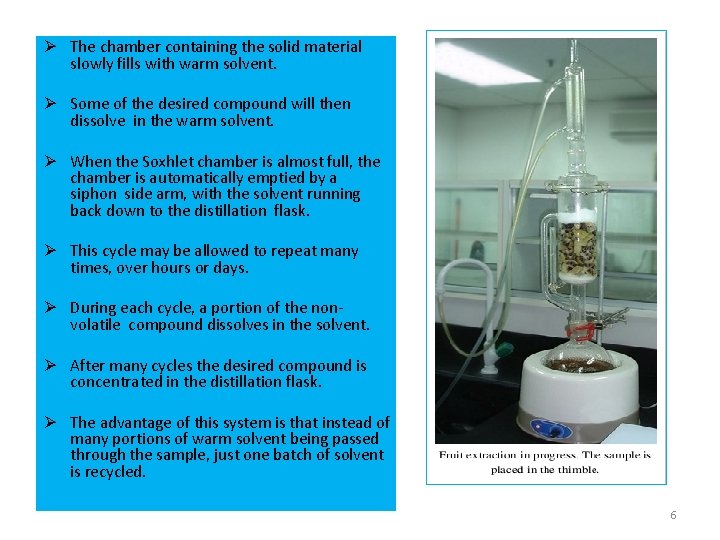
Ø The chamber containing the solid material slowly fills with warm solvent. Ø Some of the desired compound will then dissolve in the warm solvent. Ø When the Soxhlet chamber is almost full, the chamber is automatically emptied by a siphon side arm, with the solvent running back down to the distillation flask. Ø This cycle may be allowed to repeat many times, over hours or days. Ø During each cycle, a portion of the nonvolatile compound dissolves in the solvent. Ø After many cycles the desired compound is concentrated in the distillation flask. Ø The advantage of this system is that instead of many portions of warm solvent being passed through the sample, just one batch of solvent is recycled. 6
• At the end of extraction (some 12 hours), the extraction flask is removed from the apparatus, then heated on a hot plate under the hood until most of the solvent has evaporated and before complete dryness. • Place the extraction flask containing the crude fat in an oven for 30 min at 70 C • Cool to room temperature and weigh the extraction flask. • Calculate the percentage of crude fat in the airdried sample. • Crude fat % = (wt of ext. flask + crude) – (wt. of ext. flask) x 100 wt. of sample 7
B. Determination of Dry Matter and Moisture Content In Plant Materials • Materials: • Air dried food (plant) material (ground samples), • oven 105 C, • Porcelain crucibles (25 ml) 8
Procedure • 1. weigh 2 clean dry crucible • 2. Place about 2 g of food material in the crucible • 3. Place crucible and sample in an oven, set at 105 C overnight (12 h) • 4. Cool in a desiccator and weigh crucible plus dry sample • Calculations: • Dry matter% = wt. of crucible + wt. of dried sample) – (wt. of crucible) x 100 • Wt. of sample before drying 9
C. Determination of dry matter & Moisture in Meat • Procedure 1. At 103 C dry 15 g acid washed sand in a flat metal dish together with a thin glass rod 2. Cool and weigh the dish and contents 3. Weigh in 5 g prepared sample and add 5 -10 ml ethanol, mix the mass thoroughly with the glass rod 4. Place the dish on a water bath at 60 -80 C, remove the alcohol by evaporation and stir occasionally. 5. Heat the dried mass at 103 C for 2 hours in a drying oven. 6. Cool in a desiccator and weigh, repeat drying and weighing until successive weightings differ by less 0. 1% of the mass of the test portion. 7. Calculate the moisture percent in the meat sample 10
- Slides: 10