
Lab 9 Routine Urine Analysis Identification of pathological

Lab (9): Routine Urine Analysis Identification of pathological Physical and Chemical Urine Constituents KAU-Faculty of Science- Biochemistry department Clinical biochemistry lab (Bioc 416) 2012 Lecturer: Nouf Alshareef nf. shareef@hotmail. com

Identification of Pathological Physical and Chemical Urine Constituents Abnormal (Pathological) constituents of urine: 1 - Macroscopic analysis: § physical tests § chemical tests 2 - Microscopic analysis: • Pathological urine constituents are substances which are not usually present in urine such as glucose, protein, ketones, RBCs, Hb, bilirubin…. etc.
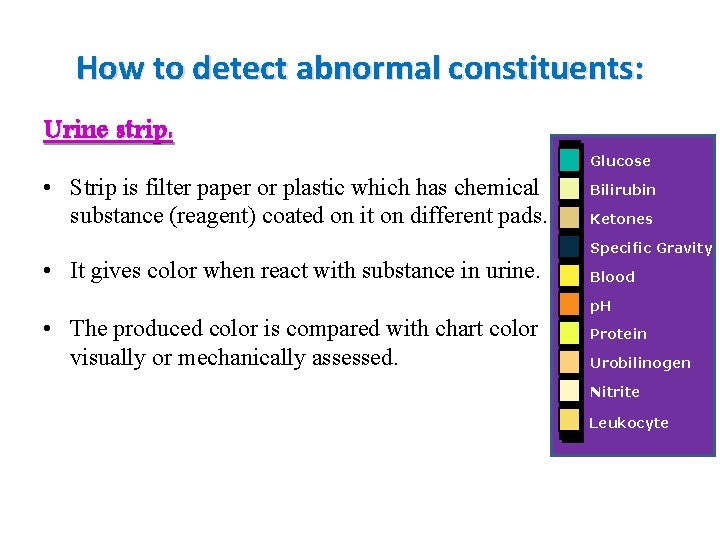
How to detect abnormal constituents: Urine strip: • Strip is filter paper or plastic which has chemical substance (reagent) coated on it on different pads. Glucose Bilirubin Ketones Specific Gravity • It gives color when react with substance in urine. Blood p. H • The produced color is compared with chart color visually or mechanically assessed. Protein Urobilinogen Nitrite Leukocyte

Results are reported as: • In concentration (mg/dl) • As small, moderate, or large • Using the plus system (1+, 2+, 3+, 4+) • As positive, negative, or normal Urinalysis test strip Automated Urine Testing Machine
• This method is rapid, easy, give early indication and qualitative. • Therefore, usually there are other confirmatory tests: (chemistry, microbiology and microscopic analysis). • Reaction in strip is effected by time, to reduce timing errors and to limit variations in color interpretation; automated instrument is used to read the reaction color on each test pad.
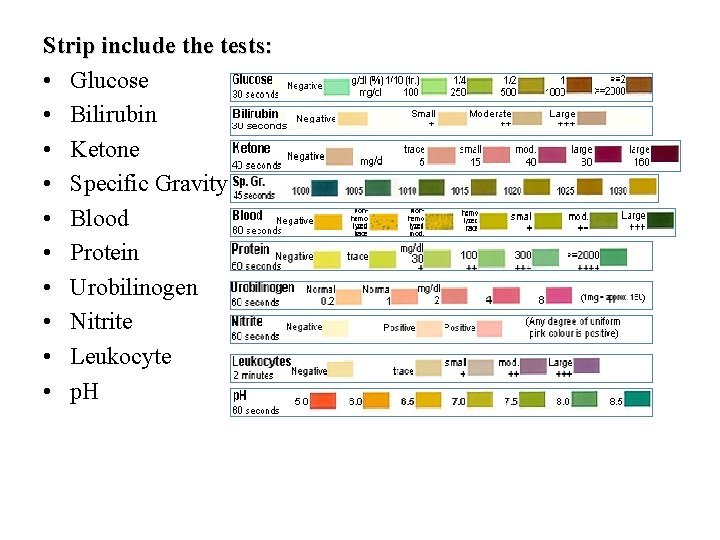
Strip include the tests: • Glucose • Bilirubin • Ketone • Specific Gravity • Blood • Protein • Urobilinogen • Nitrite • Leukocyte • p. H

Abnormal Urine Constituents include: 1 - Proteinurea: • is the presence of abnormal amount of protein in urine. • Urine of healthy individual contains no protein due to: ü In normal physiology, small M. wt. proteinsis reabsorbed by kidney tubules (proximal tubule) ü large M. wt of protein so it can't pass through kidney tubule to urine. unless kidney tubule has damage. • The main protein in urine is albumin therefore, proteinuria=albuminuria

Microalbuminuria: • Is the presence of small amounts of albumin in urine. • It is very important in detection of early stage of nephronpathy and in diagnosis of DM complication (nephropathy). • High protein in urine makes urine looks foamy. • Associated with face or feet abnormal odema, due to disturbance of liquid balance in body due to protein loss.
Detection: • Qualitative test: using a reagent test strip. • Quantitative test: depends on volume and time of urine (protein conc. in urine may vary with time and volume) • Most assays are performed on urine sample of 12 -24 h. Reference value: • Quantitative for 24 -h urine: Male: 1 -4 mg/dl Female: 3 -10 mg/dl Child: 1 -10 mg/dl • Qualitative reference value: Normal = Negative
2 - Glucoseurea: • is the presence of abnormal conc. of glucose in urine. • Normally, glucose is reabsorbed by active transport in proximal tubule and therefore doesn't appear in urine. • If the blood glucose level exceeds the reabsorption capacity of kidney tubules (renal threshold), glucose will appear in urine. • Renal threshold of glucose: is around 160 mg/100 ml.

• Glucosuria indicates that glucose concentration in blood exceeds this amount and the kidneys are unable to reabsorb it efficiently. Glucosuria occurs in DM, which characterized by: • hyperglycemia, • usually polyurea (increased volume of urine), • high SG • urine may be light in color.

3 - ketourea: • is the presence of abnormal amount of ketone bodies in urine. • Body normally uses carbohydrates as source of energy. • If carbohydrate source depleted or there is defect in carbohydrate metabolism, body use fat as a source of energy. Fatty Acids Oxidation H 2 O+CO 2+energy • Fat metabolism is occurred for certain time, at certain point, fatty acid utilization occurs incompletely results in production of intermediate substances (keton bodies). • Three ketone bodies: acetone, acetoacetate, b-hydroxybutayric acid
• Normally ketone bodies are removed by liver. • elevated levels of keton bodies in blood and urine cause acidosis which leads to coma and death. Ketourea is common in uncontrolled DM (why? ) • because diabetic patient has high blood glucose but can't use by cells, so lipids are used as source of energy. • Ketourea present in: Disease q Nutrition q Vomiting for long time q • Results effected by: diet and drugs Normal values: negative test result is normal. Small: < 20 mg/dl Moderate: 30 -40 mg/dl large > 80 mg/dl
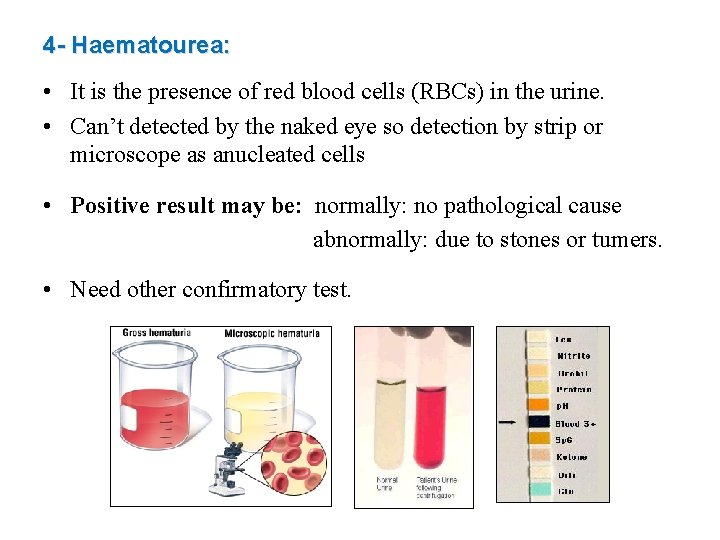
4 - Haematourea: • It is the presence of red blood cells (RBCs) in the urine. • Can’t detected by the naked eye so detection by strip or microscope as anucleated cells • Positive result may be: normally: no pathological cause abnormally: due to stones or tumers. • Need other confirmatory test.

5 - Hemoglobinuria: • Presence of heamoglobin in urine due to rupturing of RBCs • This may occur in malaria, typhoid, yellow fever, hemolytic jaundice and other diseases.

6 - Bilirubin (Bile): • Result from hemoglobin breakdown • Elevated in hepatitis and jaundice (biliary duct obstruction).

7 - Nitrite: • used for screening for bacteria. • Normal urine contain nitrate but not contain nitrites. • In the presence of bacteria, the normally present nitrate in the urine is reduced to nitrite. nitrate reduction nitrite "pink" • Positive test indicates presence of more than 10 organisms/ml.
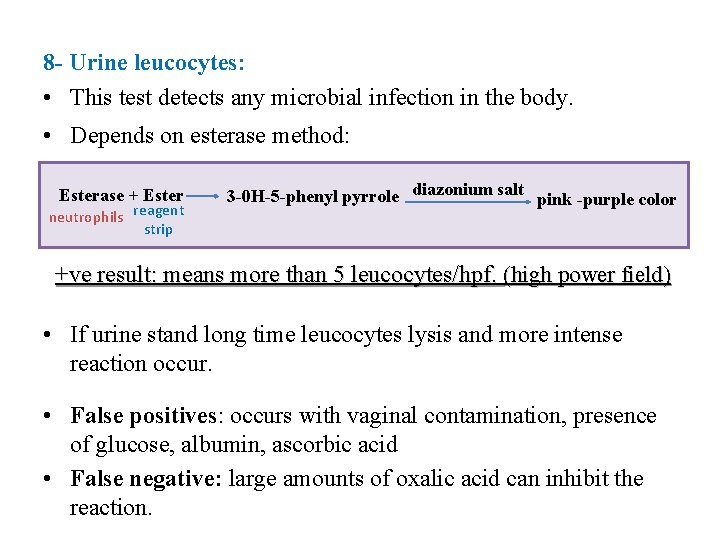
8 - Urine leucocytes: • This test detects any microbial infection in the body. • Depends on esterase method: Esterase + Ester neutrophils reagent strip 3 -0 H-5 -phenyl pyrrole diazonium salt pink -purple color +ve result: means more than 5 leucocytes/hpf. (high power field) • If urine stand long time leucocytes lysis and more intense reaction occur. • False positives: occurs with vaginal contamination, presence of glucose, albumin, ascorbic acid • False negative: large amounts of oxalic acid can inhibit the reaction.
9 - p. H: • Phosphates will precipitate in an alkaline urine, and uric acid will precipitate in an acidic urine 10 - SG: • The specific gravity is a convenient index of urine concentration. • It measures density and is only an approximate guide to true concentration. • High SG is due to protein, glucose and other substances
- Slides: 19