
Lab 9 Resampling methods Enter the bootstrap Bradley

Lab 9: Resampling methods

Enter the bootstrap Bradley Efron The computer
The procedure is quite straightforward • To obtain a sense of how stable a sample mean is (how it distributes). • Simply *resample* (with replacement!) from the existing sample. • Do this n times (10 k 100 k 1 m) • Calculate the standard deviation of these resampled means. • Compare with the figure of interest.
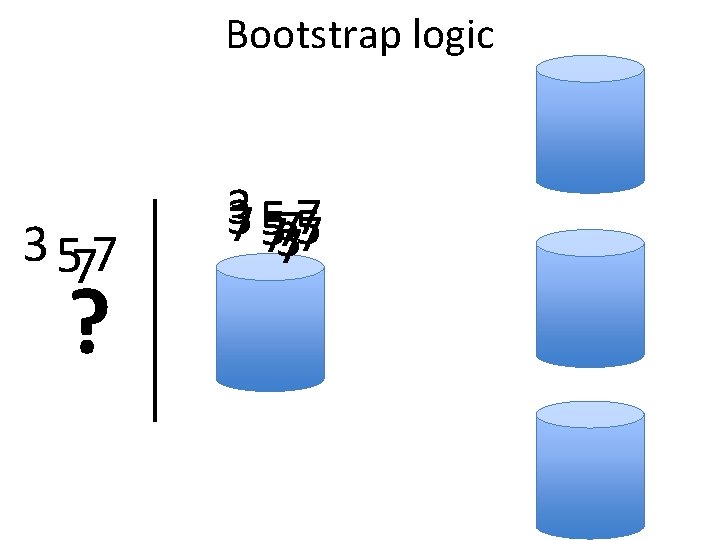
Bootstrap logic 3 577 ? 37 577 73757
Use cases • When there is only limited data (controversial) • When the underlying distribution is not normal and/or not known • When estimating sample means of rare events
Bootstrap drawback/assumption • This works if and only if the sample truly is representative of the population. • In other words, if something didn’t happen in the sample, it can’t ever happen. • “The data we have is the only data that can ever be” • So small samples necessarily over- or underestimate the probability of rare events.

It seems like a miracle But it works (usually)!
Permutation tests • Classical tests (e. g. t-test) assume that the data is distributed in a certain way. • If the distribution of the data is not what is assumed, the reported p-value by the test is not the real p-value (!) • Permutation tests use the actual data to estimate how likely a given result is. • Logic: We pretend we lost the labels (which group data came from), then create a null distribution (by random arrangement of groups) and compare with empirical result.
Example • • • A rat is stressed out for 2 weeks 10 neurons are then taken out 5 we treat with Ketamine and 5 we don't treat at all We then count the number of dendritic spines of each neuron Hypothesis: Ketamine works by growing dendritic spines K = [117 123 111 101 121] C = [98 104 106 92 88] Test statistic: sum(K) – sum(C) We can now calculate exact p-value by determining the null distribution through resampling methods.
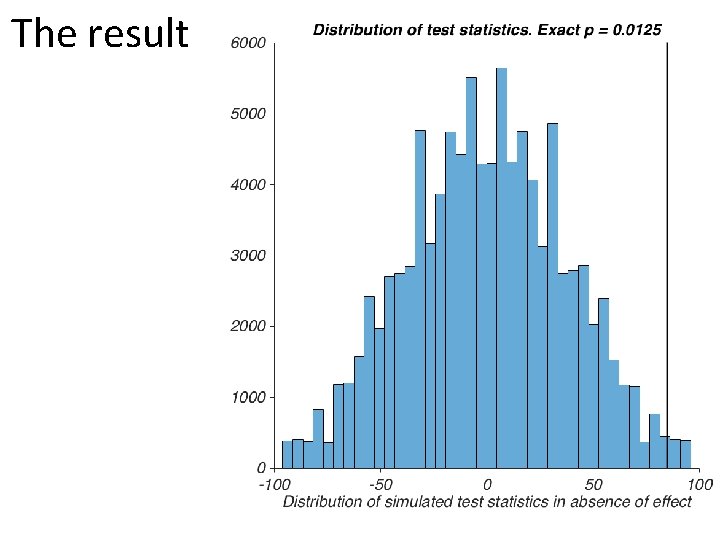
The result
- Slides: 10