
Lab 6 Saturation Atmospheric Stability Review Lab 5
Lab 6: Saturation & Atmospheric Stability
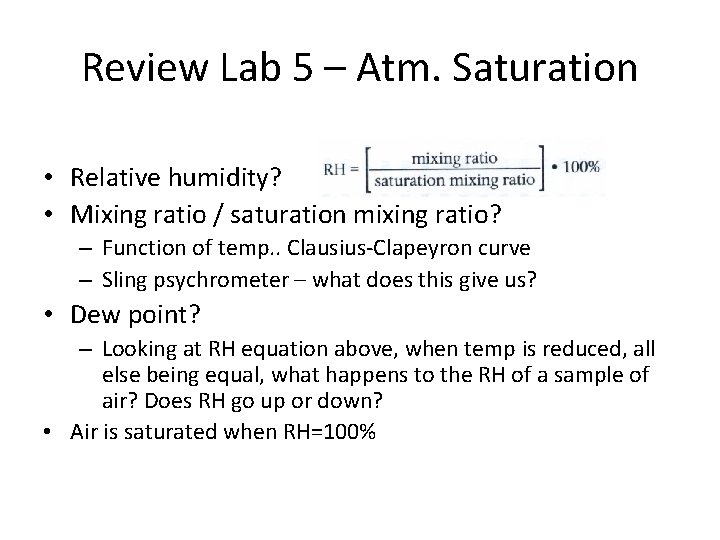
Review Lab 5 – Atm. Saturation • Relative humidity? • Mixing ratio / saturation mixing ratio? – Function of temp. . Clausius-Clapeyron curve – Sling psychrometer – what does this give us? • Dew point? – Looking at RH equation above, when temp is reduced, all else being equal, what happens to the RH of a sample of air? Does RH go up or down? • Air is saturated when RH=100%
Lab 6 • Lab 6: Saturation and Atmospheric Stability – processes that influence atmospheric saturation – i. e. , cause cooling and/or increase in water vapor content – atmospheric processes that change either the temp and/or water vapor content of an air sample – In this lab, we’ll focus on atmospheric mixing and adiabatic cooling and some processes that drive these conditions
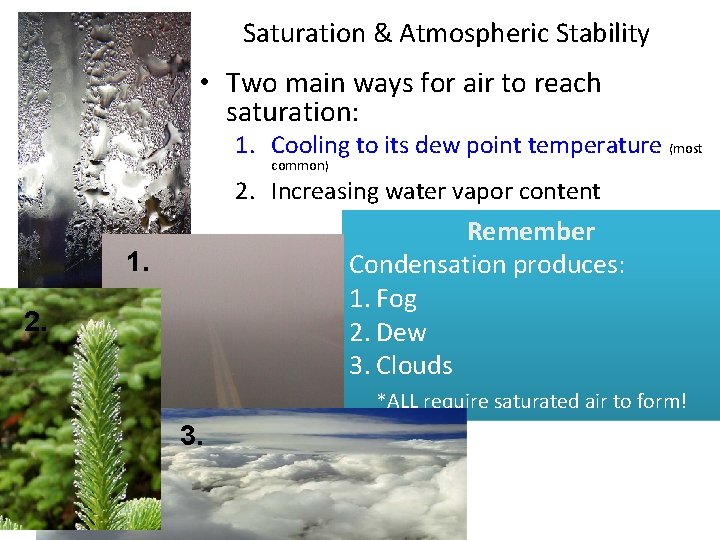
Saturation & Atmospheric Stability • Two main ways for air to reach saturation: 1. Cooling to its dew point temperature (most common) 2. Increasing water vapor content Remember Condensation produces: 1. Fog 2. Dew 3. Clouds 1. 2. *ALL require saturated air to form! 3.
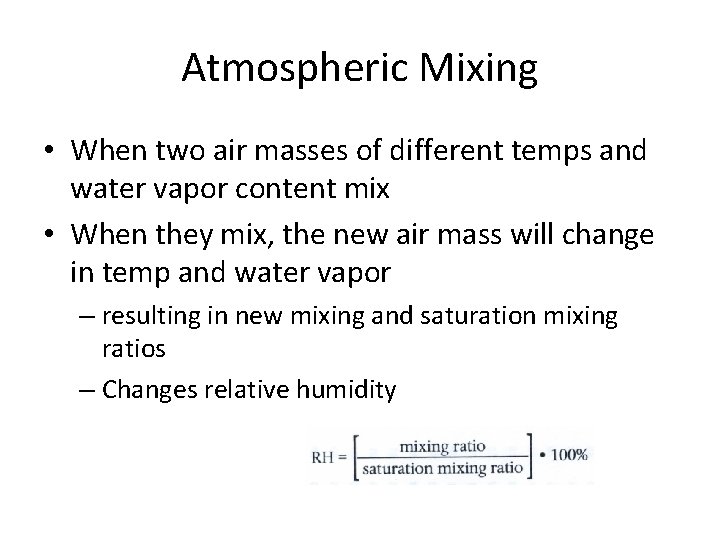
Atmospheric Mixing • When two air masses of different temps and water vapor content mix • When they mix, the new air mass will change in temp and water vapor – resulting in new mixing and saturation mixing ratios – Changes relative humidity
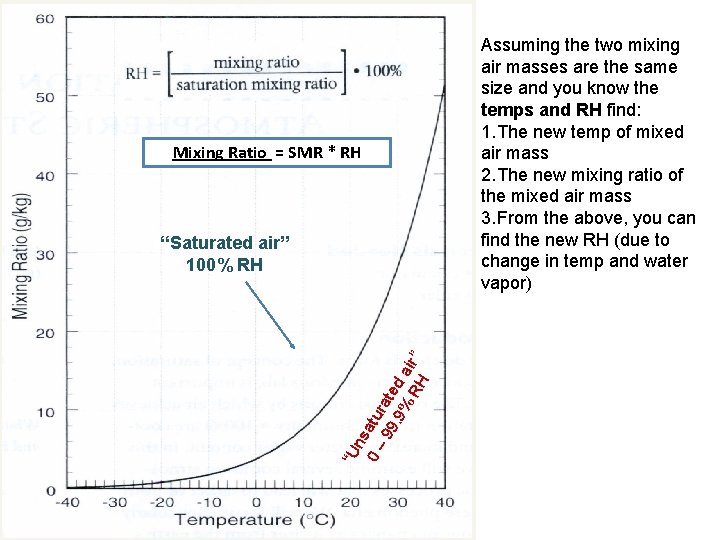
Mixing Ratio = SMR * RH “U ns 0 – atu 99 rate. 9% d a RH ir” “Saturated air” 100% RH Assuming the two mixing air masses are the same size and you know the temps and RH find: 1. The new temp of mixed air mass 2. The new mixing ratio of the mixed air mass 3. From the above, you can find the new RH (due to change in temp and water vapor)
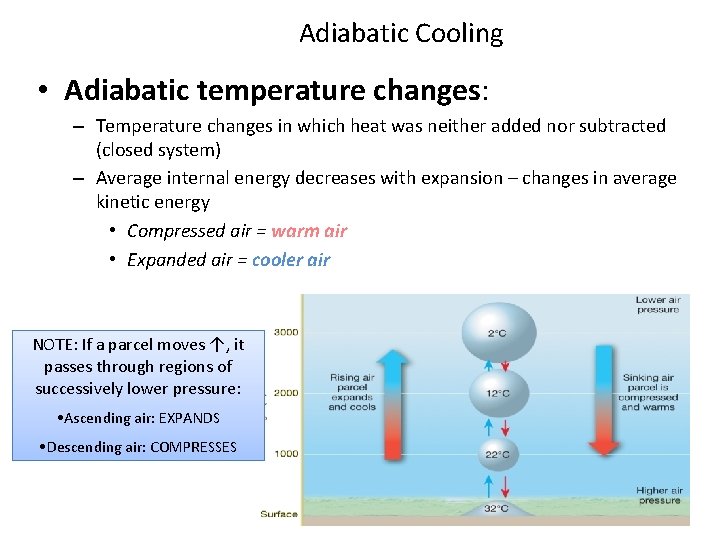
Adiabatic Cooling • Adiabatic temperature changes: – Temperature changes in which heat was neither added nor subtracted (closed system) – Average internal energy decreases with expansion – changes in average kinetic energy • Compressed air = warm air • Expanded air = cooler air NOTE: If a parcel moves ↑, it passes through regions of successively lower pressure: • Ascending air: EXPANDS • Descending air: COMPRESSES
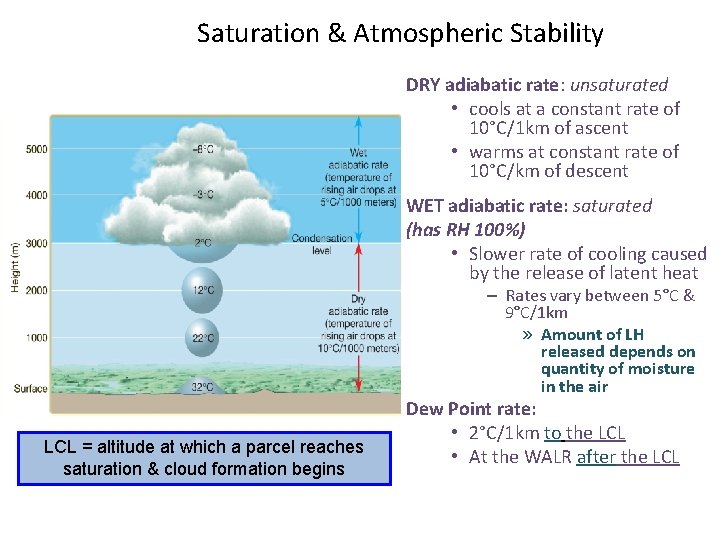
Saturation & Atmospheric Stability DRY adiabatic rate: unsaturated • cools at a constant rate of 10°C/1 km of ascent • warms at constant rate of 10°C/km of descent WET adiabatic rate: saturated (has RH 100%) • Slower rate of cooling caused by the release of latent heat – Rates vary between 5°C & 9°C/1 km » Amount of LH released depends on quantity of moisture in the air LCL = altitude at which a parcel reaches saturation & cloud formation begins Dew Point rate: • 2°C/1 km to the LCL • At the WALR after the LCL
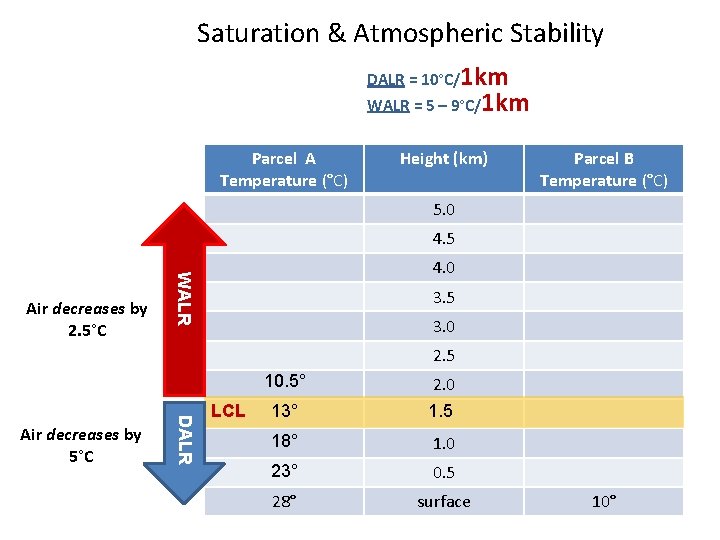
Saturation & Atmospheric Stability DALR = 10°C/1 km WALR = 5 – 9°C/1 km Parcel A Temperature (°C) Height (km) Parcel B Temperature (°C) 5. 0 4. 5 WALR Air decreases by 2. 5°C 4. 0 3. 5 3. 0 2. 5 10. 5° DALR Air decreases by 5°C LCL 13° 2. 0 1. 5 18° 1. 0 23° 0. 5 28° surface 10°
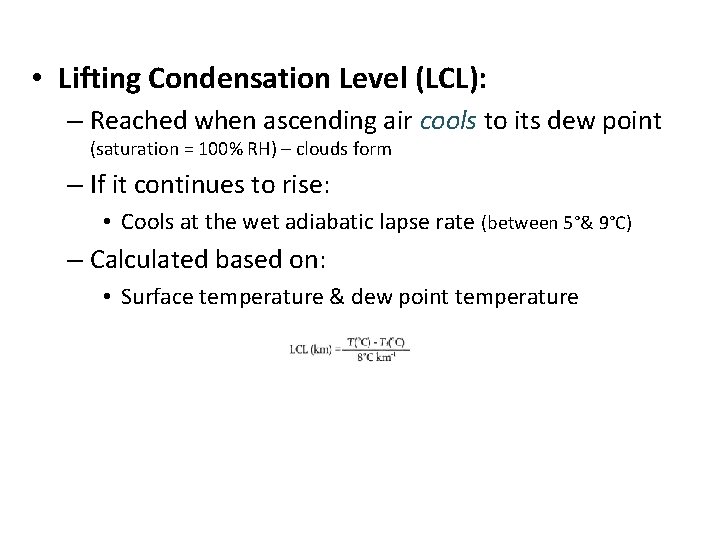
• Lifting Condensation Level (LCL): – Reached when ascending air cools to its dew point (saturation = 100% RH) – clouds form – If it continues to rise: • Cools at the wet adiabatic lapse rate (between 5°& 9°C) – Calculated based on: • Surface temperature & dew point temperature

Part II
Review • What is adiabatic cooling? – Wet versus dry – Thinking about atmospheric saturation, how does this influence cloud formation (hint: think about dew point temperature, etc. ) • What is environmental lapse rate?
• Atmospheric lifting forces: 1. Surface heating (air expansion, less dense, rise, etc. . ) 2. Two surface air masses colliding (convergence) 3. Contact of dissimilar air masses along warm & cold fronts (convergence) 4. Topographic barriers (e. g. orographic lift) 5. Upper air divergence • Rising air doesn’t mix substantially with the surrounding atmosphere. Once the initial lifting force stops, the continued rising of an air parcel depends on atmospheric stability (the state of the atmosphere surrounding the parcel).
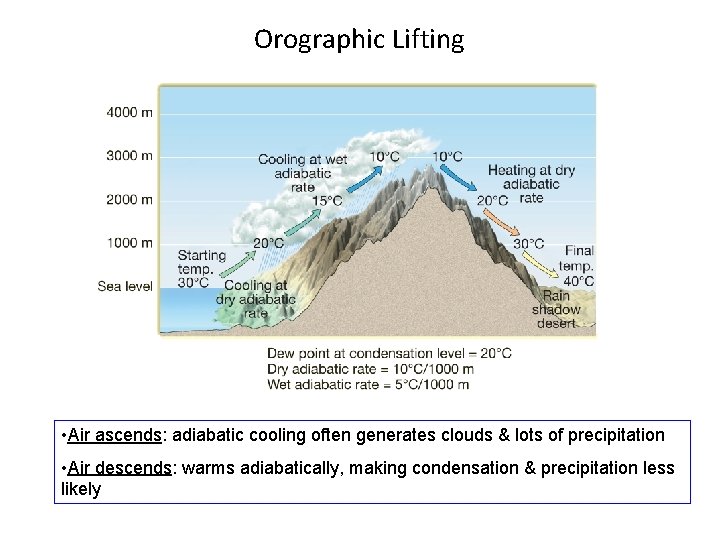
Orographic Lifting • Air ascends: adiabatic cooling often generates clouds & lots of precipitation • Air descends: warms adiabatically, making condensation & precipitation less likely
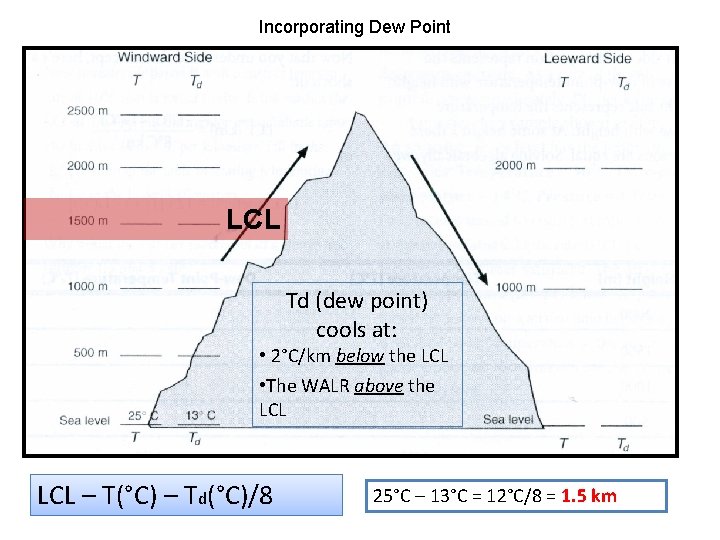
Incorporating Dew Point LCL Td (dew point) cools at: • 2°C/km below the LCL • The WALR above the LCL – T(°C) – Td(°C)/8 25°C – 13°C = 12°C/8 = 1. 5 km
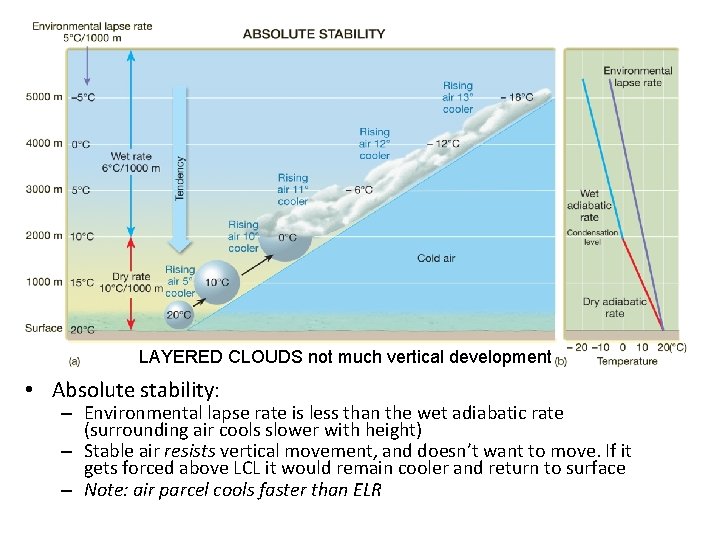
LAYERED CLOUDS not much vertical development • Absolute stability: – Environmental lapse rate is less than the wet adiabatic rate (surrounding air cools slower with height) – Stable air resists vertical movement, and doesn’t want to move. If it gets forced above LCL it would remain cooler and return to surface – Note: air parcel cools faster than ELR
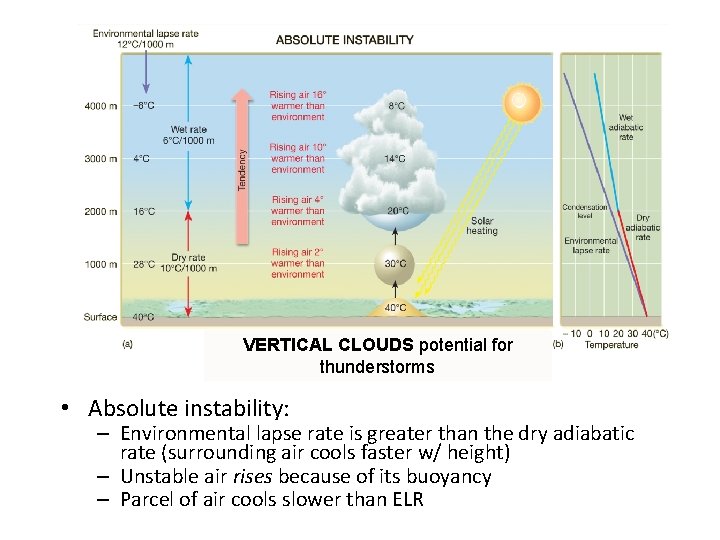
VERTICAL CLOUDS potential for thunderstorms • Absolute instability: – Environmental lapse rate is greater than the dry adiabatic rate (surrounding air cools faster w/ height) – Unstable air rises because of its buoyancy – Parcel of air cools slower than ELR
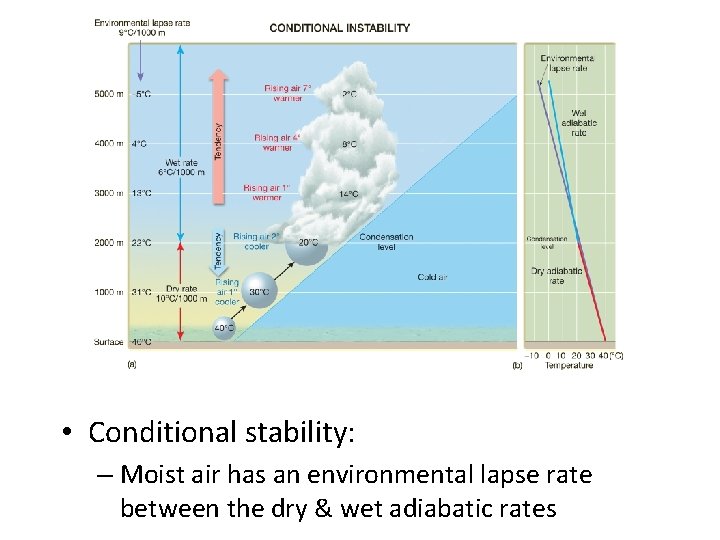
• Conditional stability: – Moist air has an environmental lapse rate between the dry & wet adiabatic rates
- Slides: 18