
LAB 6 1016 Stability Lapse Rate The rate

LAB 6 10/16
Stability – Lapse Rate • The rate at which a parcel cools as it rises. • A dry* parcel cools at 10 degrees Celsius per kilometer***. • A moist** parcel cools at 6 degrees Celsius per kilometer. • Lapse Rate = (Temp @ Bottom – Temp @ Top) / Depth • Example: The surface temperature is measured at 280 K and the 850 mb temperature is measured at 270 K. What is the lapse rate of this layer? Assume the 850 mb surface is around 1500 m. Lapse Rate = (280 K – 270 K) / 1. 5 km = 6. 7 degrees C / km * Dry = unsaturated ** Moist = saturated *** 1 km = 1000 m
Stability - Types • UNSTABLE: • Parcel’s lapse rate is less than environmental lapse rate. • Positively buoyant – if nudged upward, parcel will be less dense than its surroundings and will continue to rise. • STABLE: • Parcel’s lapse rate is greater than environmental lapse rate. • Negatively buoyant – if nudged upward, parcel will be more dense than its surroundings and will sink back down.
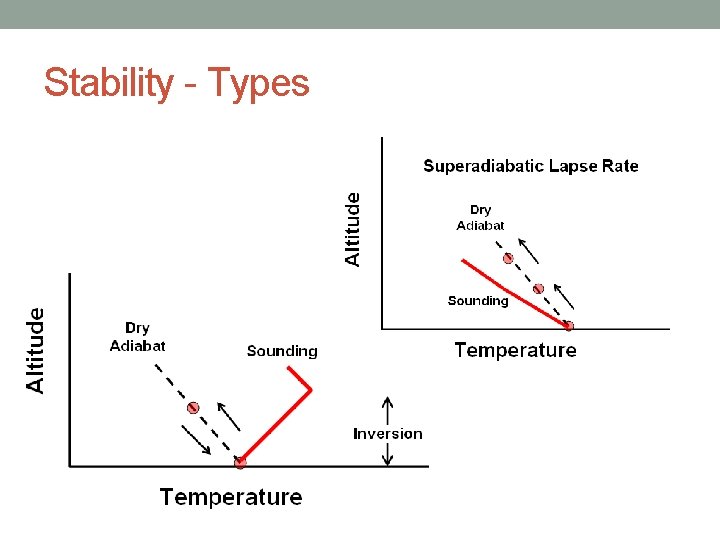
Stability - Types
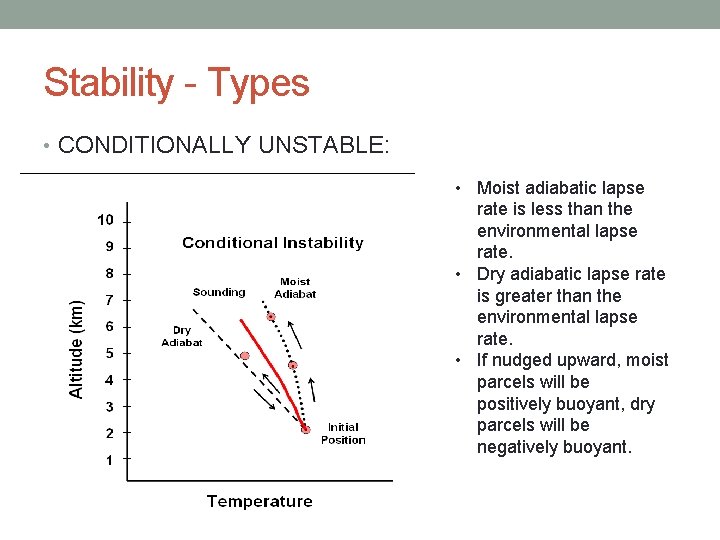
Stability - Types • CONDITIONALLY UNSTABLE: • Moist adiabatic lapse rate is less than the environmental lapse rate. • Dry adiabatic lapse rate is greater than the environmental lapse rate. • If nudged upward, moist parcels will be positively buoyant, dry parcels will be negatively buoyant.
Lifting Condensation Level • The height at which cloud bases form. • Dew point remains constant as an unsaturated parcel rises, how does the temperature change? • Cloud forms when temperature cools to the dew point. • As a saturated parcel rises, both temperature and dew point decrease (they remain equal to each other)
Lifting Condensation Level - Example • The surface temperature is 24 degrees Celsius with a dew point of 14 degrees Celsius. At what height will a cloud form if uneven heating causes parcels to become positively buoyant at the ground? • How many degrees does the parcel have to cool before reaching the dew point? • 10 degrees Celsius. • What is the parcel’s lapse rate? Is it dry or moist? • Dry adiabatic lapse rate is 10 degrees Celsius per km. • So, what is the final answer? • Clouds will form at 1 km above the surface!
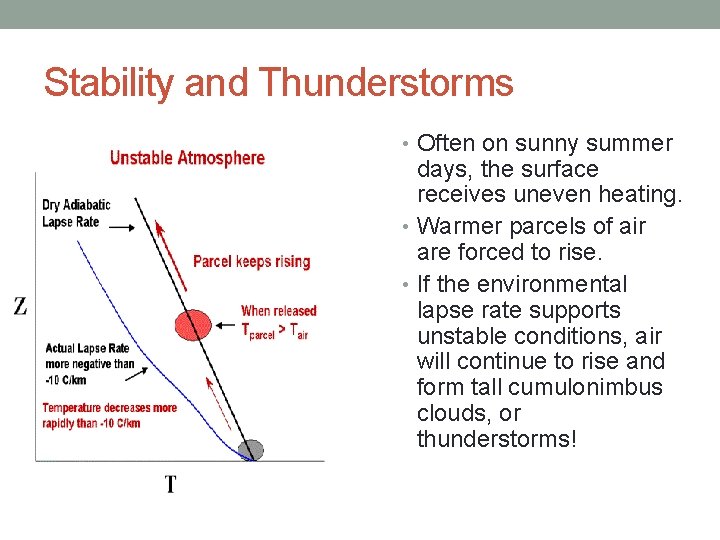
Stability and Thunderstorms • Often on sunny summer days, the surface receives uneven heating. • Warmer parcels of air are forced to rise. • If the environmental lapse rate supports unstable conditions, air will continue to rise and form tall cumulonimbus clouds, or thunderstorms!
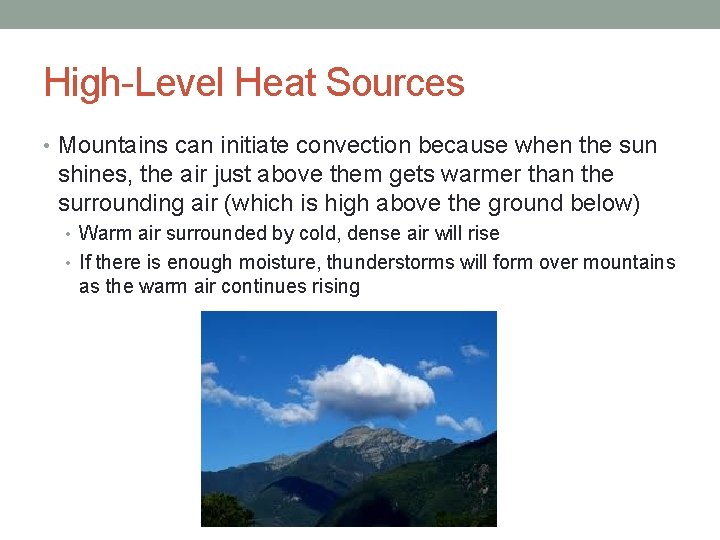
High-Level Heat Sources • Mountains can initiate convection because when the sun shines, the air just above them gets warmer than the surrounding air (which is high above the ground below) • Warm air surrounded by cold, dense air will rise • If there is enough moisture, thunderstorms will form over mountains as the warm air continues rising

Lab Assignment • 8. 1 (a, b, c) • 8. 2 (a, b, c, d) • 8. 7 (a, b) • 8. 9 (a) • 8. 11 (a, b) • 9. 2 • 9. 6 (a, b) • 9. 14 • Paul will be back for his office hours Thursday from 6 - 7 pm, pay him a visit if you need help!
- Slides: 10