
Lab 5 Process Control Operating System Lab NCHU
Lab 5 Process Control Operating System Lab NCHU System & Network Lab
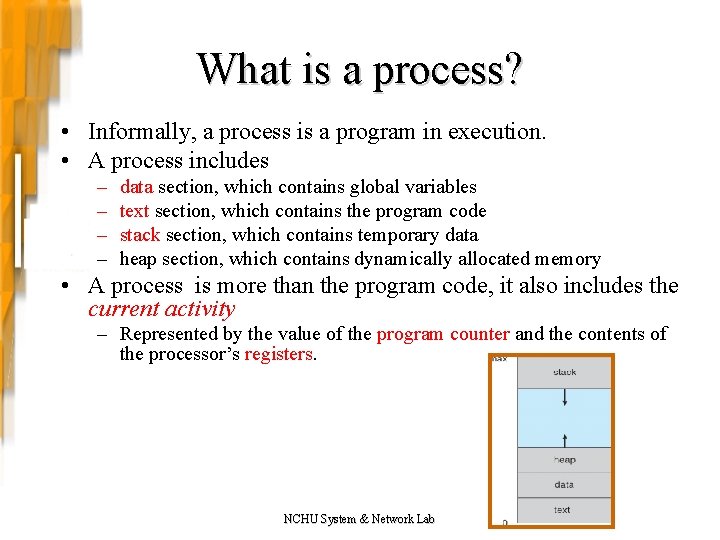
What is a process? • Informally, a process is a program in execution. • A process includes – – data section, which contains global variables text section, which contains the program code stack section, which contains temporary data heap section, which contains dynamically allocated memory • A process is more than the program code, it also includes the current activity – Represented by the value of the program counter and the contents of the processor’s registers. NCHU System & Network Lab
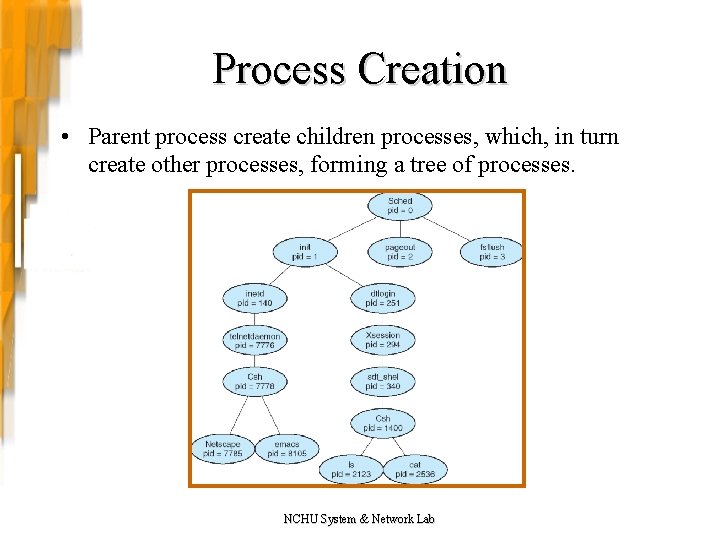
Process Creation • Parent process create children processes, which, in turn create other processes, forming a tree of processes. NCHU System & Network Lab
Process Creation (cont. ) • Resource sharing – Parent and children share all resources – Children share subset of parent’s resources – Parent and child share no resources • Execution – Parent and children execute concurrently – Parent waits until children terminate • Address space – Child duplicate of parent – Child has a program loaded into it NCHU System & Network Lab

Process Identification • UNIX identifies processes by a unique integral value called the process ID. • Each process also has a parent process ID, which is initially the process ID of the process that created it. NCHU System & Network Lab
The fork() Function • UNIX examples – fork() system call creates new process • The fork() copies the parent's memory image so that the new process receives a copy of the address space of the parent. • Both processes continue at the instruction after the fork statement (executing in their respective memory images). NCHU System & Network Lab
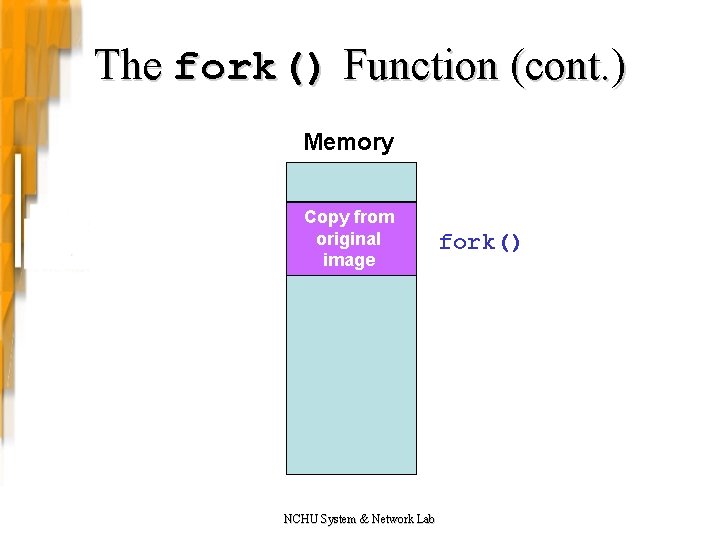
The fork() Function (cont. ) Memory Copy from Original original image New image NCHU System & Network Lab fork()
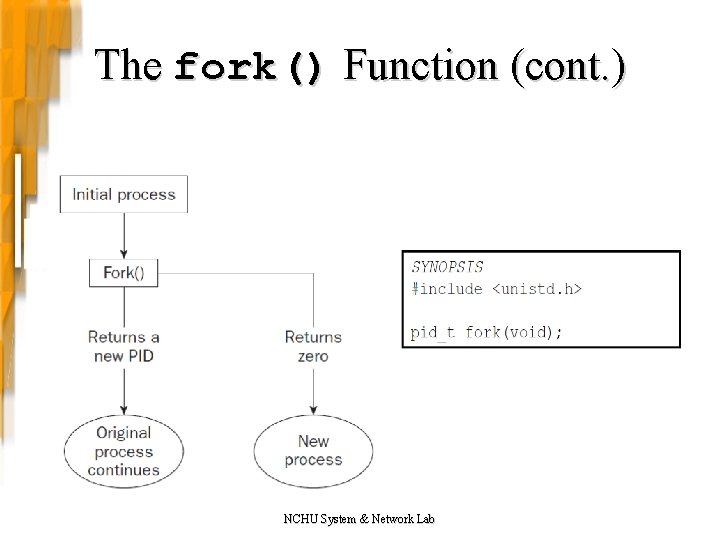
The fork() Function (cont. ) NCHU System & Network Lab
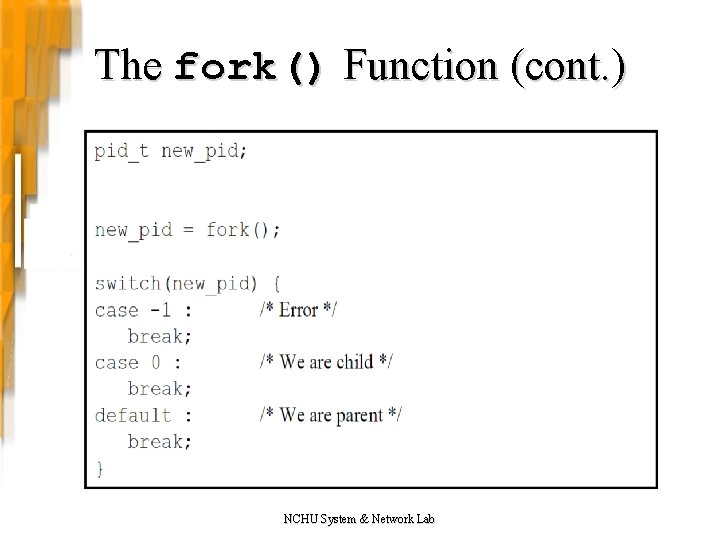
The fork() Function (cont. ) NCHU System & Network Lab
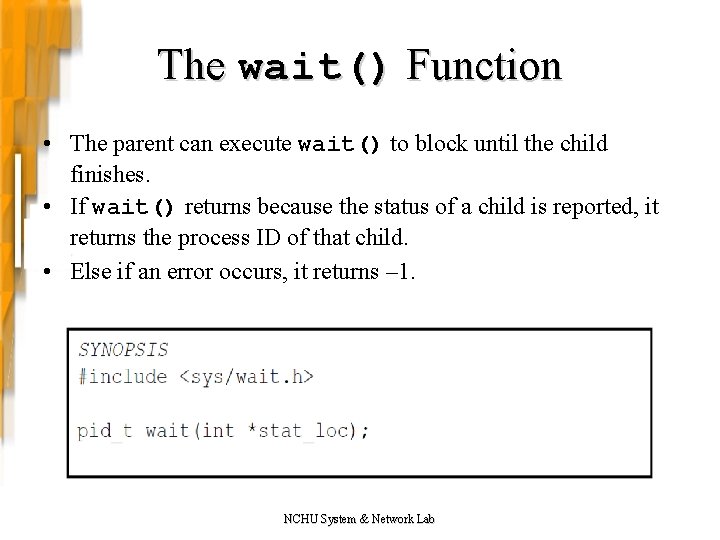
The wait() Function • The parent can execute wait() to block until the child finishes. • If wait() returns because the status of a child is reported, it returns the process ID of that child. • Else if an error occurs, it returns – 1. NCHU System & Network Lab
The exec() Family • The fork() function creates a copy of the calling process, but many applications require the child process to execute code that is different from that of the parent. • The exec() family provides a facility for overlaying the process image of the calling process with a new image. • Use the fork()–exec() combination for the child to execute the new program while the parent continues to execute the original code. NCHU System & Network Lab
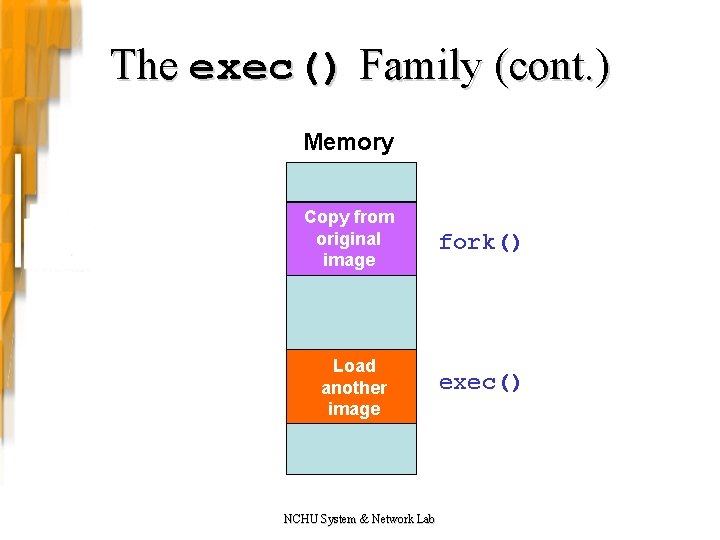
The exec() Family (cont. ) Memory Copy from Original original image New image Load another image NCHU System & Network Lab fork() exec()
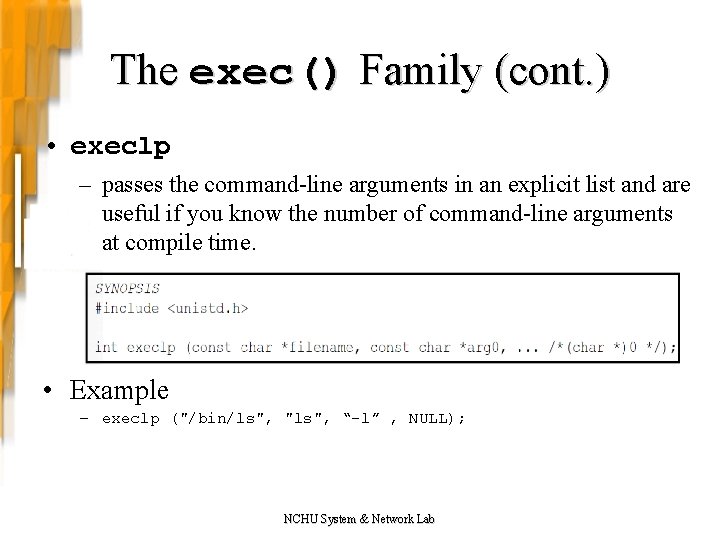
The exec() Family (cont. ) • execlp – passes the command-line arguments in an explicit list and are useful if you know the number of command-line arguments at compile time. • Example – execlp ("/bin/ls", "ls", “-l” , NULL); NCHU System & Network Lab
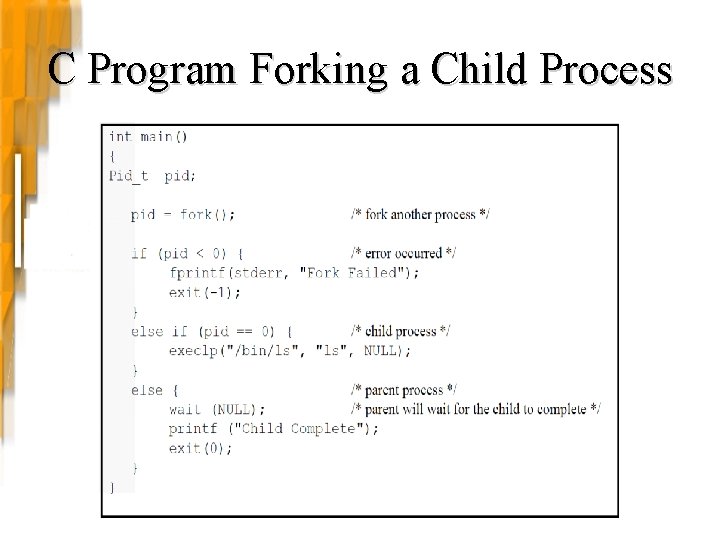
C Program Forking a Child Process
Lab I • Create a child process – Increases the value of a global variable – Declare a local variable and increase its value • Note that, both the global and local variables must be initialized and have the same values. • Finally, both of the processes print their results of global and local variables and also show their process id and parent’s id. NCHU System & Network Lab
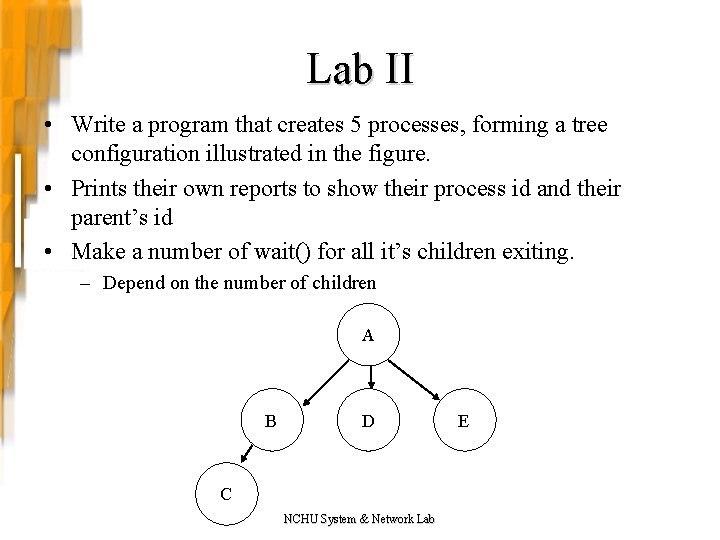
Lab II • Write a program that creates 5 processes, forming a tree configuration illustrated in the figure. • Prints their own reports to show their process id and their parent’s id • Make a number of wait() for all it’s children exiting. – Depend on the number of children A B D C NCHU System & Network Lab E
References • Avi Silberschatz, Peter Baer Galvin and Greg Gagne, “Operating System Concepts, ” John Wiley & Sons, 6 th Edition, 2001 • “Unix Systems Programming: Communication, Concurrency, and Threads” by Kay A. Robbins, Steven Robbins • Neil Matthew and Richard Stones, “Beginning Linux Programming, ” Wiley publishing, 3 rd Edition, 2004 • W. Richard Stevens, “Advanced Programming in the UNIX Environment, ” Addison-Wesley, 1992 NCHU System & Network Lab
- Slides: 17