
Lab 35 Star Clusters Objective for Day 1
Lab 35: Star Clusters

Objective for Day 1 Developing and interpreting a cluster diagram for M 45 1. Plot the B & V magnitudes of stars using photometer data; 2. Analyze the H-R Diagram and look for different star types (Main Sequence, giants, white dwarfs). 3. Consider data that may be unreliable because of signal to noise issues.
Some definitions Apparent Magnitude m (i. e. brightness) how bright the star looks in the sky. Absolute Magnitude M (i. e. luminosity) how bright the star would be if it were 10 parsecs away (a parsec is 3. 26 light-years). Spectral Class A measure of temperature, this system of letters (OBAFGKM) indicates a star’s color. (This was all covered in Lab 13, remember? )
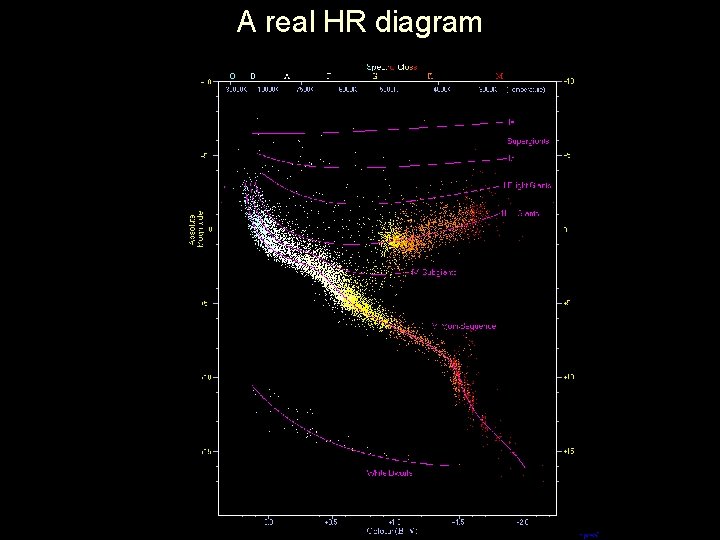
The Hertzsprung-Russell Diagram A plot of absolute magnitude (or luminosity) versus temperature (or spectral class) for stars. Main sequence: About 90% of all stars. Other categories: white dwarfs, red giants, and supergiants. (This was all covered in Lab 13, remember? )
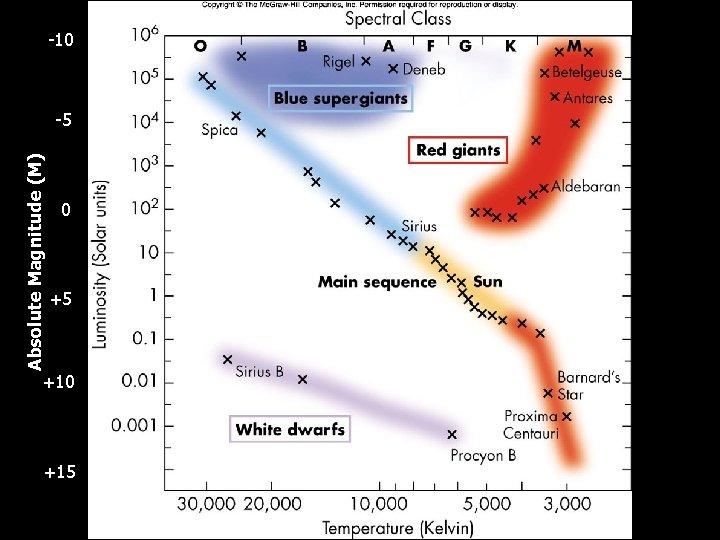
-10 Absolute Magnitude (M) -5 0 +5 +10 +15 Fig. 12. 16
A real HR diagram
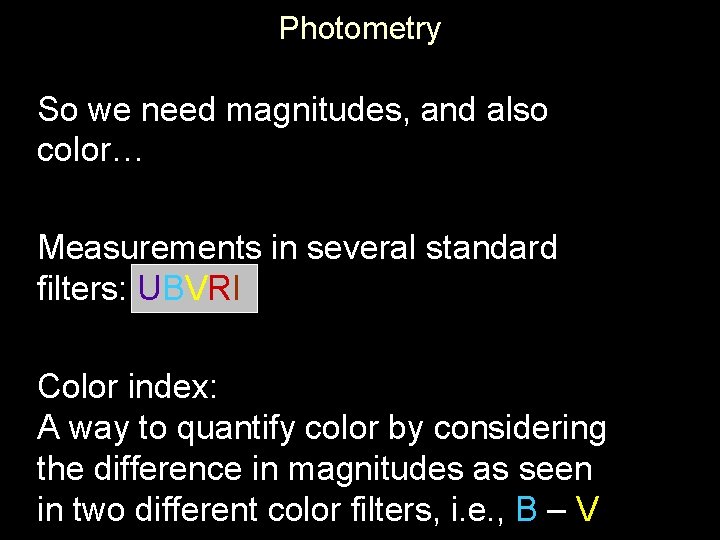
Photometry So we need magnitudes, and also color… Measurements in several standard filters: UBVRI Color index: A way to quantify color by considering the difference in magnitudes as seen in two different color filters, i. e. , B – V
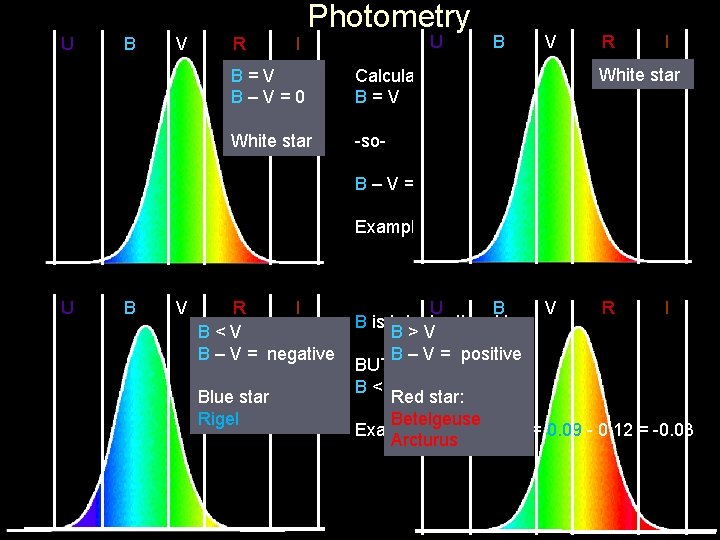
U B V R I Photometry U B B=V B–V=0 Calculating colors: B=V White star -so- V R I White star B–V=0 Example: an A 0 star like Vega U B V R I B<V B – V = negative Blue star Rigel U B V R I B is brighter than V B>V B – V = positive BUT in magnitudes, B<V Red star: Betelgeuse Example: Rigel, B - V = 0. 09 - 0. 12 = -0. 03 Arcturus
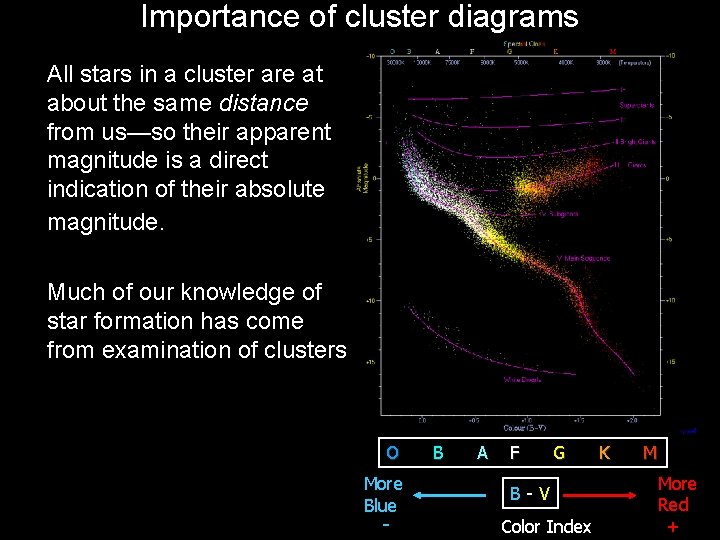
Importance of cluster diagrams All stars in a cluster are at about the same distance from us—so their apparent magnitude is a direct indication of their absolute magnitude. Much of our knowledge of star formation has come from examination of clusters. O More Blue - B A F G B-V Color Index K M More Red +
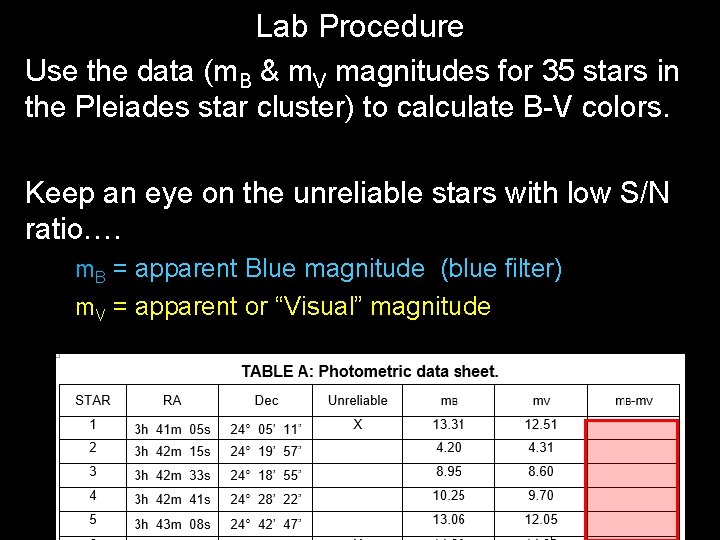
Lab Procedure Use the data (m. B & m. V magnitudes for 35 stars in the Pleiades star cluster) to calculate B-V colors. Keep an eye on the unreliable stars with low S/N ratio…. m. B = apparent Blue magnitude (blue filter) m. V = apparent or “Visual” magnitude
Lab 35: Star Clusters: Day 2 1. Plot an H-R diagram of apparent magnitude (V) vs color index (B-V)—Done!; 2. Determine (m – M) using the reference H-R diagram transparency (M vs B-V); 3. Calculate the distance d to the cluster.

Distance ladder Parallax
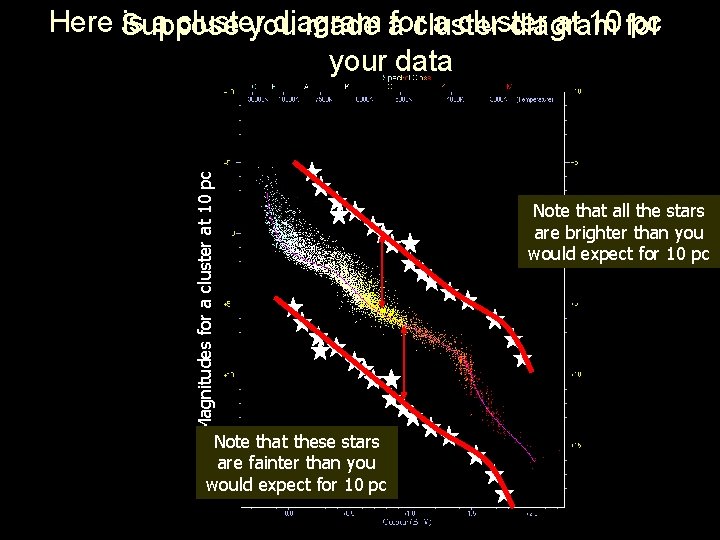
Magnitudes for a cluster at 10 pc Here Suppose is a cluster diagram a cluster at 10 for pc you made aforcluster diagram your data Note that these stars are fainter than you would expect for 10 pc Note that all the stars are brighter than you would expect for 10 pc
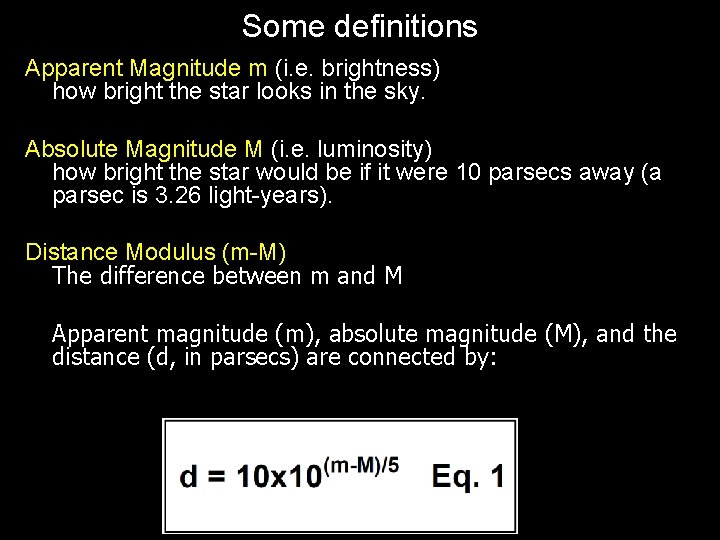
Some definitions Apparent Magnitude m (i. e. brightness) how bright the star looks in the sky. Absolute Magnitude M (i. e. luminosity) how bright the star would be if it were 10 parsecs away (a parsec is 3. 26 light-years). Distance Modulus (m-M) The difference between m and M Apparent magnitude (m), absolute magnitude (M), and the distance (d, in parsecs) are connected by:
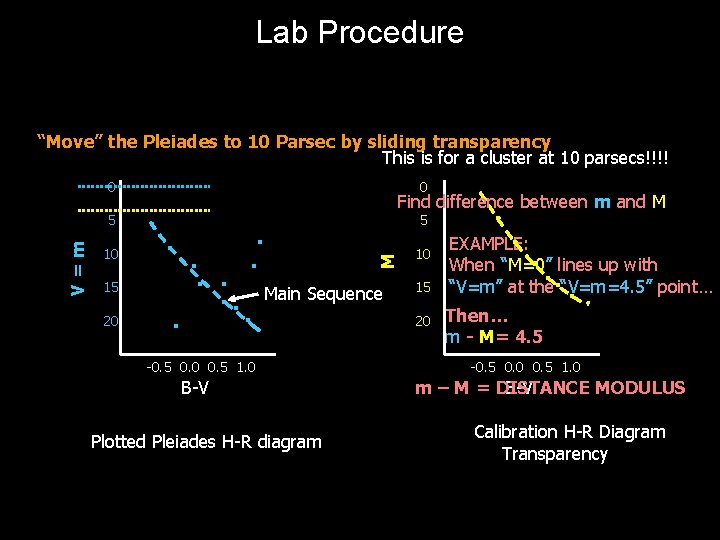
Lab Procedure “Move” the Pleiades to 10 Parsec by sliding transparency This is for a cluster at 10 parsecs!!!! 0 0 Find difference between m and M 5 10 M V=m 5 15 Main Sequence 20 10 15 20 -0. 5 0. 0 0. 5 1. 0 B-V Plotted Pleiades H-R diagram EXAMPLE: When “M=0” lines up with “V=m” at the “V=m=4. 5” point… Then… m - M= 4. 5 -0. 5 0. 0 0. 5 1. 0 m – M = DISTANCE B-V MODULUS Calibration H-R Diagram Transparency
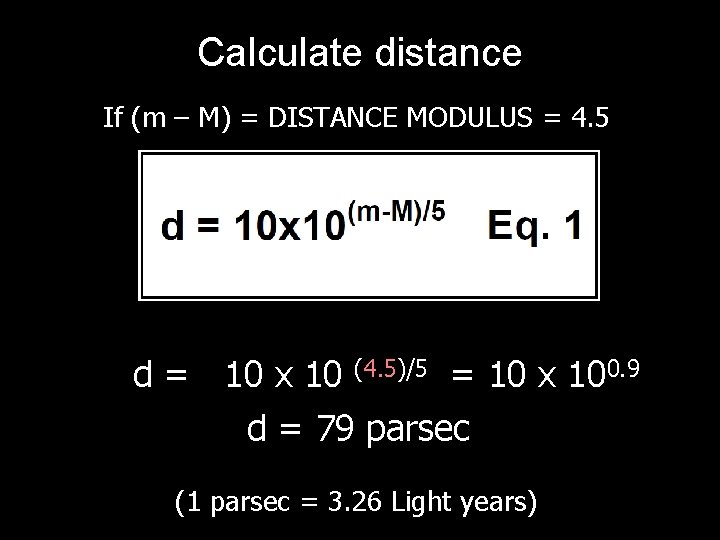
Calculate distance If (m – M) = DISTANCE MODULUS = 4. 5 d = 10 x 10 (4. 5)/5 = 10 x 100. 9 d = 79 parsec (1 parsec = 3. 26 Light years)
- Slides: 16