
Lab 3 Liver Function profile LFT T A
Lab (3): Liver Function profile (LFT) T. A Nouf Alshareef KAU-Faculty of Science- Biochemistry department Clinical biochemistry lab (Bioc 416) 2012 nf. shareef@hotmil. com
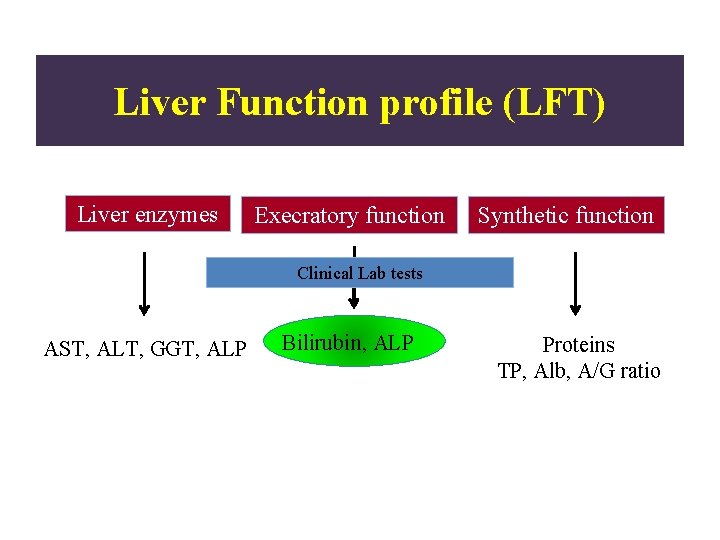
Liver Function profile (LFT) Liver enzymes Execratory function Synthetic function Clinical Lab tests AST, ALT, GGT, ALP Bilirubin, ALP Proteins TP, Alb, A/G ratio
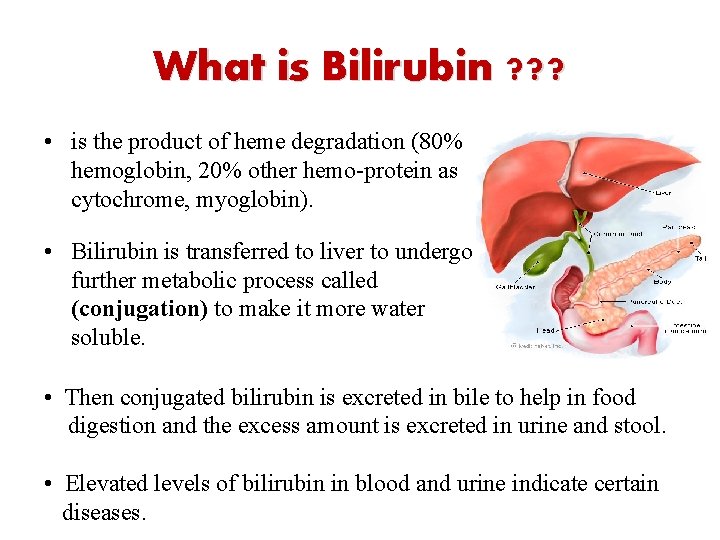
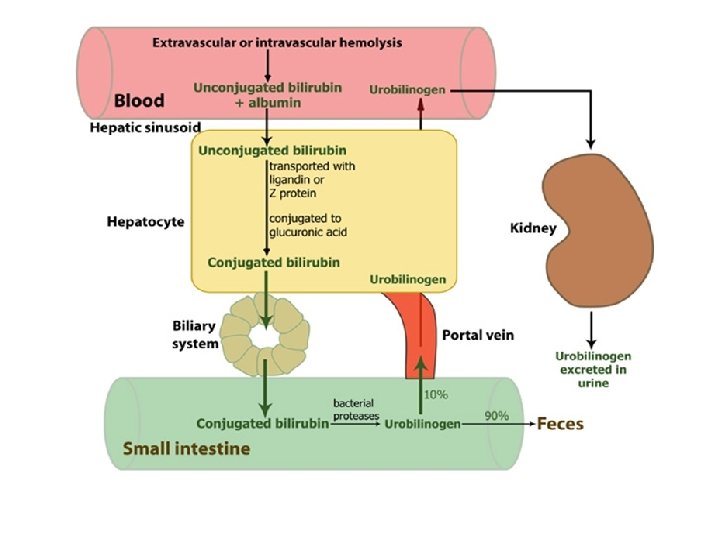
What is Bilirubin ? ? ? • is the product of heme degradation (80% hemoglobin, 20% other hemo-protein as cytochrome, myoglobin). • Bilirubin is transferred to liver to undergo further metabolic process called (conjugation) to make it more water soluble. • Then conjugated bilirubin is excreted in bile to help in food digestion and the excess amount is excreted in urine and stool. • Elevated levels of bilirubin in blood and urine indicate certain diseases.
Structure • Bilirubin consists of four open chain pyrrols, unlike heme which consists of four rings pyrrols called (porphyrin).
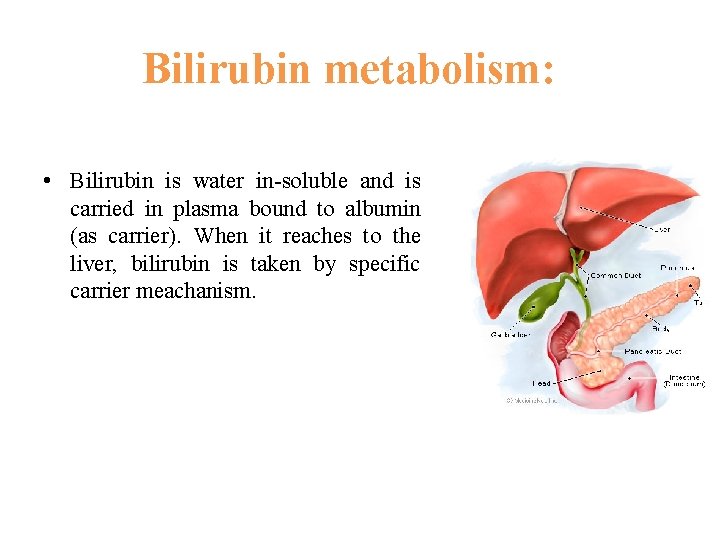
Bilirubin metabolism: • Bilirubin is water in-soluble and is carried in plasma bound to albumin (as carrier). When it reaches to the liver, bilirubin is taken by specific carrier meachanism.
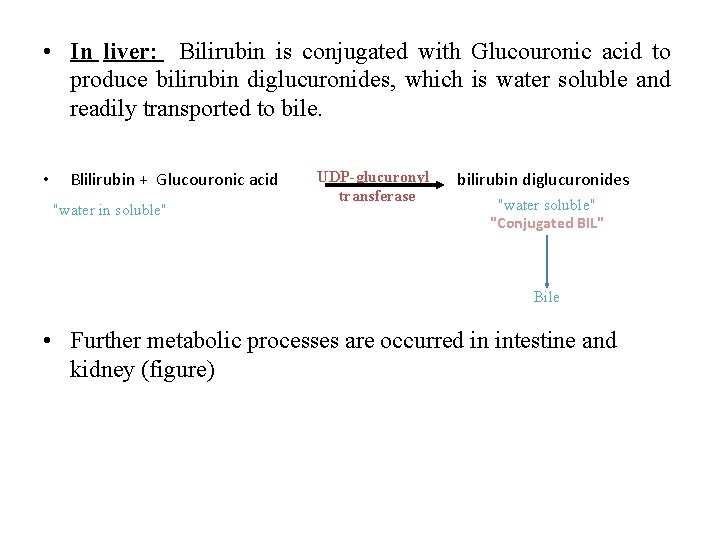
• In liver: Bilirubin is conjugated with Glucouronic acid to produce bilirubin diglucuronides, which is water soluble and readily transported to bile. • Blilirubin + Glucouronic acid "water in soluble" UDP-glucuronyl transferase bilirubin diglucuronides "water soluble" "Conjugated BIL" Bile • Further metabolic processes are occurred in intestine and kidney (figure)
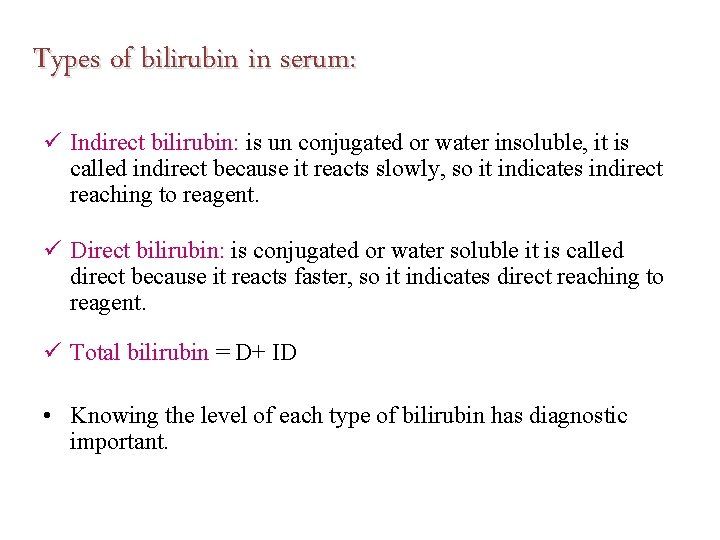
Types of bilirubin in serum: Indirect bilirubin: is un conjugated or water insoluble, it is called indirect because it reacts slowly, so it indicates indirect reaching to reagent. Direct bilirubin: is conjugated or water soluble it is called direct because it reacts faster, so it indicates direct reaching to reagent. Total bilirubin = D+ ID • Knowing the level of each type of bilirubin has diagnostic important.
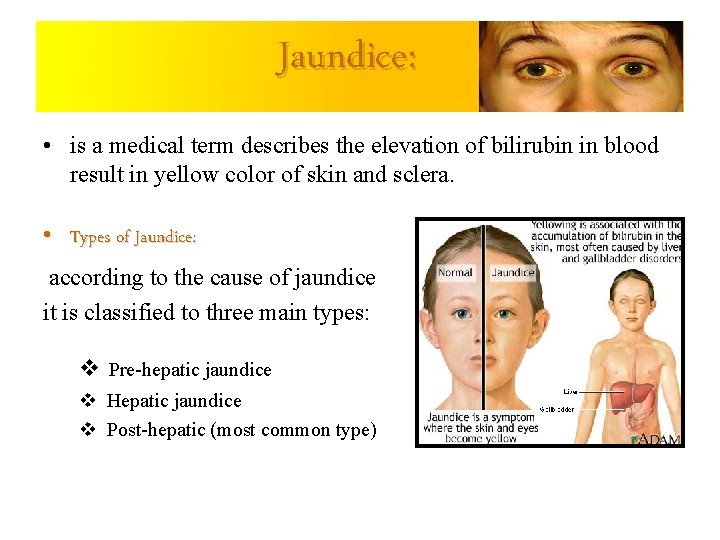
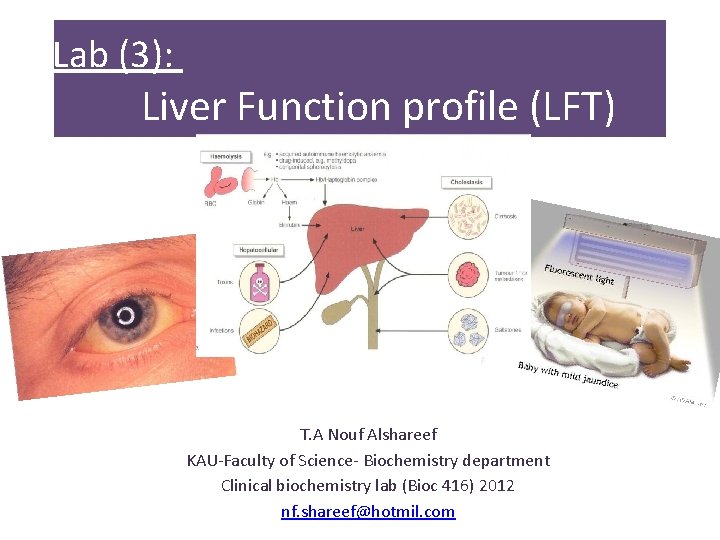
Jaundice: • is a medical term describes the elevation of bilirubin in blood result in yellow color of skin and sclera. • Types of Jaundice: according to the cause of jaundice it is classified to three main types: v Pre-hepatic jaundice v Hepatic jaundice v Post-hepatic (most common type)
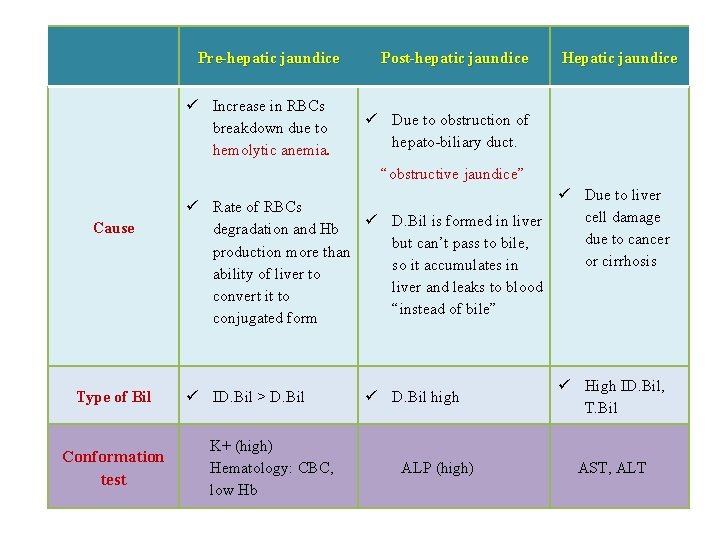
Pre-hepatic jaundice Increase in RBCs breakdown due to hemolytic anemia. Post-hepatic jaundice Hepatic jaundice Due to obstruction of hepato-biliary duct. “obstructive jaundice” Cause Type of Bil Conformation test Due to liver Rate of RBCs cell damage D. Bil is formed in liver degradation and Hb due to cancer but can’t pass to bile, production more than or cirrhosis so it accumulates in ability of liver to liver and leaks to blood convert it to “instead of bile” conjugated form ID. Bil > D. Bil K+ (high) Hematology: CBC, low Hb D. Bil high ALP (high) High ID. Bil, T. Bil AST, ALT
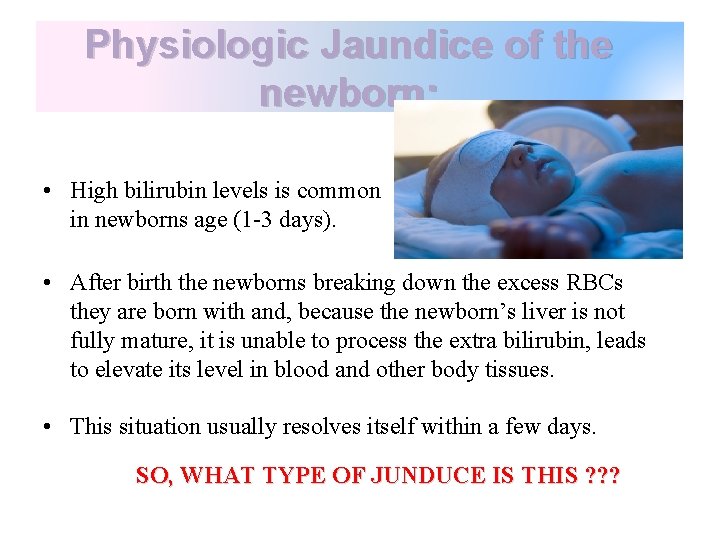
Physiologic Jaundice of the newborn: • High bilirubin levels is common in newborns age (1 -3 days). • After birth the newborns breaking down the excess RBCs they are born with and, because the newborn’s liver is not fully mature, it is unable to process the extra bilirubin, leads to elevate its level in blood and other body tissues. • This situation usually resolves itself within a few days. SO, WHAT TYPE OF JUNDUCE IS THIS ? ? ?
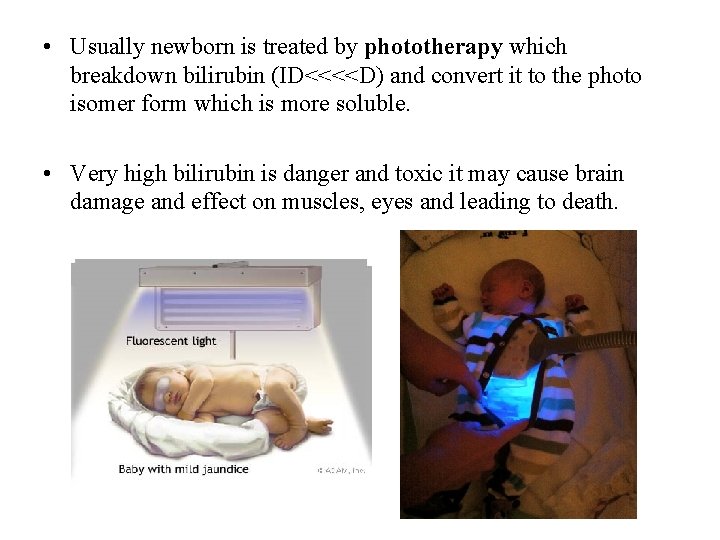
• Usually newborn is treated by phototherapy which breakdown bilirubin (ID<<<<D) and convert it to the photo isomer form which is more soluble. • Very high bilirubin is danger and toxic it may cause brain damage and effect on muscles, eyes and leading to death.
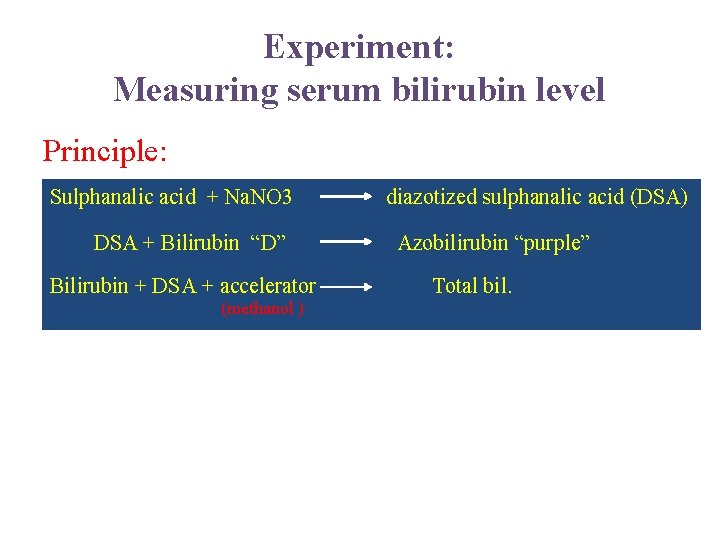
Experiment: Measuring serum bilirubin level Principle: Sulphanalic acid + Na. NO 3 DSA + Bilirubin “D” Bilirubin + DSA + accelerator (methanol ) diazotized sulphanalic acid (DSA) Azobilirubin “purple” Total bil.
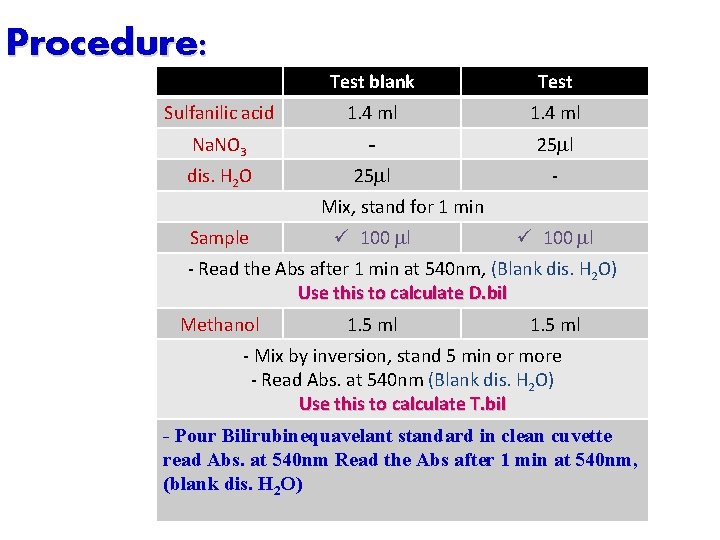
Procedure: Test blank Test Sulfanilic acid 1. 4 ml Na. NO 3 - 25 ml dis. H 2 O 25 ml - Mix, stand for 1 min Sample 100 ml - Read the Abs after 1 min at 540 nm, (Blank dis. H 2 O) Use this to calculate D. bil Methanol 1. 5 ml - Mix by inversion, stand 5 min or more - Read Abs. at 540 nm (Blank dis. H 2 O) Use this to calculate T. bil - Pour Bilirubinequavelant standard in clean cuvette read Abs. at 540 nm Read the Abs after 1 min at 540 nm, (blank dis. H 2 O)
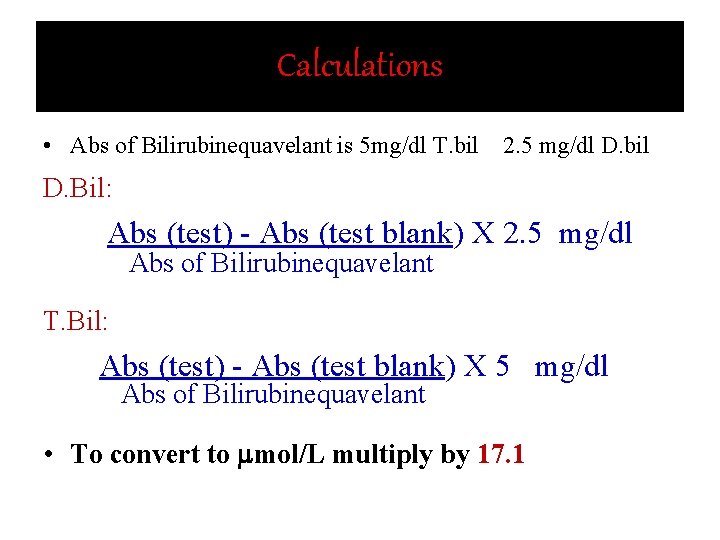
Calculations • Abs of Bilirubinequavelant is 5 mg/dl T. bil 2. 5 mg/dl D. bil D. Bil: Abs (test) - Abs (test blank) X 2. 5 mg/dl Abs of Bilirubinequavelant T. Bil: Abs (test) - Abs (test blank) X 5 mg/dl Abs of Bilirubinequavelant • To convert to mmol/L multiply by 17. 1
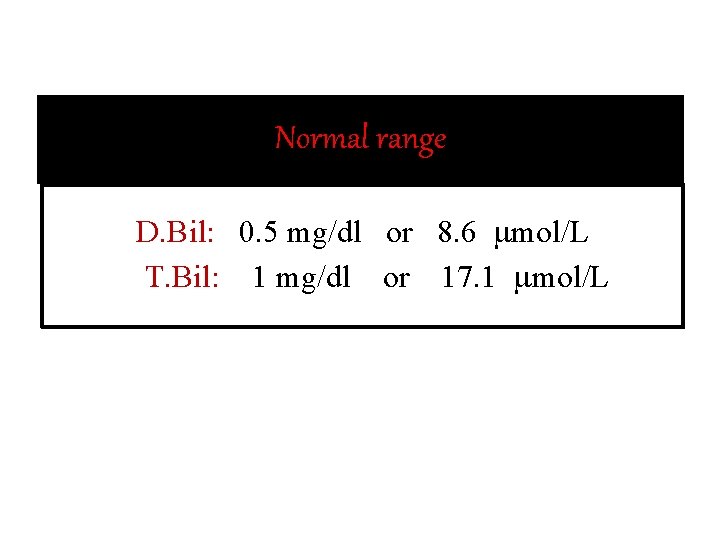
Normal range D. Bil: 0. 5 mg/dl or 8. 6 mmol/L T. Bil: 1 mg/dl or 17. 1 mmol/L
- Slides: 16