
Lab 10 Message Queue and Shared Memory NCHU
Lab 10 Message Queue and Shared Memory NCHU System & Network Lab
Message Queue NCHU System & Network Lab
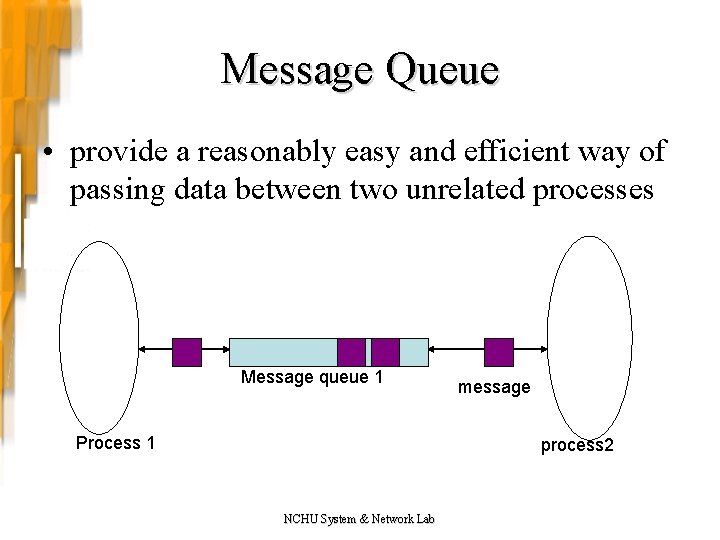
Message Queue • provide a reasonably easy and efficient way of passing data between two unrelated processes Message queue 1 Process 1 message process 2 NCHU System & Network Lab

Create and Access a Message Queue #include <sys/msg. h> int msgget(key_t key, int msgflg); key : names a particular message queue. msgflg: IPC_PRIVATE only used by process itself IPC_CREAT create new message queue, if exist, ignore this flag permission flags 0 0 0 r w x owner permission group permission others permission Return queue identifier on success, -1 on failure NCHU System & Network Lab

Send a Message to a message queue int msgsnd(int msqid, const void *msg_ptr, size_t msg_sz, int msgflg); msqid : message queue identifier msg_ptr : a pointer to the message to be sent. msg_sz: size of the message pointed to by msg_ptr. This size must not include the long int message type msgflg: controls what happens if either the current message queue is full or the systemwide limit on queued messages has been reached IPC_NOWAIT return -1 without sending message If no IPC_NOWAIT, it will be suspended and waiting for space to become available in the queue. Return 0 on success, -1 on error. NCHU System & Network Lab
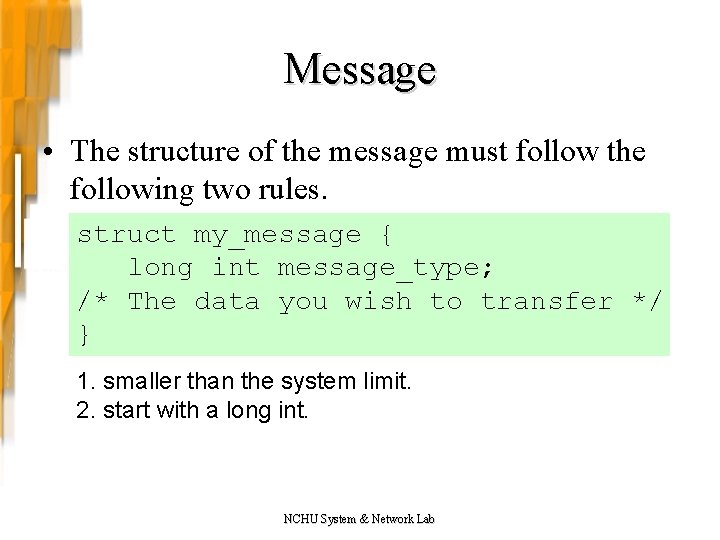
Message • The structure of the message must follow the following two rules. struct my_message { long int message_type; /* The data you wish to transfer */ } 1. smaller than the system limit. 2. start with a long int. NCHU System & Network Lab
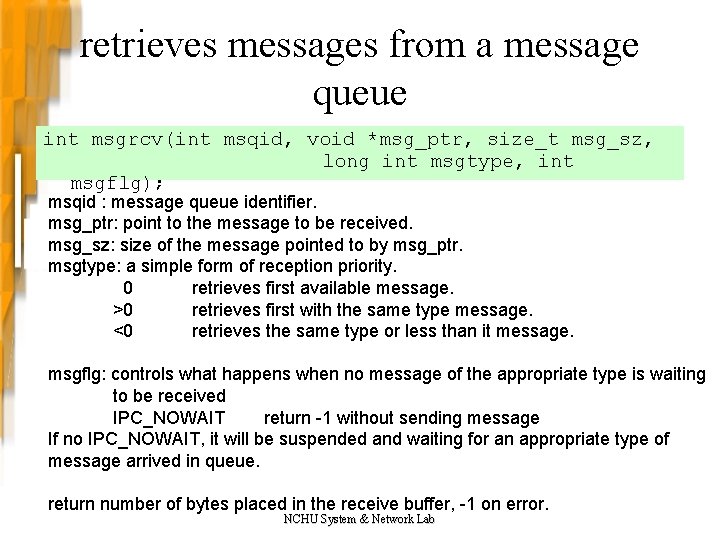
retrieves messages from a message queue int msgrcv(int msqid, void *msg_ptr, size_t msg_sz, long int msgtype, int msgflg); msqid : message queue identifier. msg_ptr: point to the message to be received. msg_sz: size of the message pointed to by msg_ptr. msgtype: a simple form of reception priority. 0 retrieves first available message. >0 retrieves first with the same type message. <0 retrieves the same type or less than it message. msgflg: controls what happens when no message of the appropriate type is waiting to be received IPC_NOWAIT return -1 without sending message If no IPC_NOWAIT, it will be suspended and waiting for an appropriate type of message arrived in queue. return number of bytes placed in the receive buffer, -1 on error. NCHU System & Network Lab
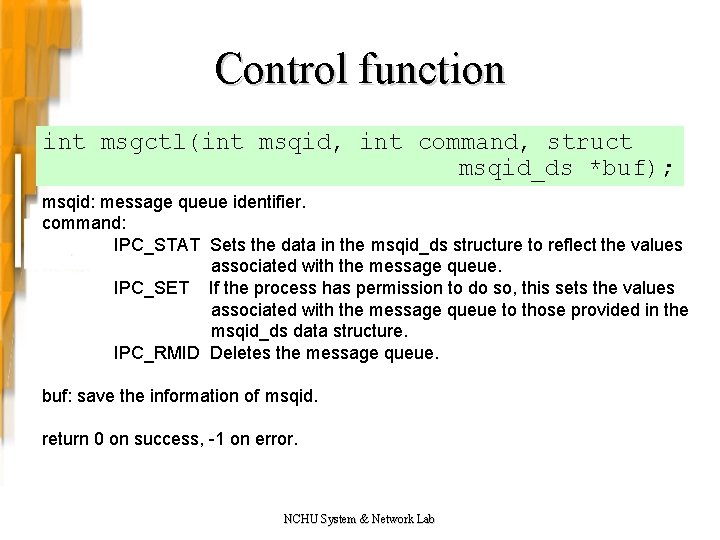
Control function int msgctl(int msqid, int command, struct msqid_ds *buf); msqid: message queue identifier. command: IPC_STAT Sets the data in the msqid_ds structure to reflect the values associated with the message queue. IPC_SET If the process has permission to do so, this sets the values associated with the message queue to those provided in the msqid_ds data structure. IPC_RMID Deletes the message queue. buf: save the information of msqid. return 0 on success, -1 on error. NCHU System & Network Lab
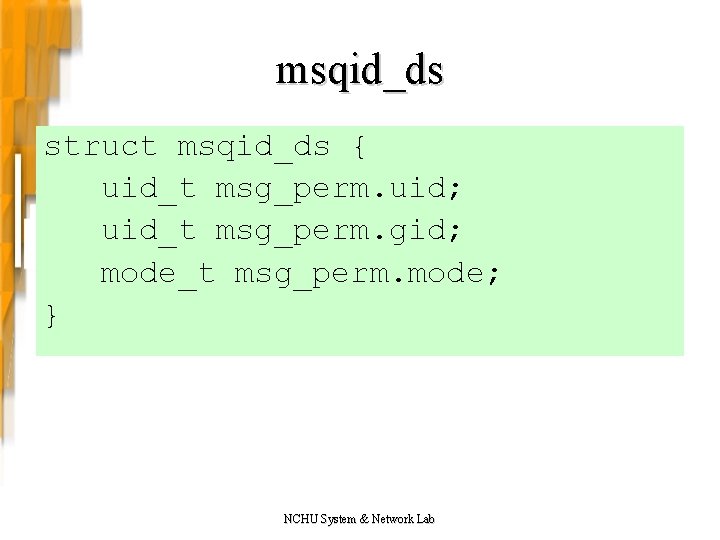
msqid_ds struct msqid_ds { uid_t msg_perm. uid; uid_t msg_perm. gid; mode_t msg_perm. mode; } NCHU System & Network Lab
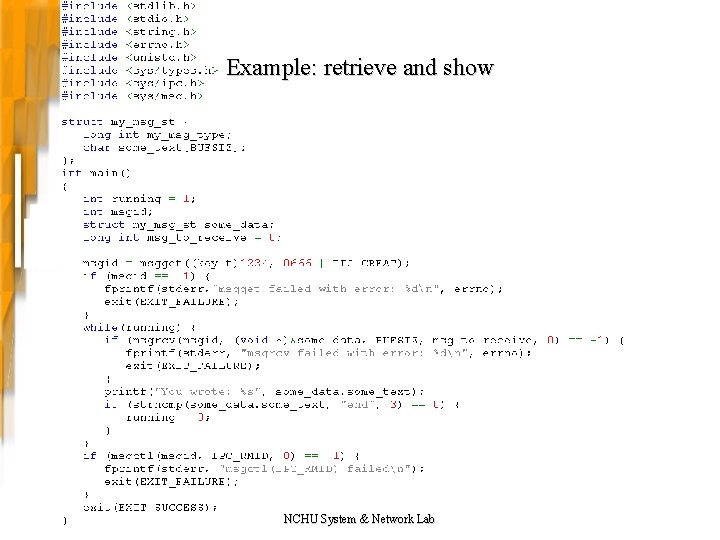
Example: retrieve and show NCHU System & Network Lab
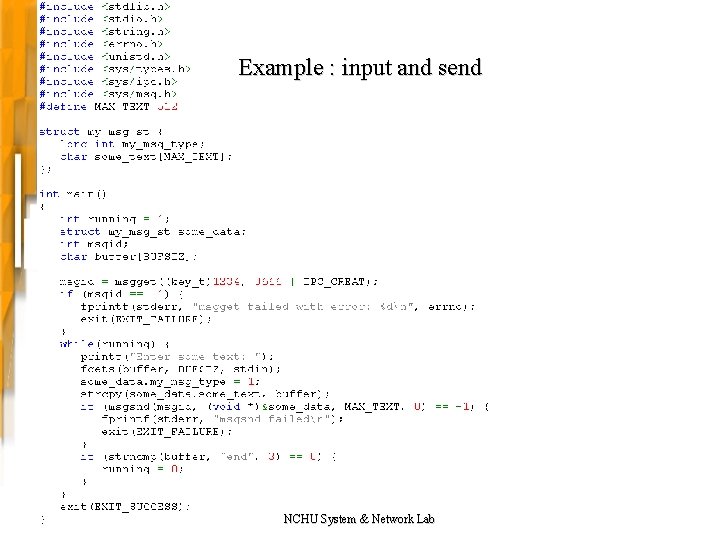
Example : input and send NCHU System & Network Lab
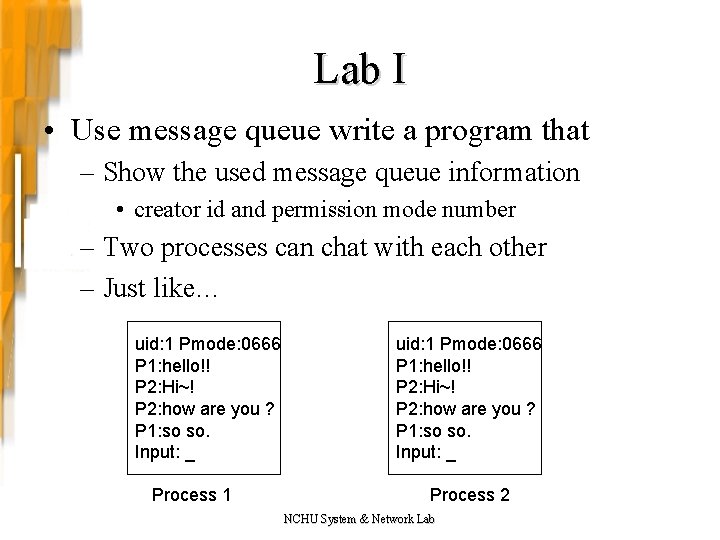
Lab I • Use message queue write a program that – Show the used message queue information • creator id and permission mode number – Two processes can chat with each other – Just like… uid: 1 Pmode: 0666 P 1: hello!! P 2: Hi~! P 2: how are you ? P 1: so so. Input: _ Process 1 uid: 1 Pmode: 0666 P 1: hello!! P 2: Hi~! P 2: how are you ? P 1: so so. Input: _ Process 2 NCHU System & Network Lab
Shared Memory NCHU System & Network Lab
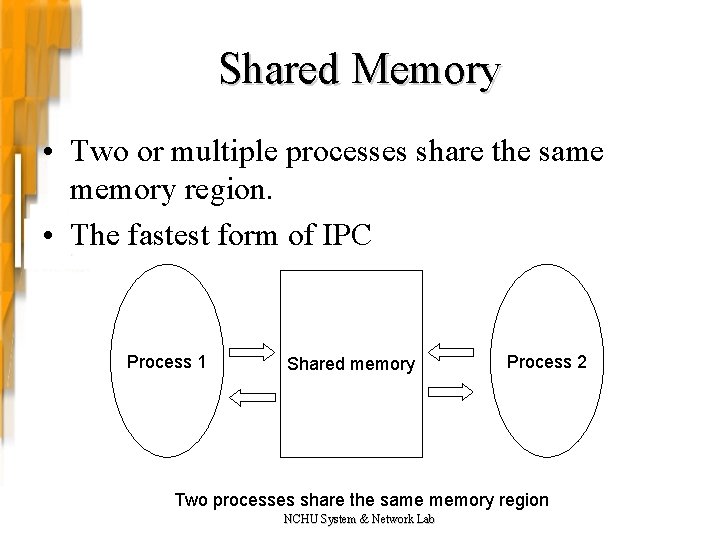
Shared Memory • Two or multiple processes share the same memory region. • The fastest form of IPC Process 1 Shared memory Process 2 Two processes share the same memory region NCHU System & Network Lab
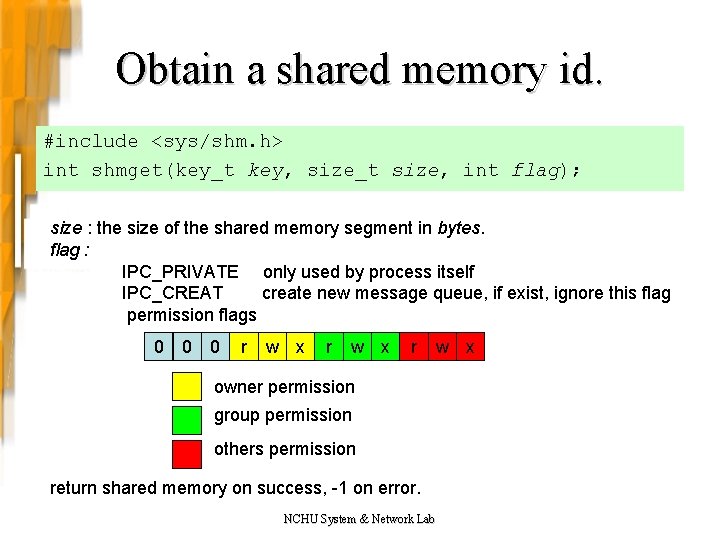
Obtain a shared memory id. #include <sys/shm. h> int shmget(key_t key, size_t size, int flag); size : the size of the shared memory segment in bytes. flag : IPC_PRIVATE only used by process itself IPC_CREAT create new message queue, if exist, ignore this flag permission flags 0 0 0 r w x owner permission group permission others permission return shared memory on success, -1 on error. NCHU System & Network Lab
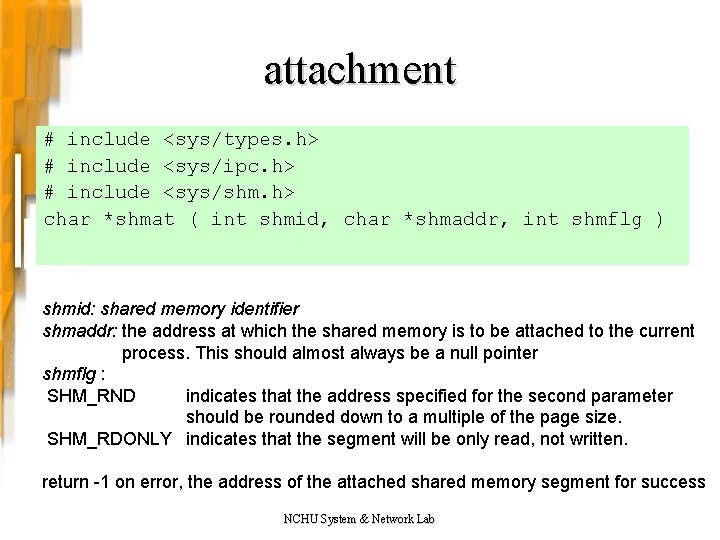
attachment # include <sys/types. h> # include <sys/ipc. h> # include <sys/shm. h> char *shmat ( int shmid, char *shmaddr, int shmflg ) shmid: shared memory identifier shmaddr: the address at which the shared memory is to be attached to the current process. This should almost always be a null pointer shmflg : SHM_RND indicates that the address specified for the second parameter should be rounded down to a multiple of the page size. SHM_RDONLY indicates that the segment will be only read, not written. return -1 on error, the address of the attached shared memory segment for success NCHU System & Network Lab
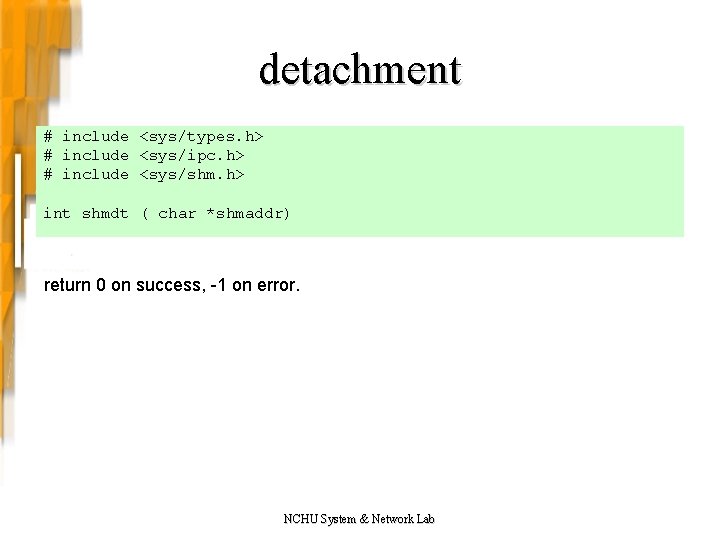
detachment # include <sys/types. h> # include <sys/ipc. h> # include <sys/shm. h> int shmdt ( char *shmaddr) return 0 on success, -1 on error. NCHU System & Network Lab
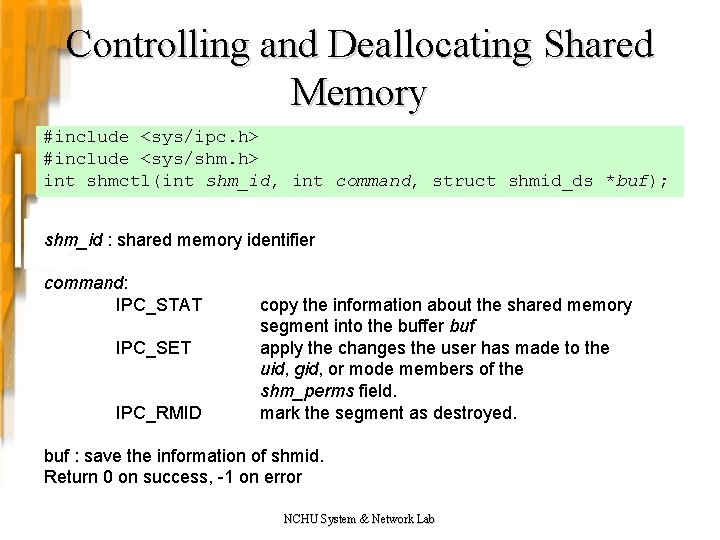
Controlling and Deallocating Shared Memory #include <sys/ipc. h> #include <sys/shm. h> int shmctl(int shm_id, int command, struct shmid_ds *buf); shm_id : shared memory identifier command: IPC_STAT IPC_SET IPC_RMID copy the information about the shared memory segment into the buffer buf apply the changes the user has made to the uid, gid, or mode members of the shm_perms field. mark the segment as destroyed. buf : save the information of shmid. Return 0 on success, -1 on error NCHU System & Network Lab
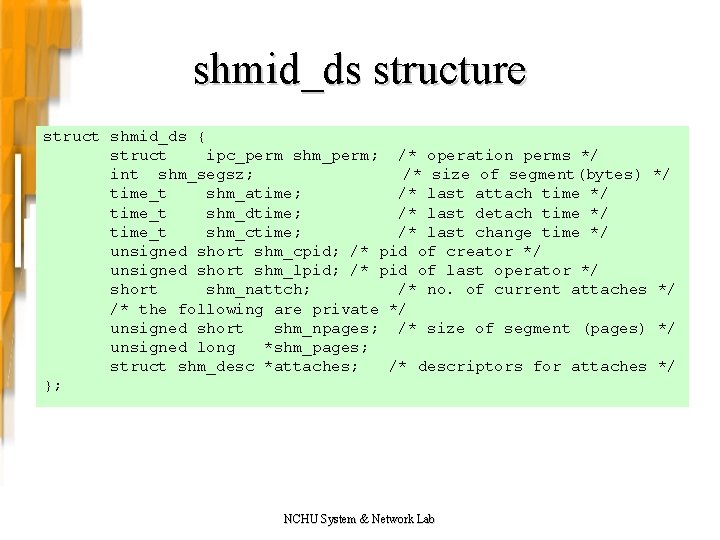
shmid_ds structure struct shmid_ds { struct ipc_perm shm_perm; /* operation perms */ int shm_segsz; /* size of segment(bytes) */ time_t shm_atime; /* last attach time */ time_t shm_dtime; /* last detach time */ time_t shm_ctime; /* last change time */ unsigned short shm_cpid; /* pid of creator */ unsigned short shm_lpid; /* pid of last operator */ short shm_nattch; /* no. of current attaches */ /* the following are private */ unsigned short shm_npages; /* size of segment (pages) */ unsigned long *shm_pages; struct shm_desc *attaches; /* descriptors for attaches */ }; NCHU System & Network Lab
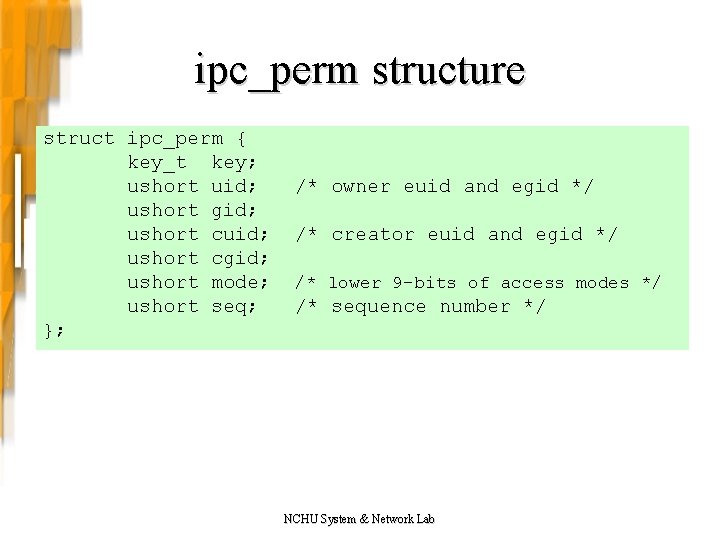
ipc_perm structure struct ipc_perm { key_t key; ushort uid; ushort gid; ushort cuid; ushort cgid; ushort mode; ushort seq; }; /* owner euid and egid */ /* creator euid and egid */ /* lower 9 -bits of access modes */ /* sequence number */ NCHU System & Network Lab

Example input. c NCHU System & Network Lab
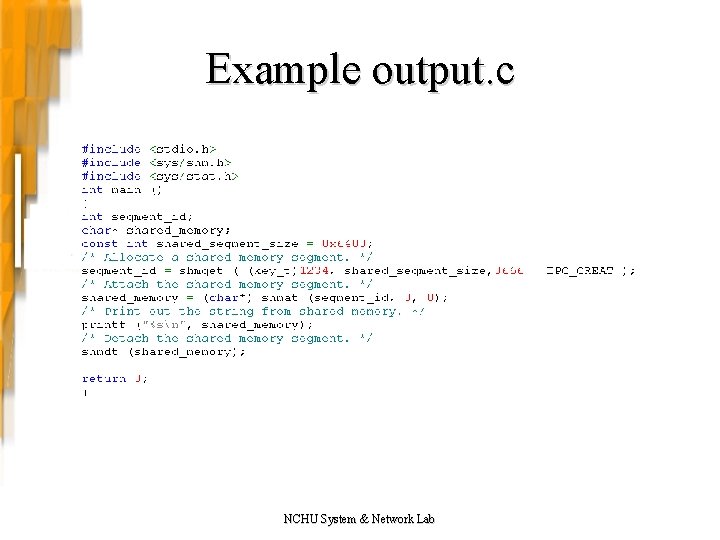
Example output. c NCHU System & Network Lab
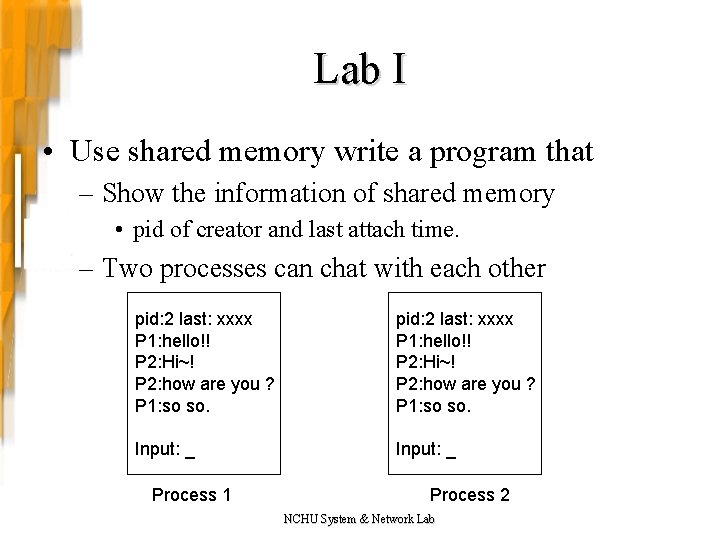
Lab I • Use shared memory write a program that – Show the information of shared memory • pid of creator and last attach time. – Two processes can chat with each other pid: 2 last: xxxx P 1: hello!! P 2: Hi~! P 2: how are you ? P 1: so so. Input: _ Process 1 Process 2 NCHU System & Network Lab
Reference • Advanced Programming in the UNIX Environment 2 nd Author : Richard Stevens, Stephen A. Rago, Publisher : Addison-Wesley • Beginning Linux Programming Author : Richard Stones, Neil Matthew Publisher : Wrox • Operating System Concepts 6 th edition Author : Abraham Silberschatz, Peter Baer Galvin, Greg Gagne Publisher : John Wiley & Sons, inc. • Google • LINUX MAN PAGES ONLINE NCHU System & Network Lab
- Slides: 24