
Lab 10 Human Ear Anatomy Biology Department 1
Lab 10 : Human Ear Anatomy Biology Department 1

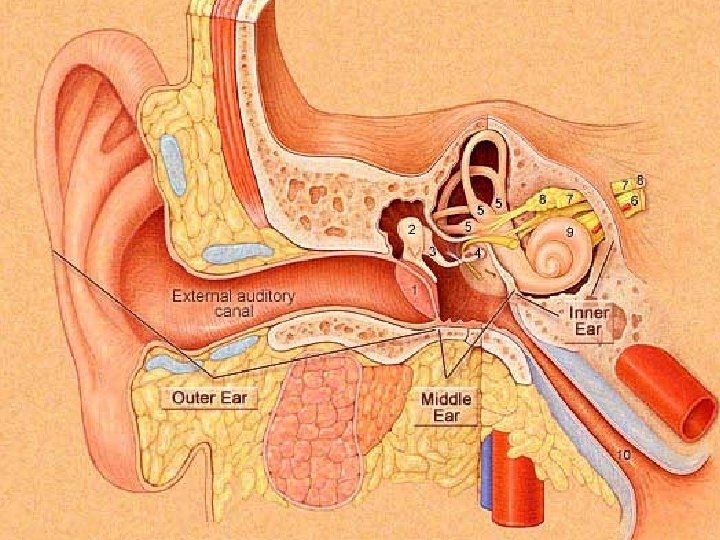
Ear Parts Ø The ear is the organ of hearing and, in mammals, balance. Ø In mammals, the ear is usually described as having three parts: ü The outer ear ü Middle ear üThe inner ear. Ø All three parts of the ear are important for detecting sound by working together to move sound from the outer part through the middle and into the inner part of the ear. Ø Ears also help to maintain balance. 2

3
The outer ear Ø The outer ear consists of : 1. Pinna (auricle ) : üCartilage covered by skin placed on opposite sides of the head üThe visible part of the outer ear. ü It collects sound and directs it into the outer ear canal 2. Auditory canal (external ear canal , external auditory meatus ): üThe tube through which sound travels to the eardrum. ü 2. 5 cm (length) 4
The outer ear üThe first part of the canal is surrounded by cartilage, while the second part near the eardrum is surrounded by bone. üThe skin surrounding the ear canal contains ceruminous and sebaceous glands that produce protective ear wax. üThe ear canal ends at the external surface of the eardrum 3. Eardrum outer layer ( tympanic membrane) : üA thin membrane that vibrates when sound waves reach it üAt the end of ear canal 5
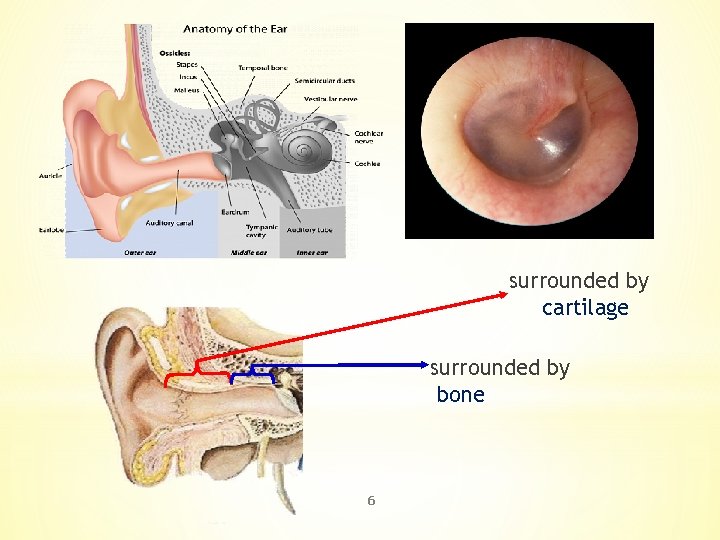
surrounded by cartilage surrounded by bone 6
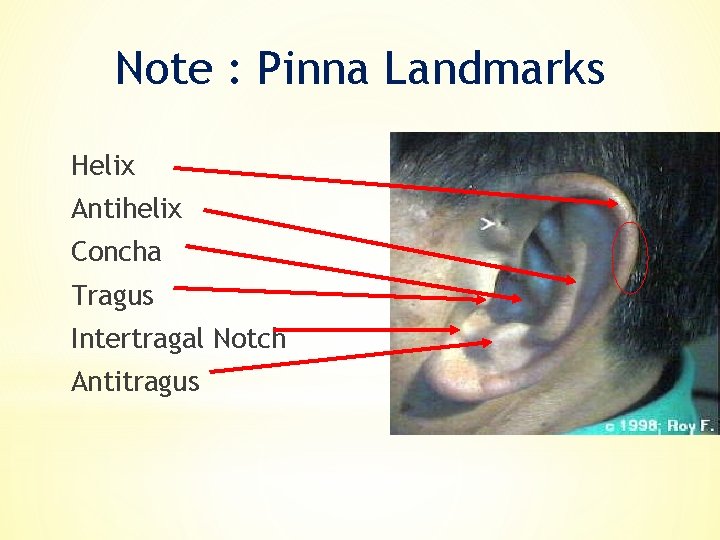
Note : Pinna Landmarks Helix Antihelix Concha Tragus Intertragal Notch Antitragus
Outer Ear Functions § Collecting the sound § Protection § Localization 8
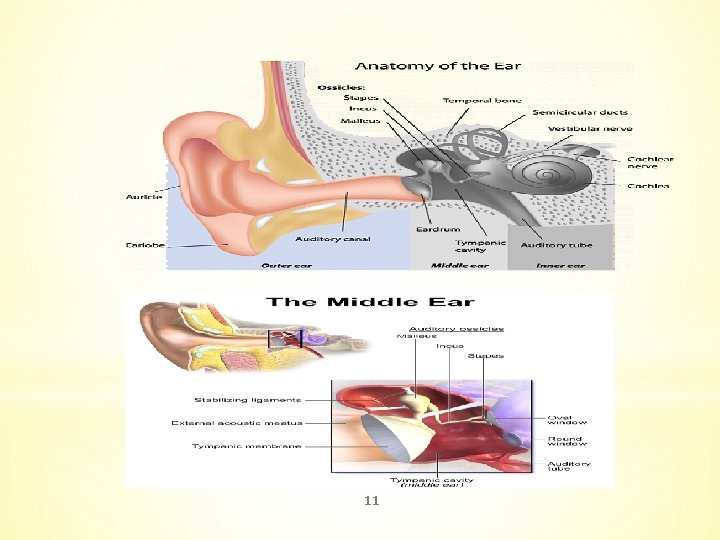
The middle ear Ø A cleft within the temporal bone. Ø Lining is mucous membrane Ø Tympanic Membrane separates it from EAC Ø It consists of : üEardrum üan air-filled cavity called the tympanic cavity üincludes the three ossicles. 9
Middle Ear Structures üThe ossicles are three small bones that function together to receive, amplify, and transmit the sound from the eardrum to the inner ear. üThe ossicles are the malleus (hammer), incus (anvil), and the stapes (stirrup). ü malleus (or hammer) : long handle attached to the eardrum ü incus (or anvil) : the bridge bone between the malleus and the stapes ü stapes (or stirrup) : the footplate; the smallest bone in the body ØThe Eustachian tube (auditory tube ) connects it to nasopharynx , it equalizes the pressure between the middle ear and the air outside. 10
11
INNER EAR • oval window : connects the middle ear with the inner ear • semicircular ducts • cochlea. • Auditory nerve - carry nerve signals from the inner ear (the cochlea) to the brain. 12
Inner Ear Ø The inner ear contains the sensory organs for hearing and balance. Ø The cochlea is the hearing part of the inner ear. The semicircular canals in the inner ear are part of our balance system. Ø The cochlea is a bony structure shaped like a snail and filled with two fluids (endolymph and perilymph). Ø The Organ of Corti is the sensory receptor inside the cochlea which holds the hair cells, the nerve receptors for hearing. Ø The mechanical energy from movement of the middle ear bones pushes in a membrane (the oval window) in the cochlea. This force moves the cochlea's fluids that, in turn, stimulate tiny hair cells 13

Inner Ear Ø Signals from these hair cells are changed into nerve impulses. The nerve impulses are sent out to the brain by the cochlear portion of the auditory nerve. ØAlso housed within the inner ear are the semicircular canals, three loops of fluid-filled tubes that are attached to the cochlea in the inner ear ØThese structures help control one’s sense of steadiness or balance. These balance organs share the temporal bone space with the cochlea. These organs also share the same fluid that is in the cochlea. 14
How Our Balance System Works Ø Balance and equilibrium help us stay upright when standing and know where we are in relation to gravity. Ø Our balance system also helps us walk, run, and move without falling. Balance is controlled through signals to the brain from your eyes, the inner ear, and the sensory systems of the body (such as the skin, muscles, and joints). This balance system is also known as the vestibular system. Ø In the inner ear, the balance system consists of three semicircular canals that contain fluid and “sensors” that detect rotational movement of the head. Ø Each of the semicircular canals lies at a different angle and is situated at a right angle to each other. 15

How Our Balance System Works ØThe semicircular canals deal with different movement: up-and -down, side-to-side, and tilting from one side to the other. Ø All contain sensory hair cells that are activated by movement of inner ear fluid (endolymph). ØAs the head moves, hair cells in the semicircular canals send nerve impulses to the brain by way of the vestibular nerve. Ø The nerve impulses are processed in the brain to help us know where we are in space or if we are moving. 16
17
- Slides: 17