
LAB 10 Genetics the Principles of Mendelian Genetics
LAB. 10 Genetics - the Principles of Mendelian Genetics Modern Genetics: § Mendelian Genetics: study the inheritance of trait (in pea plants) and inheritance of pattern. § Molecular Genetics: study the structure and functions (and regulations) of genetic materials (genes) at molecular level.
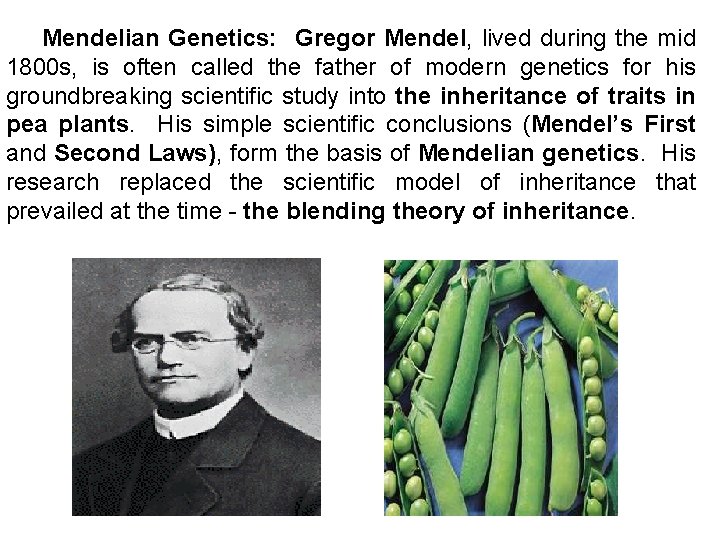
Mendelian Genetics: Gregor Mendel, lived during the mid 1800 s, is often called the father of modern genetics for his groundbreaking scientific study into the inheritance of traits in pea plants. His simple scientific conclusions (Mendel’s First and Second Laws), form the basis of Mendelian genetics. His research replaced the scientific model of inheritance that prevailed at the time - the blending theory of inheritance.

Blended theory of inheritance before Mendelian’s laws The traits of the parents blend with each other to produce traits of offspring Parents Expected offspring
1. Several scientific terms and Mendel’s laws. Genome: All the genes of an individual constitute the individual’s genome (Genetics Book: a complete haploid DNA content of a specific organism- genes + noncoding DNA). Our 46 chromosomes are estimated to contain about 23, 000 genes and a total of 32 billion bases. Genes and Alleles: Factors (genes) occur in pairs, i. e. , each gene has two copies and each of the two copies called allele. one allele inherited from father and one allele inherited from mother. In a haploid cell (sperm or egg), there are only one allele for every gene. Genotype: The genetic constitution of an organism. Phenotype: The visible or measurable characteristics of an individual or the physical expression of genetic information Traits: a trait is a distinct variant of phenotypic character of an organism, which is encoded by hereditary units called factors (now called genes).

Homozygous: An organism with two identical alleles for a given gene is said to be homozygous for that gene. Heterozygous: An organism with two different alleles for a gene is said to be heterozygous for that gene.
Mendel’s First and second Laws Law of Segregation (Mendel’s First Law): when male and female gametes form, the two alleles of a gene in a dipoid cells segregate so that each gamete contains only one allele with equal chance. (You should understand that this is a consequence of meiosis. During fertilization, a male and a female gamete unite to form a new individual that has two alleles for each gene). Law of Independent Assortment (Mendel’s Second Law): the alleles of each gene separate independently of the alleles of other genes. (Mendel found that during gametogenesis, the alleles of each gene seemed to segregate independently from how the alleles of another gene segregated. )
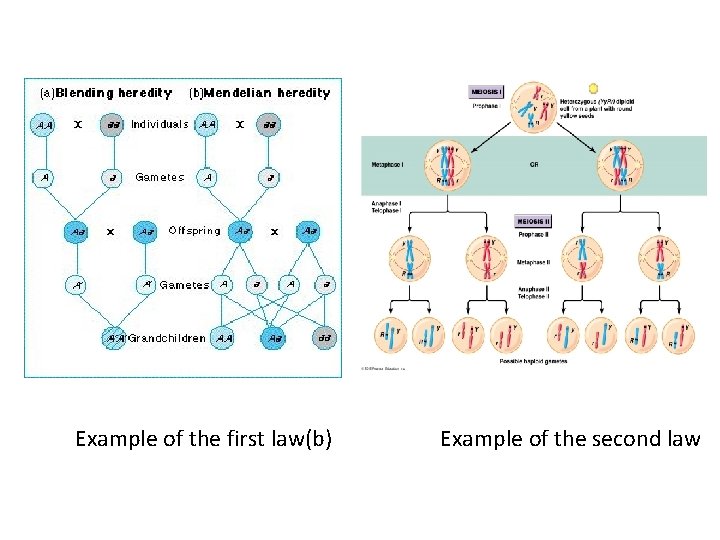
Example of the first law(b) Example of the second law
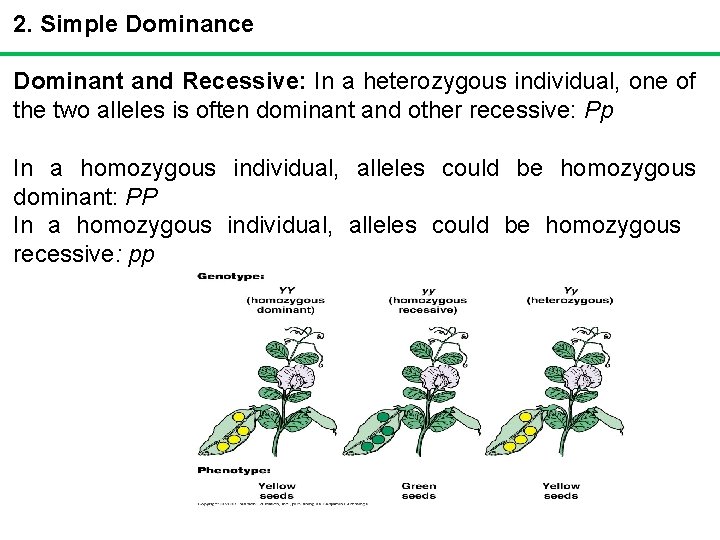
2. Simple Dominance Dominant and Recessive: In a heterozygous individual, one of the two alleles is often dominant and other recessive: Pp In a homozygous individual, alleles could be homozygous dominant: PP In a homozygous individual, alleles could be homozygous recessive: pp
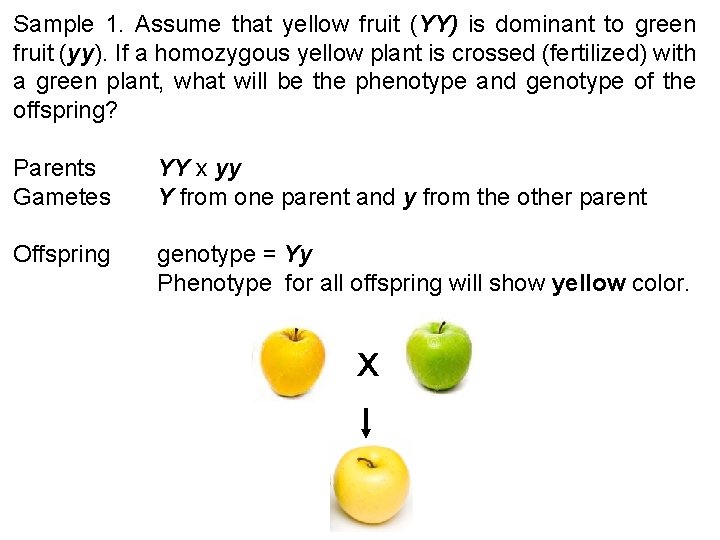
Sample 1. Assume that yellow fruit (YY) is dominant to green fruit (yy). If a homozygous yellow plant is crossed (fertilized) with a green plant, what will be the phenotype and genotype of the offspring? Parents Gametes YY x yy Y from one parent and y from the other parent Offspring genotype = Yy Phenotype for all offspring will show yellow color. x
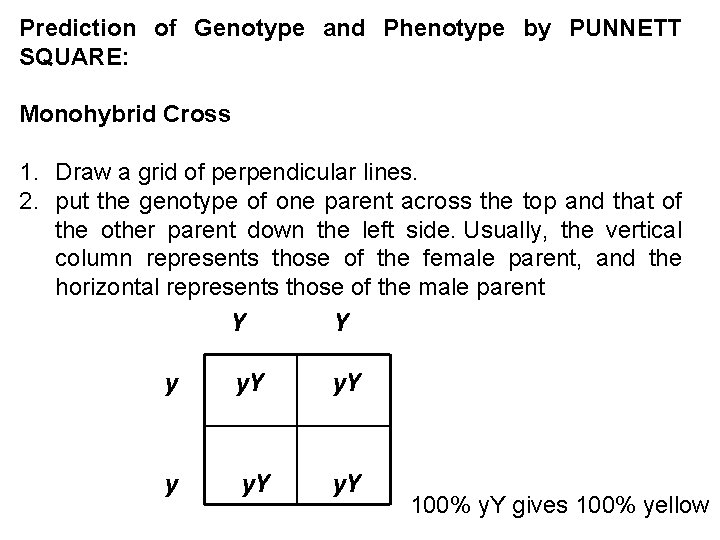
Prediction of Genotype and Phenotype by PUNNETT SQUARE: Monohybrid Cross 1. Draw a grid of perpendicular lines. 2. put the genotype of one parent across the top and that of the other parent down the left side. Usually, the vertical column represents those of the female parent, and the horizontal represents those of the male parent Y Y y y. Y 100% y. Y gives 100% yellow
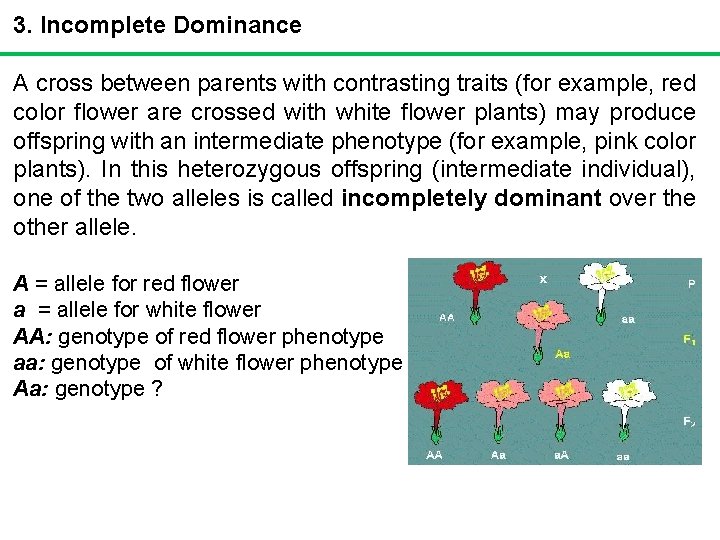
3. Incomplete Dominance A cross between parents with contrasting traits (for example, red color flower are crossed with white flower plants) may produce offspring with an intermediate phenotype (for example, pink color plants). In this heterozygous offspring (intermediate individual), one of the two alleles is called incompletely dominant over the other allele. A = allele for red flower a = allele for white flower AA: genotype of red flower phenotype aa: genotype of white flower phenotype Aa: genotype ?
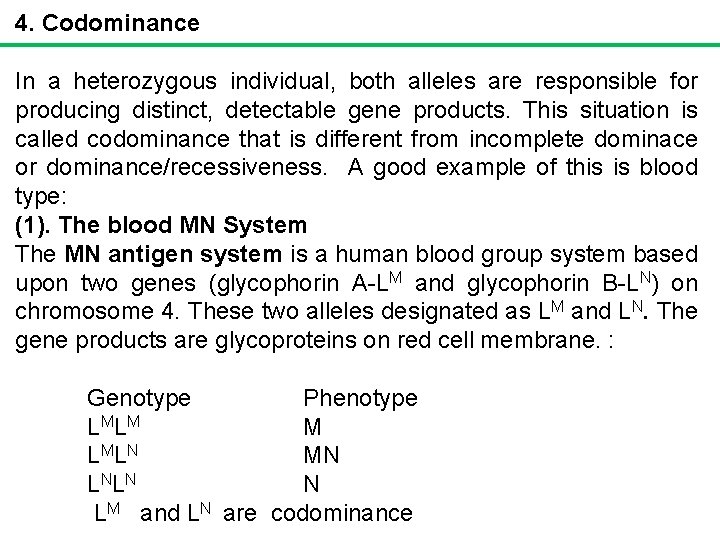
4. Codominance In a heterozygous individual, both alleles are responsible for producing distinct, detectable gene products. This situation is called codominance that is different from incomplete dominace or dominance/recessiveness. A good example of this is blood type: (1). The blood MN System The MN antigen system is a human blood group system based upon two genes (glycophorin A-LM and glycophorin B-LN) on chromosome 4. These two alleles designated as LM and LN. The gene products are glycoproteins on red cell membrane. : Genotype Phenotype L ML M M L ML N MN L NL N N LM and LN are codominance
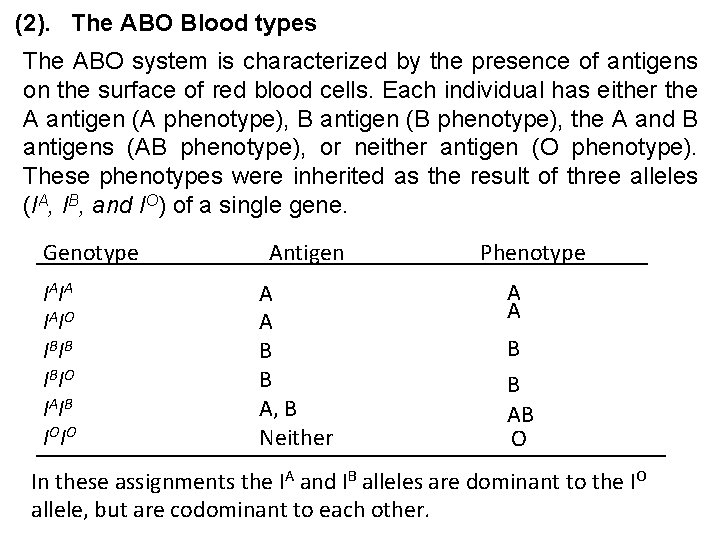
(2). The ABO Blood types The ABO system is characterized by the presence of antigens on the surface of red blood cells. Each individual has either the A antigen (A phenotype), B antigen (B phenotype), the A and B antigens (AB phenotype), or neither antigen (O phenotype). These phenotypes were inherited as the result of three alleles (IA, IB, and IO) of a single gene. Genotype I AI A I AI O I BI B I BI O I AI B I OI O Antigen A A B B A, B Neither Phenotype A A B B AB O In these assignments the IA and IB alleles are dominant to the IO allele, but are codominant to each other.
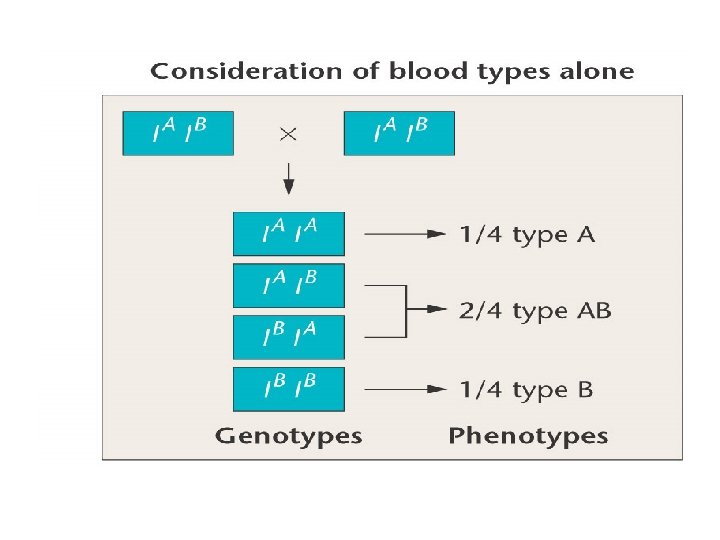
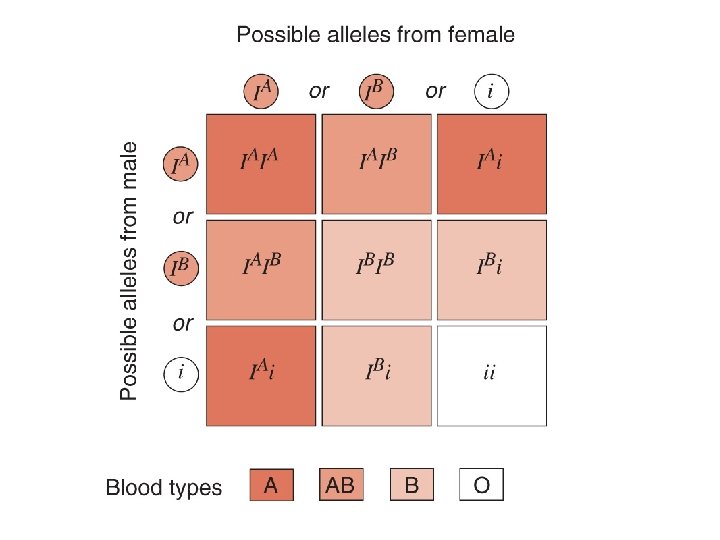
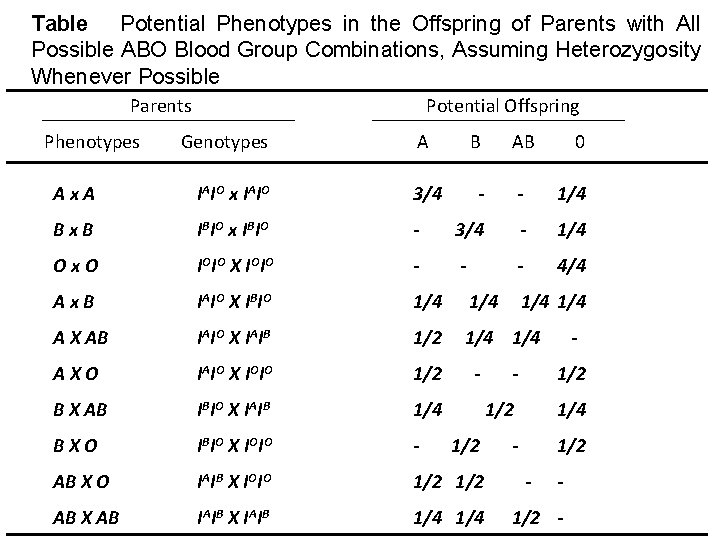
Table Potential Phenotypes in the Offspring of Parents with All Possible ABO Blood Group Combinations, Assuming Heterozygosity Whenever Possible Parents Phenotypes Potential Offspring Genotypes A B AB 0 - - 1/4 Ax. A IAIO x I AIO 3/4 Bx. B IBIO x IBIO - 3/4 - 1/4 Ox. O IO IO X I O IO - - - 4/4 Ax. B IAIO X IBIO 1/4 A X AB IAIO X I AIB 1/2 1/4 AXO IAIO X I O IO 1/2 B X AB IBIO X IAIB 1/4 BXO IBIO X IOIO - AB X O IAIB X I O IO 1/2 AB X AB I AIB X I AIB 1/4 1/2 1/4 - - 1/2 1/4 - 1/2 -
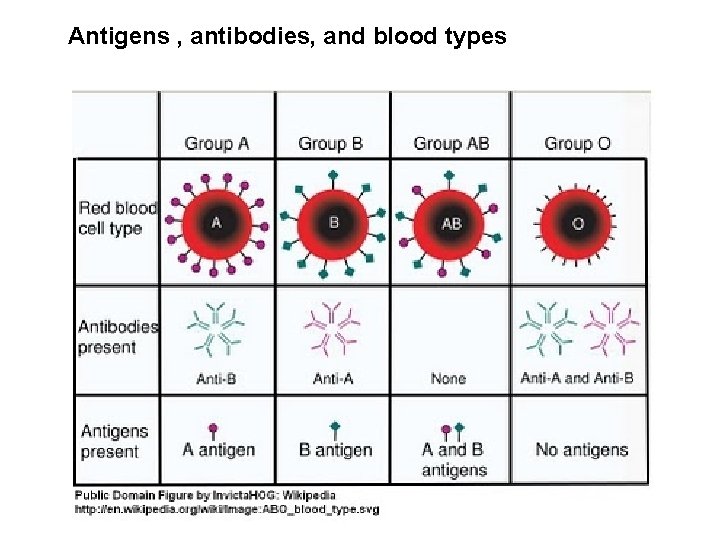
Antigens , antibodies, and blood types
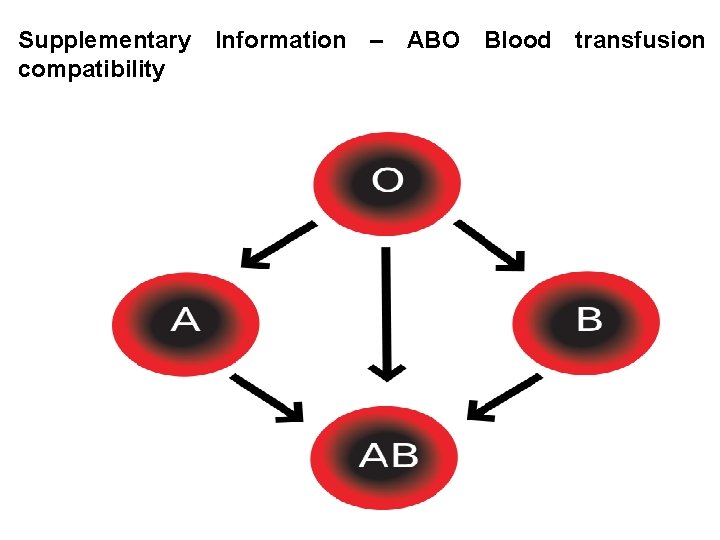
Supplementary Information – ABO Blood transfusion compatibility
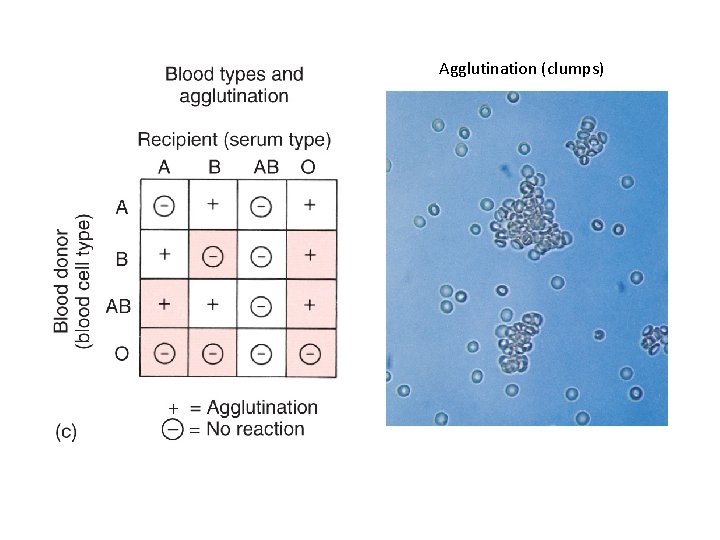
Agglutination (clumps)
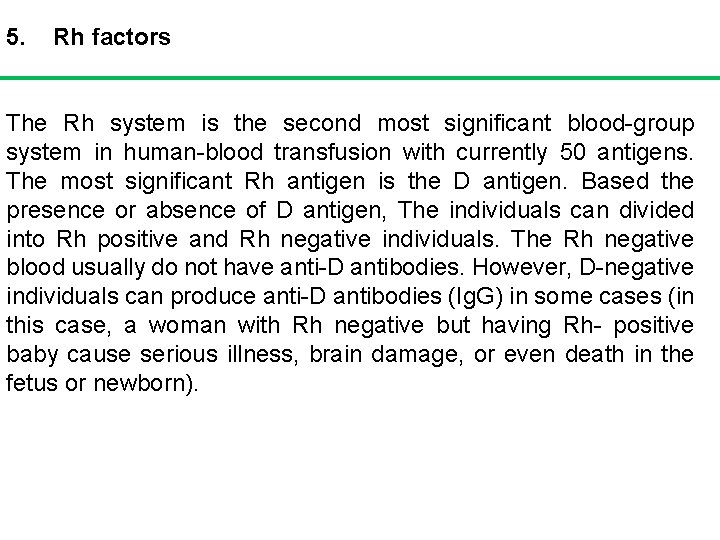
5. Rh factors The Rh system is the second most significant blood-group system in human-blood transfusion with currently 50 antigens. The most significant Rh antigen is the D antigen. Based the presence or absence of D antigen, The individuals can divided into Rh positive and Rh negative individuals. The Rh negative blood usually do not have anti-D antibodies. However, D-negative individuals can produce anti-D antibodies (Ig. G) in some cases (in this case, a woman with Rh negative but having Rh- positive baby cause serious illness, brain damage, or even death in the fetus or newborn).

The – and + in the table means Rh – and Rh +
6. ANALYZING PEDIGREES 1. If more than one individual in a family is associated with a disease, it could suggest that the disease may be inherited. A doctor needs to look at the family history by establishing the inheritance patterns of human traits. Such a family tree is called a pedigree. 2. Pedigree analysis can also used to predict the probabilities of offspring with particular genotypes and phenotypes from individuals in the pedigree who have not yet borne children. Pedigree analysis can identify the probable source of a mutation for traits that appear in a family without a prior family history of the trait
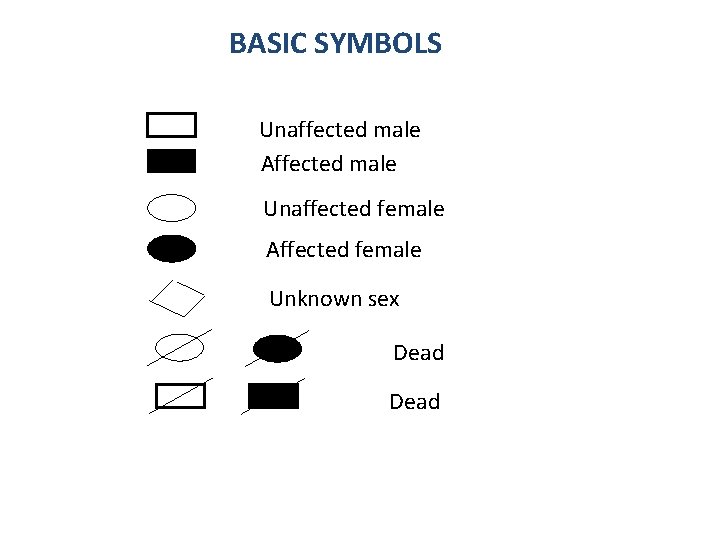
BASIC SYMBOLS Unaffected male Affected male Unaffected female Affected female Unknown sex Dead
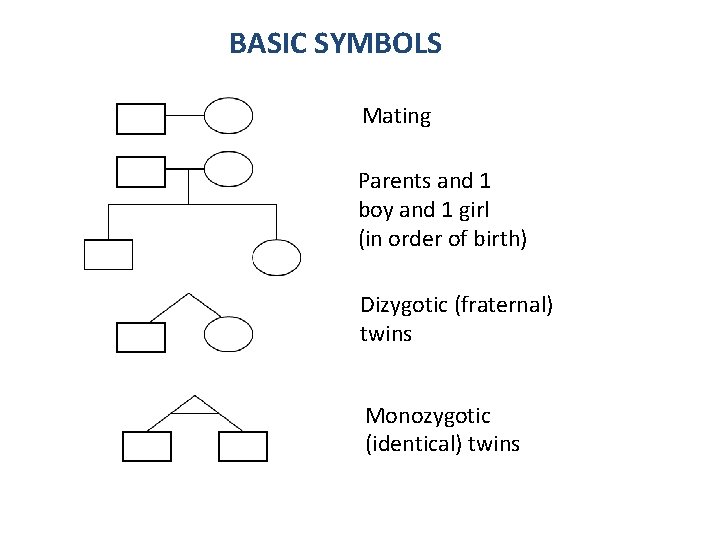
BASIC SYMBOLS Mating Parents and 1 boy and 1 girl (in order of birth) Dizygotic (fraternal) twins Monozygotic (identical) twins
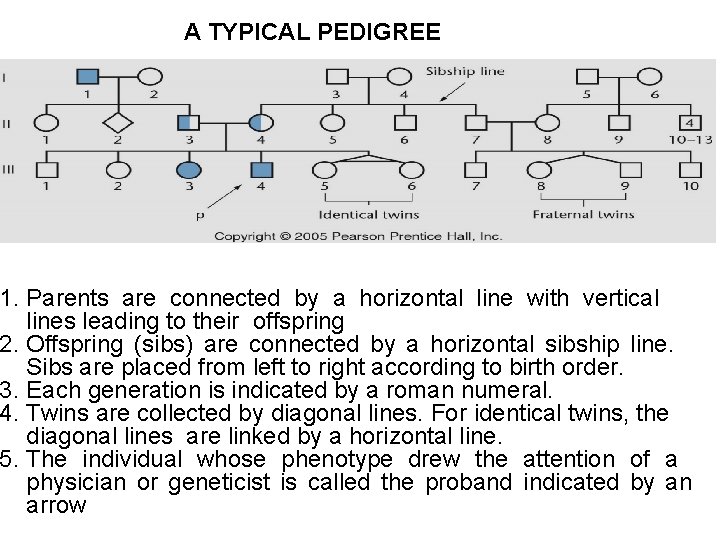
A TYPICAL PEDIGREE 1. Parents are connected by a horizontal line with vertical lines leading to their offspring 2. Offspring (sibs) are connected by a horizontal sibship line. Sibs are placed from left to right according to birth order. 3. Each generation is indicated by a roman numeral. 4. Twins are collected by diagonal lines. For identical twins, the diagonal lines are linked by a horizontal line. 5. The individual whose phenotype drew the attention of a physician or geneticist is called the proband indicated by an arrow
1. Dominant and Recessive Diseases Recessive trait Cystic Fibrosis Galactosemia Phynylketonuria (PKU) Juvenile retinoblastoma Dominant Trait Huntigton’s disease: is a dominant trait
Recessive Traits 1. Most recessive traits are passed to children from both parents and both parents are heterozygotes (silent carriers: Aa x Aa), usually producing an approximately 3: 1 ration (normal to affected). 2. Recessive traits could skip generations, particularly in the case that one parent is heterozygote or homozygote recessive and other is homozygous dominant. 3. When both parents are affected they are homozygous for the recessive trait, all their progeny usually exhibit the trait. 6. In the case of one parent being a homozygote recessive and the other a heterozygote, about half of the offspring will be affected.
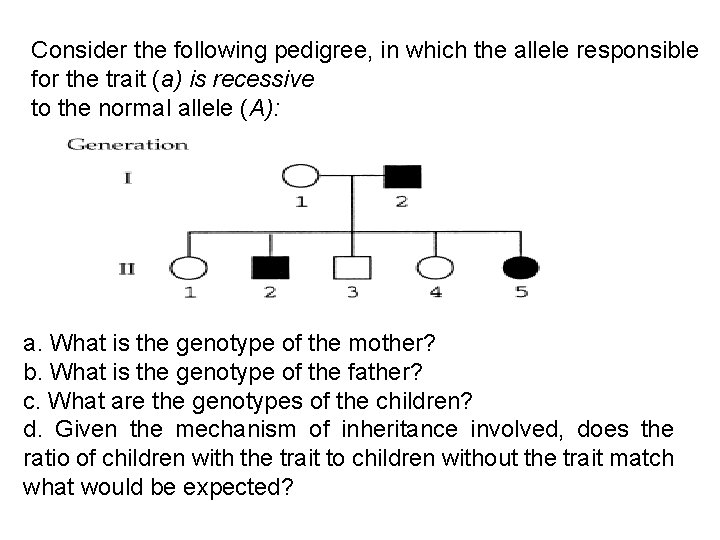
Consider the following pedigree, in which the allele responsible for the trait (a) is recessive to the normal allele (A): a. What is the genotype of the mother? b. What is the genotype of the father? c. What are the genotypes of the children? d. Given the mechanism of inheritance involved, does the ratio of children with the trait to children without the trait match what would be expected?
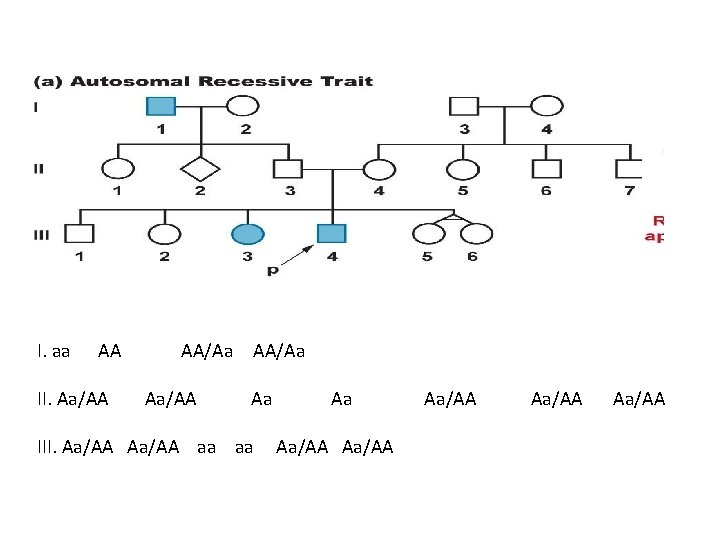
I. aa AA II. Aa/AA AA/Aa Aa III. Aa/AA aa aa Aa Aa/AA Aa/AA
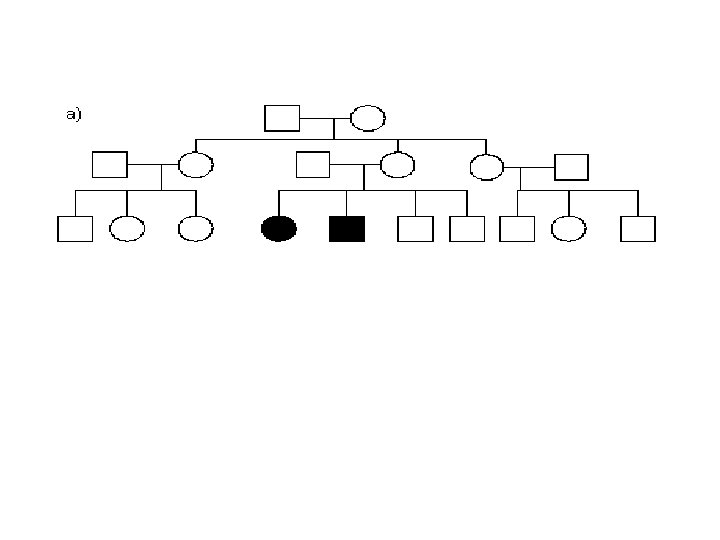
Characteristics of Dominant Traits 1. Most affected parents are heterozygotes (i. e. heterozygote is mating with homozygous recessive – Aa x aa. It is extremely unusual to find individuals homozygous for the dominant allele). All unaffected individuals are homozygous for the normal recessive allele. 2. Every affected individual has at least one affected parent; Two affected parents may have unaffected children. 3. The trait usually does not skip generations. 4. On average, affected individuals (usually heterozygous) mate with unaffected individuals (Aa x aa) have a 50% chance of transmitting the trait to each child (based on the basic Mendelian principles).
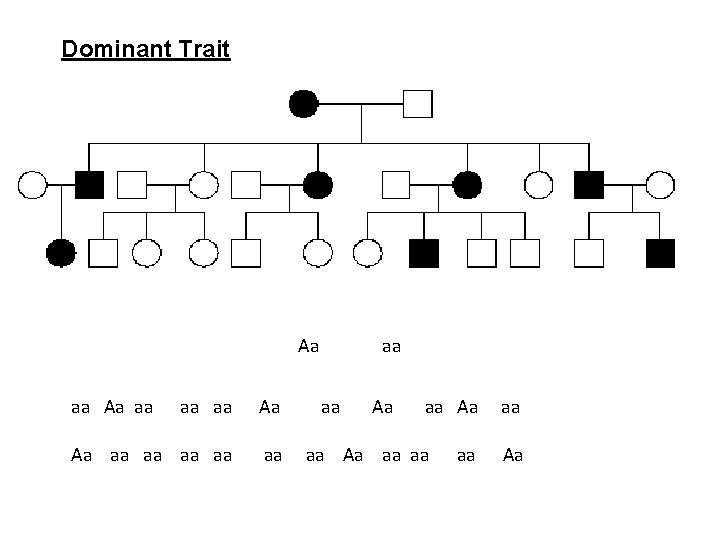
Dominant Trait Aa aa aa aa Aa Aa aa aa Aa aa aa Aa
- Slides: 32