
Lab 1 Terminology Elizabeth Hirst Anatomical Terms l

Lab 1: Terminology Elizabeth Hirst
Anatomical Terms l l l l l Anatomical position - face directed forward, the arms at the side, and the palms of the hands facing forward, used as a reference in describing the relation of body parts to one another. Anterior-the front Anteroinferior-front and lower Anterolateral-front and to the side Anteromedial- front and to the middle Anteroposterior- extending from front to back, on an axis Anterosuperior- front and above Bilateral-both sides Distal-farther from point of reference Proximal-closer to point of reference
Anatomical Terms Cont’ l l l l l Inferior-lower Caudal-near the tail or posterior part of the body Inferolateral-lower and to the side Inferomedial-lower and to the middle Lateral-to the side Medial-to the middle Posterior-back Prone-Lying on the stomach side Proximal-Closer to point of reference Superficial-not deep
Anatomical Terms Cont’ l l l Superior- above Cranial-the head Supine- lying on the spine Ventral-abdominal Rostral-oral or nasal region
Planes of Motion l l l Sagittal- dividing left from right Frontal (coronal)- dividing front to back Transverse (horizontal)-dividing top from bottom
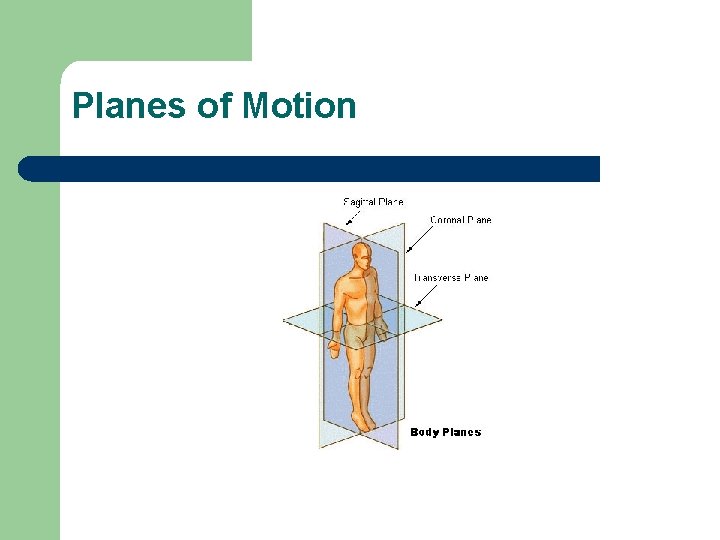
Planes of Motion
Planes of Motion In Action!!!
Bone Markings l l l l l Condyle-Femoral Condyles Facet-facet joint Head-like condyle. Head of femer Angle-pointed edge- Angle of the scapula Border/Margin-A ridge. Border of the scapula Crest-Crest of the tibia Epicondyle-Above a condyle. Lateral Epicondyle of the elbow Line-Similar to crest Process-xiphoid process Ramus- ramus pubis
Bony Landmarks Cont’ l l l l l Spine (spinous process)-part you can feel on the spine Suture-coronal suture. On the head Trochanter-greater and lesser trochanter of the femer Tubercle-conoid tubercle of the clavicle Tuberosity-tibial tuberosity Foramen-hole, obturator foramen Fossa-subscapular fossa Notch-trochlear notch of the ulna Sulcus-radial sulcus on the humerous
Movements l l l l l Abduction Adduction Flexion Extension Circumduction Diagonal abduction Diagonal adduction External rotation (lateral) Internal rotation (medial) Eversion
Movements Cont’ l l l l l Inversion Dorsal flexion Plantar flexion Pronation Supination Depression Elevation Protraction (abduction) Retraction (adduction) Rotation downward
Movements Cont’ l l l l l Rotation upward Horizontal abduction Horizontal adduction Lateral flexion Reduction Radial flexion (radial deviation) Ulnar flexion (ulnar deviation) Opposition/Reposition Contralateral- oppoisite side Ipsilateral –same side

Lets Watch Some Movement!!

Study!!!!
- Slides: 14