
Lab 1 Safety measures in Biochemistry Laboratory Rules
Lab. 1 Safety measures in Biochemistry Laboratory

Rules for working in a biochemistry laboratory -There are two major concerns to consider when working in a biochemistry laboratory. - First is safety and the second is efficiency in the laboratory work. - Although the latter very much depends on the individuals doing the experiments, I. General safety rules: 1. Keep the benches and shelves clean and well-organized 2. Avoid contaminating the chemicals; use only clean glassware and spatulas; label glassware in use 3. Plan your experiments before starting to carry them out, 4. Pay attention to others in the laboratory. 5 - Do not work alone in the laboratory.
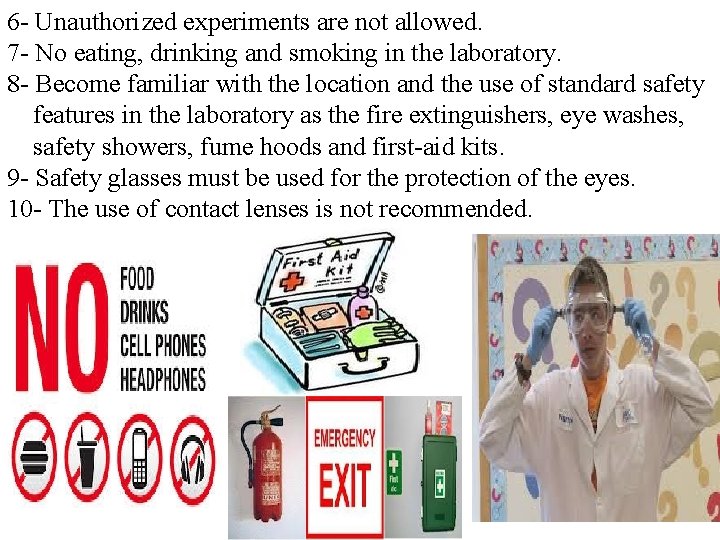
6 - Unauthorized experiments are not allowed. 7 - No eating, drinking and smoking in the laboratory. 8 - Become familiar with the location and the use of standard safety features in the laboratory as the fire extinguishers, eye washes, safety showers, fume hoods and first-aid kits. 9 - Safety glasses must be used for the protection of the eyes. 10 - The use of contact lenses is not recommended.

II. Special safety rules 1 - No overheating a solution therefore, vigorous mixing of the solution by shaking or stirring is required. 2 - The mouth of the glassware containing the solution to be heated should never be pointed toward anyone. 3 - Handling of strong acids and bases requires special attention. When diluting concentrated acids, the acid should be poured into the water and never the opposite. 4 - The pipettes should never be filled with solutions of toxic substances, biological fluids, strong acids and bases by mouth suction. Use either automatic pipettes or pipette pumps. 5 - Volatile liquids and solids that are toxic or irritating should be handled under fume hoods. 6 - While handling flammable liquids such as ether, alcohols, benzene, naked flame (burners, matches) must not be in use. The above liquids must not be stored near radiating heat sources, such as the laboratory oven. 7 - Before using electrical appliances, make sure they are grounded.
8 - Before leaving the laboratory, electrical equipment should be turned off, and gas burners extinguished. No tap water should be left running. III. Rules to follow in the case of accidents and injuries 1 - Chemical splatters into the eye, first the eyelid should be opened by using the thumb and the pointing finger, then, by using the eye wash kit, the eye should be rinsed with large amounts of water. When an acid or alkaline solution gets into eye, the eye should be rinsed with 1 % Na. HCO 3 or 1 % boric acid, respectively. The victim should be taken to the doctor as soon as possible. 2 - Burning: the burned spot on the skin should not be treated with water; rather, a special bandage should be used. See doctor if necessary 3 - Poisoning: prompt medical treatment should be obtained. 4 - All injuries and accidents must be reported to the instructor.
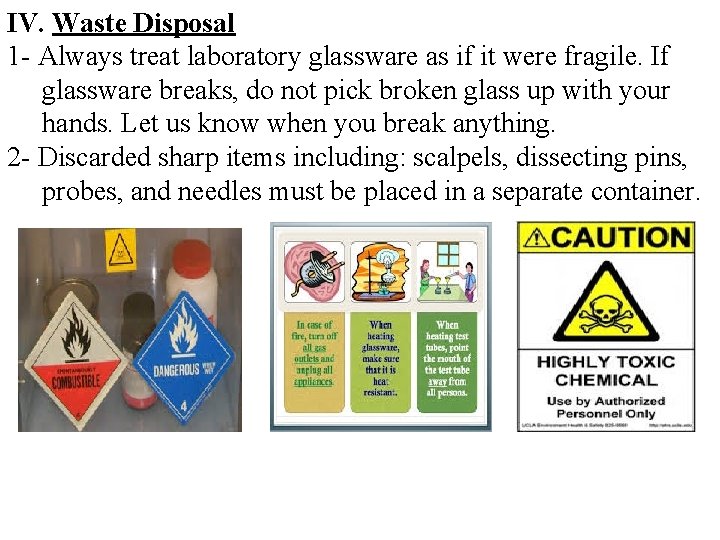
IV. Waste Disposal 1 - Always treat laboratory glassware as if it were fragile. If glassware breaks, do not pick broken glass up with your hands. Let us know when you break anything. 2 - Discarded sharp items including: scalpels, dissecting pins, probes, and needles must be placed in a separate container.
Lab. 2 Pipettes and pipetting
Pipettes - It is a laboratory tool commonly used in chemistry, biology and medicine to transport a measured volume of liquid. - Pipettes come in several designs for various purposes with differing levels of accuracy and precision, from single piece glass pipettes to more complex adjustable or electronic pipettes. Pipettes can be classified into: 1 - Automatic pipettes 2 - Non automatic pipettes, which can be classified into: A- Non quantitative B- Quantitative classified into two types: 1 - Fixed volumetric 2 - Graduated classified into two types: a- Mohr b- Serological
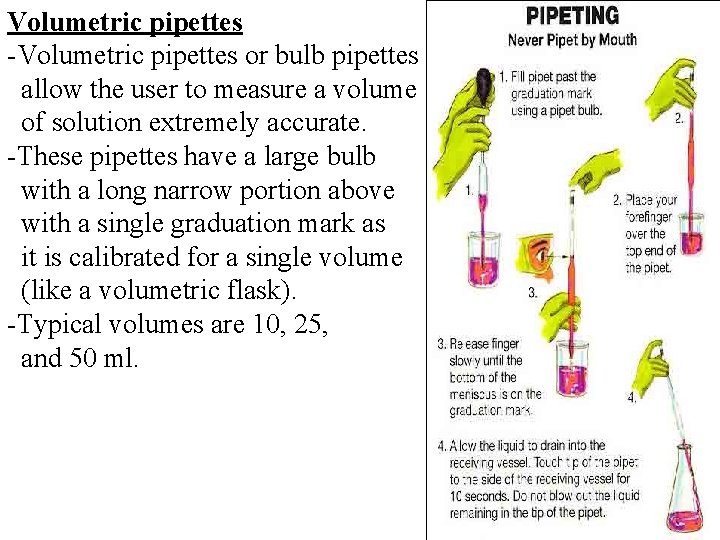
Volumetric pipettes -Volumetric pipettes or bulb pipettes allow the user to measure a volume of solution extremely accurate. -These pipettes have a large bulb with a long narrow portion above with a single graduation mark as it is calibrated for a single volume (like a volumetric flask). -Typical volumes are 10, 25, and 50 ml.
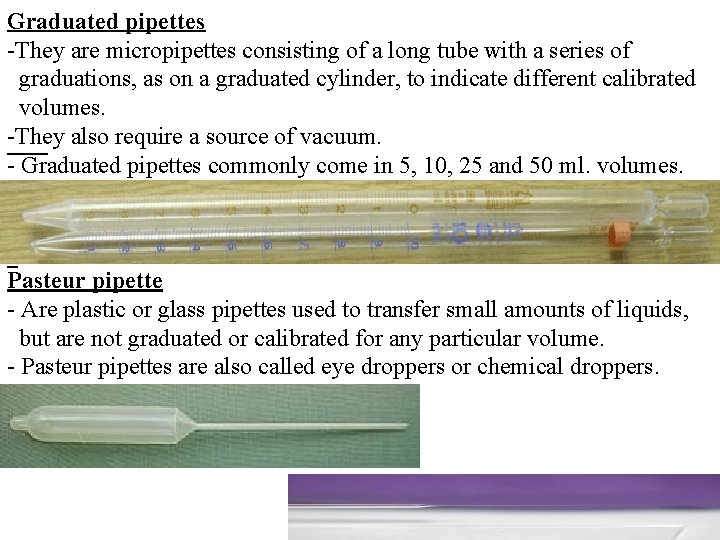
Graduated pipettes -They are micropipettes consisting of a long tube with a series of graduations, as on a graduated cylinder, to indicate different calibrated volumes. -They also require a source of vacuum. - Graduated pipettes commonly come in 5, 10, 25 and 50 ml. volumes. Pasteur pipette - Are plastic or glass pipettes used to transfer small amounts of liquids, but are not graduated or calibrated for any particular volume. - Pasteur pipettes are also called eye droppers or chemical droppers.

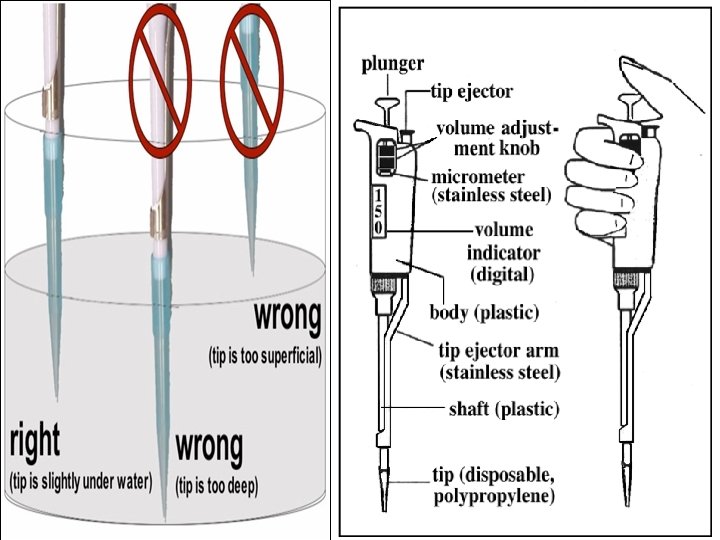
Air displacement micropipettes - Air displacement micropipettes can measure volume between about 0. 1 µl to 1000 µl (1 ml). -These pipettes require disposable tips that come in contact with the fluid. The four standard sizes of micropipettes correspond to four different disposable tip colors: Pipette type Volumes (μl) Tip color P 10 0. 1 – 10 white P 20 2 – 20 yellow P 200 20 – 200 yellow P 1000 200 – 1000 blue
-These pipettes operate by piston-driven air displacement. - A vacuum is generated by the vertical travel of a metal piston. As the piston moves upward, driven by the depression of the plunger, a vacuum is created in the space left empty by the piston. -The liquid around the tip moves into this vacuum and can then be transported and released as necessary. -These pipettes are capable of being very precise and accurate. -However, since they depend upon air displacement, they are subject to inaccuracies caused by the changing environment, particularly temperature and user technique. - This equipment must be carefully maintained and calibrated, and users must be trained to use it in a correct technique.
- Slides: 13