
Lab 1 Natural Selection Description u AP Biology
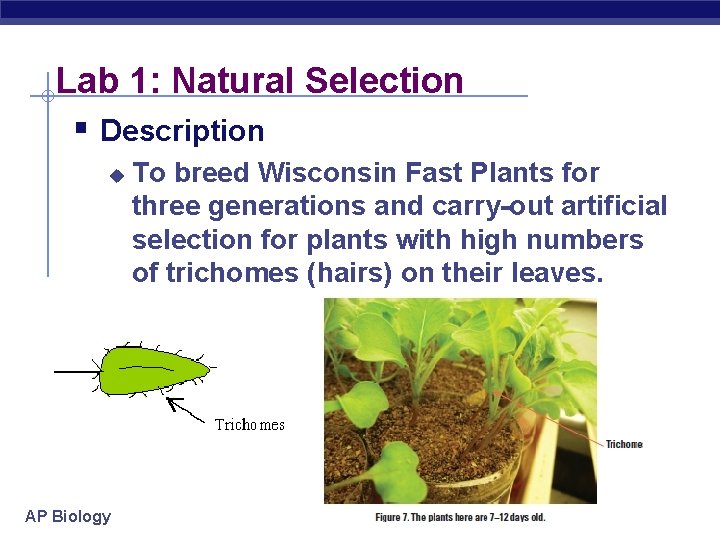
Lab 1: Natural Selection § Description u AP Biology To breed Wisconsin Fast Plants for three generations and carry-out artificial selection for plants with high numbers of trichomes (hairs) on their leaves.
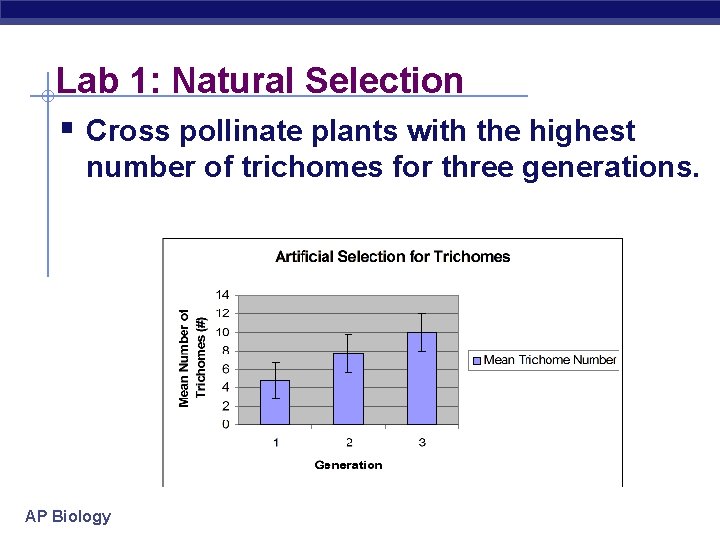
Lab 1: Natural Selection § Cross pollinate plants with the highest number of trichomes for three generations. AP Biology
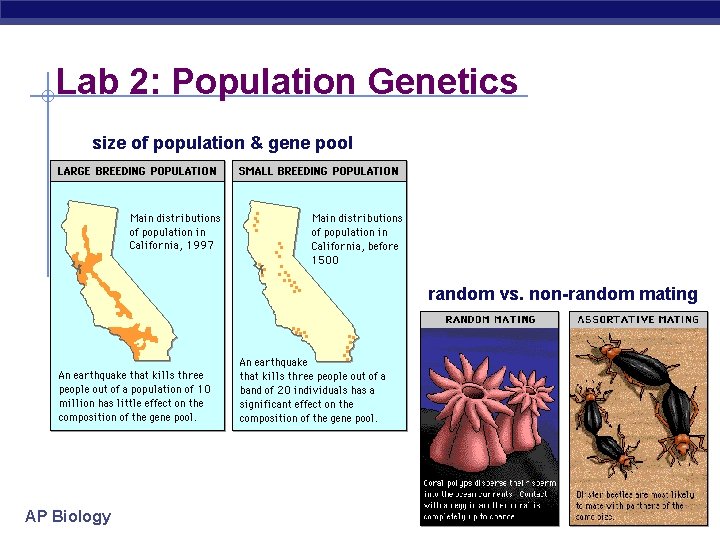
Lab 2: Population Genetics size of population & gene pool random vs. non-random mating AP Biology
Lab 2: Population Genetics § Description Students created an excel spreadsheet to look at allele frequencies changed over generations. u Students then were given different situations (i. e. selection, etc. ) and asked to alter their spreadsheet to show it changed the frequencies. u AP Biology

Lab 2: Population Genetics § Concepts u Hardy-Weinberg equilibrium § p+q=1 § p 2 + 2 pq + q 2 = 1 § required conditions w large population w random mating w no mutations w no natural selection w no migration u u u AP Biology gene pool heterozygous advantage genetic drift § founder effect § bottleneck
Lab 2: Population Genetics § Conclusions u recessive alleles remain hidden in the pool of heterozygotes § even lethal recessive alleles are not completely removed from population u know how to solve H-W problems! § to calculate allele frequencies, use p + q = 1 § to calculate genotype frequencies or how many individuals, use, p 2 + 2 pq + q 2 = 1 AP Biology
Lab 2: Population Genetics § ESSAY 2008 B-3 § Evolution is one of the unifying themes of biology. Evolution involves change in the frequencies of alleles in a population. For a particular genetic locus in a population, the frequency of the recessive allele (a) is 0. 4 and the frequency of the dominant allele (A) is 0. 6. u u u AP Biology (a) What is the frequency of each genotype (AA, Aa, aa) in this population? What is the frequency of the dominant phenotype? (b) How can the Hardy-Weinberg principle of genetic equilibrium be used to determine whether this population is evolving? (c) Identify a particular environmental change and describe how it might alter allelic frequencies in this population. Explain which condition of the Hardy-Weinberg principle would not be met.
Lab 3: Comparing DNA Using BLAST § Description Part I: draw a cladogram based on gene and protein similarities among four different species u Part II: BLAST to compare gene sequences from an “unknown” fossil to extant gene sequences. u § placed that organism on a cladogram with known living organisms. AP Biology
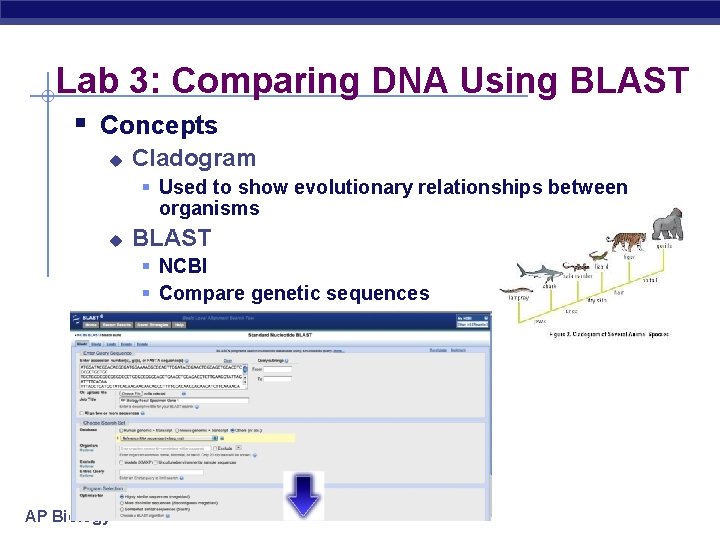
Lab 3: Comparing DNA Using BLAST § Concepts u Cladogram § Used to show evolutionary relationships between organisms u BLAST § NCBI § Compare genetic sequences AP Biology
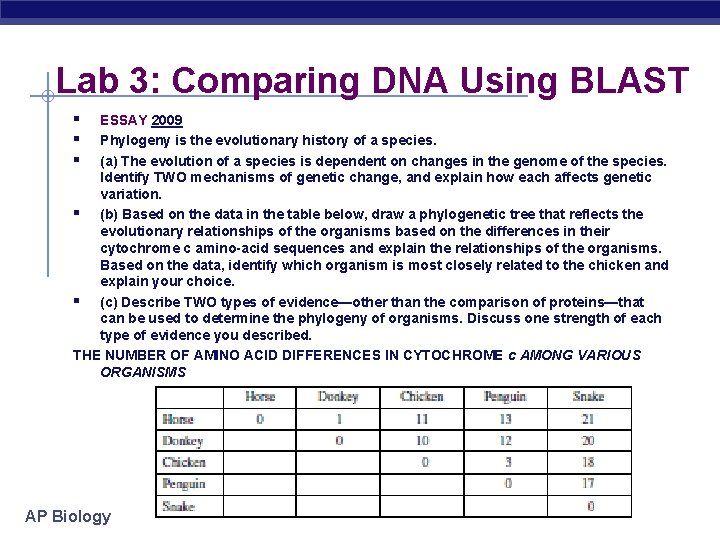
Lab 3: Comparing DNA Using BLAST § § § ESSAY 2009 Phylogeny is the evolutionary history of a species. (a) The evolution of a species is dependent on changes in the genome of the species. Identify TWO mechanisms of genetic change, and explain how each affects genetic variation. § (b) Based on the data in the table below, draw a phylogenetic tree that reflects the evolutionary relationships of the organisms based on the differences in their cytochrome c amino-acid sequences and explain the relationships of the organisms. Based on the data, identify which organism is most closely related to the chicken and explain your choice. § (c) Describe TWO types of evidence—other than the comparison of proteins—that can be used to determine the phylogeny of organisms. Discuss one strength of each type of evidence you described. THE NUMBER OF AMINO ACID DIFFERENCES IN CYTOCHROME c AMONG VARIOUS ORGANISMS AP Biology
Lab 4: Diffusion & Osmosis AP Biology
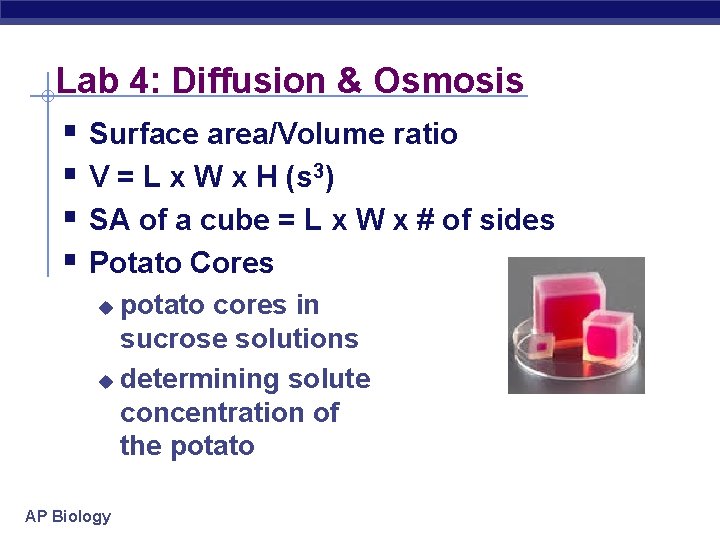
Lab 4: Diffusion & Osmosis § Surface area/Volume ratio § V = L x W x H (s 3) § SA of a cube = L x W x # of sides § Potato Cores potato cores in sucrose solutions u determining solute concentration of the potato u AP Biology
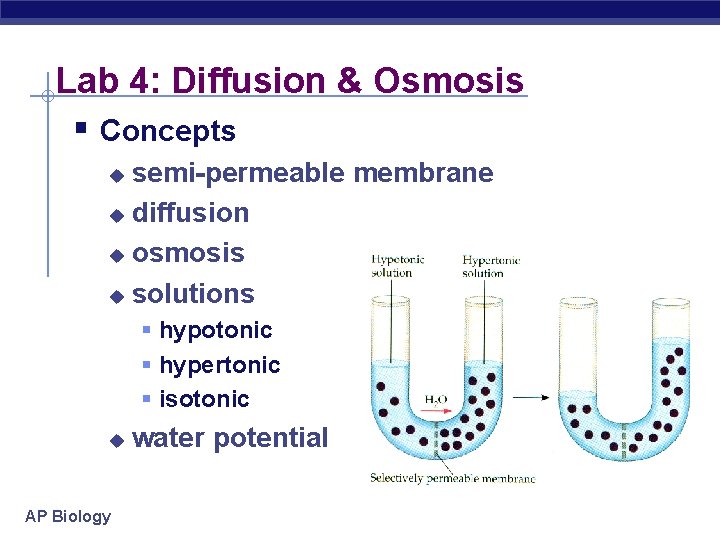
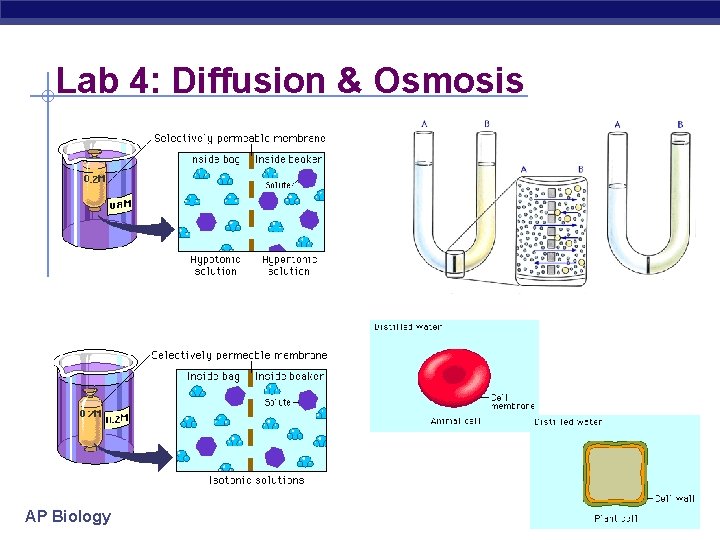
Lab 4: Diffusion & Osmosis § Concepts semi-permeable membrane u diffusion u osmosis u solutions u § hypotonic § hypertonic § isotonic u AP Biology water potential
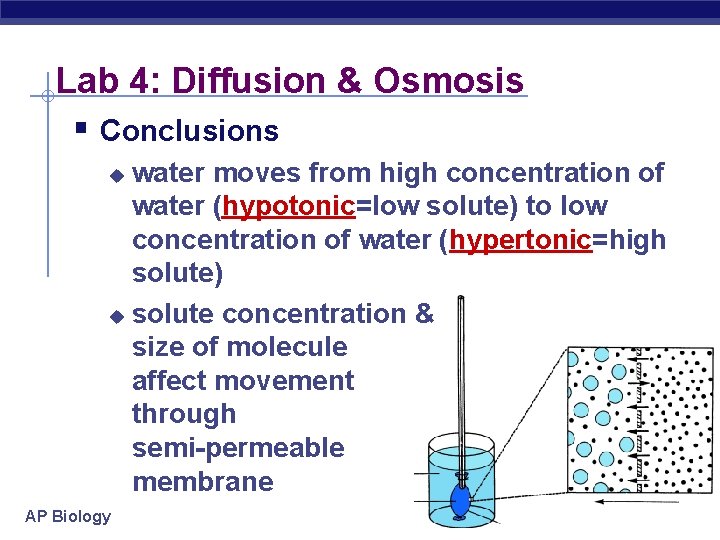
Lab 4: Diffusion & Osmosis § Conclusions water moves from high concentration of water (hypotonic=low solute) to low concentration of water (hypertonic=high solute) u solute concentration & size of molecule affect movement through semi-permeable membrane u AP Biology
Lab 4: Diffusion & Osmosis ESSAY 1992 A laboratory assistant prepared solutions of 0. 8 M, 0. 6 M, 0. 4 M, and 0. 2 M sucrose, but forgot to label them. After realizing the error, the assistant randomly labeled the flasks containing these four unknown solutions as flask A, flask B, flask C, and flask D. Design an experiment, based on the principles of diffusion and osmosis, that the assistant could use to determine which of the flasks contains each of the four unknown solutions. Include in your answer: a. a description of how you would set up and perform the experiment; b. the results you would expect from your experiment; and c. an explanation of those results based on the principles involved. Be sure to clearly state the principles addressed in your discussion. AP Biology
Lab 5: Photosynthesis AP Biology
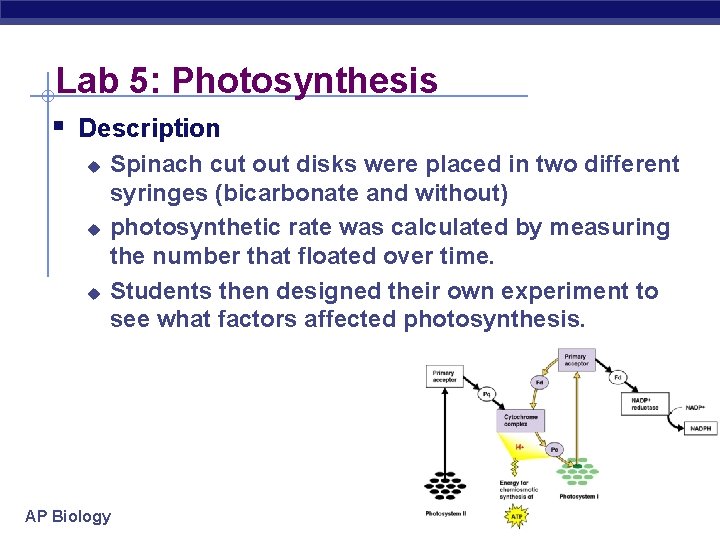
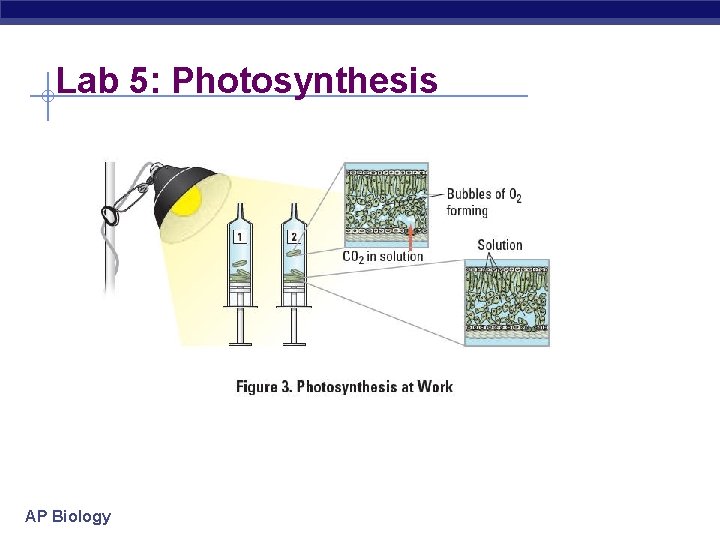
Lab 5: Photosynthesis § Description u u u Spinach cut out disks were placed in two different syringes (bicarbonate and without) photosynthetic rate was calculated by measuring the number that floated over time. Students then designed their own experiment to see what factors affected photosynthesis. AP Biology
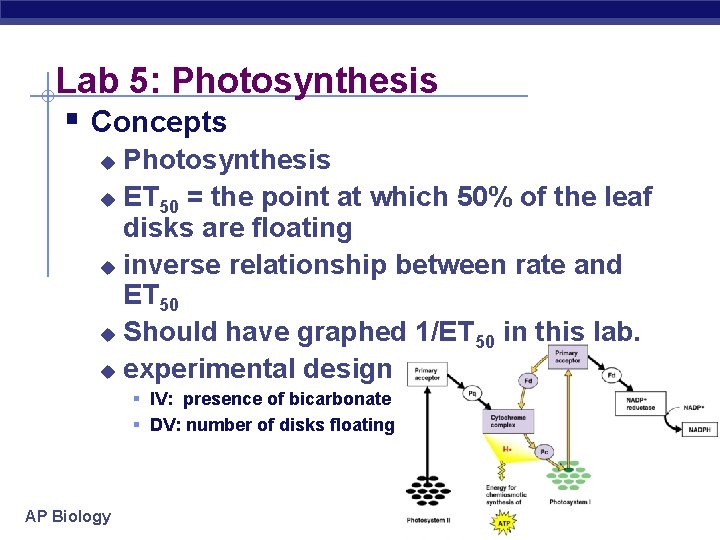
Lab 5: Photosynthesis § Concepts Photosynthesis u ET 50 = the point at which 50% of the leaf disks are floating u inverse relationship between rate and ET 50 u Should have graphed 1/ET 50 in this lab. u experimental design u § IV: presence of bicarbonate § DV: number of disks floating AP Biology
Lab 5: Photosynthesis § ESSAY 1999 -1: § The rate of photosynthesis may vary with changes that occur in § § environmental temperature, wavelength of light, and light intensity. Using a photosynthetic organism of your choice, choose only ONE of the three variables (temperature, wavelength of light, or light intensity) and for this variable design a scientific experiment to determine the effect of the variable on the rate of photosynthesis for the organism; explain how you would measure the rate of photosynthesis in your experiment; AP Biology
Lab 6: Cellular Respiration § Description u using respirometer to measure rate of O 2 production by pea seeds § § AP Biology non-germinating peas effect of temperature control for changes in pressure & temperature in room
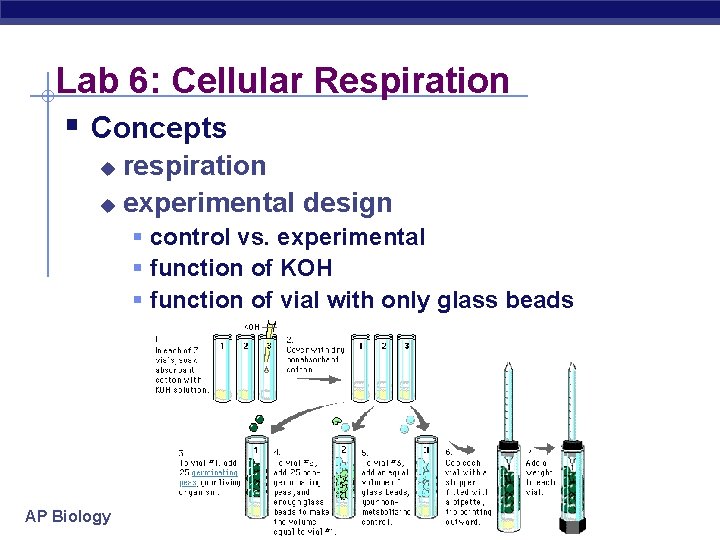
Lab 6: Cellular Respiration § Concepts respiration u experimental design u § control vs. experimental § function of KOH § function of vial with only glass beads AP Biology
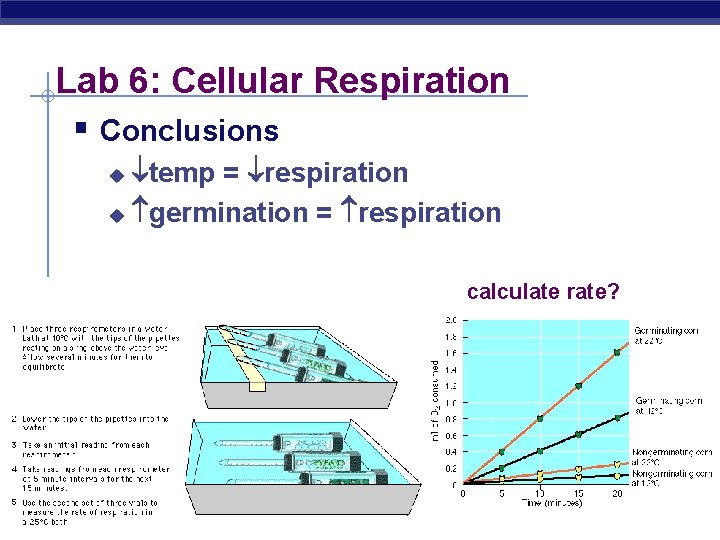
Lab 6: Cellular Respiration § Conclusions temp = respiration u germination = respiration u calculate rate? AP Biology
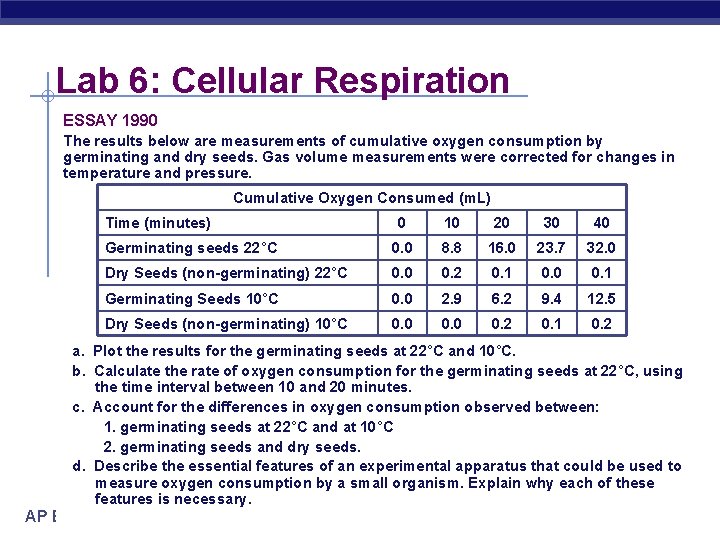
Lab 6: Cellular Respiration ESSAY 1990 The results below are measurements of cumulative oxygen consumption by germinating and dry seeds. Gas volume measurements were corrected for changes in temperature and pressure. Cumulative Oxygen Consumed (m. L) Time (minutes) 0 10 20 30 40 Germinating seeds 22°C 0. 0 8. 8 16. 0 23. 7 32. 0 Dry Seeds (non-germinating) 22°C 0. 0 0. 2 0. 1 0. 0 0. 1 Germinating Seeds 10°C 0. 0 2. 9 6. 2 9. 4 12. 5 Dry Seeds (non-germinating) 10°C 0. 0 0. 2 0. 1 0. 2 a. Plot the results for the germinating seeds at 22°C and 10°C. b. Calculate the rate of oxygen consumption for the germinating seeds at 22°C, using the time interval between 10 and 20 minutes. c. Account for the differences in oxygen consumption observed between: 1. germinating seeds at 22°C and at 10°C 2. germinating seeds and dry seeds. d. Describe the essential features of an experimental apparatus that could be used to measure oxygen consumption by a small organism. Explain why each of these features is necessary. AP Biology
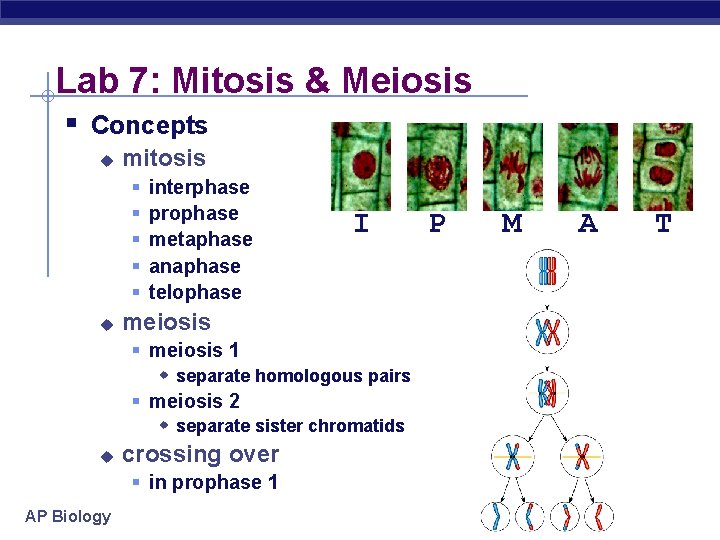
Lab 7: Mitosis & Meiosis § Concepts u mitosis § § § u interphase prophase metaphase anaphase telophase I meiosis § meiosis 1 w separate homologous pairs § meiosis 2 w separate sister chromatids u crossing over § in prophase 1 AP Biology P M A T
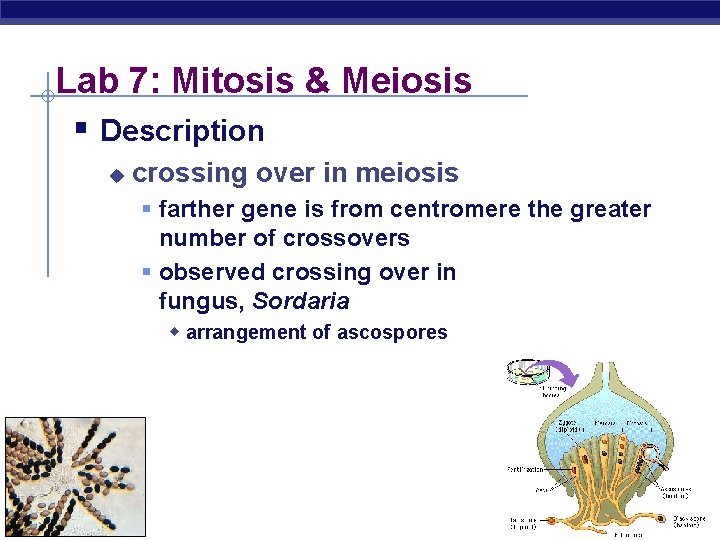
Lab 7: Mitosis & Meiosis § Description u crossing over in meiosis § farther gene is from centromere the greater number of crossovers § observed crossing over in fungus, Sordaria w arrangement of ascospores AP Biology
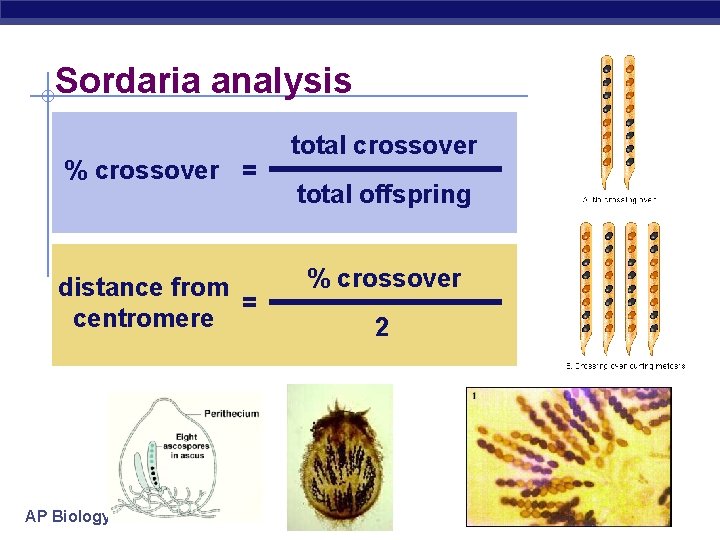
Sordaria analysis % crossover = distance from = centromere AP Biology total crossover total offspring % crossover 2
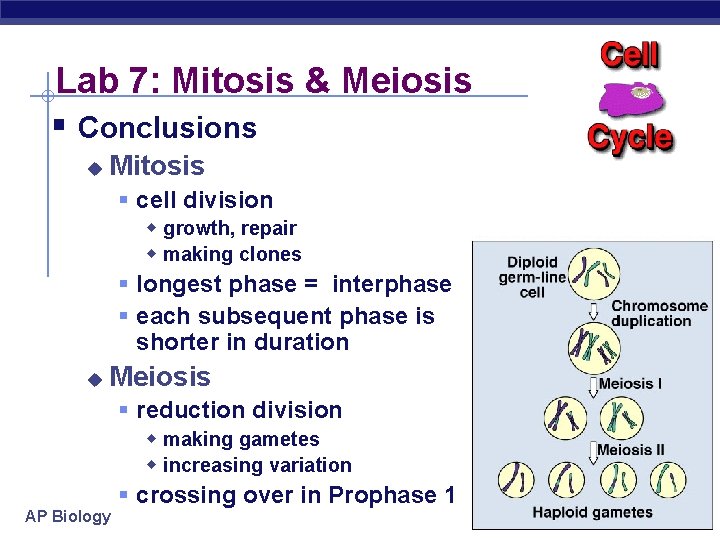
Lab 7: Mitosis & Meiosis § Conclusions u Mitosis § cell division w growth, repair w making clones § longest phase = interphase § each subsequent phase is shorter in duration u Meiosis AP Biology § reduction division w making gametes w increasing variation § crossing over in Prophase 1
Lab 7: Mitosis & Meiosis ESSAY 1987 Discuss the process of cell division in animals. Include a description of mitosis and cytokinesis, and of the other phases of the cell cycle. Do not include meiosis. ESSAY 2004 Meiosis reduces chromosome number and rearranges genetic information. a. Explain how the reduction and rearrangement are accomplished in meiosis. b. Several human disorders occur as a result of defects in the meiotic process. Identify ONE such chromosomal abnormality; what effects does it have on the phenotype of people with the disorder? Describe how this abnormality could result from a defect in meiosis. c. Production of offspring by parthenogenesis or cloning bypasses the typical meiotic process. Describe either parthenogenesis or cloning and compare the genomes of the offspring with those of the parents. AP Biology
Lab 8: Molecular Biology AP Biology
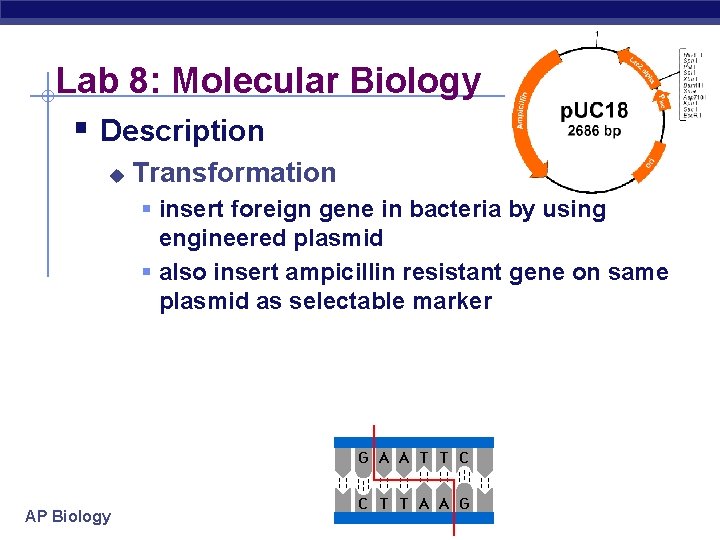
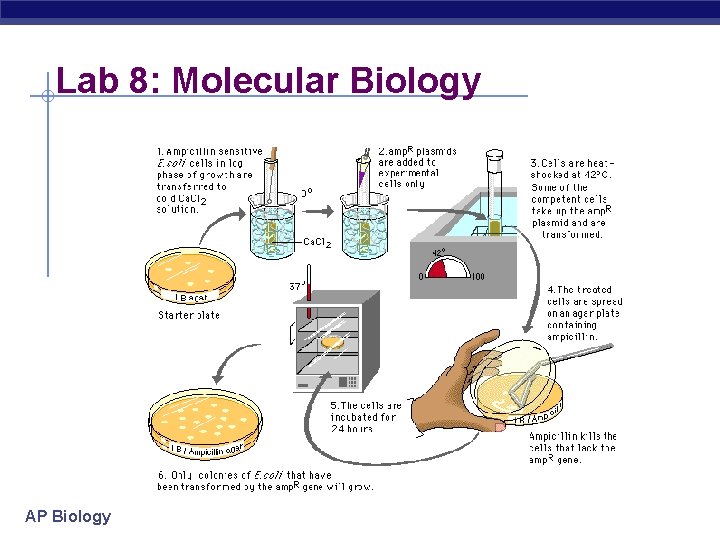
Lab 8: Molecular Biology § Description u Transformation § insert foreign gene in bacteria by using engineered plasmid § also insert ampicillin resistant gene on same plasmid as selectable marker AP Biology
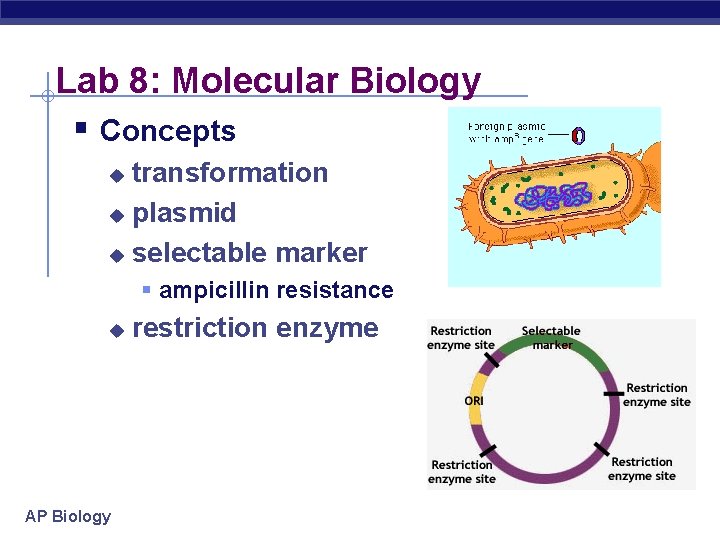
Lab 8: Molecular Biology § Concepts transformation u plasmid u selectable marker u § ampicillin resistance u AP Biology restriction enzyme
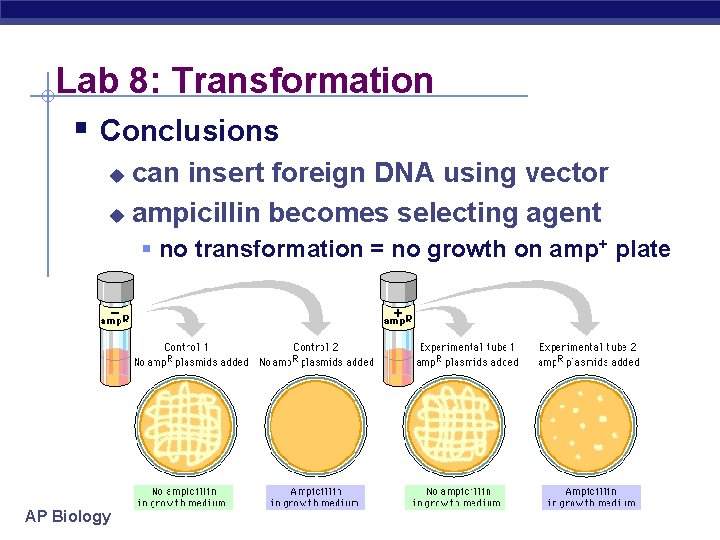
Lab 8: Transformation § Conclusions can insert foreign DNA using vector u ampicillin becomes selecting agent u § no transformation = no growth on amp+ plate AP Biology
Lab 8: Molecular Biology ESSAY 2002 The human genome illustrates both continuity and change. a. Describe the essential features of two of the procedures/techniques below. For each of the procedures/techniques you describe, explain how its application contributes to understanding genetics. § § § The use of a bacterial plasmid to clone and sequence a human gene Polymerase chain reaction (PCR) Restriction fragment polymorphism (RFLP analysis) b. All humans are nearly identical genetically in coding sequences and have many proteins that are identical in structure and function. Nevertheless, each human has a unique DNA fingerprint. Explain this apparent contradiction. AP Biology
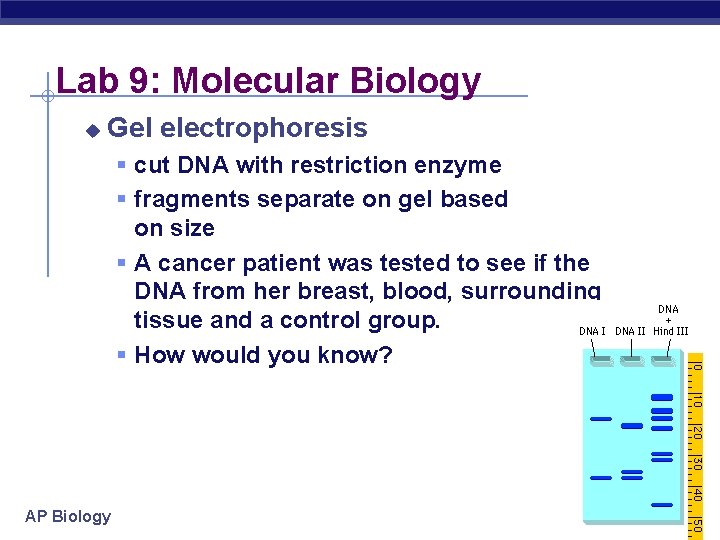
Lab 9: Molecular Biology u Gel electrophoresis § cut DNA with restriction enzyme § fragments separate on gel based on size § A cancer patient was tested to see if the DNA from her breast, blood, surrounding tissue and a control group. § How would you know? AP Biology
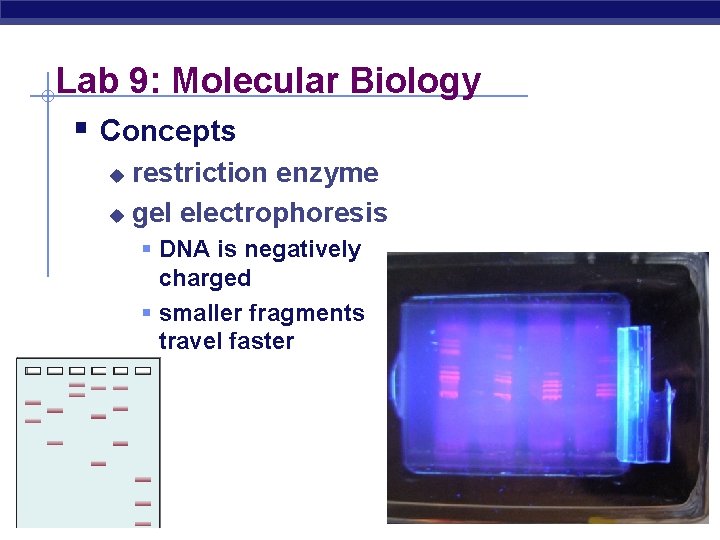
Lab 9: Molecular Biology § Concepts restriction enzyme u gel electrophoresis u § DNA is negatively charged § smaller fragments travel faster AP Biology
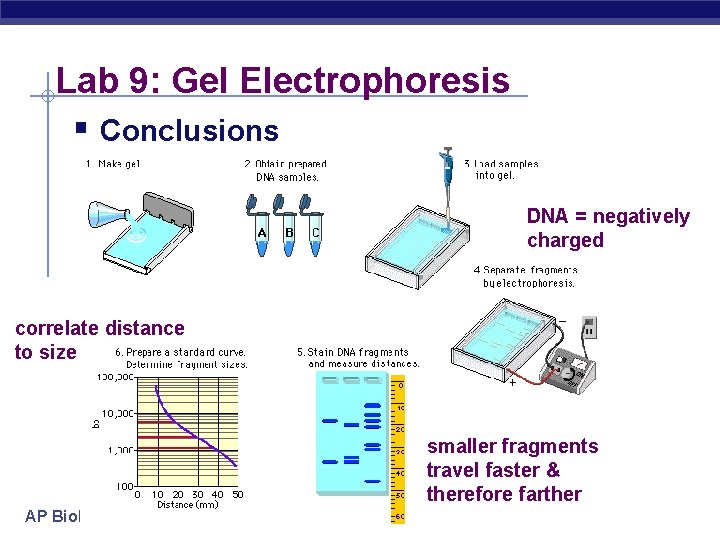
Lab 9: Gel Electrophoresis § Conclusions DNA = negatively charged correlate distance to size smaller fragments travel faster & therefore farther AP Biology
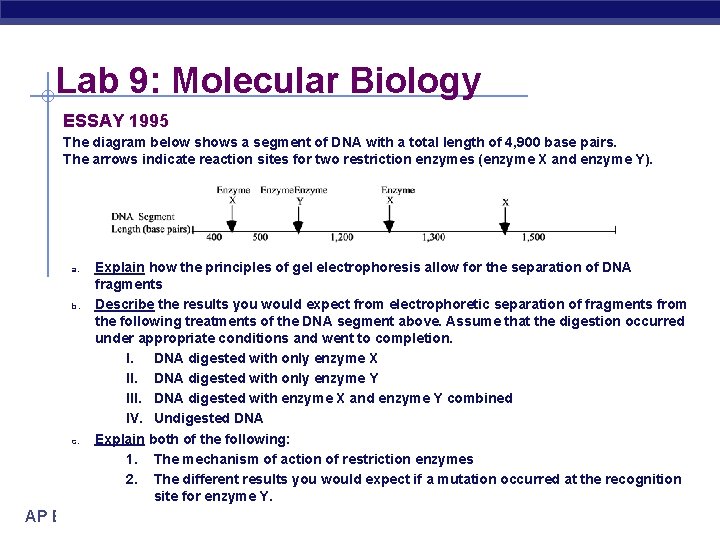
Lab 9: Molecular Biology ESSAY 1995 The diagram below shows a segment of DNA with a total length of 4, 900 base pairs. The arrows indicate reaction sites for two restriction enzymes (enzyme X and enzyme Y). a. b. c. Explain how the principles of gel electrophoresis allow for the separation of DNA fragments Describe the results you would expect from electrophoretic separation of fragments from the following treatments of the DNA segment above. Assume that the digestion occurred under appropriate conditions and went to completion. I. DNA digested with only enzyme X II. DNA digested with only enzyme Y III. DNA digested with enzyme X and enzyme Y combined IV. Undigested DNA Explain both of the following: 1. The mechanism of action of restriction enzymes 2. The different results you would expect if a mutation occurred at the recognition site for enzyme Y. AP Biology
Lab 10: Energy Dynamics § Description u Part I: Net primary productivity of Fast Plants§ Data was given on fast plants that were grown over 14 days. § Dry mass was divided by wet mass to obtain biomass. § Bio mass was multiplied by 4. 35 kcal to obtain net primary productivity per 10 plants and divided by 10 to get NPP per day per plant. AP Biology
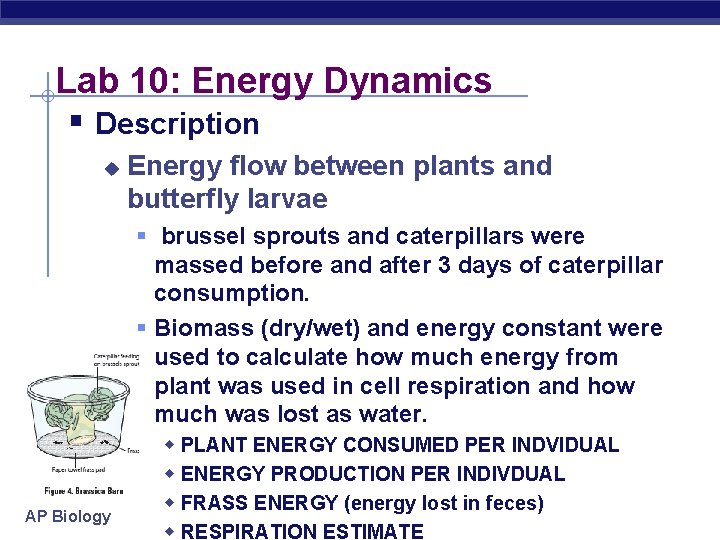
Lab 10: Energy Dynamics § Description u AP Biology Energy flow between plants and butterfly larvae § brussel sprouts and caterpillars were massed before and after 3 days of caterpillar consumption. § Biomass (dry/wet) and energy constant were used to calculate how much energy from plant was used in cell respiration and how much was lost as water. w PLANT ENERGY CONSUMED PER INDVIDUAL w ENERGY PRODUCTION PER INDIVDUAL w FRASS ENERGY (energy lost in feces) w RESPIRATION ESTIMATE
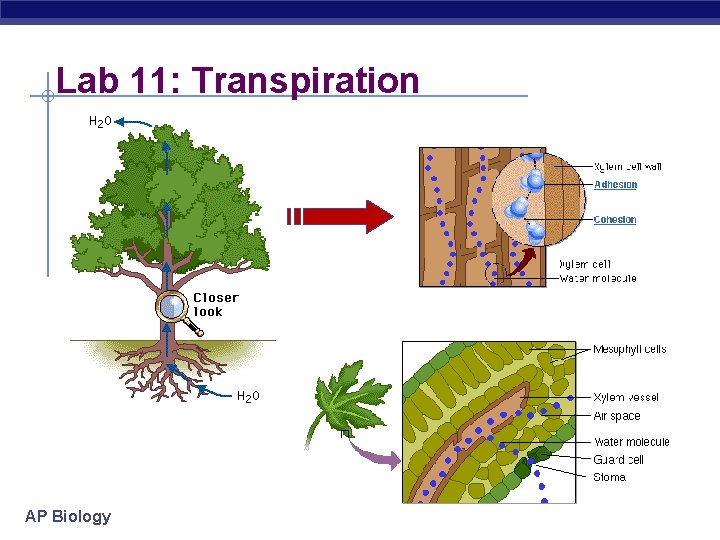
Lab 11: Transpiration AP Biology
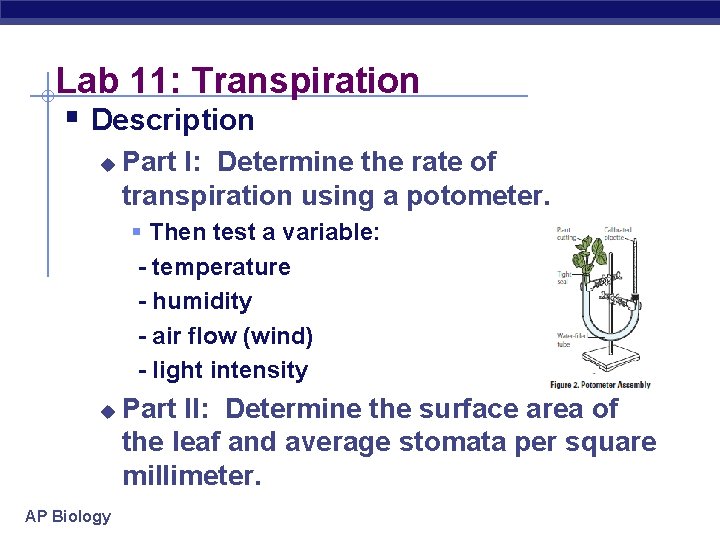
Lab 11: Transpiration § Description u Part I: Determine the rate of transpiration using a potometer. § Then test a variable: - temperature - humidity - air flow (wind) - light intensity u AP Biology Part II: Determine the surface area of the leaf and average stomata per square millimeter.
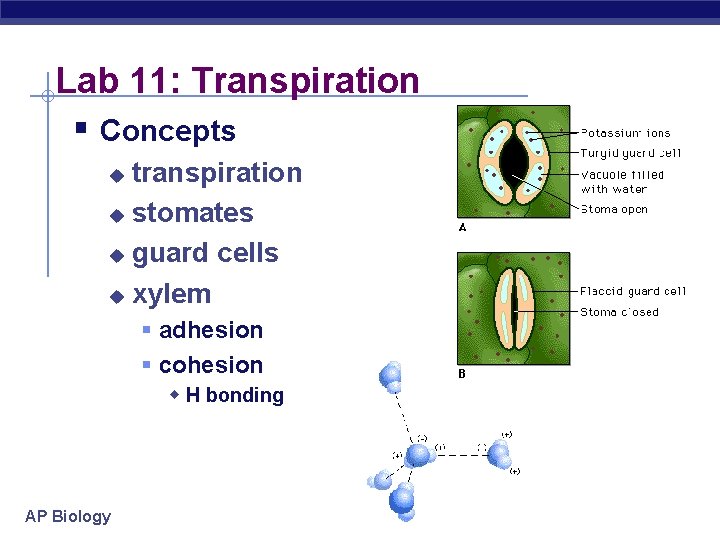
Lab 11: Transpiration § Concepts transpiration u stomates u guard cells u xylem u § adhesion § cohesion w H bonding AP Biology
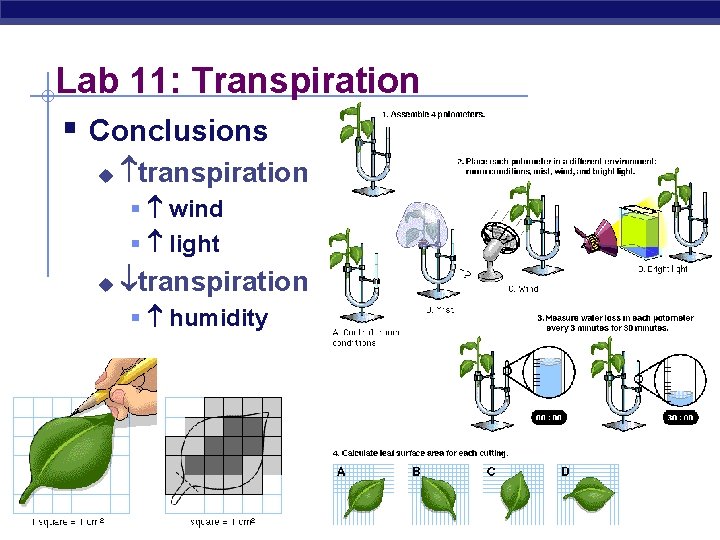
Lab 11: Transpiration § Conclusions u transpiration § wind § light u transpiration § humidity AP Biology
Lab 11: Transpiration ESSAY 1991 A group of students designed an experiment to measure transpiration rates in a particular species of herbaceous plant. Plants were divided into four groups and were exposed to the following conditions. Group I: Group III: Group IV: Room conditions (light, low humidity, 20°C, little air movement. ) Room conditions with increased humidity. Room conditions with increased air movement (fan) Room conditions with additional light The cumulative water loss due to transpiration of water from each plant was measured at 10 -minute intervals for 30 minutes. Water loss was expressed as milliliters of water per square centimeter of leaf surface area. The data for all plants in Group I (room conditions) were averaged. The average cumulative water loss by the plants in Group I is presented in the table below. Average Cumulative Water Loss by the Plants in Group I 1. 2. 3. Time (minutes) Average Cumulative Water Loss (m. L H 2 O/cm 2) 10 3. 5 x 10 -4 20 7. 7 x 10 -4 30 10. 6 x 10 -4 Construct and label a graph using the data for Group I. Using the same set of axes, draw and label three additional lines representing the results that you would predict for Groups II, III, and IV. Explain how biological and physical processes are responsible for the difference between each of your predictions and the data for Group I. Explain how the concept of water potential is used to account for the movement of water from the plant stem to the atmosphere during transpiration. AP Biology
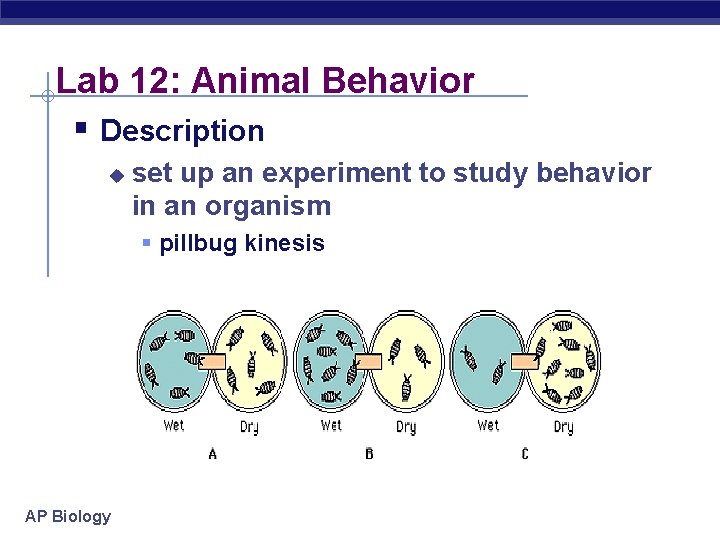
Lab 12: Animal Behavior § Description u set up an experiment to study behavior in an organism § pillbug kinesis AP Biology
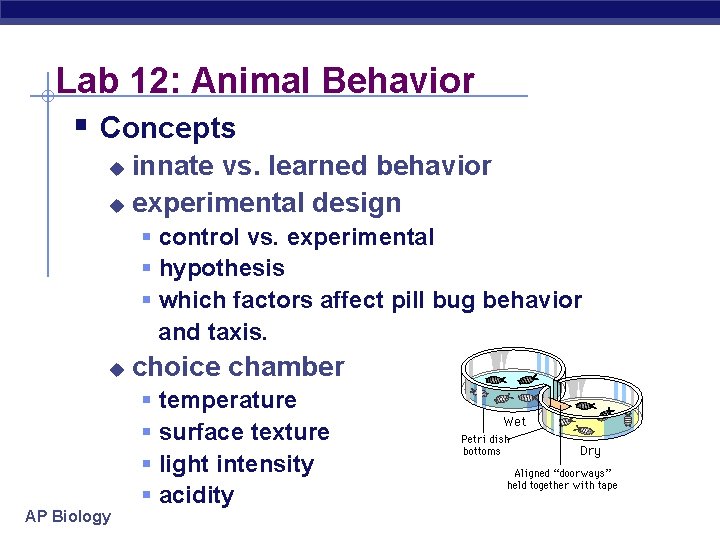
Lab 12: Animal Behavior § Concepts innate vs. learned behavior u experimental design u § control vs. experimental § hypothesis § which factors affect pill bug behavior and taxis. u AP Biology choice chamber § § temperature surface texture light intensity acidity
Lab 12: Animal Behavior § Hypothesis development Poor: I think pillbugs will move toward the wet side of a choice chamber. u Better: If pillbugs prefer a moist environment, then when they are randomly placed on both sides of a wet/dry choice chamber and allowed to move about freely for 10 minutes, most will be found on the wet side. u AP Biology
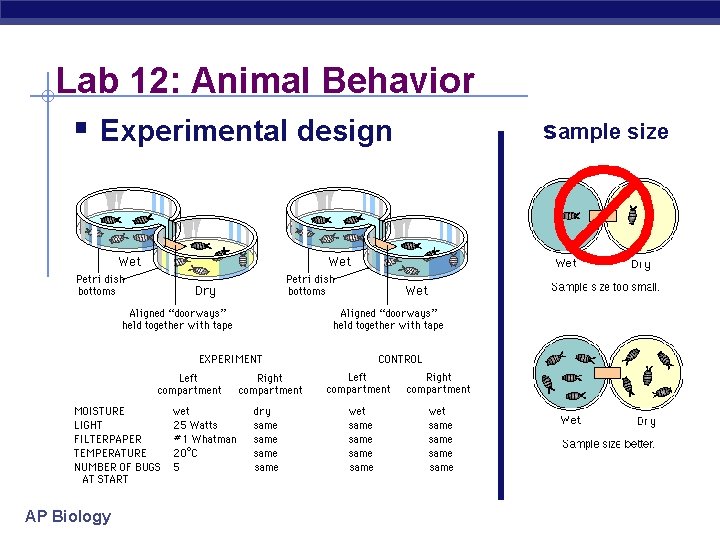
Lab 12: Animal Behavior § Experimental design AP Biology sample size
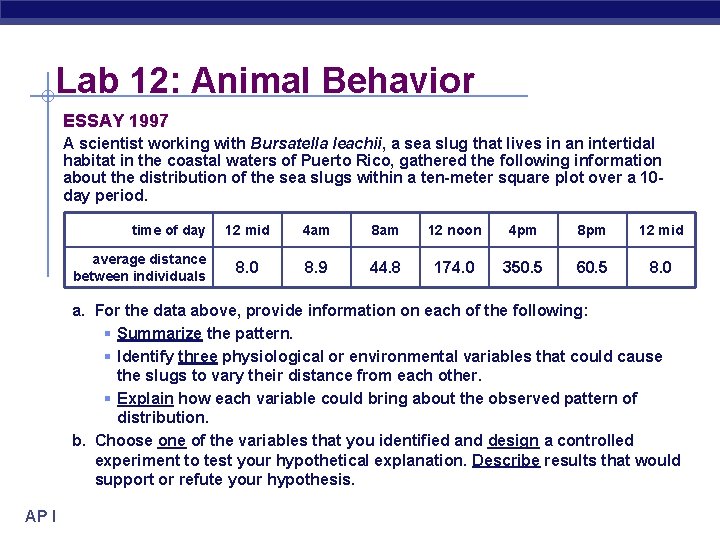
Lab 12: Animal Behavior ESSAY 1997 A scientist working with Bursatella leachii, a sea slug that lives in an intertidal habitat in the coastal waters of Puerto Rico, gathered the following information about the distribution of the sea slugs within a ten-meter square plot over a 10 day period. time of day average distance between individuals 12 mid 4 am 8 am 12 noon 4 pm 8 pm 12 mid 8. 0 8. 9 44. 8 174. 0 350. 5 60. 5 8. 0 a. For the data above, provide information on each of the following: § Summarize the pattern. § Identify three physiological or environmental variables that could cause the slugs to vary their distance from each other. § Explain how each variable could bring about the observed pattern of distribution. b. Choose one of the variables that you identified and design a controlled experiment to test your hypothetical explanation. Describe results that would support or refute your hypothesis. AP Biology
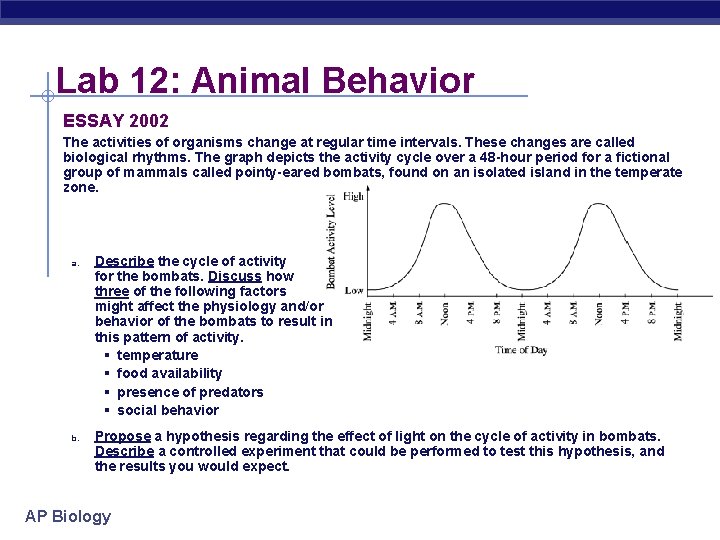
Lab 12: Animal Behavior ESSAY 2002 The activities of organisms change at regular time intervals. These changes are called biological rhythms. The graph depicts the activity cycle over a 48 -hour period for a fictional group of mammals called pointy-eared bombats, found on an isolated island in the temperate zone. a. b. Describe the cycle of activity for the bombats. Discuss how three of the following factors might affect the physiology and/or behavior of the bombats to result in this pattern of activity. § temperature § food availability § presence of predators § social behavior Propose a hypothesis regarding the effect of light on the cycle of activity in bombats. Describe a controlled experiment that could be performed to test this hypothesis, and the results you would expect. AP Biology
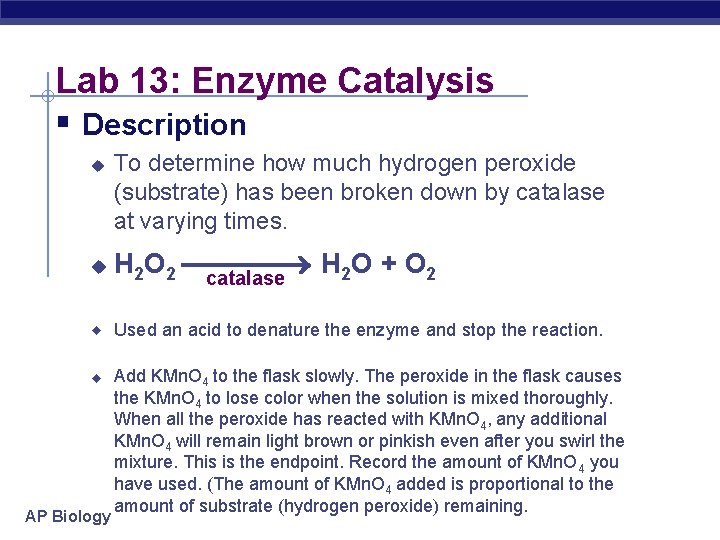
Lab 13: Enzyme Catalysis § Description u To determine how much hydrogen peroxide (substrate) has been broken down by catalase at varying times. u H 2 O 2 H 2 O + O 2 catalase u Used an acid to denature the enzyme and stop the reaction. u AP Biology Add KMn. O 4 to the flask slowly. The peroxide in the flask causes the KMn. O 4 to lose color when the solution is mixed thoroughly. When all the peroxide has reacted with KMn. O 4, any additional KMn. O 4 will remain light brown or pinkish even after you swirl the mixture. This is the endpoint. Record the amount of KMn. O 4 you have used. (The amount of KMn. O 4 added is proportional to the amount of substrate (hydrogen peroxide) remaining.
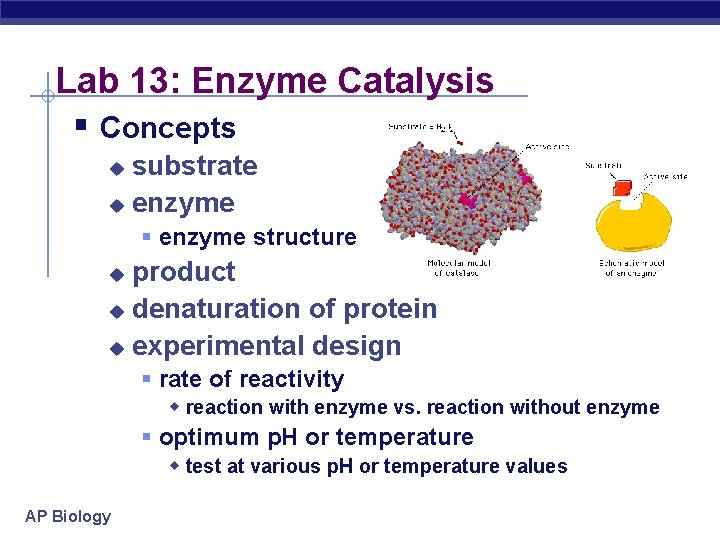
Lab 13: Enzyme Catalysis § Concepts substrate u enzyme u § enzyme structure product u denaturation of protein u experimental design u § rate of reactivity w reaction with enzyme vs. reaction without enzyme § optimum p. H or temperature w test at various p. H or temperature values AP Biology
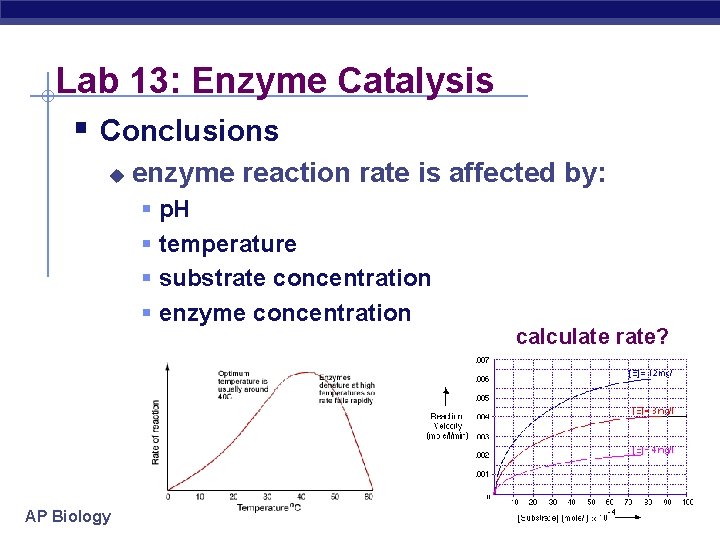
Lab 13: Enzyme Catalysis § Conclusions u enzyme reaction rate is affected by: § § AP Biology p. H temperature substrate concentration enzyme concentration calculate rate?
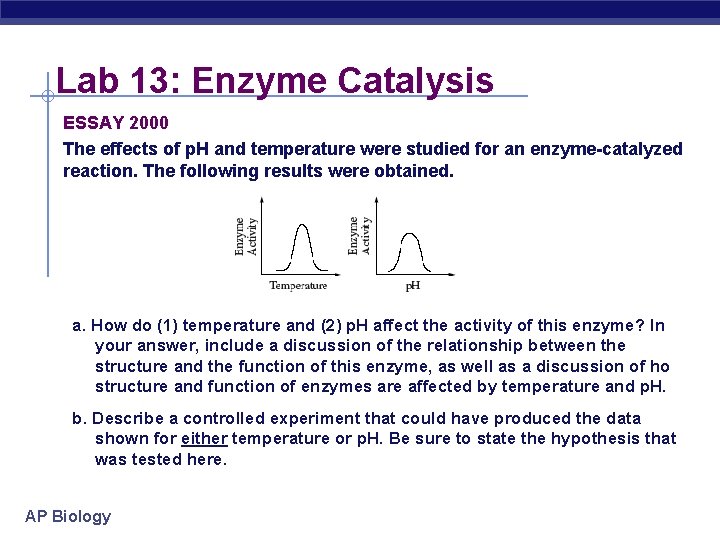
Lab 13: Enzyme Catalysis ESSAY 2000 The effects of p. H and temperature were studied for an enzyme-catalyzed reaction. The following results were obtained. a. How do (1) temperature and (2) p. H affect the activity of this enzyme? In your answer, include a discussion of the relationship between the structure and the function of this enzyme, as well as a discussion of ho structure and function of enzymes are affected by temperature and p. H. b. Describe a controlled experiment that could have produced the data shown for either temperature or p. H. Be sure to state the hypothesis that was tested here. AP Biology
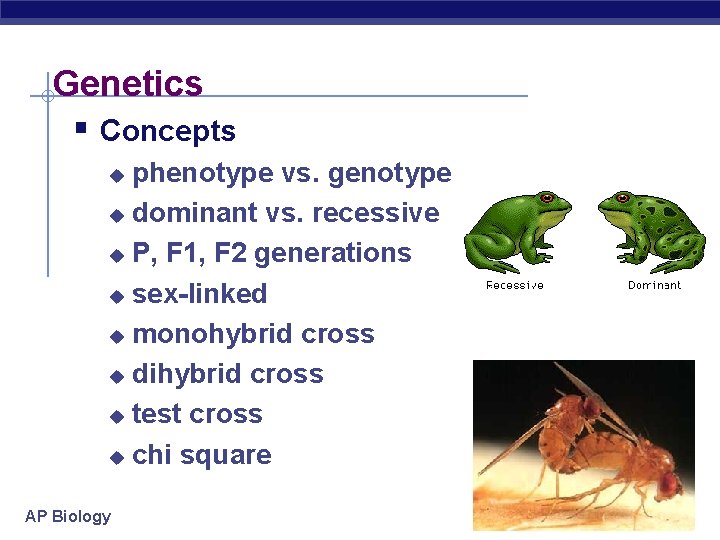
Genetics § Concepts phenotype vs. genotype u dominant vs. recessive u P, F 1, F 2 generations u sex-linked u monohybrid cross u dihybrid cross u test cross u chi square u AP Biology
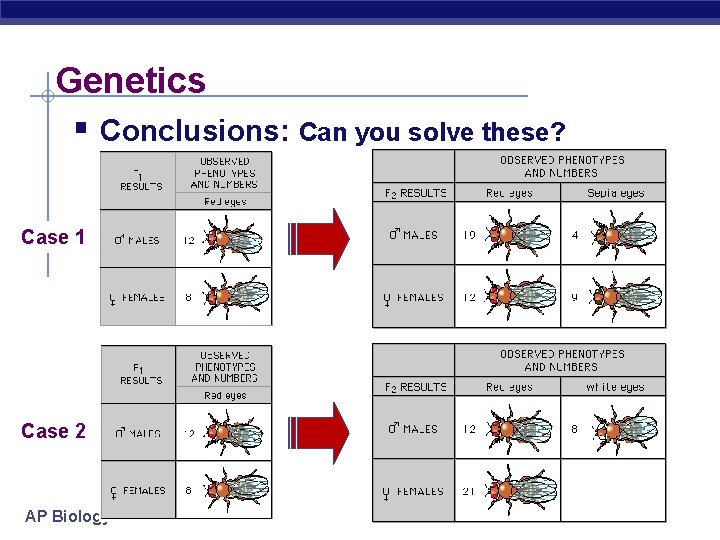
Genetics § Conclusions: Can you solve these? Case 1 Case 2 AP Biology
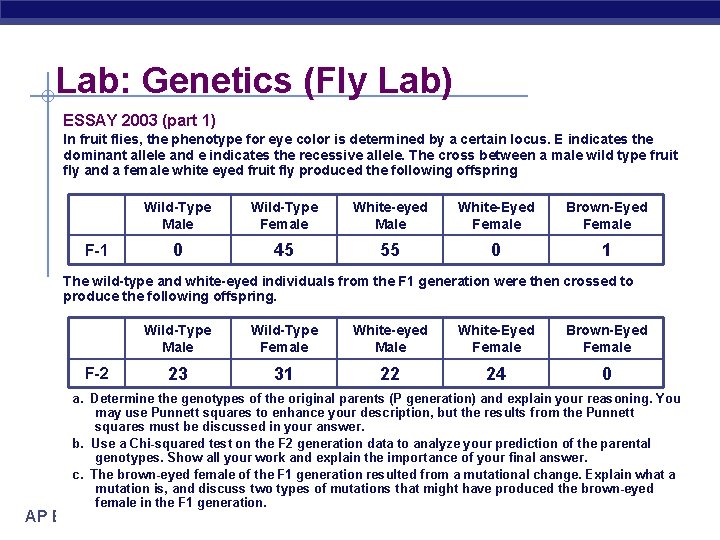
Lab: Genetics (Fly Lab) ESSAY 2003 (part 1) In fruit flies, the phenotype for eye color is determined by a certain locus. E indicates the dominant allele and e indicates the recessive allele. The cross between a male wild type fruit fly and a female white eyed fruit fly produced the following offspring F-1 Wild-Type Male Wild-Type Female White-eyed Male White-Eyed Female Brown-Eyed Female 0 45 55 0 1 The wild-type and white-eyed individuals from the F 1 generation were then crossed to produce the following offspring. F-2 Wild-Type Male Wild-Type Female White-eyed Male White-Eyed Female Brown-Eyed Female 23 31 22 24 0 a. Determine the genotypes of the original parents (P generation) and explain your reasoning. You may use Punnett squares to enhance your description, but the results from the Punnett squares must be discussed in your answer. b. Use a Chi-squared test on the F 2 generation data to analyze your prediction of the parental genotypes. Show all your work and explain the importance of your final answer. c. The brown-eyed female of the F 1 generation resulted from a mutational change. Explain what a mutation is, and discuss two types of mutations that might have produced the brown-eyed female in the F 1 generation. AP Biology
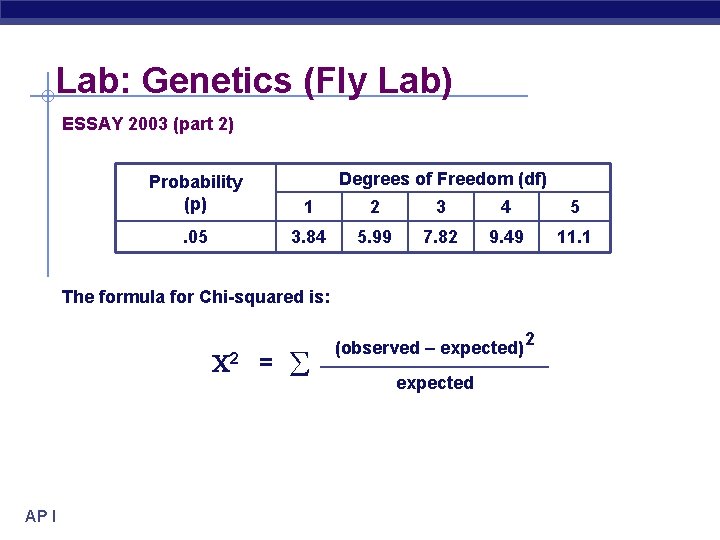
Lab: Genetics (Fly Lab) ESSAY 2003 (part 2) Degrees of Freedom (df) Probability (p) 1 2 3 4 5 . 05 3. 84 5. 99 7. 82 9. 49 11. 1 The formula for Chi-squared is: 2 = AP Biology (observed – expected)2 expected
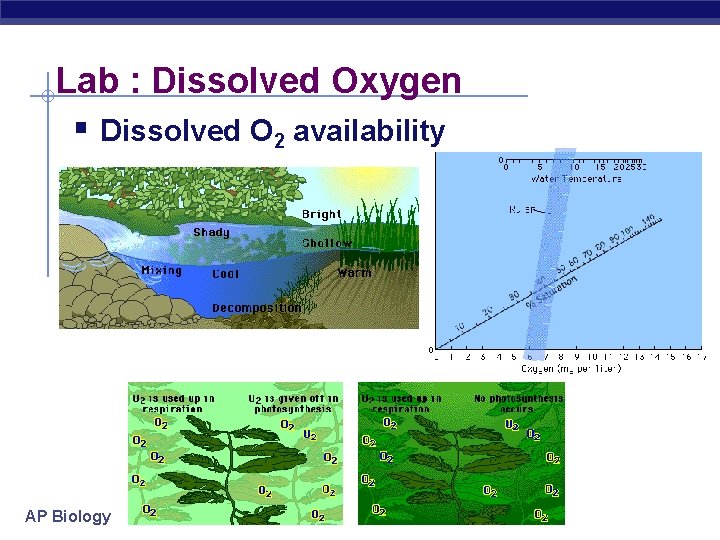
Lab : Dissolved Oxygen § Dissolved O 2 availability AP Biology
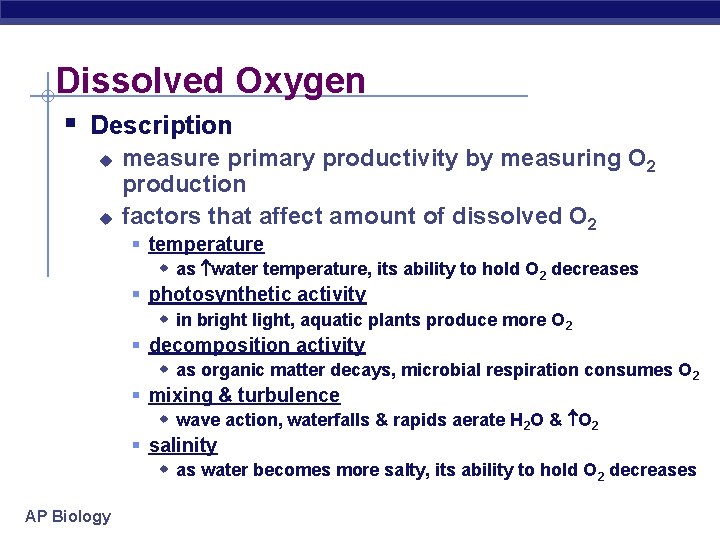
Dissolved Oxygen § Description u u measure primary productivity by measuring O 2 production factors that affect amount of dissolved O 2 § temperature w as water temperature, its ability to hold O 2 decreases § photosynthetic activity w in bright light, aquatic plants produce more O 2 § decomposition activity w as organic matter decays, microbial respiration consumes O 2 § mixing & turbulence w wave action, waterfalls & rapids aerate H 2 O & O 2 § salinity w as water becomes more salty, its ability to hold O 2 decreases AP Biology
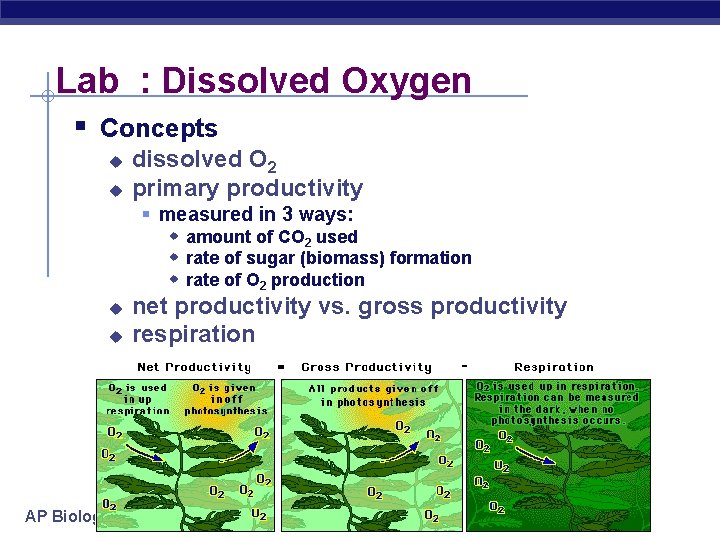
Lab : Dissolved Oxygen § Concepts u u dissolved O 2 primary productivity § measured in 3 ways: w amount of CO 2 used w rate of sugar (biomass) formation w rate of O 2 production u u AP Biology net productivity vs. gross productivity respiration
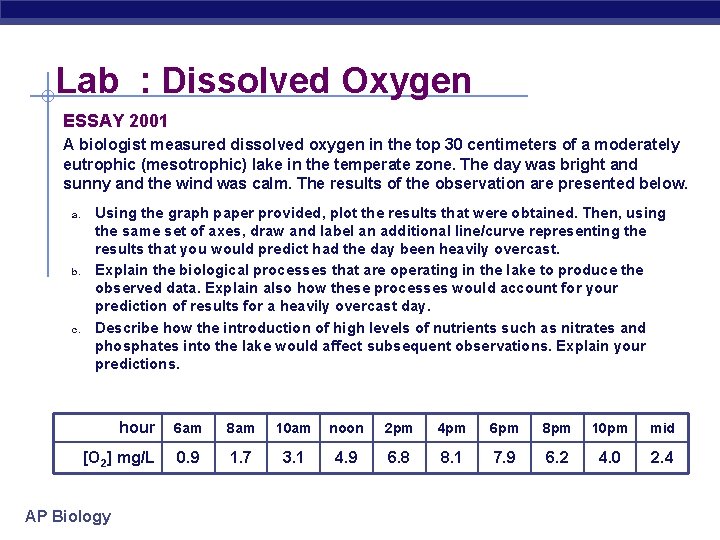
Lab : Dissolved Oxygen ESSAY 2001 A biologist measured dissolved oxygen in the top 30 centimeters of a moderately eutrophic (mesotrophic) lake in the temperate zone. The day was bright and sunny and the wind was calm. The results of the observation are presented below. a. b. c. Using the graph paper provided, plot the results that were obtained. Then, using the same set of axes, draw and label an additional line/curve representing the results that you would predict had the day been heavily overcast. Explain the biological processes that are operating in the lake to produce the observed data. Explain also how these processes would account for your prediction of results for a heavily overcast day. Describe how the introduction of high levels of nutrients such as nitrates and phosphates into the lake would affect subsequent observations. Explain your predictions. hour 6 am 8 am 10 am noon 2 pm 4 pm 6 pm 8 pm 10 pm mid [O 2] mg/L 0. 9 1. 7 3. 1 4. 9 6. 8 8. 1 7. 9 6. 2 4. 0 2. 4 AP Biology
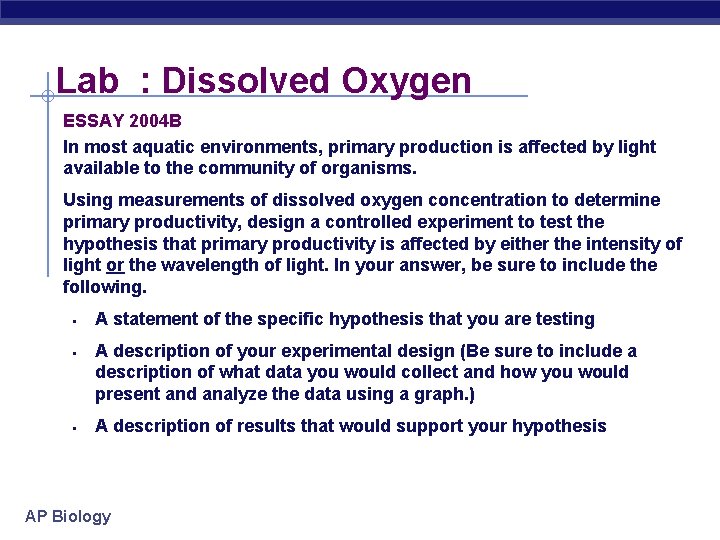
Lab : Dissolved Oxygen ESSAY 2004 B In most aquatic environments, primary production is affected by light available to the community of organisms. Using measurements of dissolved oxygen concentration to determine primary productivity, design a controlled experiment to test the hypothesis that primary productivity is affected by either the intensity of light or the wavelength of light. In your answer, be sure to include the following. § § § A statement of the specific hypothesis that you are testing A description of your experimental design (Be sure to include a description of what data you would collect and how you would present and analyze the data using a graph. ) A description of results that would support your hypothesis AP Biology
- Slides: 63