
La Te X Wireless Information Transmission System Lab
La. Te. X Wireless Information Transmission System Lab. Institute of Communications Engineering National Sun Yat-sen University 2010/07/16 王森弘
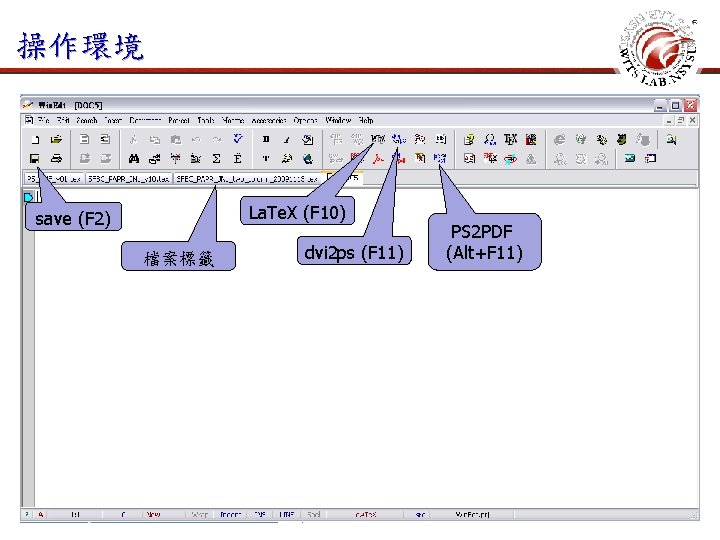
操作環境 La. Te. X (F 10) save (F 2) 檔案標籤 dvi 2 ps (F 11) PS 2 PDF (Alt+F 11)
![文稿結構 documentclass[12 pt, a 4 paper]{article} begin{document} newpage setcounter{page}{1} pagenumbering{roman} tableofcontents newpage listoffigures newpage](http://slidetodoc.com/presentation_image_h2/86995f32e2fe8121e23d72ee9f0fd63a/image-5.jpg "文稿結構 documentclass[12 pt, a 4 paper]{article} begin{document} newpage setcounter{page}{1} pagenumbering{roman} tableofcontents newpage listoffigures newpage")
文稿結構 documentclass[12 pt, a 4 paper]{article} begin{document} newpage setcounter{page}{1} pagenumbering{roman} tableofcontents newpage listoffigures newpage listoftables fontsize{12}{24 pt}selectfont newpage setcounter{page}{1} pagenumbering{arabic} section{Introduction} section{System Model} subsection{OFDM systems} subsubsection{Transmitter} end{document}
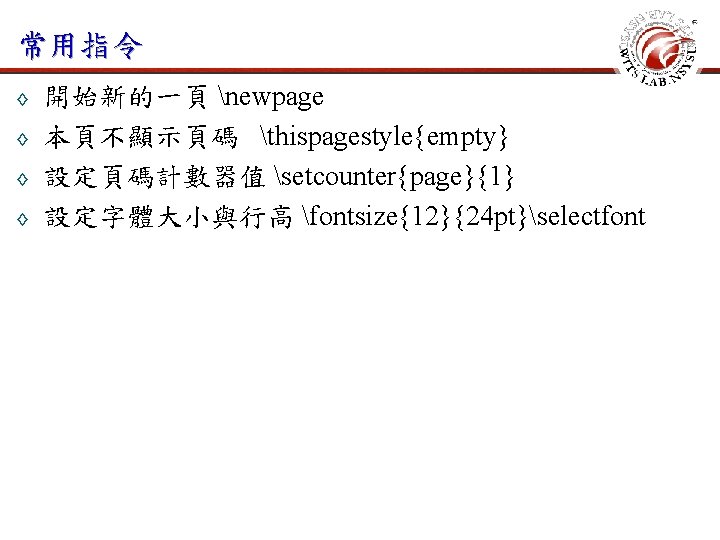
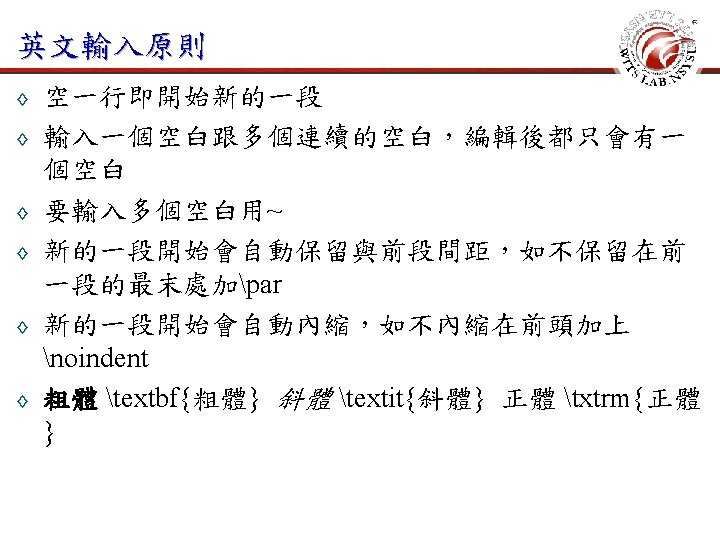
常用指令 ◊ ◊ 開始新的一頁 newpage 本頁不顯示頁碼 thispagestyle{empty} 設定頁碼計數器值 setcounter{page}{1} 設定字體大小與行高 fontsize{12}{24 pt}selectfont
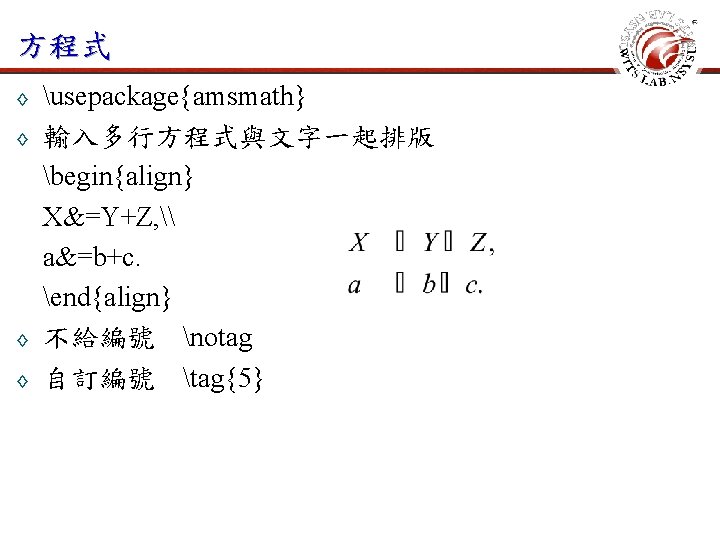
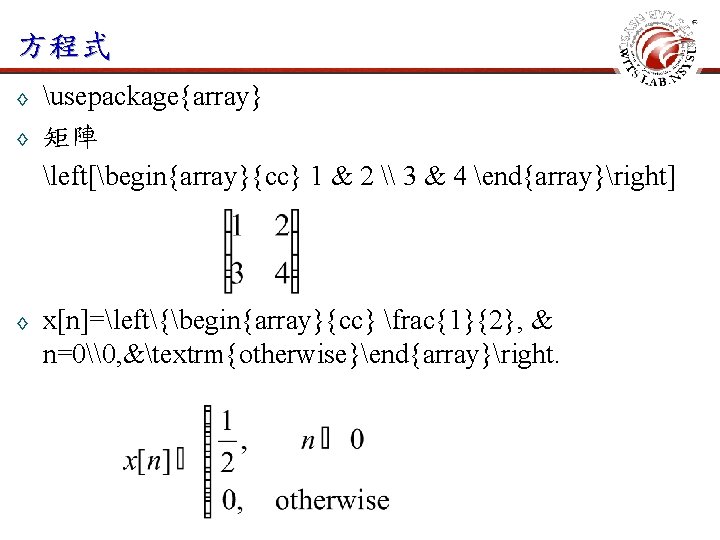
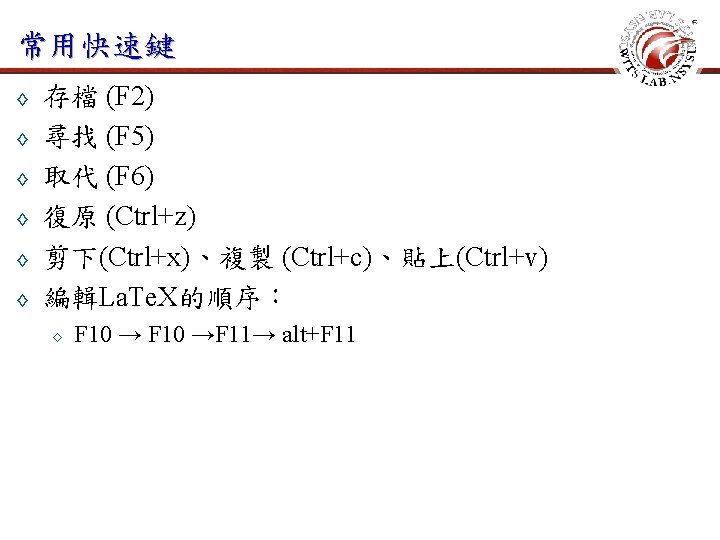
方程式 ◊ ◊ ◊ usepackage{array} 矩陣 left[begin{array}{cc} 1 & 2 \ 3 & 4 end{array}right] x[n]=left{begin{array}{cc} frac{1}{2}, & n=0\0, &textrm{otherwise}end{array}right.
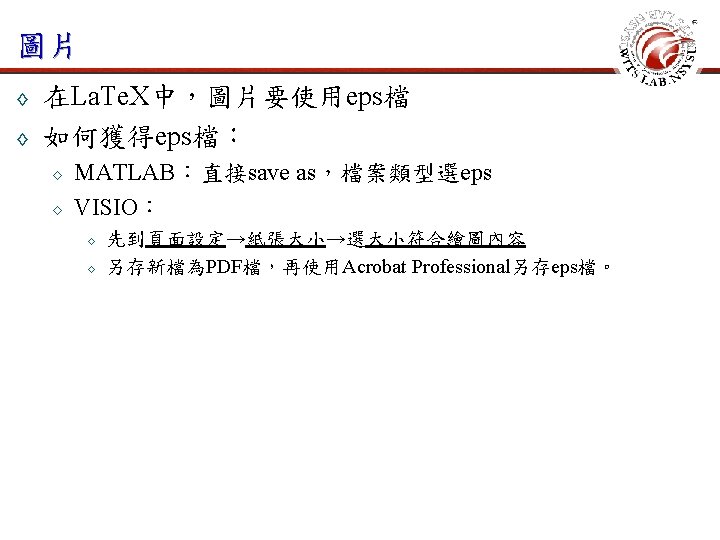
![圖片 begin{figure}[t] centering includegraphics[width = 6. 5 in]{OFDM_PAPR_JNL_fig 02. eps} caption{Architecture of Proposed Scheme](http://slidetodoc.com/presentation_image_h2/86995f32e2fe8121e23d72ee9f0fd63a/image-10.jpg "圖片 begin{figure}[t] centering includegraphics[width = 6. 5 in]{OFDM_PAPR_JNL_fig 02. eps} caption{Architecture of Proposed Scheme")
圖片 begin{figure}[t] centering includegraphics[width = 6. 5 in]{OFDM_PAPR_JNL_fig 02. eps} caption{Architecture of Proposed Scheme III. }label{PS_III} end{figure}
![表格 begin{table}[t] caption{Values of $u_{i 2}$, $u_{i 3}$, $u_{i 4}$, $i=1, 2, 3, 4$.](http://slidetodoc.com/presentation_image_h2/86995f32e2fe8121e23d72ee9f0fd63a/image-12.jpg "表格 begin{table}[t] caption{Values of $u_{i 2}$, $u_{i 3}$, $u_{i 4}$, $i=1, 2, 3, 4$.")
表格 begin{table}[t] caption{Values of $u_{i 2}$, $u_{i 3}$, $u_{i 4}$, $i=1, 2, 3, 4$. }label{coefficient_u} begin{center} begin{tabular}{c|c|c|c} hline $i$ & $u_{i 2}$ & $u_{i 3}$ & $u_{i 4}$\ hline ~~~~~1~~~~~ & ~~~~~1~~~~~\ hline ~~~~~2~~~~~ & ~~~~~$j$~~~~~ & ~~~~$-1$~~~~~ & ~~~~$-j$~~~~~\ hline ~~~~~3~~~~~ & ~~~~$-1$~~~~~ & ~~~~~1~~~~~ & ~~~~$-1$~~~~~\ hline ~~~~~4~~~~~ & ~~~~$-j$~~~~~ & ~~~~$-1$~~~~~ & ~~~~~$j$~~~~~\ hline end{tabular}% end{center} end{table}
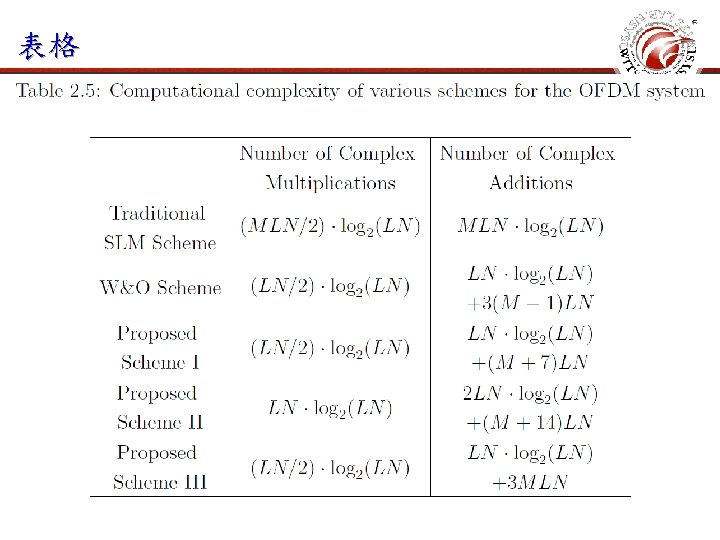
![表格 begin{table}[t] caption{Computational complexity of various schemes for the OFDM system}label{CC_analysis_OFDM} begin{center} begin{tabular}{c|c|c} hline](http://slidetodoc.com/presentation_image_h2/86995f32e2fe8121e23d72ee9f0fd63a/image-14.jpg "表格 begin{table}[t] caption{Computational complexity of various schemes for the OFDM system}label{CC_analysis_OFDM} begin{center} begin{tabular}{c|c|c} hline")
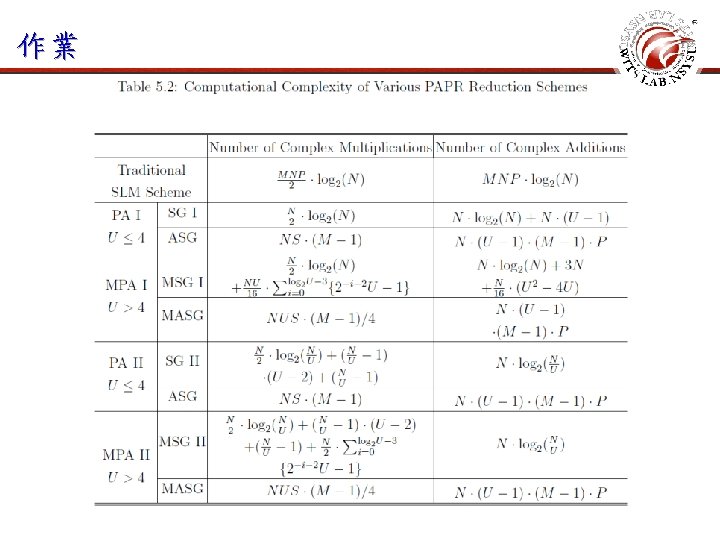
表格 begin{table}[t] caption{Computational complexity of various schemes for the OFDM system}label{CC_analysis_OFDM} begin{center} begin{tabular}{c|c|c} hline & $begin{array}{c} textrm{Number of Complex}~\ textrm{Multiplications} end{array}$ & $begin{array}{c} textrm{Number of Complex}~\ textrm{Additions}end{array}$ \ hline $begin{array}{c} textrm{Traditional}~\ textrm{SLM Scheme} end{array}$ & $(MLN/2) cdot log_2(LN)$ & $MLN cdot log_2(LN)$ \ hline $begin{array}{c} textrm{W&O}~textrm{Scheme} end{array}$ & $(LN/2) cdot log_2(LN)$ & $begin{array}{c}LN cdot log_2(LN)\+3(M-1)LNend{array}$ \ hline $begin{array}{c} textrm{Proposed}~\ textrm{Scheme I}end{array}$ & $begin{array}{c}(LN/2)cdot log_2(LN)end{array}$ & $begin{array}{c}LN cdot log_2(LN)\+(M+7)LNend{array}$\ hline $begin{array}{c} textrm{Proposed}~\ textrm{Scheme II}end{array}$ & $begin{array}{c}LNcdot log_2(LN)end{array}$ & $begin{array}{c}2 LN cdot log_2(LN)\+(M+14)LNend{array}$\ hline $begin{array}{c} textrm{Proposed}~\ textrm{Scheme III}end{array}$ & $begin{array}{c}(LN/2)cdot log_2(LN)end{array}$ & $begin{array}{c}LN cdot log_2(LN)\+3 MLNend{array}$\ hline end{tabular} end{center} end{table}
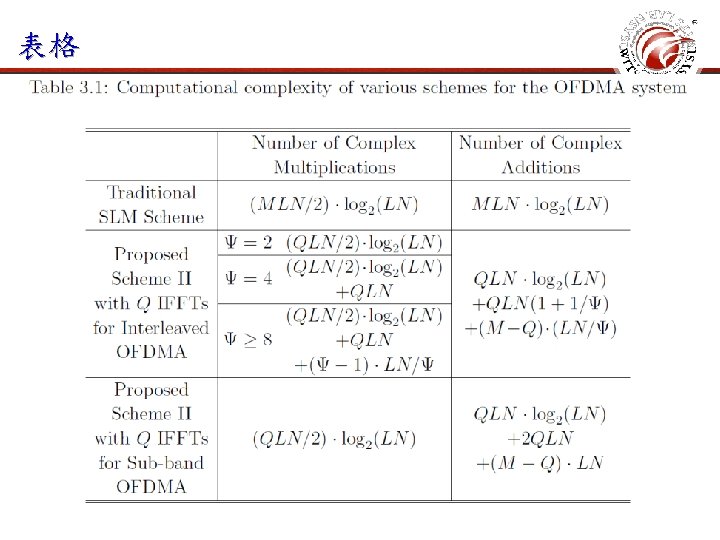
![表格 begin{table}[t] caption{Computational complexity of various schemes for the OFDMA system} label{CC_analysis} begin{center} extrarowheight=1](http://slidetodoc.com/presentation_image_h2/86995f32e2fe8121e23d72ee9f0fd63a/image-16.jpg "表格 begin{table}[t] caption{Computational complexity of various schemes for the OFDMA system} label{CC_analysis} begin{center} extrarowheight=1")
表格 begin{table}[t] caption{Computational complexity of various schemes for the OFDMA system} label{CC_analysis} begin{center} extrarowheight=1 pt doublerulesep=1 pt tabcolsep=-0. 5 pt begin{tabular}{c|c|c|c} hline & multicolumn{2}{c}{$begin{array}{c} textrm{Number of Complex}\ textrm{Multiplications} end{array}$}vline & $begin{array}{c} textrm{Number of Complex}\ textrm{Additions}end{array}$ \ hline $begin{array}{c} textrm{Traditional} \ textrm{SLM Scheme} end{array}$ & multicolumn{2}{c}{$(MLN/2) cdot log_2(LN)$}vline & $MLN cdot log_2(LN)$ \ hline multirow{6}*{$begin{array}{c} textrm{Proposed}\textrm{Scheme II}\ textrm{with $Q$ IFFTs}\ textrm{for Interleaved}\ textrm{OFDMA}end{array}$} & $~Psi=2~$ & $(QLN/2)!cdot! log_2(LN)$ & multirow{6}*{$begin{array}{c}QLN cdot log_2(LN) \+QLN(1+1/Psi)\ +(M!-!Q)!cdot! (LN/Psi)end{array}$}\ cline{2 -3}&$~Psi=4~$ & $begin{array}{c} (QLN/2)!cdot! log_2(LN)\ +QLNend{array}$ & \ cline{2 -3}&$~Psigeq 8~$ & $begin{array}{c} (QLN/2)!cdot! log_2(LN) \ +QLN\+(Psi-1)cdot LN/Psiend{array}$& \ hline $begin{array}{c} textrm{Proposed}\textrm{Scheme II}\ textrm{with $Q$ IFFTs}\ textrm{for Sub-band}\ textrm{OFDMA}end{array}$ & multicolumn{2}{c}{$begin{array}{c}(QLN/2)cdot log_2(LN)end{array}$} vline& $begin{array}{c}QLN cdot log_2(LN) \+2 QLN\ +(M-Q)cdot LNend{array}$\ hline end{tabular}% end{center} end{table}
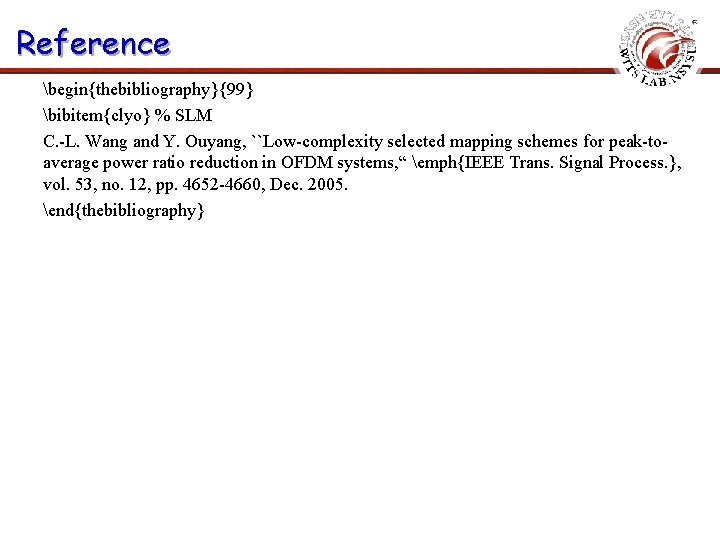
Reference begin{thebibliography}{99} bibitem{clyo} % SLM C. -L. Wang and Y. Ouyang, ``Low-complexity selected mapping schemes for peak-toaverage power ratio reduction in OFDM systems, “ emph{IEEE Trans. Signal Process. }, vol. 53, no. 12, pp. 4652 -4660, Dec. 2005. end{thebibliography}
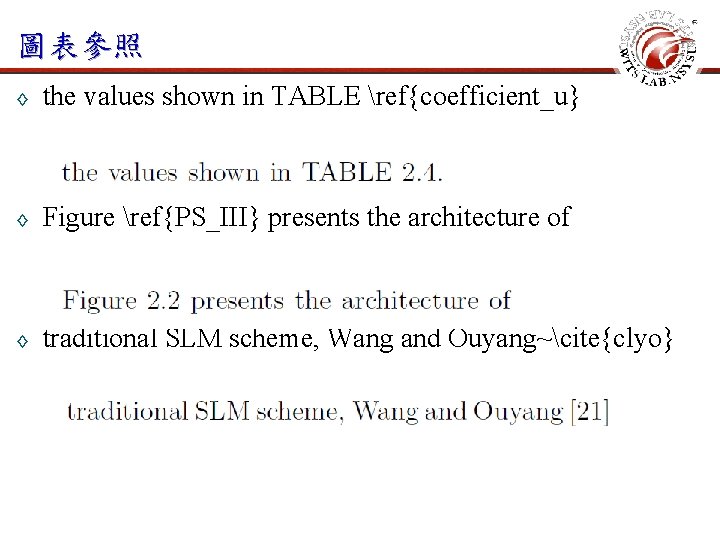
圖表參照 ◊ the values shown in TABLE ref{coefficient_u} ◊ Figure ref{PS_III} presents the architecture of ◊ traditional SLM scheme, Wang and Ouyang~cite{clyo}
編號 ◊ ◊ ◊ numberwithin{equation}{section} numberwithin{figure}{section} numberwithin{table}{section}
![定理 ◊ newtheorem{theo}{Theorem}[section] newtheorem{lemm}{Lemma}[section] ◊ begin{theo} ◊ end{theo} ◊ begin{proof} end{proof}](http://slidetodoc.com/presentation_image_h2/86995f32e2fe8121e23d72ee9f0fd63a/image-20.jpg "定理 ◊ newtheorem{theo}{Theorem}[section] newtheorem{lemm}{Lemma}[section] ◊ begin{theo} ◊ end{theo} ◊ begin{proof} end{proof}")
定理 ◊ newtheorem{theo}{Theorem}[section] newtheorem{lemm}{Lemma}[section] ◊ begin{theo} ◊ end{theo} ◊ begin{proof} end{proof}
- Slides: 21