
La minimizzazione del rischio di eventi avversi nelle






- Slides: 38
La minimizzazione del rischio di eventi avversi nelle nuove terapie per la Sclerosi Multipla Anna Maria Repice
Disclosures • Dr. Anna Maria Repice has recived honoraria for public speaking, advisory board and travel grants by Novartis, Merck Serono, Biogen, Sanofi Genzyme, Teva, Roche
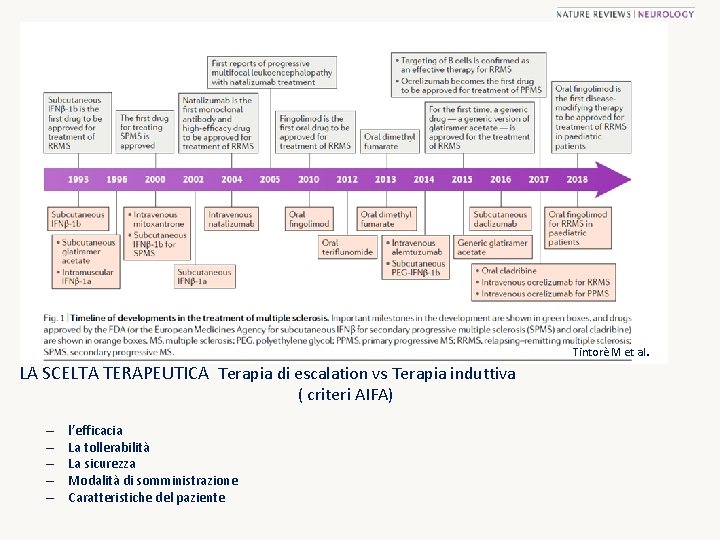
LA SCELTA TERAPEUTICA Terapia di escalation vs Terapia induttiva ( criteri AIFA) – – – l’efficacia La tollerabilità La sicurezza Modalità di somministrazione Caratteristiche del paziente Tintorè M et al.
Farmaci di seconda linea • Sicurezza – – – Reazioni di infusione Infezioni Tumori Parametri ematologici Gravidanza • I nuovi farmaci - Alemtuzumab - Cladribina - Ocrelizumab
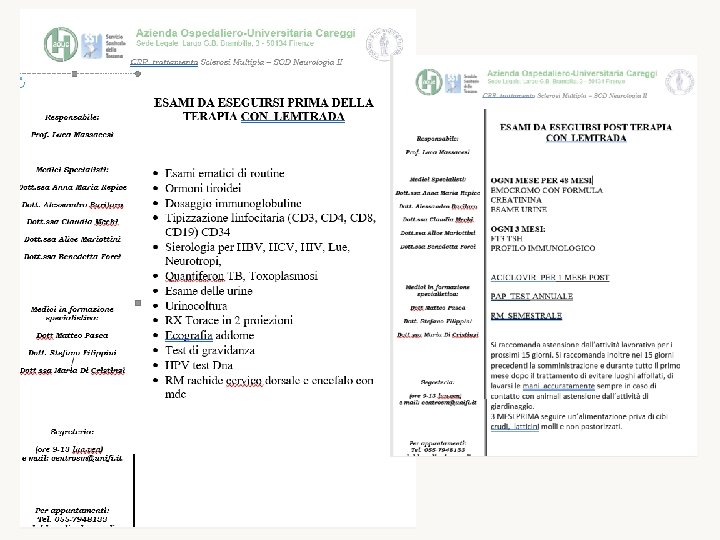
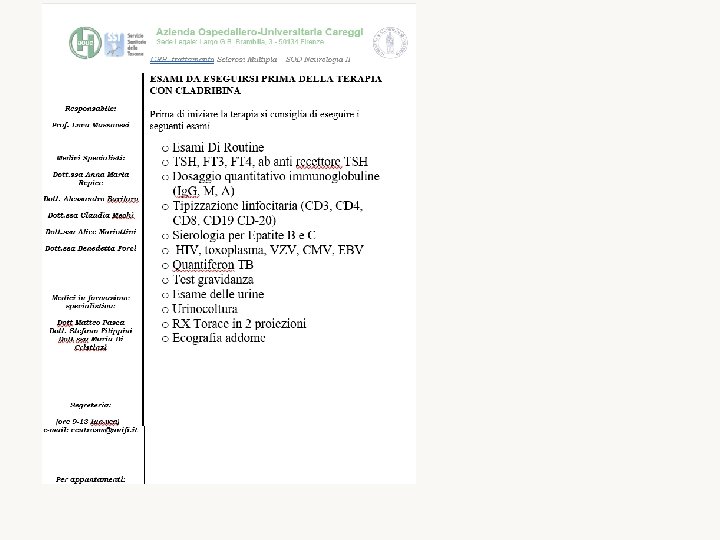
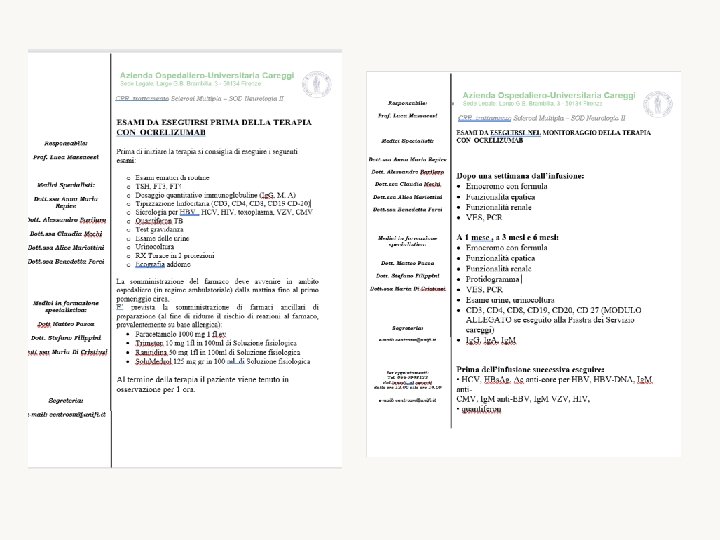
Minimizzazione del rischio • Fase di screening • Esami di laboratorio • Esami strumentali • vaccinazioni • Fase di monitoraggio • Esami di laboratorio
Farmaci di seconda linea • Sicurezza – – – Reazioni di infusione Infezioni Tumori Parametri ematologici Gravidanza • I nuovi farmaci - Alemtuzumab - Cladribina - Ocrelizumab
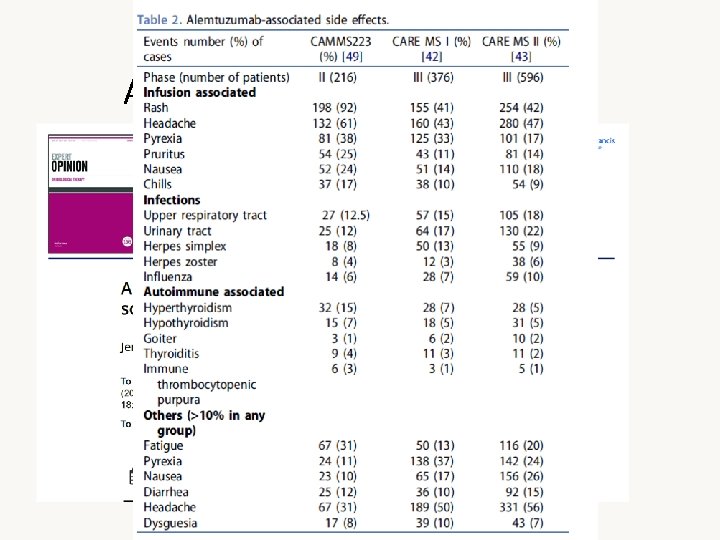
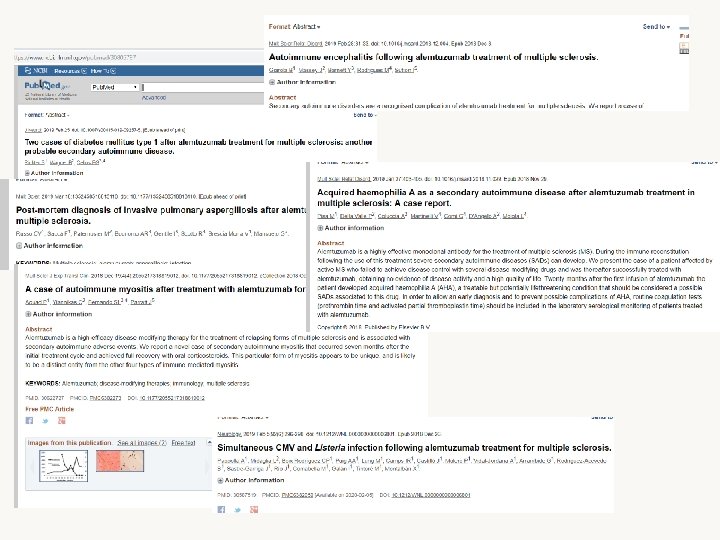
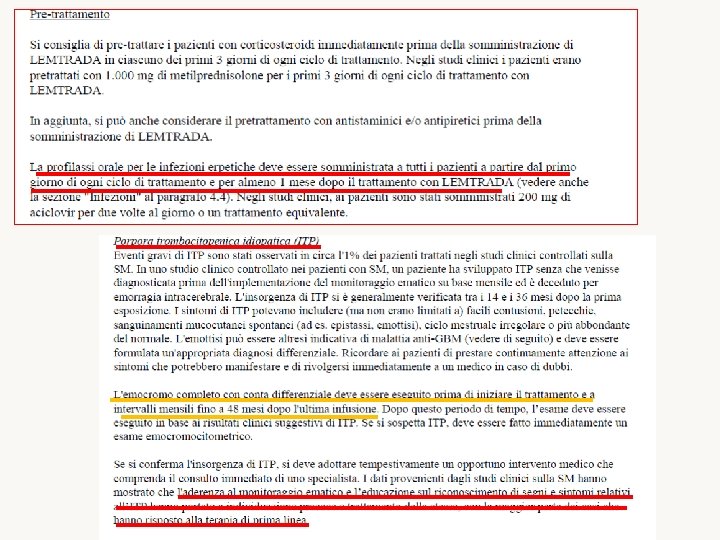
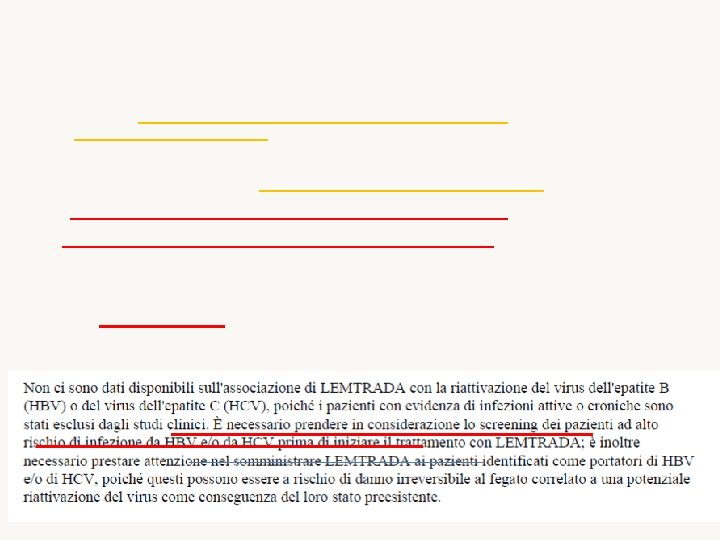
Alemtuzumab AE studi registrativi e real life
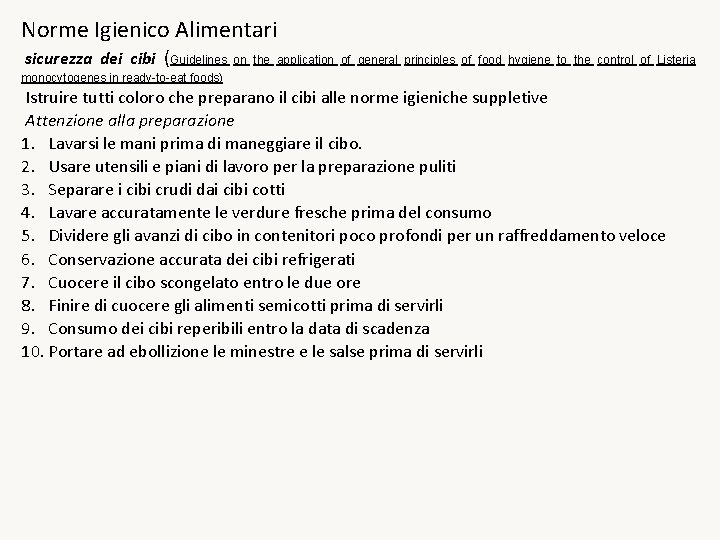
Norme Igienico Alimentari sicurezza dei cibi (Guidelines on the application of general principles of food hygiene to the control of Listeria monocytogenes in ready-to-eat foods) Istruire tutti coloro che preparano il cibi alle norme igieniche suppletive Attenzione alla preparazione 1. Lavarsi le mani prima di maneggiare il cibo. 2. Usare utensili e piani di lavoro per la preparazione puliti 3. Separare i cibi crudi dai cibi cotti 4. Lavare accuratamente le verdure fresche prima del consumo 5. Dividere gli avanzi di cibo in contenitori poco profondi per un raffreddamento veloce 6. Conservazione accurata dei cibi refrigerati 7. Cuocere il cibo scongelato entro le due ore 8. Finire di cuocere gli alimenti semicotti prima di servirli 9. Consumo dei cibi reperibili entro la data di scadenza 10. Portare ad ebollizione le minestre e le salse prima di servirli
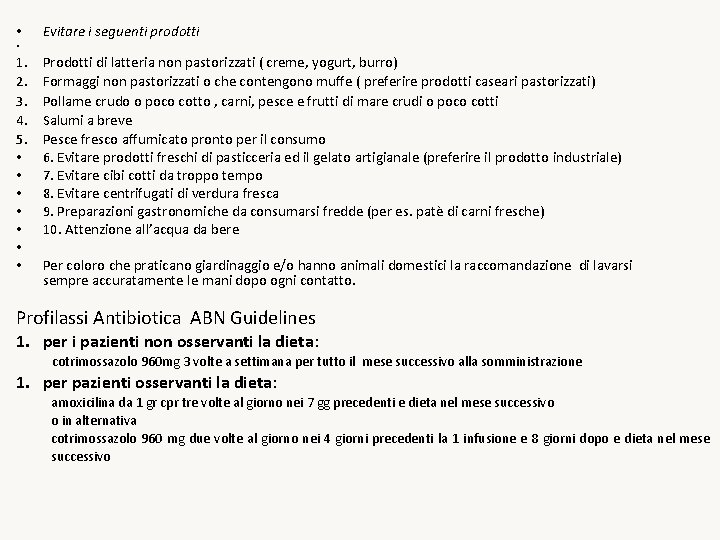
• Evitare i seguenti prodotti • 1. 2. 3. 4. 5. • • Prodotti di latteria non pastorizzati ( creme, yogurt, burro) Formaggi non pastorizzati o che contengono muffe ( preferire prodotti caseari pastorizzati) Pollame crudo o poco cotto , carni, pesce e frutti di mare crudi o poco cotti Salumi a breve Pesce fresco affumicato pronto per il consumo 6. Evitare prodotti freschi di pasticceria ed il gelato artigianale (preferire il prodotto industriale) 7. Evitare cibi cotti da troppo tempo 8. Evitare centrifugati di verdura fresca 9. Preparazioni gastronomiche da consumarsi fredde (per es. patè di carni fresche) 10. Attenzione all’acqua da bere Per coloro che praticano giardinaggio e/o hanno animali domestici la raccomandazione di lavarsi sempre accuratamente le mani dopo ogni contatto. Profilassi Antibiotica ABN Guidelines 1. per i pazienti non osservanti la dieta: cotrimossazolo 960 mg 3 volte a settimana per tutto il mese successivo alla somministrazione 1. per pazienti osservanti la dieta: amoxicilina da 1 gr cpr tre volte al giorno nei 7 gg precedenti e dieta nel mese successivo o in alternativa cotrimossazolo 960 mg due volte al giorno nei 4 giorni precedenti la 1 infusione e 8 giorni dopo e dieta nel mese successivo
Farmaci di seconda linea • Sicurezza – – – Reazioni di infusione Infezioni Tumori Parametri ematologici Gravidanza • I nuovi farmaci - Alemtuzumab - Cladribina - Ocrelizumab
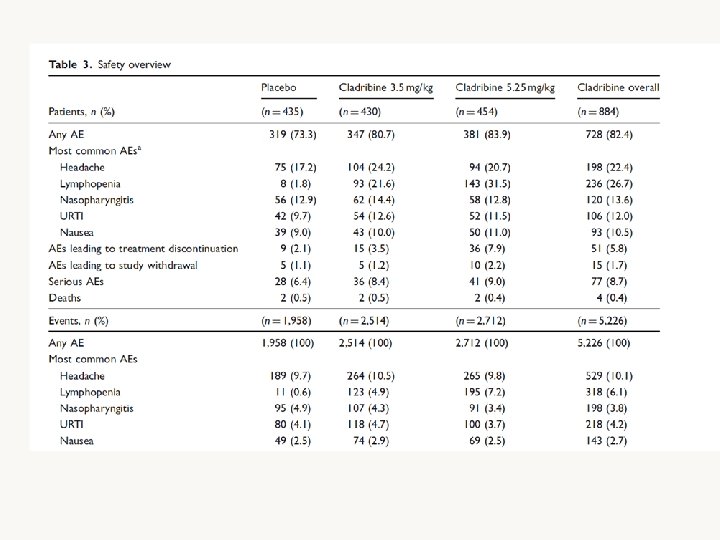
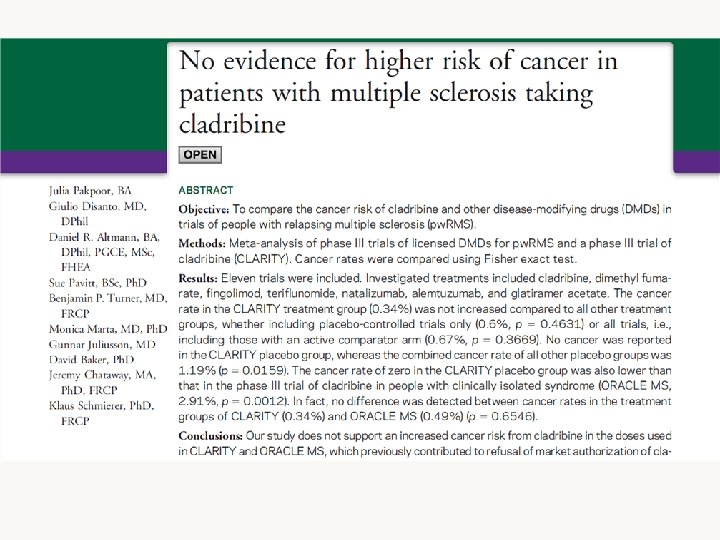
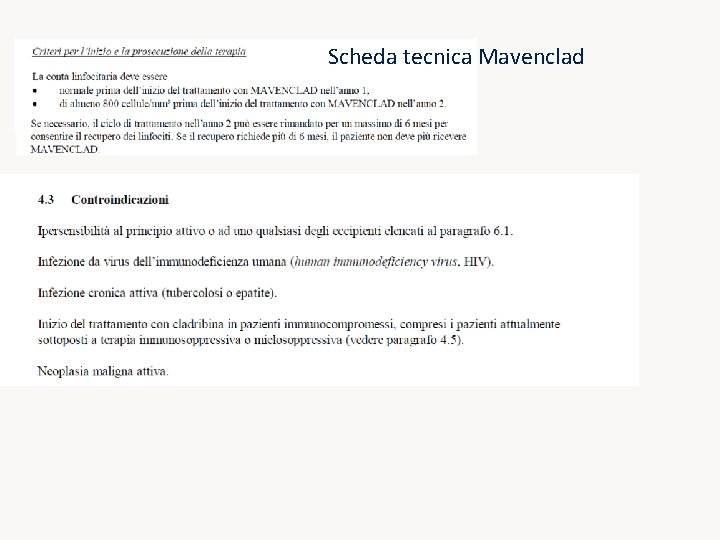
Scheda tecnica Mavenclad
Farmaci di seconda linea • Sicurezza – – – Reazioni di infusione Infezioni Tumori Parametri ematologici Gravidanza • I nuovi farmaci - Alemtuzumab - Cladribina - Ocrelizumab
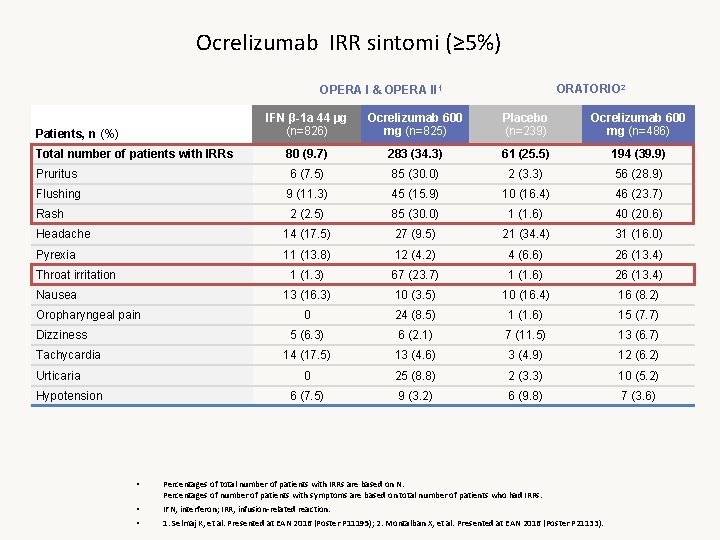
Ocrelizumab IRR sintomi (≥ 5%) ORATORIO 2 OPERA I & OPERA II 1 IFN β-1 a 44 µg (n=826) Ocrelizumab 600 mg (n=825) Placebo (n=239) Ocrelizumab 600 mg (n=486) Total number of patients with IRRs 80 (9. 7) 283 (34. 3) 61 (25. 5) 194 (39. 9) Pruritus 6 (7. 5) 85 (30. 0) 2 (3. 3) 56 (28. 9) Flushing 9 (11. 3) 45 (15. 9) 10 (16. 4) 46 (23. 7) Rash 2 (2. 5) 85 (30. 0) 1 (1. 6) 40 (20. 6) Headache 14 (17. 5) 27 (9. 5) 21 (34. 4) 31 (16. 0) Pyrexia 11 (13. 8) 12 (4. 2) 4 (6. 6) 26 (13. 4) 1 (1. 3) 67 (23. 7) 1 (1. 6) 26 (13. 4) 13 (16. 3) 10 (3. 5) 10 (16. 4) 16 (8. 2) 0 24 (8. 5) 1 (1. 6) 15 (7. 7) 5 (6. 3) 6 (2. 1) 7 (11. 5) 13 (6. 7) 14 (17. 5) 13 (4. 6) 3 (4. 9) 12 (6. 2) 0 25 (8. 8) 2 (3. 3) 10 (5. 2) 6 (7. 5) 9 (3. 2) 6 (9. 8) 7 (3. 6) Patients, n (%) Throat irritation Nausea Oropharyngeal pain Dizziness Tachycardia Urticaria Hypotension • Percentages of total number of patients with IRRs are based on N. Percentages of number of patients with symptoms are based on total number of patients who had IRRs. • • IFN, interferon; IRR, infusion-related reaction. 1. Selmaj K, et al. Presented at EAN 2016 (Poster P 11195); 2. Montalban X, et al. Presented at EAN 2016 (Poster P 21133).
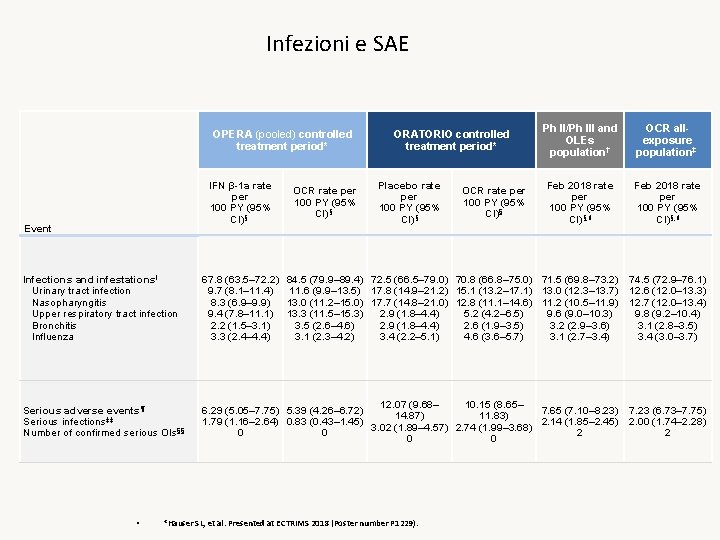
Infezioni e SAE OPERA (pooled) controlled treatment period* IFN β-1 a rate per 100 PY (95% CI)§ Event OCR rate per 100 PY (95% CI)§ ORATORIO controlled treatment period* Placebo rate per 100 PY (95% CI)§ OCR rate per 100 PY (95% CI)§ Ph II/Ph III and OLEs population† OCR allexposure population‡ Feb 2018 rate per 100 PY (95% CI)§, ‖ Infections and infestationsf Urinary tract infection Nasopharyngitis Upper respiratory tract infection Bronchitis Influenza 67. 8 (63. 5– 72. 2) 9. 7 (8. 1– 11. 4) 8. 3 (6. 9– 9. 9) 9. 4 (7. 8– 11. 1) 2. 2 (1. 5– 3. 1) 3. 3 (2. 4– 4. 4) Serious adverse events¶ Serious infections‡‡ Number of confirmed serious OIs§§ 12. 07 (9. 68– 10. 15 (8. 65– 6. 29 (5. 05– 7. 75) 5. 39 (4. 26– 6. 72) 7. 65 (7. 10– 8. 23) 7. 23 (6. 73– 7. 75) 14. 87) 11. 83) 1. 79 (1. 16– 2. 64) 0. 83 (0. 43– 1. 45) 2. 14 (1. 85– 2. 45) 2. 00 (1. 74– 2. 28) 3. 02 (1. 89– 4. 57) 2. 74 (1. 99– 3. 68) 0 0 2 2 0 0 • 84. 5 (79. 9– 89. 4) 72. 5 (66. 5– 79. 0) 70. 8 (66. 8– 75. 0) 71. 5 (69. 8– 73. 2) 74. 5 (72. 9– 76. 1) 11. 6 (9. 9– 13. 5) 17. 8 (14. 9– 21. 2) 15. 1 (13. 2– 17. 1) 13. 0 (12. 3– 13. 7) 12. 6 (12. 0– 13. 3) 13. 0 (11. 2– 15. 0) 17. 7 (14. 8– 21. 0) 12. 8 (11. 1– 14. 6) 11. 2 (10. 5– 11. 9) 12. 7 (12. 0– 13. 4) 13. 3 (11. 5– 15. 3) 2. 9 (1. 8– 4. 4) 5. 2 (4. 2– 6. 5) 9. 6 (9. 0– 10. 3) 9. 8 (9. 2– 10. 4) 3. 5 (2. 6– 4. 6) 2. 9 (1. 8– 4. 4) 2. 6 (1. 9– 3. 5) 3. 2 (2. 9– 3. 6) 3. 1 (2. 8– 3. 5) 3. 1 (2. 3– 4. 2) 3. 4 (2. 2– 5. 1) 4. 6 (3. 6– 5. 7) 3. 1 (2. 7– 3. 4) 3. 4 (3. 0– 3. 7) *Hauser SL, et al. Presented at ECTRIMS 2018 (Poster number P 1229).
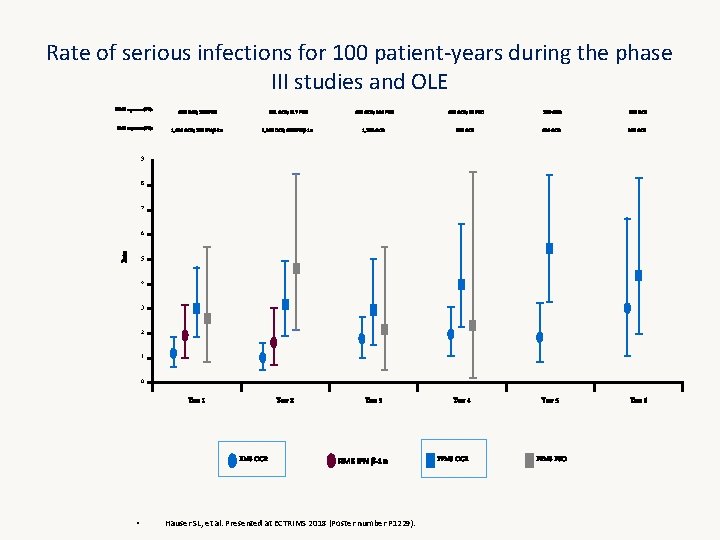
Rate of serious infections for 100 patient-years during the phase III studies and OLE PPMS exposure (PY): 633 OCR; 235 PBO 601 OCR; 217 PBO 422 OCR; 186 PBO 403 OCR; 85 PBO 368 OCR 206 OCR RMS exposure (PY): 1, 422 OCR; 793 IFN β-1 a 1, 360 OCR; 606 IFN β-1 a 1, 254 OCR 882 OCR 609 OCR 198 OCR 9 8 7 Rate 6 5 4 3 2 1 0 Year 1 Year 2 RMS OCR • Year 3 RMS IFN β-1 a Hauser SL, et al. Presented at ECTRIMS 2018 (Poster number P 1229). Year 4 PPMS OCR Year 5 PPMS PBO Year 6
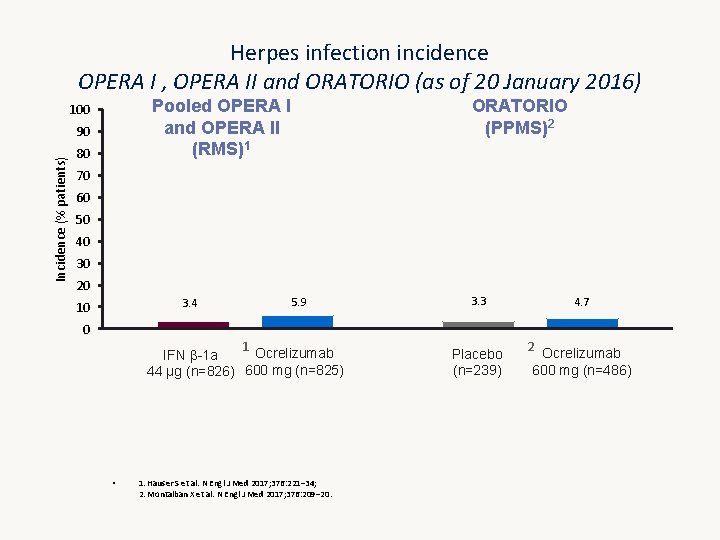
Herpes infection incidence OPERA I , OPERA II and ORATORIO (as of 20 January 2016) Pooled OPERA I and OPERA II (RMS)1 100 Incidence (% patients) 90 80 ORATORIO (PPMS)2 70 60 50 40 30 20 3. 4 10 5. 9 3. 3 4. 7 Placebo (n=239) 2 Ocrelizumab 600 mg (n=486) 0 1 Ocrelizumab IFN β-1 a 44 μg (n=826) 600 mg (n=825) • 1. Hauser S et al. N Engl J Med 2017; 376: 221– 34; 2. Montalban X et al. N Engl J Med 2017; 376: 209– 20.
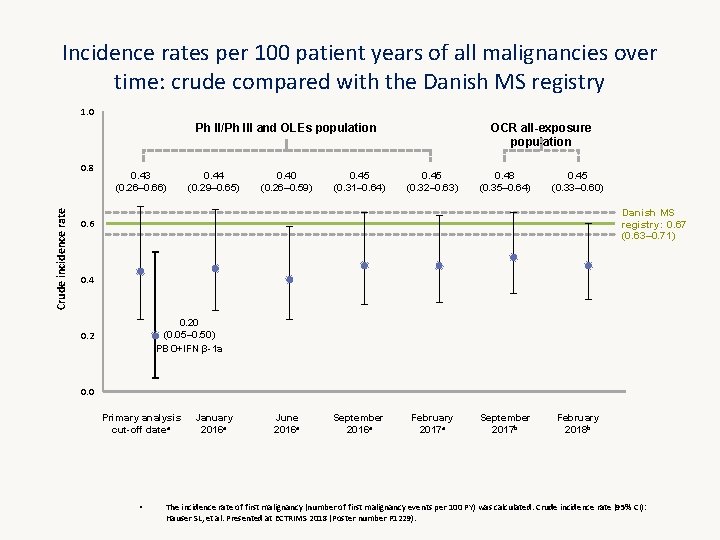
Incidence rates per 100 patient years of all malignancies over time: crude compared with the Danish MS registry 1. 0 Ph II/Ph III and OLEs population Crude incidence rate 0. 8 0. 43 (0. 26– 0. 66) 0. 44 (0. 29– 0. 65) 0. 40 (0. 26– 0. 59) 0. 45 (0. 31– 0. 64) OCR all-exposure population 0. 45 (0. 32– 0. 63) 0. 48 (0. 35– 0. 64) 0. 45 (0. 33– 0. 60) Danish MS registry: 0. 67 (0. 63– 0. 71) 0. 6 0. 4 0. 20 (0. 05– 0. 50) PBO+IFN β-1 a 0. 2 0. 0 Primary analysis cut-off datea • January 2016 a June 2016 a September 2016 a February 2017 a September 2017 b February 2018 b The incidence rate of first malignancy (number of first malignancy events per 100 PY) was calculated. Crude incidence rate (95% CI): Hauser SL, et al. Presented at ECTRIMS 2018 (Poster number P 1229).
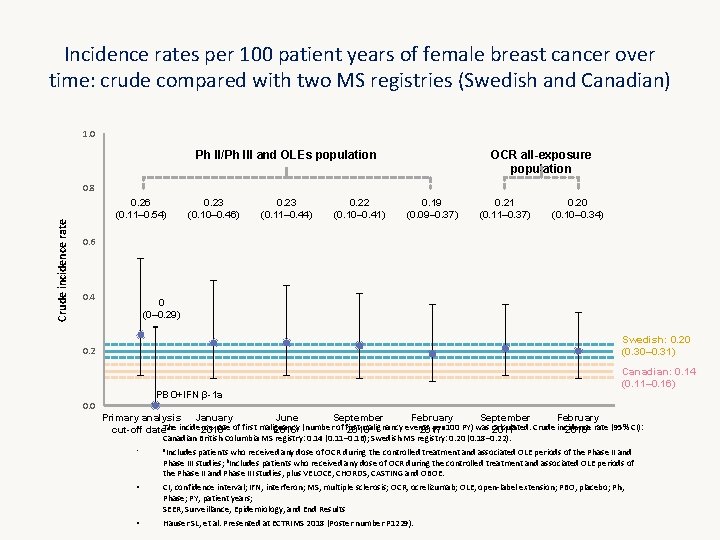
Incidence rates per 100 patient years of female breast cancer over time: crude compared with two MS registries (Swedish and Canadian) 1. 0 Ph II/Ph III and OLEs population OCR all-exposure population Crude incidence rate 0. 8 0. 26 (0. 11– 0. 54) 0. 23 (0. 10– 0. 46) 0. 23 (0. 11– 0. 44) 0. 22 (0. 10– 0. 41) 0. 19 (0. 09– 0. 37) 0. 21 (0. 11– 0. 37) 0. 20 (0. 10– 0. 34) 0. 6 0. 4 0 (0– 0. 29) Swedish: 0. 20 (0. 30– 0. 31) 0. 2 Canadian: 0. 14 (0. 11– 0. 16) PBO+IFN β-1 a 0. 0 Primary analysis January June September February a • The incidence rate of first malignancy (number of first malignancy events per 100 PY) was calculated. Crude incidence rate (95% CI): cut-off date 2016 a 2017 b 2018 b Canadian British Columbia MS registry: 0. 14 (0. 11– 0. 16); Swedish MS registry: 0. 20 (0. 18– 0. 22). • a. Includes patients who received any dose of OCR during the controlled treatment and associated OLE periods of the Phase II and Phase III studies; b. Includes patients who received any dose of OCR during the controlled treatment and associated OLE periods of the Phase II and Phase III studies, plus VELOCE, CHORDS, CASTING and OBOE. • CI, confidence interval; IFN, interferon; MS, multiple sclerosis; OCR, ocrelizumab; OLE, open-label extension; PBO, placebo; Ph, Phase; PY, patient years; SEER, Surveillance, Epidemiology, and End Results • Hauser SL, et al. Presented at ECTRIMS 2018 (Poster number P 1229).
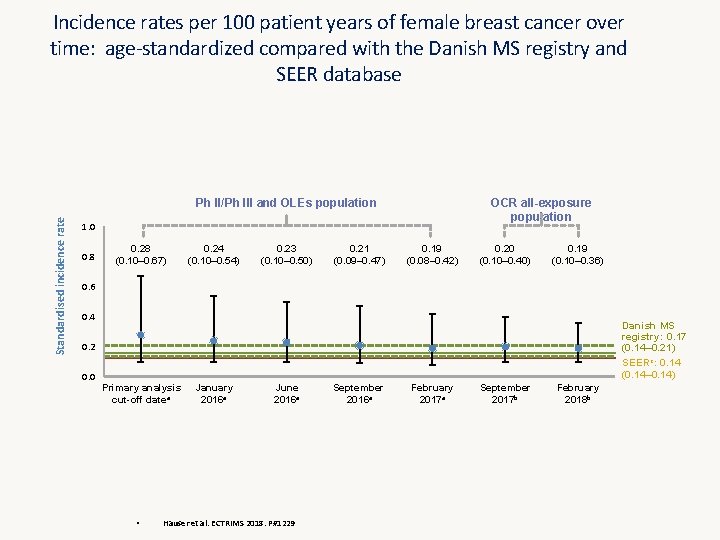
Incidence rates per 100 patient years of female breast cancer over time: age-standardized compared with the Danish MS registry and SEER database Standardised incidence rate Ph II/Ph III and OLEs population OCR all-exposure population 1. 0 0. 8 0. 28 (0. 10– 0. 67) 0. 24 (0. 10– 0. 54) 0. 23 (0. 10– 0. 50) 0. 21 (0. 09– 0. 47) 0. 19 (0. 08– 0. 42) 0. 20 (0. 10– 0. 40) 0. 19 (0. 10– 0. 36) 0. 6 0. 4 Danish MS registry: 0. 17 (0. 14– 0. 21) SEERc: 0. 14 (0. 14– 0. 14) 0. 2 0. 0 Primary analysis cut-off datea • January 2016 a June 2016 a Hauser et al. ECTRIMS 2018. P#1229 September 2016 a February 2017 a September 2017 b February 2018 b
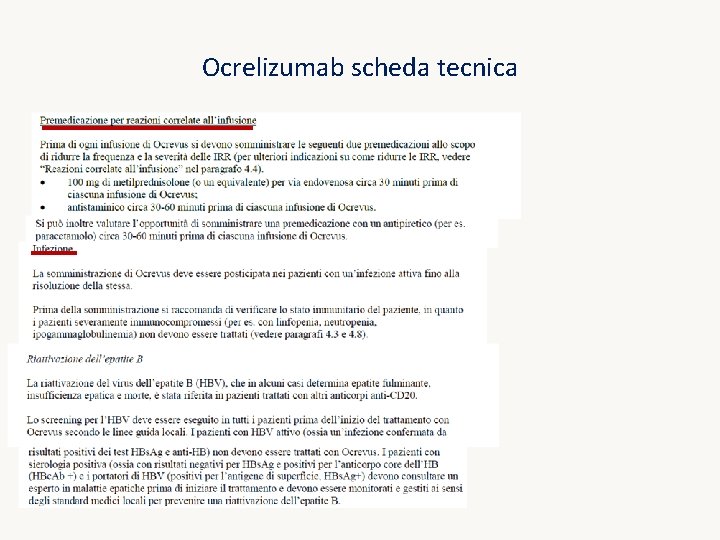
Ocrelizumab scheda tecnica
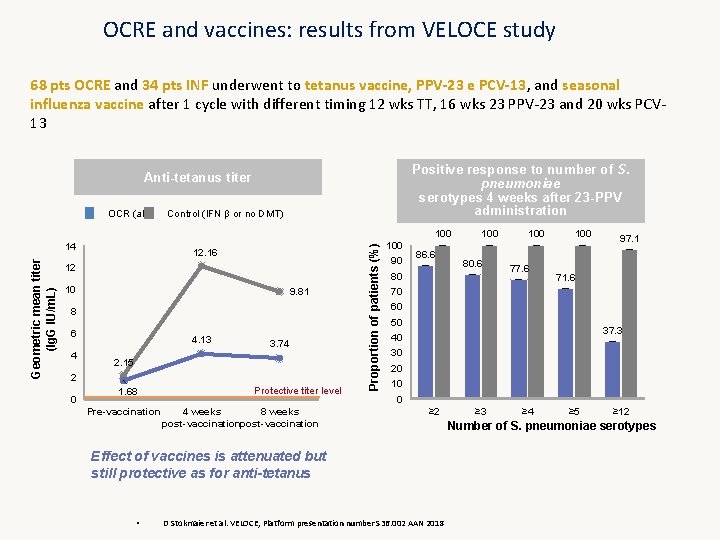
OCRE and vaccines: results from VELOCE study 68 pts OCRE and 34 pts INF underwent to tetanus vaccine, PPV-23 e PCV-13, and seasonal influenza vaccine after 1 cycle with different timing 12 wks TT, 16 wks 23 PPV-23 and 20 wks PCV 13 Positive response to number of S. pneumoniae serotypes 4 weeks after 23 -PPV OCR (all)administration Control (IFN β or no DMT) Anti-tetanus titer OCR (all) Control (IFN β or no DMT) Geometric mean titer (Ig. G IU/m. L) 12. 16 12 10 9. 81 8 6 4 4. 13 3. 74 2. 15 2 0 1. 68 Pre-vaccination Protective titer level 4 weeks 8 weeks post-vaccination Proportion of patients (%) 100 14 100 90 86. 6 80 100 77. 6 100 97. 1 71. 6 70 60 50 37. 3 40 30 20 10 0 ≥ 2 Effect of vaccines is attenuated but still protective as for anti-tetanus • 100 D Stokmaier et al. VELOCE, Platform presentation number S 36. 002 AAN 2018 ≥ 3 ≥ 4 ≥ 5 ≥ 12 Number of S. pneumoniae serotypes
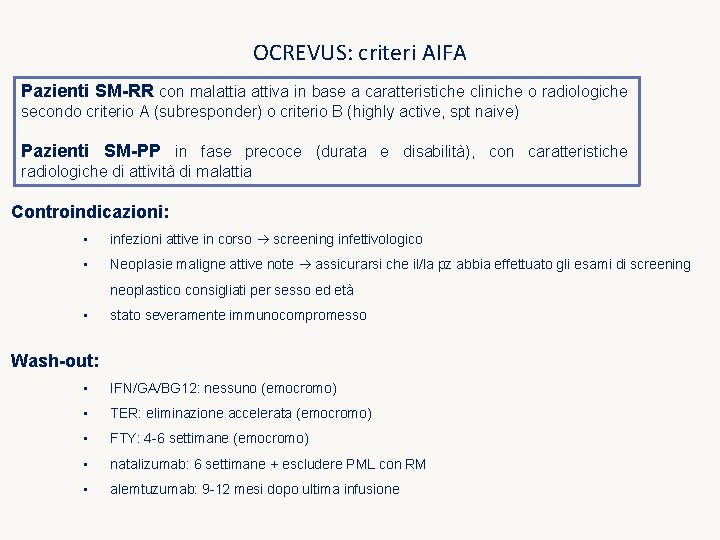
OCREVUS: criteri AIFA Pazienti SM-RR con malattia attiva in base a caratteristiche cliniche o radiologiche secondo criterio A (subresponder) o criterio B (highly active, spt naive) Pazienti SM-PP in fase precoce (durata e disabilità), con caratteristiche radiologiche di attività di malattia Controindicazioni: • infezioni attive in corso screening infettivologico • Neoplasie maligne attive note assicurarsi che il/la pz abbia effettuato gli esami di screening neoplastico consigliati per sesso ed età • stato severamente immunocompromesso Wash-out: • IFN/GA/BG 12: nessuno (emocromo) • TER: eliminazione accelerata (emocromo) • FTY: 4 -6 settimane (emocromo) • natalizumab: 6 settimane + escludere PML con RM • alemtuzumab: 9 -12 mesi dopo ultima infusione
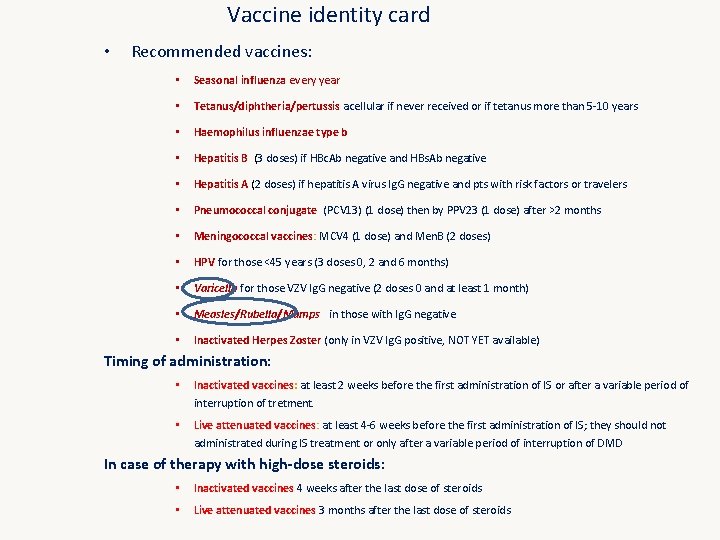
Vaccine identity card • Recommended vaccines: • Seasonal influenza every year • Tetanus/diphtheria/pertussis acellular if never received or if tetanus more than 5 -10 years • Haemophilus influenzae type b • Hepatitis B (3 doses) if HBc. Ab negative and HBs. Ab negative • Hepatitis A (2 doses) if hepatitis A virus Ig. G negative and pts with risk factors or travelers • Pneumococcal conjugate (PCV 13) (1 dose) then by PPV 23 (1 dose) after >2 months • Meningococcal vaccines: MCV 4 (1 dose) and Men. B (2 doses) • HPV for those <45 years (3 doses 0, 2 and 6 months) • Varicella for those VZV Ig. G negative (2 doses 0 and at least 1 month) • Measles/Rubella/Mumps in those with Ig. G negative • Inactivated Herpes Zoster (only in VZV Ig. G positive, NOT YET available) Timing of administration: • Inactivated vaccines: at least 2 weeks before the first administration of IS or after a variable period of interruption of tretment. • Live attenuated vaccines: at least 4 -6 weeks before the first administration of IS; they should not administrated during IS treatment or only after a variable period of interruption of DMD In case of therapy with high-dose steroids: • Inactivated vaccines 4 weeks after the last dose of steroids • Live attenuated vaccines 3 months after the last dose of steroids
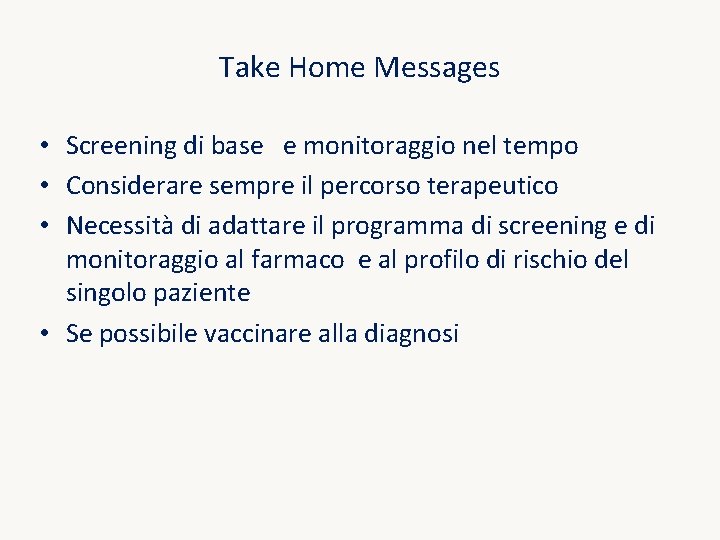
Take Home Messages • Screening di base e monitoraggio nel tempo • Considerare sempre il percorso terapeutico • Necessità di adattare il programma di screening e di monitoraggio al farmaco e al profilo di rischio del singolo paziente • Se possibile vaccinare alla diagnosi
Grazie per l’attenzione Gruppo Sclerosi Multipla Responsabile Prof Luca Massacesi Dott. ssa Anna Maria Repice Dott. ssa Claudia Mechi Dott. ssa Benedetta Forci Dott. ssa Alice Mariottini Dott. Matteo Pasca Dott. Stefano Filippini Dott. ssa Maria Di Cristinzi