
La France History Party System State Dual Executive
- Slides: 33
La France History Party System State Dual Executive Legislature Judiciary
Overview • Like Britain, one of oldest states in Europe • Like Britain, geographical and political identity established since Middle Ages • Like Britain’s Westminster Palace, the Palace of Versailles has remained the symbol and seat of government for hundreds of years • Like Britain, a major Euro power, extra Euro interests and permanent seat on UN Security Council • Like Britain, a constitutional democracy with universal suffrage, free elections, independent courts, accountable govt. , welfare state, mainly urban population (85%)
But… It is important to stress these similarities, because France’s political institutions and arrangements can appear very different from those of its European neighbours… … Britain especially…
• Most significant is France’s long tradition of constitutional instability – it is on its 17 th regime since the Revolution in 1789 • Equally important is the relatively large role played by the state in French politics and society – demonstrated by the vast array of government ministries, and the centrality of the state the political vocabulary
Why has this come about…? • History, stupid. • What history? • The French Revolution? – What about the pre-Revolutionary monarchy’s role in establishing the political and administrative identity? • The French Revolution? – What about the fact that France was the dominant European power throughout the 18 th and 19 th Century?
Nonetheless, the Revolution remains the defining moment in French history • Bastille day is STILL celebrated (date? ) • Revolution carried out in the name of the Rights of Man, still at the forefront of the constitution of the Fifth Republic (author? ) • Ancien Regime had been based on the division of society into estates: 9/10 ths in the ‘ 3 rd estate’ • Revolution brought citizenship instead (sanscoulotte slogan? )
Legacy… • Unlike the USA, Revolution failed to create a consensual and unifying myth • Numerous factions began to accuse others of betraying the values of the Revolution • Disagreements over economic and social policy • Even conflict over the constitutional form of the new state: constitutional monarchy Vs Republic Vs Empire • Legacy: - 4 separate regimes since 1940 - the Paris Commune of 1968 - the array of contenders to the presidency at each election
1799 -1875 • 1799: - Napoleon Bonaparte - Declared France an Empire and himself Emperor - Tried to take over the World • Finally put out to pasture by Wellington’s forces in 1815 • 1815 -1870: - Same pattern of a Monarchy giving way to a Republic giving way to an Empire, this time under Napoleon Bonaparte III • 1875: - Foundation of 3 rd Republic
1875 -1940: 3 rd Republic • Followed surrender of Napoleon 3 rd after Franco. Prussian war - Watershed: End of Bonapartism, plebiscitary politics, and monarchism • Far from consensual: - 1894: Dreyfus Affair (? ) - 1924 and 1937: 2 failed attempts to instigate left wing governments • Collapsed in 1940 with the Nazi invasion – Quiz question: what came next?
1944 -1958: th 4 Republic • de Gaulle, leader-in-exile, invited to head the new government • Created a constituent assembly to compose new constitution - This comprised representatives of numerous parties, and saw much disagreement on even its most basic principles: e. g. gaullists wanted strong leadership while others wanted constitutional checks - de Gaulle eventually lost patience with Parliamentary stalemate and resigned from French politics • However, though unpopular and short-lived, the 4 th Republic did witness some progressive legislation: - votes for women, nationalisation of industry, state economic planning, social reform (e. g. holiday pay and wage increases) • Nonetheless, divisions plagued its existence: 25 governments in 12 years; no stable majorities; technocrats more powerful than politicians etc…. • …and then there was Algeria
1958: Algeria • Algerian nationalists vied for independence • By May 1958, French govt. unable to cope - 13 th May: coup in Algeria by French generals determined to keep Algeria part of France - 29 th May, President Coty begged de Gaulle to return to politics as PM - de Gaulle accepted on provision that he had full powers for 6 months and compile a new constitution
General de Gaulle and the foundation of the Fifth Republic • de Gaulle was the natural choice: war hero, untainted by failure of 4 th Republic, and had the support of the Army • Like Petain, he was determined to use the crisis to force through constitutional reform • Convinced that political problems could be solved by strengthening the Executive • Got N. A. to grant him the power to compose new constitution, which was sealed over the heads of the N. A. through referendum - Removing decision making from the N. A. has been a characteristic of French politics ever since - Future president Francois Mitterrand compared his 5 th Republic to Napoleon III’s coup d’etat against the 2 nd Republic in 1851
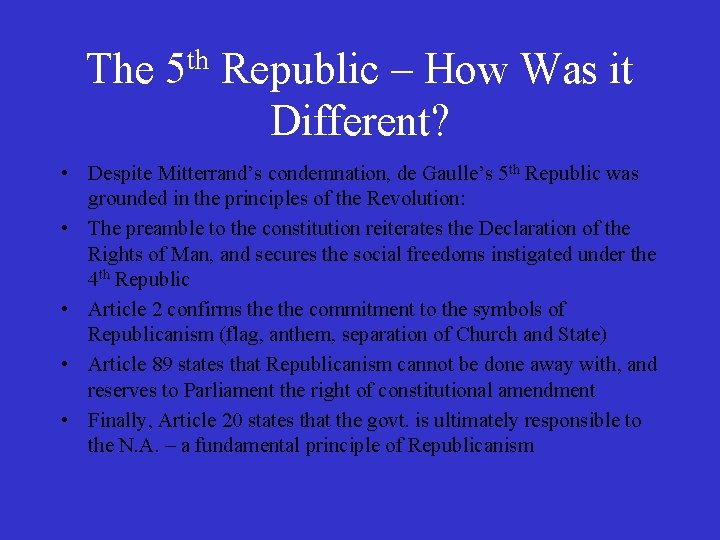
The 5 th Republic – How Was it Different? • Despite Mitterrand’s condemnation, de Gaulle’s 5 th Republic was grounded in the principles of the Revolution: • The preamble to the constitution reiterates the Declaration of the Rights of Man, and secures the social freedoms instigated under the 4 th Republic • Article 2 confirms the commitment to the symbols of Republicanism (flag, anthem, separation of Church and State) • Article 89 states that Republicanism cannot be done away with, and reserves to Parliament the right of constitutional amendment • Finally, Article 20 states that the govt. is ultimately responsible to the N. A. – a fundamental principle of Republicanism
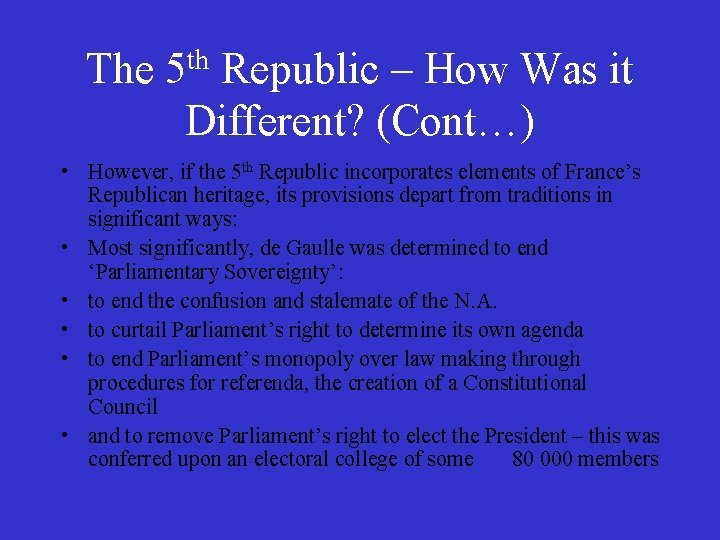
The 5 th Republic – How Was it Different? (Cont…) • However, if the 5 th Republic incorporates elements of France’s Republican heritage, its provisions depart from traditions in significant ways: • Most significantly, de Gaulle was determined to end ‘Parliamentary Sovereignty’: • to end the confusion and stalemate of the N. A. • to curtail Parliament’s right to determine its own agenda • to end Parliament’s monopoly over law making through procedures for referenda, the creation of a Constitutional Council • and to remove Parliament’s right to elect the President – this was conferred upon an electoral college of some 80 000 members
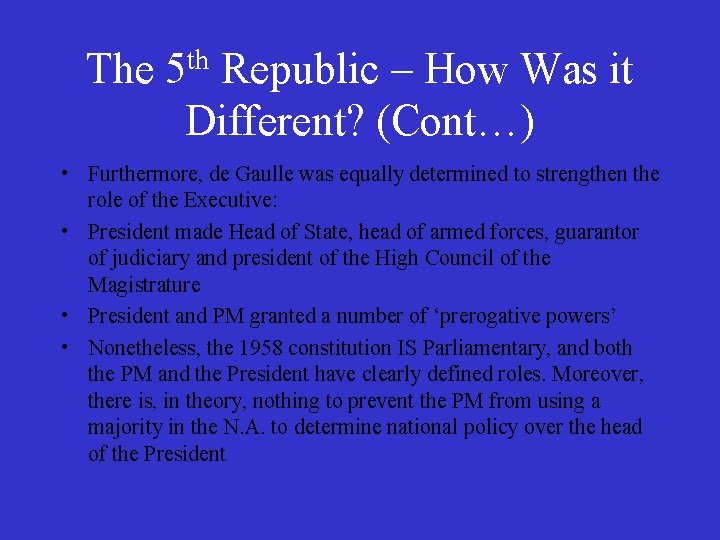
The 5 th Republic – How Was it Different? (Cont…) • Furthermore, de Gaulle was equally determined to strengthen the role of the Executive: • President made Head of State, head of armed forces, guarantor of judiciary and president of the High Council of the Magistrature • President and PM granted a number of ‘prerogative powers’ • Nonetheless, the 1958 constitution IS Parliamentary, and both the PM and the President have clearly defined roles. Moreover, there is, in theory, nothing to prevent the PM from using a majority in the N. A. to determine national policy over the head of the President
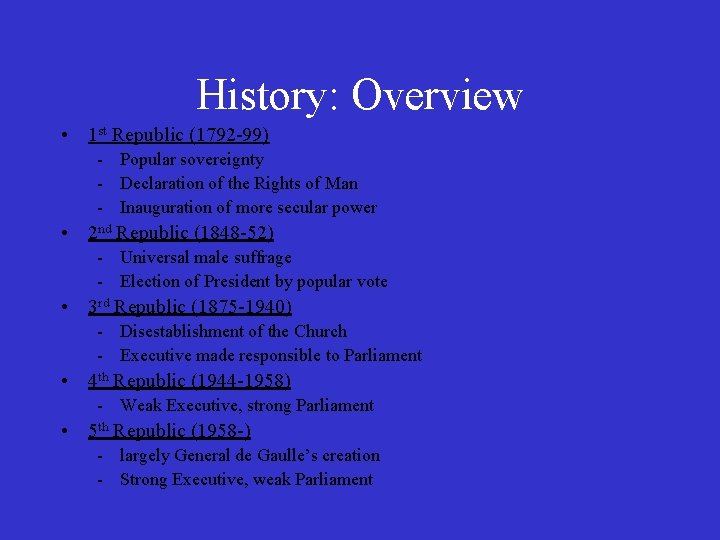
History: Overview • 1 st Republic (1792 -99) - Popular sovereignty - Declaration of the Rights of Man - Inauguration of more secular power • 2 nd Republic (1848 -52) - Universal male suffrage - Election of President by popular vote • 3 rd Republic (1875 -1940) - Disestablishment of the Church - Executive made responsible to Parliament • 4 th Republic (1944 -1958) - Weak Executive, strong Parliament • 5 th Republic (1958 -) - largely General de Gaulle’s creation - Strong Executive, weak Parliament
THE PARTY SYSTEM
Legacy of Revolution • 16 candidates in the first round - contrast this with UK (4) and US (3) • Fundamental and traditional split between left and right (quiz: origins of left and right? ) • don’t overstate left-right split: increasingly inaccurate with ‘centrists’ and ‘independents’; plus need for further distinction between conservative right and the extreme right • Moreover, ideational underpinnings of left and right have shifted in recent years (? ): • Right used to be associated with the desire for a greater role for the Church whereas the Left was traditionally secular; today the divide has more to do with socialism versus free market philosophy (although, generally, the French right favours more of a role for the state than other European rightist factions) • Nonetheless, recent research does show that voting behaviour still follows broad affiliations with either the left or right
The State
A Strong State? • This is the perception: though associated with the left, even the French right promulgates the value of a strong state: ‘ The Republican state is an impartial state, one that guarantees cohesion and solidarity between citizens, between generations, between all parts of the territory, ’ (Chiraq, 1995) • The ideal of the strong French state has both a normative and a traditional basis: • Normative basis pre-dates Revolution (Saint-Simon and Comte advocated state-led social progress). The Revolution made flesh these values and they survive to this day • In more practical terms, the belief in the strong state is witnessed in the strength of the civil service as the expression of public interests; post-war economic policy; and the bewildering array of state-centred organisations (1988: 31 ministers and 17 junior ministers)
The ‘Myth’ of the Strong State… • Though grounded in Republican rhetoric celebrating the state as the expression of national will, the French state has often failed to respond adequately to needs arising • In short, 2 of the most basic assumptions on which the ‘myth’ of the strong state is built, are overstated: 1. The state is not a cohesive unit, and is hampered by bureaucracy and internal competition 2. The state does not act independently of civil society, and has traditionally championed PPPs
The Dual Executive
Overview • Semi-Presidential style • Differs from other states, e. g. Germany, where president is just a figurehead • Pres. Selects PM from the dominant Parliamentary Party – Potential for conflict between President and Prime Minister when the dominant Party in the N. A. is opposed to that of the President (Cohabitation)
Presidential Powers • • ‘Discretionary Powers’: 8 areas Appointment, but not dismissal, of PM Right to dissolve N. A. Freedom to resign, provoking presidential election Chair of Council of Ministers Right of Emergency Powers Right to submit Bills to N. A. N. B. In contrast to the perception of Presidential power, these discretionary powers are either one-off prerogatives, or only applicable at pre-programmed intervals, or during national emergencies
Prime Ministerial Powers • • Quiz: Who is the French PM? Jean Pierre Raffarin… …PM also has some ‘discretionary powers’ Right to send Bill to Constitutional Council Chairs Council of Ministers when President is absent Responsible for day-to-day running of government Represents the Executive to Parliament – Arbitrates interministerial competition and therefore has greater influence with ministers • Finally, PM has discretionary power over 2 ndary legislation (Parliament passes around 70 laws a year, PM passes around 8000 interministerial decrees)
Shared Powers • In defence, foreign policy and judiciary • Greatest potential for conflict in these areas • E. g. President Mitterrand PM Fabius disagreed in 1984 over Mitterrand’s planned meeting with Polish Communist leader • Generally, President has greater influence than PM. President ‘sets the tone’ for policy, while the PM ‘gets on with it’ • Only rarely and in instances of cohabitation can PM-President conflict present a barrier to policy formulation and implementation
The Legislature
Senate • Indirectly elected • Has in-built conservative majority (small rural towns over-represented) • 321 senators • Elected for 9 years by electoral college of deputies and local councillors (150 000 members) • Complex and unrepresentative electoral system means Senate has become focus of much debate over Parliamentary reform • Nominally has same powers as N. A. – both must approve a bill before it becomes law – but in the very last resort it is the N. A. that has the final say
National Assembly • 577 deputies • Directly elected for 5 year term by a two-ballot majorityplurality system • Larger parties are over-represented, as the electoral system deviates from proportional representation (like Britain) • Some of the larger parties have manipulated the system – 1985: the Socialists introduced a proportional system for 1986 election only to return to previous system the following year • Again, this lack of proportionality has led to calls for reform – particularly from the Greens • Weakness: Under the 4 th Republic N. A. was strong, under the constitution of the 5 th Rep it is weak: restricted “domain of law” (Article 34) which does not include foreign policy, for example; and its limited capacity to hold the administration to account (Article 16: Presidential right to emergency powers)
The Judiciary
Overview • Unlike the famous separation of powers in the US (Executive, Legislature, Judiciary), the French tradition has been very different • Exec. and leg. seen as expression of popular will, and therefore superior to judicial branch • Result: belief that government should control the judiciary • This has been changing gradually, and the judiciary is becoming a more independent branch of government • Nonetheless, still manipulated by all sides for political ends
Constitutional Council • 3 distinct elements: constitutional law, administrative law, and civil and criminal law • CC is highest constitutional authority: determines constitutionality of bills, treaties etc. • Designed in 1958 to support the Exec. , in 1970 s it emerged as a political actor in its own right • Comprises 9 appointees, 3 chosen by president of Republic, 3 by president of the N. A. , and 3 by president of Senate • Serve for a non-renewable 9 year term and cannot hold other offices • Intention is to remove members as far from party-political interests as possible • Nonetheless, candidates are invariably selected by the 3 electors on the basis of their political leanings
La France – History – Party System – State – Dual Executive – Legislature – Judiciary