
La ACES Lab Notebooks Documenting your Work Colleen

La. ACES Lab Notebooks Documenting your Work Colleen H. Fava, La. SPACE Assistant Director September 2020 -2021 La. ACES at LSU rev 10 SEP 2020 Lab Notebooks L 01. 02
What is a Lab Notebook? Complete record of procedures, data, and thoughts for your own reference, your team members, and to pass on to other researchers. • Document why experiments were initiated, how they were performed, results, and comments on results • Place to compile data/charts/photos/ideas • Place to collect clues, to troubleshoot problems • Place to observe the whole picture and think Additional reasons lab notebooks are kept by scientists and engineers • Legal document, to prove patents • Defense against accusations of fraud or lawsuits 1 LSU rev 10 SEP 2020 Lab Notebooks L 01. 02
How will you use this Lab Notebook? All of the work you do and all the information you are provided each week is cumulative. Proper documentation of processes and results will enable you to transfer information with relative ease to: • Lab Reports (first up: Skeeter. Sat Report Presentations) • Design Documents (PDR, CDR, FRR Written & Oral Presentations) Additionally, these lab books will be reviewed to ensure an adequate level of work is being accomplished per every hour you are working on your payload. • Faculty & Staff will review books regularly. If we see little or no evidence of work being accomplished, timesheets may not be LSU rev 10 SEP 2020 Lab Notebooks L 01. 02 2 approved.
Preparing a New Lab Notebook Front and Inside Cover • Name (John Doe), Context (La. ACES @ LSU), Beginning Date (September 19, 2019) Create Table of Contents • # first 3 pages front and back: To. C-1 To. C-6 Number all Pages • Beginning with #1, number all pages following To. C pages Establish Entry/To. C Format • Start/End Times, Date, Context, Entry Title (leave title blank until entry is complete) 3 LSU rev 10 SEP 2020 Lab Notebooks L 01. 02
What goes in your Lab Notebook Notes on Lectures • Enter these notes sparingly. Lecture slides are available for future reference, but some equations or principles will be worth noting. Anything your instructors repeat is likely worth capturing. Group Activities • Document the process and procedures of any in-house activities, explain why the experiment/activity is being conducted, document results and annotate explanations for successes and failures. Independent Research/Project Development • EVERYTHING! All the articles you read, hypotheses you develop, experiments you undertake, expected results, actual results, etc. 4 LSU rev 10 SEP 2020 Lab Notebooks L 01. 02

Attachments in your Lab Notebook Use tape or glue to insert crucial materials into your lab book: Computer generated data, Photographic data Printed graphs Datasheet templates Assignment Sheets/Instructions Notes (or pasted copies) of discussions, conversations, emails, readings related to experiment design or goals • Bibliographic information for resources • Annotations for names/locations of larger files • • • Always write the date and other identifying information on these materials in case they get separated! And be sure to log these insertions into your Table of Contents. 5 LSU rev 10 SEP 2020 Lab Notebooks L 01. 02
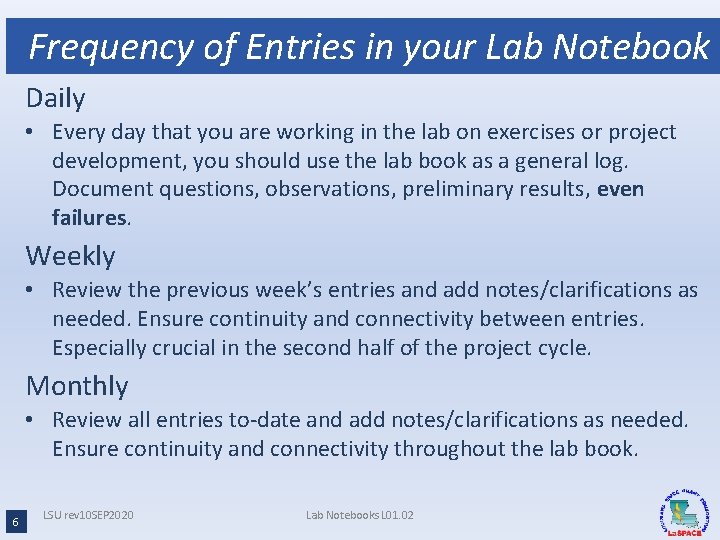
Frequency of Entries in your Lab Notebook Daily • Every day that you are working in the lab on exercises or project development, you should use the lab book as a general log. Document questions, observations, preliminary results, even failures. Weekly • Review the previous week’s entries and add notes/clarifications as needed. Ensure continuity and connectivity between entries. Especially crucial in the second half of the project cycle. Monthly • Review all entries to-date and add notes/clarifications as needed. Ensure continuity and connectivity throughout the lab book. 6 LSU rev 10 SEP 2020 Lab Notebooks L 01. 02
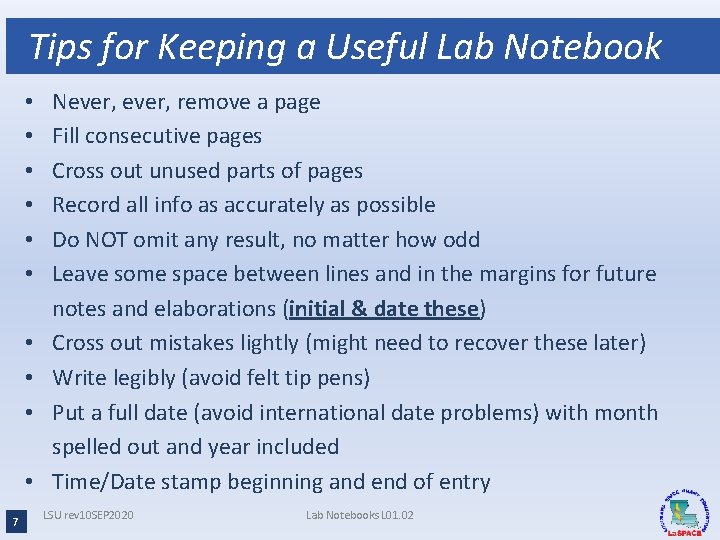
Tips for Keeping a Useful Lab Notebook • • • 7 Never, remove a page Fill consecutive pages Cross out unused parts of pages Record all info as accurately as possible Do NOT omit any result, no matter how odd Leave some space between lines and in the margins for future notes and elaborations (initial & date these) Cross out mistakes lightly (might need to recover these later) Write legibly (avoid felt tip pens) Put a full date (avoid international date problems) with month spelled out and year included Time/Date stamp beginning and end of entry LSU rev 10 SEP 2020 Lab Notebooks L 01. 02
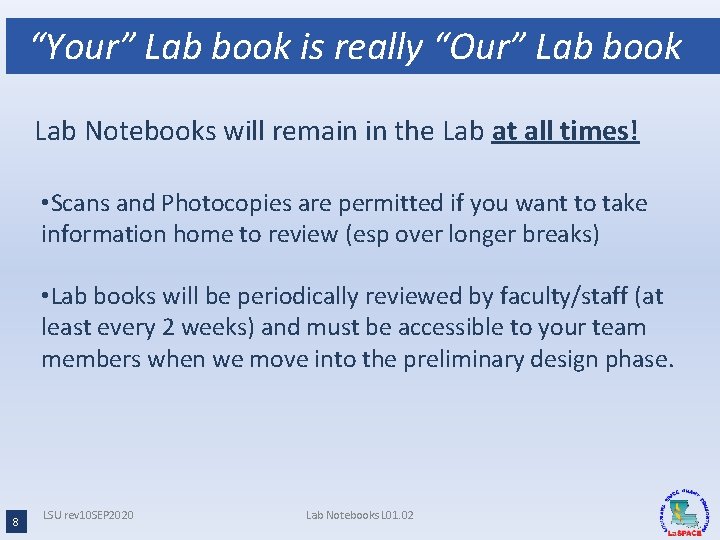
“Your” Lab book is really “Our” Lab book Lab Notebooks will remain in the Lab at all times! • Scans and Photocopies are permitted if you want to take information home to review (esp over longer breaks) • Lab books will be periodically reviewed by faculty/staff (at least every 2 weeks) and must be accessible to your team members when we move into the preliminary design phase. 8 LSU rev 10 SEP 2020 Lab Notebooks L 01. 02
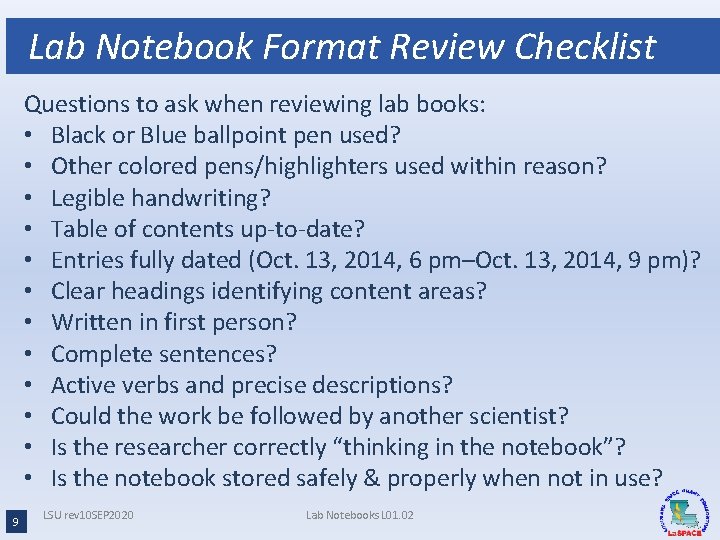
Lab Notebook Format Review Checklist Questions to ask when reviewing lab books: • Black or Blue ballpoint pen used? • Other colored pens/highlighters used within reason? • Legible handwriting? • Table of contents up-to-date? • Entries fully dated (Oct. 13, 2014, 6 pm–Oct. 13, 2014, 9 pm)? • Clear headings identifying content areas? • Written in first person? • Complete sentences? • Active verbs and precise descriptions? • Could the work be followed by another scientist? • Is the researcher correctly “thinking in the notebook”? • Is the notebook stored safely & properly when not in use? 9 LSU rev 10 SEP 2020 Lab Notebooks L 01. 02
Lab Notebook Content Checklist • Plans: tests to run, research to perform, questions to answer • Ideas: a notebook is a repository of creativity (You are not limited to the ideas you implement) • Realities: deviations from the plan; adjustments • Observations: risk mitigation; procedures eliminated • Illustrations: sketches, graphs, and photographs • “Links” to the notebooks of others in your group • “Links” to instrument logbooks and data on disks • E-mails from collaborators (tape or paste them in) • Summaries of papers you have read (full citation) • Hints and tips you may get from science friends • Concerns, questions, failures, conundrums, etc 10 LSU rev 10 SEP 2020 Lab Notebooks L 01. 02
Getting Started with your Lab Notebook • Enter your name & course info, create a 6 pg To. C, and number the following pages. • Document all the steps, any obstacles, and ultimate results during each session moving forward. • Get to the lab at least 15 minutes early and review your lab book: read previous entries to refresh your mind and clean up errors AND transfer any relevant information that was independently obtained outside of the lab. • Buddy up with at least two other student participants and exchange lab notebooks regularly. Offer each other feedback and tips for improving the notebook. 11 LSU rev 10 SEP 2020 Lab Notebooks L 01. 02
La. ACES Lab Notebook Discussion Questions? Comments? Colleen H. Fava, La. SPACE Assistant Director 364 Nicholson Hall / colleenf@lsu. edu / 225 -578 -8680 12 LSU rev 10 SEP 2020 Lab Notebooks L 01. 02
- Slides: 13