
L14 Types of inversions and wind velocity profile






- Slides: 32
L-14 Types of inversions and wind velocity profile Air Pollution and Control (Elective- I) Prof S S Jahagirdar, NKOCET 1
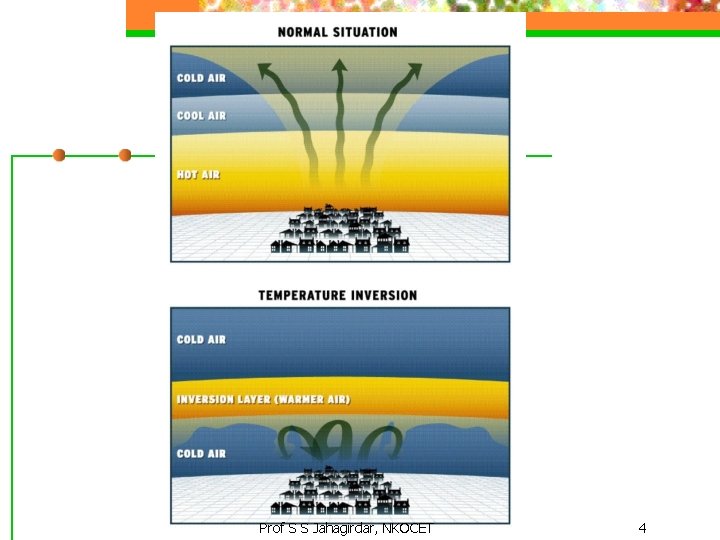
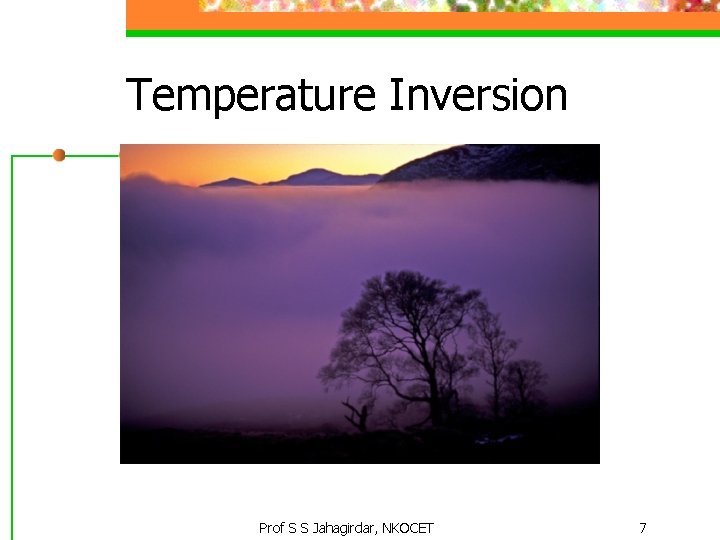
Temperature Inversion • A temperature inversion is when a layer of warmer air covers the colder air at ground level. Prof S S Jahagirdar, NKOCET 2
Temperature Inversion • It forms when the ground level air is kept cold by the cold ground. • Then a warm air mass comes from another area and covers the cold air. • The inversion acts like a lid over the cold ground level air Prof S S Jahagirdar, NKOCET 3
Prof S S Jahagirdar, NKOCET 4
The Air Gets Dirty! Prof S S Jahagirdar, NKOCET 5
Real Dirty! Prof S S Jahagirdar, NKOCET 6
Temperature Inversion Prof S S Jahagirdar, NKOCET 7
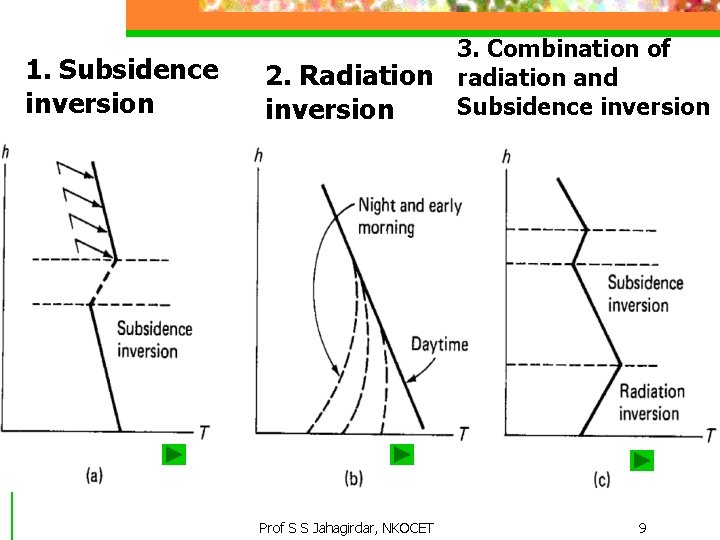
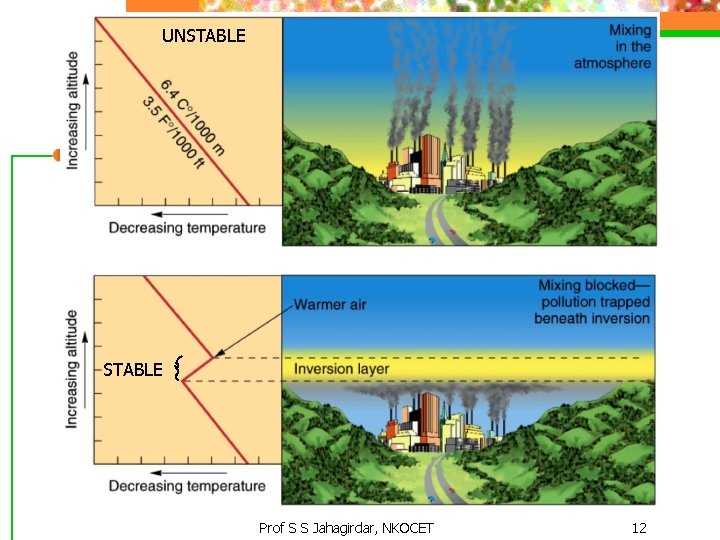
Inversion • Inversion is defined as increase in temperature with respect to altitude. It is also known as negative lapse rate. • Two major types of inversion: 1. Subsidence Inversion 2. Radiation Inversion 3. Combination of subsidence and radiation Prof S S Jahag 8 irdar, NKOCET
1. Subsidence inversion 3. Combination of 2. Radiation radiation and Subsidence inversion Prof S S Jahagirdar, NKOCET 9
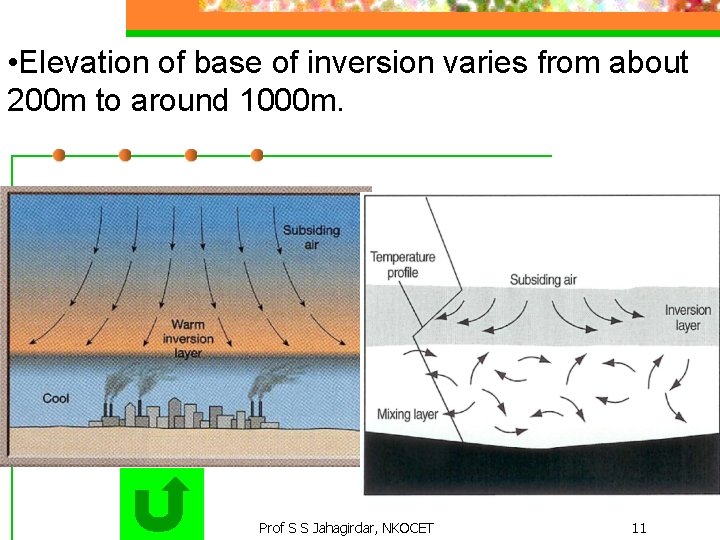
• • • 1. Subsidence Inversion Occurs high above emission sources. Associated with high-pressure systems Inversion layer is formed aloft Covers hundreds of thousands of square kms contribute to long term air pollution problems. Persists for several days and greatly contribute to long term accumulation of pollutants. • Gets broken by strong winds at that altitude. Prof S S Jahagirdar, NKOCE 1 T 0
• Elevation of base of inversion varies from about 200 m to around 1000 m. Prof S S Jahagirdar, NKOCET 11
UNSTABLE Prof S S Jahagirdar, NKOCET 12
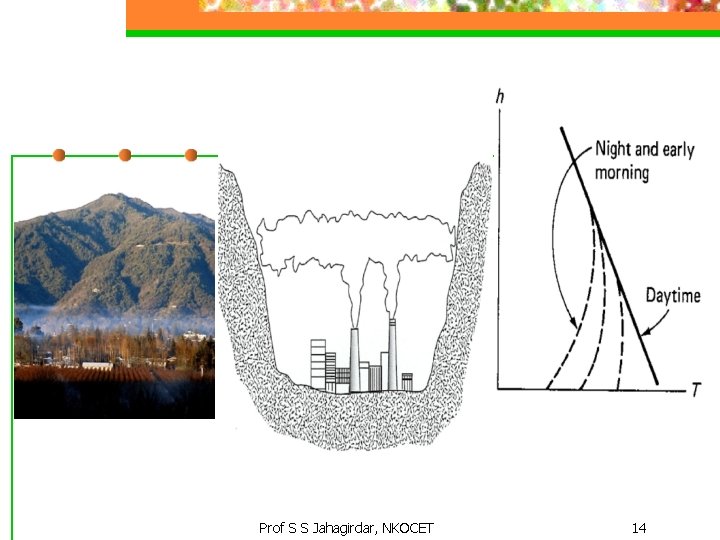
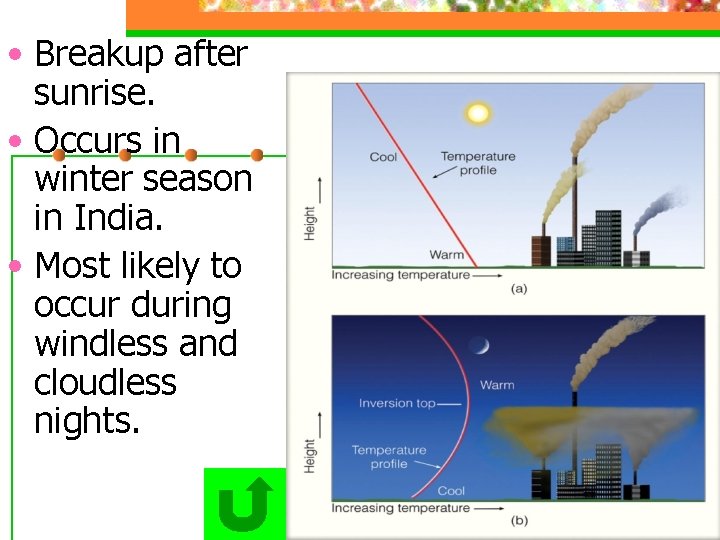
2. Radiation Inversions • Surface layers of the atmosphere during the day receive heat by conduction, convection and radiation from the earth’s surface and are warmed. • This results in temperature profile in the lower atmosphere that is represented by a negative lapse rate. • These types of inversions are intensified in river valleys. • Cause pollutants to be “trapped”. Prof S S Jaha 1 g 3 irdar, NKOCET
Prof S S Jahagirdar, NKOCET 14
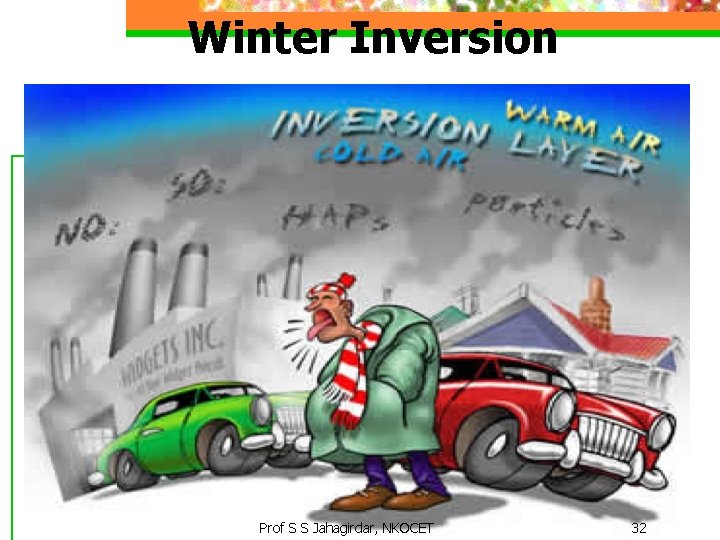
• Breakup after sunrise. • Occurs in winter season in India. • Most likely to occur during windless and cloudless nights. Prof S S Jaha 15 girdar, NKOCET
3. Combination of radiation and Subsidence inversion • It is possible for subsidence and radiation inversions to appear in the atmosphere at the same time. • Joint occurrence of these two types of inversions leads to a special phenomena called ‘Trapping of plume’. Prof S S Jahagirdar, NKOCET 16
WIND VELOCITY PROFILE Prof S S Jahagirdar, NKOCET 17
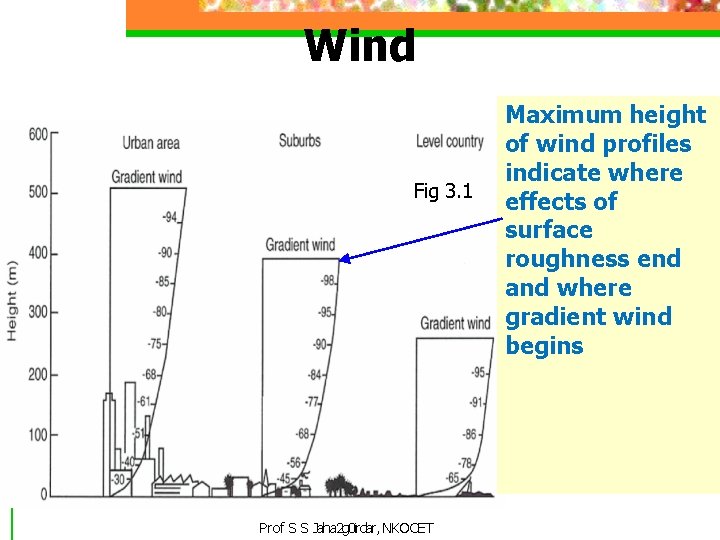
Wind Velocity Profile • Friction retards wind movement • Friction is proportional to surface roughness • Location and size of surface objects produce different wind velocity gradients in the vertical direction • Area of atmosphere influenced by friction – few hundred m to several km above earth’s surface
Wind Velocity Profile • Wind speed varies by height • International standard height for wind-speed measurements is 10 m • Dispersion of pollutant is a function of wind speed at the height where pollution is emitted • But difficult to develop relationship between height and wind speed
Wind Fig 3. 1 Prof S S Jaha 2 g 0 irdar, NKOCET Maximum height of wind profiles indicate where effects of surface roughness end and where gradient wind begins
Prof S S Jahagirdar, NKOCET 21
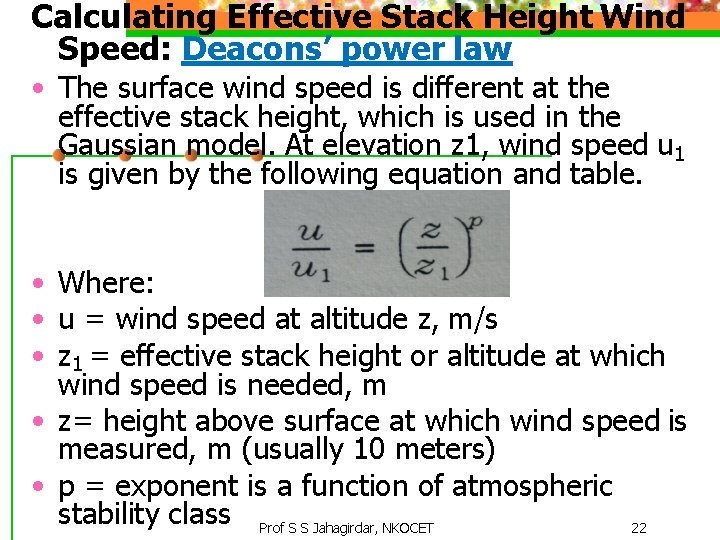
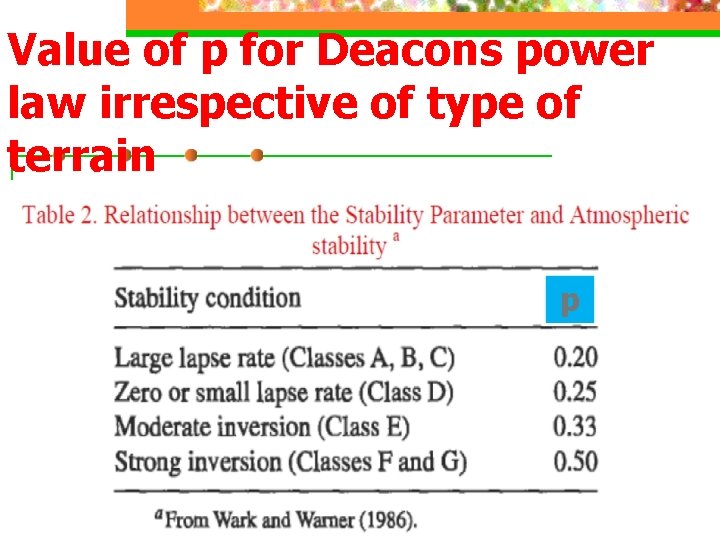
Calculating Effective Stack Height Wind Speed: Deacons’ power law • The surface wind speed is different at the effective stack height, which is used in the Gaussian model. At elevation z 1, wind speed u 1 is given by the following equation and table. • Where: • u = wind speed at altitude z, m/s • z 1 = effective stack height or altitude at which wind speed is needed, m • z= height above surface at which wind speed is measured, m (usually 10 meters) • p = exponent is a function of atmospheric stability class Prof S S Jahagirdar, NKOCET 22
Value of p for Deacons power law irrespective of type of terrain p
Problems Prof S S Jahagirdar, NKOCET 24
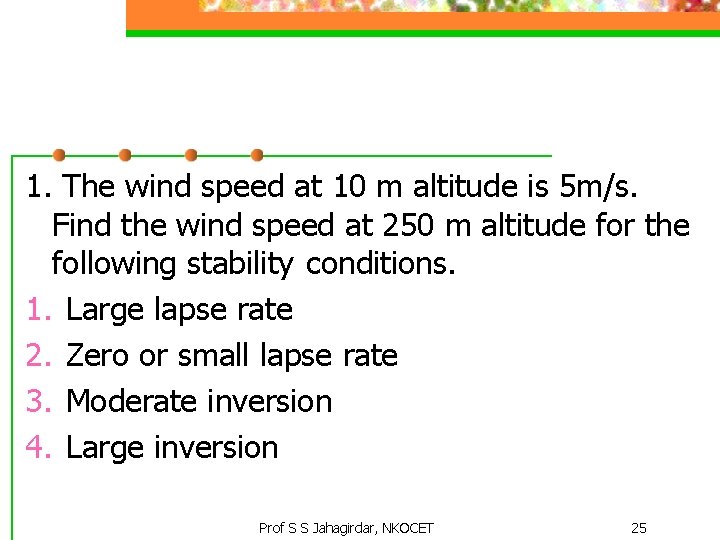
1. The wind speed at 10 m altitude is 5 m/s. Find the wind speed at 250 m altitude for the following stability conditions. 1. Large lapse rate 2. Zero or small lapse rate 3. Moderate inversion 4. Large inversion Prof S S Jahagirdar, NKOCET 25
2. Wind speed at 10 m altitude is 2 m/s. Find the wind speed at 200 m altitude for following cases 1. Large lapse rate 2. Zero lapse rate 3. Moderate inversion 4. Large inversion Prof S S Jahagirdar, NKOCET 26
3. The ground level wind velocity at 10 m elevation is 5. 2 m/sec in a city. What would you estimate the velocity to be at 125 m elevation in moderately stable atmosphere? Prof S S Jahagirdar, NKOCET 27
Objective Questions Q 1. Radiation inversion gets broken by. Q 2. Subsidence inversion persist for. Q 3. As per Deacon’s power law, Wind speed at any height is given by. Q 4. Stability class refers to neutral stability condition. Q 5. stability class refers to most unstable condition. Q 6. . stability class refers to most stable Prof S S Jahagirdar, NKOCET 28 condition.
Q 7. In Deacons law value of exponent p in rough terrain, for neutral stability condition is. (similar objective questions for all values). Q 8. An_ _actsasalidon vertical air movement. Q 9. When the earth's surface cools rapidly, such as between late night and early morning under clear skies, a _ inversion is likely to occur. Prof S S Jahagirdar, NKOCET 29
Theory Questions Q 1. Discuss in detail three types of inversions with neat sketches. Q 2. What is power law of Deacon? What is its use? Prof S S Jahagirdar, NKOCET 30
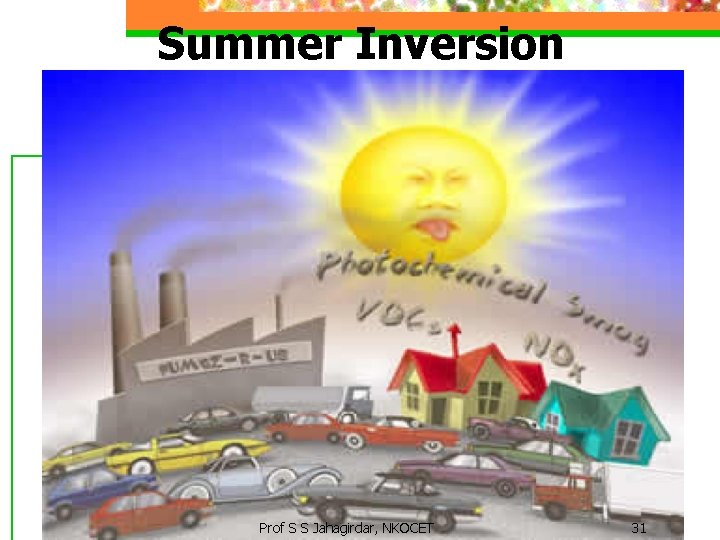
Summer Inversion Prof S S Jahagirdar, NKOCET 31
Winter Inversion Prof S S Jahagirdar, NKOCET 32