
l The function of the respiratory system is

- Slides: 17
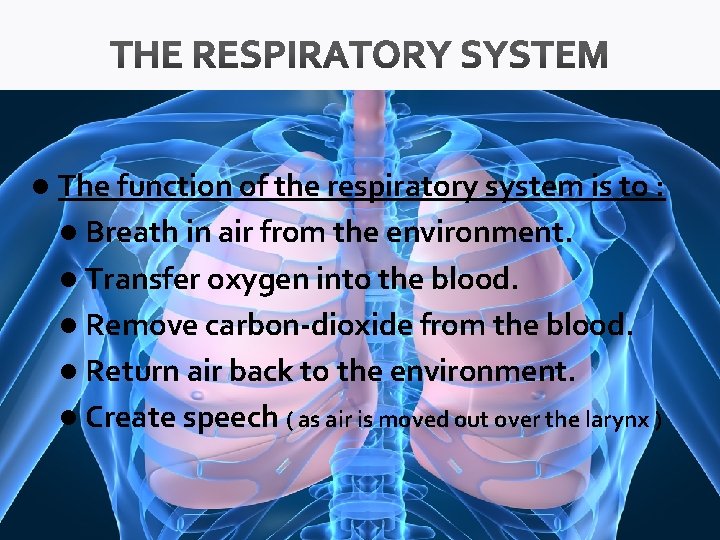
l The function of the respiratory system is to : l Breath in air from the environment. l Transfer oxygen into the blood. l Remove carbon-dioxide from the blood. l Return air back to the environment. l Create speech ( as air is moved out over the larynx )
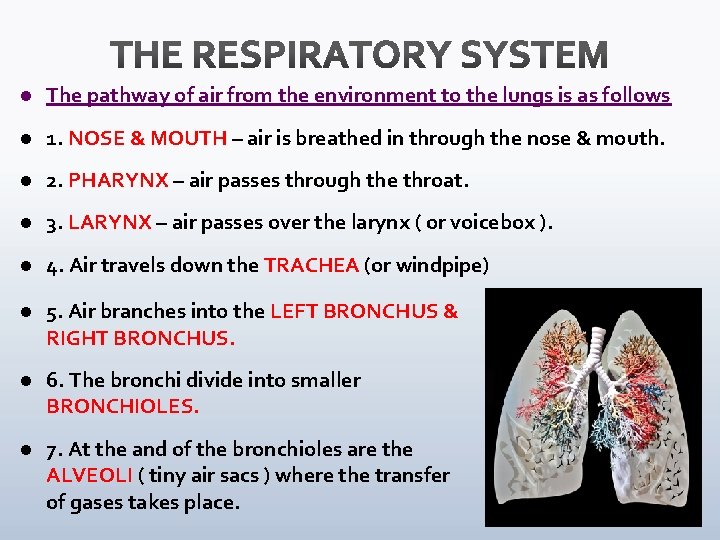
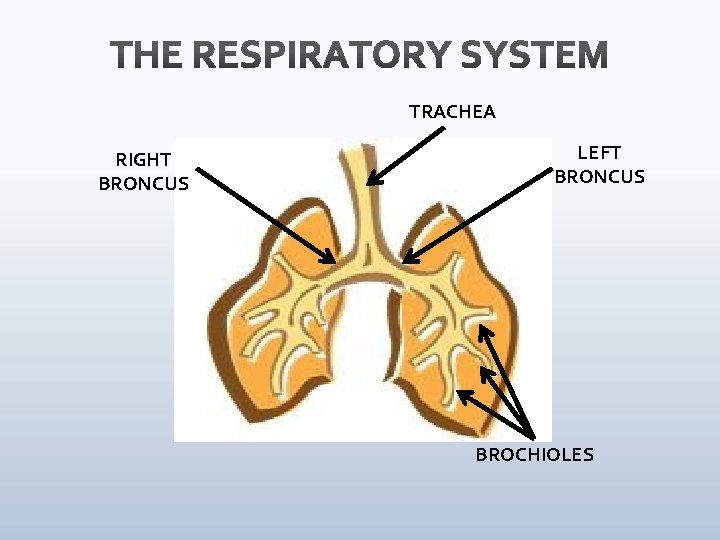
l The pathway of air from the environment to the lungs is as follows l 1. NOSE & MOUTH – air is breathed in through the nose & mouth. l 2. PHARYNX – air passes through the throat. l 3. LARYNX – air passes over the larynx ( or voicebox ). l 4. Air travels down the TRACHEA (or windpipe) l 5. Air branches into the LEFT BRONCHUS & RIGHT BRONCHUS. l 6. The bronchi divide into smaller BRONCHIOLES. l 7. At the and of the bronchioles are the ALVEOLI ( tiny air sacs ) where the transfer of gases takes place.
TRACHEA RIGHT BRONCUS LEFT BRONCUS BROCHIOLES
l INSPIRATION : l The DIAPHRAGM muscle contracts & flattens, whilst the INTERCOSTAL muscles raise thorax and sternum out. l The chest cavity is now bigger which lowers the pressure in the lungs to less than that of the environment. l Air is drawn into the lungs ( as gases will always move from higher pressure to lower pressure areas ). DIAPHRAGM contracts & flattens to make the chest cavity bigger.
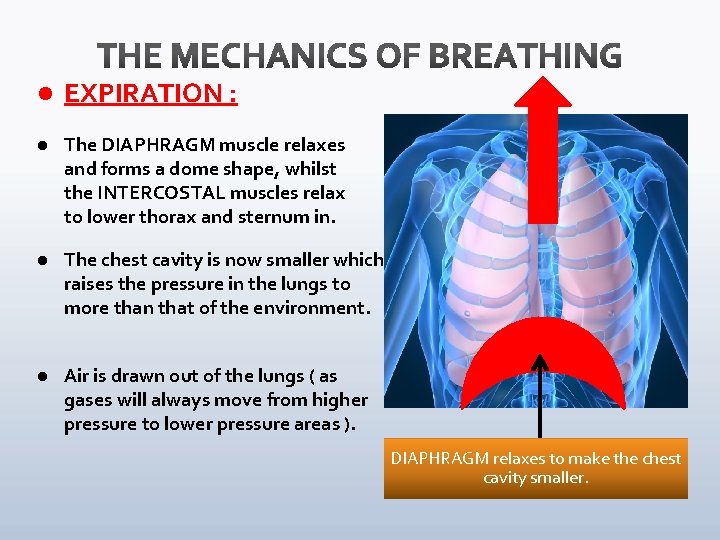
l EXPIRATION : l The DIAPHRAGM muscle relaxes and forms a dome shape, whilst the INTERCOSTAL muscles relax to lower thorax and sternum in. l The chest cavity is now smaller which raises the pressure in the lungs to more than that of the environment. l Air is drawn out of the lungs ( as gases will always move from higher pressure to lower pressure areas ). DIAPHRAGM relaxes to make the chest cavity smaller.
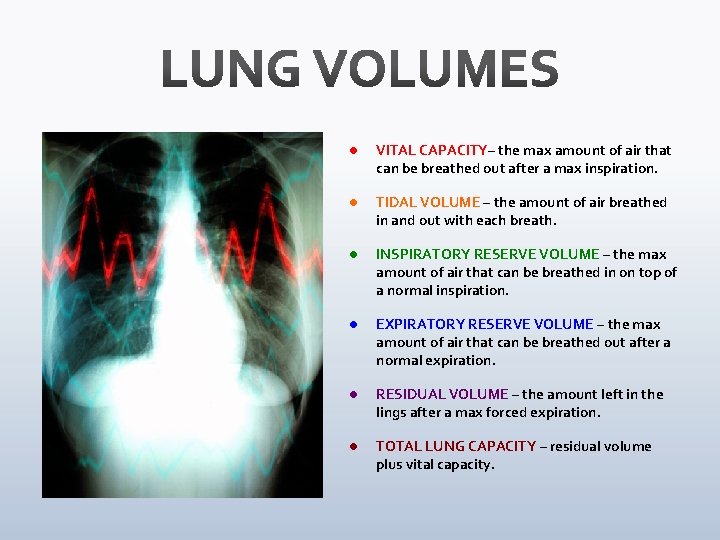
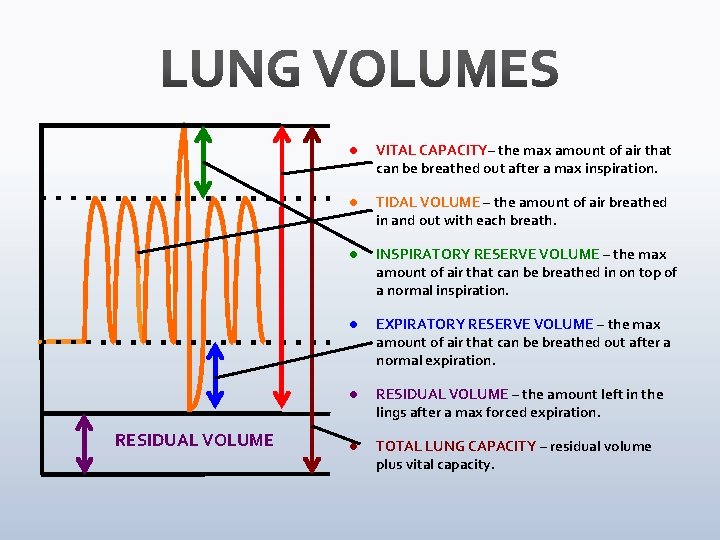
l VITAL CAPACITY– the max amount of air that can be breathed out after a max inspiration. l TIDAL VOLUME – the amount of air breathed in and out with each breath. l INSPIRATORY RESERVE VOLUME – the max amount of air that can be breathed in on top of a normal inspiration. l EXPIRATORY RESERVE VOLUME – the max amount of air that can be breathed out after a normal expiration. l RESIDUAL VOLUME – the amount left in the lings after a max forced expiration. l TOTAL LUNG CAPACITY – residual volume plus vital capacity.
RESIDUAL VOLUME l VITAL CAPACITY– the max amount of air that can be breathed out after a max inspiration. l TIDAL VOLUME – the amount of air breathed in and out with each breath. l INSPIRATORY RESERVE VOLUME – the max amount of air that can be breathed in on top of a normal inspiration. l EXPIRATORY RESERVE VOLUME – the max amount of air that can be breathed out after a normal expiration. l RESIDUAL VOLUME – the amount left in the lings after a max forced expiration. l TOTAL LUNG CAPACITY – residual volume plus vital capacity.
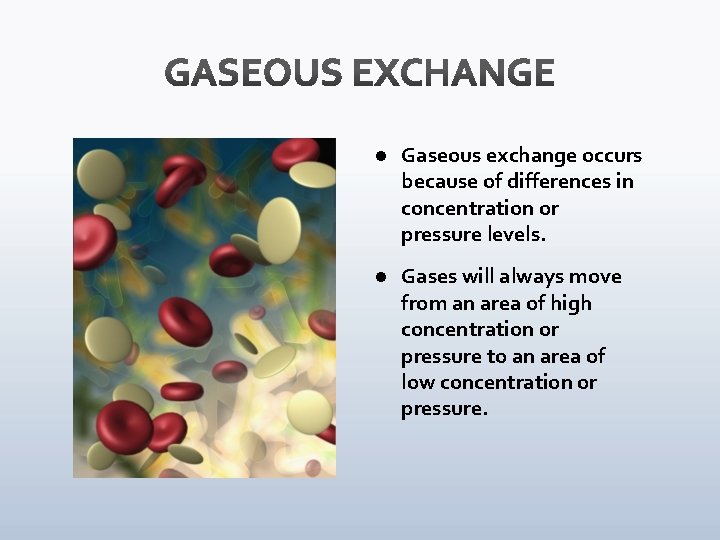
l Gaseous exchange occurs because of differences in concentration or pressure levels. l Gases will always move from an area of high concentration or pressure to an area of low concentration or pressure.
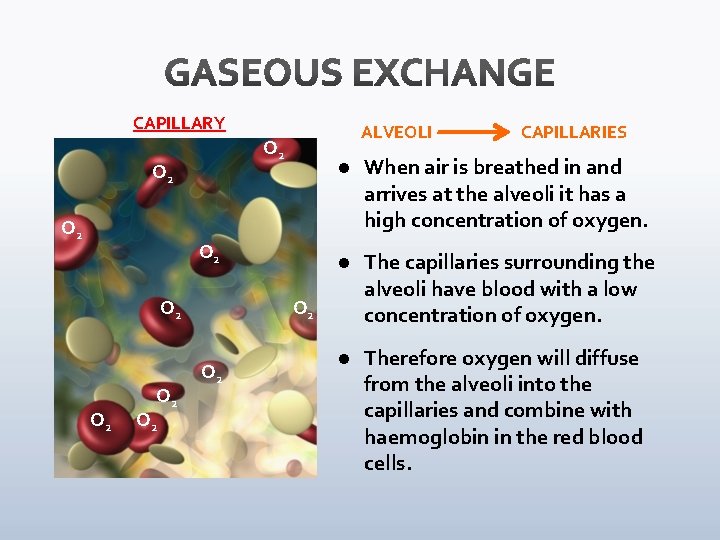
CAPILLARY O 2 O 2 ALVEOLI O 2 O 2 O 2 l When air is breathed in and arrives at the alveoli it has a high concentration of oxygen. l The capillaries surrounding the alveoli have blood with a low concentration of oxygen. l Therefore oxygen will diffuse from the alveoli into the capillaries and combine with haemoglobin in the red blood cells. O 2 CAPILLARIES
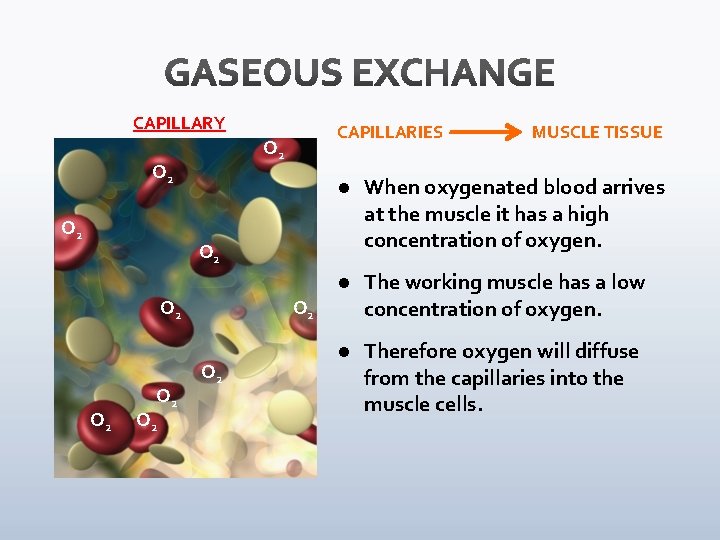
CAPILLARY O 2 O 2 CAPILLARIES l When oxygenated blood arrives at the muscle it has a high concentration of oxygen. l The working muscle has a low concentration of oxygen. l Therefore oxygen will diffuse from the capillaries into the muscle cells. O 2 O 2 MUSCLE TISSUE
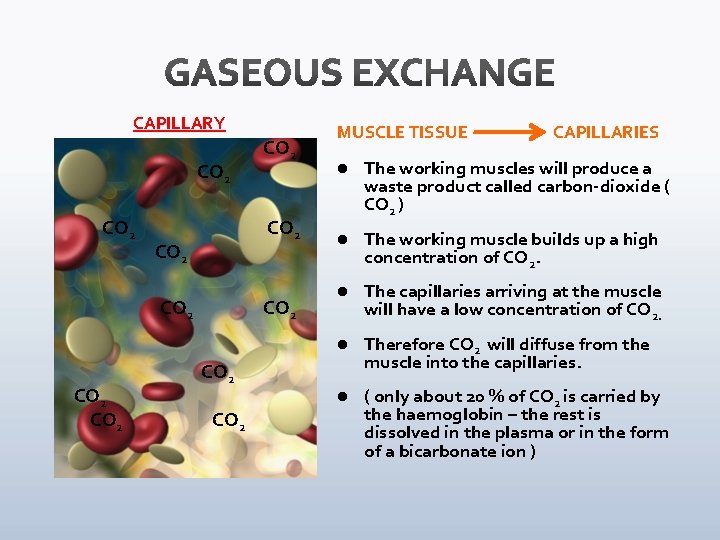
CAPILLARY CO 2 CO 2 CO 2 MUSCLE TISSUE l The working muscles will produce a waste product called carbon-dioxide ( CO 2 ) l The working muscle builds up a high concentration of CO 2. l The capillaries arriving at the muscle will have a low concentration of CO 2. l Therefore CO 2 will diffuse from the muscle into the capillaries. l ( only about 20 % of CO 2 is carried by the haemoglobin – the rest is dissolved in the plasma or in the form of a bicarbonate ion ) CO 2 CAPILLARIES
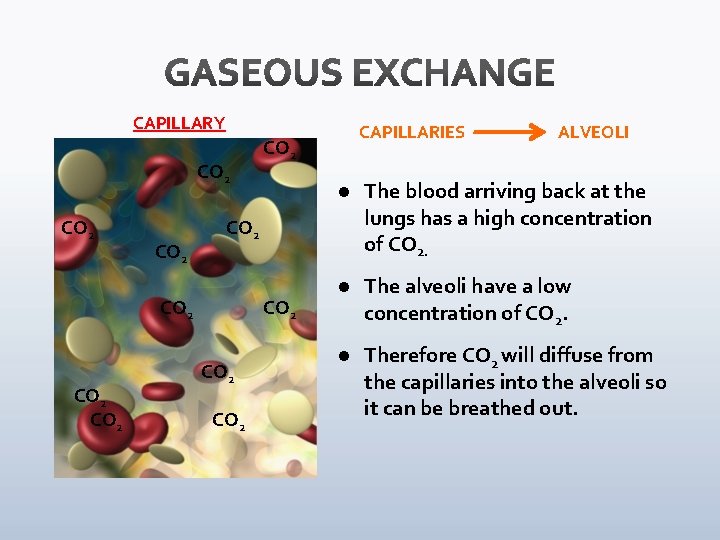
CAPILLARY CO 2 CO 2 ALVEOLI l The blood arriving back at the lungs has a high concentration of CO 2. l The alveoli have a low concentration of CO 2. l Therefore CO 2 will diffuse from the capillaries into the alveoli so it can be breathed out. CO 2 CAPILLARIES
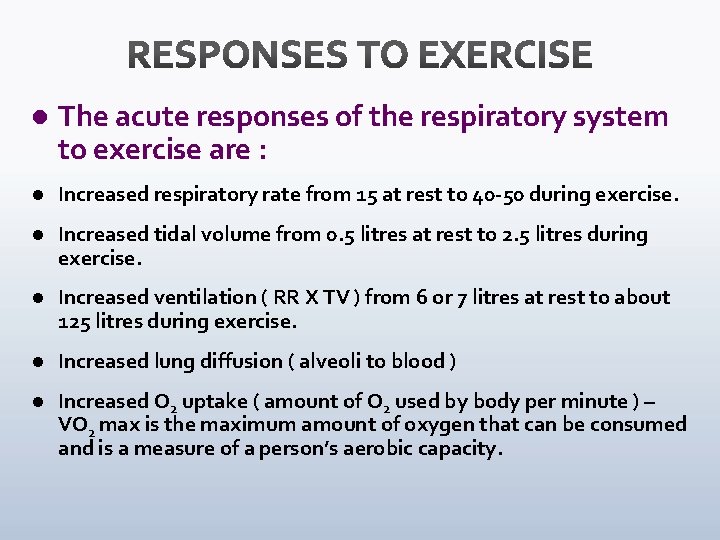
l The acute responses of the respiratory system to exercise are : l Increased respiratory rate from 15 at rest to 40 -50 during exercise. l Increased tidal volume from 0. 5 litres at rest to 2. 5 litres during exercise. l Increased ventilation ( RR X TV ) from 6 or 7 litres at rest to about 125 litres during exercise. l Increased lung diffusion ( alveoli to blood ) l Increased O 2 uptake ( amount of O 2 used by body per minute ) – VO 2 max is the maximum amount of oxygen that can be consumed and is a measure of a person’s aerobic capacity.
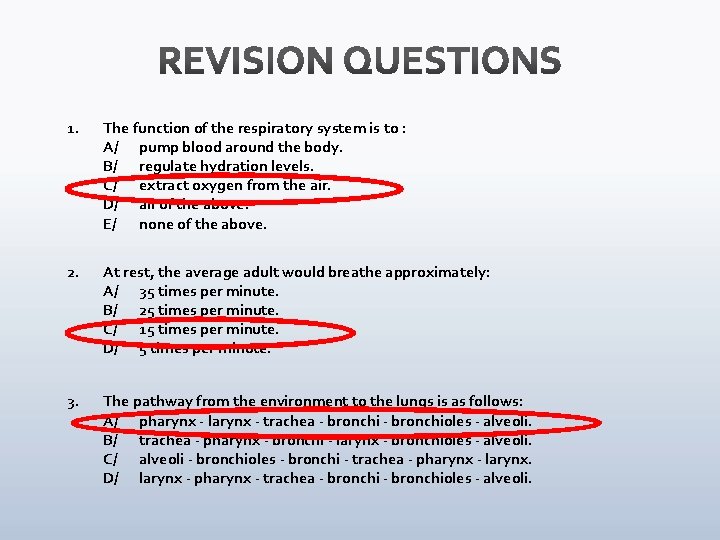
1. The function of the respiratory system is to : A/ pump blood around the body. B/ regulate hydration levels. C/ extract oxygen from the air. D/ all of the above. E/ none of the above. 2. At rest, the average adult would breathe approximately: A/ 35 times per minute. B/ 25 times per minute. C/ 15 times per minute. D/ 5 times per minute. 3. The pathway from the environment to the lungs is as follows: A/ pharynx - larynx - trachea - bronchioles - alveoli. B/ trachea - pharynx - bronchi - larynx - bronchioles - alveoli. C/ alveoli - bronchioles - bronchi - trachea - pharynx - larynx. D/ larynx - pharynx - trachea - bronchioles - alveoli.
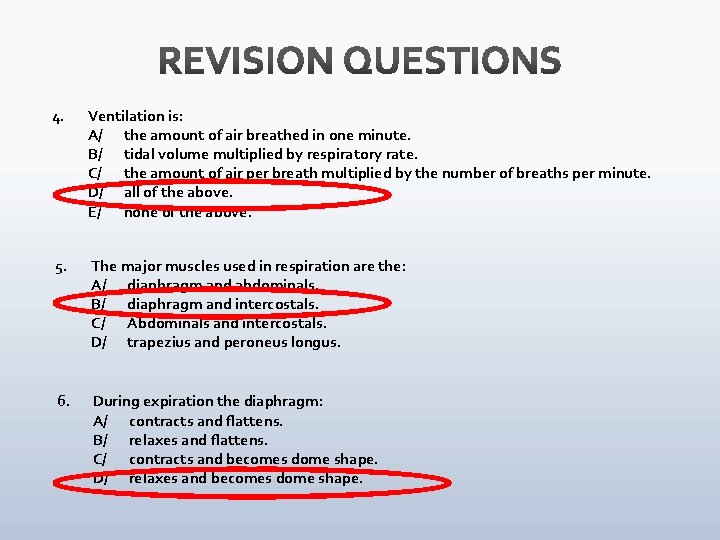
4. Ventilation is: A/ the amount of air breathed in one minute. B/ tidal volume multiplied by respiratory rate. C/ the amount of air per breath multiplied by the number of breaths per minute. D/ all of the above. E/ none of the above. 5. The major muscles used in respiration are the: A/ diaphragm and abdominals. B/ diaphragm and intercostals. C/ Abdominals and intercostals. D/ trapezius and peroneus longus. 6. During expiration the diaphragm: A/ contracts and flattens. B/ relaxes and flattens. C/ contracts and becomes dome shape. D/ relaxes and becomes dome shape.
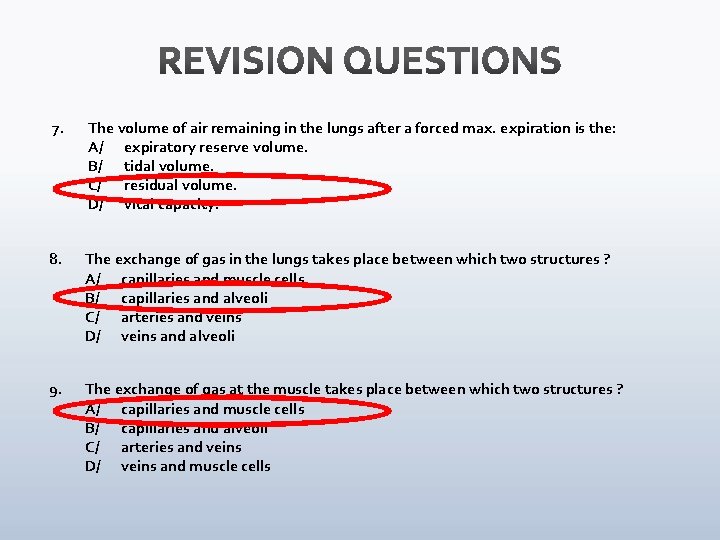
7. The volume of air remaining in the lungs after a forced max. expiration is the: A/ expiratory reserve volume. B/ tidal volume. C/ residual volume. D/ vital capacity. 8. The exchange of gas in the lungs takes place between which two structures ? A/ capillaries and muscle cells B/ capillaries and alveoli C/ arteries and veins D/ veins and alveoli 9. The exchange of gas at the muscle takes place between which two structures ? A/ capillaries and muscle cells B/ capillaries and alveoli C/ arteries and veins D/ veins and muscle cells