
L O To learn about why and how
L. O To learn about why and how music is written down. Music is an international language, so a piece written down in music notation can be read by musicians all over the world.
We write down music so that: We have a record of what we have written and other people, can play what we have written.

We write music on a stave, this stave has a Treble Clef. The Clef determines the pitch, the stave is where the musical notes go, there are twelve different notes.
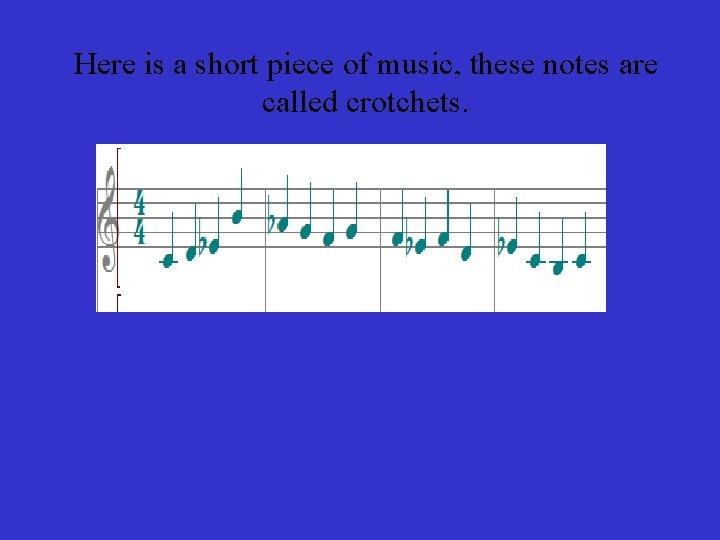
Here is a short piece of music, these notes are called crotchets.
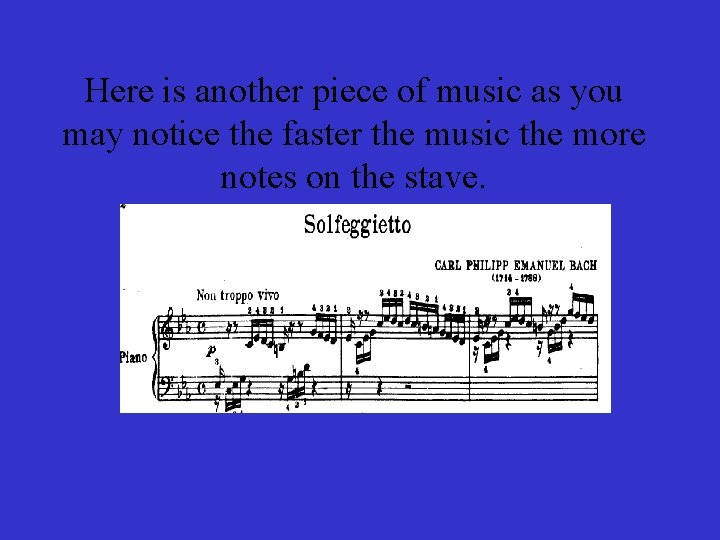
Here is another piece of music as you may notice the faster the music the more notes on the stave.
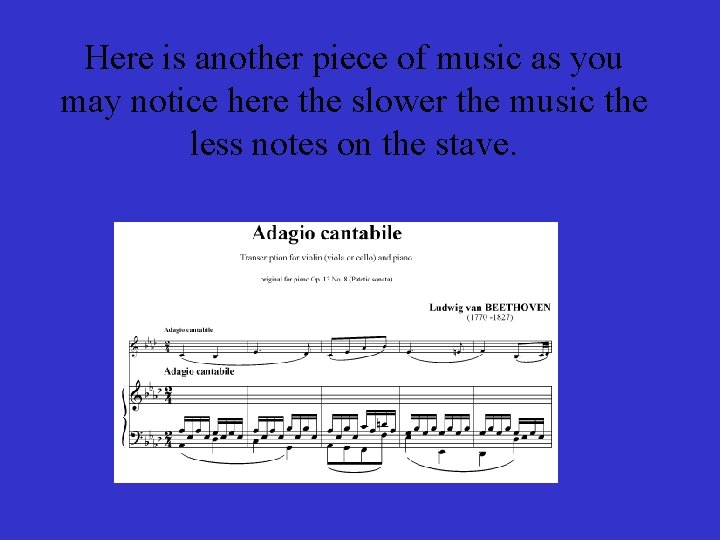
Here is another piece of music as you may notice here the slower the music the less notes on the stave.
Here are some more musical terms and their definitions.
Beat. Beat is defined as a rhythmic movement, or is the speed at which a piece of music is played.
Rhythm is what makes music move and flow. Rhythm is made up of sounds and silences. These sounds and silences are put together to form patterns of sound, which are repeated to create rhythm. A rhythm has a steady beat, but it may also have many different kinds of beats.
Note. In music, a note is a symbol denoting a musical sound. . Notes can represent the pitch and duration of a sound in musical notation. Notes are the building blocks of much written music.
Rest. A rest is a musical notation sign that indicates the absence of a sound. Each rest symbol and name corresponds with a particular note value for length, indicating how long the silence should last.
Duration. The length of time that a note is played is called its note duration, which is determined by the type of note. The whole note has the longest note duration in modern music. The quarter note is a fourth (or a quarter) of a whole note. The crotchet is an eighth of a whole note.
Pitch. The pitch of a note means how high or low the note is.
Volume. The volume of a note is how loud or quiet it is played.
Stave. In Western musical notation, stave is a set of five horizontal lines and four spaces that each represent a different musical pitch.
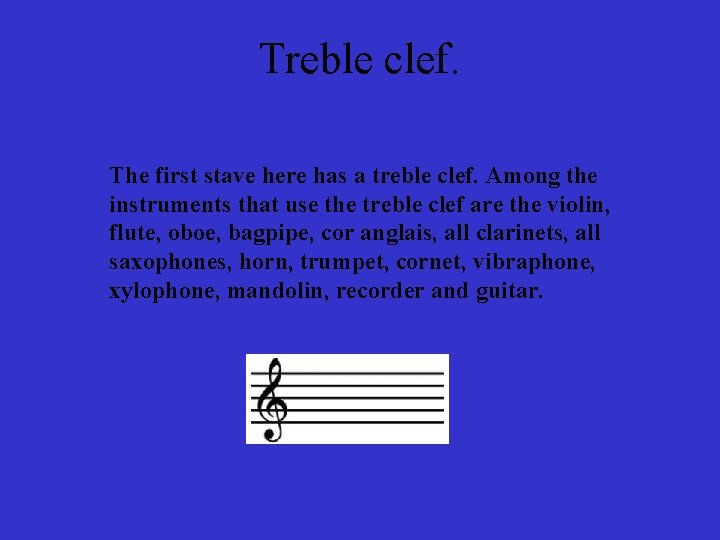
Treble clef. The first stave here has a treble clef. Among the instruments that use the treble clef are the violin, flute, oboe, bagpipe, cor anglais, all clarinets, all saxophones, horn, trumpet, cornet, vibraphone, xylophone, mandolin, recorder and guitar.
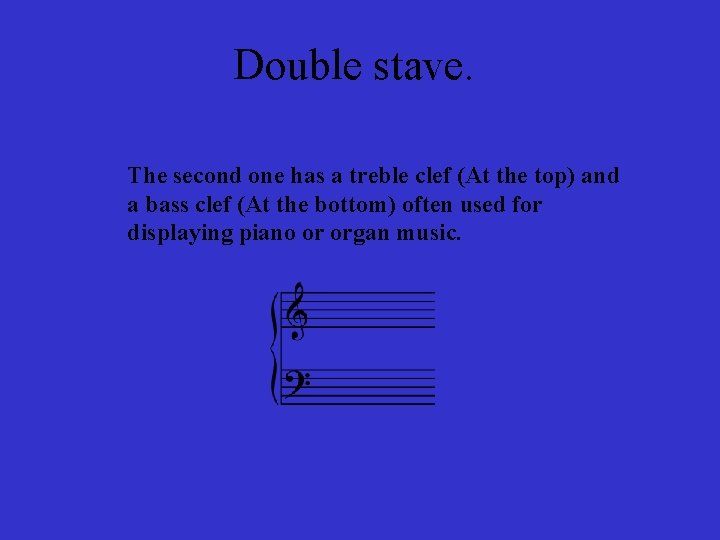
Double stave. The second one has a treble clef (At the top) and a bass clef (At the bottom) often used for displaying piano or organ music.
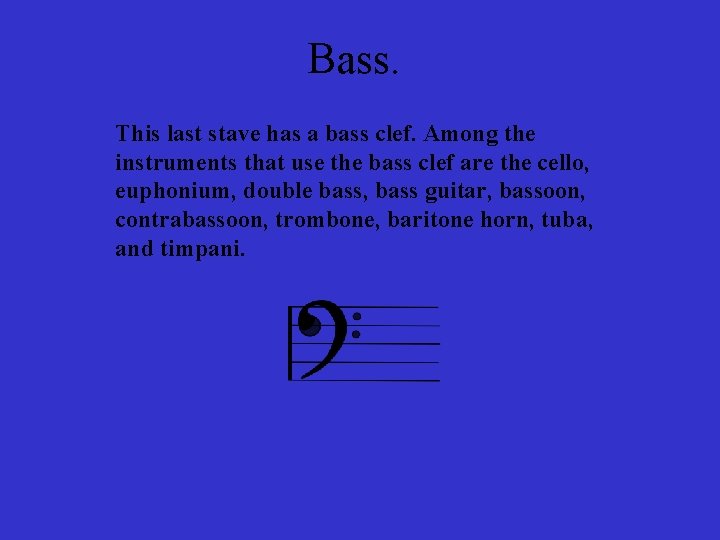
Bass. This last stave has a bass clef. Among the instruments that use the bass clef are the cello, euphonium, double bass, bass guitar, bassoon, contrabassoon, trombone, baritone horn, tuba, and timpani.

End.
- Slides: 19