
l l Study Points What did Copernicus do
- Slides: 61
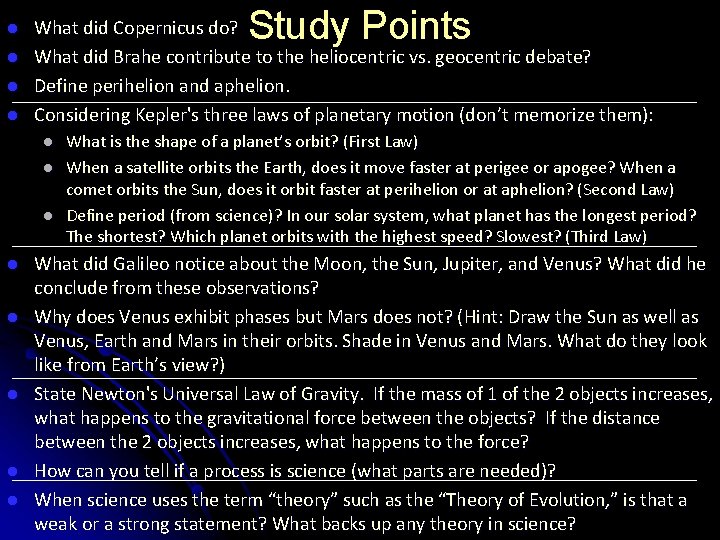
l l Study Points What did Copernicus do? What did Brahe contribute to the heliocentric vs. geocentric debate? Define perihelion and aphelion. Considering Kepler's three laws of planetary motion (don’t memorize them): l l l l What is the shape of a planet’s orbit? (First Law) When a satellite orbits the Earth, does it move faster at perigee or apogee? When a comet orbits the Sun, does it orbit faster at perihelion or at aphelion? (Second Law) Define period (from science)? In our solar system, what planet has the longest period? The shortest? Which planet orbits with the highest speed? Slowest? (Third Law) What did Galileo notice about the Moon, the Sun, Jupiter, and Venus? What did he conclude from these observations? Why does Venus exhibit phases but Mars does not? (Hint: Draw the Sun as well as Venus, Earth and Mars in their orbits. Shade in Venus and Mars. What do they look like from Earth’s view? ) State Newton's Universal Law of Gravity. If the mass of 1 of the 2 objects increases, what happens to the gravitational force between the objects? If the distance between the 2 objects increases, what happens to the force? How can you tell if a process is science (what parts are needed)? When science uses the term “theory” such as the “Theory of Evolution, ” is that a weak or a strong statement? What backs up any theory in science?
Copernican Revolution ~1500 to ~1700
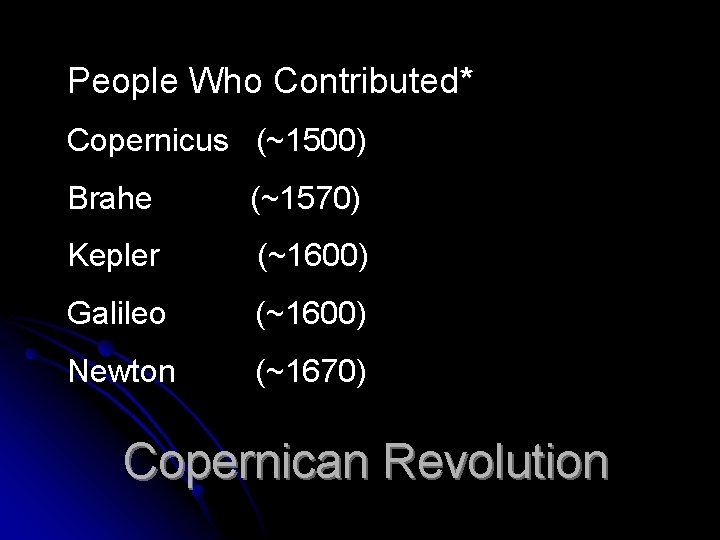
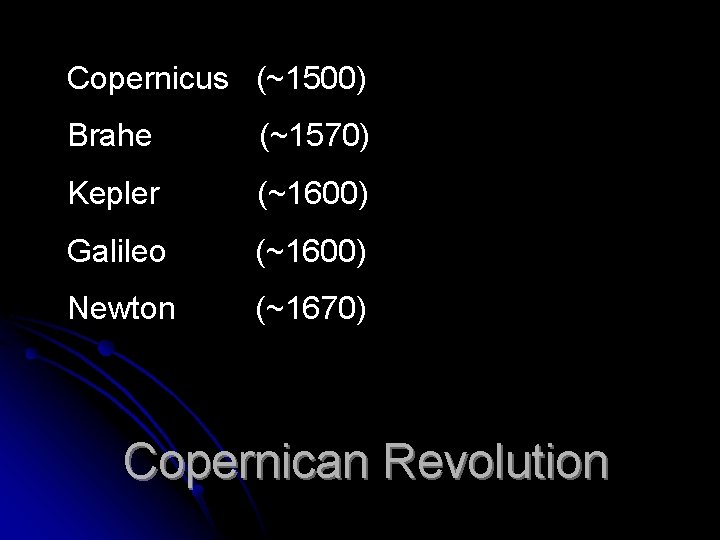
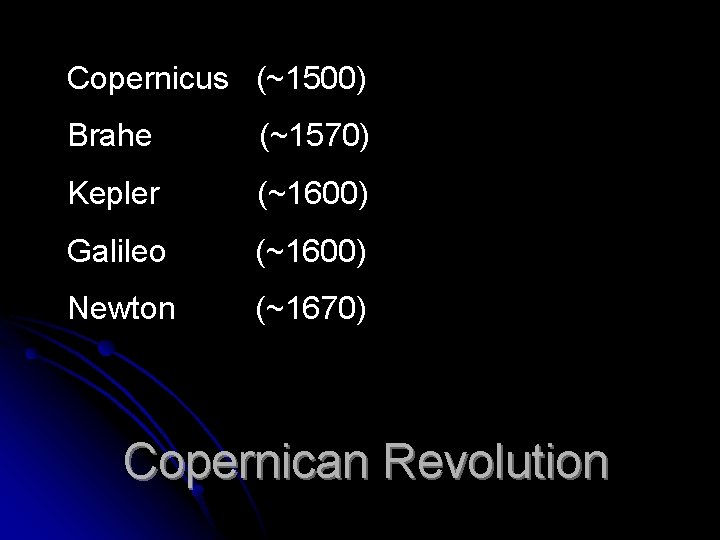
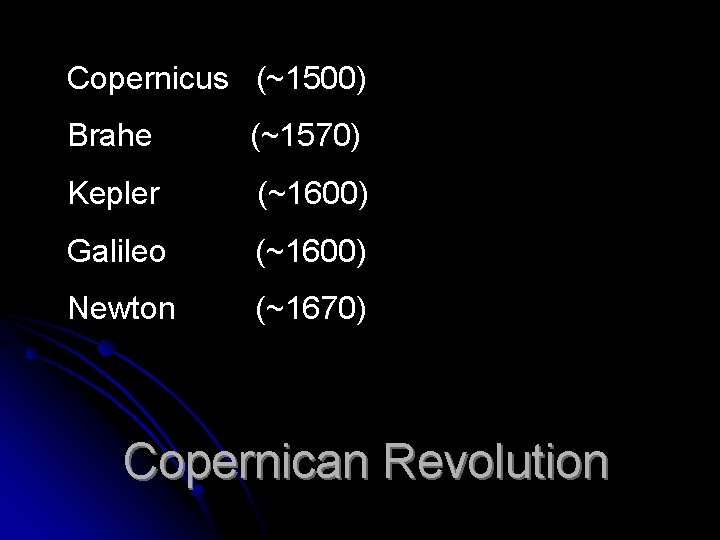
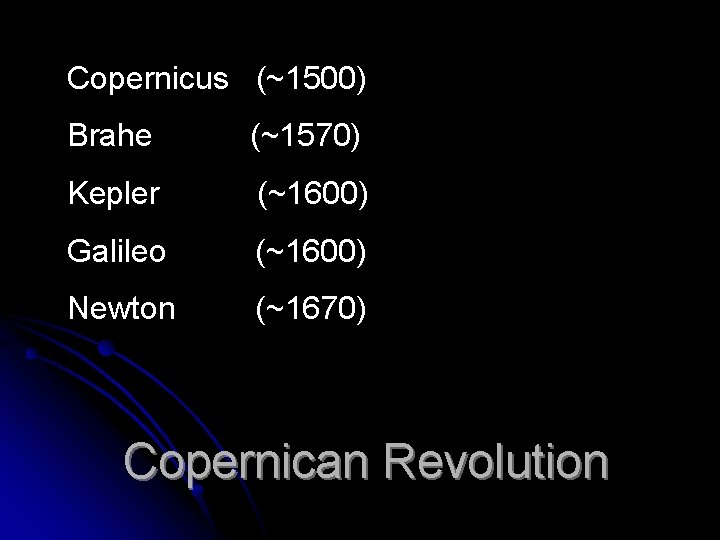
People Who Contributed* Copernicus (~1500) Brahe (~1570) Kepler (~1600) Galileo (~1600) Newton (~1670) Copernican Revolution
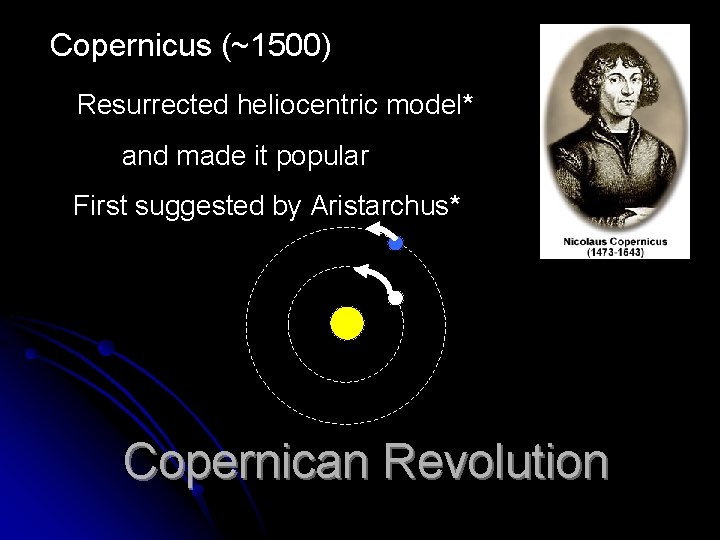
Copernicus (~1500) Resurrected heliocentric model* and made it popular First suggested by Aristarchus* Copernican Revolution
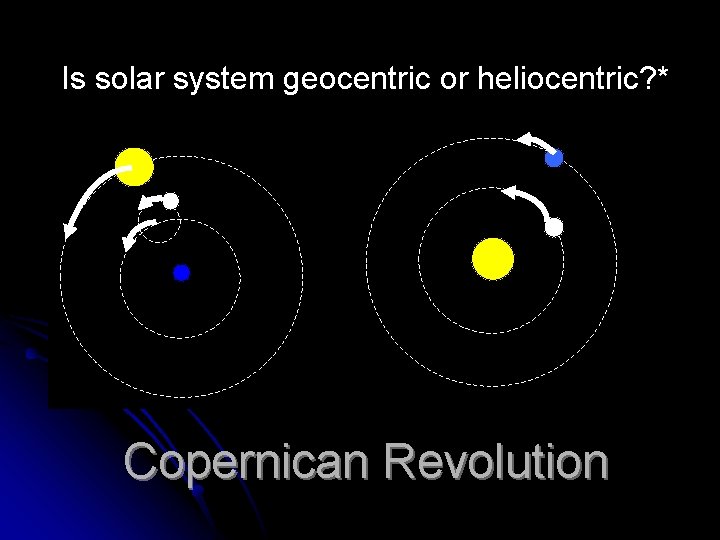
Is solar system geocentric or heliocentric? * Copernican Revolution
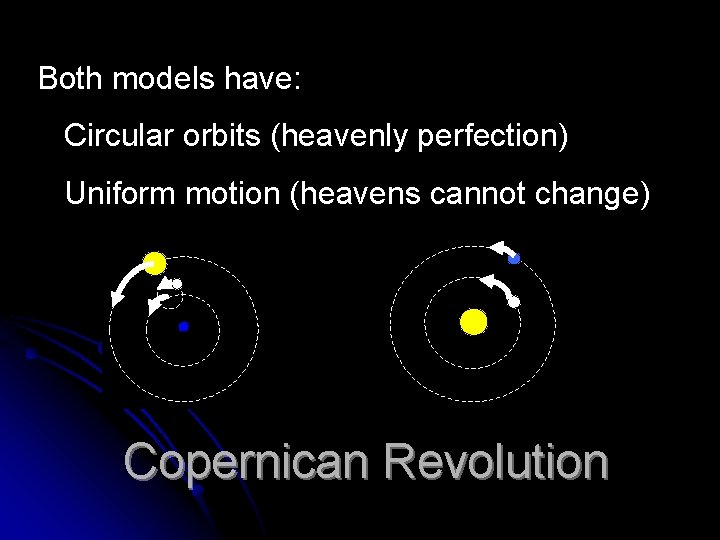
Both models have: Circular orbits (heavenly perfection) Uniform motion (heavens cannot change) Copernican Revolution
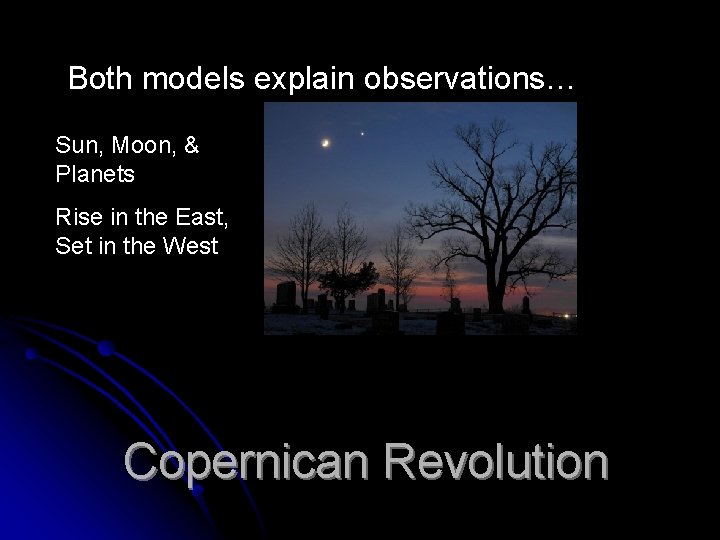
Both models explain observations… Sun, Moon, & Planets Rise in the East, Set in the West Copernican Revolution
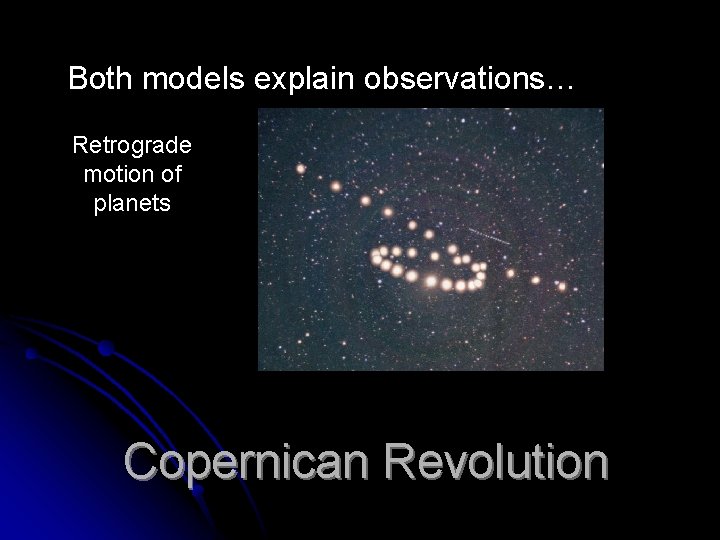
Both models explain observations… Retrograde motion of planets Copernican Revolution
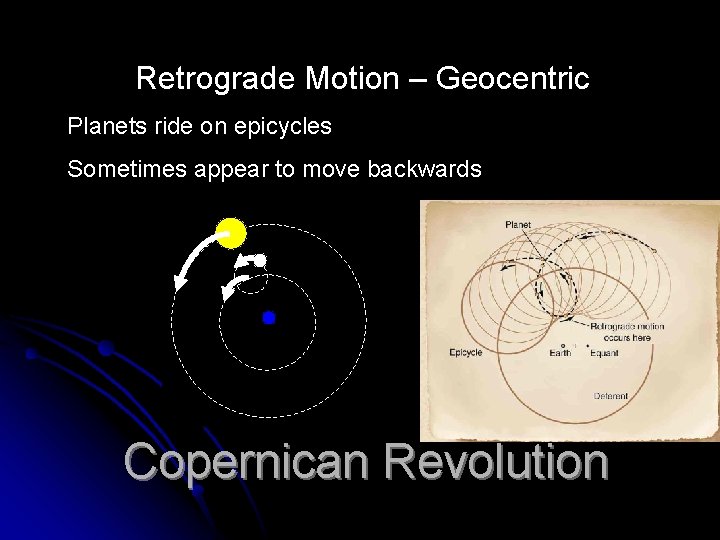
Retrograde Motion – Geocentric Planets ride on epicycles Sometimes appear to move backwards Copernican Revolution
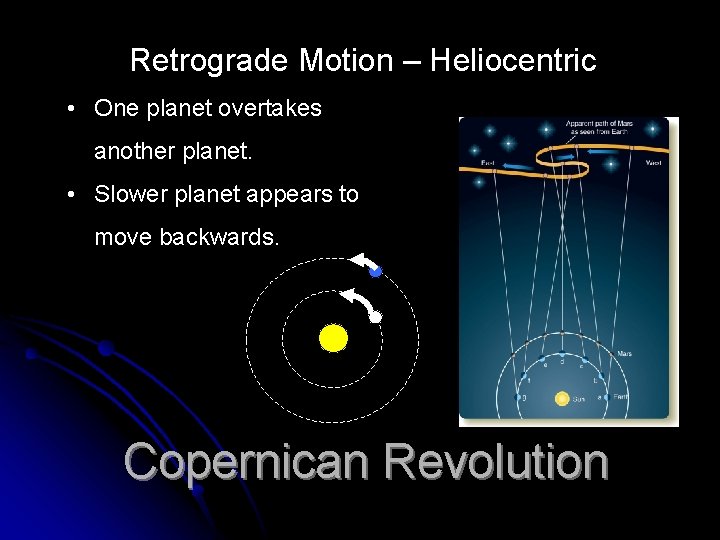
Retrograde Motion – Heliocentric • One planet overtakes another planet. • Slower planet appears to move backwards. Copernican Revolution
Copernicus (~1500) Brahe (~1570) Kepler (~1600) Galileo (~1600) Newton (~1670) Copernican Revolution
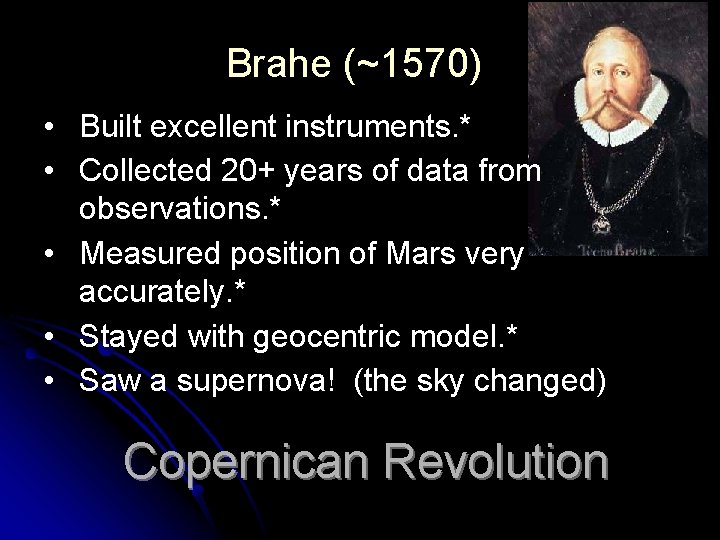
Brahe (~1570) • Built excellent instruments. * • Collected 20+ years of data from observations. * • Measured position of Mars very accurately. * • Stayed with geocentric model. * • Saw a supernova! (the sky changed) Copernican Revolution
Copernicus (~1500) Brahe (~1570) Kepler (~1600) Galileo (~1600) Newton (~1670) Copernican Revolution
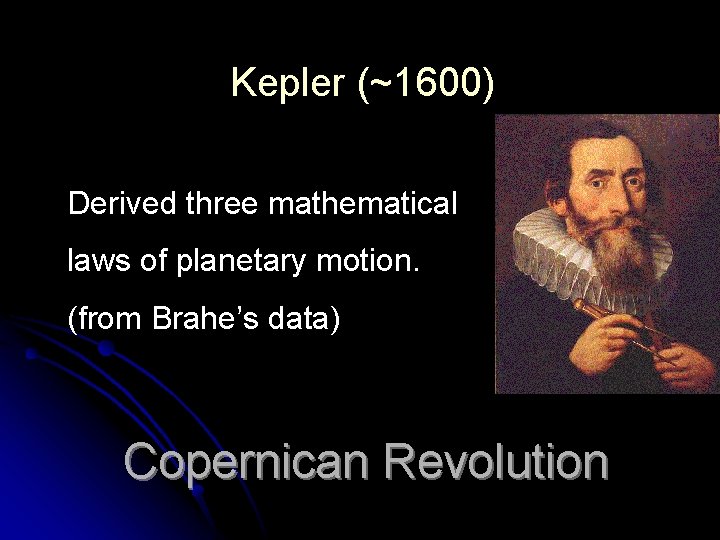
Kepler (~1600) Derived three mathematical laws of planetary motion. (from Brahe’s data) Copernican Revolution
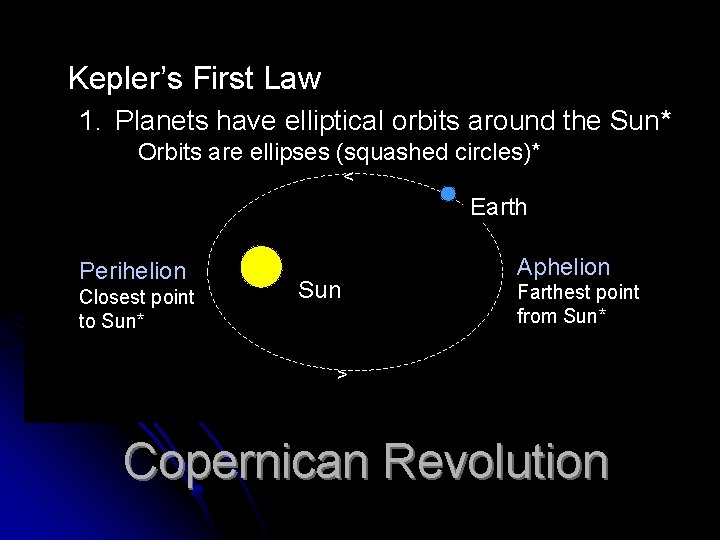
Kepler’s First Law 1. Planets have elliptical orbits around the Sun* Orbits are ellipses (squashed circles)* < Earth Perihelion Closest point to Sun* Sun Aphelion Farthest point from Sun* > Copernican Revolution
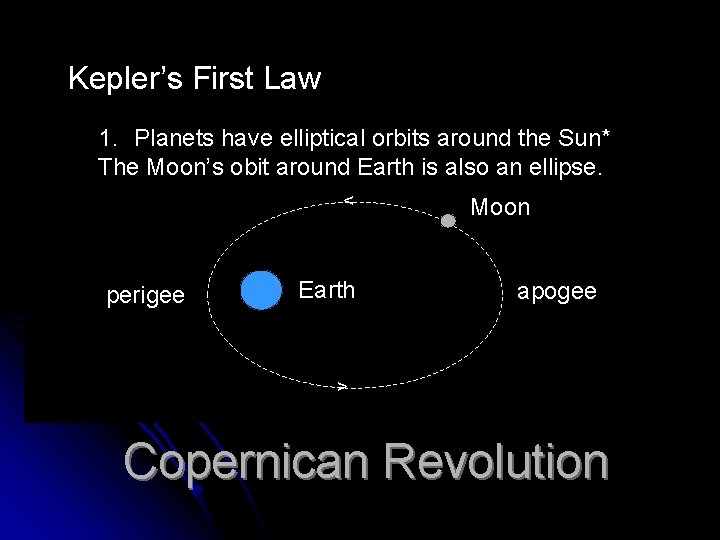
Kepler’s First Law 1. Planets have elliptical orbits around the Sun* The Moon’s obit around Earth is also an ellipse. < perigee Earth Moon apogee > Copernican Revolution
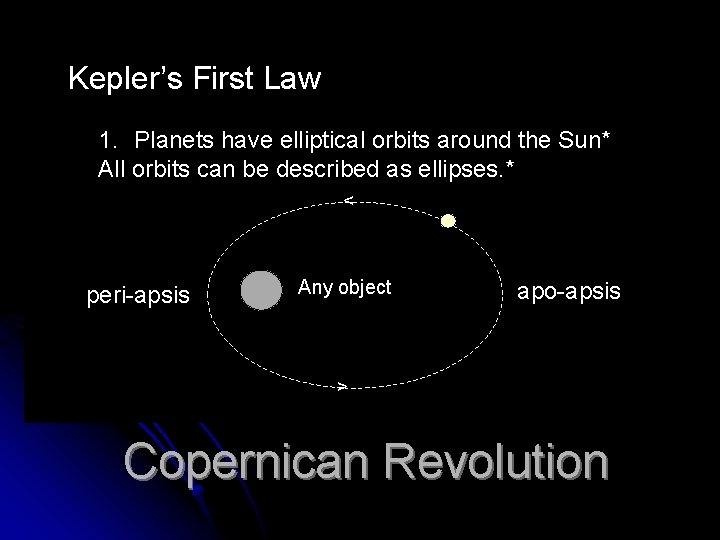
Kepler’s First Law 1. Planets have elliptical orbits around the Sun* All orbits can be described as ellipses. * < peri-apsis Any object apo-apsis > Copernican Revolution
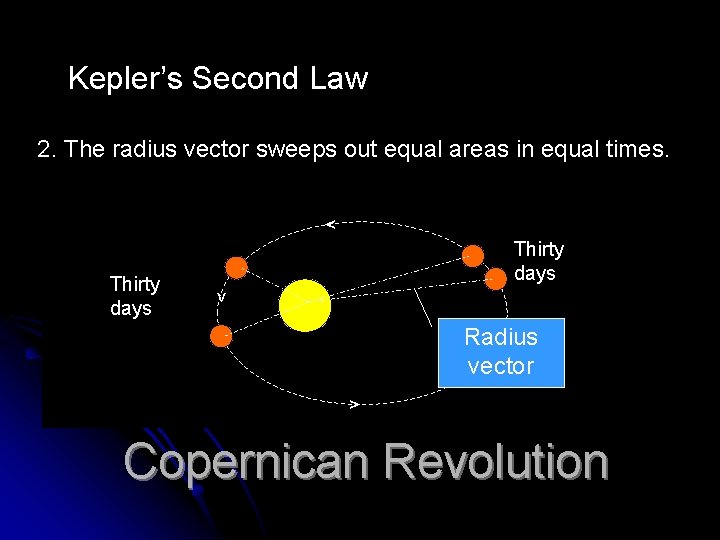
Kepler’s Second Law 2. The radius vector sweeps out equal areas in equal times. < > Thirty days Radius vector > Copernican Revolution
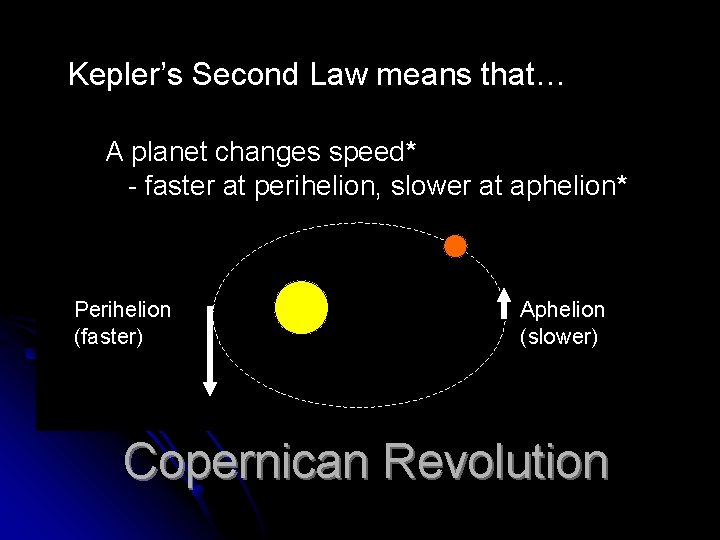
Kepler’s Second Law means that… A planet changes speed* - faster at perihelion, slower at aphelion* Perihelion (faster) Aphelion (slower) Copernican Revolution
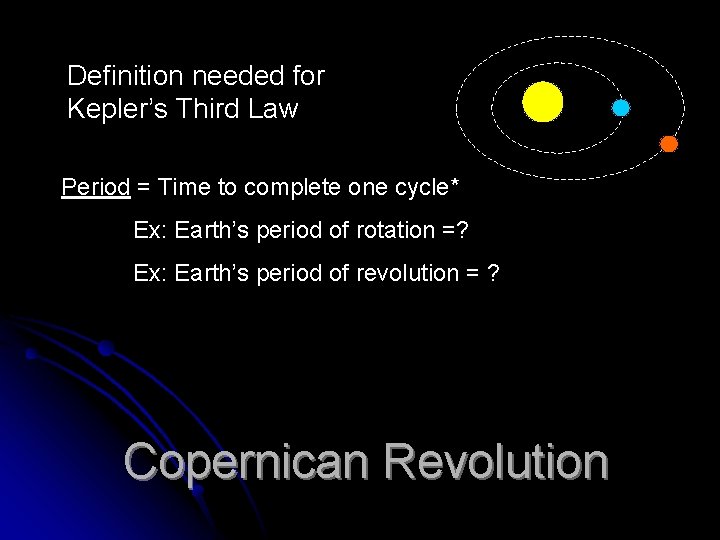
Definition needed for Kepler’s Third Law Period = Time to complete one cycle* Ex: Earth’s period of rotation =? Ex: Earth’s period of revolution = ? Copernican Revolution
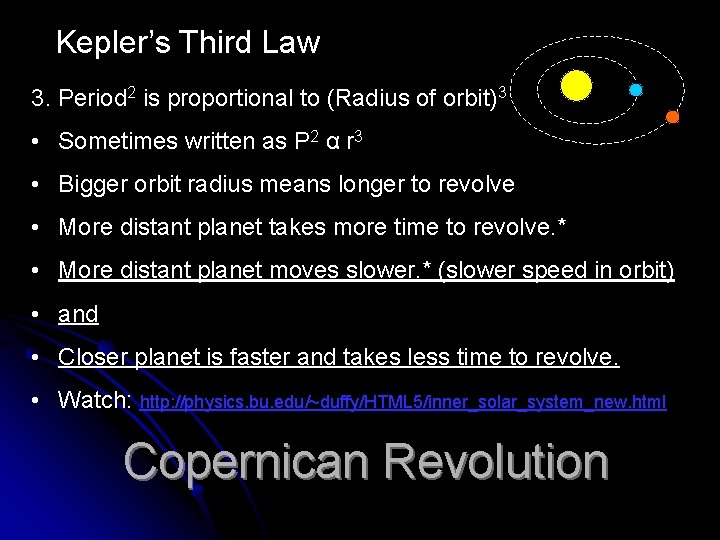
Kepler’s Third Law 3. Period 2 is proportional to (Radius of orbit)3 • Sometimes written as P 2 α r 3 • Bigger orbit radius means longer to revolve • More distant planet takes more time to revolve. * • More distant planet moves slower. * (slower speed in orbit) • and • Closer planet is faster and takes less time to revolve. • Watch: http: //physics. bu. edu/~duffy/HTML 5/inner_solar_system_new. html Copernican Revolution
Kepler’s 3 Laws 1. 2. Planets have elliptical orbits around the Sun* The radius vector sweeps out equal areas in equal times. • 3. A planet changes speed* Period 2 is proportional to (Radius of orbit)3 • • More distant planet takes more time to revolve. * More distant planet moves slower. * Copernican Revolution
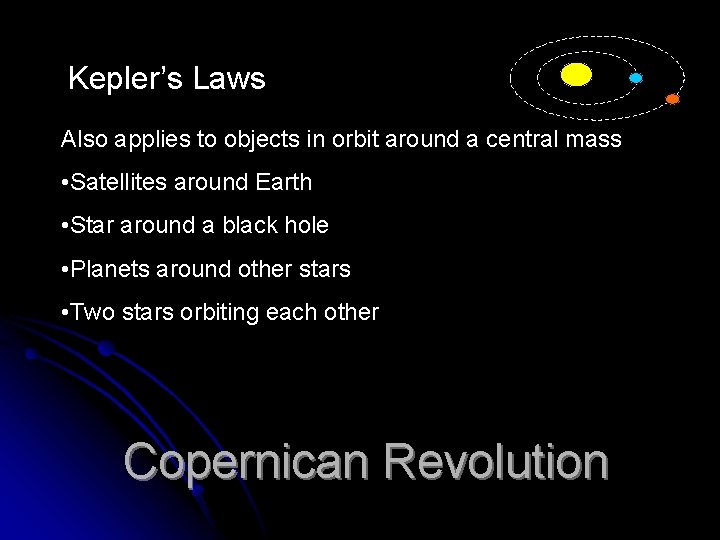
Kepler’s Laws Also applies to objects in orbit around a central mass • Satellites around Earth • Star around a black hole • Planets around other stars • Two stars orbiting each other Copernican Revolution
Copernicus (~1500) Brahe (~1570) Kepler (~1600) Galileo (~1600) Newton (~1670) Copernican Revolution
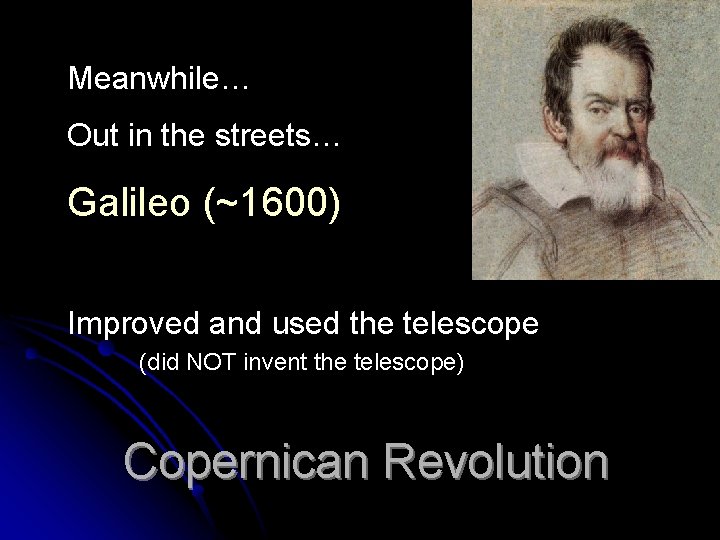
Meanwhile… Out in the streets… Galileo (~1600) Improved and used the telescope (did NOT invent the telescope) Copernican Revolution
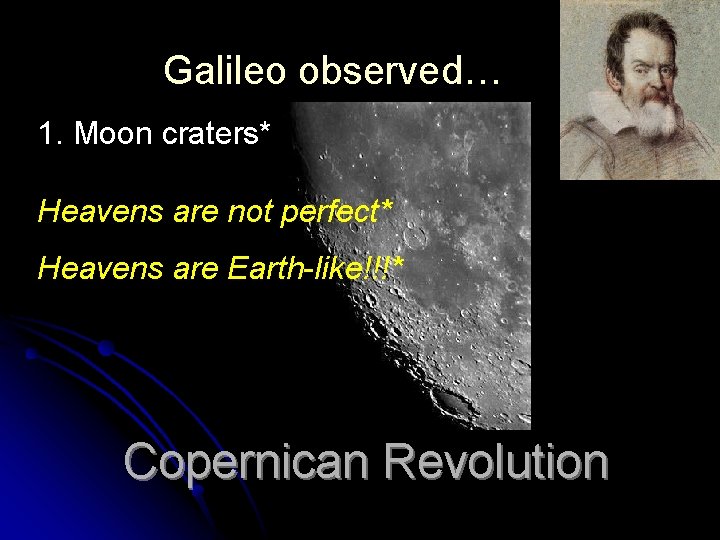
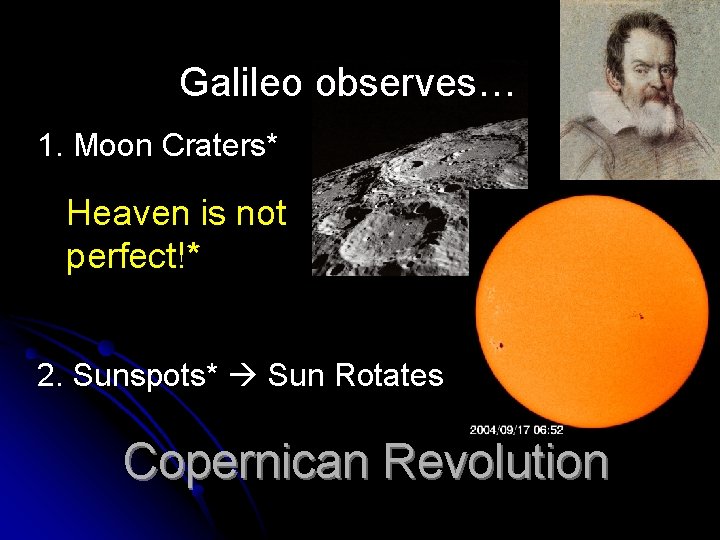
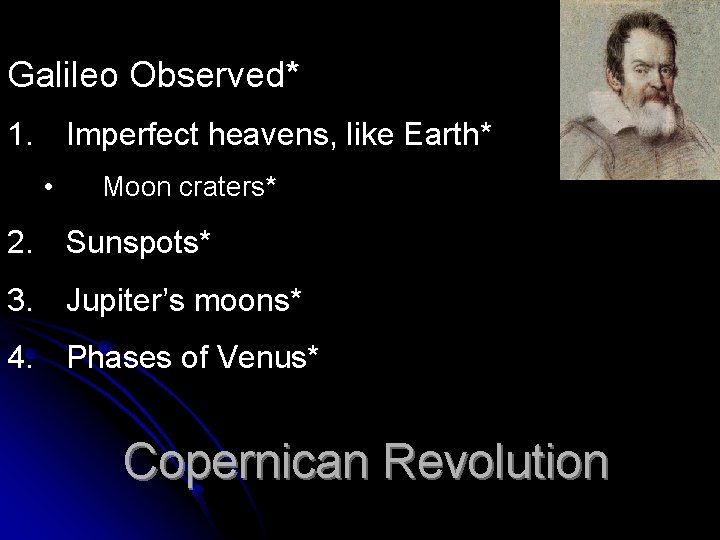
Galileo observed… 1. Moon craters* Heavens are not perfect* Heavens are Earth-like!!!* Copernican Revolution
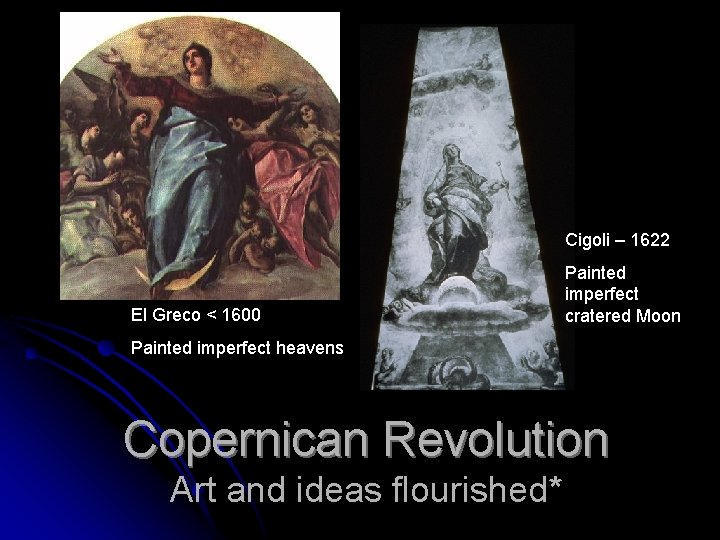
Cigoli – 1622 El Greco < 1600 Painted imperfect cratered Moon Painted imperfect heavens Copernican Revolution Art and ideas flourished*
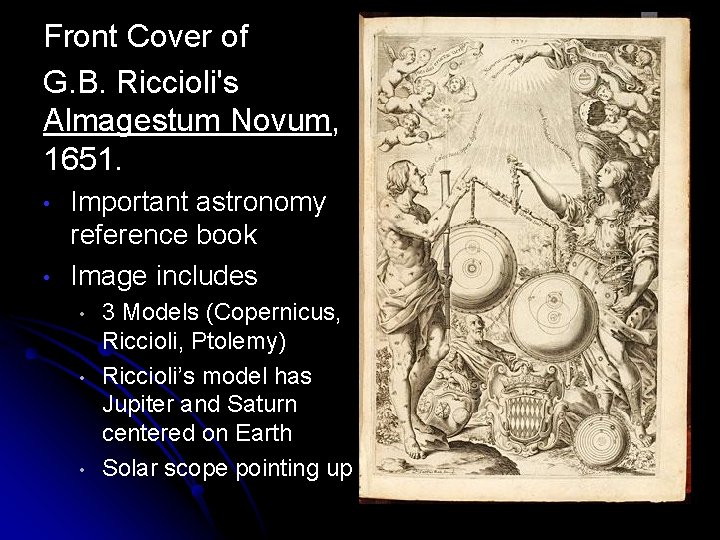
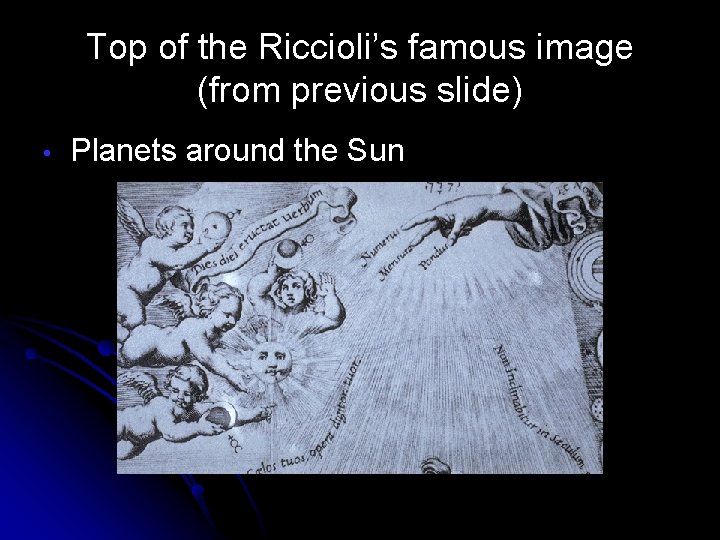
Front Cover of G. B. Riccioli's Almagestum Novum, 1651. • • Important astronomy reference book Image includes • • • 3 Models (Copernicus, Riccioli, Ptolemy) Riccioli’s model has Jupiter and Saturn centered on Earth Solar scope pointing up
Top of the Riccioli’s famous image (from previous slide) • Planets around the Sun
Galileo observes… 1. Moon Craters* Heaven is not perfect!* 2. Sunspots* Sun Rotates Copernican Revolution
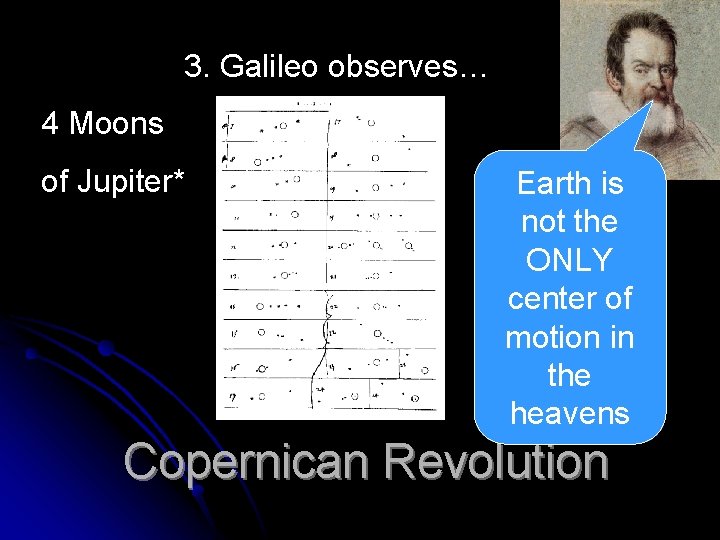
3. Galileo observes… 4 Moons of Jupiter* Earth is not the ONLY center of motion in the heavens Copernican Revolution
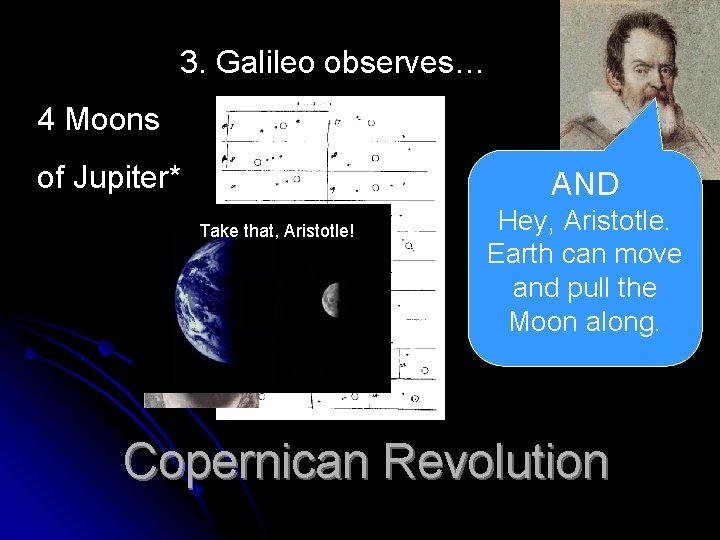
3. Galileo observes… 4 Moons of Jupiter* AND Take that, Aristotle! Hey, Aristotle. Earth can move and pull the Moon along. Copernican Revolution
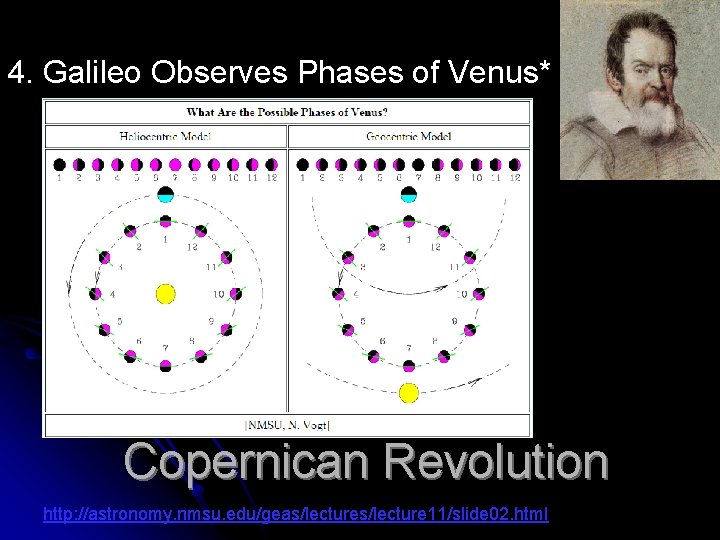
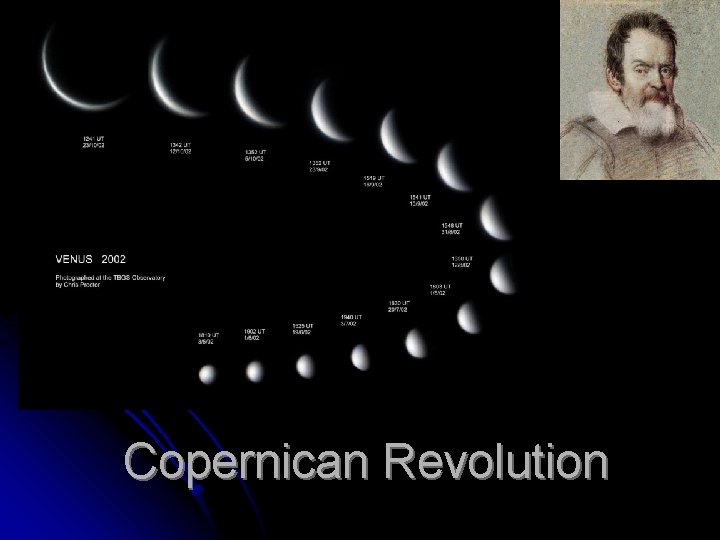
4. Galileo Observes Phases of Venus* • Geocentric model predicts: • Crescent phase only and little size change • Heliocentric predicts: • All phases AND • Gibbous is small, while crescent is large Watch: Venus phases video http: //galileoandeinstein. physics. virginia. edu/more_stuff/flashlets/Phasesof. Venus. htm Copernican Revolution
4. Galileo Observes Phases of Venus* Copernican Revolution http: //astronomy. nmsu. edu/geas/lecture 11/slide 02. html
Copernican Revolution
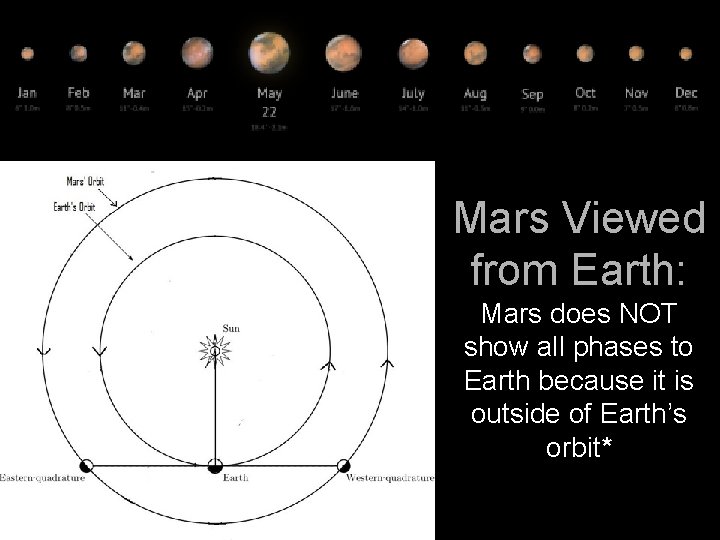
Mars Viewed from Earth: Mars does NOT show all phases to Earth because it is outside of Earth’s orbit*
Galileo Observed* 1. Imperfect heavens, like Earth* • Moon craters* 2. Sunspots* 3. Jupiter’s moons* 4. Phases of Venus* Copernican Revolution
Copernicus (~1500) Brahe (~1570) Kepler (~1600) Galileo (~1600) Newton (~1670) Copernican Revolution
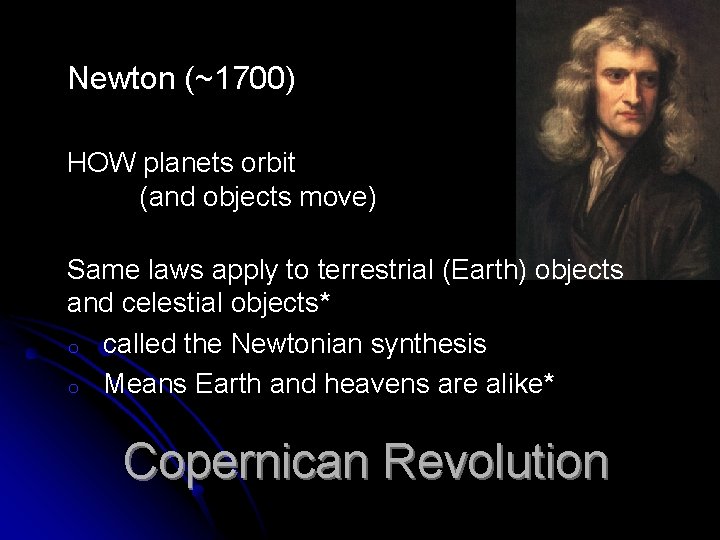
Newton (~1700) HOW planets orbit (and objects move) Same laws apply to terrestrial (Earth) objects and celestial objects* o called the Newtonian synthesis o Means Earth and heavens are alike* Copernican Revolution
Newton (~1700) HOW planets orbit (and objects move) Newton’s Cannon Demo Watch: https: //physics. weber. edu/schroeder/software/Newtons. Cannon. html • Objects in orbit are continuously falling* • Floating in space is really falling (not due to zero gravity) • Watch: Earth’s orbit around Sun http: //physics. bu. edu/~duffy/HTML 5/gravitation_Earth_Sun. html Copernican Revolution
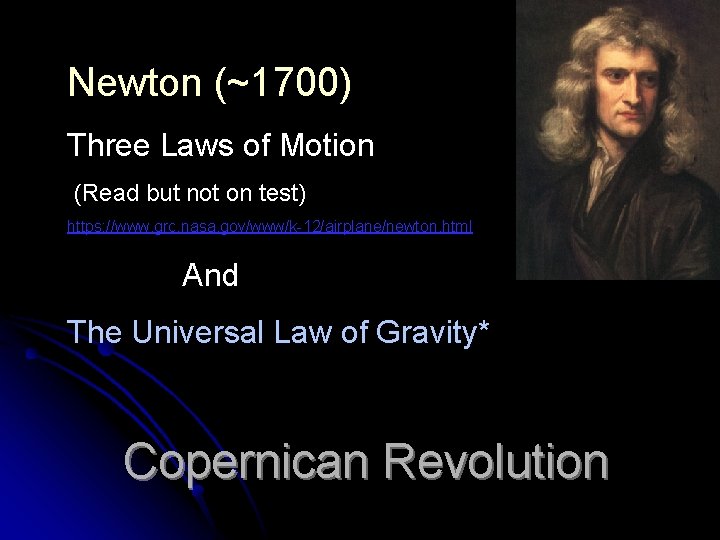
Newton (~1700) Three Laws of Motion (Read but not on test) https: //www. grc. nasa. gov/www/k-12/airplane/newton. html And The Universal Law of Gravity* Copernican Revolution
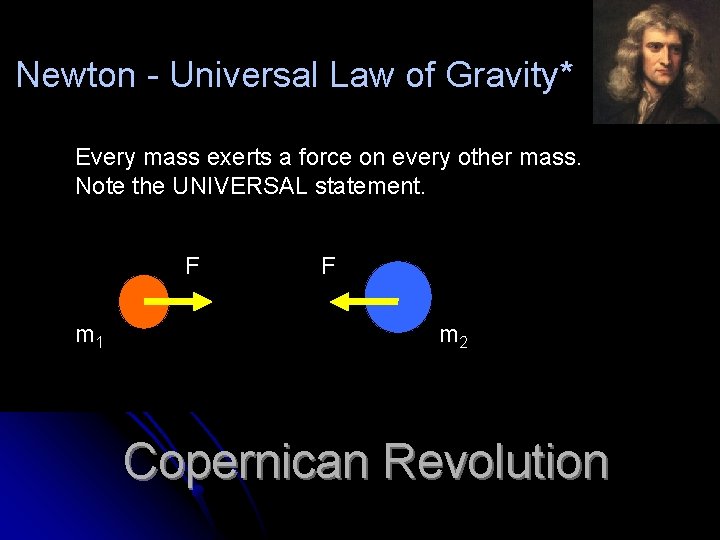
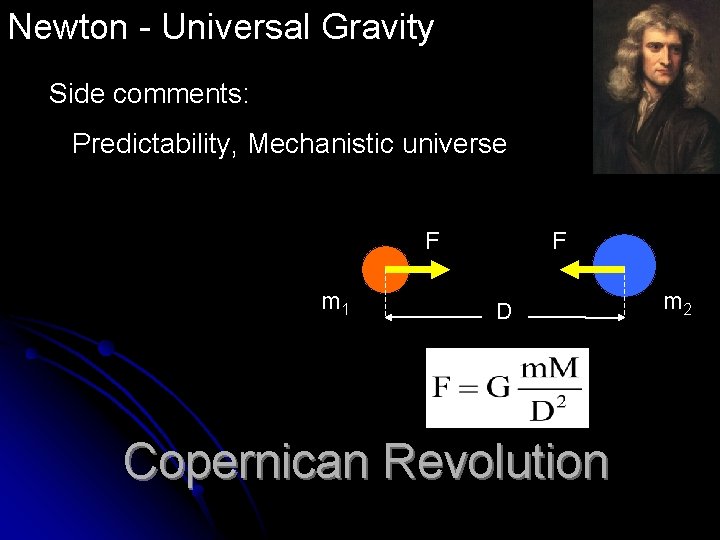
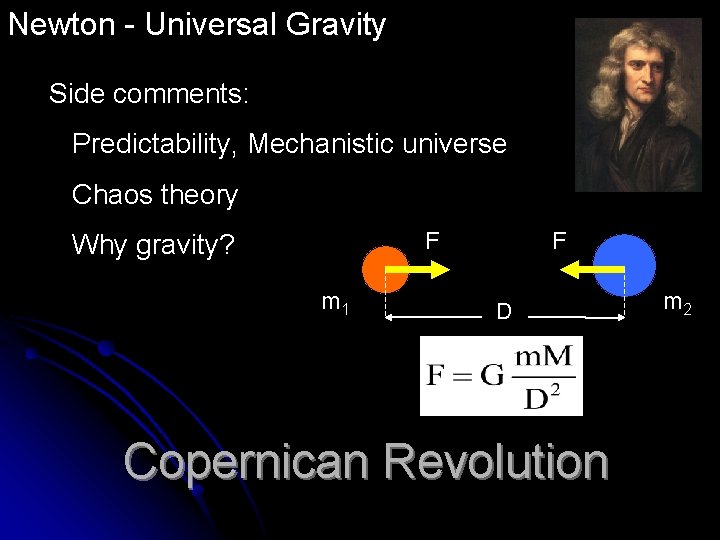
Newton - Universal Law of Gravity* Every mass exerts a force on every other mass. Note the UNIVERSAL statement. F m 1 F m 2 Copernican Revolution
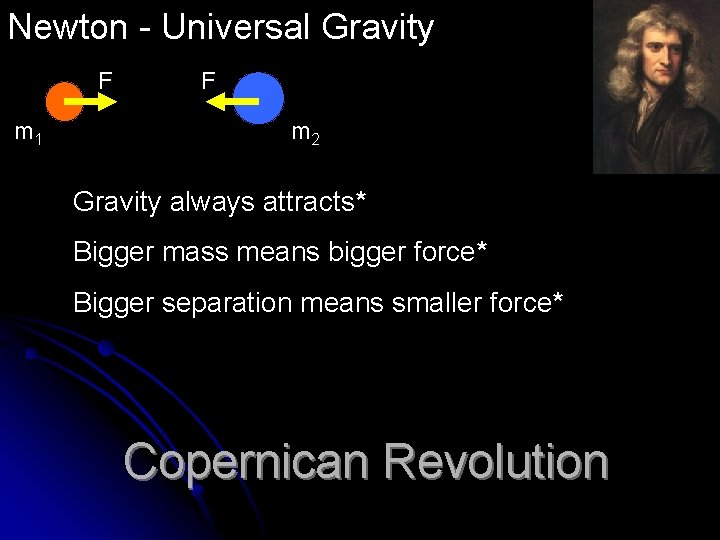
Newton - Universal Gravity F m 1 F m 2 Gravity always attracts* Bigger mass means bigger force* Bigger separation means smaller force* Copernican Revolution
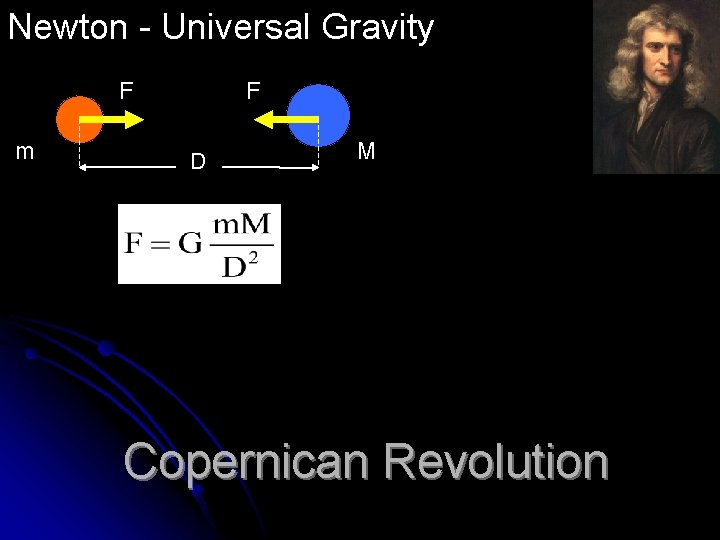
Newton - Universal Gravity F m F D M Copernican Revolution
Newton - Universal Gravity Side comments: Predictability, Mechanistic universe F m 1 F D Copernican Revolution m 2
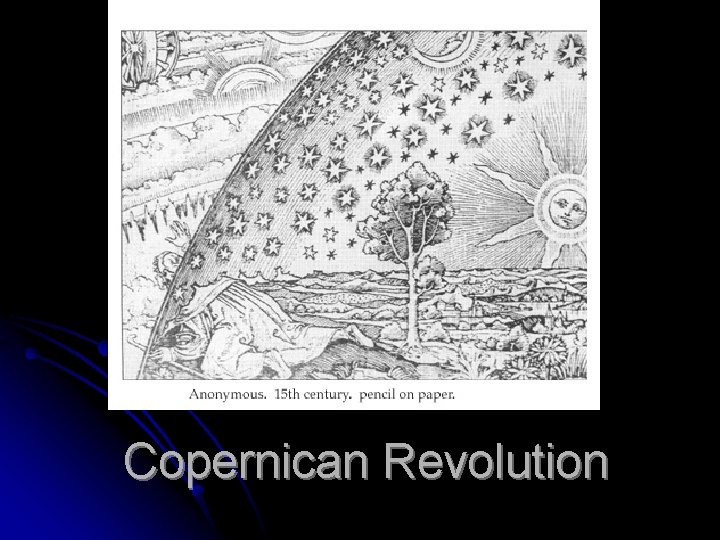
Copernican Revolution
Newton - Universal Gravity Side comments: Predictability, Mechanistic universe Chaos theory F Why gravity? m 1 F D Copernican Revolution m 2
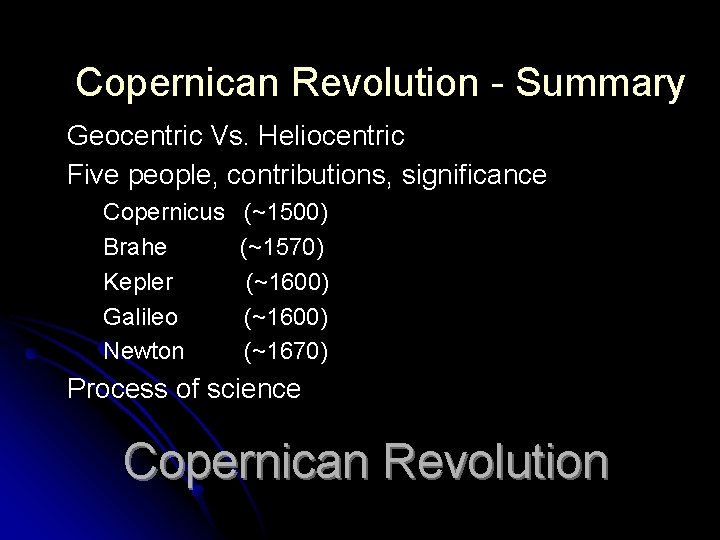
Copernican Revolution - Summary Geocentric Vs. Heliocentric Five people, contributions, significance Copernicus Brahe Kepler Galileo Newton (~1500) (~1570) (~1600) (~1670) Process of science Copernican Revolution
Science A process of knowing that uncovers the laws and processes of the universe* Way to get past the conflicts in various belief systems (by looking at evidence) l Differs from theology or philosophy because of the scientific method l
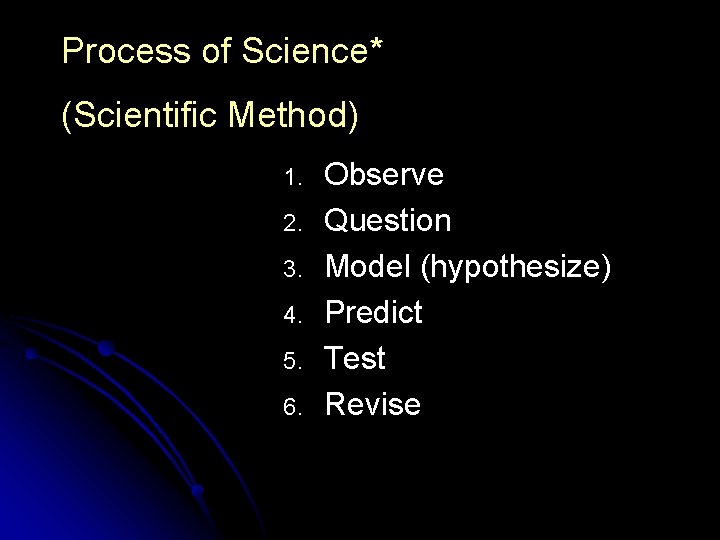
Process of Science* (Scientific Method) 1. 2. 3. 4. 5. 6. Observe Question Model (hypothesize) Predict Test Revise
You use much of this process all the time in daily life Examples: - Car stops…. - Flashlight doesn’t work… - Cooking…
Three Hallmarks of Science* Natural explanations (not supernatural) l Models that make testable predictions l Simplest explanation; K. I. S. S. (Occam’s Razor) l
Theory vs. Law l Vote: Which is stronger? Or more powerful?
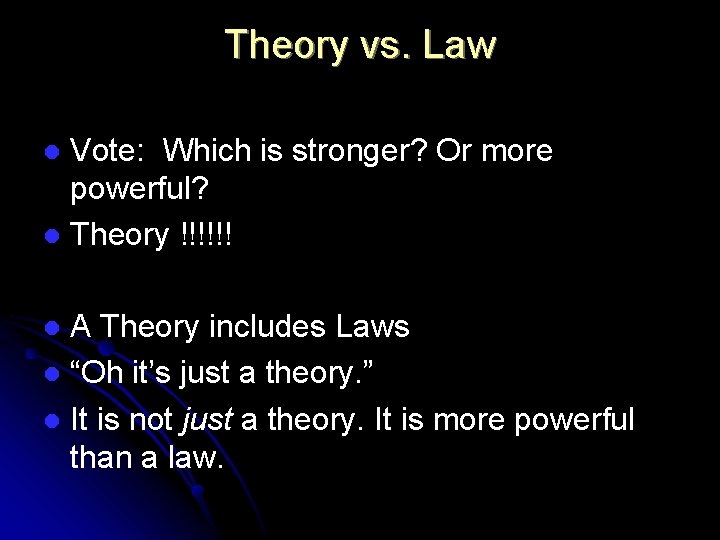
Theory vs. Law Vote: Which is stronger? Or more powerful? l Theory !!!!!! l A Theory includes Laws l “Oh it’s just a theory. ” l It is not just a theory. It is more powerful than a law. l
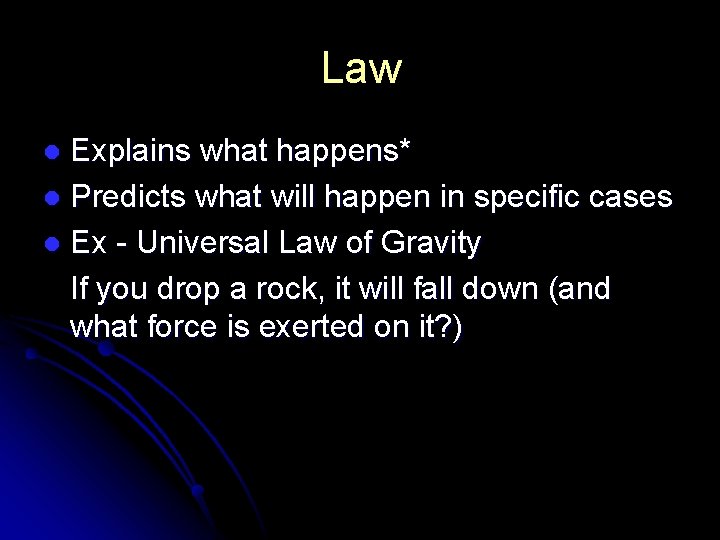
Law Explains what happens* l Predicts what will happen in specific cases l Ex - Universal Law of Gravity If you drop a rock, it will fall down (and what force is exerted on it? ) l
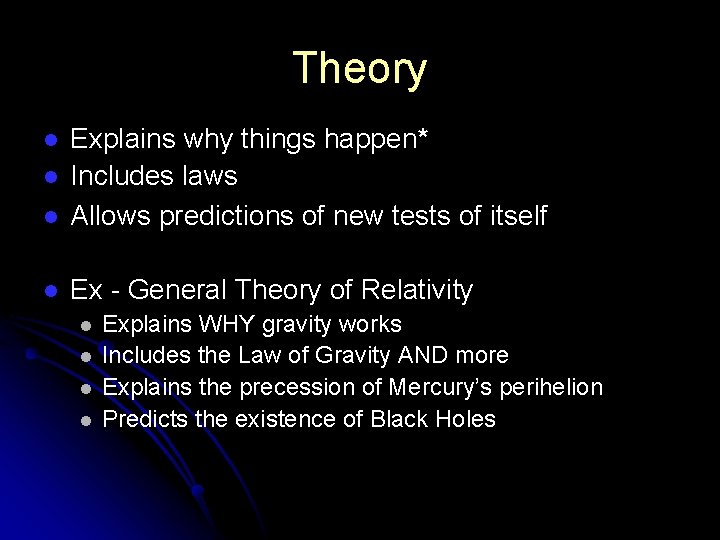
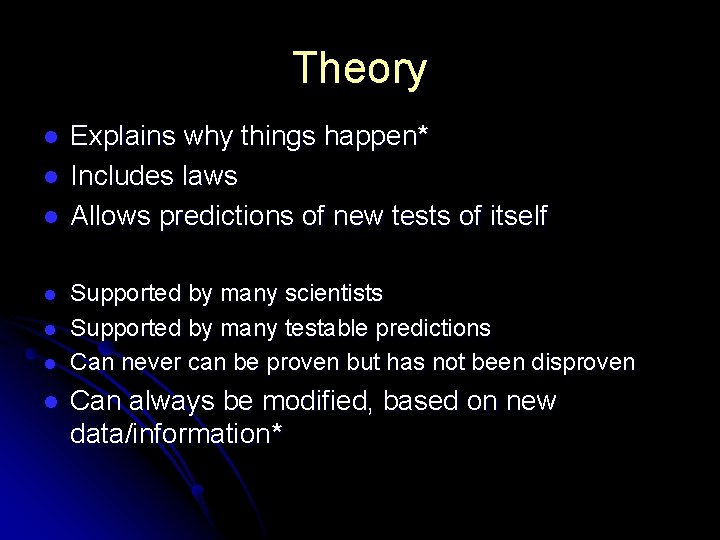
Theory l Explains why things happen* Includes laws Allows predictions of new tests of itself l Ex - General Theory of Relativity l l l Explains WHY gravity works Includes the Law of Gravity AND more Explains the precession of Mercury’s perihelion Predicts the existence of Black Holes
Theory l l l l Explains why things happen* Includes laws Allows predictions of new tests of itself Supported by many scientists Supported by many testable predictions Can never can be proven but has not been disproven Can always be modified, based on new data/information*
Exercise Can you investigate this using science? l If so, does science support the idea? l If not, why not? (what hallmarks? ) Ex – People get nuttier during a full Moon. l
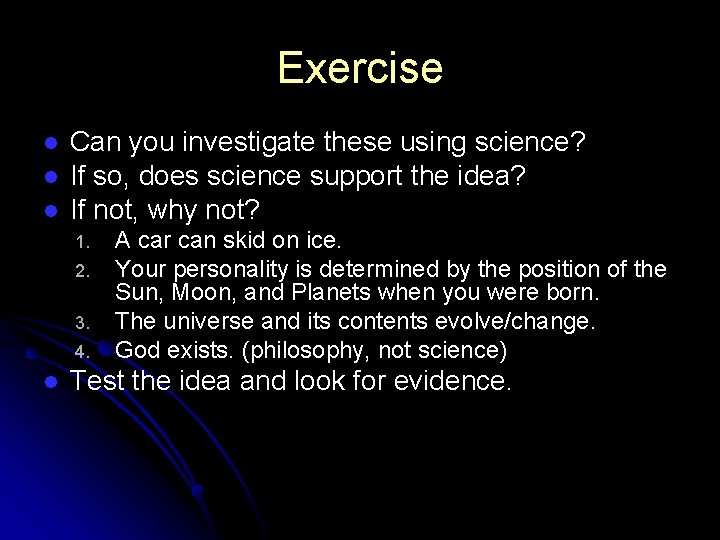
Exercise l l l Can you investigate these using science? If so, does science support the idea? If not, why not? 1. 2. 3. 4. l A car can skid on ice. Your personality is determined by the position of the Sun, Moon, and Planets when you were born. The universe and its contents evolve/change. God exists. (philosophy, not science) Test the idea and look for evidence.
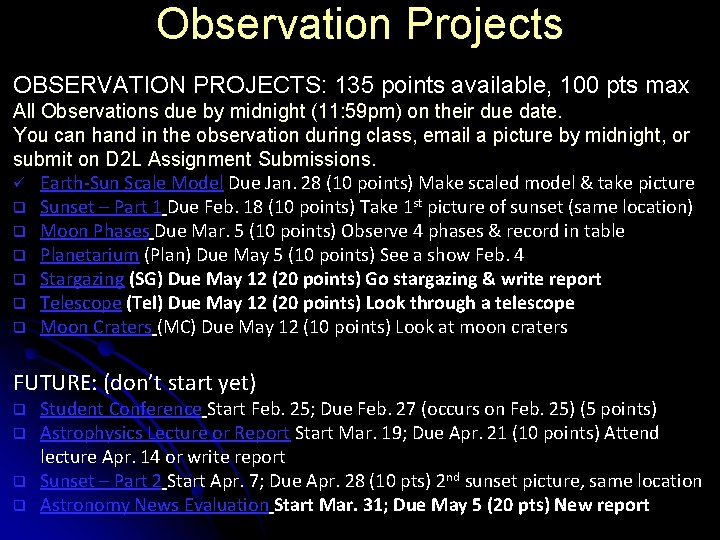
Observation Projects OBSERVATION PROJECTS: 135 points available, 100 pts max All Observations due by midnight (11: 59 pm) on their due date. You can hand in the observation during class, email a picture by midnight, or submit on D 2 L Assignment Submissions. ü Earth-Sun Scale Model Due Jan. 28 (10 points) Make scaled model & take picture q Sunset – Part 1 Due Feb. 18 (10 points) Take 1 st picture of sunset (same location) q Moon Phases Due Mar. 5 (10 points) Observe 4 phases & record in table q Planetarium (Plan) Due May 5 (10 points) See a show Feb. 4 q Stargazing (SG) Due May 12 (20 points) Go stargazing & write report q Telescope (Tel) Due May 12 (20 points) Look through a telescope q Moon Craters (MC) Due May 12 (10 points) Look at moon craters FUTURE: (don’t start yet) q q Student Conference Start Feb. 25; Due Feb. 27 (occurs on Feb. 25) (5 points) Astrophysics Lecture or Report Start Mar. 19; Due Apr. 21 (10 points) Attend lecture Apr. 14 or write report Sunset – Part 2 Start Apr. 7; Due Apr. 28 (10 pts) 2 nd sunset picture, same location Astronomy News Evaluation Start Mar. 31; Due May 5 (20 pts) New report
Homework l l l Continue flashcards of STUDY POINTS Do D 2 L Brightspace Quizzes 1 – 4 Work on Observations Come prepared to Lab for next week – no Lab today Test 1 Tuesday, Feb. 11 l To prepare: study points & 4 D 2 L Brightspace quizzes l About 60 multiple choice questions. Bring a pencil. l Optional – bring calculator (not graphing), some in the room to use l No notes, not open book Grades updated weekly