
l CONTENTS l Introduction l Robust hybrid control
l CONTENTS l Introduction l Robust hybrid control system l Numerical examples l Conclusions 2
l INTRODUCTION l Hybrid control system (HCS) A combination of passive and active control devices • Passive devices: offer some degree of protection in the case of power failure • Active devices: improve the control performances However, the robustness of HCS could be decreased by the active control devices. 3
l Objective of this study Apply robust control algorithms to improve the controller robustness of HCS 4
l ROBUST HYBRID CONTROL SYSTEM l Control devices Passive control devices • Lead rubber bearings (LRBs) • Design procedure: Ali and Abdel-Ghaffar (1995) • Bouc-Wen model Active control devices • Hydraulic actuators (HAs) • actuator capacity: 1000 k. N • The actuator dynamics are neglected. 5
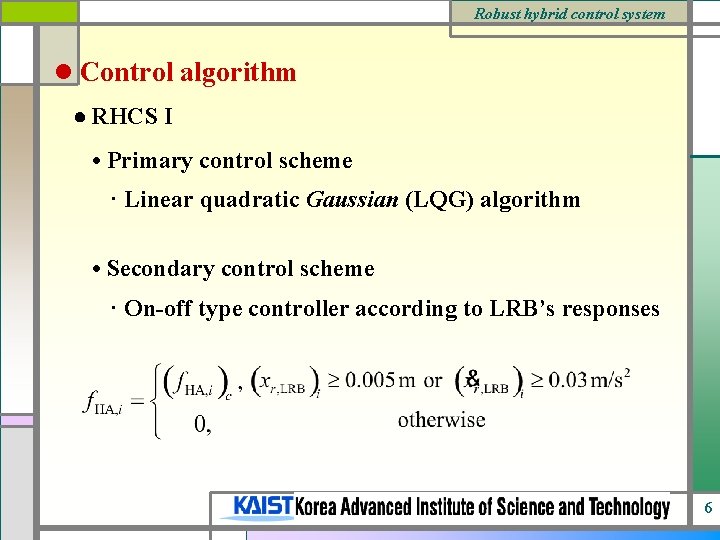
Robust hybrid control system l Control algorithm RHCS I • Primary control scheme · Linear quadratic Gaussian (LQG) algorithm • Secondary control scheme · On-off type controller according to LRB’s responses 6
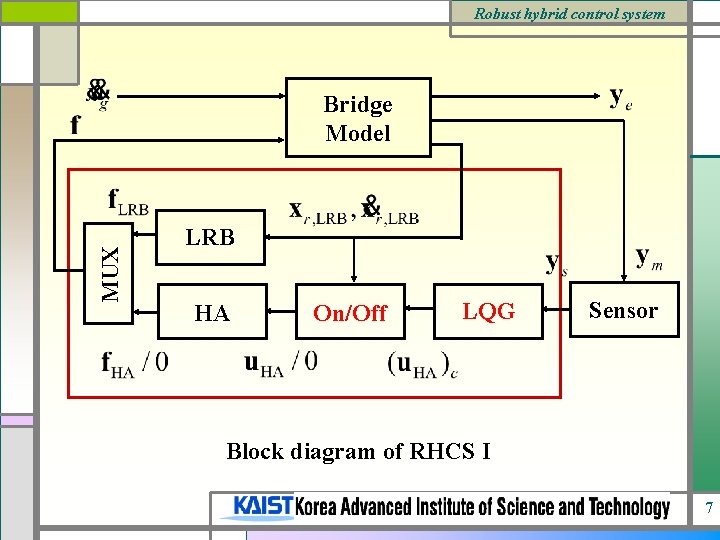
Robust hybrid control system MUX Bridge Model LRB HA On/Off LQG Sensor Block diagram of RHCS I 7
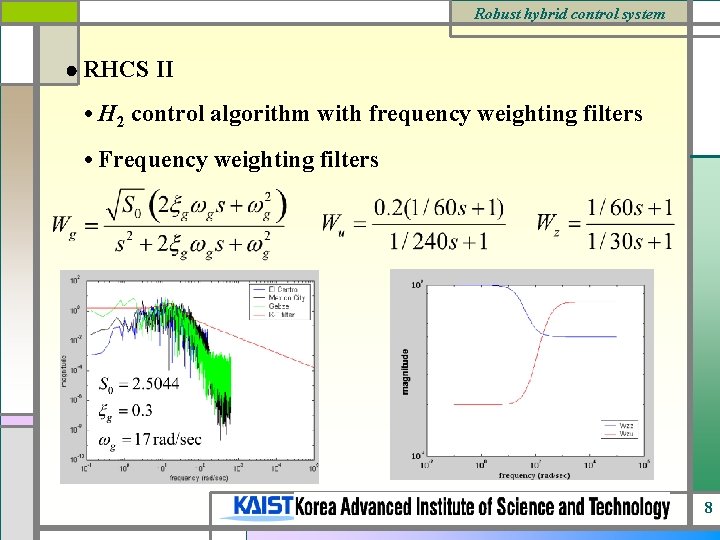
Robust hybrid control system RHCS II • H 2 control algorithm with frequency weighting filters • Frequency weighting filters 8
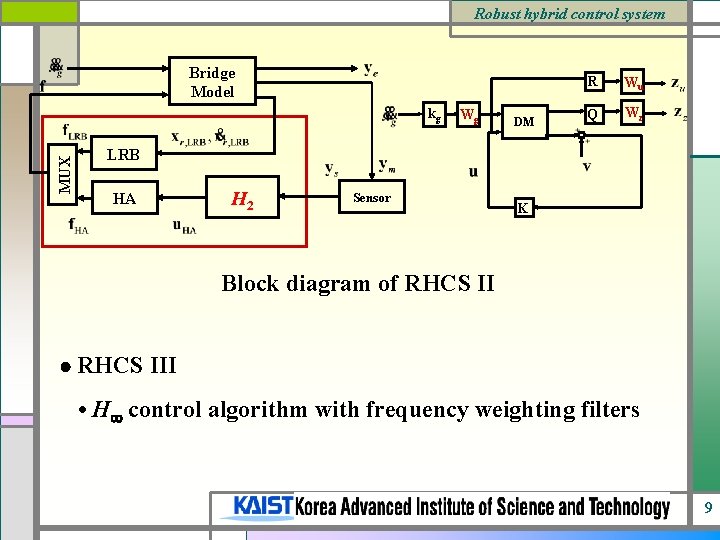
Robust hybrid control system Bridge Model MUX kg Wg DM R Wu Q Wz LRB HA H 2 Sensor K Block diagram of RHCS III • H control algorithm with frequency weighting filters 9
l NUMERICAL EXAMPLES l Analysis model Bridge model • Bill Emerson Memorial Bridge · Benchmark control problem · Under construction in Cape Girardeau, MO, USA · 16 Shock transmission devices (STDs) are employed between the tower-deck connections. 10

Numerical examples 142. 7 m 350. 6 m 142. 7 m 2+3 4+3 4+3 2+3 Configuration of control devices (HAs+LRBs) 11

Numerical examples Historical earthquake excitations PGA: 0. 348 g PGA: 0. 143 g PGA: 0. 265 g 12

Numerical examples l Analysis results Control performances El Centro Mexico City Gebze Max. 13

Numerical examples Controller robustness • The dynamic characteristic of as-built bridge is not identical to the numerical model. • To verify the applicability of RHCS, the controller robustness is investigated to perturbation of stiffness parameter. where : nominal stiffness matrix : perturbed stiffness matrix : perturbation amount 14
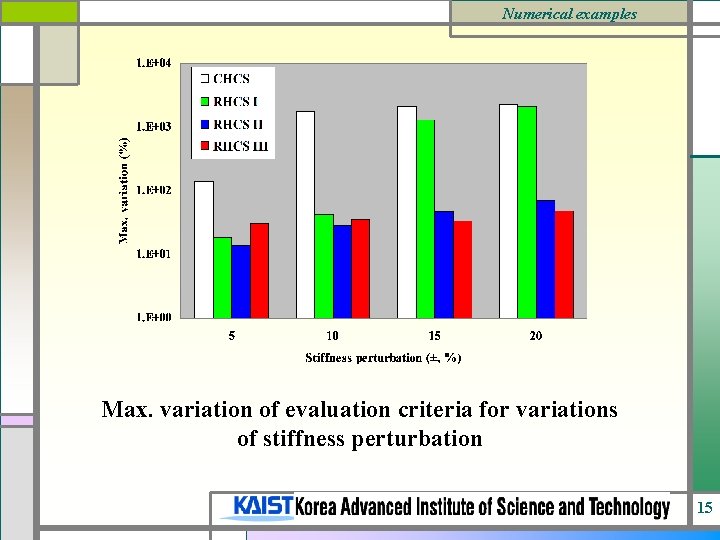
Numerical examples Max. variation of evaluation criteria for variations of stiffness perturbation 15
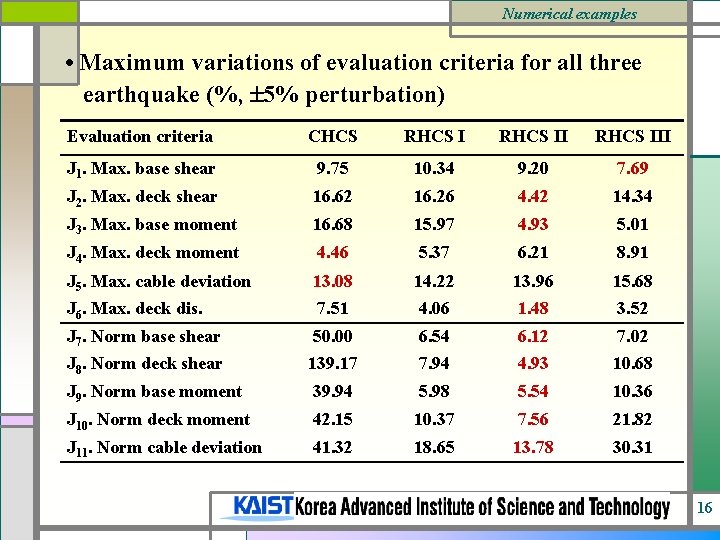
Numerical examples • Maximum variations of evaluation criteria for all three earthquake (%, 5% perturbation) Evaluation criteria CHCS RHCS III J 1. Max. base shear 9. 75 10. 34 9. 20 7. 69 J 2. Max. deck shear 16. 62 16. 26 4. 42 14. 34 J 3. Max. base moment 16. 68 15. 97 4. 93 5. 01 J 4. Max. deck moment 4. 46 5. 37 6. 21 8. 91 J 5. Max. cable deviation 13. 08 14. 22 13. 96 15. 68 J 6. Max. deck dis. 7. 51 4. 06 1. 48 3. 52 J 7. Norm base shear 50. 00 6. 54 6. 12 7. 02 J 8. Norm deck shear 139. 17 7. 94 4. 93 10. 68 J 9. Norm base moment 39. 94 5. 98 5. 54 10. 36 J 10. Norm deck moment 42. 15 10. 37 7. 56 21. 82 J 11. Norm cable deviation 41. 32 18. 65 13. 78 30. 31 16
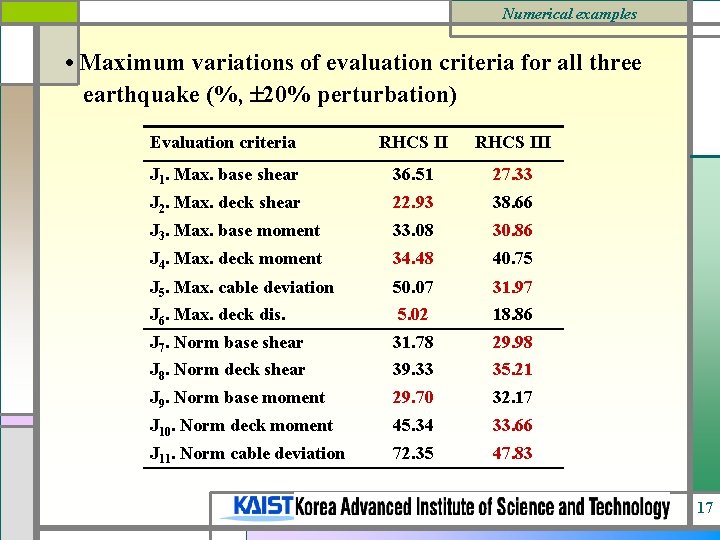
Numerical examples • Maximum variations of evaluation criteria for all three earthquake (%, 20% perturbation) Evaluation criteria RHCS III J 1. Max. base shear 36. 51 27. 33 J 2. Max. deck shear 22. 93 38. 66 J 3. Max. base moment 33. 08 30. 86 J 4. Max. deck moment 34. 48 40. 75 J 5. Max. cable deviation 50. 07 31. 97 J 6. Max. deck dis. 5. 02 18. 86 J 7. Norm base shear 31. 78 29. 98 J 8. Norm deck shear 39. 33 35. 21 J 9. Norm base moment 29. 70 32. 17 J 10. Norm deck moment 45. 34 33. 66 J 11. Norm cable deviation 72. 35 47. 83 17
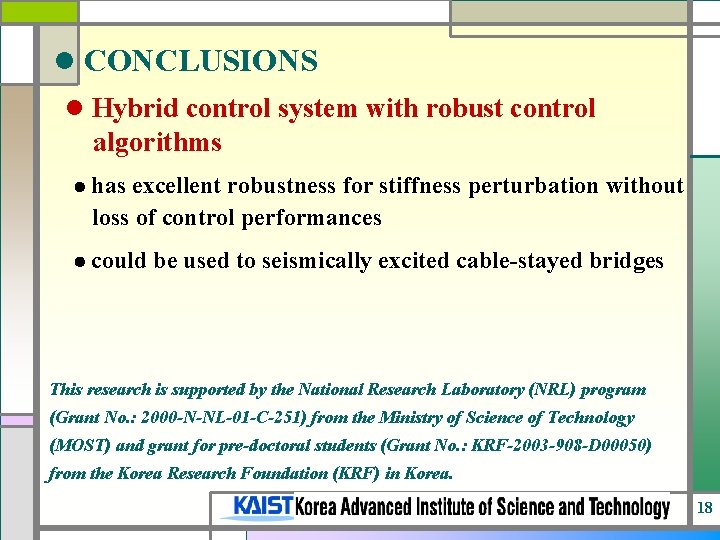
l CONCLUSIONS l Hybrid control system with robust control algorithms has excellent robustness for stiffness perturbation without loss of control performances could be used to seismically excited cable-stayed bridges This research is supported by the National Research Laboratory (NRL) program (Grant No. : 2000 -N-NL-01 -C-251) from the Ministry of Science of Technology (MOST) and grant for pre-doctoral students (Grant No. : KRF-2003 -908 -D 00050) from the Korea Research Foundation (KRF) in Korea. 18
- Slides: 18