
l Basic ConceptsQuestions l Developmental Theories l Policy

l. Basic Concepts/Questions l. Developmental Theories l. Policy Implications Developmental Criminology
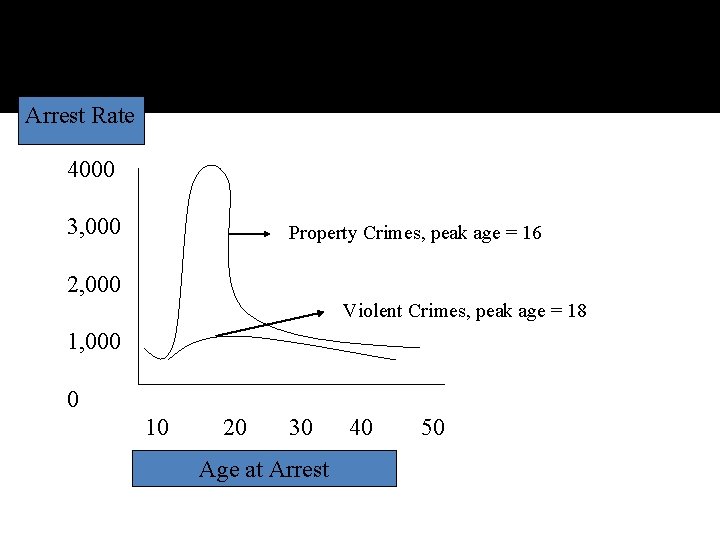
The Age-Crime Relationship Arrest Rate 4000 3, 000 Property Crimes, peak age = 16 2, 000 Violent Crimes, peak age = 18 1, 000 0 10 20 30 Age at Arrest 40 50
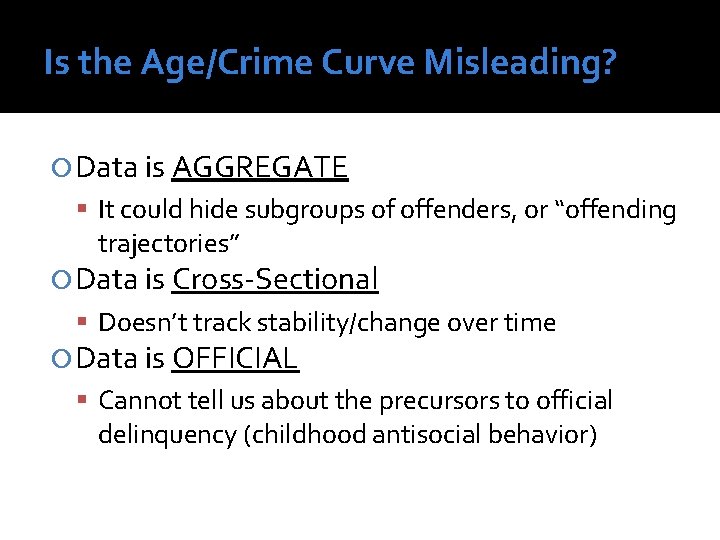
Is the Age/Crime Curve Misleading? Data is AGGREGATE It could hide subgroups of offenders, or “offending trajectories” Data is Cross-Sectional Doesn’t track stability/change over time Data is OFFICIAL Cannot tell us about the precursors to official delinquency (childhood antisocial behavior)
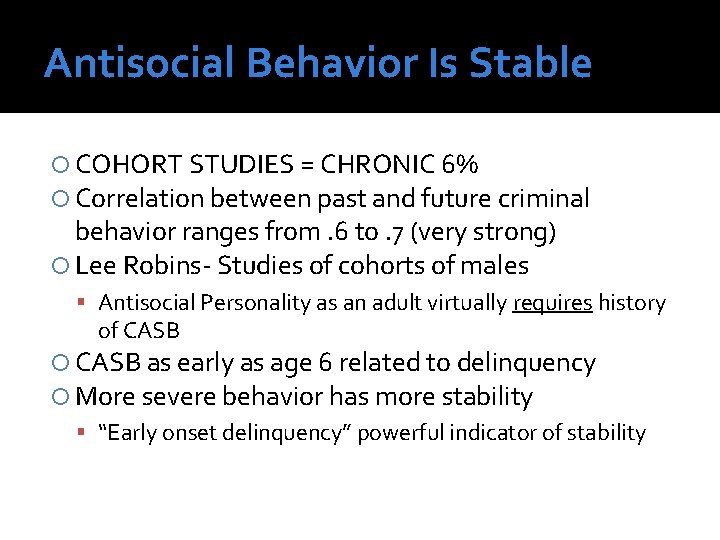
Antisocial Behavior Is Stable COHORT STUDIES = CHRONIC 6% Correlation between past and future criminal behavior ranges from. 6 to. 7 (very strong) Lee Robins- Studies of cohorts of males Antisocial Personality as an adult virtually requires history of CASB as early as age 6 related to delinquency More severe behavior has more stability “Early onset delinquency” powerful indicator of stability
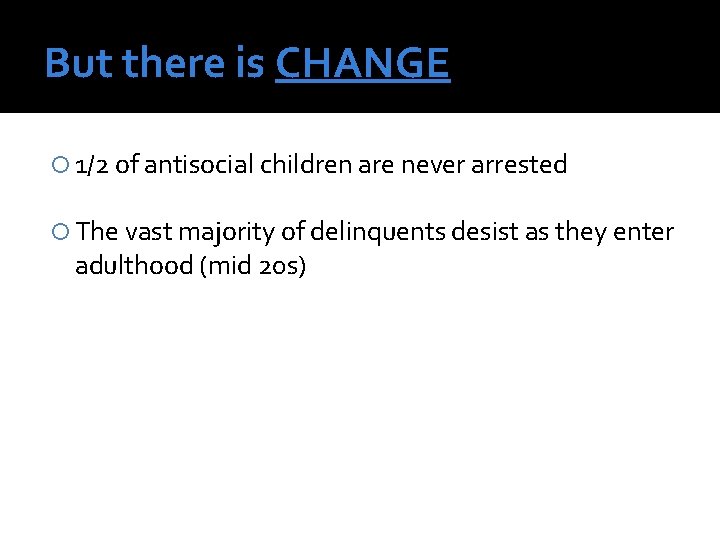
But there is CHANGE 1/2 of antisocial children are never arrested The vast majority of delinquents desist as they enter adulthood (mid 20 s)
New and Old Ideas OLD: Crime is the province of adolescents; theories of delinquency most important ▪ Easier to find/survey adolescents too! New (Considering stability/development ) Theories of adolescent delinquency are at best incomplete ▪ Central causes of delinquency lie in childhood ▪ Chronic offenders still may desist during adulthood Lifecourse Questions ▪ Why do some age out of crime while others don’t? ▪ Why is criminality so stable over time? ▪ What causes crime at different stages of life?
Terminology “Career Criminal” Paradigm Early roots in criminology—studies of robbers, fences, and so forth Crime as an occupation specialization, escalation, etc. Empirical evidence = little specialization, crime not as an “occupation” Developmental Criminology replaces “Career Criminal” paradigm in 1980 s
Lifecourse Theory I Must explain why there is stability (continuity) in antisocial behavior Must explain childhood precursors to offending (childhood antisocial behavior) Severe (age inappropriate) temper tantrums Deviant/criminal behavior Must explain desistence, or “change” Antisocial children, but not adults Adults that “age out”
Lifecourse Theory II Types of Lifecourse Theories Continuity (Trait) Theories (G&H) Continuity and Change Theories (Sampson and Laub) 3. Continuity or Change Theories (Moffitt) 1. 2.
Continuity Theories Some “thing” that is stable over time and related to crime Gottfreson and Hirschi Low self-control ▪ Becomes very stable by age 8 ▪ Causes crime and other nastiness Problem? ▪ Why do people desist? Explain “childhood recoveries” or adult desistence? G&H ▪ People desist –it’s a “law” or “constant” like gravity, which doesn’t’ need explanation
Sampson and Laub Important/Popular book: Crime in the Making: Pathways and Turning Points Through Life First to fully outline “lifecourse” criminology Put forth a lifecourse theory Use “Glueck data” to test theory

Pathways and Turning Points Pathways = stability Turning Points = opportunity for change
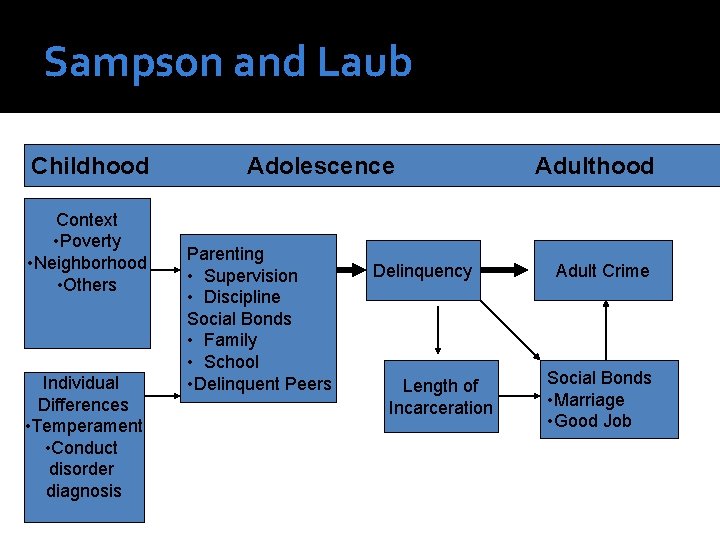
Sampson and Laub Childhood Context • Poverty • Neighborhood • Others Individual Differences • Temperament • Conduct disorder diagnosis Adolescence Parenting • Supervision • Discipline Social Bonds • Family • School • Delinquent Peers Delinquency Length of Incarceration Adulthood Adult Crime Social Bonds • Marriage • Good Job
Continuity Stability of Trajectory Individual differences (traits) possible Cumulative Continuity ▪ Delinquency/crime has effect on “adult social bonds” ▪ Delinquency/crime can lead to incarceration, which also has effect on adult social bonds ▪ These bonds, in turn, have effect on future crime
Just a little reminder… Chicago Bears Green Bay Packers Minnesota Vikings Detroit Lions W L Pct PF PA 7 6 5 4 1 3 4 4 . 875. 667. 556. 500 236 239 204 192 120 187 197 188 Because I care…
Change Turning Points = Adult Social Bonds Quality Marriage Quality Employment Why would these things reduce crime? S&L: they increase informal control (bind individuals to society, give them something to lose) Other explanations (spend less time with criminal friends, etc. )
Sampson and Laub II New Book/Articles based on follow-up data from Gleuck sample Followed until age 70 Similar to original theory Employment, marriage, military service More complex-why a “turning point? ” Knife off past from the present/future Supervision/monitoring (control) but also opportunities for social support/growth Change to structure/routine activities Opportunity for identity transformation
How do people desist? Desistence by Default No conscious decision to “stop offending” ▪ Rather, roles, structure, social context changes Human Agency Vague concept that implies people have some say in the matter. ▪ Not same as “rational choice” nor is it a “trait” ▪ Interaction = land a good job but still must want to keep Theoretical Importance ▪ Lives do not “unfold” in predictable sequences ▪ Desistence more difficult to explain than onset or persistence
Terrie Moffitt A Stability or Change Theory Argument: There are 2 different “kinds” of offenders in the world These types can be characterized by their unique “offending trajectories” Failure of Mainstream Criminology? During adolescence, these two groups look rather similar
Moffitt’s 2 Groups of Offenders LCP’s Early Start, Stable over lifecourse, 5% of general population (small group) Therefore… ▪ Why start so early? Why so stable? AL’s Late starters, desist in adulthood, very prevalent in population Therefore…. ▪ Why start so late? Why desist right away?
Explaining the LCP trajectory Presence of “Neuropsychological Deficits” Where do they come from? Why do they matter? INTERACTING WITH Ineffective Parenting Monitoring, supervision, etc. This “dual hazard” puts them on bad path…however…
Cumulative Continuity for LCP’s What in the environment is affected? Peer Rejection School Failure Parenting THEREFORE Cumulative continuity Contemporary continuity (still have N. P. Deficit, personality traits)
Explaining the AL’s Maturity Gap Knifing off Bonds as “rewarding” Mimic Why do AL’s desist? However, some may exhibit continuity “Snares” as another example of cumulative continuity
Key Moffitt Questions Why do we need 2 theories? How does she account for stability and change? Specific explanations of LCP and AL offending
Policy Implications The seduction of the chronic 6% The promise of early intervention Theory Specific Implications Moffitt causes of neurological deficits, effective parenting, other? S&L family context, parenting, bonds (child and adult)
- Slides: 25