
l Astigmatism is a type of refractive error






- Slides: 35
l Astigmatism is a type of refractive error wherein the refraction varies in the different meridian. l Astigmatism is a defect in which light entering the eye is unable to be brought to a single focus on retina resulting in blurred vision at all distances.
l It simply means that there is a variation and disturbance in the shape of the cornea or lens. It is usually due to an – *Irregularly shaped cornea * Scarring of the cornea *Abnormities in the crystalline lens
**Some eyes conditions are seen along with astigmatism as l Nystagmus l Cataract l Ptosis l Retinitis pigmentosa l Albinism l Inflammation l degeneration
Symptoms: Eye strain l discomfort l headache l dry eye l sensitivity to light l Blurred vision l
Classification of astigmatism Pathological Physiology regular Irregular compound simple myopic mixed hypermetropic Hypermetropic With the rule With the rule Against the rule Against the rule
l Type of astigmatism : there are two type of astigmatism: - Regular astigmatism 2. Irregular astigmatism 1.
Regular astigmatism l The astigmatism is regular when the refractive power changes uniformly from one meridian to another
l A etiology : - Corneal astigmatism 2. Lenticular astigmatism 3. Retinal astigmatism 1.
corneal astigmatism it is the result of abnormality of curvature of cornea l It is usually congenital l acquired corneal astigmatism is often irregular l
Causes l Congenital curvature astigmatism l Keratoconous l Trauma to the cornea or lens l After cataract operation
Lenticular astigmatism l Mainly due to *congenital abnormality of lens *refractive index of lens *congenital or traumatic subluxation of the lens
Retinal astigmatism *Due to oblique placement of macula * It can be corrected by visual aid
l type of regular astigmatism It is subdivided into four type ; – l With-the-rule astigmatism l Against-the-rule astigmatism l Oblique astigmatism l bi-oblique astigmatism
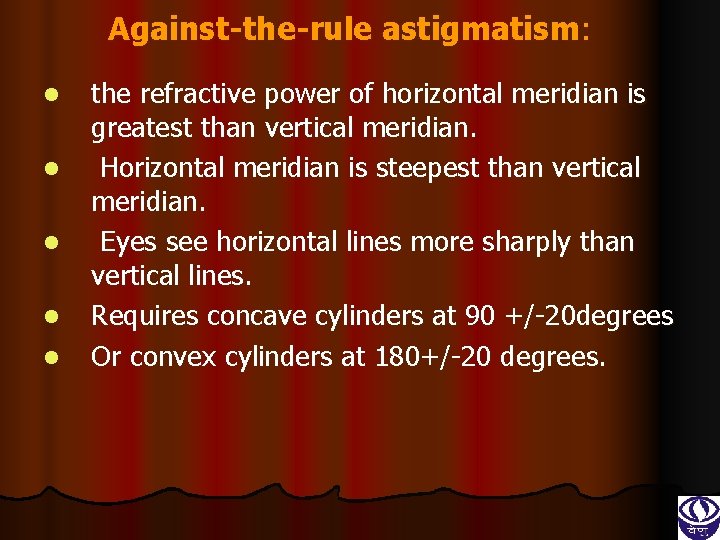
With-the-rule astigmatism: l l l Refractive power of the vertical meridian is greatest. The vertical meridian is steepest than horizontal meridian. Eyes see vertical lines more sharply than horizontal lines. Requires concave cylinders at 180+ /-20 Or convex cylinders at 90+/-20 degrees
Against-the-rule astigmatism: l l l the refractive power of horizontal meridian is greatest than vertical meridian. Horizontal meridian is steepest than vertical meridian. Eyes see horizontal lines more sharply than vertical lines. Requires concave cylinders at 90 +/-20 degrees Or convex cylinders at 180+/-20 degrees.
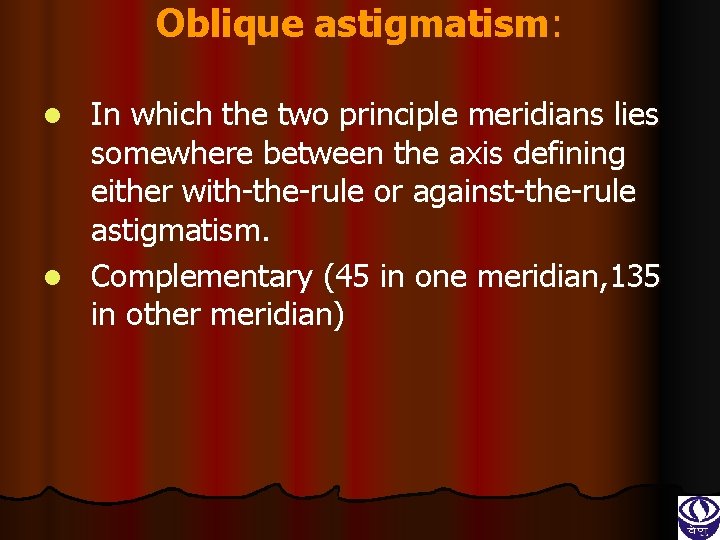
Oblique astigmatism: In which the two principle meridians lies somewhere between the axis defining either with-the-rule or against-the-rule astigmatism. l Complementary (45 in one meridian, 135 in other meridian) l
Bi –oblique astigmatism l Principle meridian are not at right angle l One at 30 , other at 100
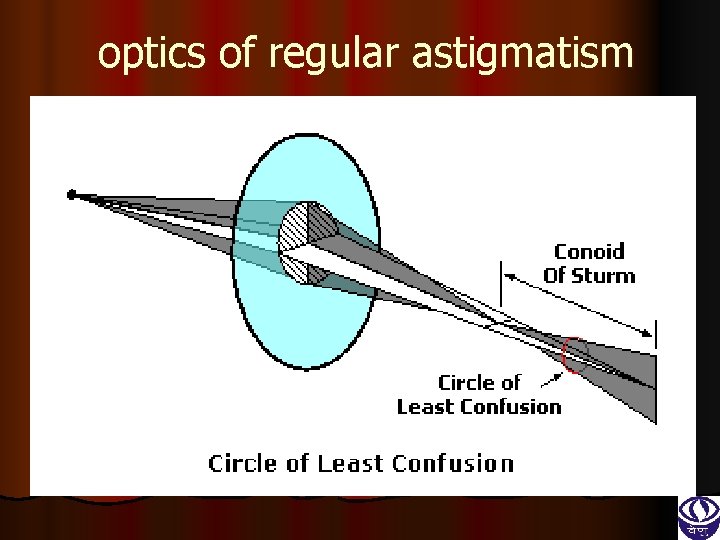
optics of regular astigmatism
l Light entering the eye cannot converge to a point focus but form focal lines l Configuration of rays refracted from the astigmatic surface –( sturms conoid). l Lens with cylinder produces an astigmatic focus. this astigmatic focus contains vertical line , corresponding to the focus of the horizontal principal meridian. and horizontal focal line corresponding to the focus of the vertical principal meridian.
l The region between these two lines is known as the conoid of sturm. l At the dioptric mid –point between these two focal line , the astigmatic focus forms a circular patch known as circle of least confusion
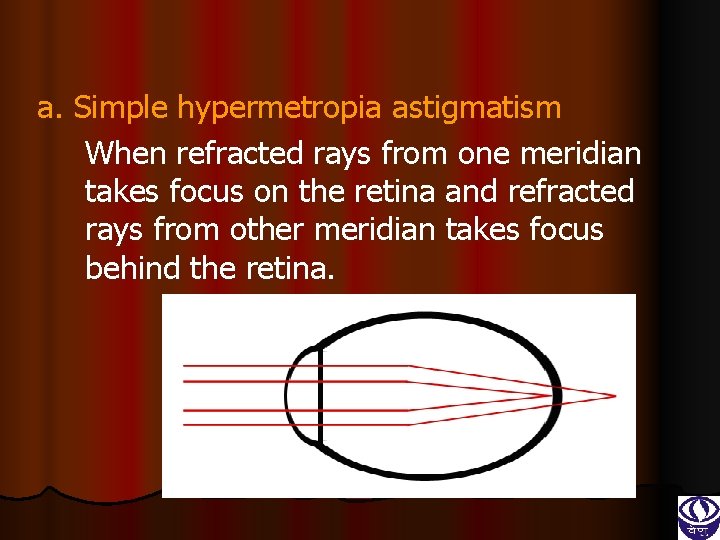
a. Simple hypermetropia astigmatism When refracted rays from one meridian takes focus on the retina and refracted rays from other meridian takes focus behind the retina.
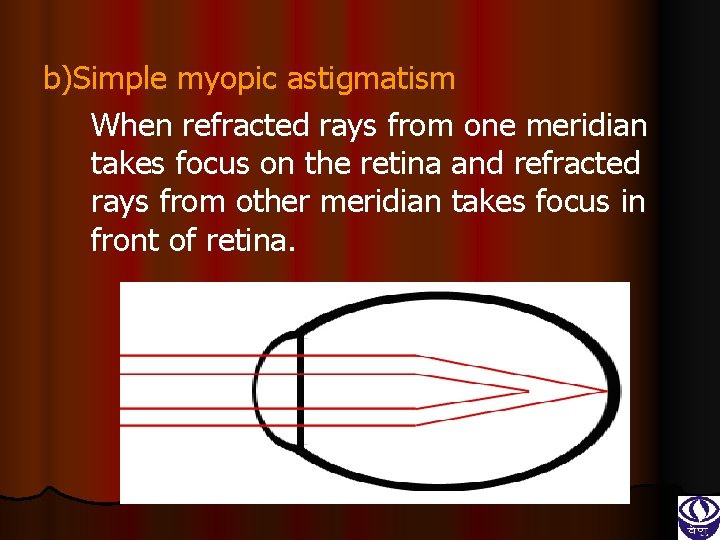
b)Simple myopic astigmatism When refracted rays from one meridian takes focus on the retina and refracted rays from other meridian takes focus in front of retina.
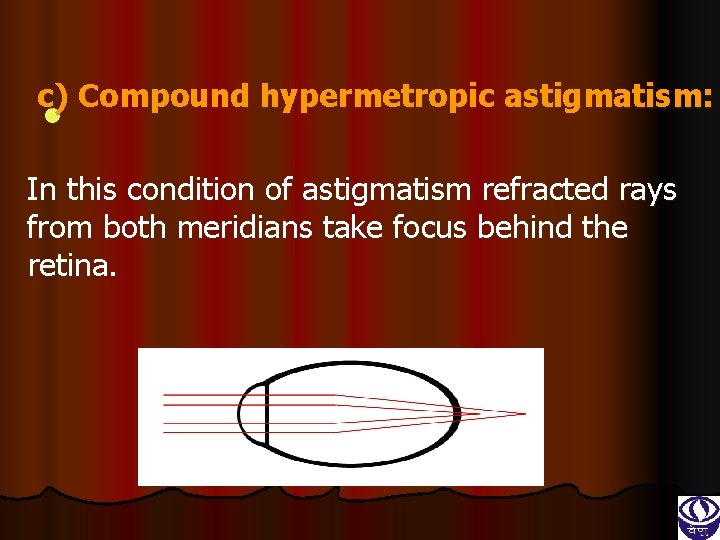
c) Compound hypermetropic astigmatism: l In this condition of astigmatism refracted rays from both meridians take focus behind the retina.
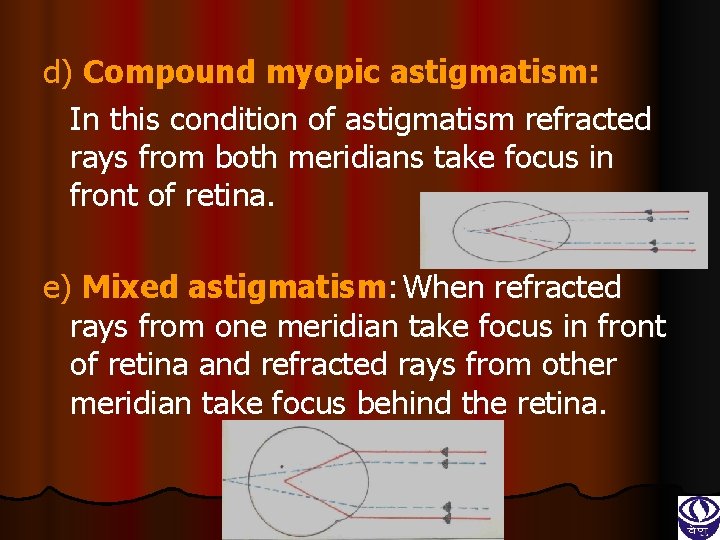
d) Compound myopic astigmatism: In this condition of astigmatism refracted rays from both meridians take focus in front of retina. e) Mixed astigmatism: When refracted rays from one meridian take focus in front of retina and refracted rays from other meridian take focus behind the retina.
l b) Irregular astigmatism: Irregular differences in curvature or refractive index of the optic components or misalignment of any optical component may lead to irregularity. l It is often the result of trauma, l pterygium, l corneal scars, l and complication of refractive surgery. l Another not uncommon condition is conical cornea (keratoconous) l
Diagnostic Objectively: l With the help of retinoscopy l Autorefractometer l Keratometer l Corneal topography Subjectively: l By Jackson’s cross cylinder l By astigmatic fan l By stenopaeic slit
management l CONSERVATIVE MANAGEMENT: l l Prescription eye wear Spherical soft contact lenses Spherical RGP contact lenses Toric soft contact lenses
SURGICAL MANAGEMENT 1. 2. 3. 4. 5. 6. 7. Conventional LASIK Astigmatic Keratotomy Photorefractive Keratectomy PAI LASIK LASEK Orthokeratology Phakic Intraocular Lens(PIOL)
Physiological astigmatism l Almost all have minor degree of astigmatism {physiological } l Diameter of cornea in vertical axis is 11. 5 mm and in horizontal meridian is 12 mm. l This means horizontal meridian is flatter than vertical. l Because diameter is inversely proportional to curvature.
l Occur as lid press on anterior corneal surface. l Make vertical meridian steeper l Only small astigmatic error l Usually 0. 12 D l NO TREATMENT REQUIRED,
life is an echo , all comes back , the good , the bad, the false and the true , so give the world the best u have and the best will come back to u.
For Further Queries Contact : Ms. Priyanka Singh Head – Optometry Service Email – optometry@venueyeinstitute. org