
L 9 Teams and teamwork Motivation What is

- Slides: 14
L 9: Teams and teamwork • • Motivation What is a team? Stages of team development Real teams Characteristics of real teams Team process guidelines Case study
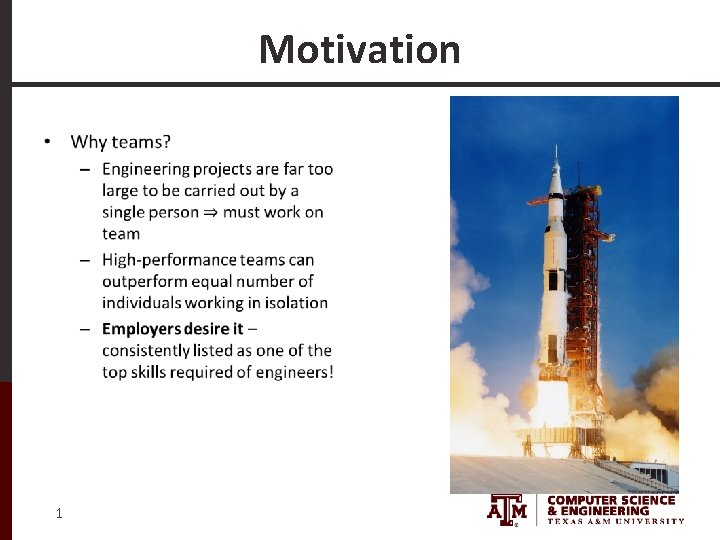
Motivation • 1
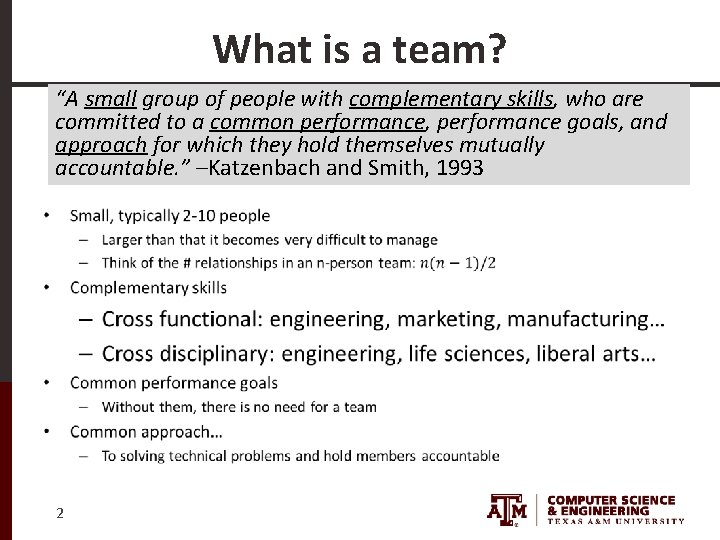
What is a team? “A small group of people with complementary skills, who are committed to a common performance, performance goals, and approach for which they hold themselves mutually accountable. ” –Katzenbach and Smith, 1993 • 2
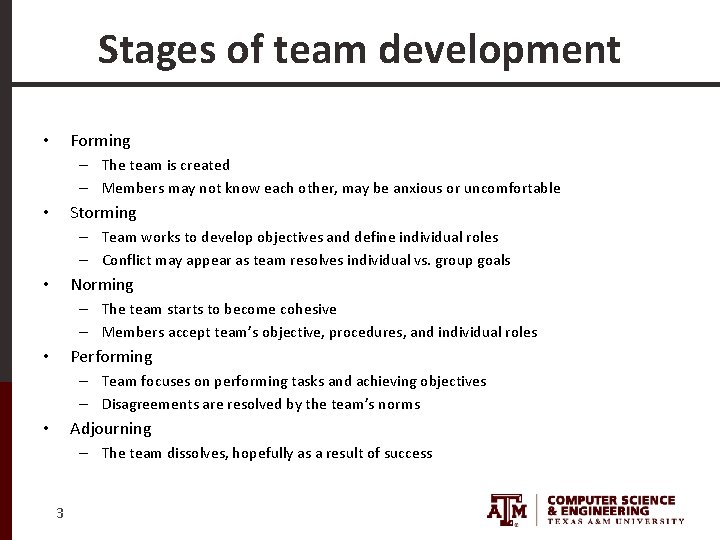
Stages of team development Forming • – The team is created – Members may not know each other, may be anxious or uncomfortable Storming • – Team works to develop objectives and define individual roles – Conflict may appear as team resolves individual vs. group goals Norming • – The team starts to become cohesive – Members accept team’s objective, procedures, and individual roles Performing • – Team focuses on performing tasks and achieving objectives – Disagreements are resolved by the team’s norms Adjourning • – The team dissolves, hopefully as a result of success 3
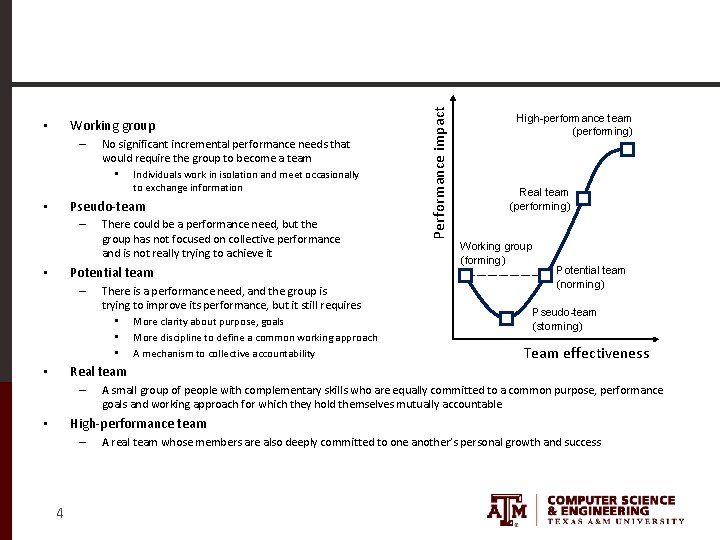
– No significant incremental performance needs that would require the group to become a team • Individuals work in isolation and meet occasionally to exchange information Pseudo-team • – There could be a performance need, but the group has not focused on collective performance and is not really trying to achieve it Potential team • – There is a performance need, and the group is trying to improve its performance, but it still requires • More clarity about purpose, goals • More discipline to define a common working approach • A mechanism to collective accountability Performance impact Working group • High-performance team (performing) Real team (performing) Working group (forming) Potential team (norming) Pseudo-team (storming) Team effectiveness Real team • – A small group of people with complementary skills who are equally committed to a common purpose, performance goals and working approach for which they hold themselves mutually accountable High-performance team • – 4 A real team whose members are also deeply committed to one another’s personal growth and success
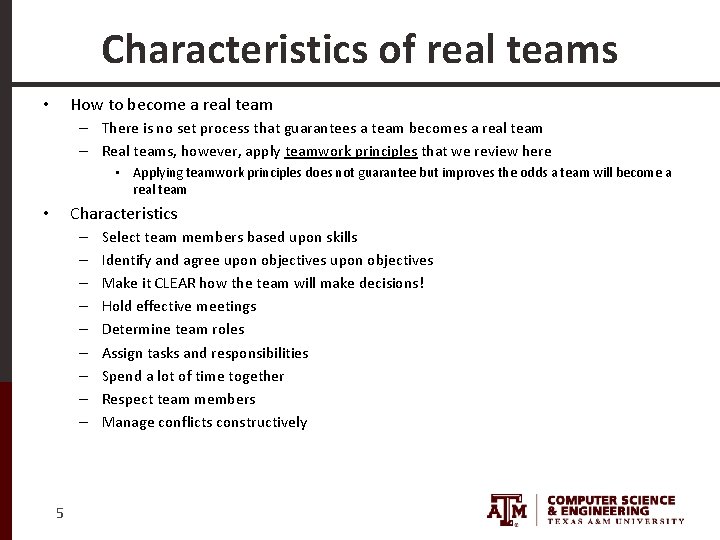
Characteristics of real teams How to become a real team • – There is no set process that guarantees a team becomes a real team – Real teams, however, apply teamwork principles that we review here • Applying teamwork principles does not guarantee but improves the odds a team will become a real team Characteristics • – – – – – 5 Select team members based upon skills Identify and agree upon objectives Make it CLEAR how the team will make decisions! Hold effective meetings Determine team roles Assign tasks and responsibilities Spend a lot of time together Respect team members Manage conflicts constructively
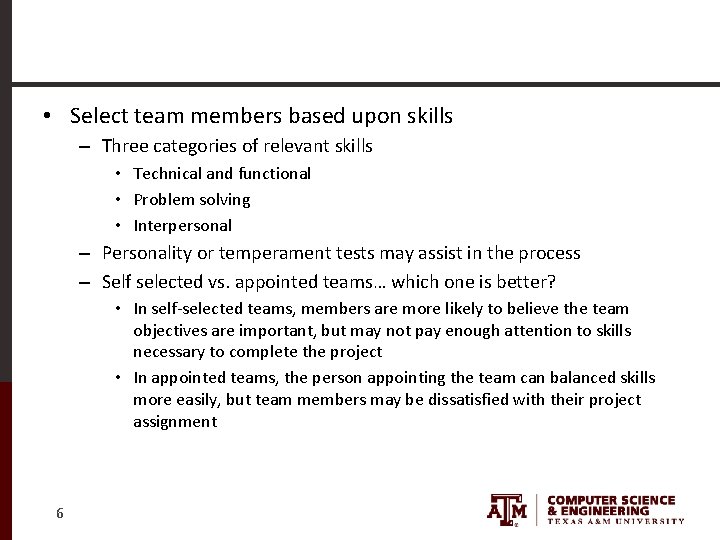
• Select team members based upon skills – Three categories of relevant skills • Technical and functional • Problem solving • Interpersonal – Personality or temperament tests may assist in the process – Self selected vs. appointed teams… which one is better? • In self-selected teams, members are more likely to believe the team objectives are important, but may not pay enough attention to skills necessary to complete the project • In appointed teams, the person appointing the team can balanced skills more easily, but team members may be dissatisfied with their project assignment 6
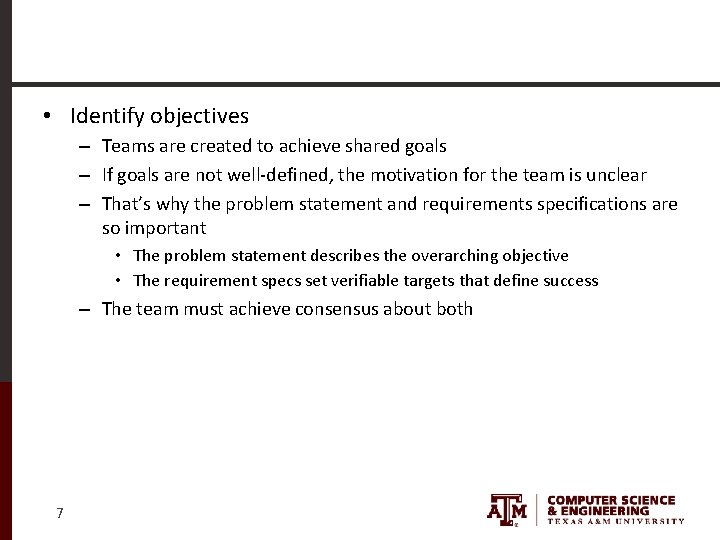
• Identify objectives – Teams are created to achieve shared goals – If goals are not well-defined, the motivation for the team is unclear – That’s why the problem statement and requirements specifications are so important • The problem statement describes the overarching objective • The requirement specs set verifiable targets that define success – The team must achieve consensus about both 7
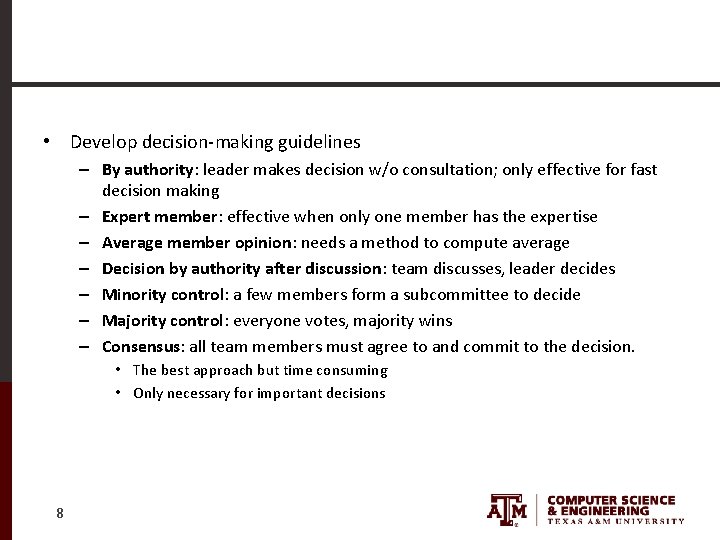
• Develop decision-making guidelines – By authority: leader makes decision w/o consultation; only effective for fast decision making – Expert member: effective when only one member has the expertise – Average member opinion: needs a method to compute average – Decision by authority after discussion: team discusses, leader decides – Minority control: a few members form a subcommittee to decide – Majority control: everyone votes, majority wins – Consensus: all team members must agree to and commit to the decision. • The best approach but time consuming • Only necessary for important decisions 8
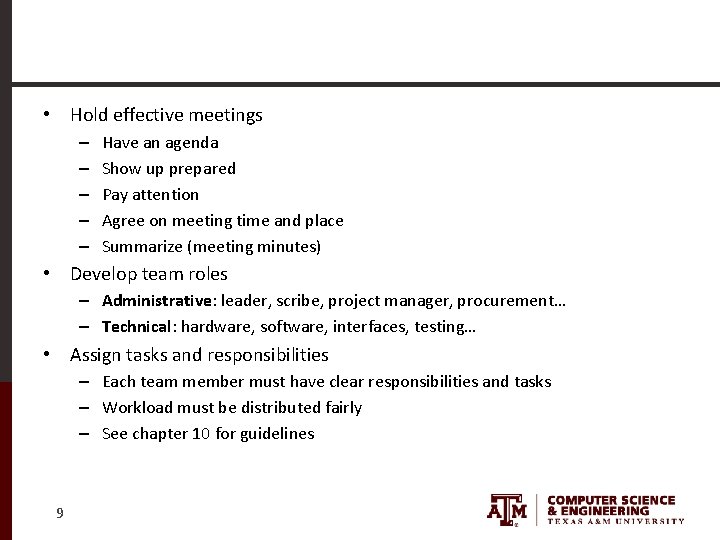
• Hold effective meetings – – – Have an agenda Show up prepared Pay attention Agree on meeting time and place Summarize (meeting minutes) • Develop team roles – Administrative: leader, scribe, project manager, procurement… – Technical: hardware, software, interfaces, testing… • Assign tasks and responsibilities – Each team member must have clear responsibilities and tasks – Workload must be distributed fairly – See chapter 10 for guidelines 9
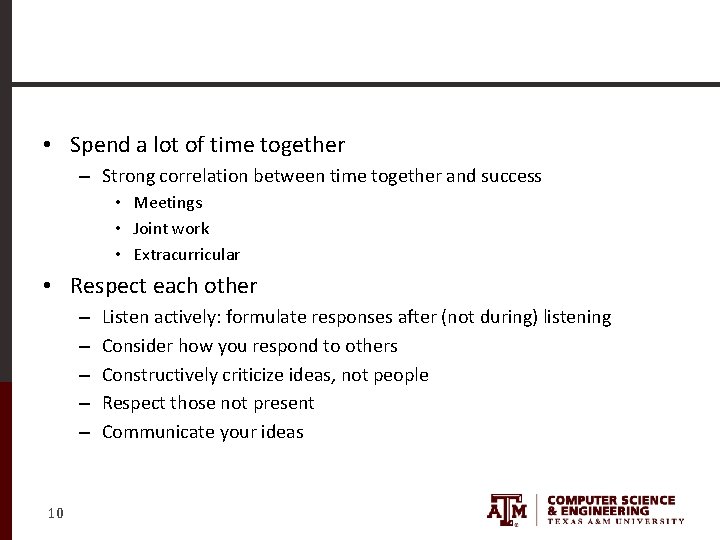
• Spend a lot of time together – Strong correlation between time together and success • Meetings • Joint work • Extracurricular • Respect each other – – – 10 Listen actively: formulate responses after (not during) listening Consider how you respond to others Constructively criticize ideas, not people Respect those not present Communicate your ideas
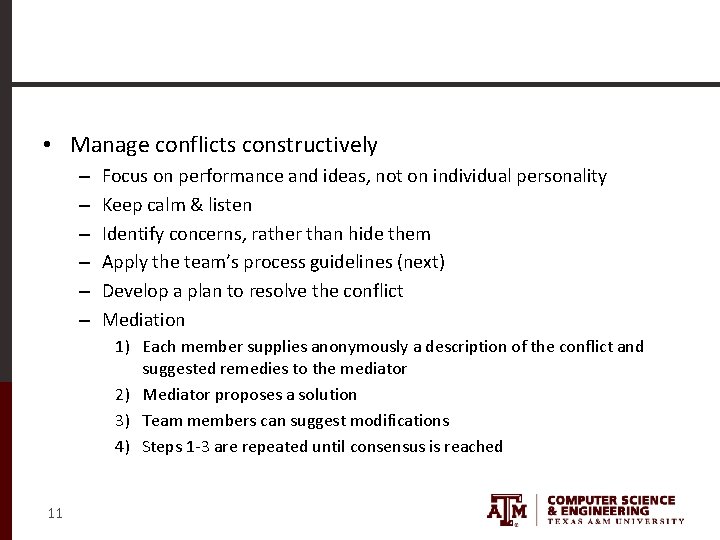
• Manage conflicts constructively – – – Focus on performance and ideas, not on individual personality Keep calm & listen Identify concerns, rather than hide them Apply the team’s process guidelines (next) Develop a plan to resolve the conflict Mediation 1) Each member supplies anonymously a description of the conflict and suggested remedies to the mediator 2) Mediator proposes a solution 3) Team members can suggest modifications 4) Steps 1 -3 are repeated until consensus is reached 11
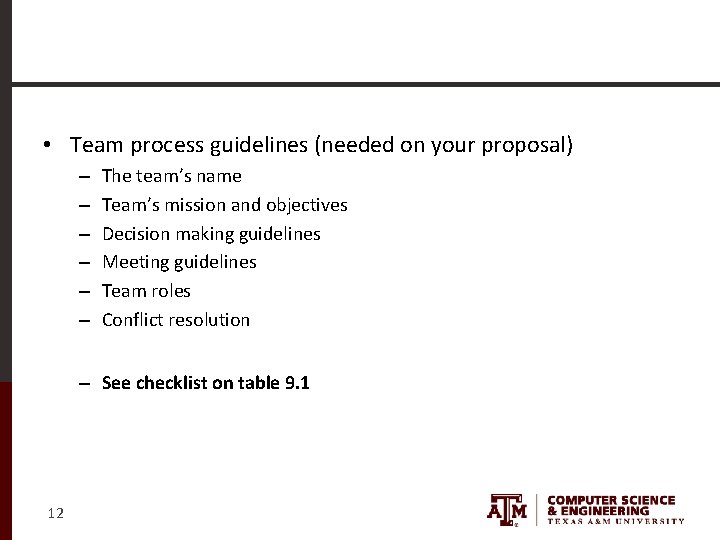
• Team process guidelines (needed on your proposal) – – – The team’s name Team’s mission and objectives Decision making guidelines Meeting guidelines Team roles Conflict resolution – See checklist on table 9. 1 12
• Boeing’s code of cooperation – – – – • Every member responsible for team’s progress and success Attend all meetings, be on time Come prepared Carry out assignments on schedule Listen to and show respect for others’ contributions; be an active listener Constructively criticize ideas, not persons Resolve conflicts constructively Pay attention; avoid disruptive behavior Boeing’s code of conduct – – – – 13 – No disruptive side conversations Only one person speaks at a time Everyone participates; no one dominates Be succinct; avoid long anecdotes and examples No rank in the room Respect those not present Ask questions when you do not understand. Have fun