
L 7 Memory Hierarchy Optimization IV Bandwidth Optimization

L 7: Memory Hierarchy Optimization IV, Bandwidth Optimization and Case Studies CS 6963

Administrative • Next assignment on the website – Description at end of class – Due Wednesday, Feb. 17, 5 PM – Use handin program on CADE machines • “handin cs 6963 lab 2 <probfile>” • Mailing lists – cs 6963 s 10 -discussion@list. eng. utah. edu • Please use for all questions suitable for the whole class • Feel free to answer your classmates questions! – cs 6963 s 10 -teach@list. eng. utah. edu • Please use for questions to Protonu and me CS 6963 2 L 7: Memory Hierarchy IV

Administrative, cont. • New Linux Grad Lab on-line! – 6 machines up and running – All machines have the GTX 260 graphics cards, Intel Core i 7 CPU 920 (quad-core 2. 67 GHz) and 6 Gb of 1600 MHz (DDR) RAM. CS 6963 3 L 7: Memory Hierarchy IV

Overview • Complete discussion of data placement in registers and texture memory • Introduction to memory system • Bandwidth optimization • Global memory coalescing • Avoiding shared memory bank conflicts • A few words on alignment • Reading: – Chapter 4, Kirk and Hwu – http: //courses. ece. illinois. edu/ece 498/al/textbook/Chapter 4 Cuda. Memory. Model. pdf – Chapter 5, Kirk and Hwu – http: //courses. ece. illinois. edu/ece 498/al/textbook/Chapter 5 Cuda. Performance. pdf – Sections 3. 2. 4 (texture memory) and 5. 1. 2 (bandwidth optimizations) of NVIDIA CUDA Programming Guide CS 6963 4 L 7: Memory Hierarchy IV

Targets of Memory Hierarchy Optimizations • Reduce memory latency – The latency of a memory access is the time (usually in cycles) between a memory request and its completion • Maximize memory bandwidth – Bandwidth is the amount of useful data that can be retrieved over a time interval • Manage overhead – Cost of performing optimization (e. g. , copying) should be less than anticipated gain CS 6963 5 L 7: Memory Hierarchy IV
Optimizing the Memory Hierarchy on GPUs, Overview • Device memory access times non-uniform so data placement significantly affects performance. • But controlling data placement may require additional copying, so consider overhead. • Optimizations to increase memory bandwidth. Idea: maximize utility of each memory access. • Coalesce global memory accesses • Avoid memory bank conflicts to increase memory access parallelism • Align data structures to address boundaries CS 6963 6 L 7: Memory Hierarchy IV
Bandwidth to Shared Memory: Parallel Memory Accesses • Consider each thread accessing a different location in shared memory • Bandwidth maximized if each one is able to proceed in parallel • Hardware to support this – Banked memory: each bank can support an access on every memory cycle CS 6963 7 L 7: Memory Hierarchy IV
How addresses map to banks on G 80 • Each bank has a bandwidth of 32 bits per clock cycle • Successive 32 -bit words are assigned to successive banks • G 80 has 16 banks – So bank = address % 16 – Same as the size of a half-warp • No bank conflicts between different halfwarps, only within a single half-warp © David Kirk/NVIDIA and Wen-mei W. Hwu, 2007 -2009 8 ECE 498 AL, University of Illinois, Urbana-Champaign L 7: Memory Hierarchy IV
Shared memory bank conflicts • Shared memory is as fast as registers if there are no bank conflicts • The fast case: – If all threads of a half-warp access different banks, there is no bank conflict – If all threads of a half-warp access the identical address, there is no bank conflict (broadcast) • The slow case: – Bank Conflict: multiple threads in the same half-warp access the same bank – Must serialize the accesses – Cost = max # of simultaneous accesses to a single bank © David Kirk/NVIDIA and Wen-mei W. Hwu, 2007 -2009 9 ECE 498 AL, University of Illinois, Urbana-Champaign L 7: Memory Hierarchy IV

Bank Addressing Examples • No Bank Conflicts – Linear addressing stride == 1 – Random 1: 1 Permutation Thread 0 Thread 1 Thread 2 Thread 3 Thread 4 Thread 5 Thread 6 Thread 7 Bank 0 Bank 1 Bank 2 Bank 3 Bank 4 Bank 5 Bank 6 Bank 7 Thread 15 Bank 15 © David Kirk/NVIDIA and Wen-mei W. Hwu, 2007 -2009 10 ECE 498 AL, University of Illinois, Urbana-Champaign L 7: Memory Hierarchy IV
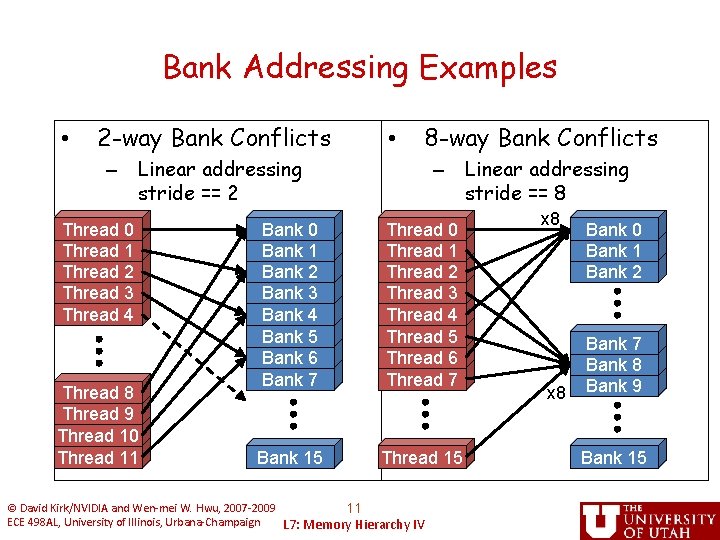
Bank Addressing Examples • 2 -way Bank Conflicts • 8 -way Bank Conflicts – Linear addressing stride == 2 Thread 0 Thread 1 Thread 2 Thread 3 Thread 4 Thread 8 Thread 9 Thread 10 Thread 11 – Linear addressing stride == 8 Bank 0 Bank 1 Bank 2 Bank 3 Bank 4 Bank 5 Bank 6 Bank 7 Thread 0 Thread 1 Thread 2 Thread 3 Thread 4 Thread 5 Thread 6 Thread 7 Bank 15 Thread 15 © David Kirk/NVIDIA and Wen-mei W. Hwu, 2007 -2009 11 ECE 498 AL, University of Illinois, Urbana-Champaign L 7: Memory Hierarchy IV x 8 Bank 0 Bank 1 Bank 2 Bank 7 Bank 8 Bank 9 Bank 15
![Linear Addressing • Given: __shared__ float shared[256]; float foo = shared[base. Index + s](http://slidetodoc.com/presentation_image_h2/fe2069428cc0186219825ab53eff398c/image-12.jpg "Linear Addressing • Given: __shared__ float shared[256]; float foo = shared[base. Index + s")
Linear Addressing • Given: __shared__ float shared[256]; float foo = shared[base. Index + s * thread. Idx. x]; • This is only bank-conflictfree if s shares no common factors with the number of banks – 16 on G 80, so s must be odd © David Kirk/NVIDIA and Wen-mei W. Hwu, 2007 -2009 12 ECE 498 AL, University of Illinois, Urbana-Champaign L 7: Memory Hierarchy IV s=1 Thread 0 Thread 1 Bank 0 Bank 1 Thread 2 Thread 3 Bank 2 Bank 3 Thread 4 Bank 4 Thread 5 Thread 6 Bank 5 Bank 6 Thread 7 Bank 7 Thread 15 Bank 15 s=3 Thread 0 Thread 1 Bank 0 Bank 1 Thread 2 Thread 3 Bank 2 Bank 3 Thread 4 Bank 4 Thread 5 Thread 6 Bank 5 Bank 6 Thread 7 Bank 7 Thread 15 Bank 15
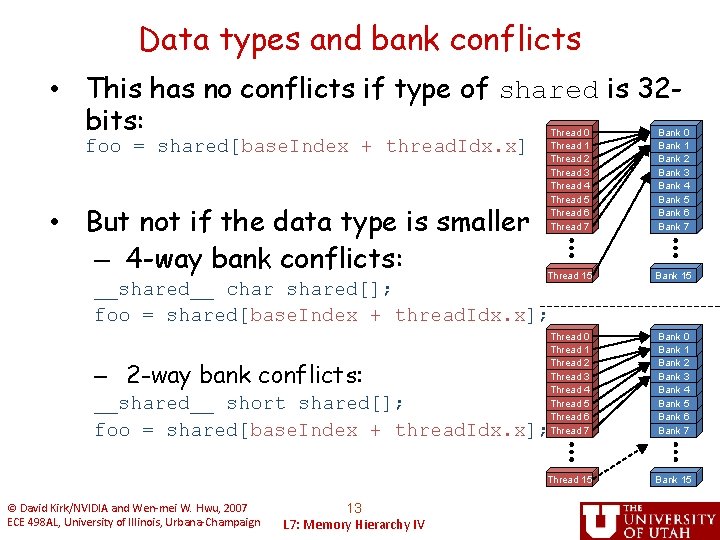
Data types and bank conflicts • This has no conflicts if type of shared is 32 bits: foo = shared[base. Index + thread. Idx. x] • But not if the data type is smaller – 4 -way bank conflicts: Thread 0 Thread 1 Thread 2 Thread 3 Thread 4 Thread 5 Thread 6 Thread 7 Bank 0 Bank 1 Bank 2 Bank 3 Bank 4 Bank 5 Bank 6 Bank 7 Thread 15 Bank 15 __shared__ char shared[]; foo = shared[base. Index + thread. Idx. x]; – 2 -way bank conflicts: __shared__ short shared[]; foo = shared[base. Index + thread. Idx. x]; © David Kirk/NVIDIA and Wen-mei W. Hwu, 2007 ECE 498 AL, University of Illinois, Urbana-Champaign 13 L 7: Memory Hierarchy IV

Structs and Bank Conflicts • Struct assignments compile into as many memory accesses as there are struct members: struct vector { float x, y, z; }; struct my. Type { float f; int c; }; __shared__ struct vectors[64]; __shared__ struct my. Types[64]; • Thread 0 Thread 1 Thread 2 Thread 3 Thread 4 Thread 5 Thread 6 Thread 7 Bank 0 Bank 1 Bank 2 Bank 3 Bank 4 Bank 5 Bank 6 Bank 7 Thread 15 Bank 15 This has no bank conflicts for vector; struct size is 3 words – 3 accesses per thread, contiguous banks (no common factor with 16) struct vector v = vectors[base. Index + thread. Idx. x]; • This has 2 -way bank conflicts for my Type; (2 accesses per thread) struct my. Type m = my. Types[base. Index + thread. Idx. x]; © David Kirk/NVIDIA and Wen-mei W. Hwu, 2007 14 ECE 498 AL, University of Illinois, Urbana-Champaign L 7: Memory Hierarchy IV
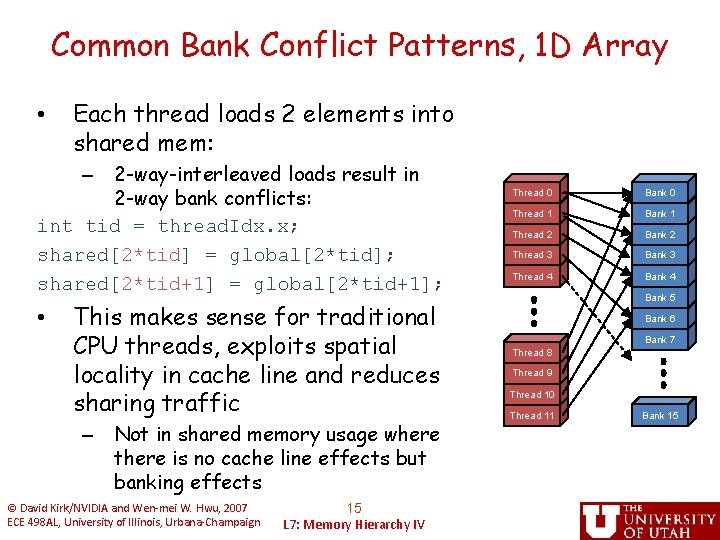
Common Bank Conflict Patterns, 1 D Array • Each thread loads 2 elements into shared mem: – 2 -way-interleaved loads result in 2 -way bank conflicts: int tid = thread. Idx. x; shared[2*tid] = global[2*tid]; shared[2*tid+1] = global[2*tid+1]; • This makes sense for traditional CPU threads, exploits spatial locality in cache line and reduces sharing traffic – Not in shared memory usage where there is no cache line effects but banking effects © David Kirk/NVIDIA and Wen-mei W. Hwu, 2007 ECE 498 AL, University of Illinois, Urbana-Champaign 15 L 7: Memory Hierarchy IV Thread 0 Bank 0 Thread 1 Bank 1 Thread 2 Bank 2 Thread 3 Bank 3 Thread 4 Bank 5 Bank 6 Bank 7 Thread 8 Thread 9 Thread 10 Thread 11 Bank 15
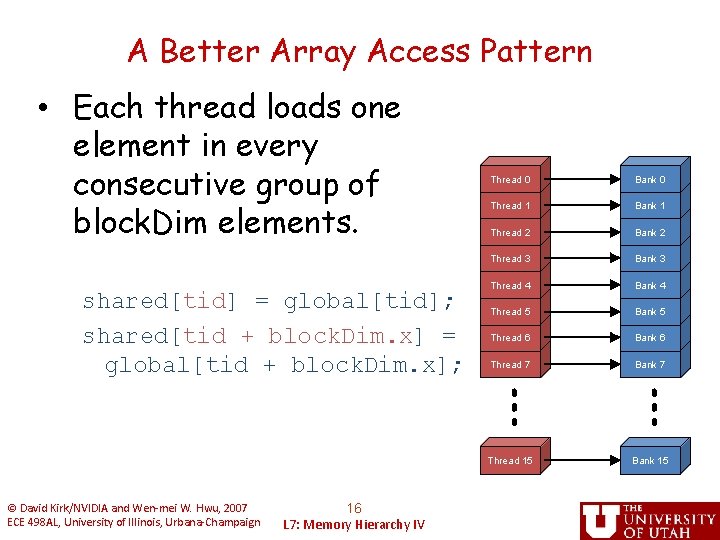
A Better Array Access Pattern • Each thread loads one element in every consecutive group of block. Dim elements. shared[tid] = global[tid]; shared[tid + block. Dim. x] = global[tid + block. Dim. x]; © David Kirk/NVIDIA and Wen-mei W. Hwu, 2007 ECE 498 AL, University of Illinois, Urbana-Champaign 16 L 7: Memory Hierarchy IV Thread 0 Bank 0 Thread 1 Bank 1 Thread 2 Bank 2 Thread 3 Bank 3 Thread 4 Bank 4 Thread 5 Bank 5 Thread 6 Bank 6 Thread 7 Bank 7 Thread 15 Bank 15

What Can You Do to Improve Bandwidth to Shared Memory? • Think about memory access patterns across threads – May need a different computation & data partitioning – Sometimes “padding” can be used on a dimension to align accesses CS 6963 17 L 7: Memory Hierarchy IV
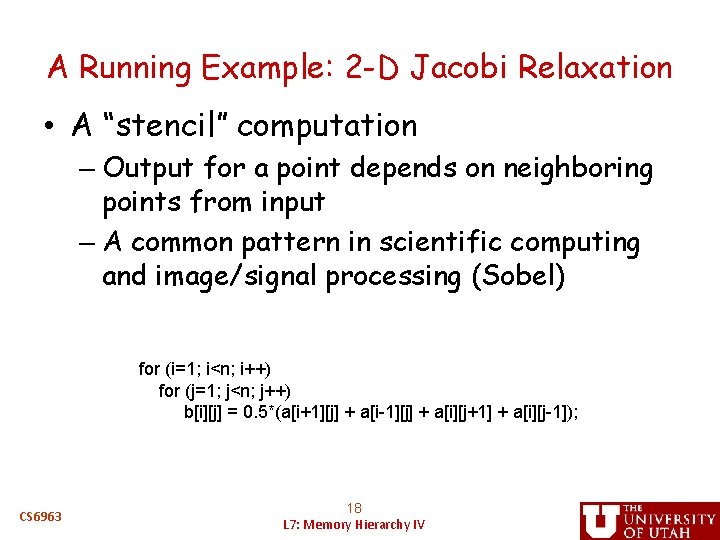
A Running Example: 2 -D Jacobi Relaxation • A “stencil” computation – Output for a point depends on neighboring points from input – A common pattern in scientific computing and image/signal processing (Sobel) for (i=1; i<n; i++) for (j=1; j<n; j++) b[i][j] = 0. 5*(a[i+1][j] + a[i-1][j] + a[i][j+1] + a[i][j-1]); CS 6963 18 L 7: Memory Hierarchy IV
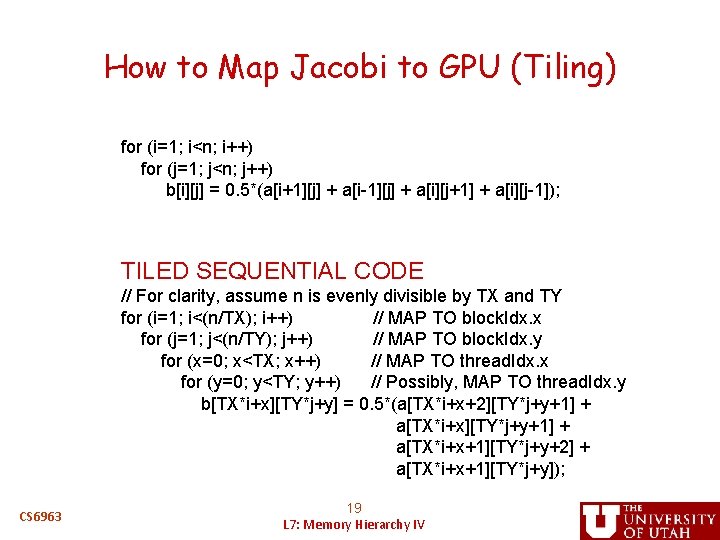
How to Map Jacobi to GPU (Tiling) for (i=1; i<n; i++) for (j=1; j<n; j++) b[i][j] = 0. 5*(a[i+1][j] + a[i-1][j] + a[i][j+1] + a[i][j-1]); TILED SEQUENTIAL CODE // For clarity, assume n is evenly divisible by TX and TY for (i=1; i<(n/TX); i++) // MAP TO block. Idx. x for (j=1; j<(n/TY); j++) // MAP TO block. Idx. y for (x=0; x<TX; x++) // MAP TO thread. Idx. x for (y=0; y<TY; y++) // Possibly, MAP TO thread. Idx. y b[TX*i+x][TY*j+y] = 0. 5*(a[TX*i+x+2][TY*j+y+1] + a[TX*i+x+1][TY*j+y+2] + a[TX*i+x+1][TY*j+y]); CS 6963 19 L 7: Memory Hierarchy IV
Global Memory Accesses • Each thread issues memory accesses to data types of varying sizes, perhaps as small as 1 byte entities • Given an address to load or store, memory returns/updates “segments” of either 32 bytes, 64 bytes or 128 bytes • Maximizing bandwidth: – Operate on an entire 128 byte segment for each memory transfer CS 6963 20 L 7: Memory Hierarchy IV
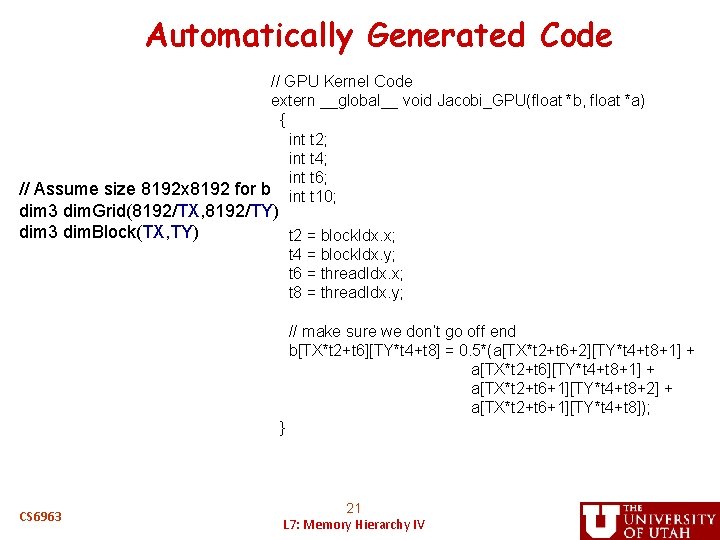
Automatically Generated Code // GPU Kernel Code extern __global__ void Jacobi_GPU(float *b, float *a) { int t 2; int t 4; int t 6; // Assume size 8192 x 8192 for b int t 10; dim 3 dim. Grid(8192/TX, 8192/TY) dim 3 dim. Block(TX, TY) t 2 = block. Idx. x; t 4 = block. Idx. y; t 6 = thread. Idx. x; t 8 = thread. Idx. y; // make sure we don’t go off end b[TX*t 2+t 6][TY*t 4+t 8] = 0. 5*(a[TX*t 2+t 6+2][TY*t 4+t 8+1] + a[TX*t 2+t 6+1][TY*t 4+t 8+2] + a[TX*t 2+t 6+1][TY*t 4+t 8]); } CS 6963 21 L 7: Memory Hierarchy IV
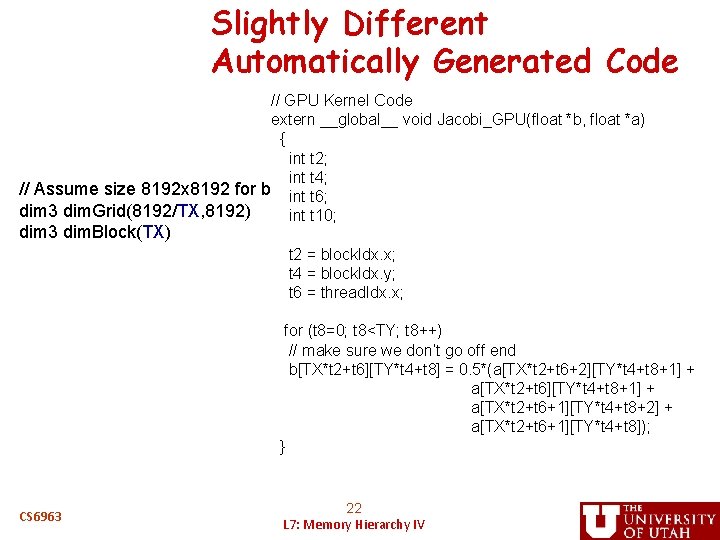
Slightly Different Automatically Generated Code // GPU Kernel Code extern __global__ void Jacobi_GPU(float *b, float *a) { int t 2; int t 4; // Assume size 8192 x 8192 for b int t 6; dim 3 dim. Grid(8192/TX, 8192) int t 10; dim 3 dim. Block(TX) t 2 = block. Idx. x; t 4 = block. Idx. y; t 6 = thread. Idx. x; for (t 8=0; t 8<TY; t 8++) // make sure we don’t go off end b[TX*t 2+t 6][TY*t 4+t 8] = 0. 5*(a[TX*t 2+t 6+2][TY*t 4+t 8+1] + a[TX*t 2+t 6+1][TY*t 4+t 8+2] + a[TX*t 2+t 6+1][TY*t 4+t 8]); } CS 6963 22 L 7: Memory Hierarchy IV
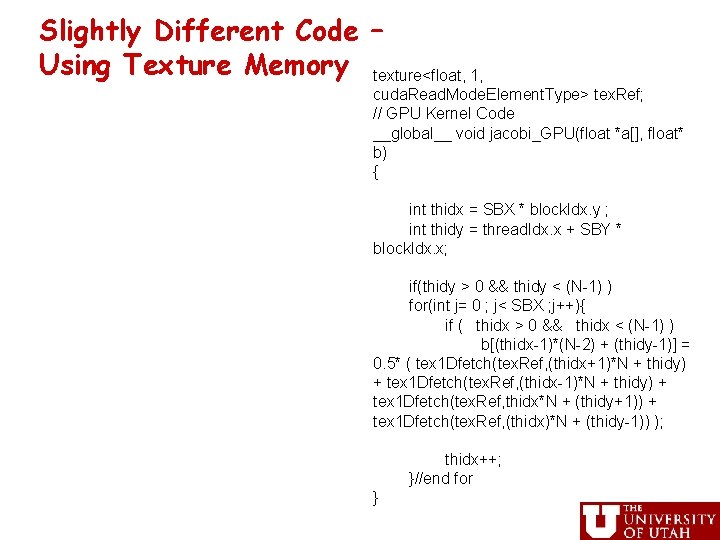
Slightly Different Code – Using Texture Memory texture<float, 1, cuda. Read. Mode. Element. Type> tex. Ref; // GPU Kernel Code __global__ void jacobi_GPU(float *a[], float* b) { int thidx = SBX * block. Idx. y ; int thidy = thread. Idx. x + SBY * block. Idx. x; if(thidy > 0 && thidy < (N-1) ) for(int j= 0 ; j< SBX ; j++){ if ( thidx > 0 && thidx < (N-1) ) b[(thidx-1)*(N-2) + (thidy-1)] = 0. 5* ( tex 1 Dfetch(tex. Ref, (thidx+1)*N + thidy) + tex 1 Dfetch(tex. Ref, (thidx-1)*N + thidy) + tex 1 Dfetch(tex. Ref, thidx*N + (thidy+1)) + tex 1 Dfetch(tex. Ref, (thidx)*N + (thidy-1)) ); thidx++; }//end for }
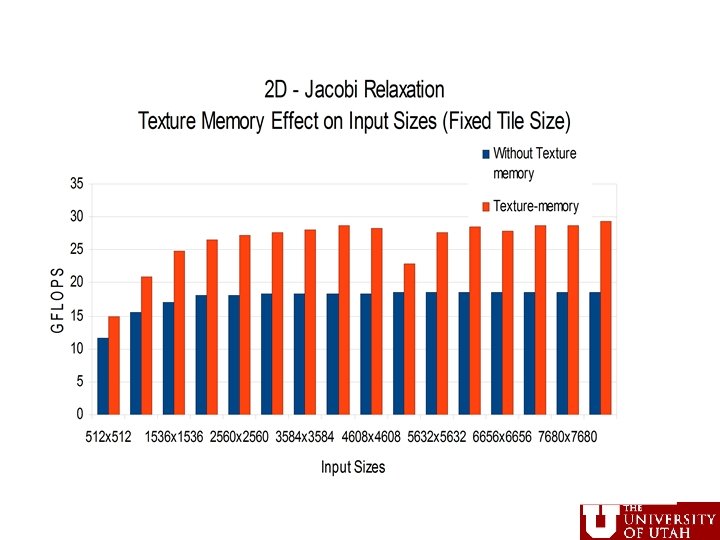
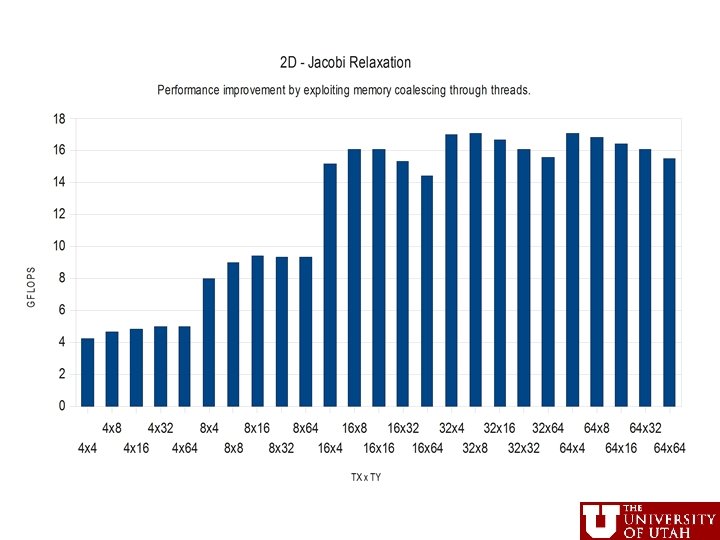
From 2 -D Jacobi Example • Use of tiling just for computation partitioning to GPU • Factor of 2 difference due to coalescing, even for identical layout and just differences in partitioning • Texture memory improves performance CS 6963 26 L 7: Memory Hierarchy IV
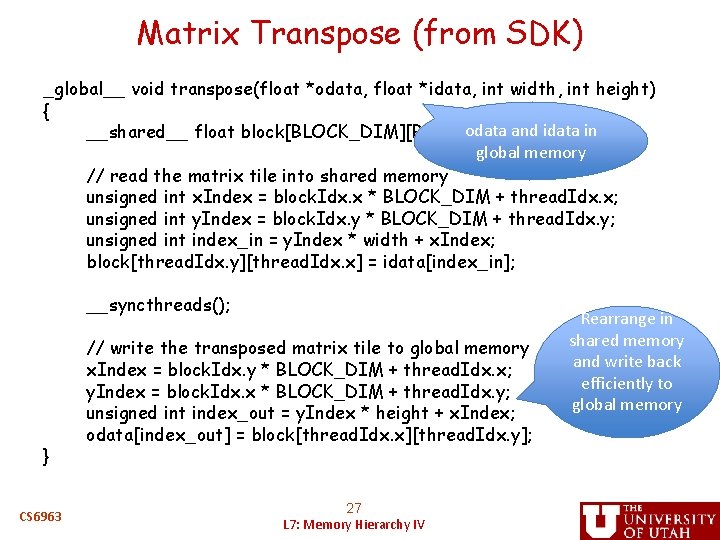
Matrix Transpose (from SDK) _global__ void transpose(float *odata, float *idata, int width, int height) { odata and idata in __shared__ float block[BLOCK_DIM][BLOCK_DIM+1]; global memory // read the matrix tile into shared memory unsigned int x. Index = block. Idx. x * BLOCK_DIM + thread. Idx. x; unsigned int y. Index = block. Idx. y * BLOCK_DIM + thread. Idx. y; unsigned int index_in = y. Index * width + x. Index; block[thread. Idx. y][thread. Idx. x] = idata[index_in]; __syncthreads(); } CS 6963 // write the transposed matrix tile to global memory x. Index = block. Idx. y * BLOCK_DIM + thread. Idx. x; y. Index = block. Idx. x * BLOCK_DIM + thread. Idx. y; unsigned int index_out = y. Index * height + x. Index; odata[index_out] = block[thread. Idx. x][thread. Idx. y]; 27 L 7: Memory Hierarchy IV Rearrange in shared memory and write back efficiently to global memory
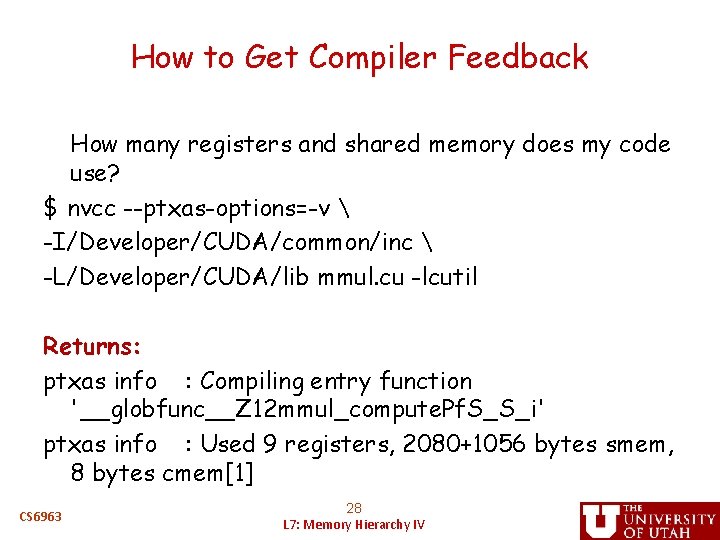
How to Get Compiler Feedback How many registers and shared memory does my code use? $ nvcc --ptxas-options=-v -I/Developer/CUDA/common/inc -L/Developer/CUDA/lib mmul. cu -lcutil Returns: ptxas info : Compiling entry function '__globfunc__Z 12 mmul_compute. Pf. S_S_i' ptxas info : Used 9 registers, 2080+1056 bytes smem, 8 bytes cmem[1] CS 6963 28 L 7: Memory Hierarchy IV
CUDA Profiler • What it does: – Provide access to hardware performance monitors – Pinpoint performance issues and compare across implementations • Two interfaces: – Text-based: • Built-in and included with compiler – GUI: • Download from http: //www. nvidia. com/object/cuda_programming_tools. html CS 6963 29 L 7: Memory Hierarchy IV

Example • Reverse array from Dr. Dobb’s journal • http: //www. ddj. com/architect/207200659 (Part 6) • Reverse_global • Copy from global to shared, then back to global in reverse order • Reverse_shared • Copy from global to reverse shared and rewrite in order to global • Output – http: //www. ddj. com/architect/209601096? pgno=2 CS 6963 30 L 7: Memory Hierarchy IV

Summary of Lecture • Reordering transformations to improve locality – Tiling, permutation and unroll-and-jam • Guiding data to be placed in registers • Placing data in texture memory • Introduction to global memory bandwidth CS 6963 31 L 7: Memory Hierarchy IV

Next Time • Real examples with measurements • cuda. Profiler and output from compiler – How to tell if your optimizations are working CS 6963 32 L 7: Memory Hierarchy IV
- Slides: 32