
L 7 1 Review Liquid Phase Reaction in

- Slides: 21
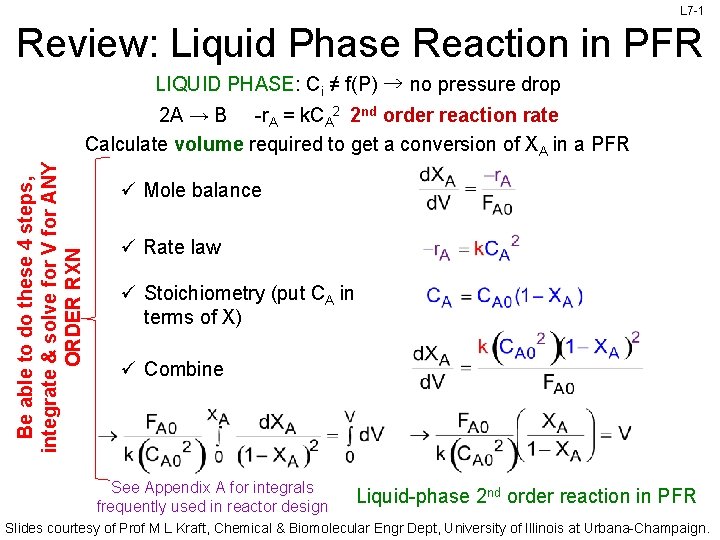
L 7 -1 Review: Liquid Phase Reaction in PFR LIQUID PHASE: Ci ≠ f(P) → no pressure drop Be able to do these 4 steps, integrate & solve for V for ANY ORDER RXN 2 A → B -r. A = k. CA 2 2 nd order reaction rate Calculate volume required to get a conversion of XA in a PFR ü Mole balance ü Rate law ü Stoichiometry (put CA in terms of X) ü Combine See Appendix A for integrals frequently used in reactor design Liquid-phase 2 nd order reaction in PFR Slides courtesy of Prof M L Kraft, Chemical & Biomolecular Engr Dept, University of Illinois at Urbana-Champaign.
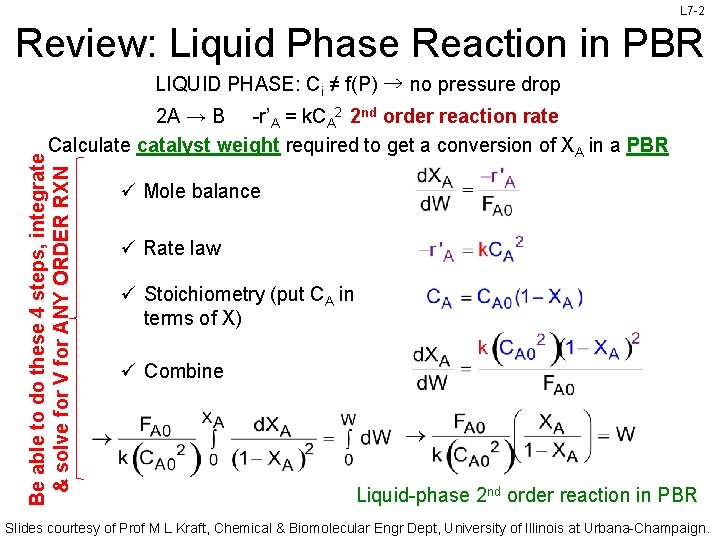
L 7 -2 Review: Liquid Phase Reaction in PBR LIQUID PHASE: Ci ≠ f(P) → no pressure drop Be able to do these 4 steps, integrate & solve for V for ANY ORDER RXN 2 A → B -r’A = k. CA 2 2 nd order reaction rate Calculate catalyst weight required to get a conversion of XA in a PBR ü Mole balance ü Rate law ü Stoichiometry (put CA in terms of X) ü Combine Liquid-phase 2 nd order reaction in PBR Slides courtesy of Prof M L Kraft, Chemical & Biomolecular Engr Dept, University of Illinois at Urbana-Champaign.
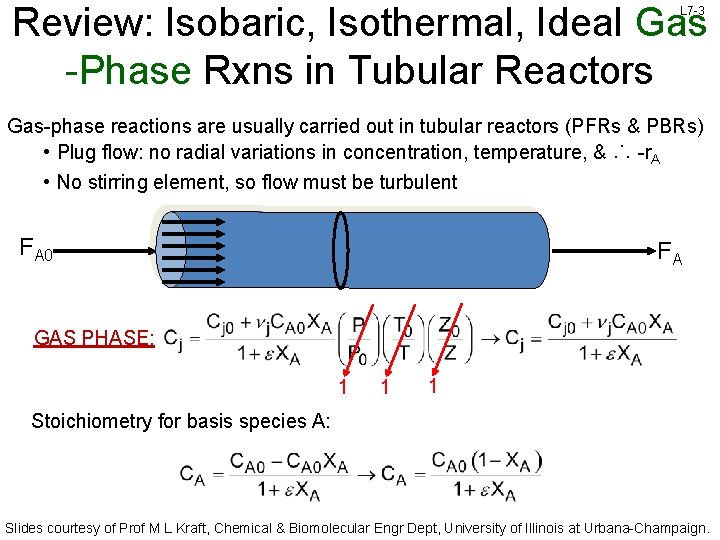
Review: Isobaric, Isothermal, Ideal Gas -Phase Rxns in Tubular Reactors L 7 -3 Gas-phase reactions are usually carried out in tubular reactors (PFRs & PBRs) • Plug flow: no radial variations in concentration, temperature, & ∴ -r. A • No stirring element, so flow must be turbulent FA 0 FA GAS PHASE: 1 1 1 Stoichiometry for basis species A: Slides courtesy of Prof M L Kraft, Chemical & Biomolecular Engr Dept, University of Illinois at Urbana-Champaign.
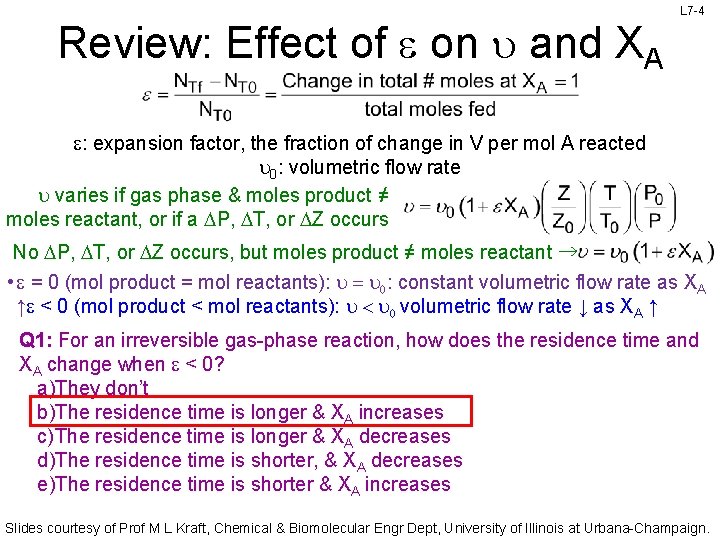
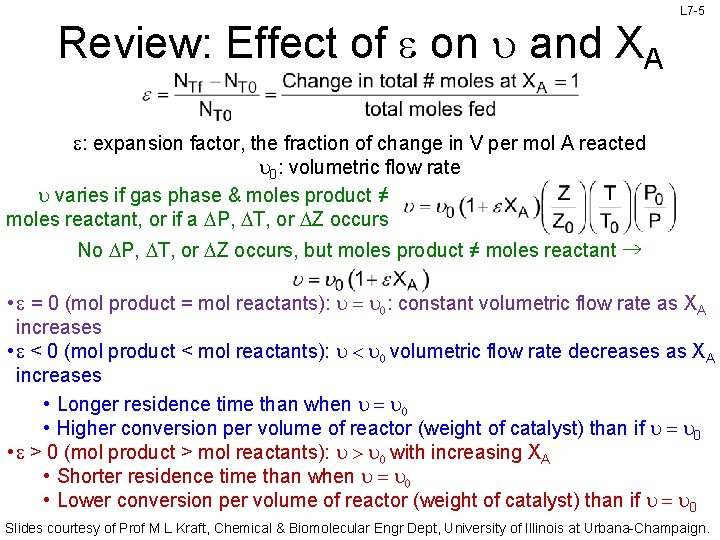
Review: Effect of on u and XA L 7 -4 : expansion factor, the fraction of change in V per mol A reacted u 0: volumetric flow rate u varies if gas phase & moles product ≠ moles reactant, or if a DP, DT, or DZ occurs No DP, DT, or DZ occurs, but moles product ≠ moles reactant → • = 0 (mol product = mol reactants): u = u 0: constant volumetric flow rate as XA ↑ < 0 (mol product < mol reactants): u < u 0 volumetric flow rate ↓ as XA ↑ Q 1: For an irreversible gas-phase reaction, how does the residence time and XA change when < 0? a)They don’t b)The residence time is longer & XA increases c) The residence time is longer & XA decreases d)The residence time is shorter, & XA decreases e)The residence time is shorter & XA increases Slides courtesy of Prof M L Kraft, Chemical & Biomolecular Engr Dept, University of Illinois at Urbana-Champaign.
Review: Effect of on u and XA L 7 -5 : expansion factor, the fraction of change in V per mol A reacted u 0: volumetric flow rate u varies if gas phase & moles product ≠ moles reactant, or if a DP, DT, or DZ occurs No DP, DT, or DZ occurs, but moles product ≠ moles reactant → • = 0 (mol product = mol reactants): u = u 0: constant volumetric flow rate as XA increases • < 0 (mol product < mol reactants): u < u 0 volumetric flow rate decreases as XA increases • Longer residence time than when u = u 0 • Higher conversion per volume of reactor (weight of catalyst) than if u = u 0 • > 0 (mol product > mol reactants): u > u 0 with increasing XA • Shorter residence time than when u = u 0 • Lower conversion per volume of reactor (weight of catalyst) than if u = u 0 Slides courtesy of Prof M L Kraft, Chemical & Biomolecular Engr Dept, University of Illinois at Urbana-Champaign.
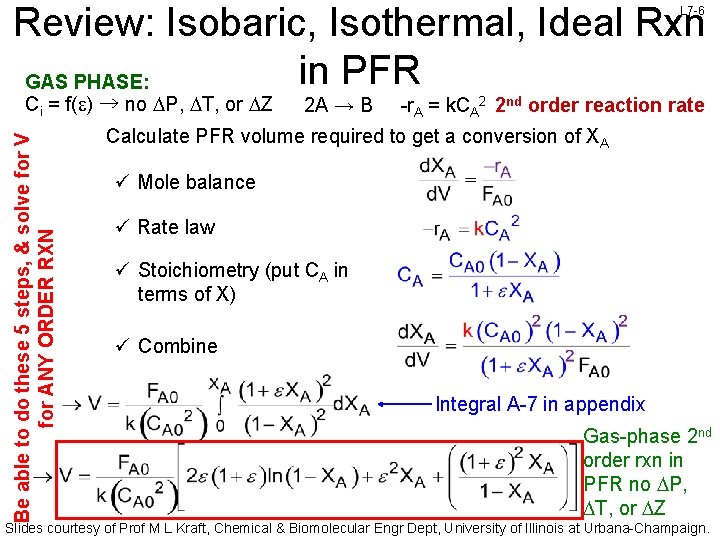
Review: Isobaric, Isothermal, Ideal Rxn in PFR GAS PHASE: L 7 -6 Be able to do these 5 steps, & solve for V for ANY ORDER RXN Ci = f( ) → no DP, DT, or DZ 2 A → B -r. A = k. CA 2 2 nd order reaction rate Calculate PFR volume required to get a conversion of XA ü Mole balance ü Rate law ü Stoichiometry (put CA in terms of X) ü Combine Integral A-7 in appendix Gas-phase 2 nd order rxn in PFR no DP, DT, or DZ Slides courtesy of Prof M L Kraft, Chemical & Biomolecular Engr Dept, University of Illinois at Urbana-Champaign.
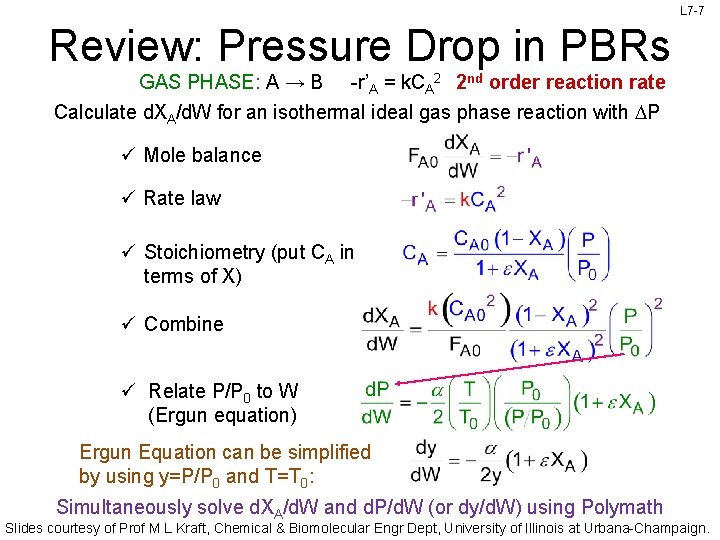
L 7 -7 Review: Pressure Drop in PBRs GAS PHASE: A → B -r’A = k. CA 2 2 nd order reaction rate Calculate d. XA/d. W for an isothermal ideal gas phase reaction with DP ü Mole balance ü Rate law ü Stoichiometry (put CA in terms of X) ü Combine ü Relate P/P 0 to W (Ergun equation) Ergun Equation can be simplified by using y=P/P 0 and T=T 0: Simultaneously solve d. XA/d. W and d. P/d. W (or dy/d. W) using Polymath Slides courtesy of Prof M L Kraft, Chemical & Biomolecular Engr Dept, University of Illinois at Urbana-Champaign.
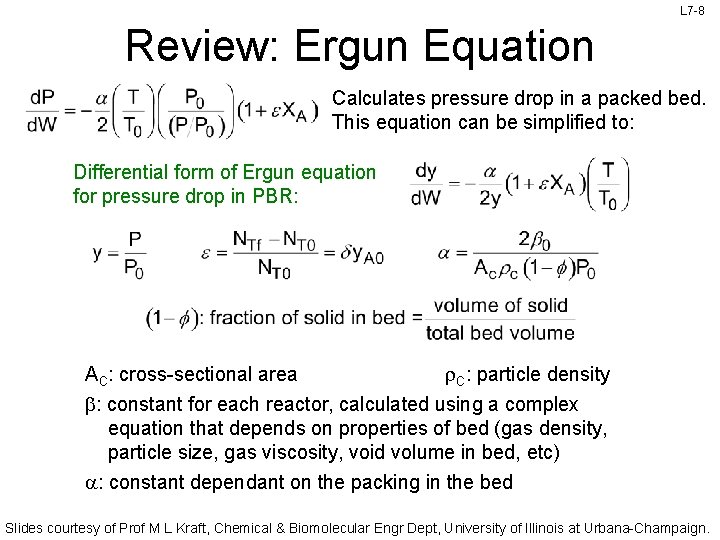
L 7 -8 Review: Ergun Equation Calculates pressure drop in a packed bed. This equation can be simplified to: Differential form of Ergun equation for pressure drop in PBR: AC: cross-sectional area r. C: particle density b: constant for each reactor, calculated using a complex equation that depends on properties of bed (gas density, particle size, gas viscosity, void volume in bed, etc) a: constant dependant on the packing in the bed Slides courtesy of Prof M L Kraft, Chemical & Biomolecular Engr Dept, University of Illinois at Urbana-Champaign.
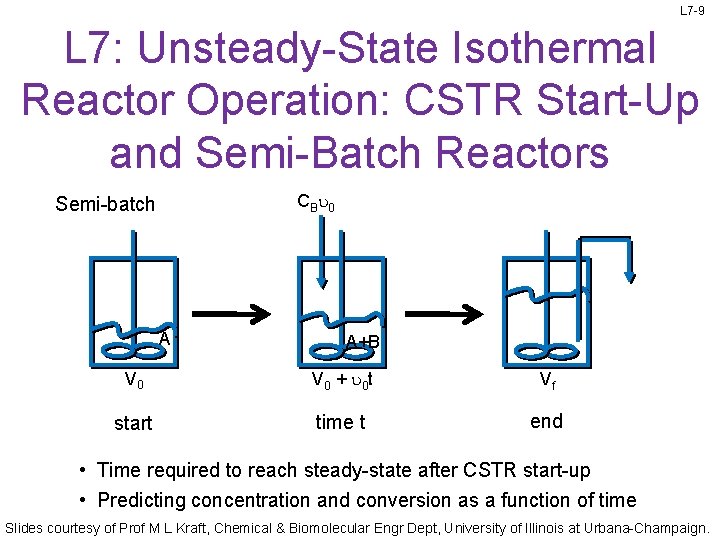
L 7 -9 L 7: Unsteady-State Isothermal Reactor Operation: CSTR Start-Up and Semi-Batch Reactors CBu 0 Semi-batch A A+B V 0 + u 0 t Vf start time t end • Time required to reach steady-state after CSTR start-up • Predicting concentration and conversion as a function of time Slides courtesy of Prof M L Kraft, Chemical & Biomolecular Engr Dept, University of Illinois at Urbana-Champaign.
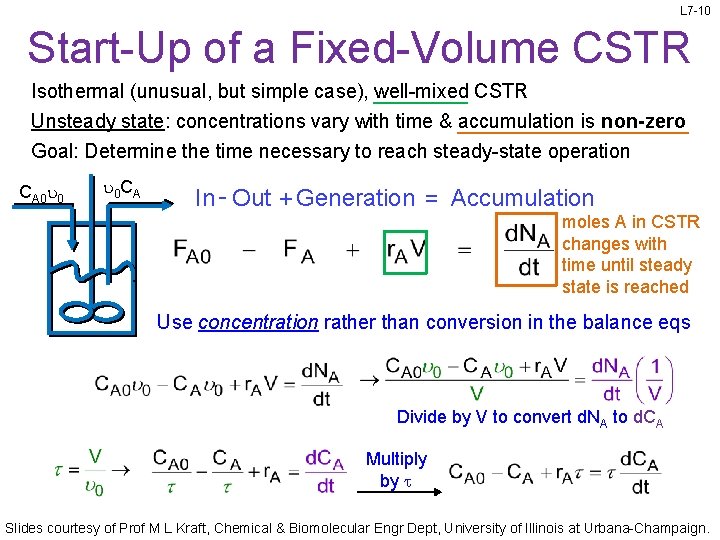
L 7 -10 Start-Up of a Fixed-Volume CSTR Isothermal (unusual, but simple case), well-mixed CSTR Unsteady state: concentrations vary with time & accumulation is non-zero Goal: Determine the time necessary to reach steady-state operation CA 0 u 0 CA In - Out + Generation = Accumulation moles A in CSTR changes with time until steady state is reached Use concentration rather than conversion in the balance eqs Divide by V to convert d. NA to d. CA Multiply by t Slides courtesy of Prof M L Kraft, Chemical & Biomolecular Engr Dept, University of Illinois at Urbana-Champaign.
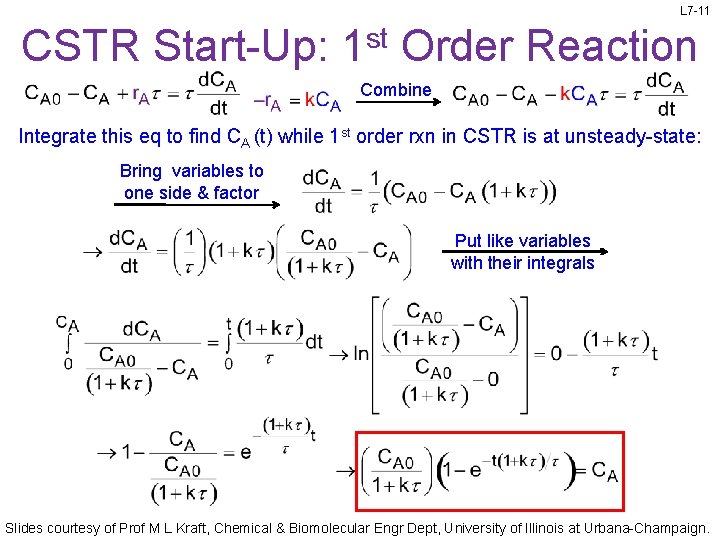
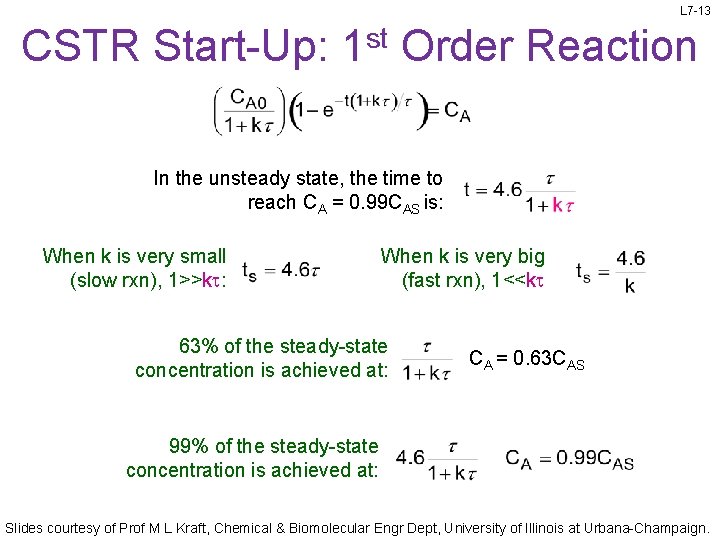
L 7 -11 CSTR Start-Up: 1 st Order Reaction Combine Integrate this eq to find CA (t) while 1 st order rxn in CSTR is at unsteady-state: Bring variables to one side & factor Put like variables with their integrals Slides courtesy of Prof M L Kraft, Chemical & Biomolecular Engr Dept, University of Illinois at Urbana-Champaign.
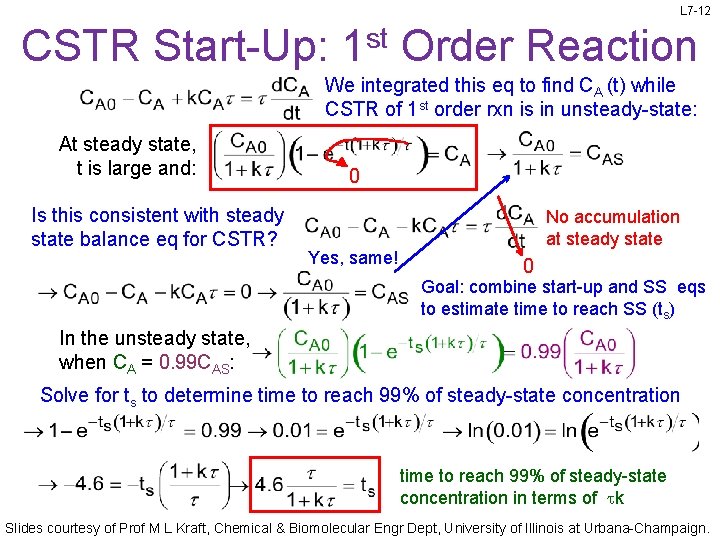
L 7 -12 CSTR Start-Up: 1 st Order Reaction We integrated this eq to find CA (t) while CSTR of 1 st order rxn is in unsteady-state: At steady state, t is large and: Is this consistent with steady state balance eq for CSTR? 0 Yes, same! No accumulation at steady state 0 Goal: combine start-up and SS eqs to estimate time to reach SS (ts) In the unsteady state, when CA = 0. 99 CAS: Solve for ts to determine time to reach 99% of steady-state concentration in terms of tk Slides courtesy of Prof M L Kraft, Chemical & Biomolecular Engr Dept, University of Illinois at Urbana-Champaign.
L 7 -13 CSTR Start-Up: 1 st Order Reaction In the unsteady state, the time to reach CA = 0. 99 CAS is: When k is very small (slow rxn), 1>>kt: When k is very big (fast rxn), 1<<kt 63% of the steady-state concentration is achieved at: CA = 0. 63 CAS 99% of the steady-state concentration is achieved at: Slides courtesy of Prof M L Kraft, Chemical & Biomolecular Engr Dept, University of Illinois at Urbana-Champaign.
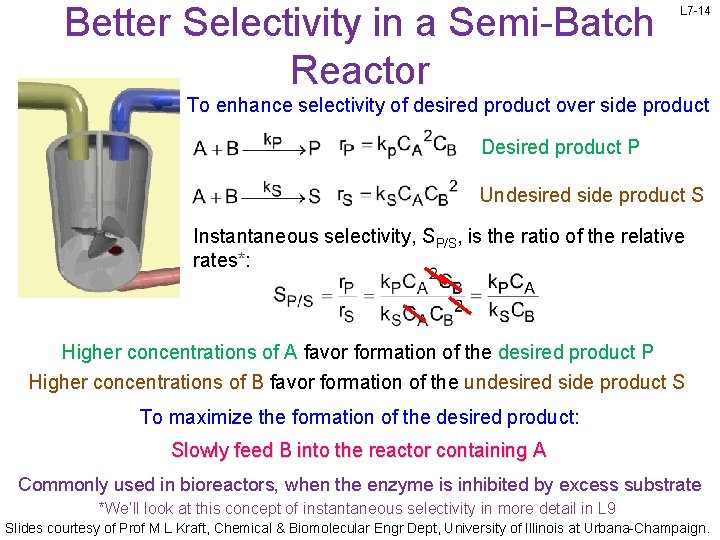
Better Selectivity in a Semi-Batch Reactor L 7 -14 To enhance selectivity of desired product over side product Desired product P Undesired side product S Instantaneous selectivity, SP/S, is the ratio of the relative rates*: Higher concentrations of A favor formation of the desired product P Higher concentrations of B favor formation of the undesired side product S To maximize the formation of the desired product: Slowly feed B into the reactor containing A Commonly used in bioreactors, when the enzyme is inhibited by excess substrate *We’ll look at this concept of instantaneous selectivity in more detail in L 9 Slides courtesy of Prof M L Kraft, Chemical & Biomolecular Engr Dept, University of Illinois at Urbana-Champaign.
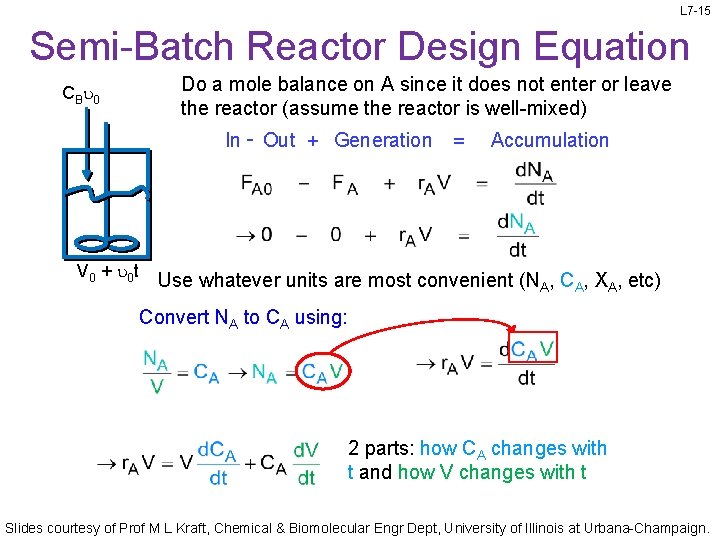
L 7 -15 Semi-Batch Reactor Design Equation CBu 0 V 0 + u 0 t Do a mole balance on A since it does not enter or leave the reactor (assume the reactor is well-mixed) In - Out + Generation = Accumulation Use whatever units are most convenient (NA, CA, XA, etc) Convert NA to CA using: 2 parts: how CA changes with t and how V changes with t Slides courtesy of Prof M L Kraft, Chemical & Biomolecular Engr Dept, University of Illinois at Urbana-Champaign.
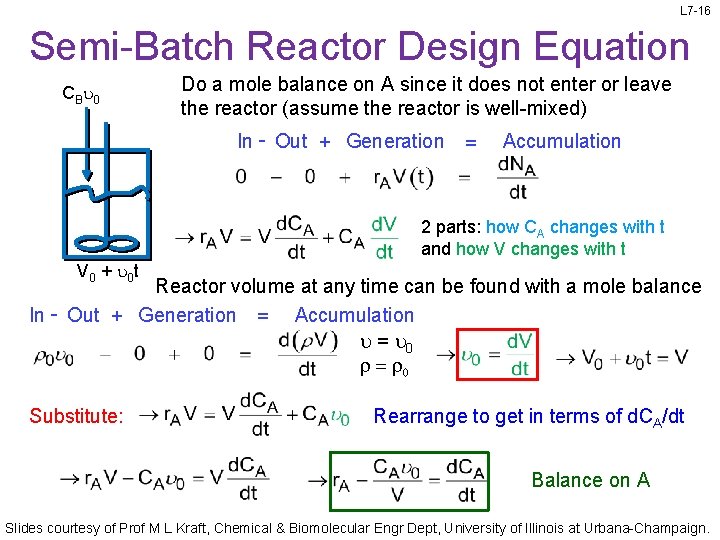
L 7 -16 Semi-Batch Reactor Design Equation CBu 0 Do a mole balance on A since it does not enter or leave the reactor (assume the reactor is well-mixed) In - Out + Generation = Accumulation 2 parts: how CA changes with t and how V changes with t V 0 + u 0 t Reactor volume at any time can be found with a mole balance In - Out + Generation = Accumulation u = u 0 r = r 0 Substitute: Rearrange to get in terms of d. CA/dt Balance on A Slides courtesy of Prof M L Kraft, Chemical & Biomolecular Engr Dept, University of Illinois at Urbana-Champaign.
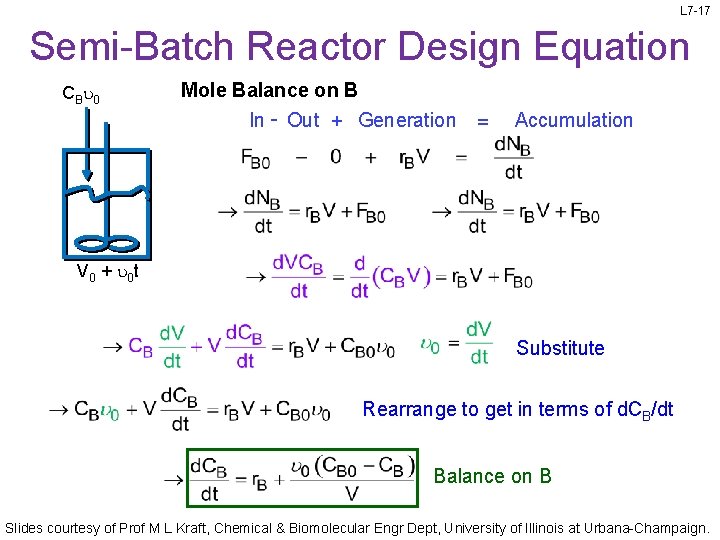
L 7 -17 Semi-Batch Reactor Design Equation CBu 0 Mole Balance on B In - Out + Generation = Accumulation V 0 + u 0 t Substitute Rearrange to get in terms of d. CB/dt Balance on B Slides courtesy of Prof M L Kraft, Chemical & Biomolecular Engr Dept, University of Illinois at Urbana-Champaign.
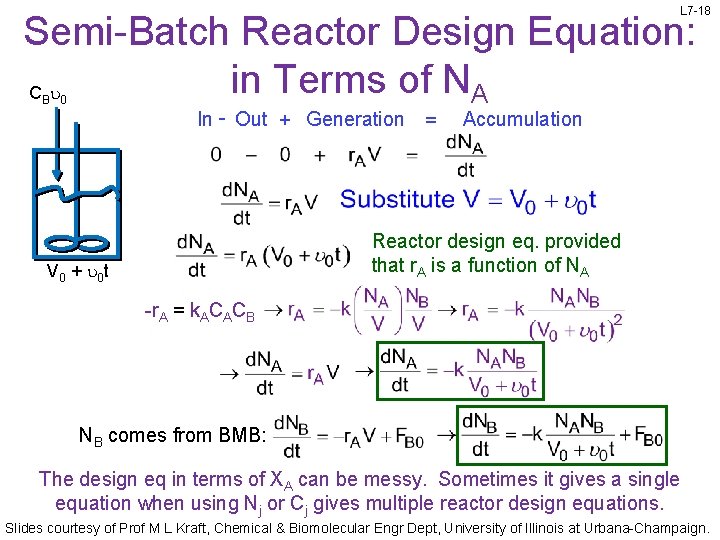
L 7 -18 Semi-Batch Reactor Design Equation: in Terms of NA C u B 0 In - Out + Generation = Accumulation Reactor design eq. provided that r. A is a function of NA V 0 + u 0 t -r. A = k. ACACB NB comes from BMB: The design eq in terms of XA can be messy. Sometimes it gives a single equation when using Nj or Cj gives multiple reactor design equations. Slides courtesy of Prof M L Kraft, Chemical & Biomolecular Engr Dept, University of Illinois at Urbana-Champaign.
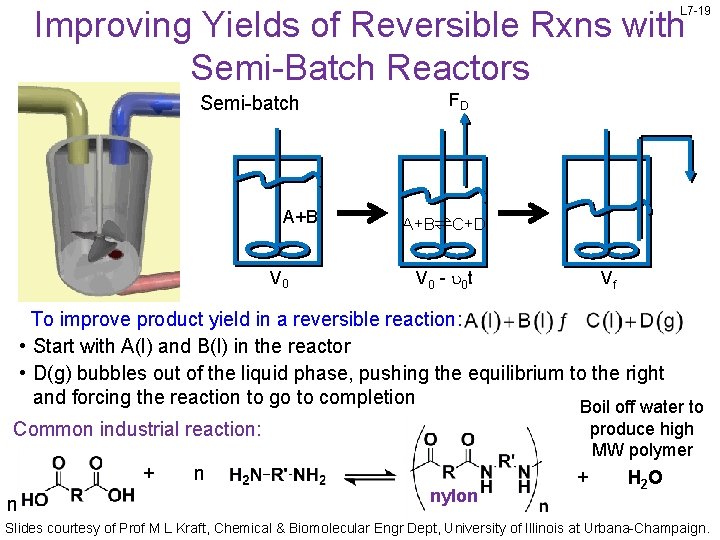
Improving Yields of Reversible Rxns with Semi-Batch Reactors L 7 -19 Semi-batch A+B V 0 FD A+B⇌C+D V 0 - u 0 t Vf To improve product yield in a reversible reaction: • Start with A(l) and B(l) in the reactor • D(g) bubbles out of the liquid phase, pushing the equilibrium to the right and forcing the reaction to go to completion Boil off water to produce high MW polymer Common industrial reaction: + n n nylon + H 2 O Slides courtesy of Prof M L Kraft, Chemical & Biomolecular Engr Dept, University of Illinois at Urbana-Champaign.
Improving Yields of Reversible Rxns with Semi-Batch Reactors L 7 -20 Semi-batch A+B V 0 FD A+B⇌C+D V 0 - u 0 t Vf To improve product yield in a reversible reaction: • Start with A(l) and B(l) in the reactor • D(g) bubbles out of the liquid phase, pushing the equilibrium to the right and forcing the reaction to go to completion How do we account for the loss of product D in the material balance? Slides courtesy of Prof M L Kraft, Chemical & Biomolecular Engr Dept, University of Illinois at Urbana-Champaign.
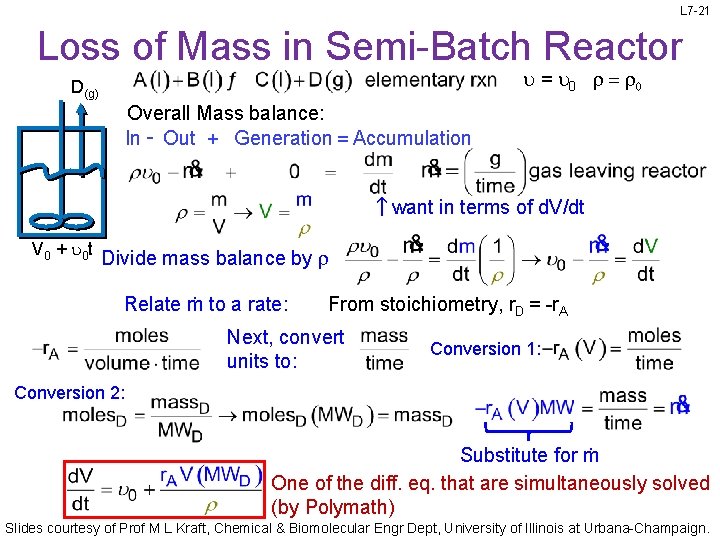
L 7 -21 Loss of Mass in Semi-Batch Reactor u = u 0 r = r 0 D(g) Overall Mass balance: In - Out + Generation = Accumulation ↑want in terms of d. V/dt V 0 + u 0 t Divide mass balance by r Relate ṁ to a rate: From stoichiometry, r. D = -r. A Next, convert units to: Conversion 1: Conversion 2: Substitute for ṁ One of the diff. eq. that are simultaneously solved (by Polymath) Slides courtesy of Prof M L Kraft, Chemical & Biomolecular Engr Dept, University of Illinois at Urbana-Champaign.