
L 6 Introduction to Verilog Combinational Logic Acknowledgements

L 6: Introduction to Verilog (Combinational Logic) Acknowledgements: Materials in this lecture are courtesy of the following sources and are used with permission. Rex Min Verilog References: • Samir Palnitkar, Verilog HDL, Pearson Education (2 nd edition). • Donald Thomas, Philip Moorby, The Verilog Hardware Description Language, Fifth Edition, Kluwer Academic Publishers. • J. Bhasker, Verilog HDL Synthesis (A Practical Primer), Star Galaxy Publishing Introductory Digital Systems Laboratory
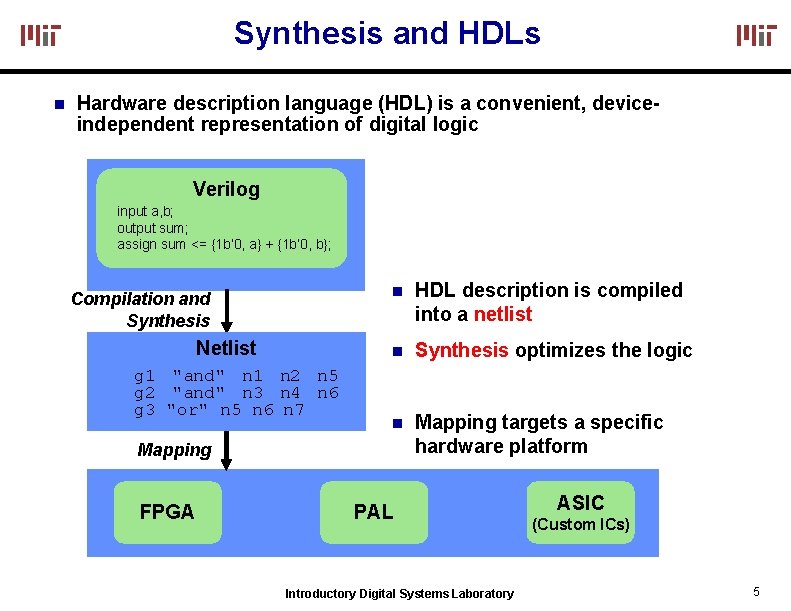
Synthesis and HDLs Hardware description language (HDL) is a convenient, deviceindependent representation of digital logic Verilog input a, b; output sum; assign sum <= {1 b’ 0, a} + {1 b’ 0, b}; Compilation and Synthesis Netlist g 1 "and" n 1 n 2 n 5 g 2 "and" n 3 n 4 n 6 g 3 "or" n 5 n 6 n 7 HDL description is compiled into a netlist Synthesis optimizes the logic Mapping targets a specific hardware platform Mapping FPGA PAL Introductory Digital Systems Laboratory ASIC (Custom ICs) 5
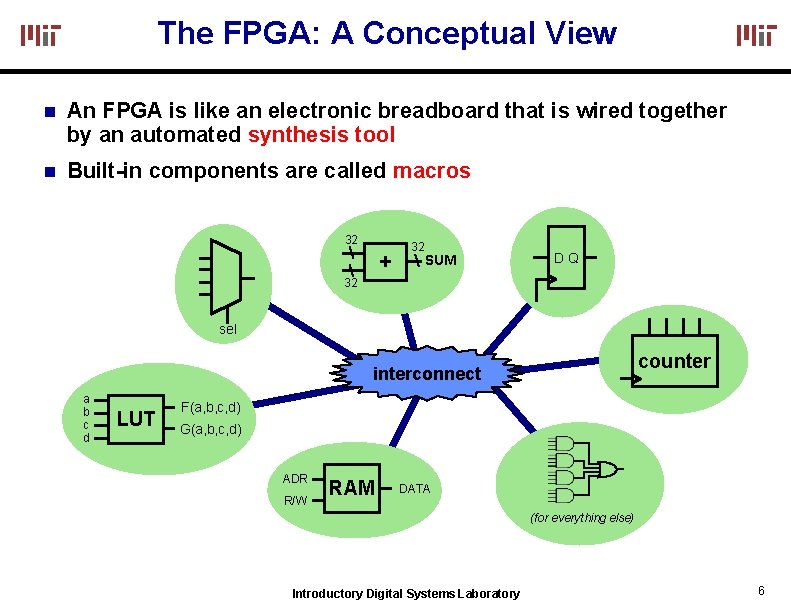
The FPGA: A Conceptual View An FPGA is like an electronic breadboard that is wired together by an automated synthesis tool Built-in components are called macros 32 + 32 SUM DQ 32 sel counter interconnect a b c d LUT F(a, b, c, d) G(a, b, c, d) ADR R/W RAM DATA (for everything else) Introductory Digital Systems Laboratory 6
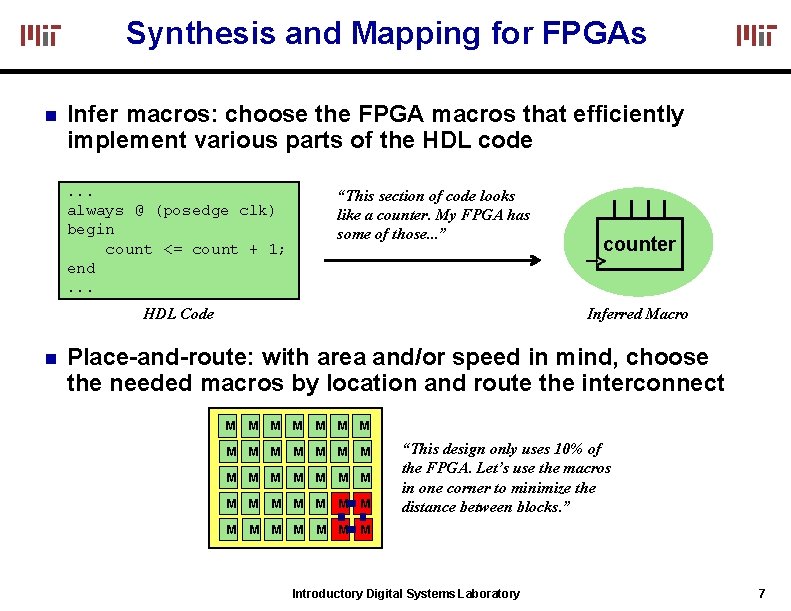
Synthesis and Mapping for FPGAs Infer macros: choose the FPGA macros that efficiently implement various parts of the HDL code. . . always @ (posedge clk) begin count <= count + 1; end. . . “This section of code looks like a counter. My FPGA has some of those. . . ” HDL Code counter Inferred Macro Place-and-route: with area and/or speed in mind, choose the needed macros by location and route the interconnect M M M M M M M M M “This design only uses 10% of the FPGA. Let’s use the macros in one corner to minimize the distance between blocks. ” Introductory Digital Systems Laboratory 7
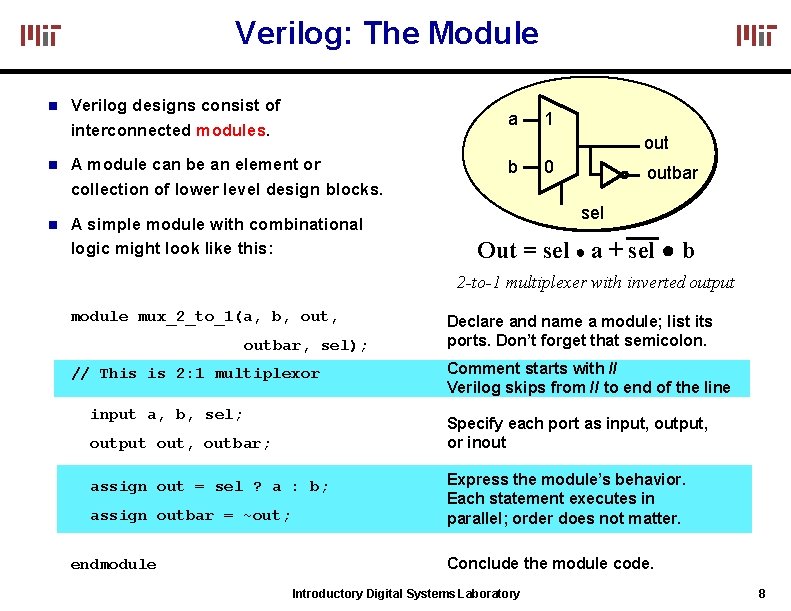
Verilog: The Module Verilog designs consist of interconnected modules. a 1 out A module can be an element or collection of lower level design blocks. A simple module with combinational logic might look like this: b 0 outbar sel Out = sel ● a + sel ● b 2 -to-1 multiplexer with inverted output module mux_2_to_1(a, b, outbar, sel); // This is 2: 1 multiplexor input a, b, sel; assign out = sel ? a : b; endmodule Comment starts with // Verilog skips from // to end of the line Specify each port as input, output, or inout output out, outbar; assign outbar = ~out; Declare and name a module; list its ports. Don’t forget that semicolon. Express the module’s behavior. Each statement executes in parallel; order does not matter. Conclude the module code. Introductory Digital Systems Laboratory 8
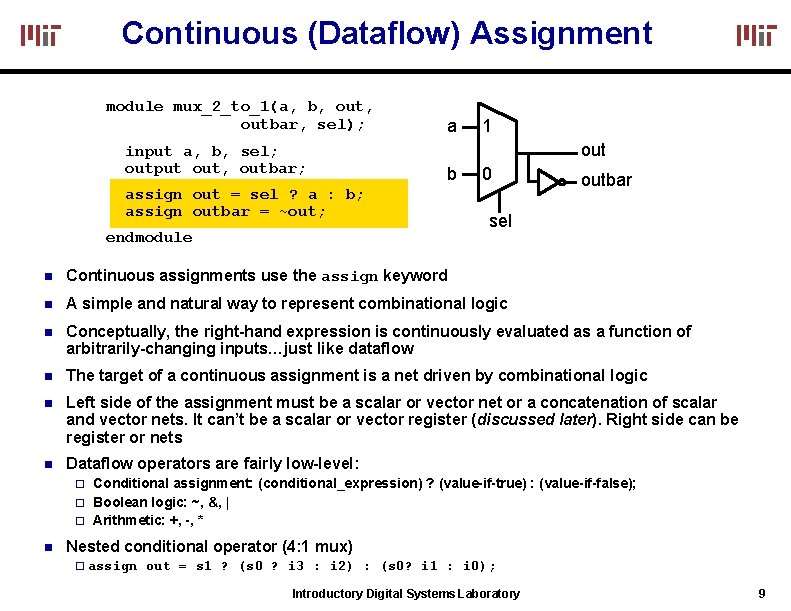
Continuous (Dataflow) Assignment module mux_2_to_1(a, b, outbar, sel); input a, b, sel; output out, outbar; a 1 out b assign out = sel ? a : b; assign outbar = ~out; endmodule 0 outbar sel Continuous assignments use the assign keyword A simple and natural way to represent combinational logic Conceptually, the right-hand expression is continuously evaluated as a function of arbitrarily-changing inputs…just like dataflow The target of a continuous assignment is a net driven by combinational logic Left side of the assignment must be a scalar or vector net or a concatenation of scalar and vector nets. It can’t be a scalar or vector register (discussed later). Right side can be register or nets Dataflow operators are fairly low-level: Conditional assignment: (conditional_expression) ? (value-if-true) : (value-if-false); Boolean logic: ~, &, | Arithmetic: +, -, * Nested conditional operator (4: 1 mux) assign out = s 1 ? (s 0 ? i 3 : i 2) : (s 0? i 1 : i 0); Introductory Digital Systems Laboratory 9
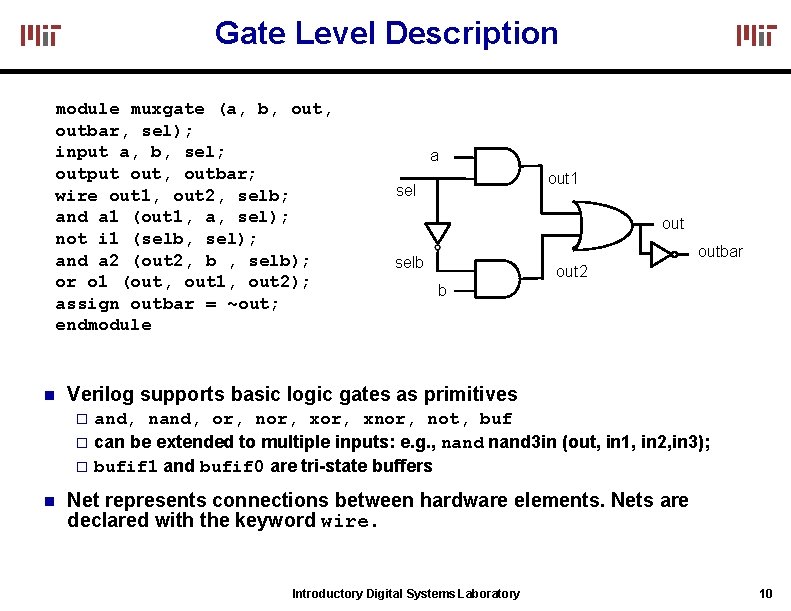
Gate Level Description module muxgate (a, b, outbar, sel); input a, b, sel; output out, outbar; wire out 1, out 2, selb; and a 1 (out 1, a, sel); not i 1 (selb, sel); and a 2 (out 2, b , selb); or o 1 (out, out 1, out 2); assign outbar = ~out; endmodule a out 1 sel outbar selb out 2 b Verilog supports basic logic gates as primitives and, nand, or, nor, xnor, not, buf can be extended to multiple inputs: e. g. , nand 3 in (out, in 1, in 2, in 3); bufif 1 and bufif 0 are tri-state buffers Net represents connections between hardware elements. Nets are declared with the keyword wire. Introductory Digital Systems Laboratory 10
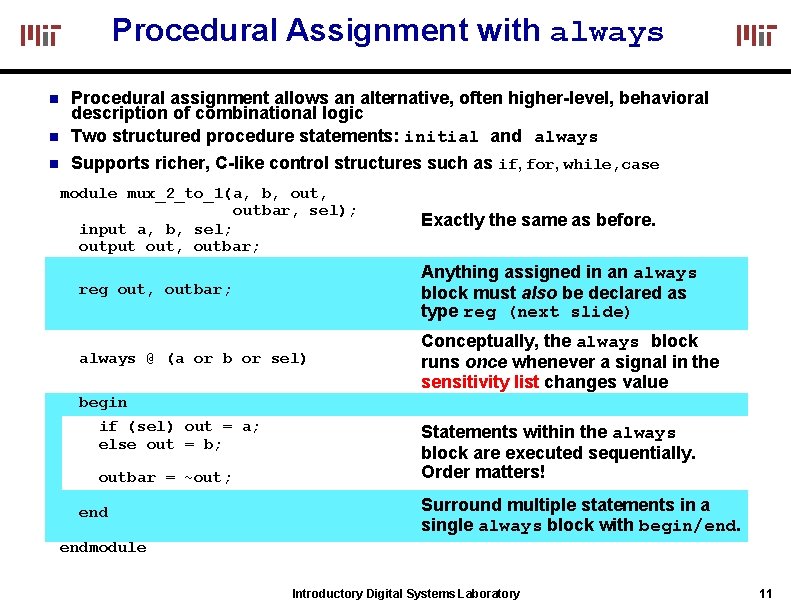
Procedural Assignment with always Procedural assignment allows an alternative, often higher-level, behavioral description of combinational logic Two structured procedure statements: initial and always Supports richer, C-like control structures such as if, for, while, case module mux_2_to_1(a, b, outbar, sel); input a, b, sel; output out, outbar; Exactly the same as before. reg out, outbar; Anything assigned in an always block must also be declared as type reg (next slide) always @ (a or b or sel) Conceptually, the always block runs once whenever a signal in the sensitivity list changes value begin if (sel) out = a; else out = b; outbar = ~out; end Statements within the always block are executed sequentially. Order matters! Surround multiple statements in a single always block with begin/end. endmodule Introductory Digital Systems Laboratory 11
Verilog Registers In digital design, registers represent memory elements (we will study these in the next few lectures) Digital registers need a clock to operate and update their state on certain phase or edge Registers in Verilog should not be confused with hardware registers In Verilog, the term register (reg) simply means a variable that can hold a value Verilog registers don’t need a clock and don’t need to be driven like a net. Values of registers can be changed anytime in a simulation by assuming a new value to the register Introductory Digital Systems Laboratory 12
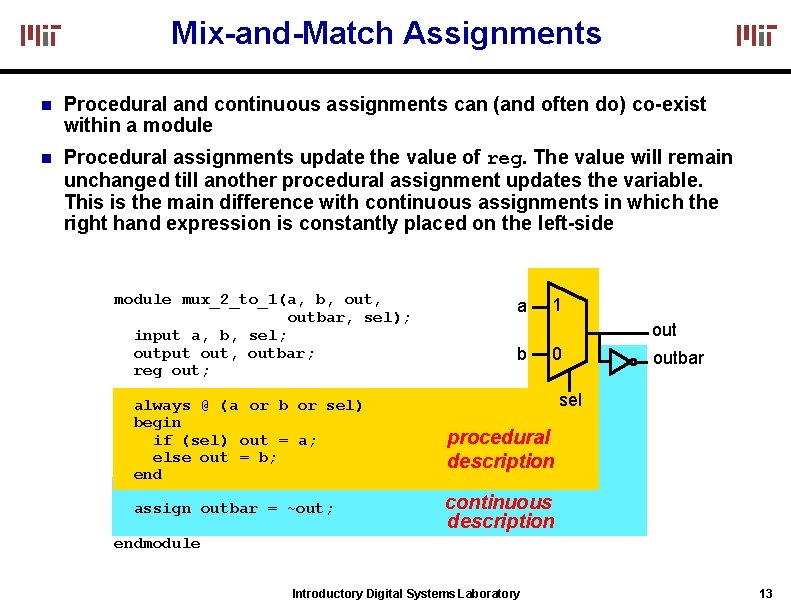
Mix-and-Match Assignments Procedural and continuous assignments can (and often do) co-exist within a module Procedural assignments update the value of reg. The value will remain unchanged till another procedural assignment updates the variable. This is the main difference with continuous assignments in which the right hand expression is constantly placed on the left-side module mux_2_to_1(a, b, outbar, sel); input a, b, sel; output out, outbar; reg out; always @ (a or b or sel) begin if (sel) out = a; else out = b; end assign outbar = ~out; a 1 out b 0 outbar sel procedural description continuous description endmodule Introductory Digital Systems Laboratory 13

The case Statement case and if may be used interchangeably to implement conditional execution within always blocks case is easier to read than a long string of if. . . else statements module mux_2_to_1(a, b, outbar, sel); input a, b, sel; output out, outbar; reg out; always @ (a or b or sel) begin if (sel) out = a; else out = b; end assign outbar = ~out; endmodule mux_2_to_1(a, b, outbar, sel); input a, b, sel; output out, outbar; reg out; always @ (a or b or sel) begin case (sel) 1’b 1: out = a; 1’b 0: out = b; endcase end assign outbar = ~out; endmodule Note: Number specification notation: <size>’<base><number> (4’b 1010 if a 4 -bit binary value, 16’h 6 cda is a 16 bit hex number, and 8’d 40 is an 8 -bit decimal value) Introductory Digital Systems Laboratory 14
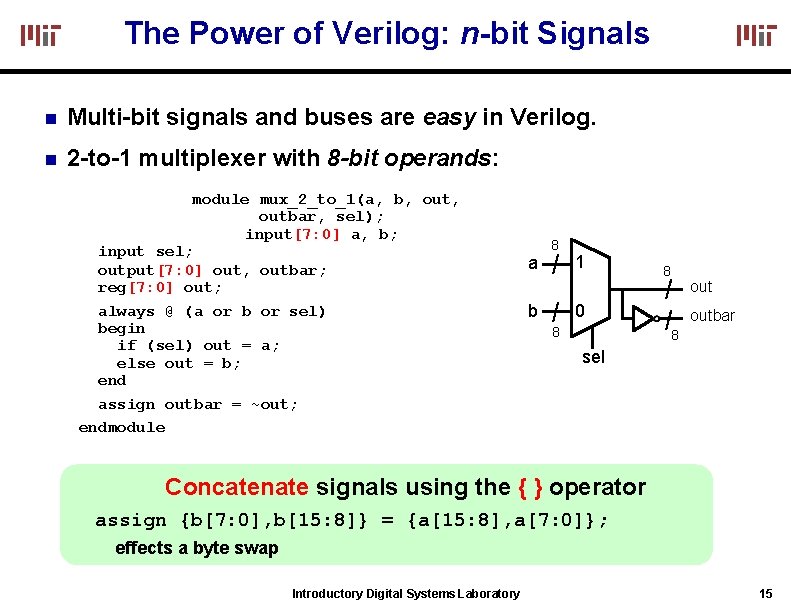
The Power of Verilog: n-bit Signals Multi-bit signals and buses are easy in Verilog. 2 -to-1 multiplexer with 8 -bit operands: module mux_2_to_1(a, b, outbar, sel); input[7: 0] a, b; input sel; output[7: 0] out, outbar; reg[7: 0] out; always @ (a or b or sel) begin if (sel) out = a; else out = b; end assign outbar = ~out; endmodule a 8 b 1 8 out 0 8 outbar 8 sel Concatenate signals using the { } operator assign {b[7: 0], b[15: 8]} = {a[15: 8], a[7: 0]}; effects a byte swap Introductory Digital Systems Laboratory 15
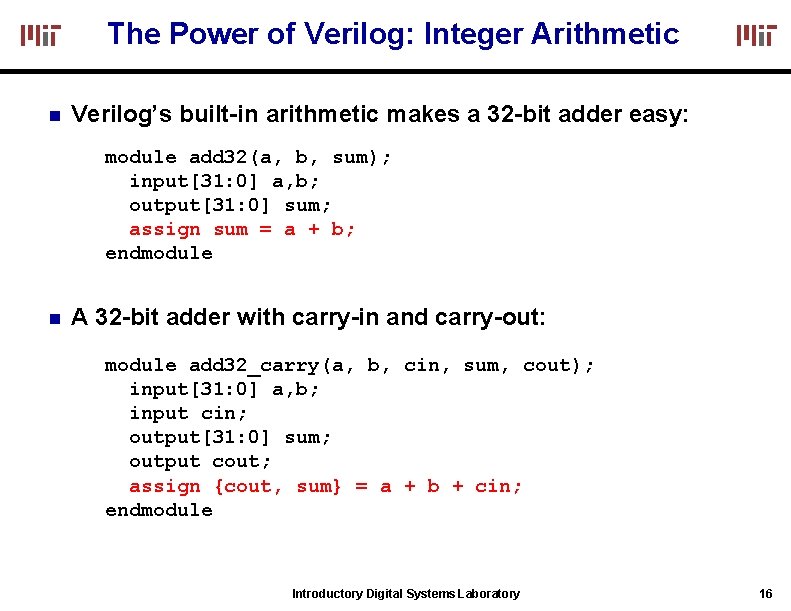
The Power of Verilog: Integer Arithmetic Verilog’s built-in arithmetic makes a 32 -bit adder easy: module add 32(a, b, sum); input[31: 0] a, b; output[31: 0] sum; assign sum = a + b; endmodule A 32 -bit adder with carry-in and carry-out: module add 32_carry(a, b, cin, sum, cout); input[31: 0] a, b; input cin; output[31: 0] sum; output cout; assign {cout, sum} = a + b + cin; endmodule Introductory Digital Systems Laboratory 16

Dangers of Verilog: Incomplete Specification Goal: a 00 b 01 c 10 Proposed Verilog Code: out 2 sel 3 -to-1 MUX (‘ 11’ input is a don’t-care) module maybe_mux_3 to 1(a, b, c, sel, out); input [1: 0] sel; input a, b, c; output out; reg out; always @(a or b or c or sel) begin case (sel) 2'b 00: out = a; 2'b 01: out = b; 2'b 10: out = c; endcase endmodule Is this a 3 -to-1 multiplexer? Introductory Digital Systems Laboratory 17
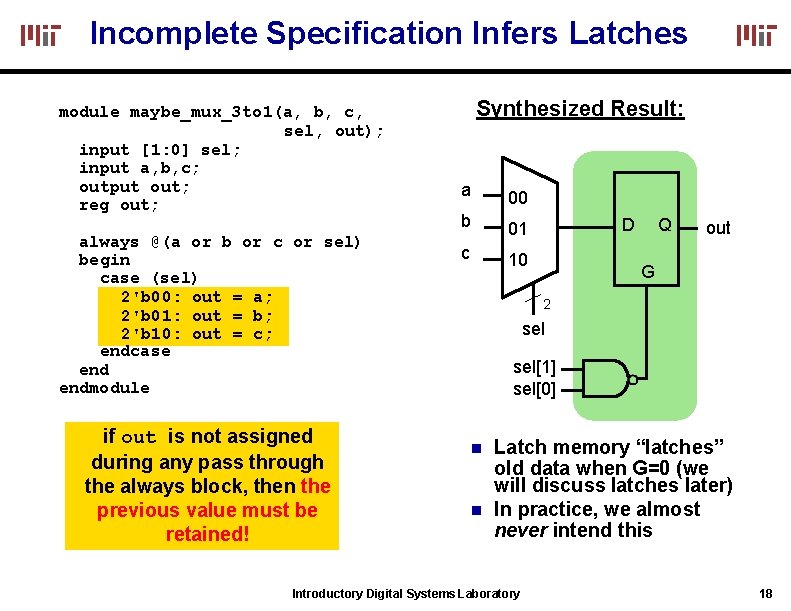
Incomplete Specification Infers Latches module maybe_mux_3 to 1(a, b, c, sel, out); input [1: 0] sel; input a, b, c; output out; reg out; always @(a or b or c or sel) begin case (sel) 2'b 00: out = a; 2'b 01: out = b; 2'b 10: out = c; endcase endmodule if out is not assigned during any pass through the always block, then the previous value must be retained! Synthesized Result: a 00 b 01 c 10 D Q out G 2 sel[1] sel[0] Latch memory “latches” old data when G=0 (we will discuss latches later) In practice, we almost never intend this Introductory Digital Systems Laboratory 18
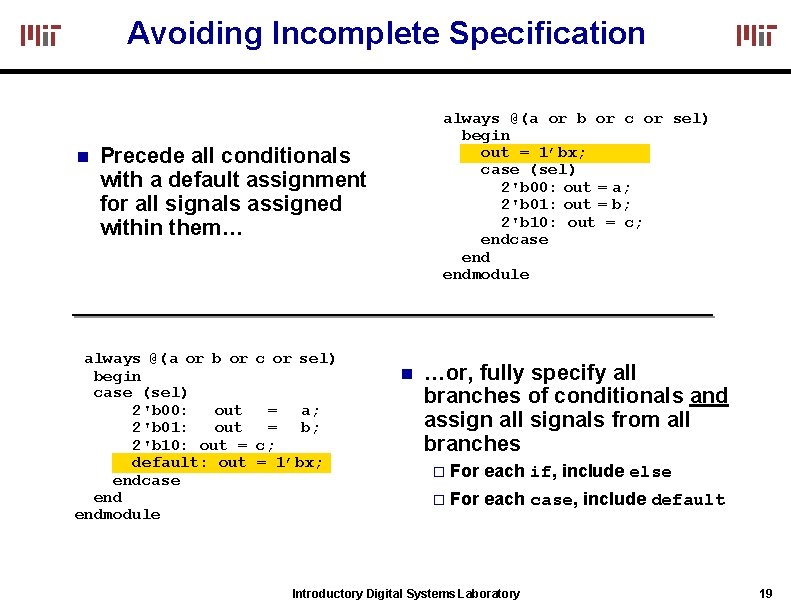
Avoiding Incomplete Specification always @(a or b or c or sel) begin out = 1’bx; case (sel) 2'b 00: out = a; 2'b 01: out = b; 2'b 10: out = c; endcase endmodule Precede all conditionals with a default assignment for all signals assigned within them… always @(a or b or c or sel) begin case (sel) 2'b 00: out = a; 2'b 01: out = b; 2'b 10: out = c; default: out = 1’bx; endcase endmodule …or, fully specify all branches of conditionals and assign all signals from all branches For each if, include else For each case, include default Introductory Digital Systems Laboratory 19
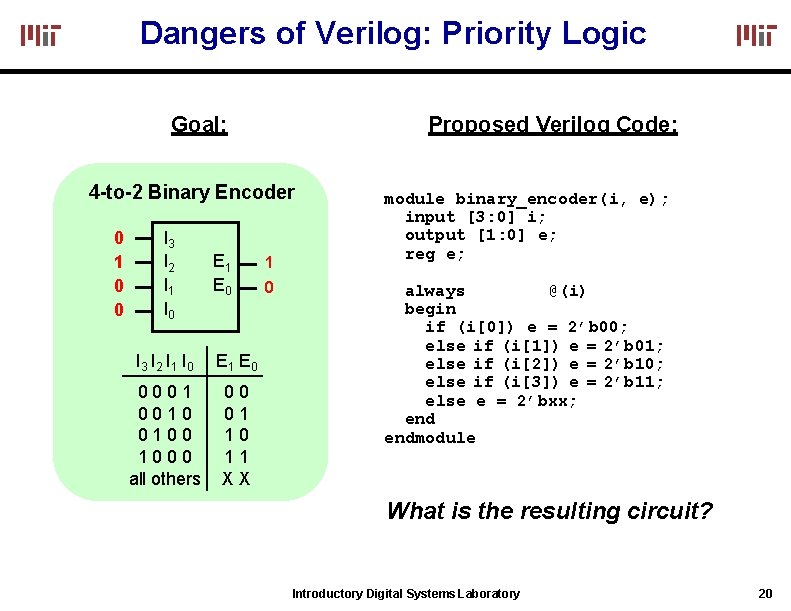
Dangers of Verilog: Priority Logic Goal: Proposed Verilog Code: 4 -to-2 Binary Encoder 0 1 0 0 I 3 I 2 I 1 I 0 E 1 E 0 0001 0010 0100 1000 all others 00 01 10 11 XX 1 0 module binary_encoder(i, e); input [3: 0] i; output [1: 0] e; reg e; always @(i) begin if (i[0]) e = 2’b 00; else if (i[1]) e = 2’b 01; else if (i[2]) e = 2’b 10; else if (i[3]) e = 2’b 11; else e = 2’bxx; endmodule What is the resulting circuit? Introductory Digital Systems Laboratory 20
![Priority Logic Code: if i[0] is 1, the result is 00 regardless of the](http://slidetodoc.com/presentation_image_h2/61499f58a54362db634027104fb3c27a/image-18.jpg "Priority Logic Code: if i[0] is 1, the result is 00 regardless of the")
Priority Logic Code: if i[0] is 1, the result is 00 regardless of the other inputs. i[0] takes the highest priority. Intent: if more than one input is 1, the result is a don’t-care. I 3 I 2 I 1 I 0 E 1 E 0 0001 0010 0100 1000 all others 00 01 10 11 XX Inferred Result: if (i[0]) e = 2’b 00; else if (i[1]) e = 2’b 01; else if (i[2]) e = 2’b 10; else if (i[3]) e = 2’b 11; else e = 2’bxx; end 2’b 11 1 2’bxx 0 i[3] 2’b 10 1 0 i[2] 2’b 01 1 0 i[1] 2’b 00 1 0 e[1: 0] i[0] if-else and case statements are interpreted very literally! Beware of unintended priority logic. Introductory Digital Systems Laboratory 21
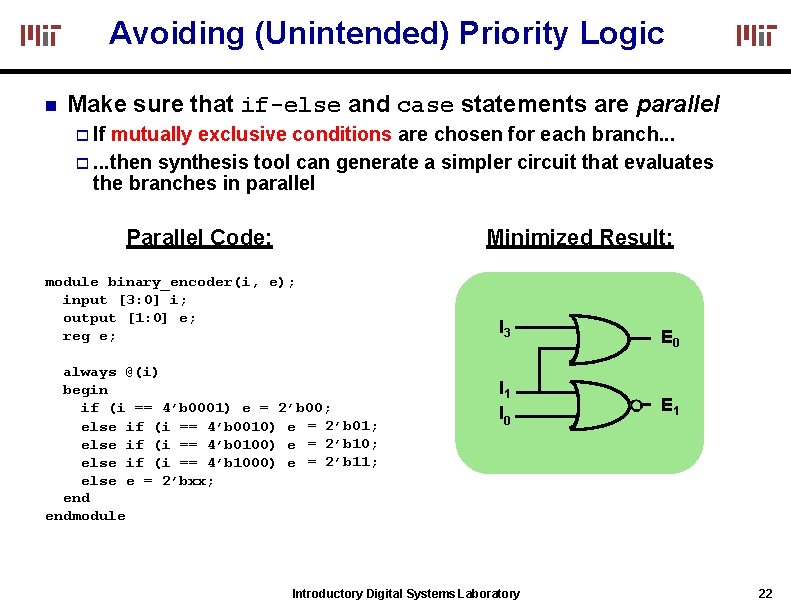
Avoiding (Unintended) Priority Logic Make sure that if-else and case statements are parallel If mutually exclusive conditions are chosen for each branch. . . . then synthesis tool can generate a simpler circuit that evaluates the branches in parallel Parallel Code: Minimized Result: module binary_encoder(i, e); input [3: 0] i; output [1: 0] e; reg e; always @(i) begin if (i == 4’b 0001) e = 2’b 00; else if (i == 4’b 0010) e = 2’b 01; else if (i == 4’b 0100) e = 2’b 10; else if (i == 4’b 1000) e = 2’b 11; else e = 2’bxx; endmodule I 3 I 1 I 0 Introductory Digital Systems Laboratory E 0 E 1 22
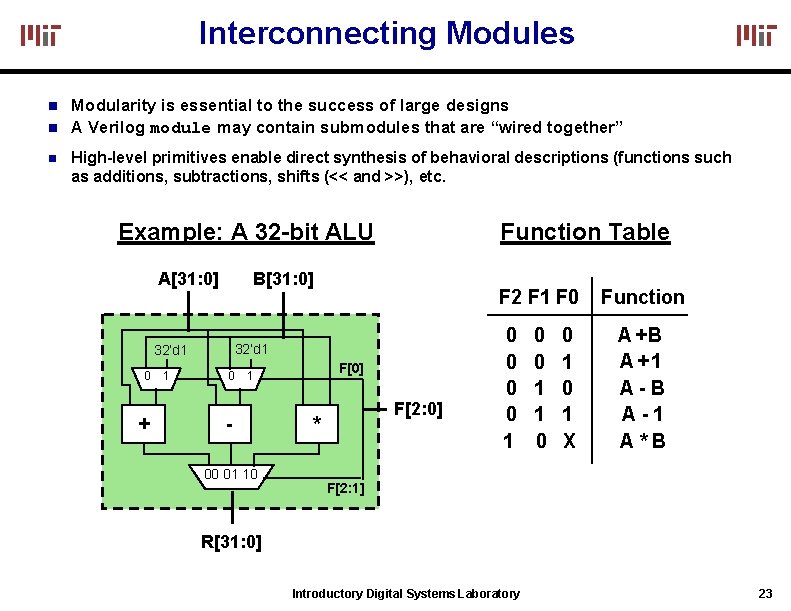
Interconnecting Modules Modularity is essential to the success of large designs A Verilog module may contain submodules that are “wired together” High-level primitives enable direct synthesis of behavioral descriptions (functions such as additions, subtractions, shifts (<< and >>), etc. Example: A 32 -bit ALU A[31: 0] B[31: 0] + 1 F 2 F 1 F 0 32’d 1 0 Function Table 0 F[0] 1 00 01 10 F[2: 0] * 0 0 1 0 1 X Function A +B A+1 A-B A-1 A*B F[2: 1] R[31: 0] Introductory Digital Systems Laboratory 23
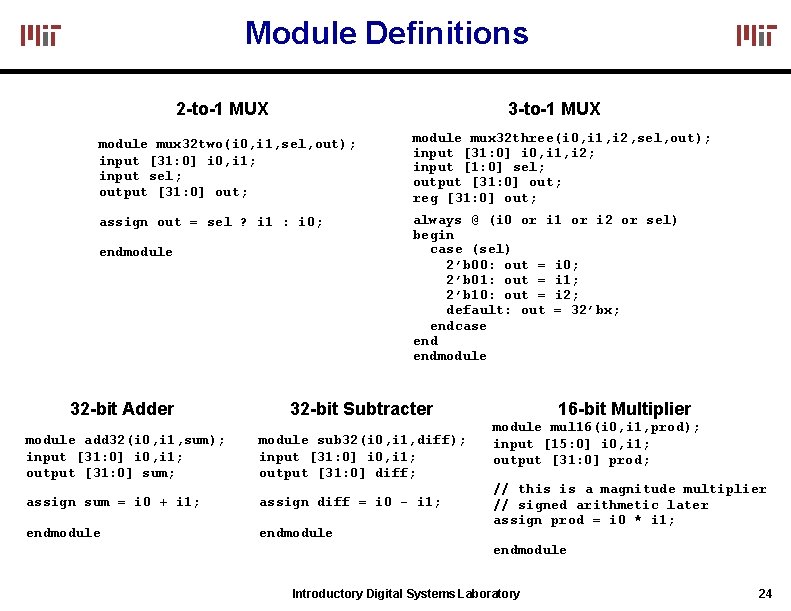
Module Definitions 3 -to-1 MUX 2 -to-1 MUX module mux 32 two(i 0, i 1, sel, out); input [31: 0] i 0, i 1; input sel; output [31: 0] out; module mux 32 three(i 0, i 1, i 2, sel, out); input [31: 0] i 0, i 1, i 2; input [1: 0] sel; output [31: 0] out; reg [31: 0] out; assign out = sel ? i 1 : i 0; always @ (i 0 or i 1 or i 2 or sel) begin case (sel) 2’b 00: out = i 0; 2’b 01: out = i 1; 2’b 10: out = i 2; default: out = 32’bx; endcase endmodule 32 -bit Adder 32 -bit Subtracter module add 32(i 0, i 1, sum); input [31: 0] i 0, i 1; output [31: 0] sum; module sub 32(i 0, i 1, diff); input [31: 0] i 0, i 1; output [31: 0] diff; assign sum = i 0 + i 1; assign diff = i 0 - i 1; endmodule 16 -bit Multiplier module mul 16(i 0, i 1, prod); input [15: 0] i 0, i 1; output [31: 0] prod; // this is a magnitude multiplier // signed arithmetic later assign prod = i 0 * i 1; endmodule Introductory Digital Systems Laboratory 24
![Top-Level ALU Declaration module module A[31: 0] Given submodules: mux 32 two(i 0, i](http://slidetodoc.com/presentation_image_h2/61499f58a54362db634027104fb3c27a/image-22.jpg "Top-Level ALU Declaration module module A[31: 0] Given submodules: mux 32 two(i 0, i")
Top-Level ALU Declaration module module A[31: 0] Given submodules: mux 32 two(i 0, i 1, sel, out); mux 32 three(i 0, i 1, i 2, sel, out); add 32(i 0, i 1, sum); sub 32(i 0, i 1, diff); mul 16(i 0, i 1, prod); Declaration of the ALU Module: 0 1 + 0 F[0] 1 00 01 10 F[2: 0] * F[2: 1] R[31: 0] wire [31: 0] addmux_out, submux_out; wire [31: 0] add_out, sub_out, mul_out; endmodule alu 32’d 1 module alu(a, b, f, r); input [31: 0] a, b; input [2: 0] f; output [31: 0] r; mux 32 two add 32 sub 32 mul 16 mux 32 three B[31: 0] intermediate output nodes adder_mux(b, 32'd 1, f[0], addmux_out); sub_mux(b, 32'd 1, f[0], submux_out); our_adder(a, addmux_out, add_out); our_subtracter(a, submux_out, sub_out); our_multiplier(a[15: 0], b[15: 0], mul_out); output_mux(add_out, sub_out, mul_out, f[2: 1], r); module names (unique) instance names corresponding wires/regs in module alu Introductory Digital Systems Laboratory 25
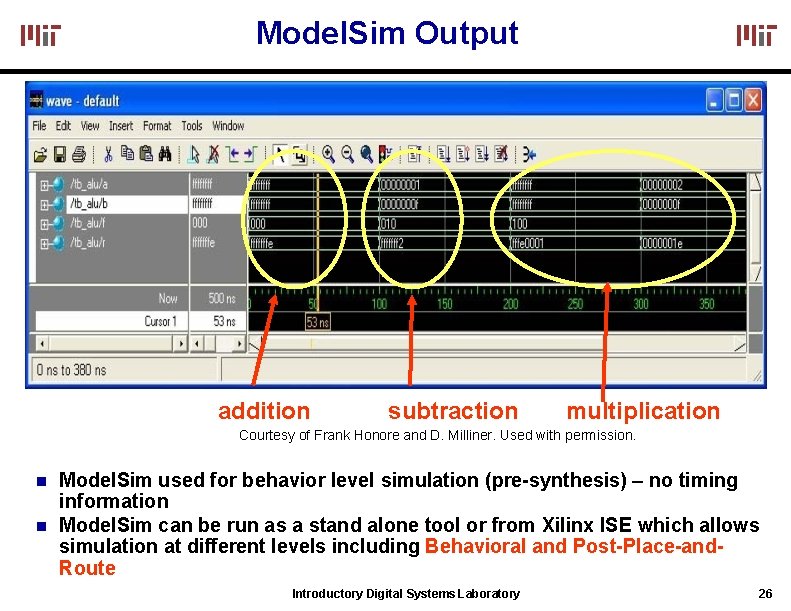
Model. Sim Output addition subtraction multiplication Courtesy of Frank Honore and D. Milliner. Used with permission. Model. Sim used for behavior level simulation (pre-synthesis) – no timing information Model. Sim can be run as a stand alone tool or from Xilinx ISE which allows simulation at different levels including Behavioral and Post-Place-and. Route Introductory Digital Systems Laboratory 26
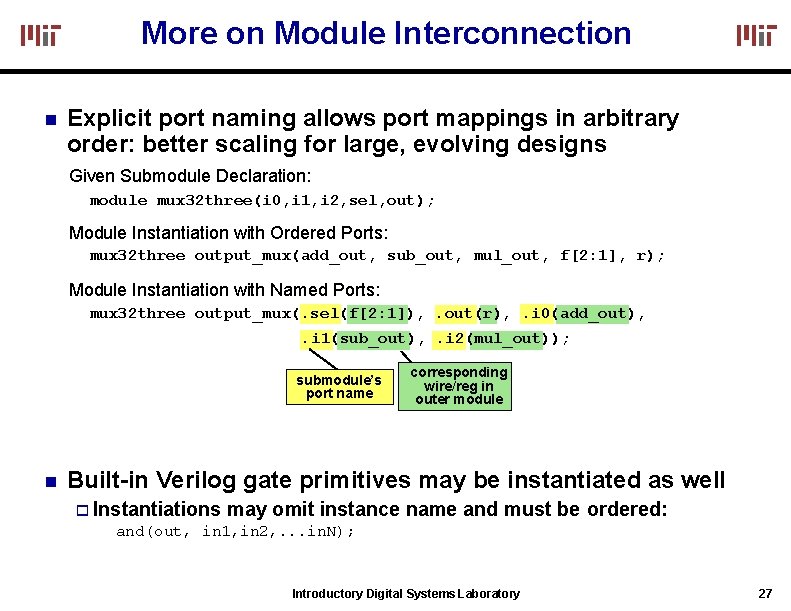
More on Module Interconnection Explicit port naming allows port mappings in arbitrary order: better scaling for large, evolving designs Given Submodule Declaration: module mux 32 three(i 0, i 1, i 2, sel, out); Module Instantiation with Ordered Ports: mux 32 three output_mux(add_out, sub_out, mul_out, f[2: 1], r); Module Instantiation with Named Ports: mux 32 three output_mux(. sel(f[2: 1]), . out(r), . i 0(add_out), . i 1(sub_out), . i 2(mul_out)); submodule’s port name corresponding wire/reg in outer module Built-in Verilog gate primitives may be instantiated as well Instantiations may omit instance name and must be ordered: and(out, in 1, in 2, . . . in. N); Introductory Digital Systems Laboratory 27
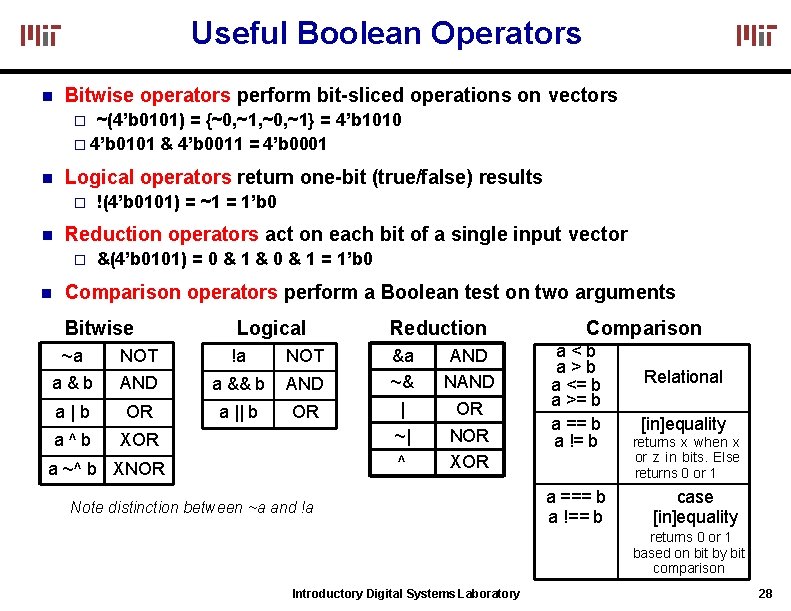
Useful Boolean Operators Bitwise operators perform bit-sliced operations on vectors ~(4’b 0101) = {~0, ~1, ~0, ~1} = 4’b 1010 4’b 0101 & 4’b 0011 = 4’b 0001 Logical operators return one-bit (true/false) results Reduction operators act on each bit of a single input vector !(4’b 0101) = ~1 = 1’b 0 &(4’b 0101) = 0 & 1 & 0 & 1 = 1’b 0 Comparison operators perform a Boolean test on two arguments Bitwise Logical ~a NOT !a NOT a&b AND a && b AND a|b OR a || b OR a^b XOR a ~^ b XNOR Reduction &a ~& | ~| ^ AND NAND OR NOR XOR Note distinction between ~a and !a Comparison a<b a>b a <= b a >= b a == b a != b a === b a !== b Relational [in]equality returns x when x or z in bits. Else returns 0 or 1 case [in]equality returns 0 or 1 based on bit by bit comparison Introductory Digital Systems Laboratory 28
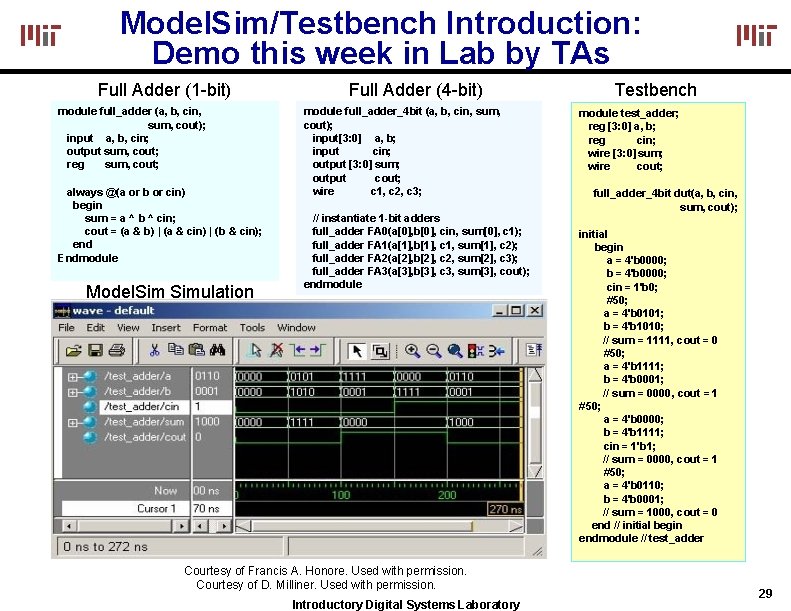
Model. Sim/Testbench Introduction: Demo this week in Lab by TAs Full Adder (1 -bit) module full_adder (a, b, cin, sum, cout); input a, b, cin; output sum, cout; reg sum, cout; always @(a or b or cin) begin sum = a ^ b ^ cin; cout = (a & b) | (a & cin) | (b & cin); end Endmodule Model. Simulation Full Adder (4 -bit) module full_adder_4 bit (a, b, cin, sum, cout); input[3: 0] a, b; input cin; output [3: 0] sum; output cout; wire c 1, c 2, c 3; // instantiate 1 -bit adders full_adder FA 0(a[0], b[0], cin, sum[0], c 1); full_adder FA 1(a[1], b[1], c 1, sum[1], c 2); full_adder FA 2(a[2], b[2], c 2, sum[2], c 3); full_adder FA 3(a[3], b[3], c 3, sum[3], cout); endmodule Courtesy of Francis A. Honore. Used with permission. Courtesy of D. Milliner. Used with permission. Introductory Digital Systems Laboratory Testbench module test_adder; reg [3: 0] a, b; reg cin; wire [3: 0] sum; wire cout; full_adder_4 bit dut(a, b, cin, sum, cout); initial begin a = 4'b 0000; b = 4'b 0000; cin = 1'b 0; #50; a = 4'b 0101; b = 4'b 1010; // sum = 1111, cout = 0 #50; a = 4'b 1111; b = 4'b 0001; // sum = 0000, cout = 1 #50; a = 4'b 0000; b = 4'b 1111; cin = 1'b 1; // sum = 0000, cout = 1 #50; a = 4'b 0110; b = 4'b 0001; // sum = 1000, cout = 0 end // initial begin endmodule // test_adder 29
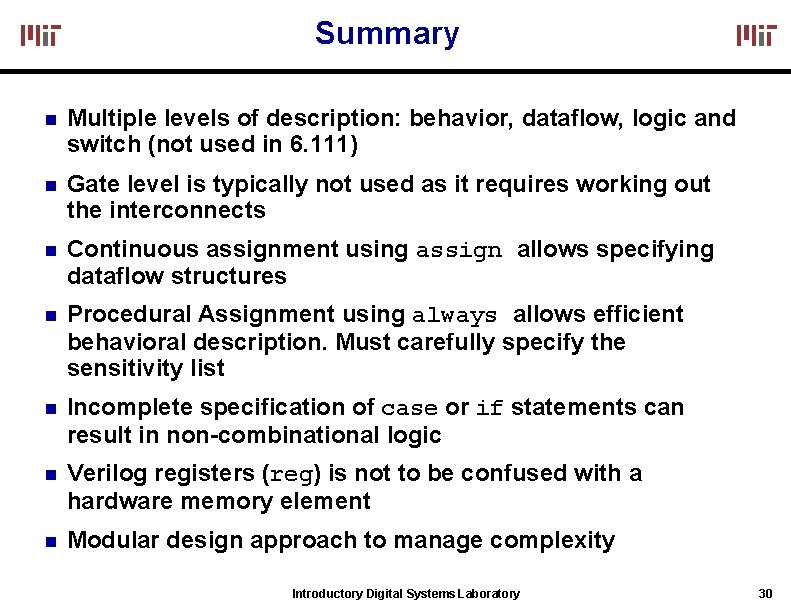
Summary Multiple levels of description: behavior, dataflow, logic and switch (not used in 6. 111) Gate level is typically not used as it requires working out the interconnects Continuous assignment using assign allows specifying dataflow structures Procedural Assignment using always allows efficient behavioral description. Must carefully specify the sensitivity list Incomplete specification of case or if statements can result in non-combinational logic Verilog registers (reg) is not to be confused with a hardware memory element Modular design approach to manage complexity Introductory Digital Systems Laboratory 30
- Slides: 27