
L 28 Course WrapUp CSE 351 Spring 2019
- Slides: 26
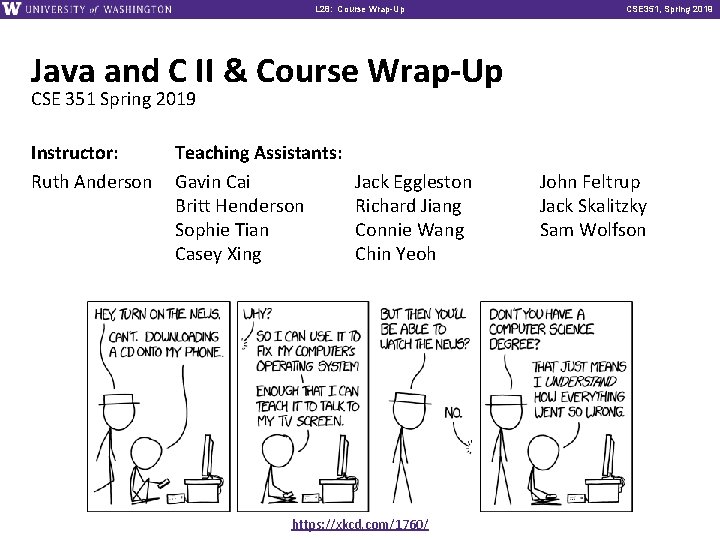
L 28: Course Wrap-Up CSE 351, Spring 2019 Java and C II & Course Wrap-Up CSE 351 Spring 2019 Instructor: Ruth Anderson Teaching Assistants: Gavin Cai Britt Henderson Sophie Tian Casey Xing Jack Eggleston Richard Jiang Connie Wang Chin Yeoh https: //xkcd. com/1760/ John Feltrup Jack Skalitzky Sam Wolfson
L 28: Course Wrap-Up CSE 351, Spring 2019 Administrivia v Lab 5, due TONIGHT, Friday (6/7) § Memory Allocation § Recommended that you watch the Lab 5 helper videos § Sunday 6/9 is last day Lab 5 may be submitted (if one late day is used) v v Final Exam: Wed, 6/12, 12: 30 -2: 20 pm in KNE 130 § Review session Tuesday June 11, 3 -6 pm in ECE 105 § Check course calendar for office hours for next week Course evaluations now open, please fill out! 2
L 28: Course Wrap-Up CSE 351, Spring 2019 Today v v Finish Java & C End-to-end Review § What happens after you write your source code? How code becomes a program • How your computer executes your code • v Review of high-level concepts & course themes § More useful for “ 5 years from now” than “next week’s final” 3
L 28: Course Wrap-Up CSE 351, Spring 2019 C: The Low-Level High-Level Language v C is a “hands-off” language that “exposes” more of hardware (especially memory) § Weakly-typed language that stresses data as bits • Anything can be represented with a number! § Unconstrained pointers can hold address of anything • And no bounds checking – buffer overflow possible! § Efficient by leaving everything up to the programmer
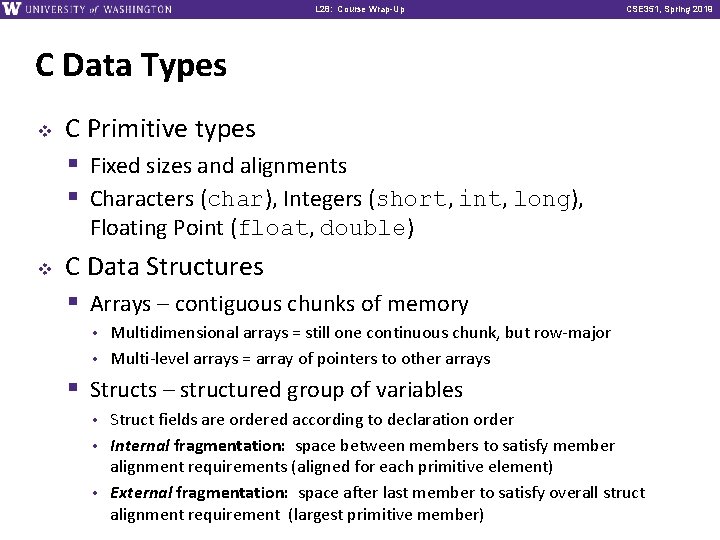
L 28: Course Wrap-Up CSE 351, Spring 2019 C Data Types v C Primitive types § Fixed sizes and alignments § Characters (char), Integers (short, int, long), Floating Point (float, double) v C Data Structures § Arrays – contiguous chunks of memory Multidimensional arrays = still one continuous chunk, but row-major • Multi-level arrays = array of pointers to other arrays • § Structs – structured group of variables Struct fields are ordered according to declaration order • Internal fragmentation: space between members to satisfy member alignment requirements (aligned for each primitive element) • External fragmentation: space after last member to satisfy overall struct alignment requirement (largest primitive member) •
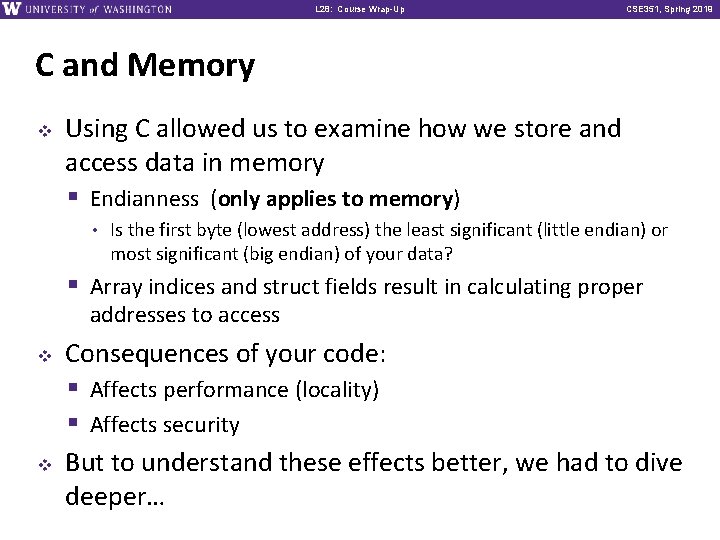
L 28: Course Wrap-Up CSE 351, Spring 2019 C and Memory v Using C allowed us to examine how we store and access data in memory § Endianness (only applies to memory) • Is the first byte (lowest address) the least significant (little endian) or most significant (big endian) of your data? § Array indices and struct fields result in calculating proper addresses to access v v Consequences of your code: § Affects performance (locality) § Affects security But to understand these effects better, we had to dive deeper…
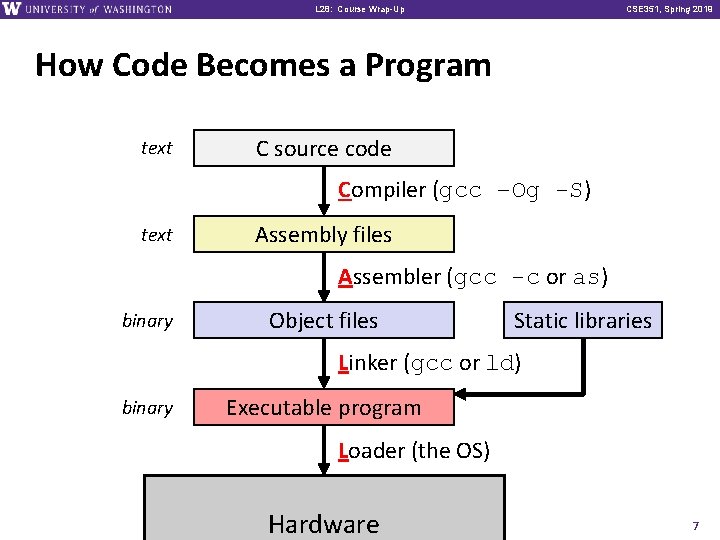
L 28: Course Wrap-Up CSE 351, Spring 2019 How Code Becomes a Program text C source code Compiler (gcc –Og -S) text Assembly files Assembler (gcc -c or as) binary Object files Static libraries Linker (gcc or ld) binary Executable program Loader (the OS) Hardware 7
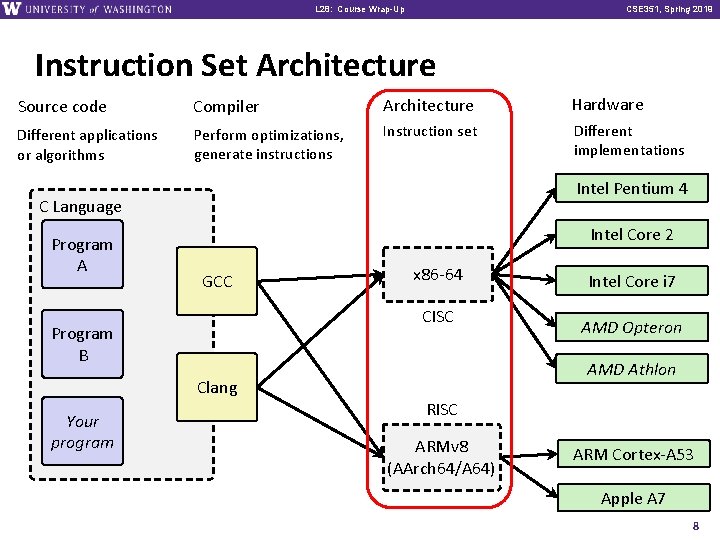
L 28: Course Wrap-Up CSE 351, Spring 2019 Instruction Set Architecture Source code Compiler Architecture Hardware Different applications or algorithms Perform optimizations, generate instructions Instruction set Different implementations Intel Pentium 4 C Language Program A Intel Core 2 GCC CISC Program B Clang Your program x 86 -64 Intel Core i 7 AMD Opteron AMD Athlon RISC ARMv 8 (AArch 64/A 64) ARM Cortex-A 53 Apple A 7 8
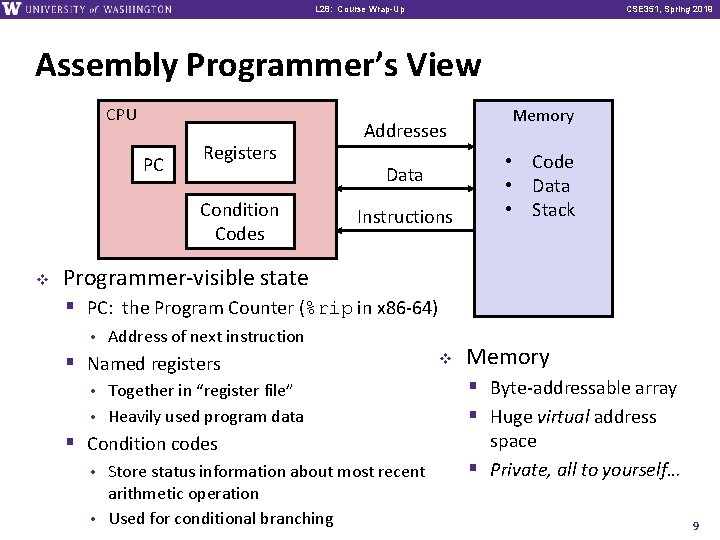
L 28: Course Wrap-Up CSE 351, Spring 2019 Assembly Programmer’s View CPU PC Registers Condition Codes v Addresses Data Instructions Memory • Code • Data • Stack Programmer-visible state § PC: the Program Counter (%rip in x 86 -64) • Address of next instruction § Named registers Together in “register file” • Heavily used program data • § Condition codes Store status information about most recent arithmetic operation • Used for conditional branching • v Memory § Byte-addressable array § Huge virtual address space § Private, all to yourself… 9
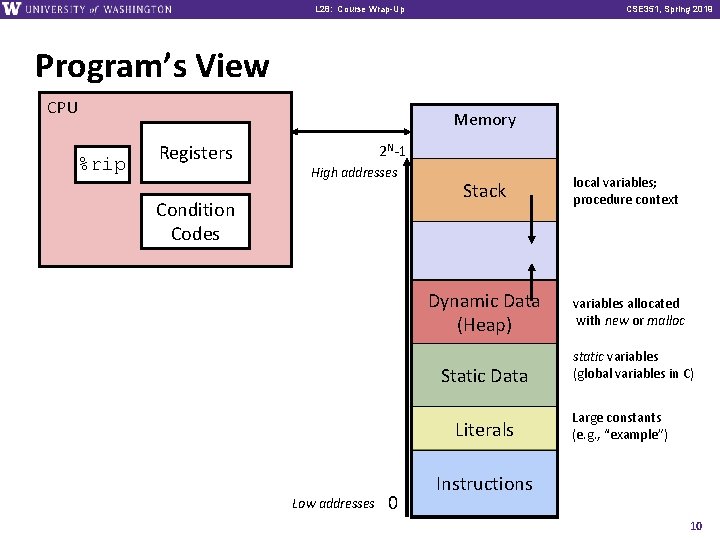
L 28: Course Wrap-Up CSE 351, Spring 2019 Program’s View CPU Memory %rip Registers 2 N-1 High addresses Condition Codes Stack local variables; procedure context Dynamic Data (Heap) variables allocated with new or malloc Static Data Literals Low addresses 0 static variables (global variables in C) Large constants (e. g. , “example”) Instructions 10
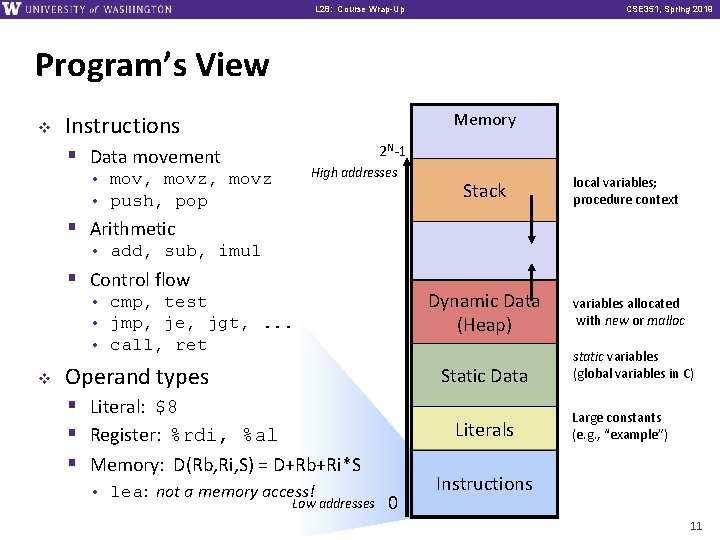
L 28: Course Wrap-Up CSE 351, Spring 2019 Program’s View v Memory Instructions 2 N-1 § Data movement • • High addresses mov, movz push, pop Stack local variables; procedure context Dynamic Data (Heap) variables allocated with new or malloc § Arithmetic • add, sub, imul § Control flow • • • v cmp, test jmp, je, jgt, . . . call, ret Operand types Static Data § Literal: $8 § Register: %rdi, %al § Memory: D(Rb, Ri, S) = D+Rb+Ri*S • lea: not a memory access! Low addresses Literals 0 static variables (global variables in C) Large constants (e. g. , “example”) Instructions 11
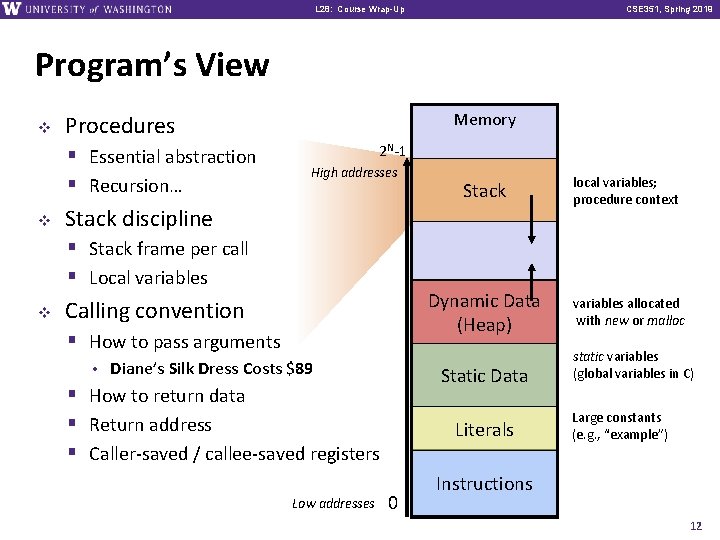
L 28: Course Wrap-Up CSE 351, Spring 2019 Program’s View v § Essential abstraction § Recursion… v Memory Procedures 2 N-1 High addresses Stack discipline § Stack frame per call § Local variables v Calling convention § How to pass arguments • Diane’s Silk Dress Costs $89 local variables; procedure context Dynamic Data (Heap) variables allocated with new or malloc Static Data § How to return data § Return address § Caller-saved / callee-saved registers Low addresses Stack Literals 0 static variables (global variables in C) Large constants (e. g. , “example”) Instructions 12
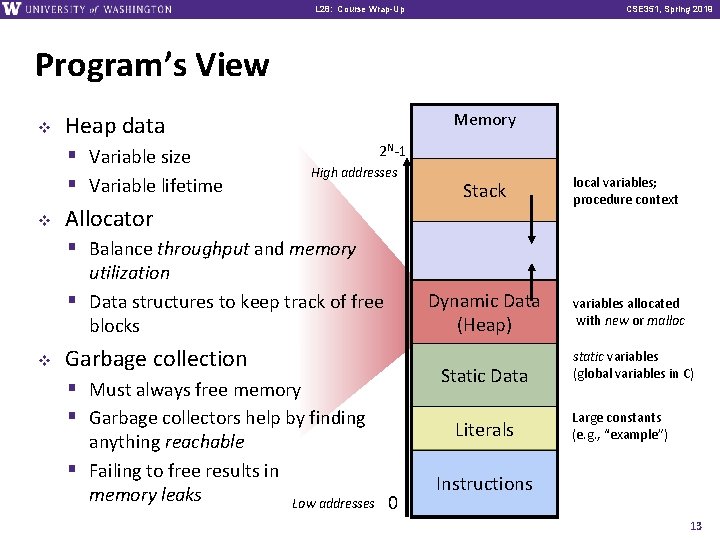
L 28: Course Wrap-Up CSE 351, Spring 2019 Program’s View v § Variable size § Variable lifetime v Memory Heap data 2 N-1 High addresses Allocator Stack local variables; procedure context Dynamic Data (Heap) variables allocated with new or malloc § Balance throughput and memory utilization § Data structures to keep track of free blocks v Garbage collection Static Data § Must always free memory § Garbage collectors help by finding anything reachable § Failing to free results in memory leaks Low addresses Literals 0 static variables (global variables in C) Large constants (e. g. , “example”) Instructions 13
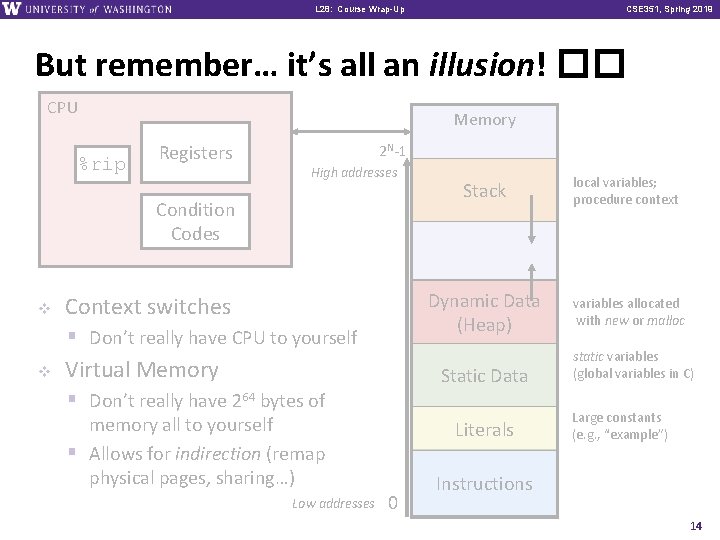
L 28: Course Wrap-Up CSE 351, Spring 2019 But remember… it’s all an illusion! �� CPU Memory %rip Registers 2 N-1 High addresses Condition Codes v Context switches § Don’t really have CPU to yourself v Virtual Memory local variables; procedure context Dynamic Data (Heap) variables allocated with new or malloc Static Data § Don’t really have 264 bytes of memory all to yourself § Allows for indirection (remap physical pages, sharing…) Low addresses Stack Literals 0 static variables (global variables in C) Large constants (e. g. , “example”) Instructions 14
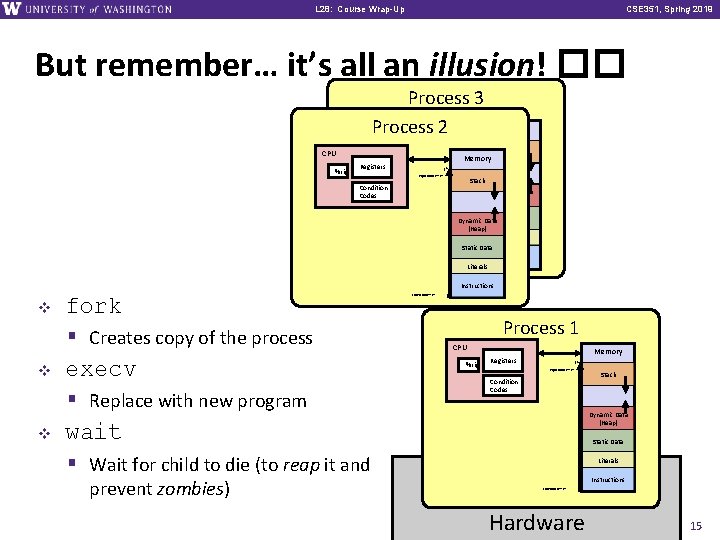
L 28: Course Wrap-Up CSE 351, Spring 2019 But remember… it’s all an illusion! �� Process 3 Process 2 CPU %rip Registers Memory 2 N-1 High addresses Condition Codes Stack Memory 2 N-1 High addresses Stack Condition Codes Dynamic Data (Heap) Dynamic Data Static Data (Heap) Literals Static Data Instructions Low addresses Literals 0 Instructions v fork § Creates copy of the process v execv § Replace with new program v Low addresses 0 Process 1 CPU %rip Memory Registers 2 N-1 High addresses Stack Condition Codes Dynamic Data (Heap) wait Static Data § Wait for child to die (to reap it and prevent zombies) Literals Instructions Low addresses 0 Hardware 15
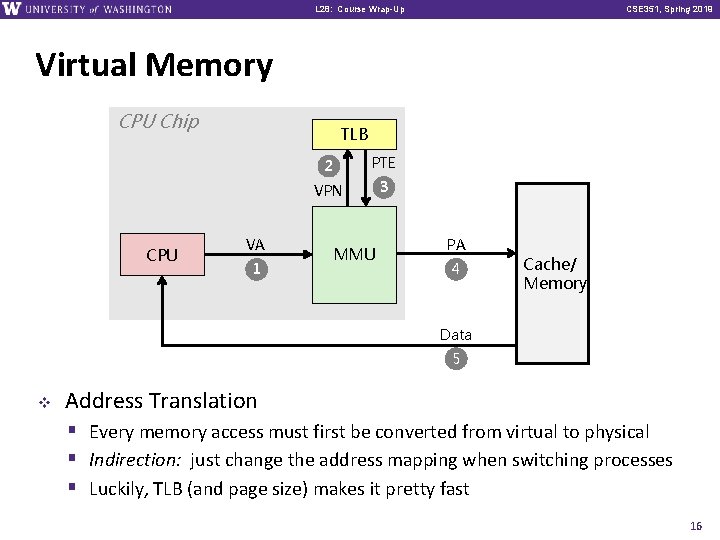
L 28: Course Wrap-Up CSE 351, Spring 2019 Virtual Memory CPU Chip CPU TLB VA 1 2 PTE VPN 3 MMU PA 4 Cache/ Memory Data 5 v Address Translation § Every memory access must first be converted from virtual to physical § Indirection: just change the address mapping when switching processes § Luckily, TLB (and page size) makes it pretty fast 16
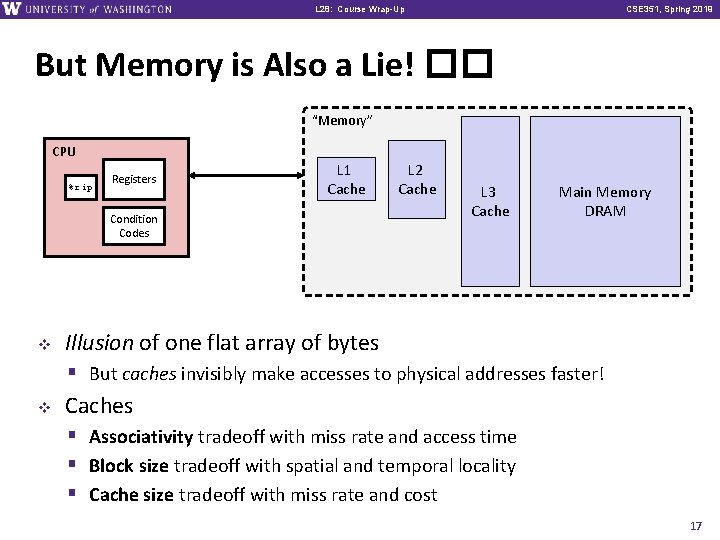
L 28: Course Wrap-Up CSE 351, Spring 2019 But Memory is Also a Lie! �� “Memory” CPU %rip Registers L 1 Cache Condition Codes v L 2 Cache L 3 Cache Main Memory DRAM Illusion of one flat array of bytes § But caches invisibly make accesses to physical addresses faster! v Caches § Associativity tradeoff with miss rate and access time § Block size tradeoff with spatial and temporal locality § Cache size tradeoff with miss rate and cost 17
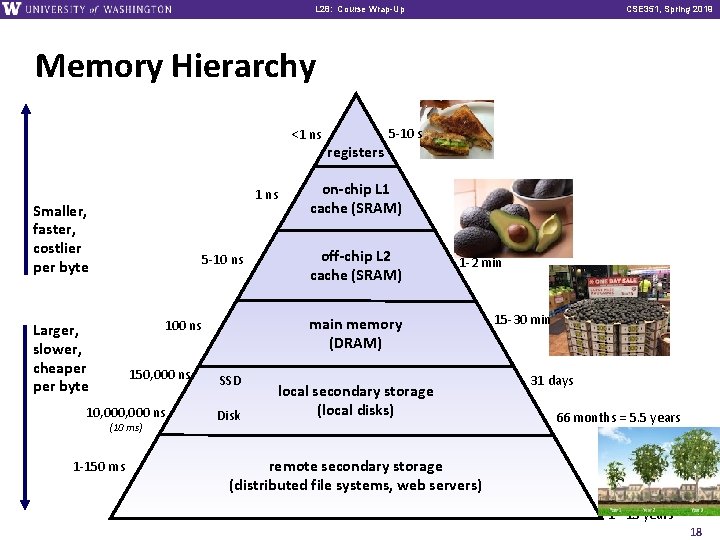
L 28: Course Wrap-Up CSE 351, Spring 2019 Memory Hierarchy <1 ns Smaller, faster, costlier per byte 5 -10 ns 150, 000 ns 10, 000 ns (10 ms) 1 -150 ms on-chip L 1 cache (SRAM) off-chip L 2 cache (SRAM) 1 -2 min main memory (DRAM) 100 ns Larger, slower, cheaper byte registers 5 -10 s SSD Disk local secondary storage (local disks) 15 -30 min 31 days 66 months = 5. 5 years remote secondary storage (distributed file systems, web servers) 1 - 15 years 18
L 28: Course Wrap-Up Review of Course Themes v Review course goals § They should make much more sense now! CSE 351, Spring 2019
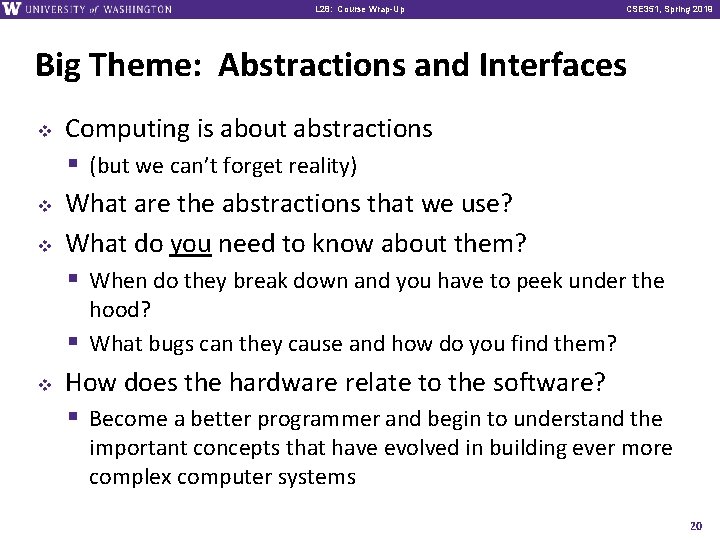
L 28: Course Wrap-Up CSE 351, Spring 2019 Big Theme: Abstractions and Interfaces v v v Computing is about abstractions § (but we can’t forget reality) What are the abstractions that we use? What do you need to know about them? § When do they break down and you have to peek under the hood? § What bugs can they cause and how do you find them? v How does the hardware relate to the software? § Become a better programmer and begin to understand the important concepts that have evolved in building ever more complex computer systems 20
L 28: Course Wrap-Up CSE 351, Spring 2019 Little Theme 1: Representation v All digital systems represent everything as 0 s and 1 s § The 0 and 1 are really two different voltage ranges in the wires § Or magnetic positions on a disc, or hole depths on a DVD, or even DNA… v “Everything” includes: § § v Numbers – integers and floating point Characters – the building blocks of strings Instructions – the directives to the CPU that make up a program Pointers – addresses of data objects stored away in memory Encodings are stored throughout a computer system § In registers, caches, memories, disks, etc. v They all need addresses (a way to locate) § Find a new place to put a new item § Reclaim the place in memory when data no longer needed 21
L 28: Course Wrap-Up CSE 351, Spring 2019 Little Theme 2: Translation v v There is a big gap between how we think about programs and data and the 0 s and 1 s of computers § Need languages to describe what we mean § These languages need to be translated one level at a time We know Java as a programming language § Have to work our way down to the 0 s and 1 s of computers § Try not to lose anything in translation! § We encountered C language, assembly language, and machine code (for the x 86 family of CPU architectures) 22
L 28: Course Wrap-Up CSE 351, Spring 2019 Little Theme 3: Control Flow v v How do computers orchestrate everything they are doing? Within one program: § How do we implement if/else, loops, switches? § What do we have to keep track of when we call a procedure, and then another, and so on? § How do we know what to do upon “return”? v Across programs and operating systems: § Multiple user programs § Operating system has to orchestrate them all Each gets a share of computing cycles • They may need to share system resources (memory, I/O, disks) § Yielding and taking control of the processor • Voluntary or “by force”? • 23
L 28: Course Wrap-Up CSE 351, Spring 2019 Course Perspective v CSE 351 will make you a better programmer § Purpose is to show software really works § Understanding the underlying system makes you more effective Better debugging • Better basis for evaluating performance • How multiple activities work in concert (e. g. , OS and user programs) § Not just a course for hardware enthusiasts! • What every CSE major needs to know (plus many more details) • See many patterns that come up over and over in computing (like caching and indirection) § “Stuff everybody learns and uses and forgets not knowing” • v CSE 351 presents a world-view that will empower you § The intellectual and software tools to understand the trillions+ of 1 s and 0 s that are “flying around” when your program runs 24
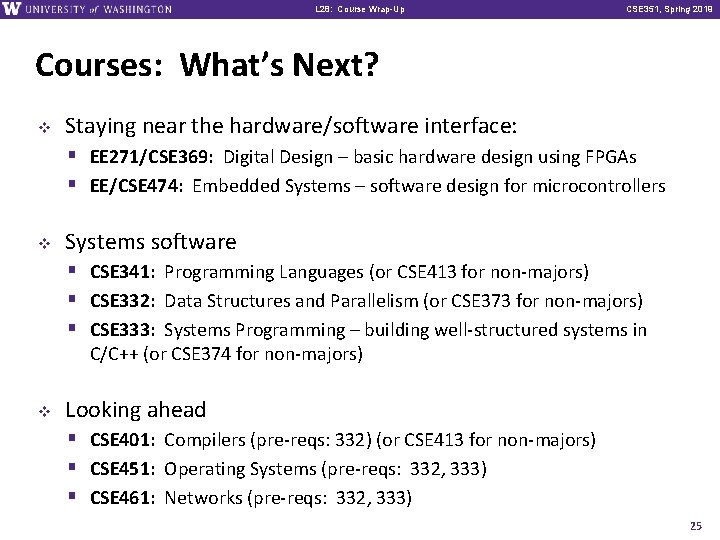
L 28: Course Wrap-Up CSE 351, Spring 2019 Courses: What’s Next? v Staying near the hardware/software interface: § EE 271/CSE 369: Digital Design – basic hardware design using FPGAs § EE/CSE 474: Embedded Systems – software design for microcontrollers v Systems software § CSE 341: Programming Languages (or CSE 413 for non-majors) § CSE 332: Data Structures and Parallelism (or CSE 373 for non-majors) § CSE 333: Systems Programming – building well-structured systems in C/C++ (or CSE 374 for non-majors) v Looking ahead § CSE 401: Compilers (pre-reqs: 332) (or CSE 413 for non-majors) § CSE 451: Operating Systems (pre-reqs: 332, 333) § CSE 461: Networks (pre-reqs: 332, 333) 25
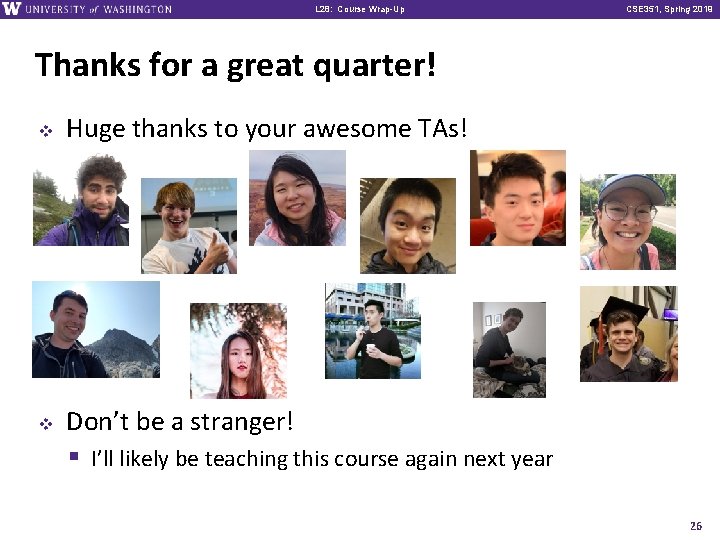
L 28: Course Wrap-Up CSE 351, Spring 2019 Thanks for a great quarter! v v Huge thanks to your awesome TAs! Don’t be a stranger! § I’ll likely be teaching this course again next year 26