
L 20 Thermodynamics 5 heat work and internal
![L 20 Thermodynamics [5] • • • heat, work, and internal energy the 1](https://slidetodoc.com/presentation_image_h/038c8a00041422ef78a33bd2b2d0bef6/image-1.jpg "L 20 Thermodynamics [5] • • • heat, work, and internal energy the 1")
- Slides: 22
L 20 Thermodynamics [5] • • • heat, work, and internal energy the 1 st law of thermodynamics the 2 nd law of thermodynamics Heat engines order to disorder entropy Electric cars and Hybrid cars
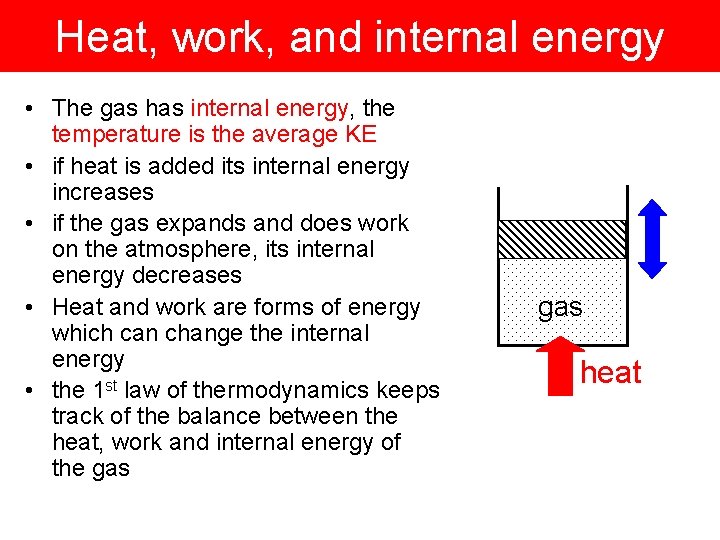
Heat, work, and internal energy • The gas has internal energy, the temperature is the average KE • if heat is added its internal energy increases • if the gas expands and does work on the atmosphere, its internal energy decreases • Heat and work are forms of energy which can change the internal energy • the 1 st law of thermodynamics keeps track of the balance between the heat, work and internal energy of the gas heat
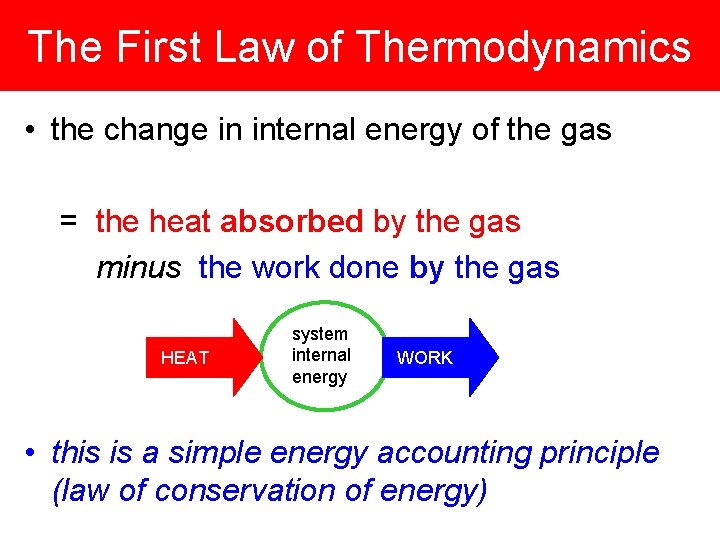
The First Law of Thermodynamics • the change in internal energy of the gas = the heat absorbed by the gas minus the work done by the gas HEAT system internal energy WORK • this is a simple energy accounting principle (law of conservation of energy)
work done by or on a gas • if a gas does work (expansion) its internal energy goes down and so does its temp. • if work is done on a gas (compression) its internal energy goes up and so does its temperature • the internal energy of a gas can be changed by adding or taking away heat or by having the gas do work or doing work on the gas
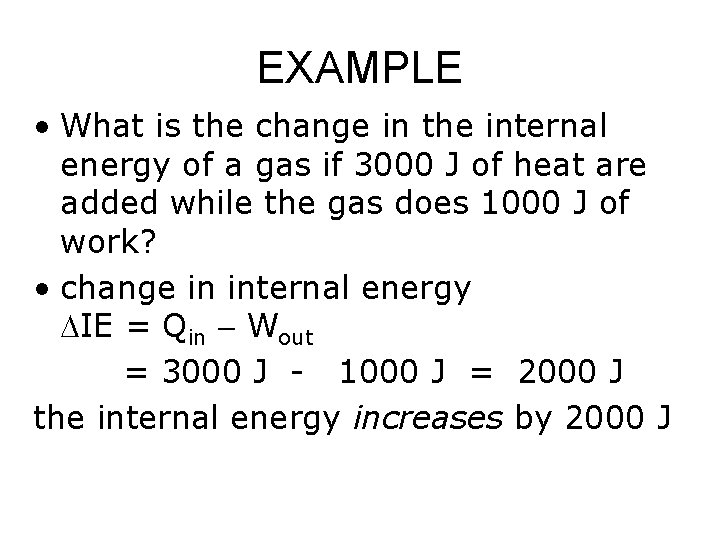
EXAMPLE • What is the change in the internal energy of a gas if 3000 J of heat are added while the gas does 1000 J of work? • change in internal energy DIE = Qin Wout = 3000 J - 1000 J = 2000 J the internal energy increases by 2000 J
Meteorology and the 1 st Law • Air temperature rises as heat is added • Air temperature rises (or falls) as pressure increases (decreases) • In processes called adiabatic the amount of heat added or lost is very small • As a parcel of air rises it expands adiabatically and its temperature decreases by about 10 C for each kilometer of elevation
Heat engines • A heat engine is a device that uses heat (input, which you must pay for) to do work (output, which is useful). • The central issue is how much of the heat taken in can be converted into work • This is quantified by the engine efficiency • The amount of heat that can be converted to work is limited by the 1 st law you can’t get more out than goes in
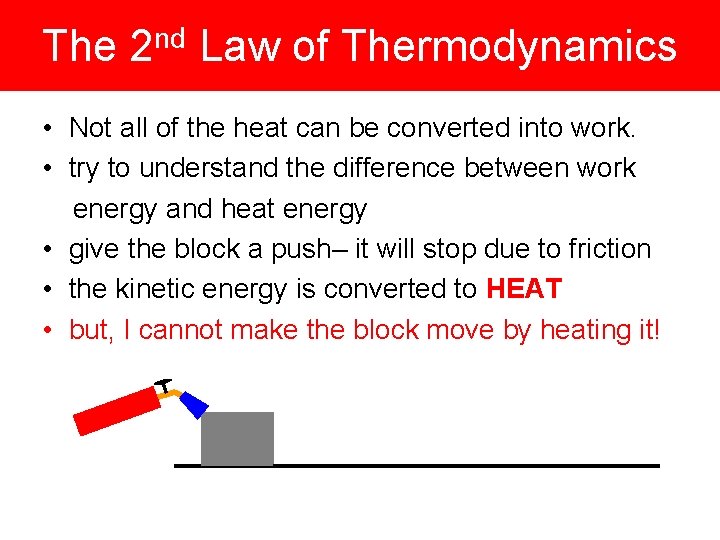
The 2 nd Law of Thermodynamics • Not all of the heat can be converted into work. • try to understand the difference between work energy and heat energy • give the block a push– it will stop due to friction • the kinetic energy is converted to HEAT • but, I cannot make the block move by heating it!
Heat – disordered energy • When an object is heated, the energy of all of its molecules is increased. • however, the molecules do not all move in the same direction they move about in all directions this is what we mean by disordered (or thermal) energy • on the other hand, if we want to get the system to do some useful work, we want it to move in some particular direction
order to disorder • All naturally occurring processes go in the direction from order to disorder • ice melts when placed in water; it never gets colder and the water gets warmer • ice, the solid state of H 2 O is more ordered than water, the liquid state • in a solid all the molecules are lined up in a regular (ordered) array; there is less order in the liquid state, and even less in the gaseous state • when salt is put in water it dissociates; crystals of salt never spontaneously form in a salt water solution
Work is ordered energy, heat is disordered energy • It is possible to convert some of the random energy to do useful work • when a gas is allowed to expand, some of its random thermal energy is converted into work • the 2 nd law explicitly prohibits all of the heat from being converted into work • this is a fact of nature the way things are!
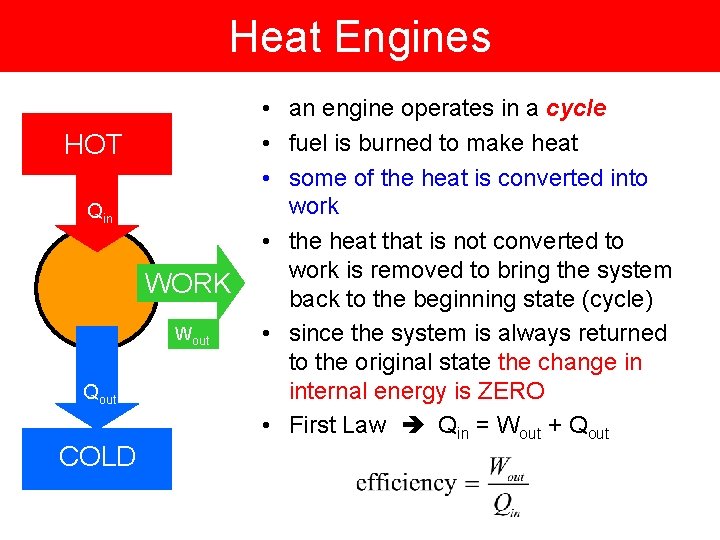
Heat Engines HOT Qin WORK Wout Qout COLD • an engine operates in a cycle • fuel is burned to make heat • some of the heat is converted into work • the heat that is not converted to work is removed to bring the system back to the beginning state (cycle) • since the system is always returned to the original state the change in internal energy is ZERO • First Law Qin = Wout + Qout
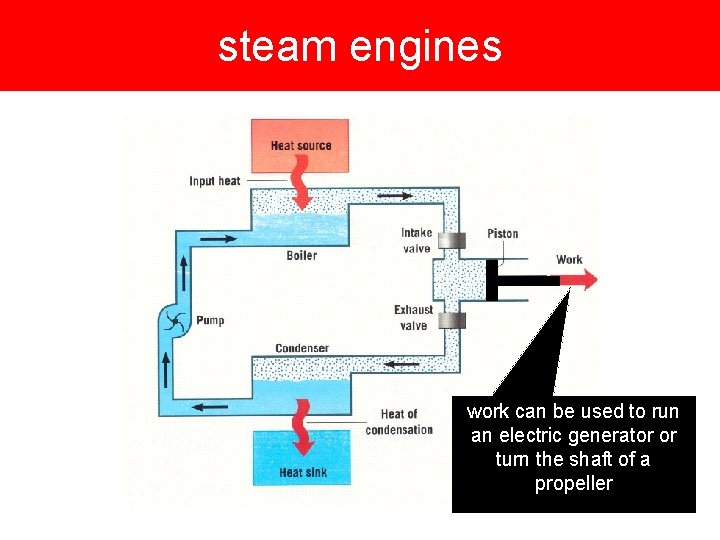
steam engines work can be used to run an electric generator or turn the shaft of a propeller
1 st and 2 nd Laws of Thermodynamics • For an engine operating in a cycle the 1 st law requires that: work out = heat in – heat out • the 2 nd law says that it is impossible to make the heat out (Qout) = 0 not all the heat energy can be converted into work, some must be discarded – thermal waste • engine efficiency = work out / heat in • no engine can be 100% efficient this is a law of nature!
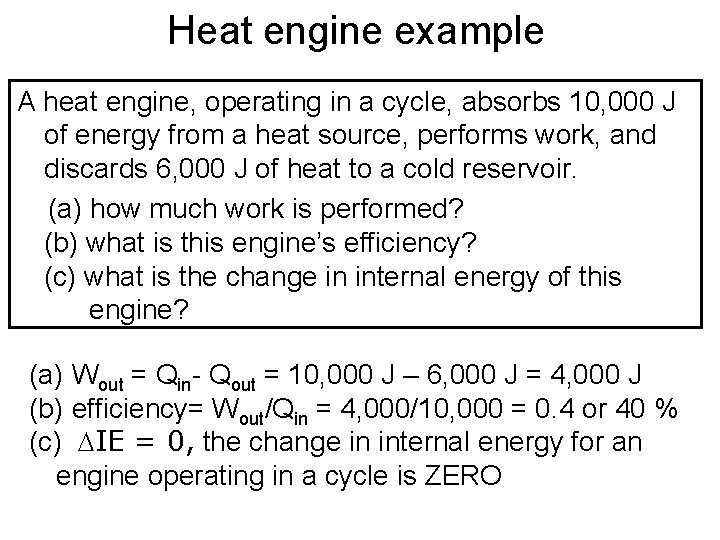
Heat engine example A heat engine, operating in a cycle, absorbs 10, 000 J of energy from a heat source, performs work, and discards 6, 000 J of heat to a cold reservoir. (a) how much work is performed? (b) what is this engine’s efficiency? (c) what is the change in internal energy of this engine? (a) Wout = Qin- Qout = 10, 000 J – 6, 000 J = 4, 000 J (b) efficiency= Wout/Qin = 4, 000/10, 000 = 0. 4 or 40 % (c) DIE = 0, the change in internal energy for an engine operating in a cycle is ZERO
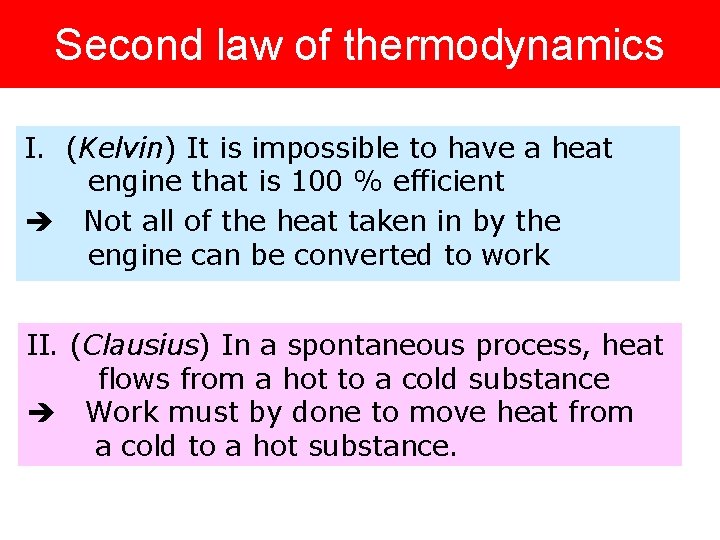
Second law of thermodynamics I. (Kelvin) It is impossible to have a heat engine that is 100 % efficient Not all of the heat taken in by the engine can be converted to work II. (Clausius) In a spontaneous process, heat flows from a hot to a cold substance Work must by done to move heat from a cold to a hot substance.
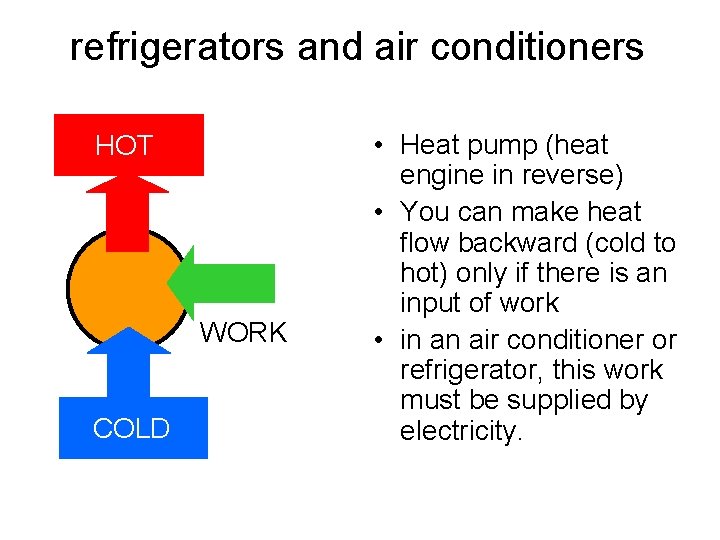
refrigerators and air conditioners HOT WORK COLD • Heat pump (heat engine in reverse) • You can make heat flow backward (cold to hot) only if there is an input of work • in an air conditioner or refrigerator, this work must be supplied by electricity.
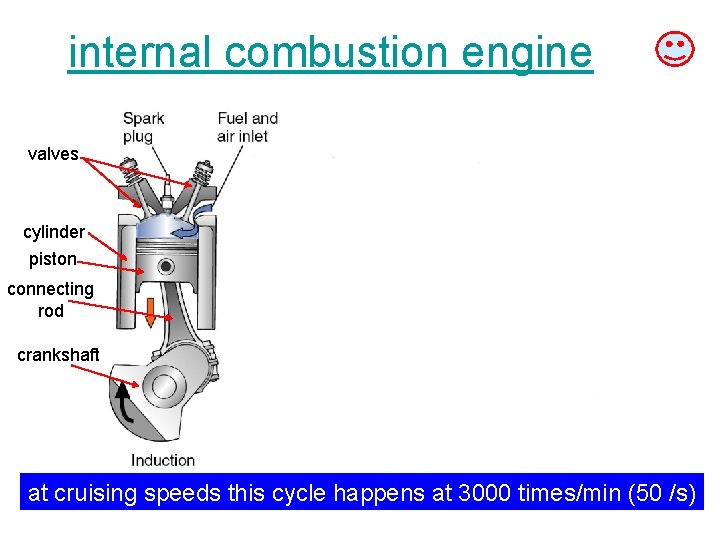
internal combustion engine valves cylinder piston connecting rod crankshaft at cruising speeds this cycle happens at 3000 times/min (50 /s)
Electric cars • Propelled by a battery-powered electric motor – does not need gasoline • No tailpipe emissions – reduces urban pollution and greenhouse gases • Batteries must be charged, but electric power is provided by domestic fuel sources • Chevy Volt – charged on $1. 50/day • Range limited by battery charge • Poor acceleration • expensive
Hybrid Automobiles Combination of 2 different systems • • A hybrid car propels itself on fuel or batteries It combines electrical and mechanical power It switches easily between fuel, batteries, or both It can recharge its batteries during braking. In a conventional auto, much of the kinetic energy is dissipated as heat during braking. • It can turn its engine off when not needed • It can restart its engine quickly and easily • Excellent fuel economy up to 50 mpg (Toyota Prius)
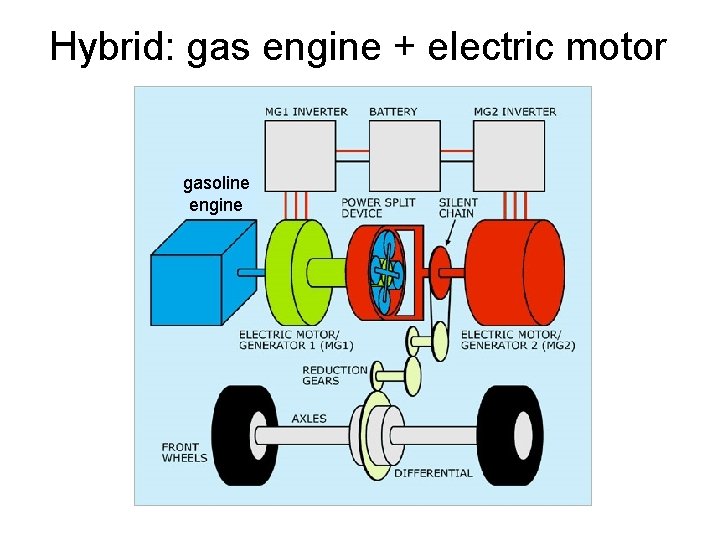
Hybrid: gas engine + electric motor gasoline engine
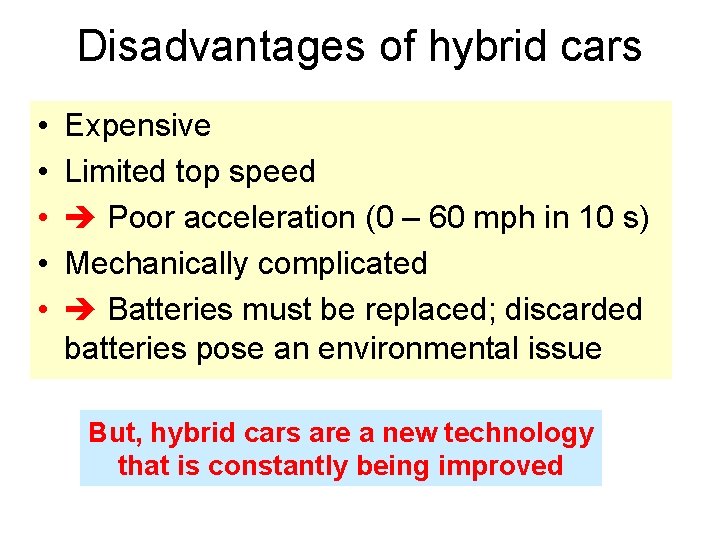
Disadvantages of hybrid cars • • • Expensive Limited top speed Poor acceleration (0 – 60 mph in 10 s) Mechanically complicated Batteries must be replaced; discarded batteries pose an environmental issue But, hybrid cars are a new technology that is constantly being improved