
L 14 Permutations Combinations and Some Review EECS

L 14: Permutations, Combinations and Some Review EECS 203: Discrete Mathematics
Last time we did a number of things • Looked at the sum, product, subtraction and division rules. – Don’t need to know by name. • Spent a while on the Pigeonhole Principle – Including the generalized version. – Worked a few complex examples. • They were tricky! • Started on Combinations and Permutations.
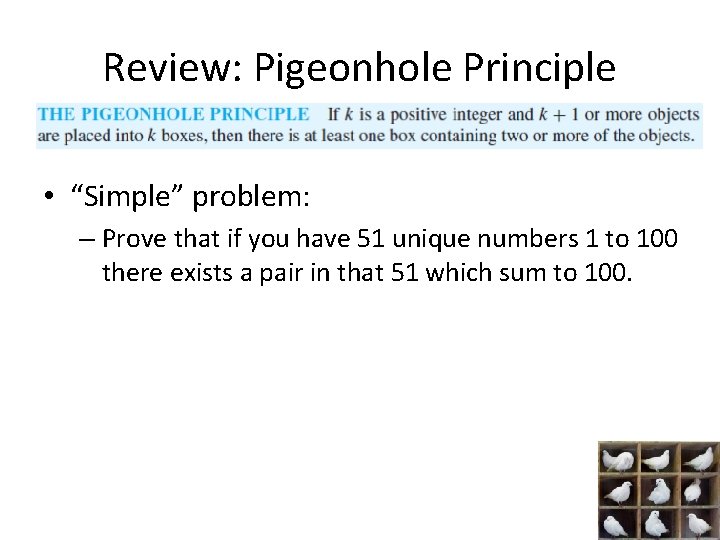
Review: Pigeonhole Principle • “Simple” problem: – Prove that if you have 51 unique numbers 1 to 100 there exists a pair in that 51 which sum to 100.
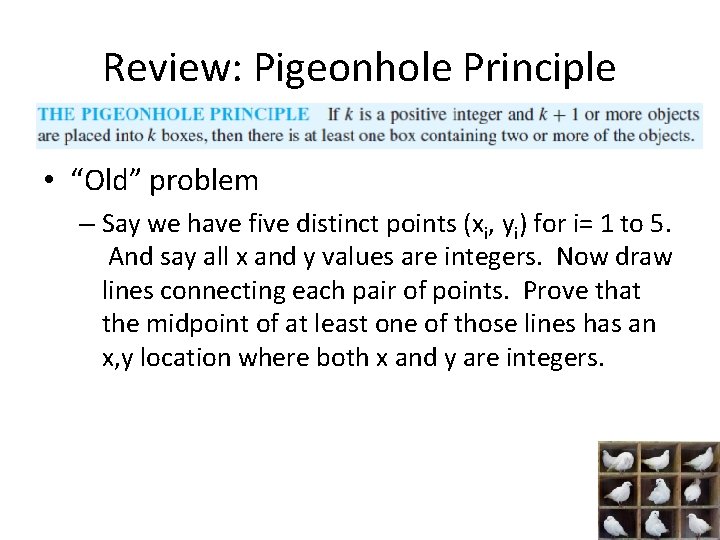
Review: Pigeonhole Principle • “Old” problem – Say we have five distinct points (xi, yi) for i= 1 to 5. And say all x and y values are integers. Now draw lines connecting each pair of points. Prove that the midpoint of at least one of those lines has an x, y location where both x and y are integers.
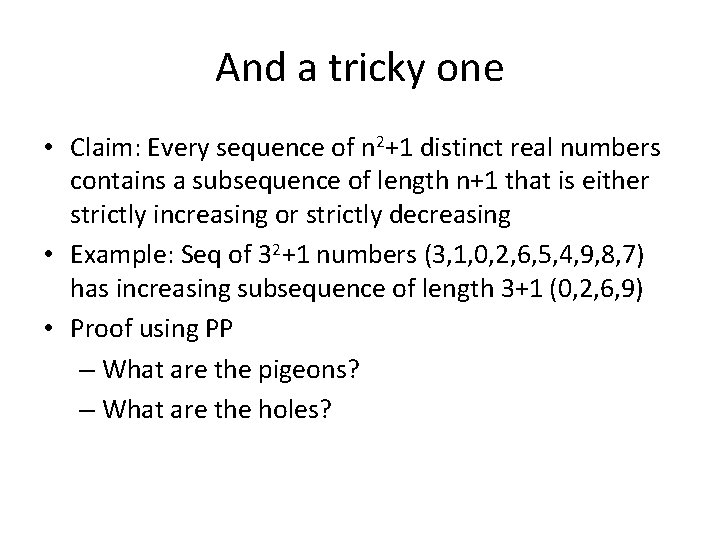
And a tricky one • Claim: Every sequence of n 2+1 distinct real numbers contains a subsequence of length n+1 that is either strictly increasing or strictly decreasing • Example: Seq of 32+1 numbers (3, 1, 0, 2, 6, 5, 4, 9, 8, 7) has increasing subsequence of length 3+1 (0, 2, 6, 9) • Proof using PP – What are the pigeons? – What are the holes?
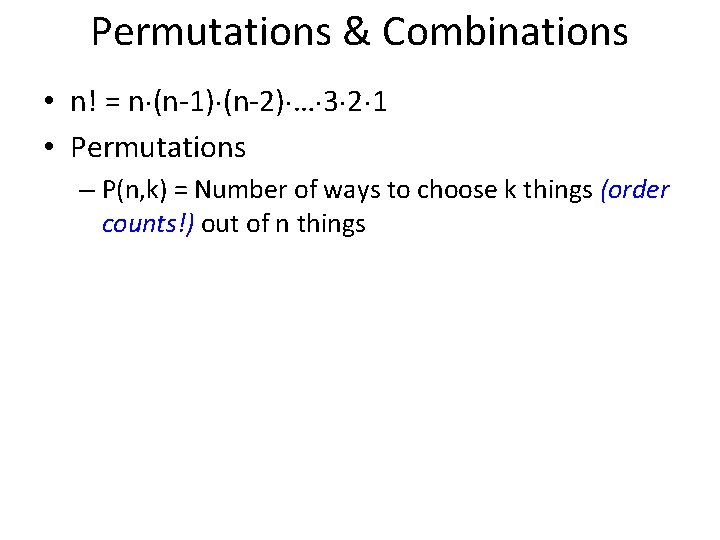
Permutations & Combinations • n! = n (n-1) (n-2) … 3 2 1 • Permutations – P(n, k) = Number of ways to choose k things (order counts!) out of n thingsngs in order: 6 (brush, floss), (brush, gargle), (floss, brush), (floss, gargle), (gargle, brush), (gargle, floss) P(n, 3) = #ways to do three things in order: 6 (brush, floss, gargle), (brush, gargle, floss), (floss, brush, gargle), (floss, gargle, brush), (gargle, brush, floss), (gargle, floss, brush)
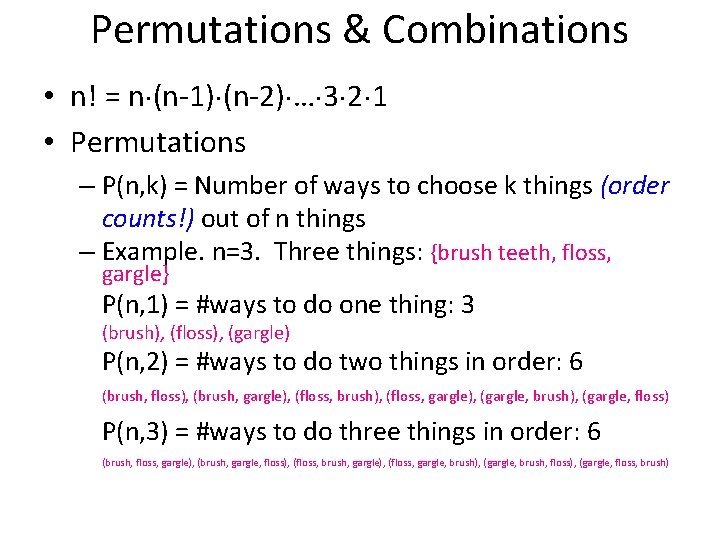
Permutations & Combinations • n! = n (n-1) (n-2) … 3 2 1 • Permutations – P(n, k) = Number of ways to choose k things (order counts!) out of n things – Example. n=3. Three things: {brush teeth, floss, gargle} P(n, 1) = #ways to do one thing: 3 (brush), (floss), (gargle) P(n, 2) = #ways to do two things in order: 6 (brush, floss), (brush, gargle), (floss, brush), (floss, gargle), (gargle, brush), (gargle, floss) P(n, 3) = #ways to do three things in order: 6 (brush, floss, gargle), (brush, gargle, floss), (floss, brush, gargle), (floss, gargle, brush), (gargle, brush, floss), (gargle, floss, brush)

Permutations & Combinations • n! = n (n-1) (n-2) … 3 2 1 • Permutations – P(n, k) = Number of ways to choose k things (order counts!) out of n things – P(n, k) = n (n-1) … (n-k+1) = n choices for first thing n-1 choices for second thing n-k+1 choices for kth thing
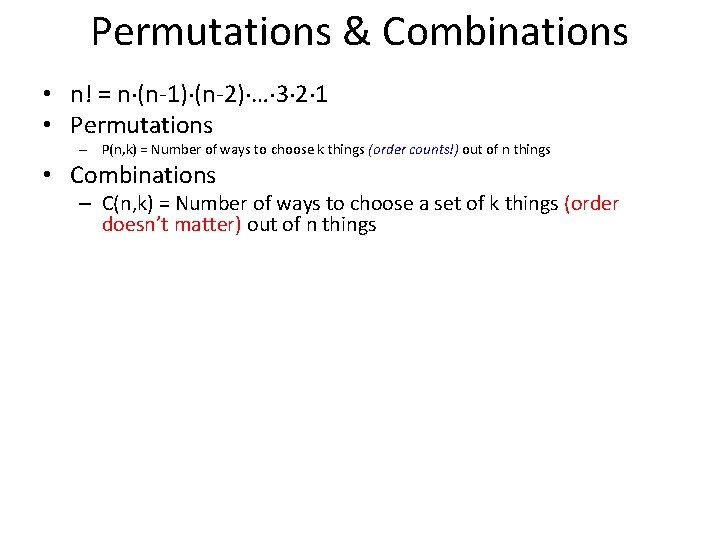
Permutations & Combinations • n! = n (n-1) (n-2) … 3 2 1 • Permutations – P(n, k) = Number of ways to choose k things (order counts!) out of n things • Combinations – C(n, k) = Number of ways to choose a set of k things (order doesn’t matter) out of n things Example: {brush, floss, gargle} C(n, 1) = #ways to choose one thing: 3 {brush}, {floss}, {gargle} C(n, 2) = #ways to do choose two things: 3 {brush, floss}, {brush, gargle}, {floss, gargle} C(n, 3) = #ways to choose three things: 1 {brush, floss, gargle}
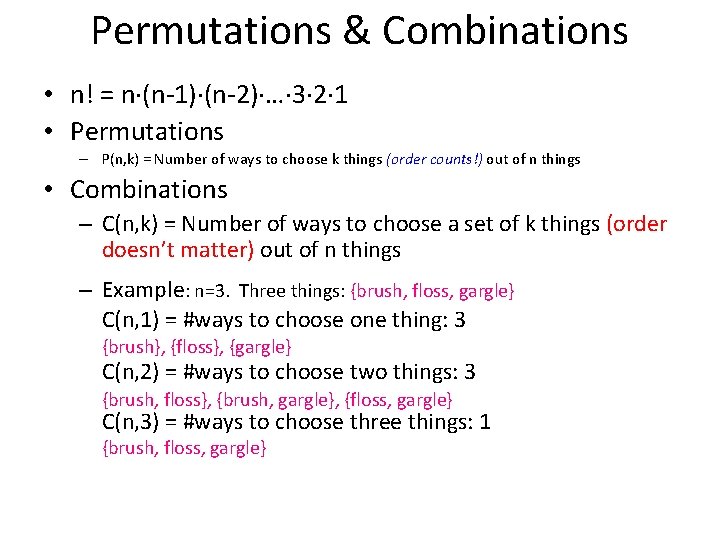
Permutations & Combinations • n! = n (n-1) (n-2) … 3 2 1 • Permutations – P(n, k) = Number of ways to choose k things (order counts!) out of n things • Combinations – C(n, k) = Number of ways to choose a set of k things (order doesn’t matter) out of n things – Example: n=3. Three things: {brush, floss, gargle} C(n, 1) = #ways to choose one thing: 3 {brush}, {floss}, {gargle} C(n, 2) = #ways to choose two things: 3 {brush, floss}, {brush, gargle}, {floss, gargle} C(n, 3) = #ways to choose three things: 1 {brush, floss, gargle}
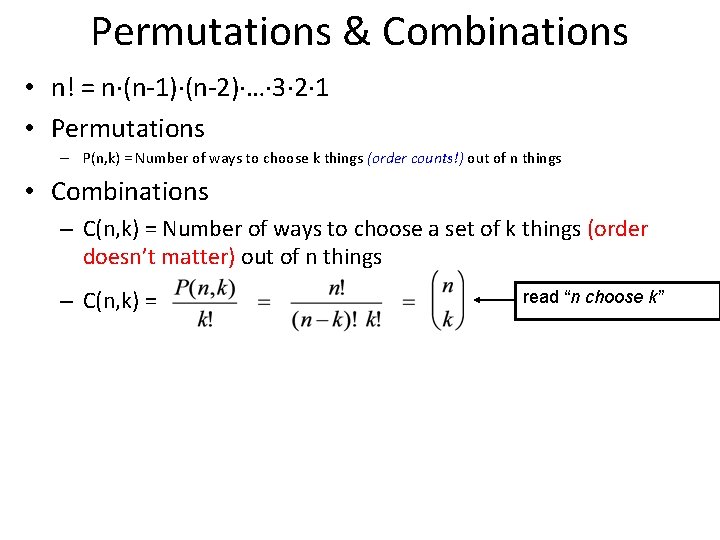
Permutations & Combinations • n! = n (n-1) (n-2) … 3 2 1 • Permutations – P(n, k) = Number of ways to choose k things (order counts!) out of n things • Combinations – C(n, k) = Number of ways to choose a set of k things (order doesn’t matter) out of n things – C(n, k) = read “n choose k”
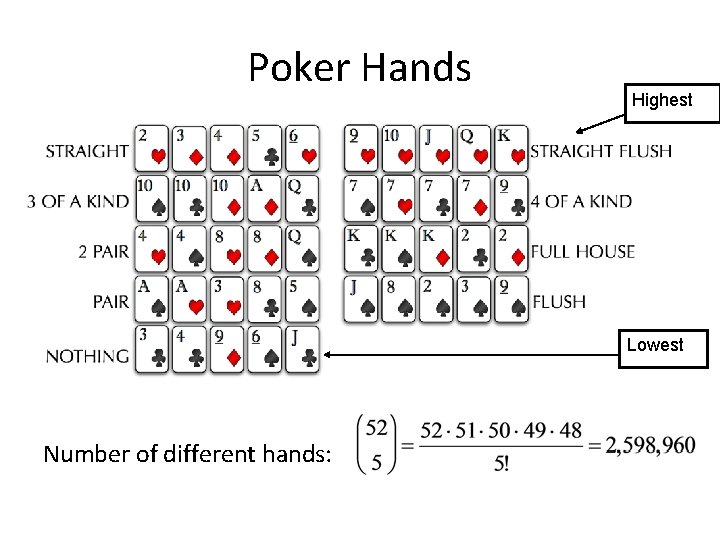
Poker Hands Highest How many ways to make a pair? Lowest Number of different hands:
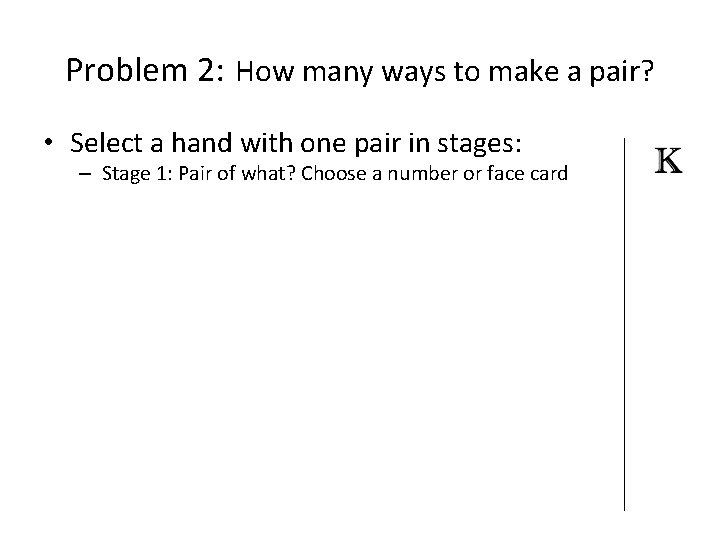
Problem 2: How many ways to make a pair? • Select a hand with one pair in stages: – Stage 1: Pair of what? Choose a number or face card Stage 2: Choose which suits (from stage 1) = 6 choices Stage 3: Choose third card (different than stage 1) (52 -4) = 48 choices Stage 4: Choose fourth card (different than stages 1&3) (52 -8) = 44 choices Stage 5: Choose fifth card (different than stages 1, 3, 4) (52 -12) = 40 choices
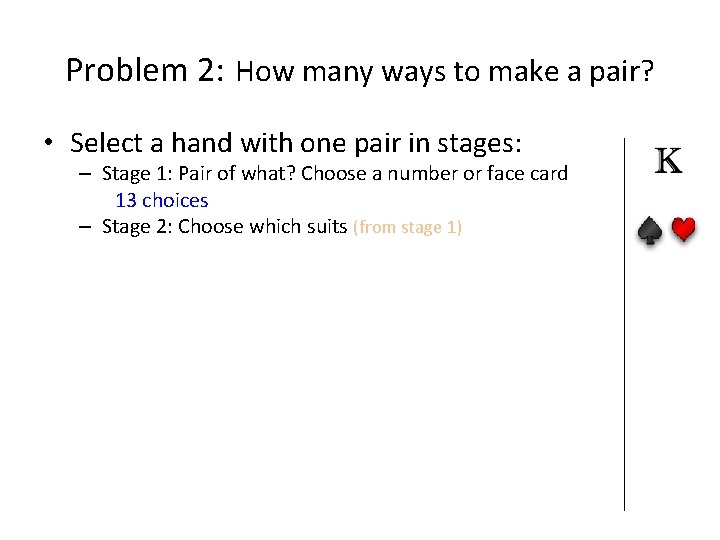
Problem 2: How many ways to make a pair? • Select a hand with one pair in stages: – Stage 1: Pair of what? Choose a number or face card 13 choices – Stage 2: Choose which suits (from stage 1) Stage 3: Choose third card (different than stage 1) (52 -4) = 48 choices Stage 4: Choose fourth card (different than stages 1&3) (52 -8) = 44 choices Stage 5: Choose fifth card (different than stages 1, 3, 4) (52 -12) = 40 choices
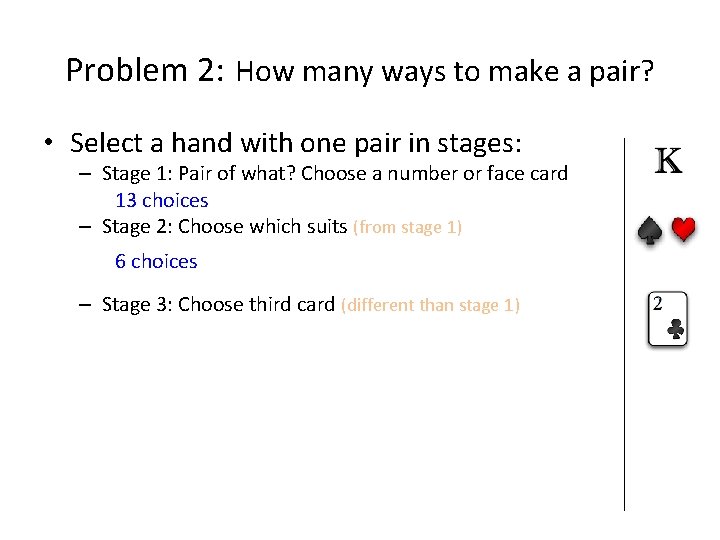
Problem 2: How many ways to make a pair? • Select a hand with one pair in stages: – Stage 1: Pair of what? Choose a number or face card 13 choices – Stage 2: Choose which suits (from stage 1) 6 choices – Stage 3: Choose third card (different than stage 1) Stage 4: Choose fourth card (different than stages 1&3) (52 -8) = 44 choices Stage 5: Choose fifth card (different than stages 1, 3, 4) (52 -12) = 40 choices
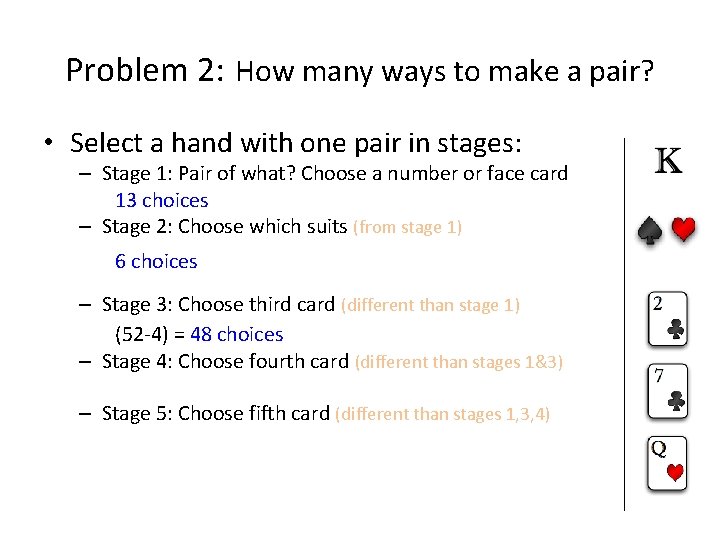
Problem 2: How many ways to make a pair? • Select a hand with one pair in stages: – Stage 1: Pair of what? Choose a number or face card 13 choices – Stage 2: Choose which suits (from stage 1) 6 choices – Stage 3: Choose third card (different than stage 1) (52 -4) = 48 choices – Stage 4: Choose fourth card (different than stages 1&3) – Stage 5: Choose fifth card (different than stages 1, 3, 4)
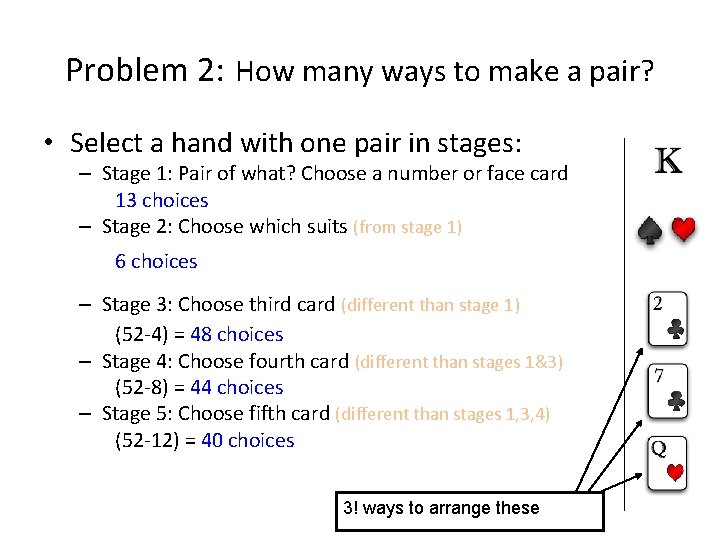
Problem 2: How many ways to make a pair? • Select a hand with one pair in stages: – Stage 1: Pair of what? Choose a number or face card 13 choices – Stage 2: Choose which suits (from stage 1) 6 choices – Stage 3: Choose third card (different than stage 1) (52 -4) = 48 choices – Stage 4: Choose fourth card (different than stages 1&3) (52 -8) = 44 choices – Stage 5: Choose fifth card (different than stages 1, 3, 4) (52 -12) = 40 choices 3! ways to arrange these
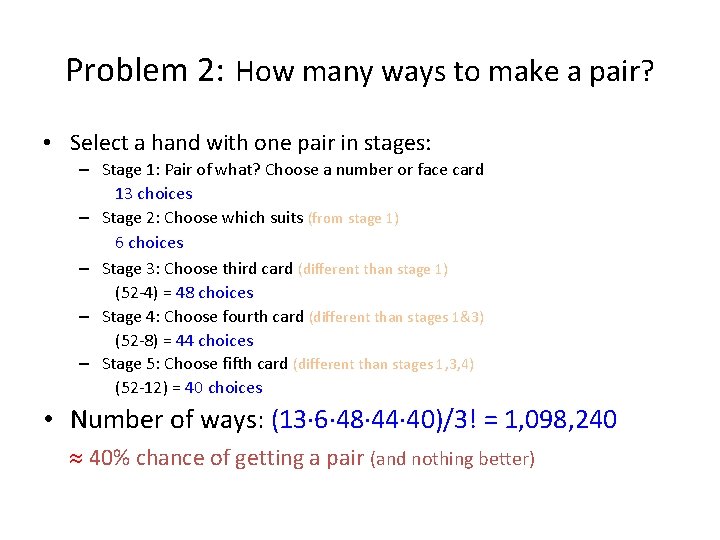
Problem 2: How many ways to make a pair? • Select a hand with one pair in stages: – Stage 1: Pair of what? Choose a number or face card 13 choices – Stage 2: Choose which suits (from stage 1) 6 choices – Stage 3: Choose third card (different than stage 1) (52 -4) = 48 choices – Stage 4: Choose fourth card (different than stages 1&3) (52 -8) = 44 choices – Stage 5: Choose fifth card (different than stages 1, 3, 4) (52 -12) = 40 choices • Number of ways: (13 6 48 44 40)/3! = 1, 098, 240 40% chance of getting a pair (and nothing better)
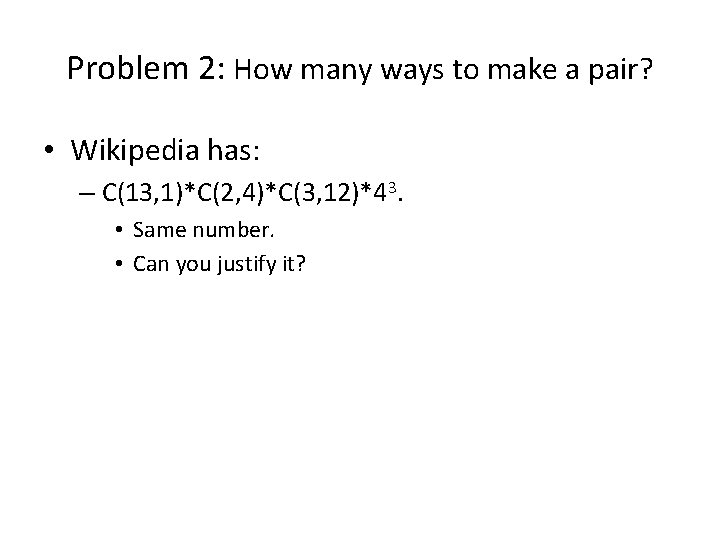
Problem 2: How many ways to make a pair? • Wikipedia has: – C(13, 1)*C(2, 4)*C(3, 12)*43. • Same number. • Can you justify it?
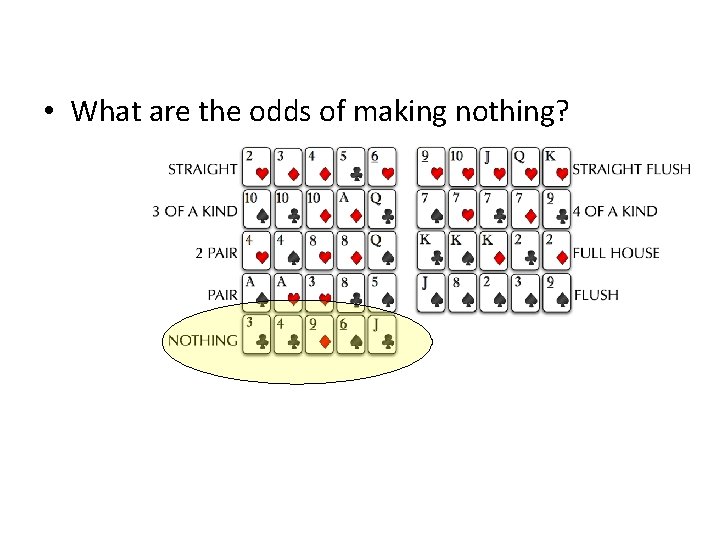
• What are the odds of making nothing?
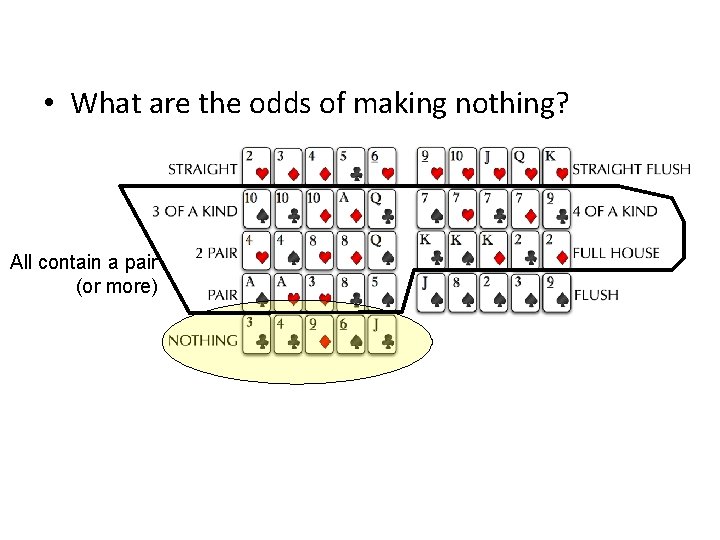
• What are the odds of making nothing? All contain a pair (or more)
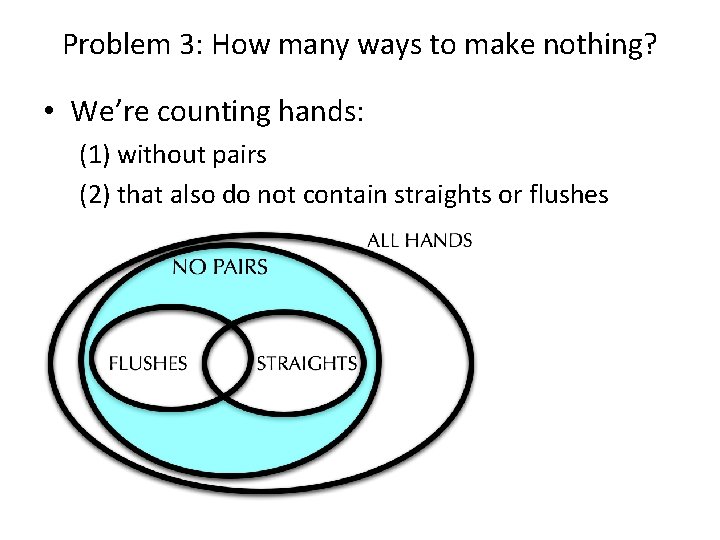
Problem 3: How many ways to make nothing? • We’re counting hands: (1) without pairs (2) that also do not contain straights or flushes
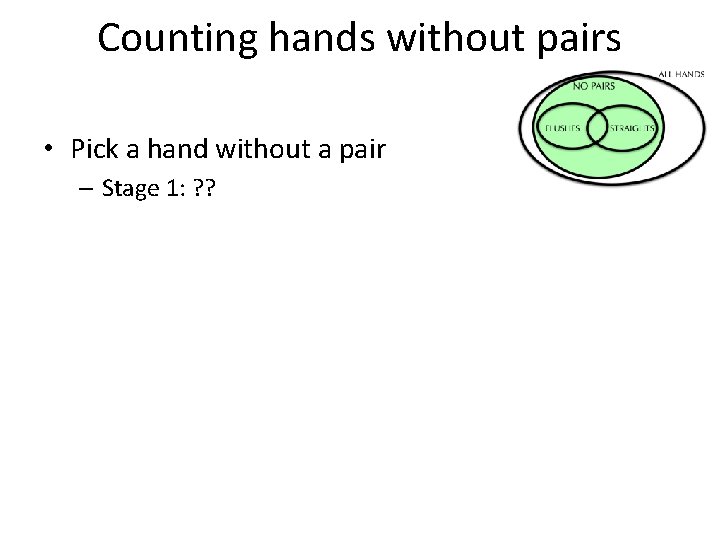
Counting hands without pairs • Pick a hand without a pair – Stage 1: ? ? 2 nd card: 48 choices (not same number/face as 1 st card) 3 rd card: 44 choices (different from 1 st & 2 nd) 4 th card: 40 choices (different from 1 st, 2 nd, 3 rd) 5 th card: 36 choices (different from 1 st, 2 nd, 3 rd, 4 th) Division rule: Each hand could have been chosen in exactly 5! different ways. Total = (52 48 44 40 36)/5! = 1, 317, 888
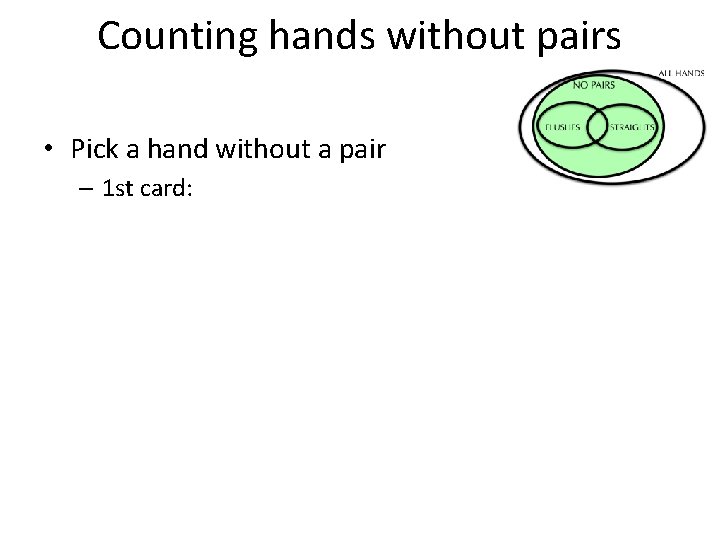
Counting hands without pairs • Pick a hand without a pair – 1 st card: 2 nd card: 48 choices (not same number/face as 1 st card) 3 rd card: 44 choices (different from 1 st & 2 nd) 4 th card: 40 choices (different from 1 st, 2 nd, 3 rd) 5 th card: 36 choices (different from 1 st, 2 nd, 3 rd, 4 th) Division rule: Each hand could have been chosen in exactly 5! different ways. Total = (52 48 44 40 36)/5! = 1, 317, 888
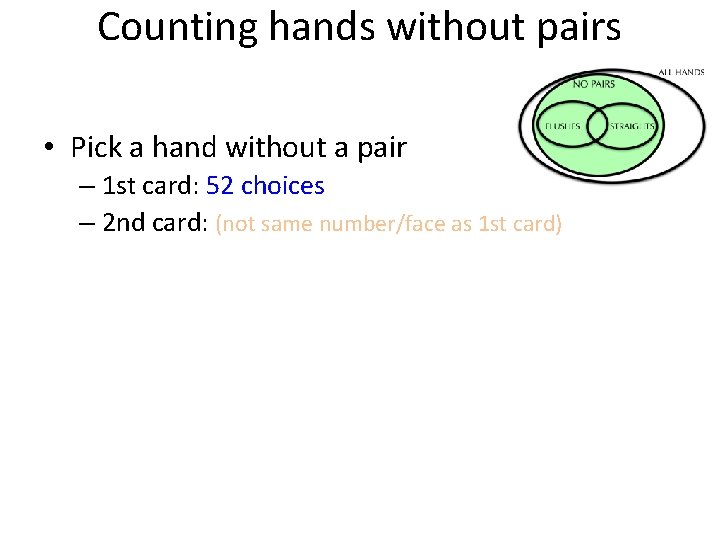
Counting hands without pairs • Pick a hand without a pair – 1 st card: 52 choices – 2 nd card: (not same number/face as 1 st card) 3 rd card: 44 choices (different from 1 st & 2 nd) 4 th card: 40 choices (different from 1 st, 2 nd, 3 rd) 5 th card: 36 choices (different from 1 st, 2 nd, 3 rd, 4 th) Division rule: Each hand could have been chosen in exactly 5! different ways. Total = (52 48 44 40 36)/5! = 1, 317, 888
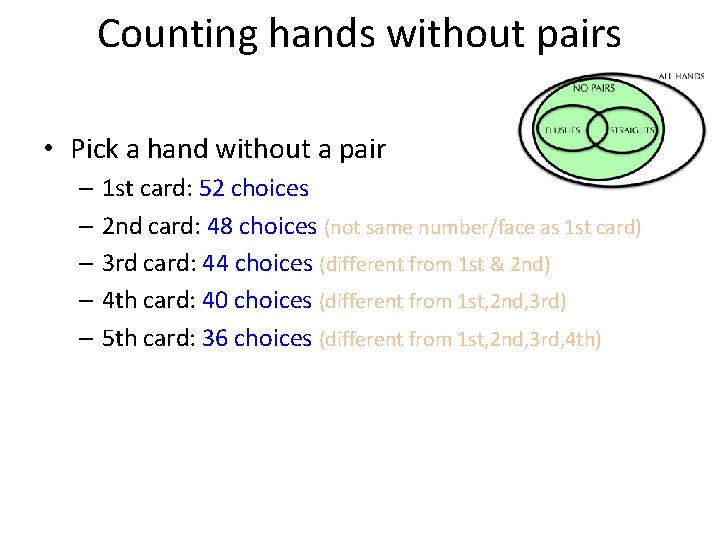
Counting hands without pairs • Pick a hand without a pair – 1 st card: 52 choices – 2 nd card: 48 choices (not same number/face as 1 st card) – 3 rd card: 44 choices (different from 1 st & 2 nd) – 4 th card: 40 choices (different from 1 st, 2 nd, 3 rd) – 5 th card: 36 choices (different from 1 st, 2 nd, 3 rd, 4 th) Division rule: Each hand could have been chosen in exactly 5! different ways. Total = (52 48 44 40 36)/5! = 1, 317, 888
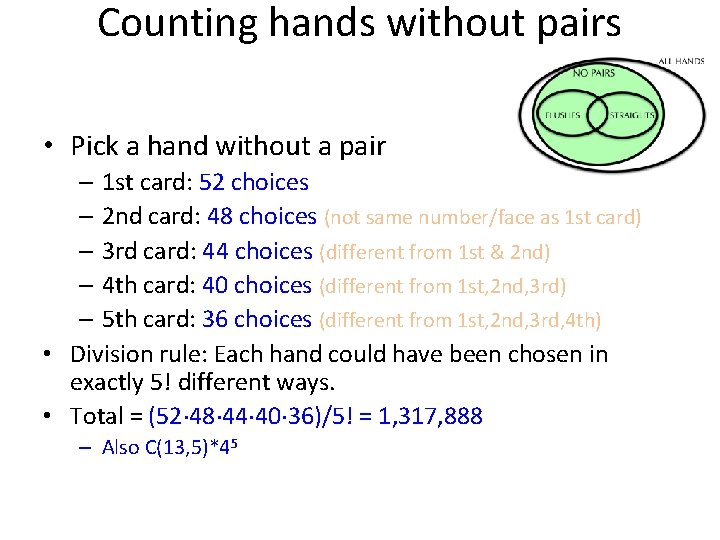
Counting hands without pairs • Pick a hand without a pair – 1 st card: 52 choices – 2 nd card: 48 choices (not same number/face as 1 st card) – 3 rd card: 44 choices (different from 1 st & 2 nd) – 4 th card: 40 choices (different from 1 st, 2 nd, 3 rd) – 5 th card: 36 choices (different from 1 st, 2 nd, 3 rd, 4 th) • Division rule: Each hand could have been chosen in exactly 5! different ways. • Total = (52 48 44 40 36)/5! = 1, 317, 888 – Also C(13, 5)*45
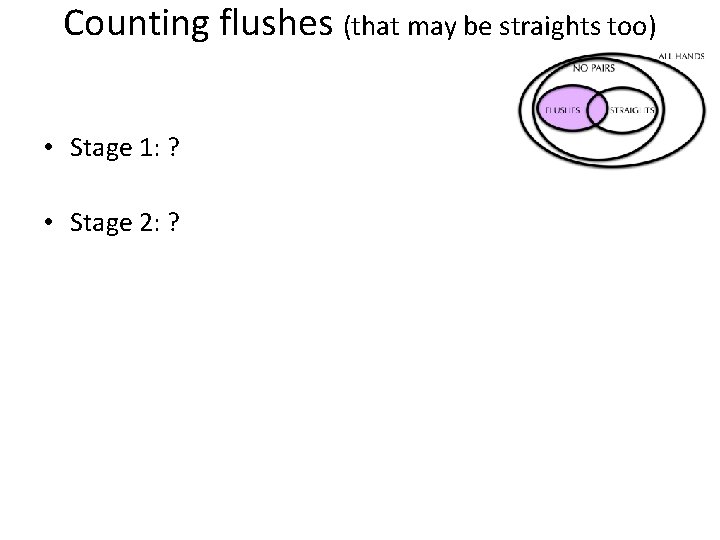
Counting flushes (that may be straights too) • Stage 1: ? 4 choices • Stage 2: ? Total = 5, 148 = 1, 287 choices
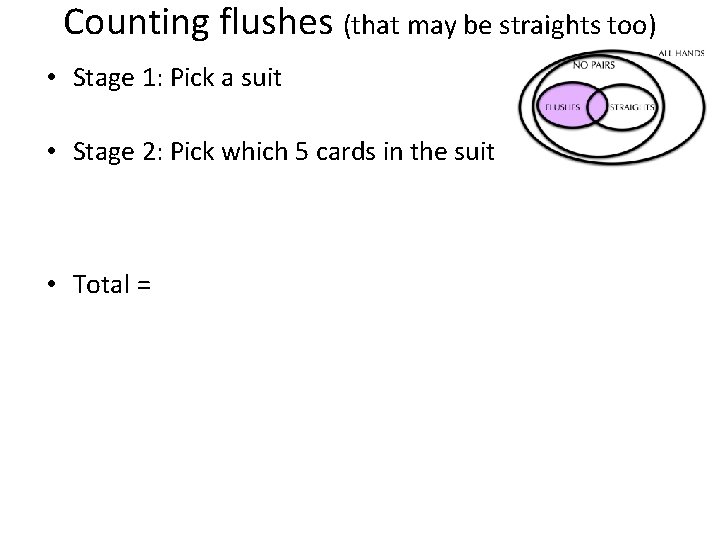
Counting flushes (that may be straights too) • Stage 1: Pick a suit • Stage 2: Pick which 5 cards in the suit • Total =
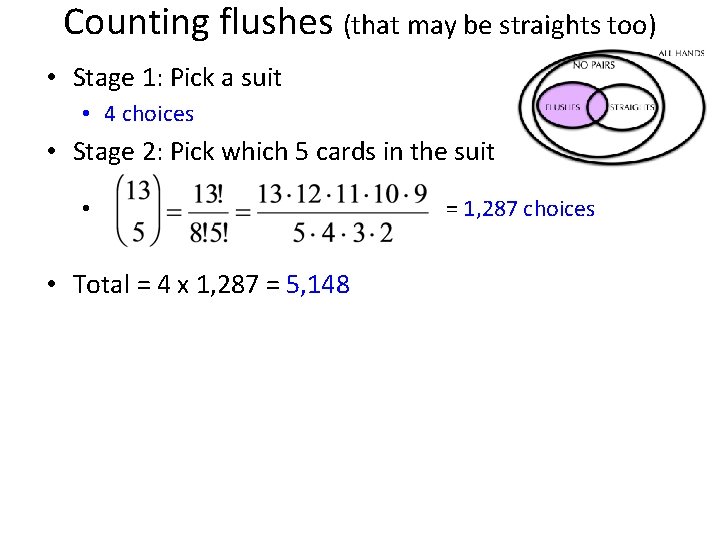
Counting flushes (that may be straights too) • Stage 1: Pick a suit • 4 choices • Stage 2: Pick which 5 cards in the suit • = 1, 287 choices • Total = 4 x 1, 287 = 5, 148
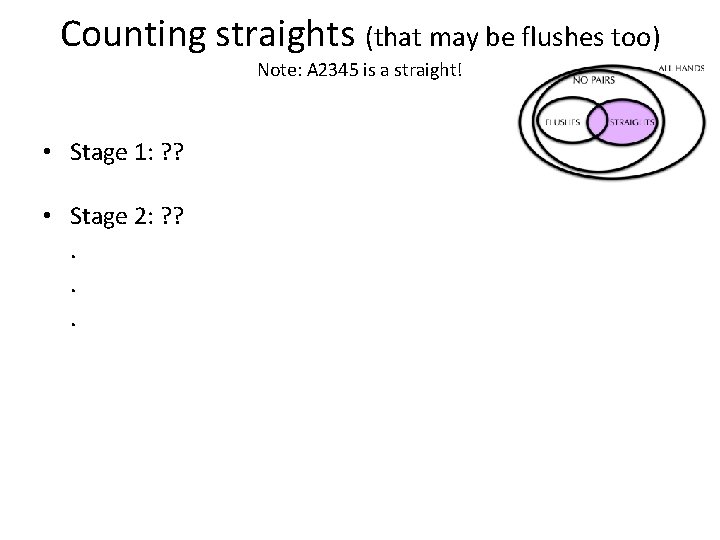
Counting straights (that may be flushes too) Note: A 2345 is a straight! • Stage 1: ? ? 10 choices (A, 2, 3, 4, 5, 6, 7, 8, 9, 10) • Stage 2: ? ? . . . Stage 6: Pick the 5 th card: 4 choices Total = 10 45 = 10, 240
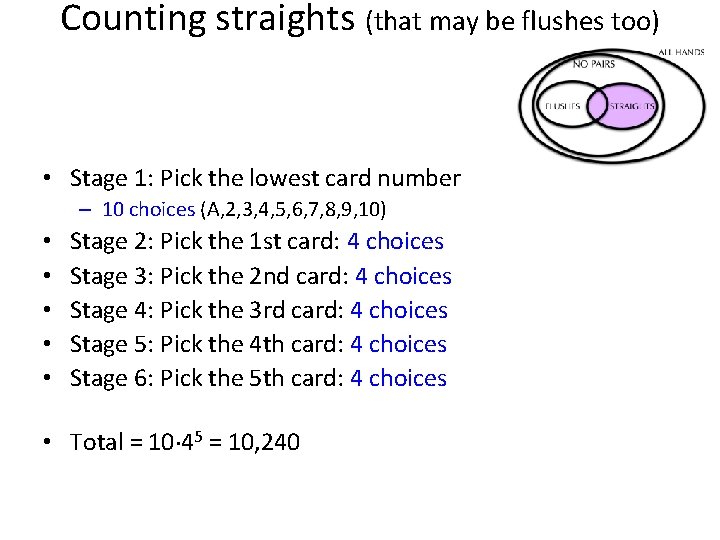
Counting straights (that may be flushes too) • Stage 1: Pick the lowest card number – 10 choices (A, 2, 3, 4, 5, 6, 7, 8, 9, 10) • • • Stage 2: Pick the 1 st card: 4 choices Stage 3: Pick the 2 nd card: 4 choices Stage 4: Pick the 3 rd card: 4 choices Stage 5: Pick the 4 th card: 4 choices Stage 6: Pick the 5 th card: 4 choices • Total = 10 45 = 10, 240
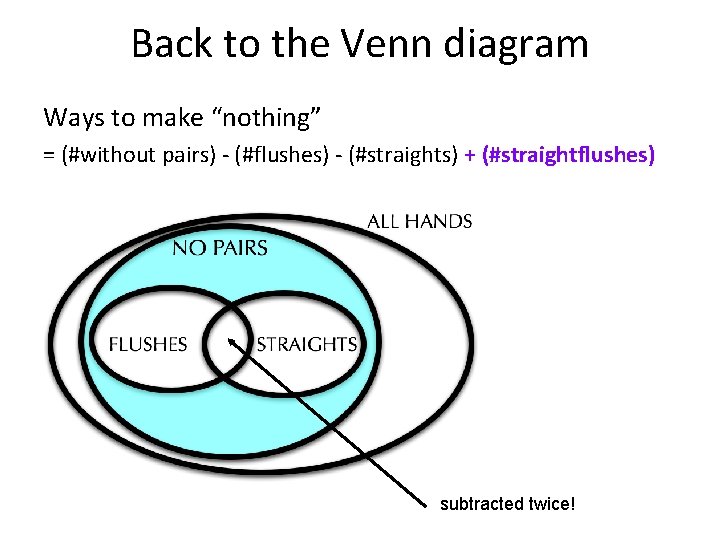
Back to the Venn diagram Ways to make “nothing” = (#without pairs) - (#flushes) - (#straights) + (#straightflushes) subtracted twice!
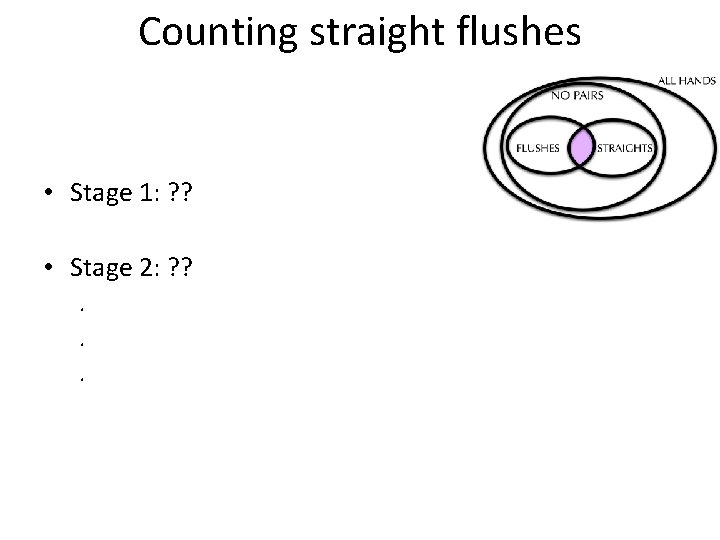
Counting straight flushes • Stage 1: ? ? 4 choices • Stage 2: ? ? . . . 10 choices
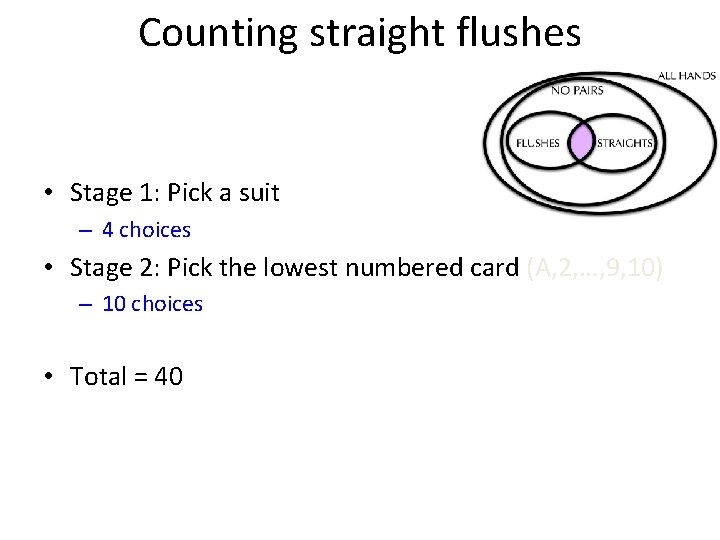
Counting straight flushes • Stage 1: Pick a suit – 4 choices • Stage 2: Pick the lowest numbered card (A, 2, …, 9, 10) – 10 choices • Total = 40
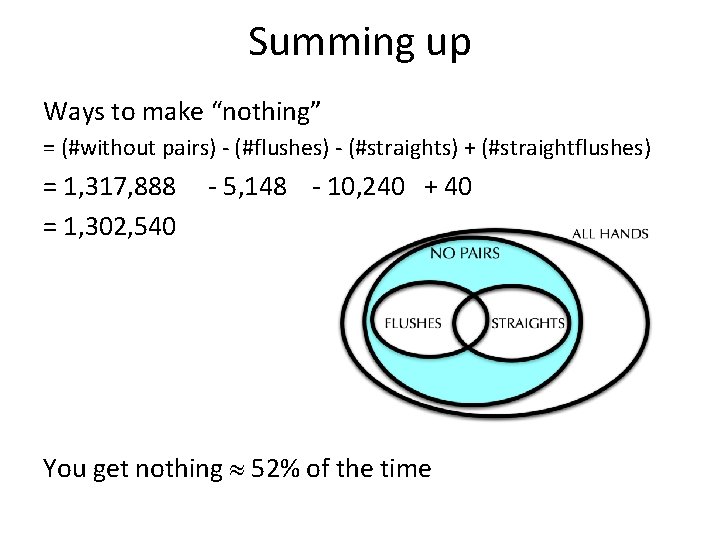
Summing up Ways to make “nothing” = (#without pairs) - (#flushes) - (#straights) + (#straightflushes) = 1, 317, 888 - 5, 148 - 10, 240 + 40 = 1, 302, 540 You get nothing 52% of the time
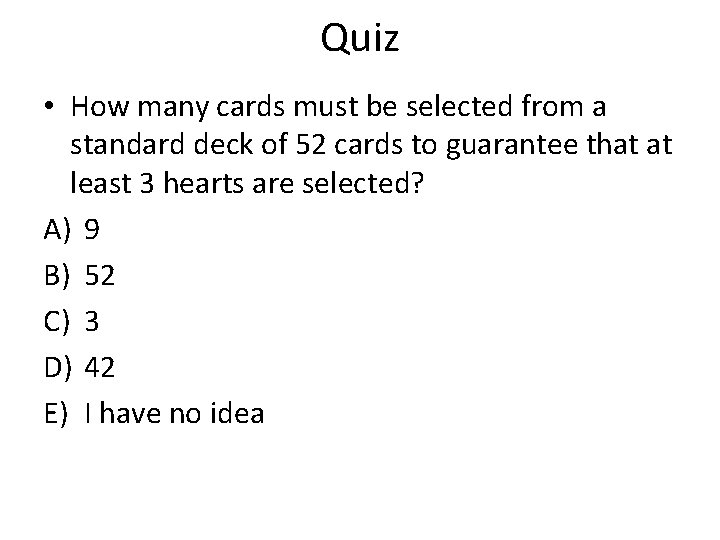
Quiz • How many cards must be selected from a standard deck of 52 cards to guarantee that at least 3 hearts are selected? A) 9 B) 52 C) 3 D) 42 E) I have no idea

Counting Recap • k-permutation: a sequence of k things (selected from n things) • k-combination: a set of k things (selected from n things) Repetitions not allowed!

Counting Recap • k-permutation: a sequence of k things (selected from n things) • k-combination: a set of k things (selected from n things) • P(n, k) = number of k-permutations • C(n, k) = number of k-combinations
Permutations and Combinations with repetitions • So far today, we have assumed that we can select items without repetitions. – We did look at selecting permutations with repetitions last time (dice) – We’ve not looked at combinations with repetitions in any formal way. • But first, we turn to Binomial Coefficients and Pascal’s Triangle
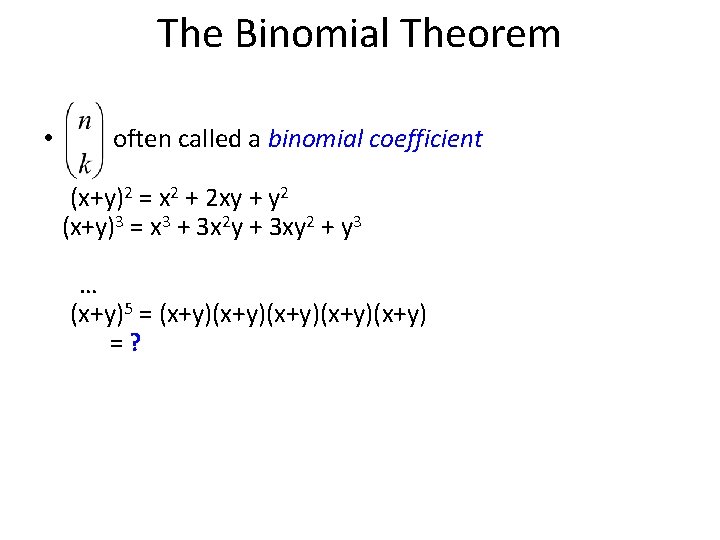
The Binomial Theorem • often called a binomial coefficient (x+y)2 = x 2 + 2 xy + y 2 (x+y)3 = x 3 + 3 x 2 y + 3 xy 2 + y 3 … (x+y)5 = (x+y)(x+y)(x+y) = ?
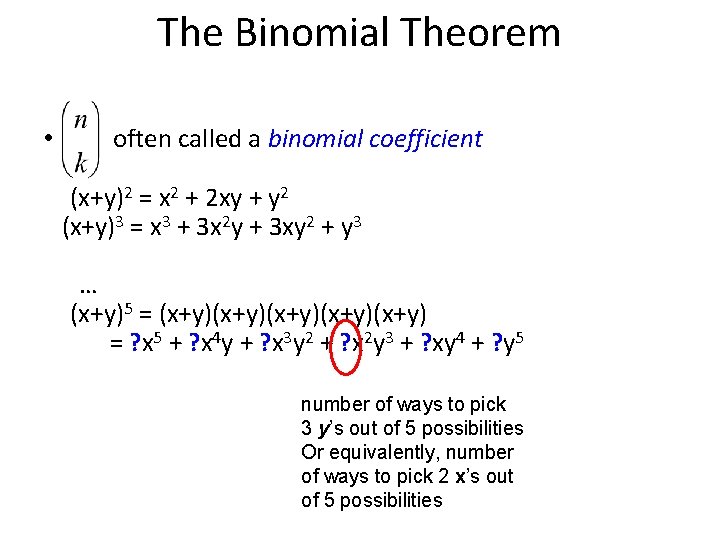
The Binomial Theorem • often called a binomial coefficient (x+y)2 = x 2 + 2 xy + y 2 (x+y)3 = x 3 + 3 x 2 y + 3 xy 2 + y 3 … (x+y)5 = (x+y)(x+y)(x+y) = ? x 5 + ? x 4 y + ? x 3 y 2 + ? x 2 y 3 + ? xy 4 + ? y 5 number of ways to pick 3 y’s out of 5 possibilities Or equivalently, number of ways to pick 2 x’s out of 5 possibilities
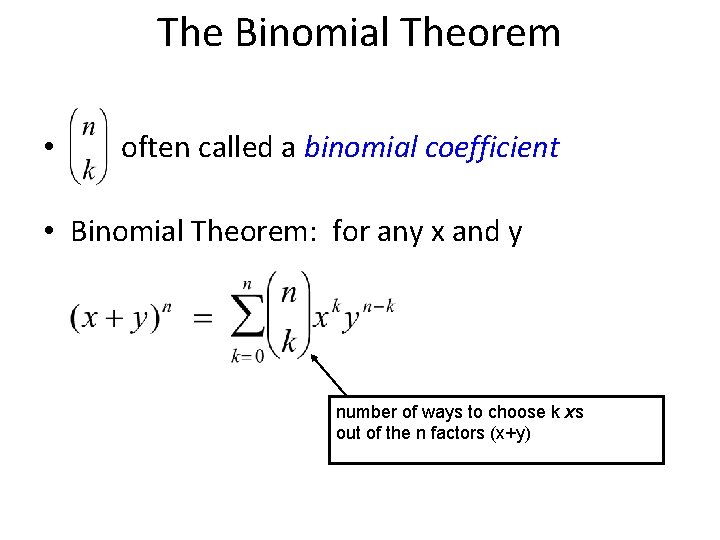
The Binomial Theorem • often called a binomial coefficient • Binomial Theorem: for any x and y number of ways to choose k xs out of the n factors (x+y)
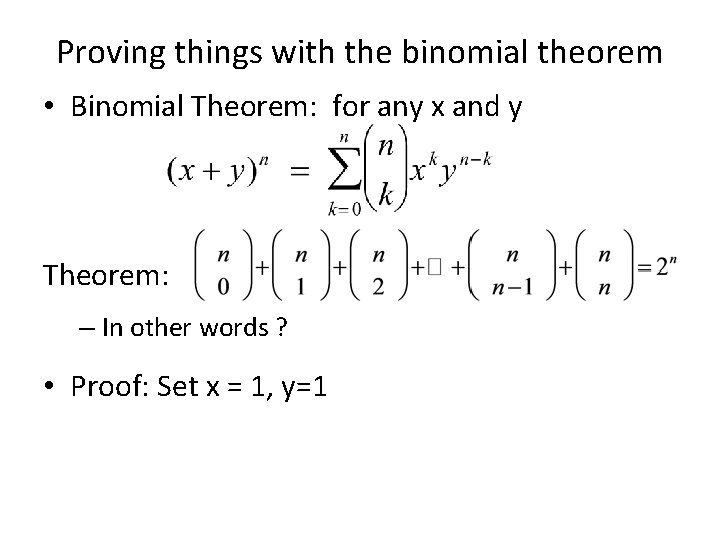
Proving things with the binomial theorem • Binomial Theorem: for any x and y Theorem: – In other words ? • Proof: Set x = 1, y=1
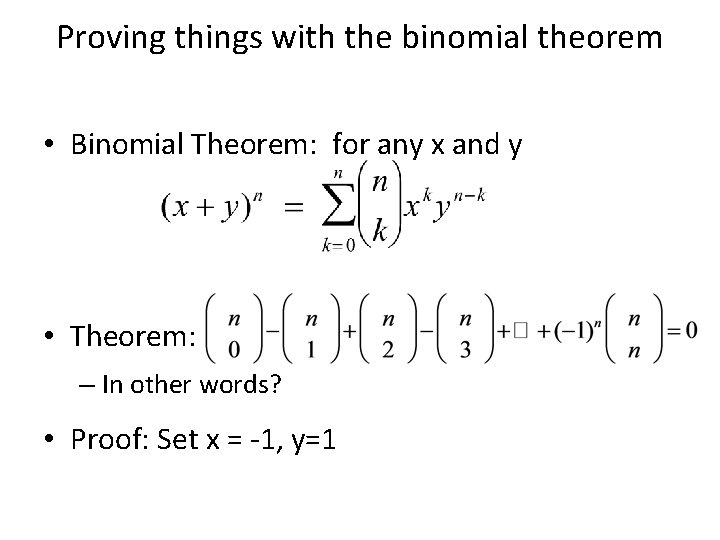
Proving things with the binomial theorem • Binomial Theorem: for any x and y • Theorem: – In other words? • Proof: Set x = -1, y=1
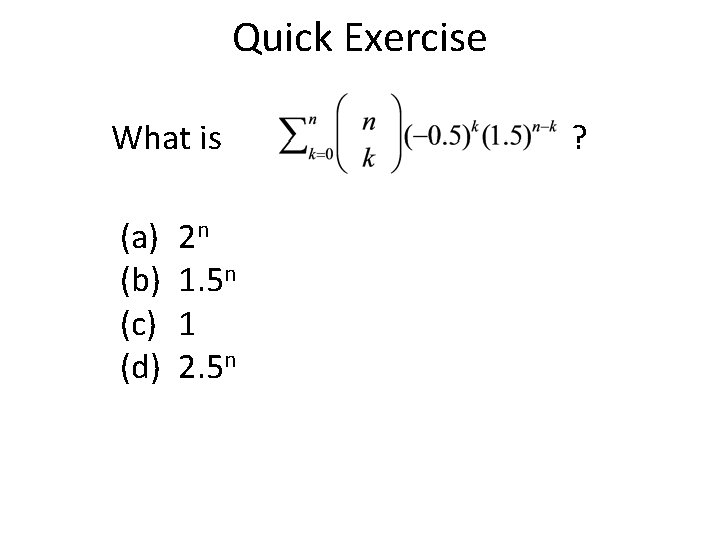
Quick Exercise What is ? (a) (b) (c) (d) 2 n 1. 5 n 1 2. 5 n
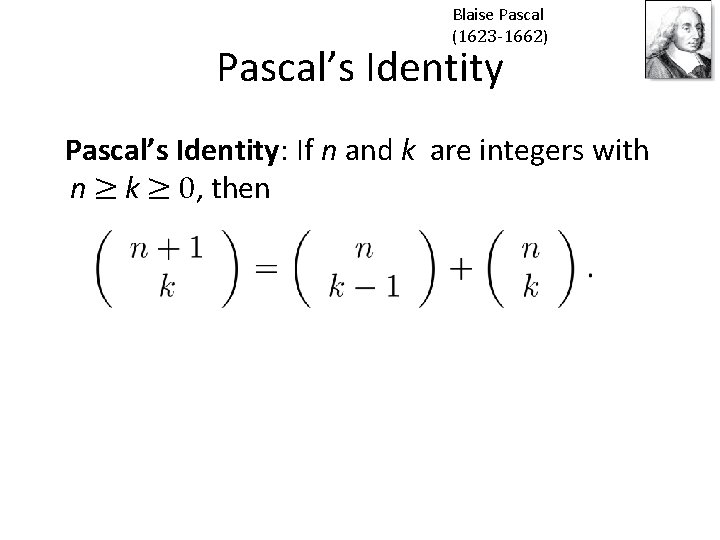
Blaise Pascal (1623 -1662) Pascal’s Identity: If n and k are integers with n ≥ k ≥ 0, then
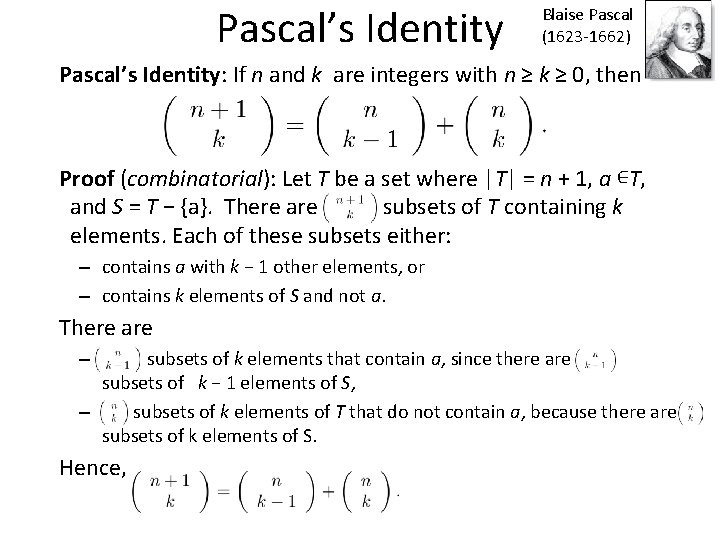
Pascal’s Identity Blaise Pascal (1623 -1662) Pascal’s Identity: If n and k are integers with n ≥ k ≥ 0, then Proof (combinatorial): Let T be a set where |T| = n + 1, a ∊T, and S = T − {a}. There are subsets of T containing k elements. Each of these subsets either: – contains a with k − 1 other elements, or – contains k elements of S and not a. There are – subsets of k elements that contain a, since there are subsets of k − 1 elements of S, – subsets of k elements of T that do not contain a, because there are subsets of k elements of S. Hence,
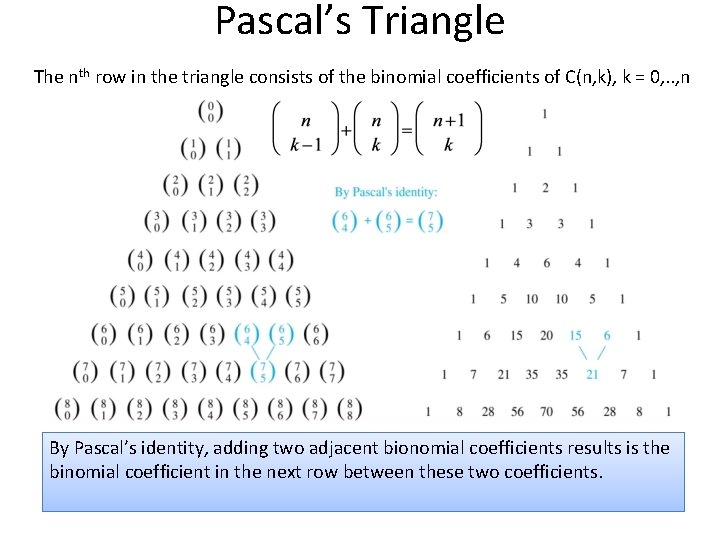
Pascal’s Triangle The nth row in the triangle consists of the binomial coefficients of C(n, k), k = 0, . . , n By Pascal’s identity, adding two adjacent bionomial coefficients results is the binomial coefficient in the next row between these two coefficients.
Review problem • If I have 9 books and plan on taking 4 on the plane with me, how many different sets of books could I bring?
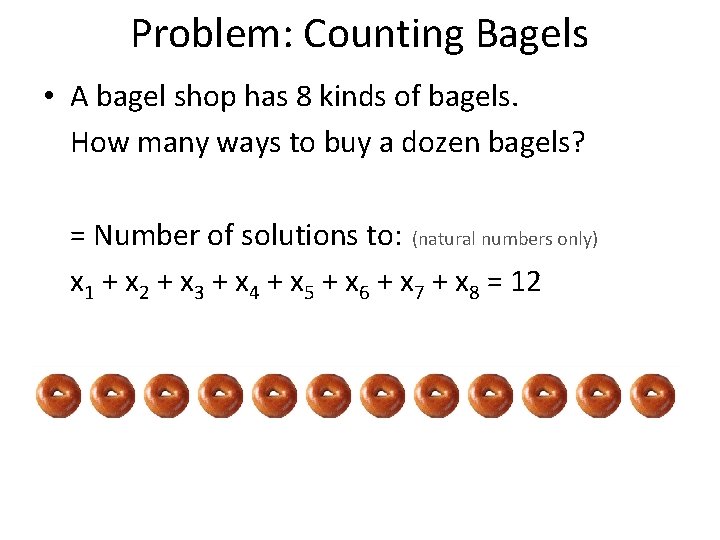
Problem: Counting Bagels • A bagel shop has 8 kinds of bagels. How many ways to buy a dozen bagels? = Number of solutions to: (natural numbers only) x 1 + x 2 + x 3 + x 4 + x 5 + x 6 + x 7 + x 8 = 12
Problem: Counting Bagels • A bagel shop has 8 kinds of bagels. How many ways to buy a dozen bagels? = Number of solutions to: (natural numbers only) x 1 + x 2 + x 3 + x 4 + x 5 + x 6 + x 7 + x 8 = 12
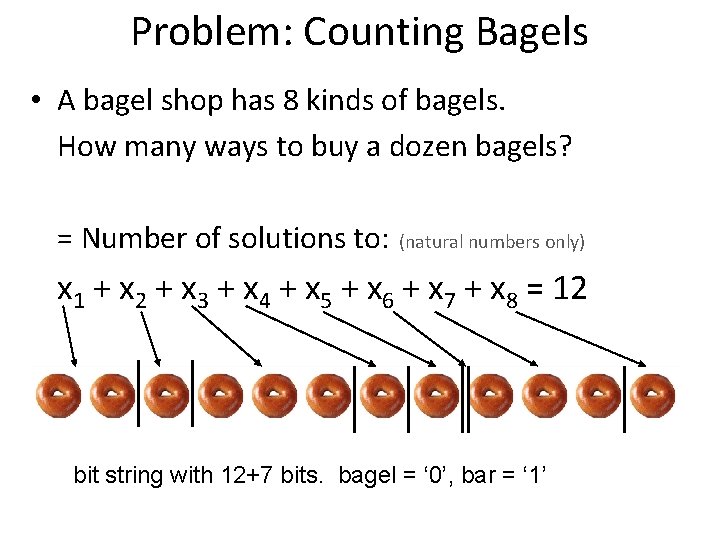
Problem: Counting Bagels • A bagel shop has 8 kinds of bagels. How many ways to buy a dozen bagels? = Number of solutions to: (natural numbers only) x 1 + x 2 + x 3 + x 4 + x 5 + x 6 + x 7 + x 8 = 12 bit string with 12+7 bits. bagel = ‘ 0’, bar = ‘ 1’
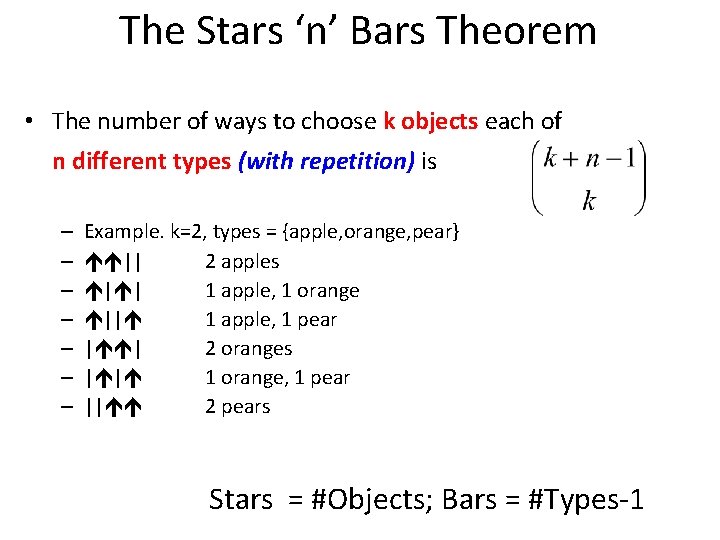
The Stars ‘n’ Bars Theorem • The number of ways to choose k objects each of n different types (with repetition) is – – – – Example. k=2, types = {apple, orange, pear} || 2 apples | | 1 apple, 1 orange || 1 apple, 1 pear | | 2 oranges | | 1 orange, 1 pear || 2 pears Stars = #Objects; Bars = #Types-1
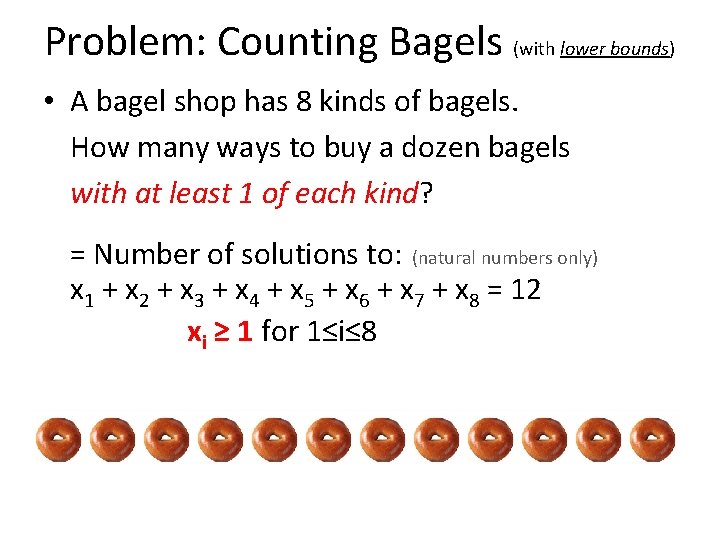
Problem: Counting Bagels (with lower bounds) • A bagel shop has 8 kinds of bagels. How many ways to buy a dozen bagels with at least 1 of each kind? = Number of solutions to: (natural numbers only) x 1 + x 2 + x 3 + x 4 + x 5 + x 6 + x 7 + x 8 = 12 xi ≥ 1 for 1≤i≤ 8
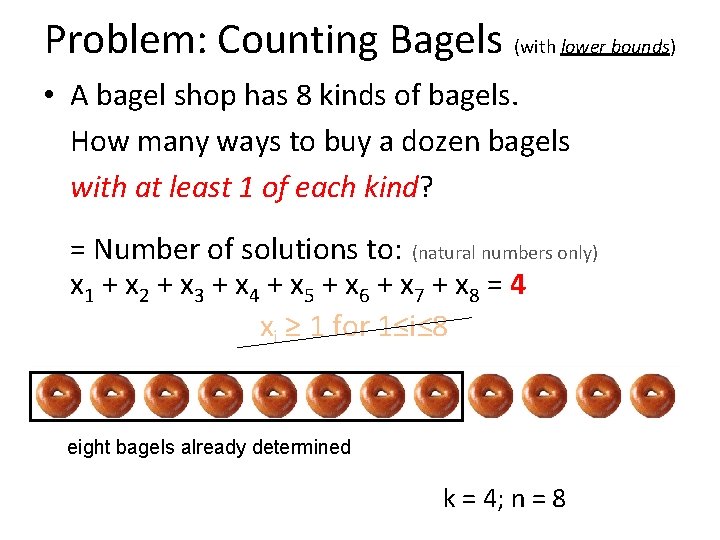
Problem: Counting Bagels (with lower bounds) • A bagel shop has 8 kinds of bagels. How many ways to buy a dozen bagels with at least 1 of each kind? = Number of solutions to: (natural numbers only) x 1 + x 2 + x 3 + x 4 + x 5 + x 6 + x 7 + x 8 = 4 xi ≥ 1 for 1≤i≤ 8 eight bagels already determined k = 4; n = 8
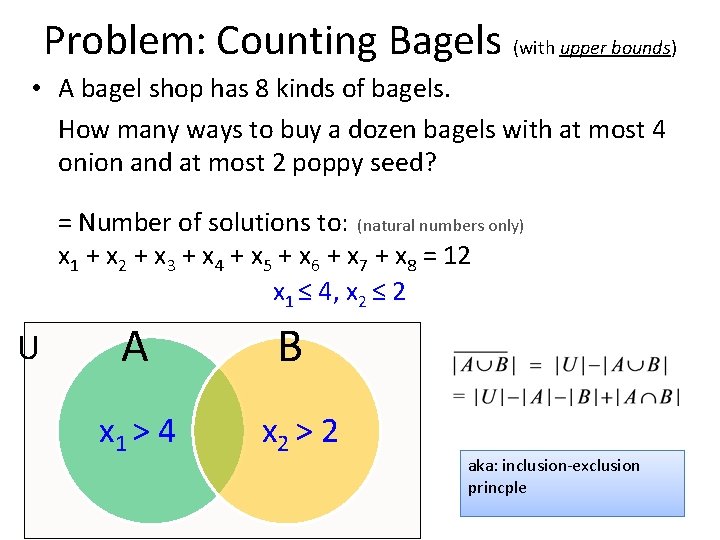
Problem: Counting Bagels (with upper bounds) • A bagel shop has 8 kinds of bagels. How many ways to buy a dozen bagels with at most 4 onion and at most 2 poppy seed? = Number of solutions to: (natural numbers only) x 1 + x 2 + x 3 + x 4 + x 5 + x 6 + x 7 + x 8 = 12 x 1 ≤ 4, x 2 ≤ 2 U A B x 1 > 4 x 2 > 2 aka: inclusion-exclusion princple
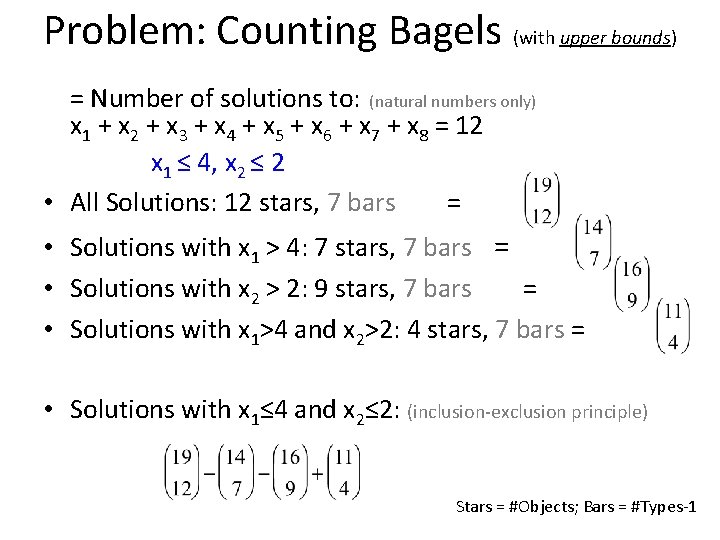
Problem: Counting Bagels (with upper bounds) = Number of solutions to: (natural numbers only) x 1 + x 2 + x 3 + x 4 + x 5 + x 6 + x 7 + x 8 = 12 x 1 ≤ 4, x 2 ≤ 2 • All Solutions: 12 stars, 7 bars = • Solutions with x 1 > 4: 7 stars, 7 bars = • Solutions with x 2 > 2: 9 stars, 7 bars = • Solutions with x 1>4 and x 2>2: 4 stars, 7 bars = • Solutions with x 1≤ 4 and x 2≤ 2: (inclusion-exclusion principle) Stars = #Objects; Bars = #Types-1
- Slides: 58