
L 12 FLUIDS1 STUFF THAT FLOWS liquids FLUIDS
- Slides: 22
L 12 - FLUIDS-1 STUFF THAT FLOWS • liquids FLUIDS • gases • sand, snow, or grain
States of Matter Ø Comes in three states – solid, liquid, gas Ø So far we have only dealt with solid objects blocks, sticks, balls, etc. Ø The study of fluids is more complicated because fluids are complicated they do not have any particular shape. Ø But, Newton’s laws can be applied to them
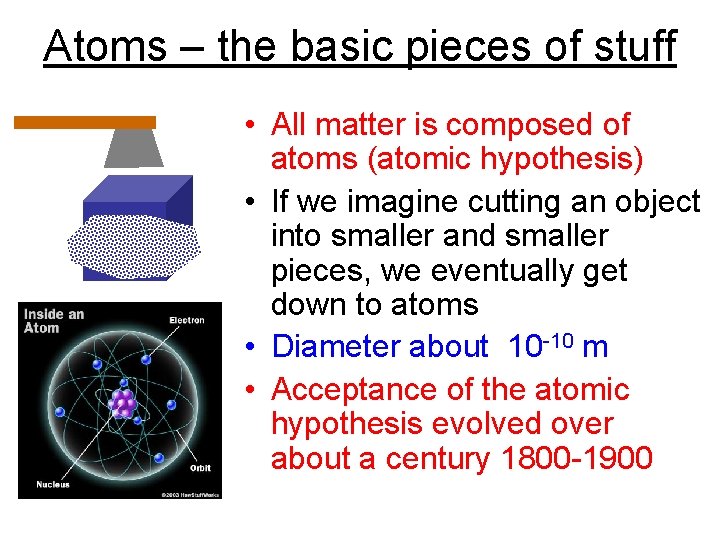
Atoms – the basic pieces of stuff • All matter is composed of atoms (atomic hypothesis) • If we imagine cutting an object into smaller and smaller pieces, we eventually get down to atoms • Diameter about 10 -10 m • Acceptance of the atomic hypothesis evolved over about a century 1800 -1900
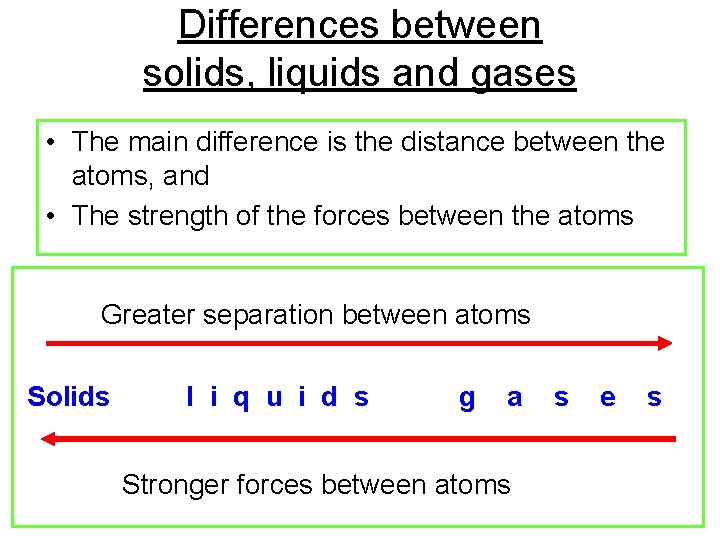
Differences between solids, liquids and gases • The main difference is the distance between the atoms, and • The strength of the forces between the atoms Greater separation between atoms Solids l i q u i d s g a Stronger forces between atoms s e s
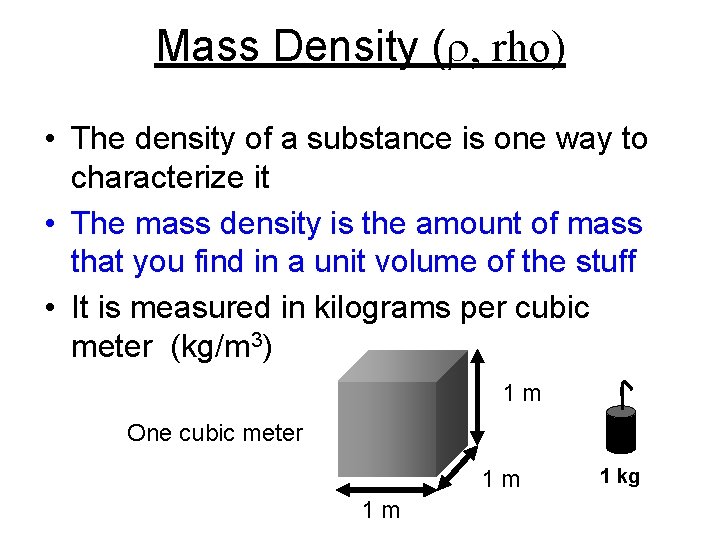
Mass Density ( , rho) • The density of a substance is one way to characterize it • The mass density is the amount of mass that you find in a unit volume of the stuff • It is measured in kilograms per cubic meter (kg/m 3) 1 m One cubic meter 1 m 1 m 1 kg
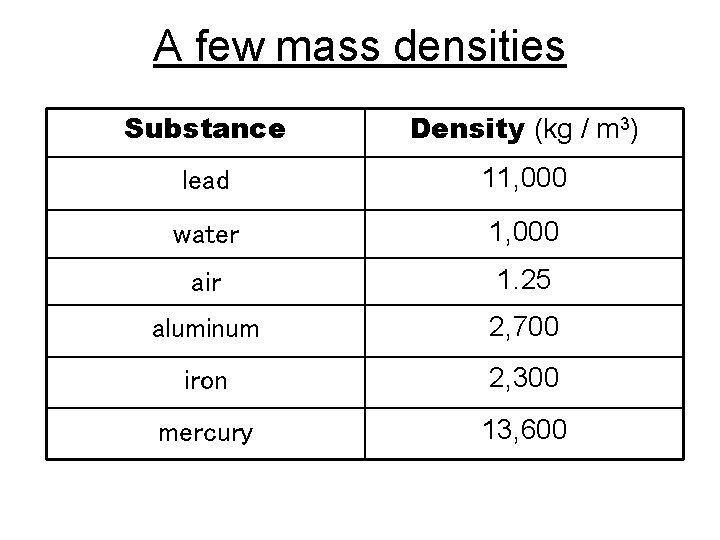
A few mass densities Substance Density (kg / m 3) lead 11, 000 water 1, 000 air 1. 25 aluminum 2, 700 iron 2, 300 mercury 13, 600
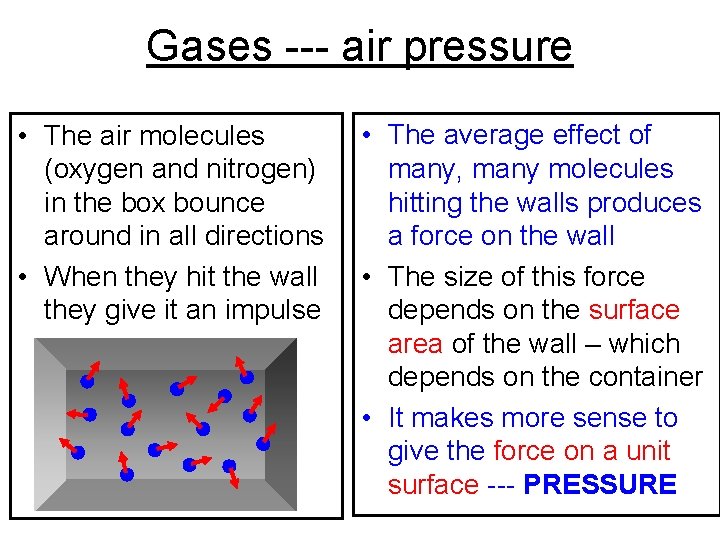
Gases --- air pressure • The air molecules (oxygen and nitrogen) in the box bounce around in all directions • When they hit the wall they give it an impulse • The average effect of many, many molecules hitting the walls produces a force on the wall • The size of this force depends on the surface area of the wall – which depends on the container • It makes more sense to give the force on a unit surface --- PRESSURE
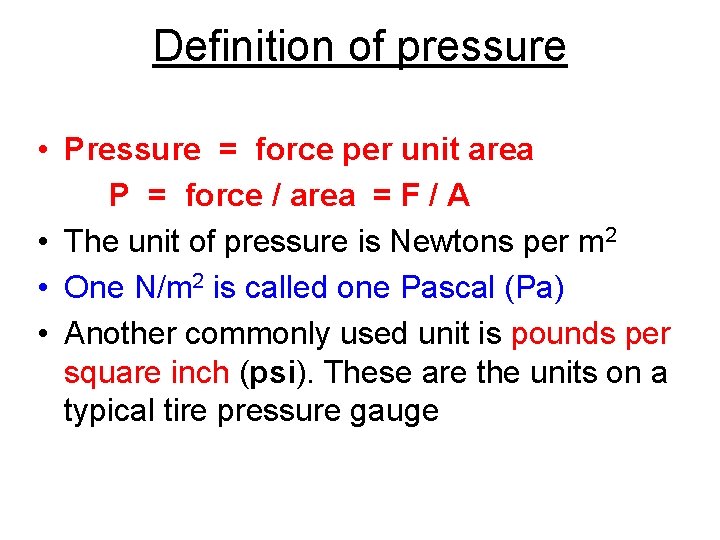
Definition of pressure • Pressure = force per unit area P = force / area = F / A • The unit of pressure is Newtons per m 2 • One N/m 2 is called one Pascal (Pa) • Another commonly used unit is pounds per square inch (psi). These are the units on a typical tire pressure gauge
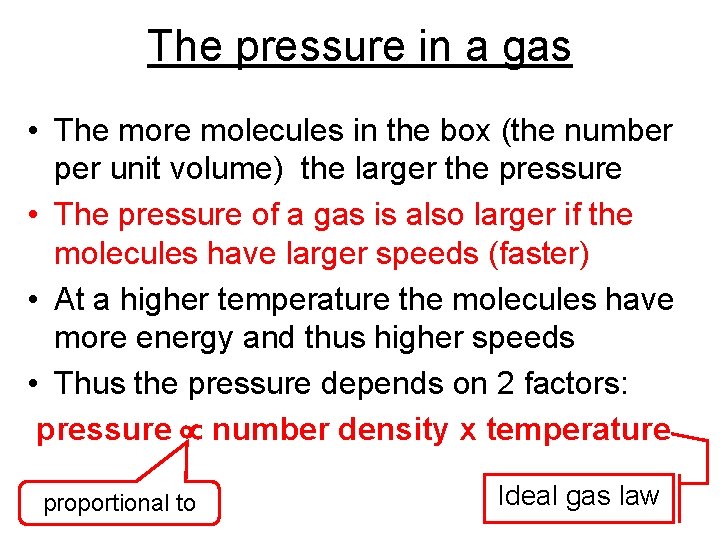
The pressure in a gas • The more molecules in the box (the number per unit volume) the larger the pressure • The pressure of a gas is also larger if the molecules have larger speeds (faster) • At a higher temperature the molecules have more energy and thus higher speeds • Thus the pressure depends on 2 factors: pressure number density x temperature proportional to Ideal gas law
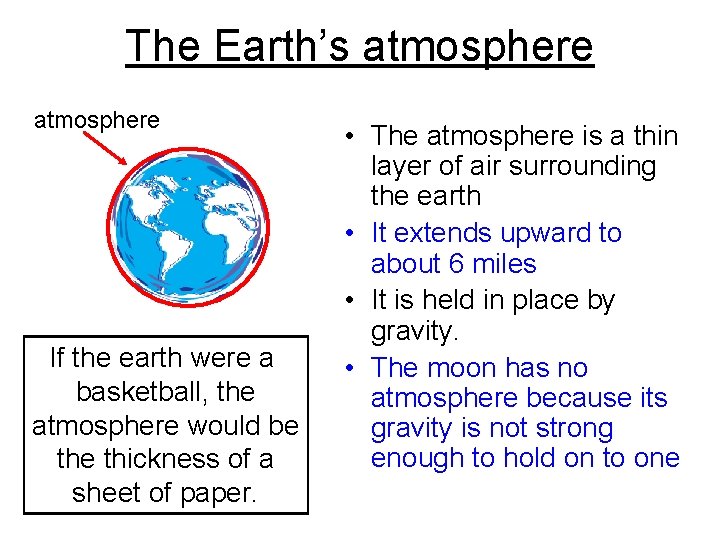
The Earth’s atmosphere If the earth were a basketball, the atmosphere would be thickness of a sheet of paper. • The atmosphere is a thin layer of air surrounding the earth • It extends upward to about 6 miles • It is held in place by gravity. • The moon has no atmosphere because its gravity is not strong enough to hold on to one
Atmospheric pressure • At the earth’s surface the pressure due to the atmosphere is about 100, 000 N/m 2 (1 atm) • units: 1 N/m 2 = 1 Pa (Pascal) • This means that over a 1 square meter of surface area the atmosphere exerts a force of 100, 000 N/m 2 x 1 m 2 = 100, 000 N • This amounts to about 22, 500 lbs or 11 tons! • This corresponds to a mass of 10, 000 kg • Why don’t we notice this force?
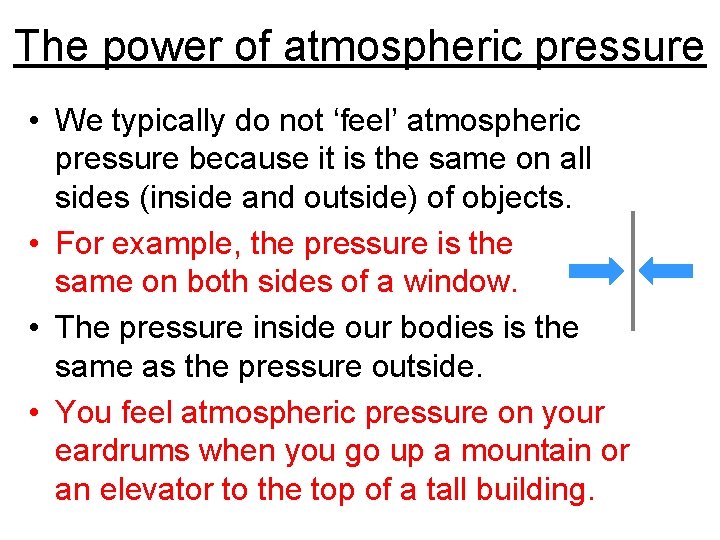
The power of atmospheric pressure • We typically do not ‘feel’ atmospheric pressure because it is the same on all sides (inside and outside) of objects. • For example, the pressure is the same on both sides of a window. • The pressure inside our bodies is the same as the pressure outside. • You feel atmospheric pressure on your eardrums when you go up a mountain or an elevator to the top of a tall building.
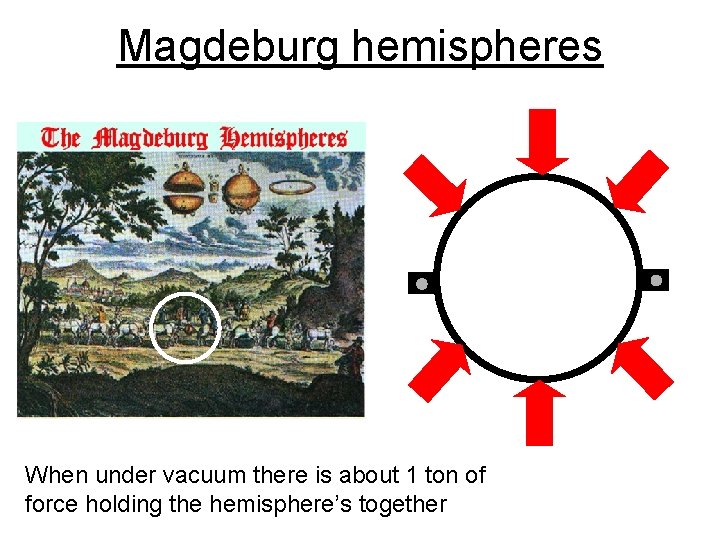
Magdeburg hemispheres When under vacuum there is about 1 ton of force holding the hemisphere’s together
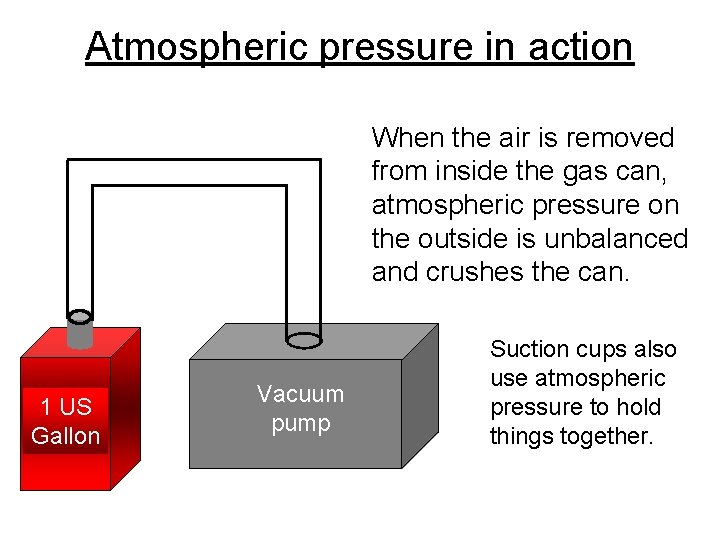
Atmospheric pressure in action When the air is removed from inside the gas can, atmospheric pressure on the outside is unbalanced and crushes the can. 1 US Gallon Vacuum pump Suction cups also use atmospheric pressure to hold things together.
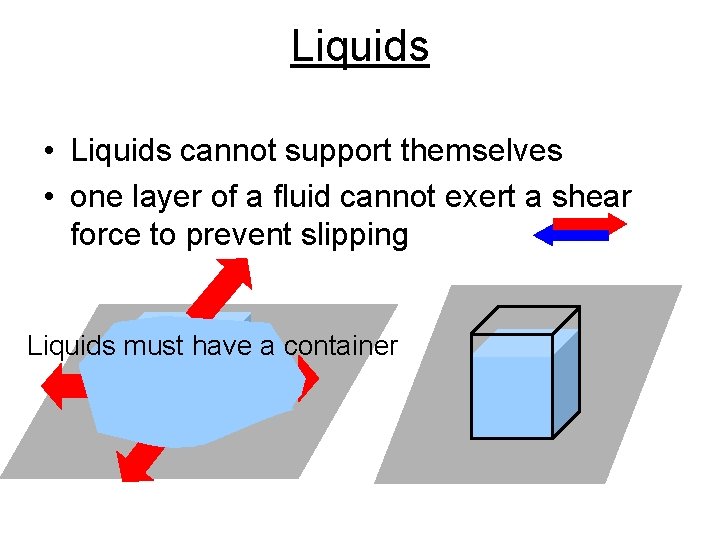
Liquids • Liquids cannot support themselves • one layer of a fluid cannot exert a shear force to prevent slipping Liquids must have a container
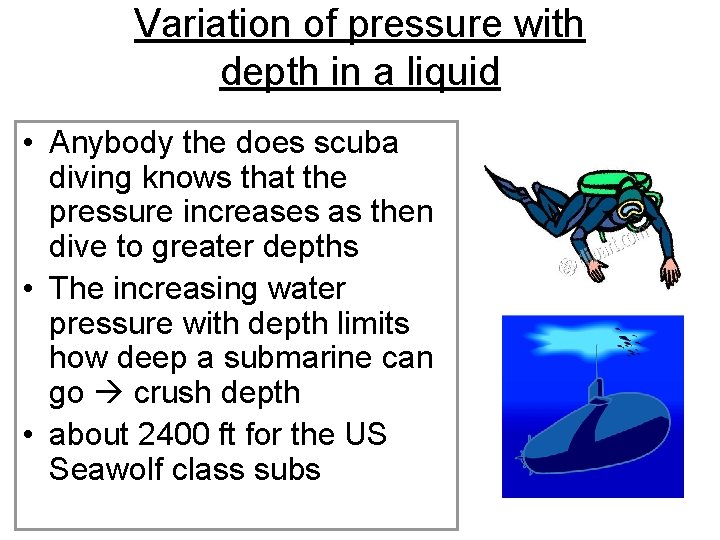
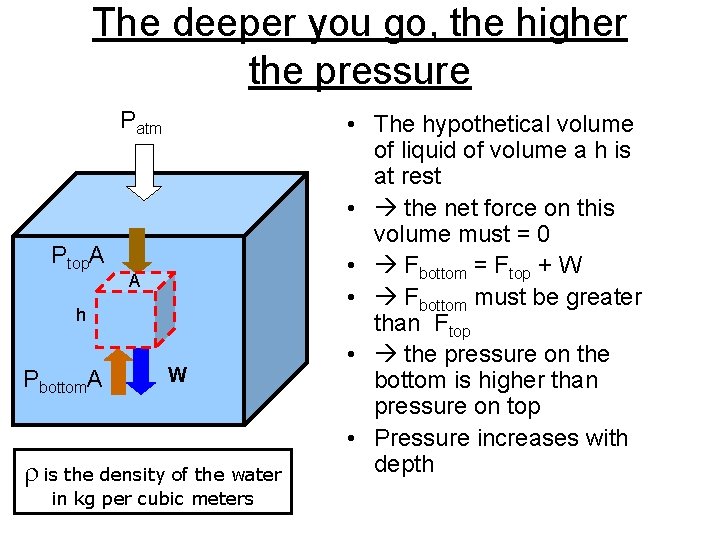
Variation of pressure with depth in a liquid • Anybody the does scuba diving knows that the pressure increases as then dive to greater depths • The increasing water pressure with depth limits how deep a submarine can go crush depth • about 2400 ft for the US Seawolf class subs
The deeper you go, the higher the pressure Patm Ptop. A A h Pbottom. A W is the density of the water in kg per cubic meters • The hypothetical volume of liquid of volume a h is at rest • the net force on this volume must = 0 • Fbottom = Ftop + W • Fbottom must be greater than Ftop • the pressure on the bottom is higher than pressure on top • Pressure increases with depth
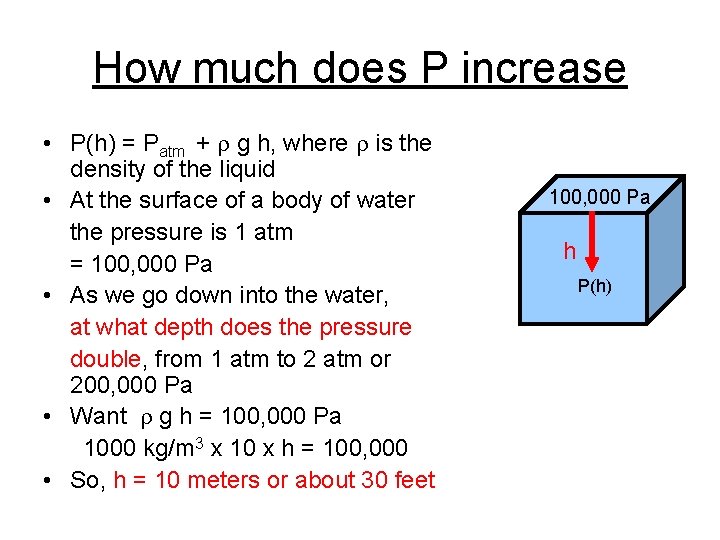
How much does P increase • P(h) = Patm + g h, where is the density of the liquid • At the surface of a body of water the pressure is 1 atm = 100, 000 Pa • As we go down into the water, at what depth does the pressure double, from 1 atm to 2 atm or 200, 000 Pa • Want g h = 100, 000 Pa 1000 kg/m 3 x 10 x h = 100, 000 • So, h = 10 meters or about 30 feet 100, 000 Pa h P(h)
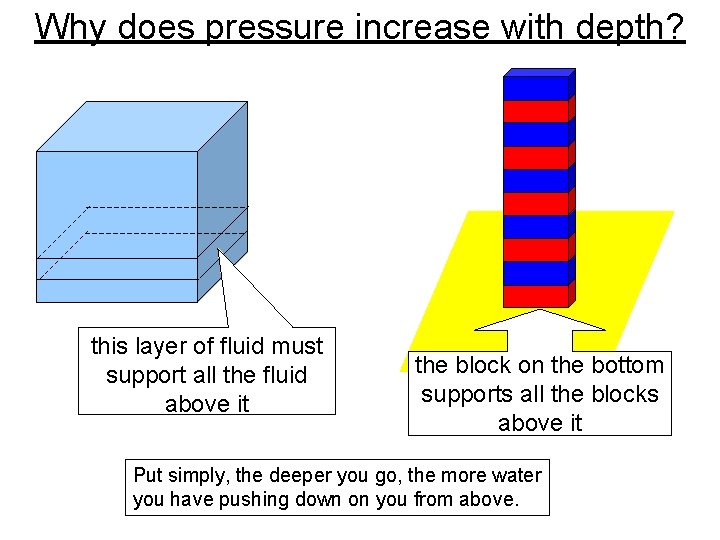
Why does pressure increase with depth? this layer of fluid must support all the fluid above it the block on the bottom supports all the blocks above it Put simply, the deeper you go, the more water you have pushing down on you from above.
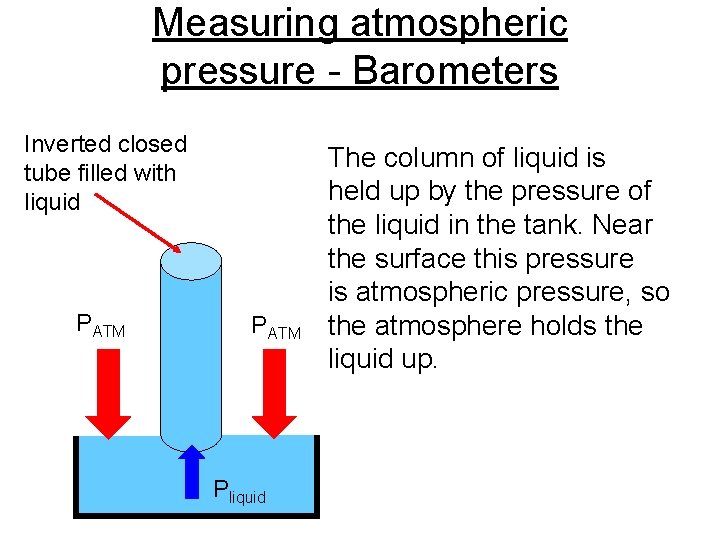
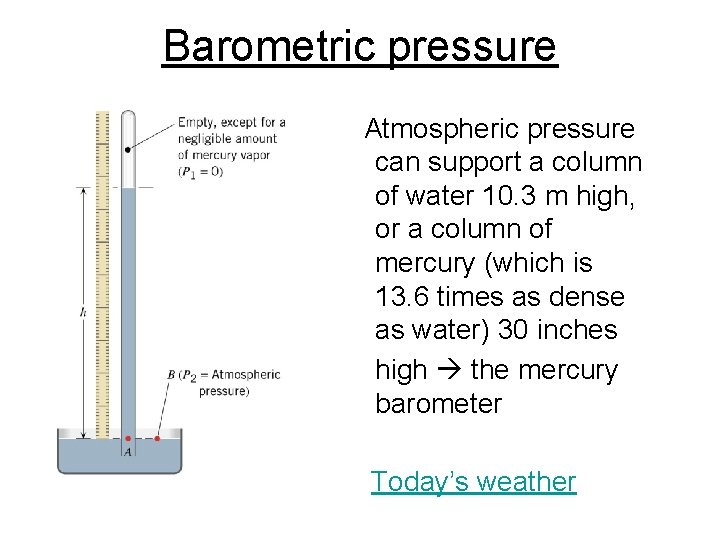
Measuring atmospheric pressure - Barometers Inverted closed tube filled with liquid PATM Pliquid The column of liquid is held up by the pressure of the liquid in the tank. Near the surface this pressure is atmospheric pressure, so the atmosphere holds the liquid up.
Barometric pressure Atmospheric pressure can support a column of water 10. 3 m high, or a column of mercury (which is 13. 6 times as dense as water) 30 inches high the mercury barometer Today’s weather
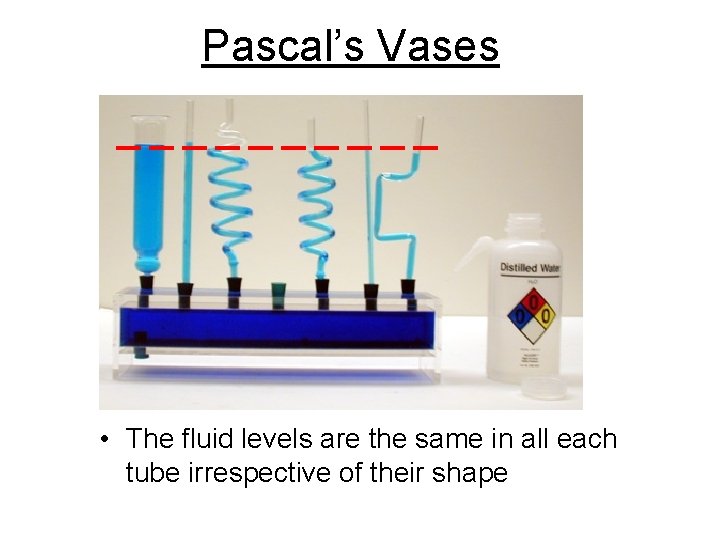
Pascal’s Vases • The fluid levels are the same in all each tube irrespective of their shape