
L 11 Jacobi Tools and Project CS 6963
L 11: Jacobi, Tools and Project CS 6963
Administrative Issues • Office hours today: – Begin at 1: 30 • Homework 2 graded – I’m reviewing, grades will come out later this week • Project proposals – Due 5 PM, Friday, March 13 (hard deadline) • Homework (Lab 2) – Due 5 PM, Friday, March 6 – Where are we? CS 6963 2 L 11: Tools
Outline • Jacobi – How to approach – Things to take care of • Programming Tools for CUDA – Occupancy Calculator – Profiler • Project – Discuss MPM/GIMP – Construct list of questions CS 6963 3 L 11: Tools
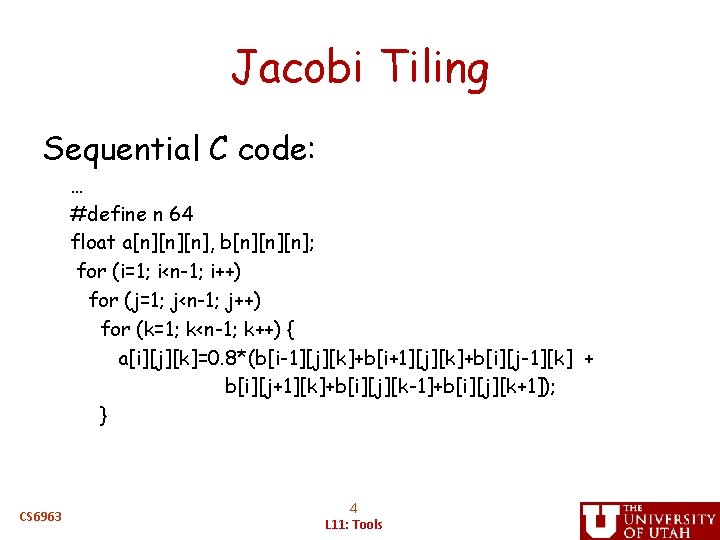
Jacobi Tiling Sequential C code: … #define n 64 float a[n][n][n], b[n][n][n]; for (i=1; i<n-1; i++) for (j=1; j<n-1; j++) for (k=1; k<n-1; k++) { a[i][j][k]=0. 8*(b[i-1][j][k]+b[i+1][j][k]+b[i][j-1][k] + b[i][j+1][k]+b[i][j][k-1]+b[i][j][k+1]); } CS 6963 4 L 11: Tools
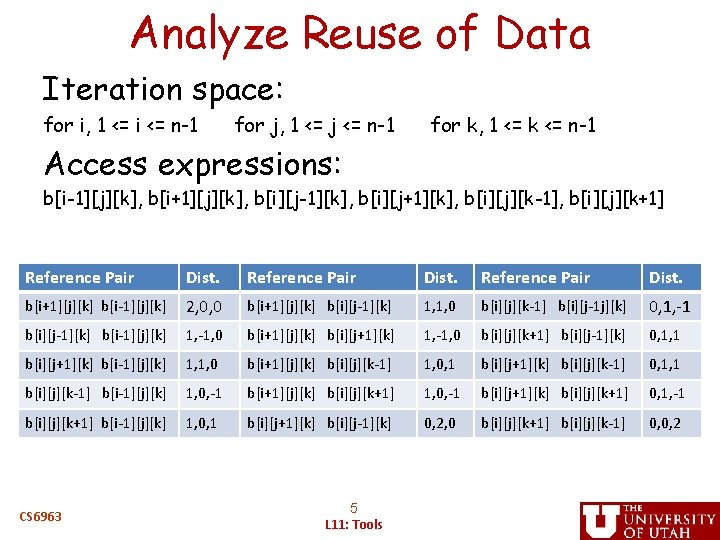
Analyze Reuse of Data Iteration space: for i, 1 <= i <= n-1 for j, 1 <= j <= n-1 for k, 1 <= k <= n-1 Access expressions: b[i-1][j][k], b[i+1][j][k], b[i][j-1][k], b[i][j+1][k], b[i][j][k-1], b[i][j][k+1] Reference Pair Dist. b[i+1][j][k] b[i-1][j][k] 2, 0, 0 b[i+1][j][k] b[i][j-1][k] 1, 1, 0 b[i][j][k-1] b[i][j-1 j][k] 0, 1, -1 b[i][j-1][k] b[i-1][j][k] 1, -1, 0 b[i+1][j][k] b[i][j+1][k] 1, -1, 0 b[i][j][k+1] b[i][j-1][k] 0, 1, 1 b[i][j+1][k] b[i-1][j][k] 1, 1, 0 b[i+1][j][k] b[i][j][k-1] 1, 0, 1 b[i][j+1][k] b[i][j][k-1] 0, 1, 1 b[i][j][k-1] b[i-1][j][k] 1, 0, -1 b[i+1][j][k] b[i][j][k+1] 1, 0, -1 b[i][j+1][k] b[i][j][k+1] 0, 1, -1 b[i][j][k+1] b[i-1][j][k] 1, 0, 1 b[i][j+1][k] b[i][j-1][k] 0, 2, 0 b[i][j][k+1] b[i][j][k-1] 0, 0, 2 CS 6963 5 L 11: Tools
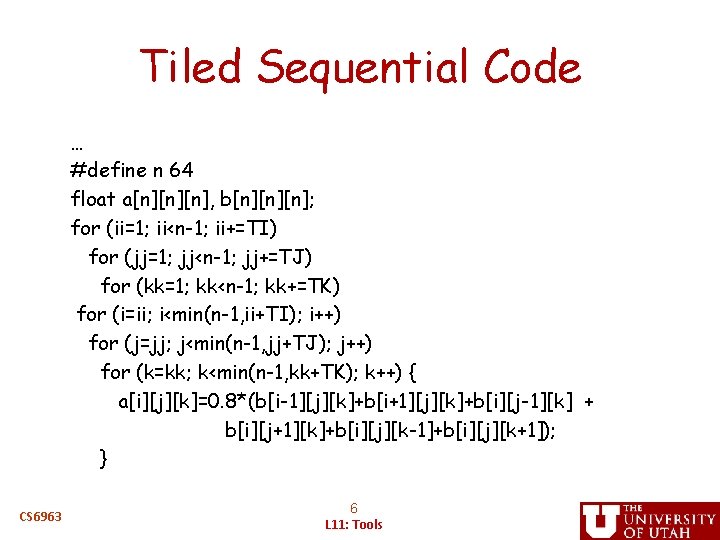
Tiled Sequential Code … #define n 64 float a[n][n][n], b[n][n][n]; for (ii=1; ii<n-1; ii+=TI) for (jj=1; jj<n-1; jj+=TJ) for (kk=1; kk<n-1; kk+=TK) for (i=ii; i<min(n-1, ii+TI); i++) for (j=jj; j<min(n-1, jj+TJ); j++) for (k=kk; k<min(n-1, kk+TK); k++) { a[i][j][k]=0. 8*(b[i-1][j][k]+b[i+1][j][k]+b[i][j-1][k] + b[i][j+1][k]+b[i][j][k-1]+b[i][j][k+1]); } CS 6963 6 L 11: Tools
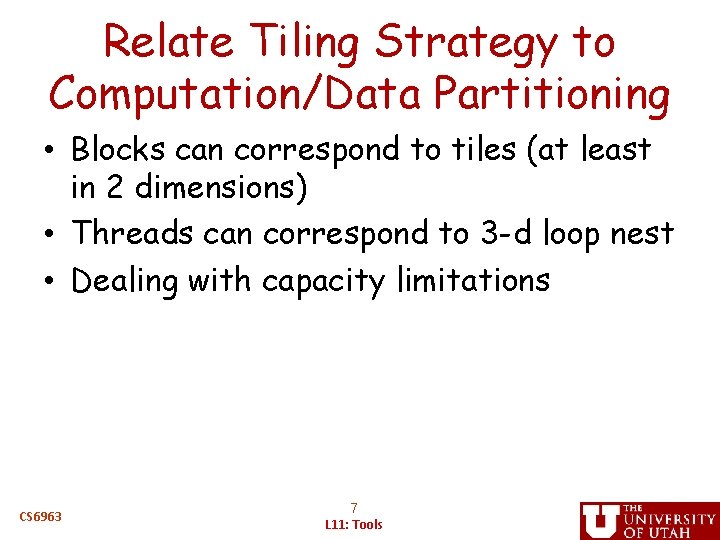
Relate Tiling Strategy to Computation/Data Partitioning • Blocks can correspond to tiles (at least in 2 dimensions) • Threads can correspond to 3 -d loop nest • Dealing with capacity limitations CS 6963 7 L 11: Tools
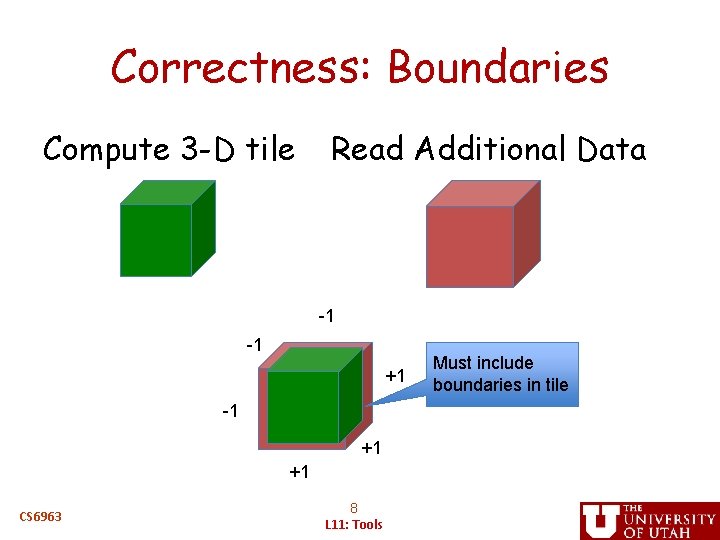
Correctness: Boundaries Compute 3 -D tile Read Additional Data -1 -1 +1 +1 CS 6963 8 L 11: Tools Must include boundaries in tile
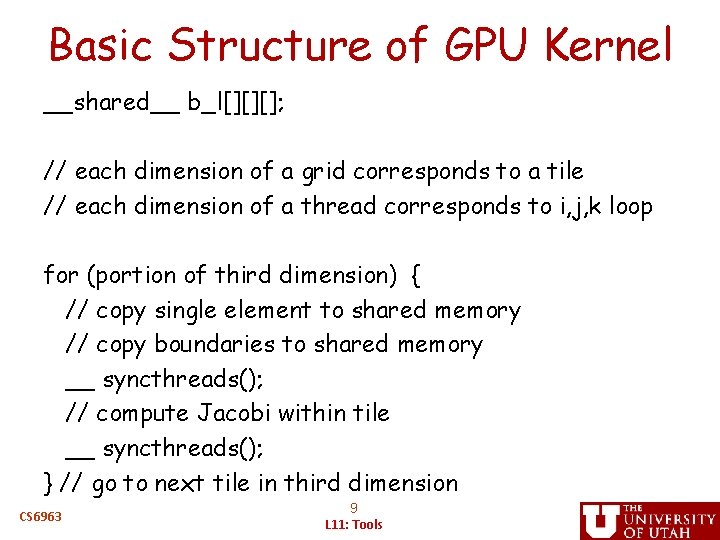
Basic Structure of GPU Kernel __shared__ b_l[][][]; // each dimension of a grid corresponds to a tile // each dimension of a thread corresponds to i, j, k loop for (portion of third dimension) { // copy single element to shared memory // copy boundaries to shared memory __ syncthreads(); // compute Jacobi within tile __ syncthreads(); } // go to next tile in third dimension CS 6963 9 L 11: Tools
Performance Expectations? • Host-only original • Global memory • Shared memory CS 6963 10 L 11: Tools
Tools: Occupancy Calculator • Assists in calculating how many threads and blocks to use in the computation partitioning – Points to resource limitations – Points to underutilized resources • Download from: – http: //www. nvidia. com/object/cuda_programming_tools. html CS 6963 11 L 11: Tools
Using the Occupancy Calculator • First, what is the “compute capability” of your device? (see Appendix A of programmer’s guide) – Most available devices are 1. 1 – GTX and Tesla are 1. 3 • Second, compile code with special flag to obtain feedback from compiler – --ptxas-options=-v CS 6963 12 L 11: Tools
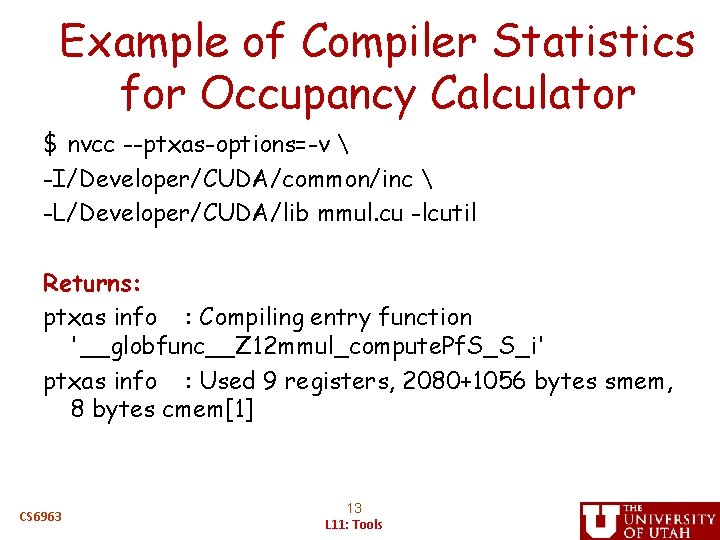
Example of Compiler Statistics for Occupancy Calculator $ nvcc --ptxas-options=-v -I/Developer/CUDA/common/inc -L/Developer/CUDA/lib mmul. cu -lcutil Returns: ptxas info : Compiling entry function '__globfunc__Z 12 mmul_compute. Pf. S_S_i' ptxas info : Used 9 registers, 2080+1056 bytes smem, 8 bytes cmem[1] CS 6963 13 L 11: Tools
Next Tool: Profiler • What it does: – Provide access to hardware performance monitors – Pinpoint performance issues and compare across implementations • Two interfaces: – Text-based: • Built-in and included with compiler – GUI: • Download from http: //www. nvidia. com/object/cuda_programming_tools. html CS 6963 14 L 11: Tools
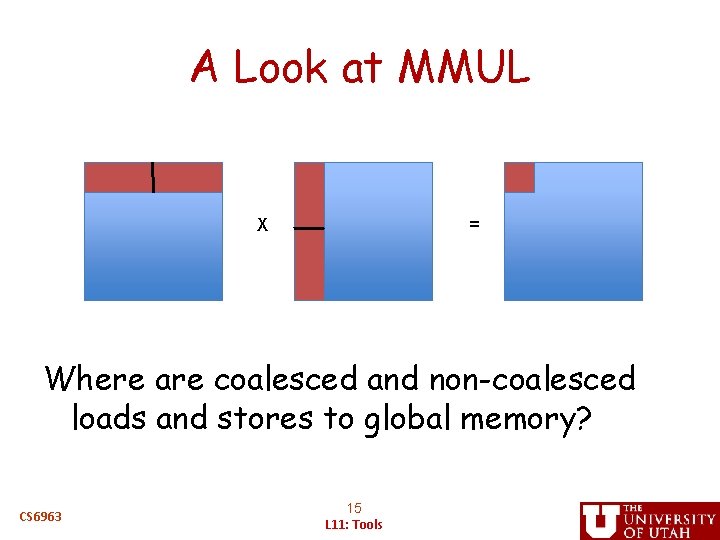
A Look at MMUL X = Where are coalesced and non-coalesced loads and stores to global memory? CS 6963 15 L 11: Tools
Another example • Reverse array from Dr. Dobb’s journal • http: //www. ddj. com/architect/207200659 • Reverse_global • Copy from global to shared, then back to global in reverse order • Reverse_shared • Copy from global to reverse shared and rewrite in order to global • Output – http: //www. ddj. com/architect/209601096? pgno=2 CS 6963 16 L 11: Tools
MPM/GIMP Questions from Last Time • Lab machine set up? Python? Gnuplot? • Hybrid data structure to deal with updates to grid in some cases and particles in other cases CS 6963 17 L 11: Tools
Some Strategies and Methodologies • Note that README. txt tells how to run “impact. exe”, using small number of cpp files • Convert to single precision by replacing all “double” with “float” • Discussion of data structures See update. Contrib. List in shape. cpp and patch. h CS 6963 18 L 11: Tools
- Slides: 18