
L 10 additional State Machine examples States Machine
- Slides: 30
L 10 – additional State Machine examples
States Machine Design o Other topics on state machine design n n o Examples that are Equivalent More one hot examples Ref: text Unit 15. 4, 15. 5, 15. 8 9/2/2012 – ECE 3561 Lect 10 Copyright 2012 - Joanne De. Groat, ECE, OSU 2
Equivalent State Machines o o So far have seen that equivalent states in the state table of a sequential machine are equivalent and can be removed. How about the equivalence between two sequential circuits? n Two sequential circuits are equivalent if they are capable of doing the same work. 9/2/2012 – ECE 3561 Lect 10 Copyright 2012 - Joanne De. Groat, ECE, OSU 3
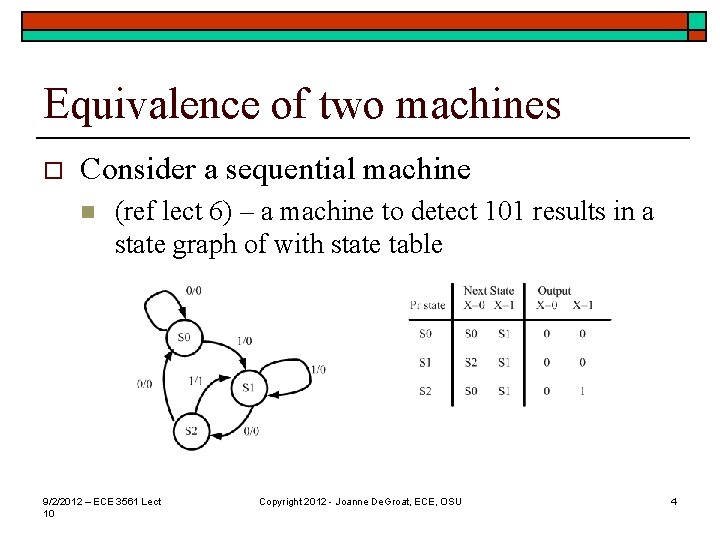
Equivalence of two machines o Consider a sequential machine n (ref lect 6) – a machine to detect 101 results in a state graph of with state table 9/2/2012 – ECE 3561 Lect 10 Copyright 2012 - Joanne De. Groat, ECE, OSU 4
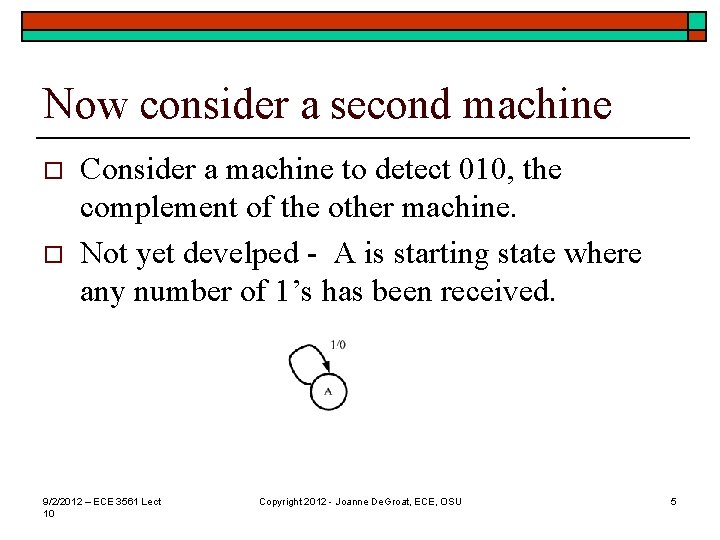
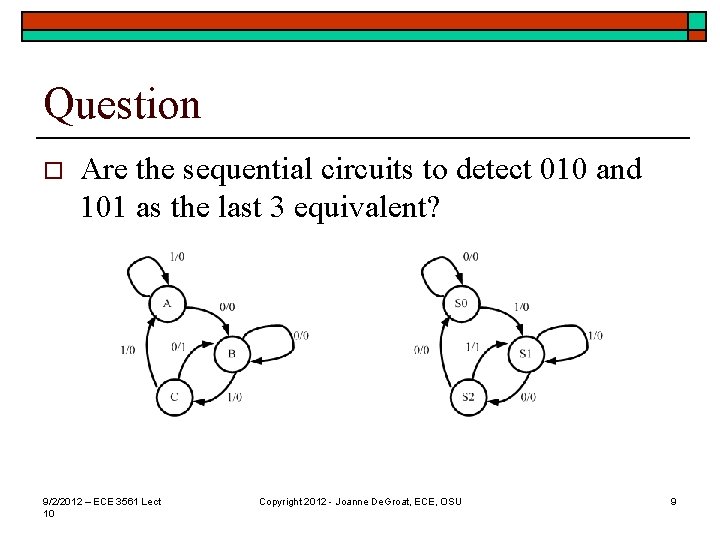
Now consider a second machine o o Consider a machine to detect 010, the complement of the other machine. Not yet develped - A is starting state where any number of 1’s has been received. 9/2/2012 – ECE 3561 Lect 10 Copyright 2012 - Joanne De. Groat, ECE, OSU 5
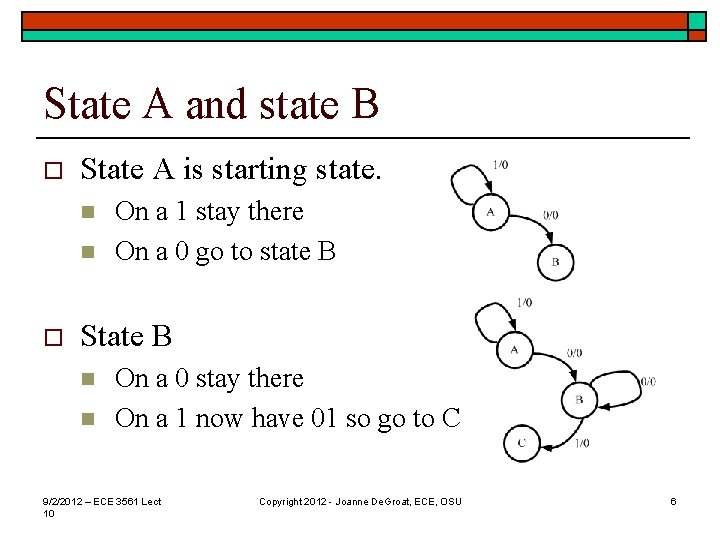
State A and state B o State A is starting state. n n o On a 1 stay there On a 0 go to state B State B n n On a 0 stay there On a 1 now have 01 so go to C 9/2/2012 – ECE 3561 Lect 10 Copyright 2012 - Joanne De. Groat, ECE, OSU 6
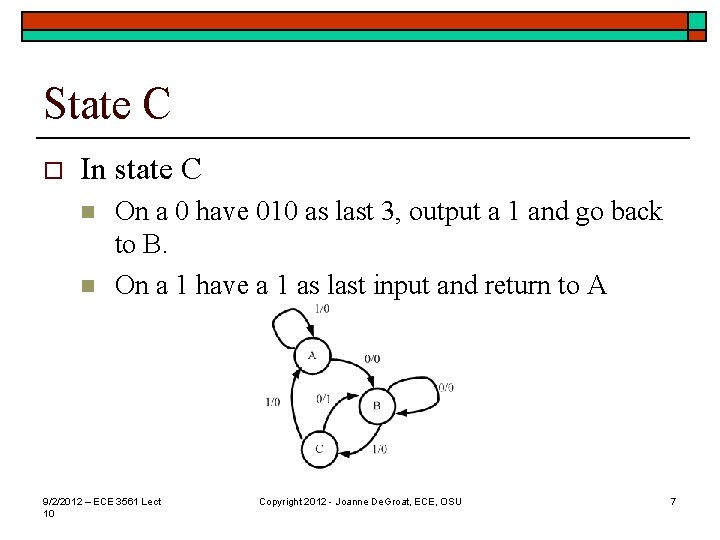
State C o In state C n n On a 0 have 010 as last 3, output a 1 and go back to B. On a 1 have a 1 as last input and return to A 9/2/2012 – ECE 3561 Lect 10 Copyright 2012 - Joanne De. Groat, ECE, OSU 7
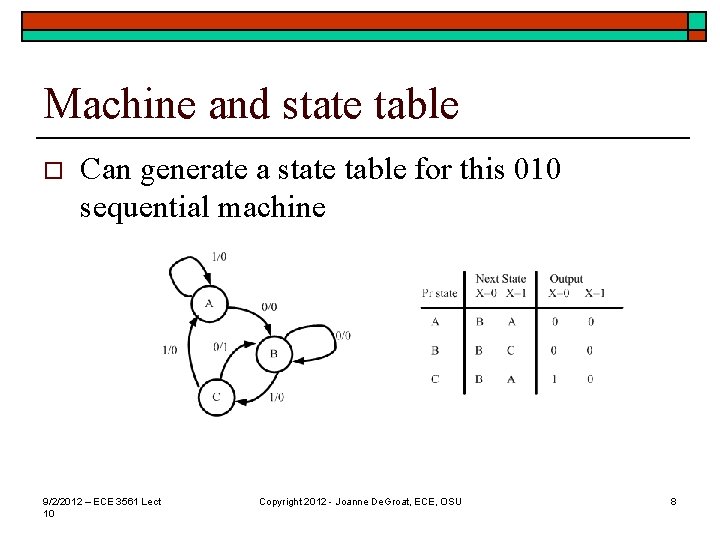
Machine and state table o Can generate a state table for this 010 sequential machine 9/2/2012 – ECE 3561 Lect 10 Copyright 2012 - Joanne De. Groat, ECE, OSU 8
Question o Are the sequential circuits to detect 010 and 101 as the last 3 equivalent? 9/2/2012 – ECE 3561 Lect 10 Copyright 2012 - Joanne De. Groat, ECE, OSU 9
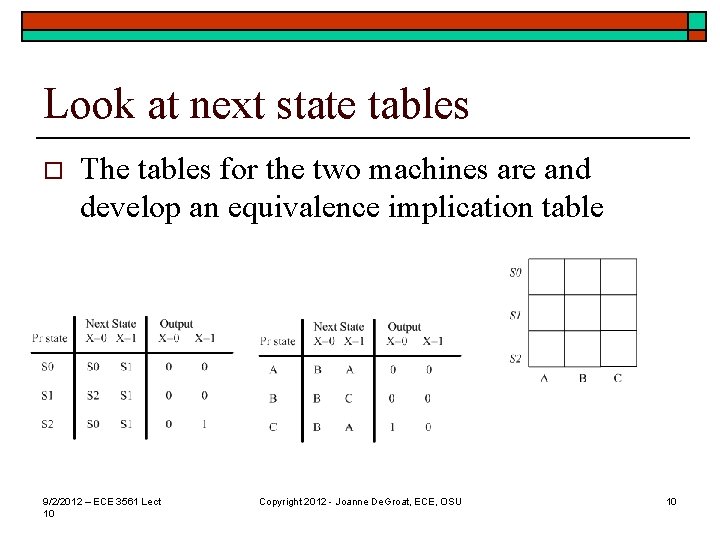
Look at next state tables o The tables for the two machines are and develop an equivalence implication table 9/2/2012 – ECE 3561 Lect 10 Copyright 2012 - Joanne De. Groat, ECE, OSU 10
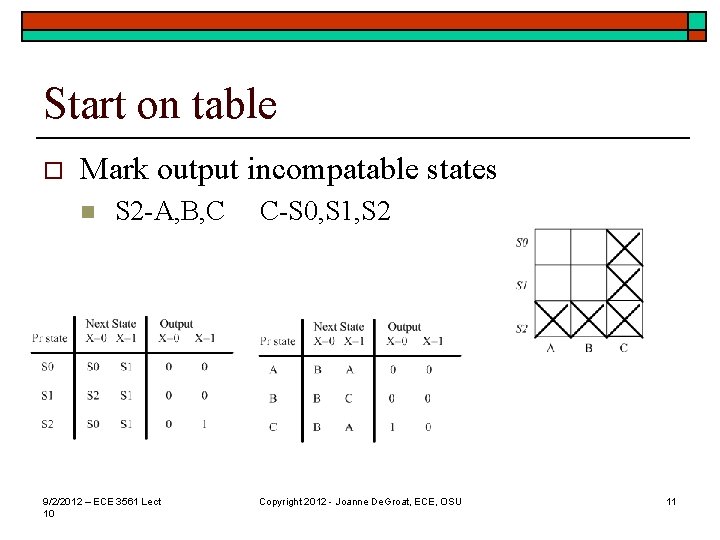
Start on table o Mark output incompatable states n S 2 -A, B, C 9/2/2012 – ECE 3561 Lect 10 C-S 0, S 1, S 2 Copyright 2012 - Joanne De. Groat, ECE, OSU 11
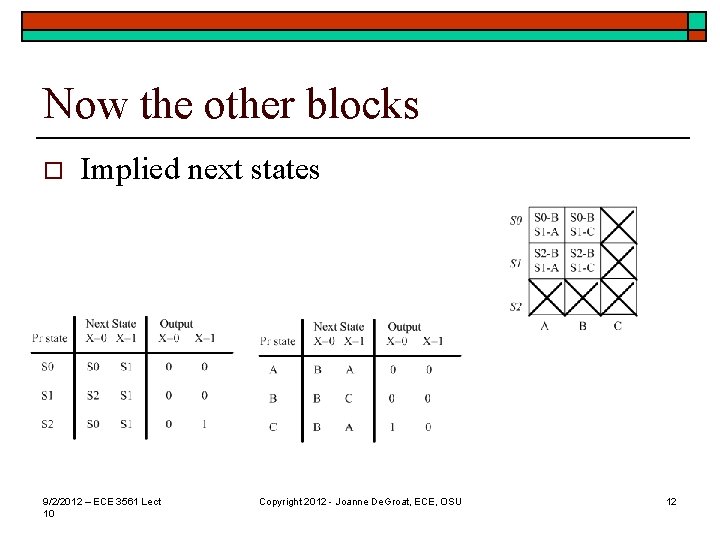
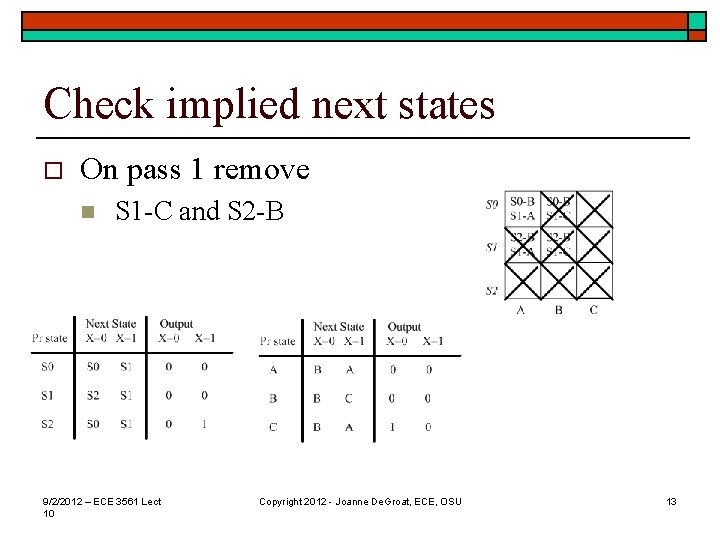
Now the other blocks o Implied next states 9/2/2012 – ECE 3561 Lect 10 Copyright 2012 - Joanne De. Groat, ECE, OSU 12
Check implied next states o On pass 1 remove n S 1 -C and S 2 -B 9/2/2012 – ECE 3561 Lect 10 Copyright 2012 - Joanne De. Groat, ECE, OSU 13
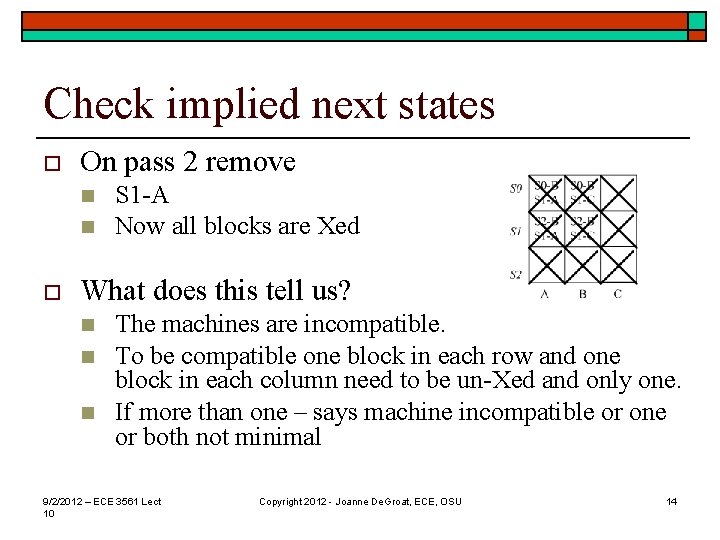
Check implied next states o On pass 2 remove n n o S 1 -A Now all blocks are Xed What does this tell us? n n n The machines are incompatible. To be compatible one block in each row and one block in each column need to be un-Xed and only one. If more than one – says machine incompatible or one or both not minimal 9/2/2012 – ECE 3561 Lect 10 Copyright 2012 - Joanne De. Groat, ECE, OSU 14
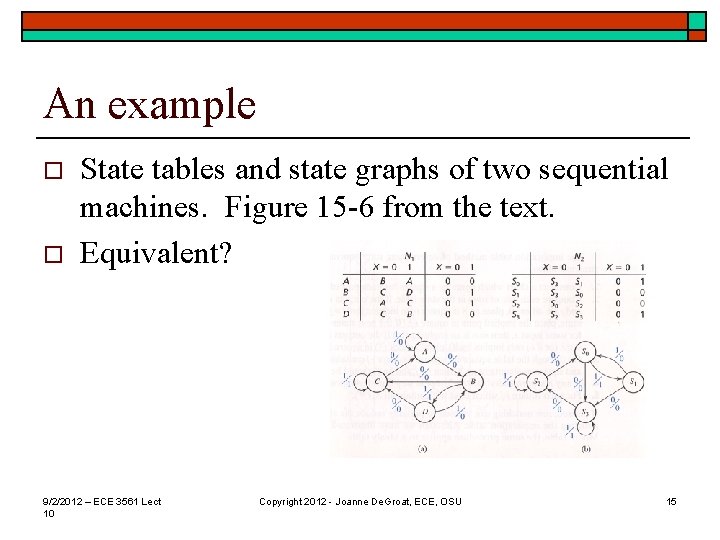
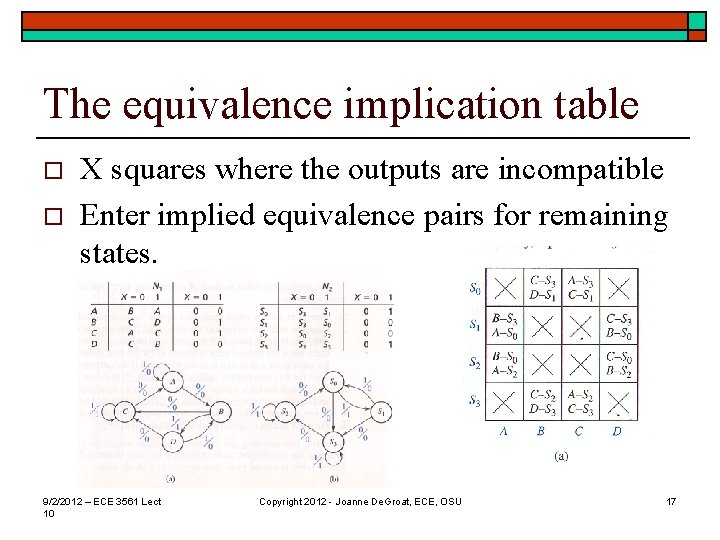
An example o o State tables and state graphs of two sequential machines. Figure 15 -6 from the text. Equivalent? 9/2/2012 – ECE 3561 Lect 10 Copyright 2012 - Joanne De. Groat, ECE, OSU 15
Proving equivalence o Again will use an implication table. n n n o Only this time, it is the full square. Along bottom are the states of one machine Along the side are the states of the second. Start by removing output incompatible states. 9/2/2012 – ECE 3561 Lect 10 Copyright 2012 - Joanne De. Groat, ECE, OSU 16
The equivalence implication table o o X squares where the outputs are incompatible Enter implied equivalence pairs for remaining states. 9/2/2012 – ECE 3561 Lect 10 Copyright 2012 - Joanne De. Groat, ECE, OSU 17
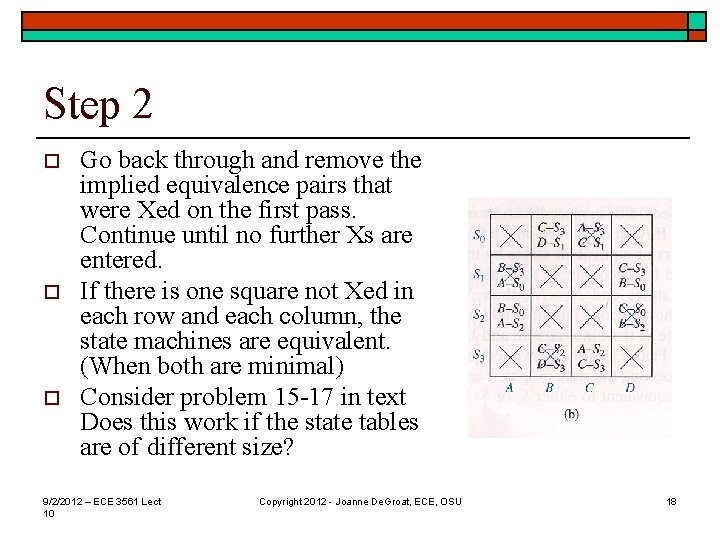
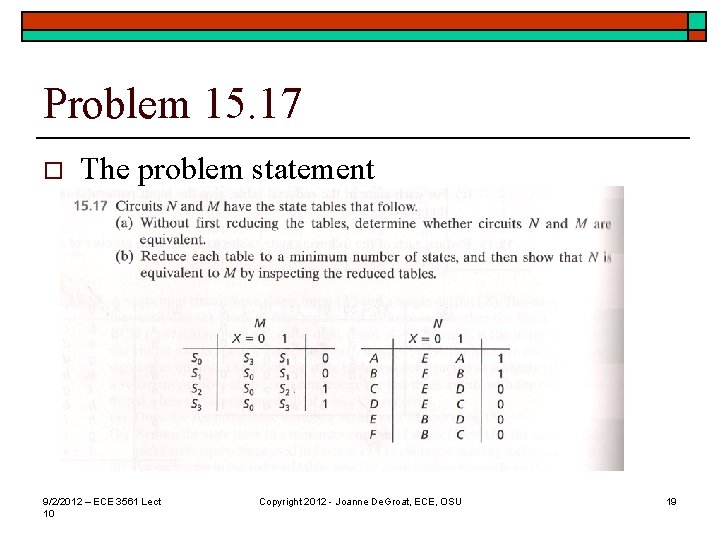
Step 2 o o o Go back through and remove the implied equivalence pairs that were Xed on the first pass. Continue until no further Xs are entered. If there is one square not Xed in each row and each column, the state machines are equivalent. (When both are minimal) Consider problem 15 -17 in text Does this work if the state tables are of different size? 9/2/2012 – ECE 3561 Lect 10 Copyright 2012 - Joanne De. Groat, ECE, OSU 18
Problem 15. 17 o The problem statement 9/2/2012 – ECE 3561 Lect 10 Copyright 2012 - Joanne De. Groat, ECE, OSU 19
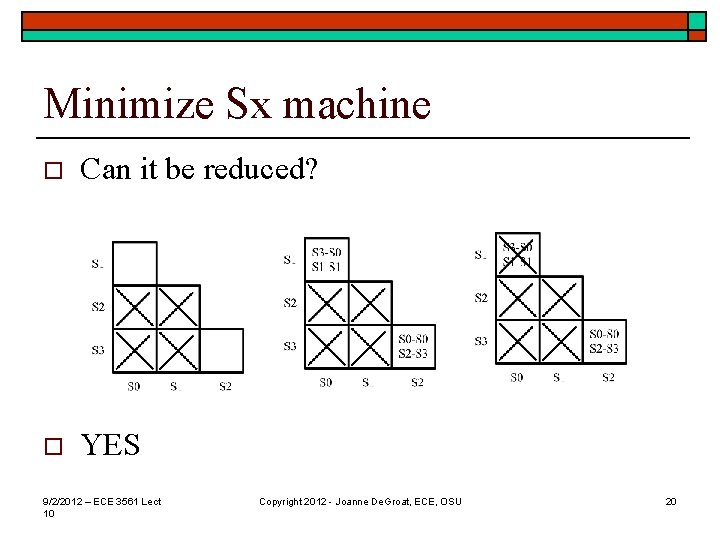
Minimize Sx machine o Can it be reduced? o YES 9/2/2012 – ECE 3561 Lect 10 Copyright 2012 - Joanne De. Groat, ECE, OSU 20
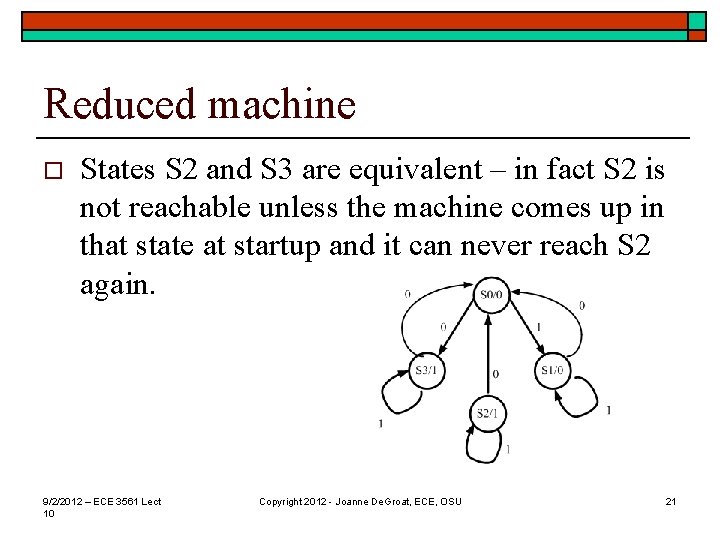
Reduced machine o States S 2 and S 3 are equivalent – in fact S 2 is not reachable unless the machine comes up in that state at startup and it can never reach S 2 again. 9/2/2012 – ECE 3561 Lect 10 Copyright 2012 - Joanne De. Groat, ECE, OSU 21
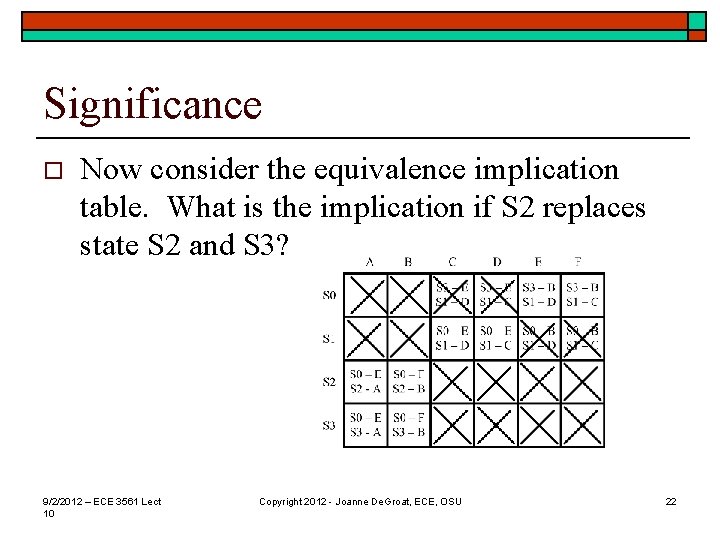
Significance o Now consider the equivalence implication table. What is the implication if S 2 replaces state S 2 and S 3? 9/2/2012 – ECE 3561 Lect 10 Copyright 2012 - Joanne De. Groat, ECE, OSU 22
Incompletely Specified o Incompletely Specified State Tables n n o o State tables that contain don’t cares. Results in reduced logic Determining the best way to fill in the don’t cares is another of the n-p complete problems. For this course do the most logical approach. 9/2/2012 – ECE 3561 Lect 10 Copyright 2012 - Joanne De. Groat, ECE, OSU 23
One Hot o o o CPLDs and FPGAs have a good number of F/Fs onboard. The F/Fs are there whether they are used or not, so a circuit with the minimum number of F/Fs is not the ultimate objective. For these devices the objective is to reduce the total number of logic cells used and the interconnection between cells. One hot encoding is one approach to have shorter signal paths and reduce logic cells. 9/2/2012 – ECE 3561 Lect 10 Copyright 2012 - Joanne De. Groat, ECE, OSU 24
What is one hot? o o o One hot is a method where a flip flop is used for each state in the state machine. A state machine with n states will require n flip flops in its realization. One hot realization is excellent for controllers that step through a set sequence of linear steps. Text gives example of a multiplier controller state graph which is not linear. 9/2/2012 – ECE 3561 Lect 10 Copyright 2012 - Joanne De. Groat, ECE, OSU 25
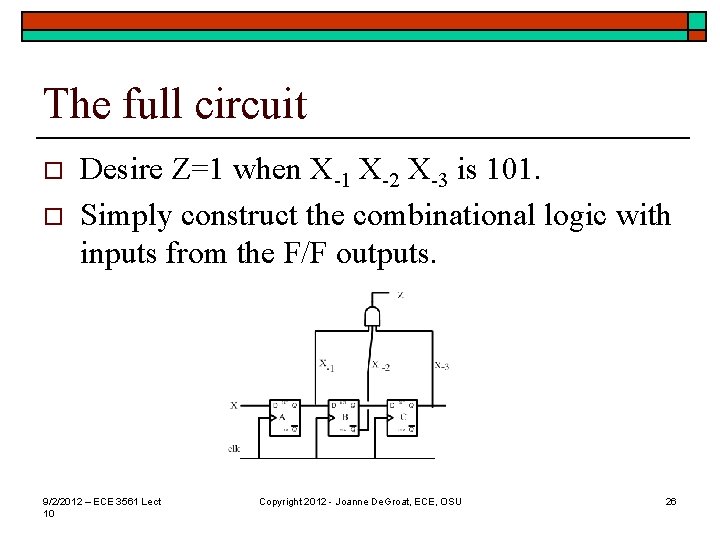
The full circuit o o Desire Z=1 when X-1 X-2 X-3 is 101. Simply construct the combinational logic with inputs from the F/F outputs. 9/2/2012 – ECE 3561 Lect 10 Copyright 2012 - Joanne De. Groat, ECE, OSU 26
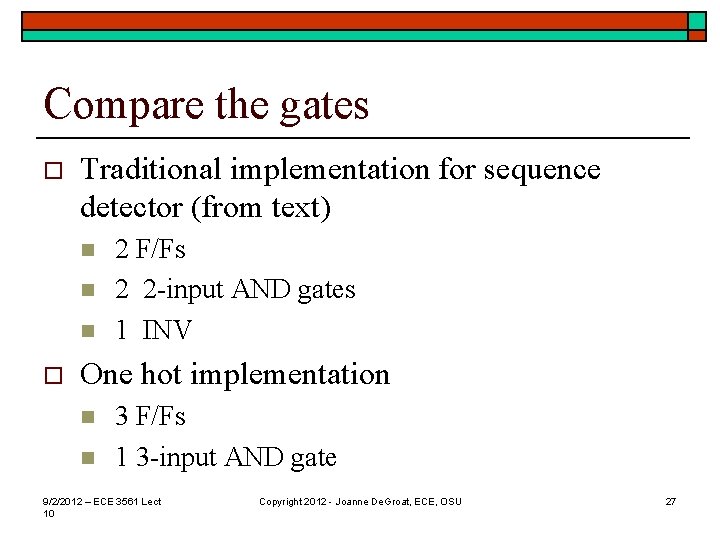
Compare the gates o Traditional implementation for sequence detector (from text) n n n o 2 F/Fs 2 2 -input AND gates 1 INV One hot implementation n n 3 F/Fs 1 3 -input AND gate 9/2/2012 – ECE 3561 Lect 10 Copyright 2012 - Joanne De. Groat, ECE, OSU 27
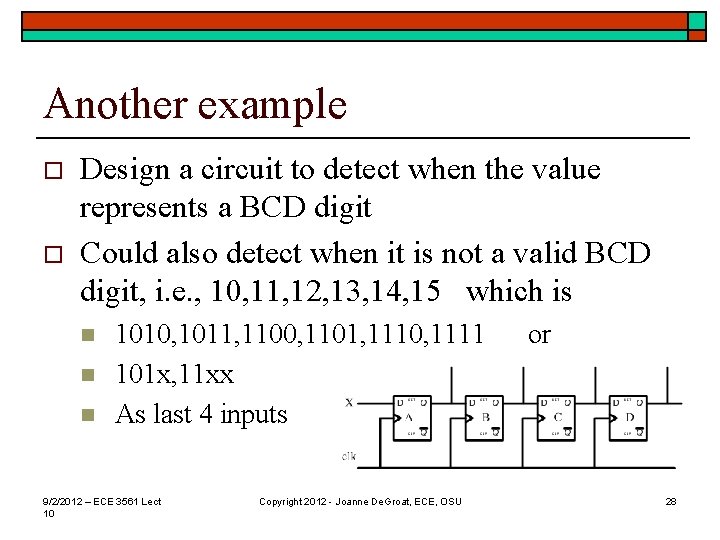
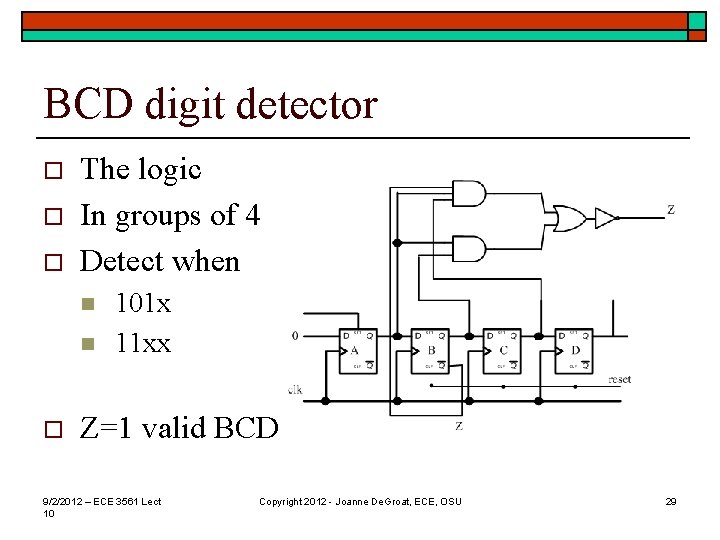
Another example o o Design a circuit to detect when the value represents a BCD digit Could also detect when it is not a valid BCD digit, i. e. , 10, 11, 12, 13, 14, 15 which is n n n 1010, 1011, 1100, 1101, 1110, 1111 101 x, 11 xx As last 4 inputs 9/2/2012 – ECE 3561 Lect 10 Copyright 2012 - Joanne De. Groat, ECE, OSU or 28
BCD digit detector o o o The logic In groups of 4 Detect when n n o 101 x 11 xx Z=1 valid BCD 9/2/2012 – ECE 3561 Lect 10 Copyright 2012 - Joanne De. Groat, ECE, OSU 29
Lecture summary o o Have again looked at state machine equivalence. One hot encoding and it is interesting for many implementations. 9/2/2012 – ECE 3561 Lect 10 Copyright 2012 - Joanne De. Groat, ECE, OSU 30