
L 10 1 Review Multiple Rxns Selectivity 1
![Rate of disappearance of ethane: L 10 -22 Purpose: replace [CH 3 • ]](https://slidetodoc.com/presentation_image_h/edfeb21060b1e81d89f9aba8f1402e29/image-22.jpg "Rate of disappearance of ethane: L 10 -22 Purpose: replace [CH 3 • ]")
- Slides: 34
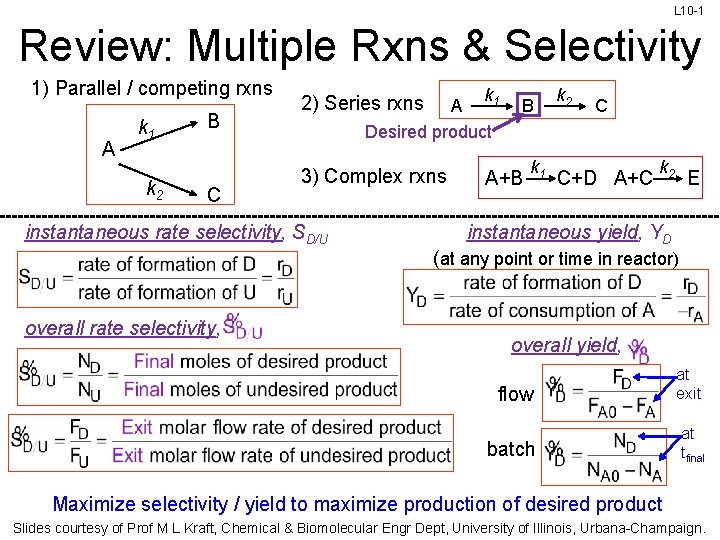
L 10 -1 Review: Multiple Rxns & Selectivity 1) Parallel / competing rxns A k 1 k 2 B C k 1 A Desired product 2) Series rxns 3) Complex rxns instantaneous rate selectivity, SD/U overall rate selectivity, B A+B k 1 k 2 C C+D A+C k 2 E instantaneous yield, YD (at any point or time in reactor) overall yield, flow at exit batch at tfinal Maximize selectivity / yield to maximize production of desired product Slides courtesy of Prof M L Kraft, Chemical & Biomolecular Engr Dept, University of Illinois, Urbana-Champaign.
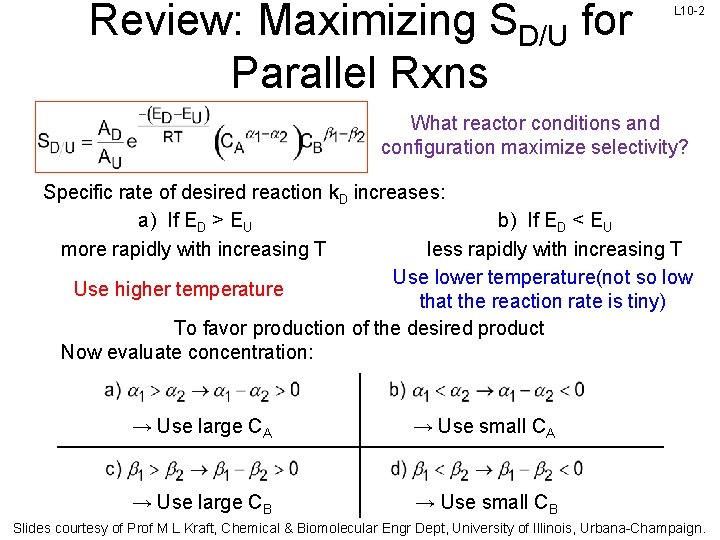
Review: Maximizing SD/U for Parallel Rxns L 10 -2 What reactor conditions and configuration maximize selectivity? Specific rate of desired reaction k. D increases: a) If ED > EU b) If ED < EU more rapidly with increasing T less rapidly with increasing T Use lower temperature(not so low Use higher temperature that the reaction rate is tiny) To favor production of the desired product Now evaluate concentration: → Use large CA → Use small CA → Use large CB → Use small CB Slides courtesy of Prof M L Kraft, Chemical & Biomolecular Engr Dept, University of Illinois, Urbana-Champaign.
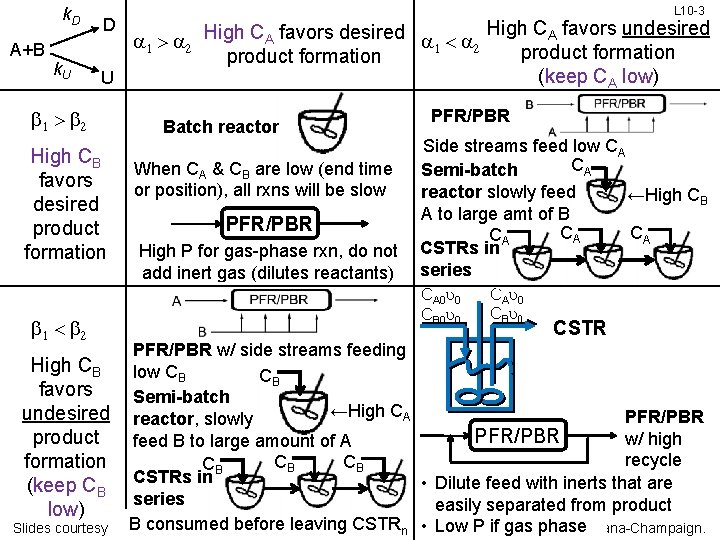
k. D A+B k. U D High CA favors undesired High C favors desired A a 1 > a 2 a 1 < a 2 product formation (keep CA low) U b 1 > b 2 High CB favors desired product formation b 1 < b 2 L 10 -3 Batch reactor When CA & CB are low (end time or position), all rxns will be slow PFR/PBR High P for gas-phase rxn, do not add inert gas (dilutes reactants) PFR/PBR Side streams feed low CA CA Semi-batch reactor slowly feed ←High CB A to large amt of B CA CA CA CSTRs in series CA 0 u 0 CB 0 u 0 CAu 0 CBu 0 CSTR PFR/PBR w/ side streams feeding High CB low CB CB favors Semi-batch ←High CA undesired reactor, slowly PFR/PBR product w/ high feed B to large amount of A recycle CB CB formation CB • Dilute feed with inerts that are (keep CB CSTRs in series easily separated from product low) B consumed before&leaving CSTR • Low P if gas phase. Urbana-Champaign. Slides courtesy of Prof M L Kraft, Chemical Biomolecular Engr University of Illinois, n Dept,
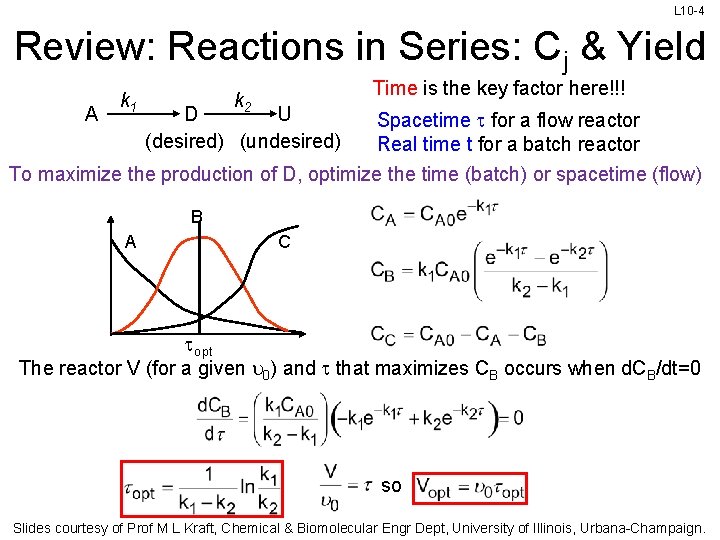
L 10 -4 Review: Reactions in Series: Cj & Yield A k 1 Time is the key factor here!!! k 2 U D (desired) (undesired) Spacetime t for a flow reactor Real time t for a batch reactor To maximize the production of D, optimize the time (batch) or spacetime (flow) B A C topt The reactor V (for a given u 0) and t that maximizes CB occurs when d. CB/dt=0 so Slides courtesy of Prof M L Kraft, Chemical & Biomolecular Engr Dept, University of Illinois, Urbana-Champaign.
L 10 -5 L 10: Nonelementary Reaction Kinetics In practice, knowledge of the reaction mechanism helps use to design better catalyst, trouble shoot, aid in troubleshooting poor reactor performance • Rate law is typically determined from experimental data • Goal: Use the experimental rate law to postulate a reaction mechanism • Elementary: the reaction orders and stoichiometric coefficients are identical • Nonelementary reaction kinetics: no direct correspondence between reaction order and stoichiometry – Nonelementary kinetics – Pseudo-steady-state hypothesis (PSSH) – Chain reactions: cracking ethane or polymerizations – Enzymatic reactions (covered in CHBE 471) – Bioreactors (covered in CHBE 471) Slides courtesy of Prof M L Kraft, Chemical & Biomolecular Engr Dept, University of Illinois, Urbana-Champaign.
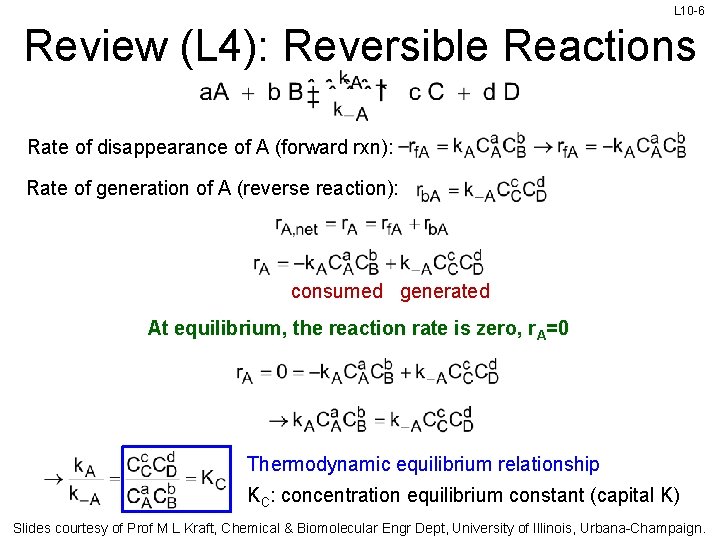
L 10 -6 Review (L 4): Reversible Reactions Rate of disappearance of A (forward rxn): Rate of generation of A (reverse reaction): consumed generated At equilibrium, the reaction rate is zero, r. A=0 Thermodynamic equilibrium relationship KC: concentration equilibrium constant (capital K) Slides courtesy of Prof M L Kraft, Chemical & Biomolecular Engr Dept, University of Illinois, Urbana-Champaign.
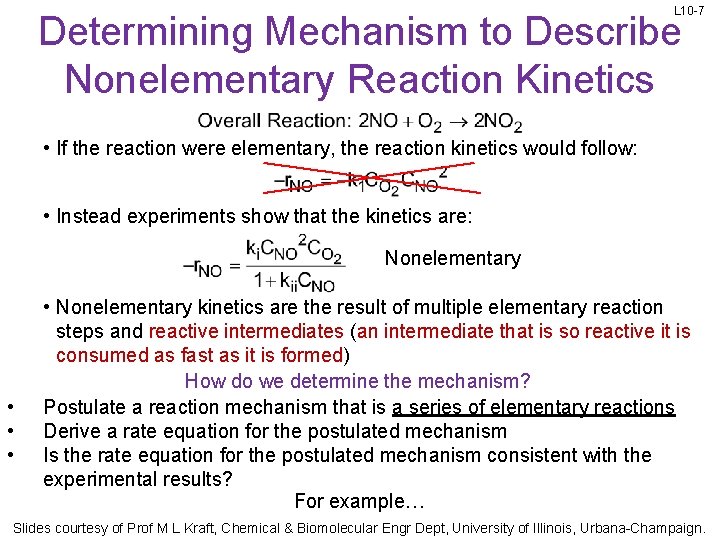
L 10 -7 Determining Mechanism to Describe Nonelementary Reaction Kinetics • If the reaction were elementary, the reaction kinetics would follow: • Instead experiments show that the kinetics are: Nonelementary • • Nonelementary kinetics are the result of multiple elementary reaction steps and reactive intermediates (an intermediate that is so reactive it is consumed as fast as it is formed) How do we determine the mechanism? Postulate a reaction mechanism that is a series of elementary reactions Derive a rate equation for the postulated mechanism Is the rate equation for the postulated mechanism consistent with the experimental results? For example… Slides courtesy of Prof M L Kraft, Chemical & Biomolecular Engr Dept, University of Illinois, Urbana-Champaign.
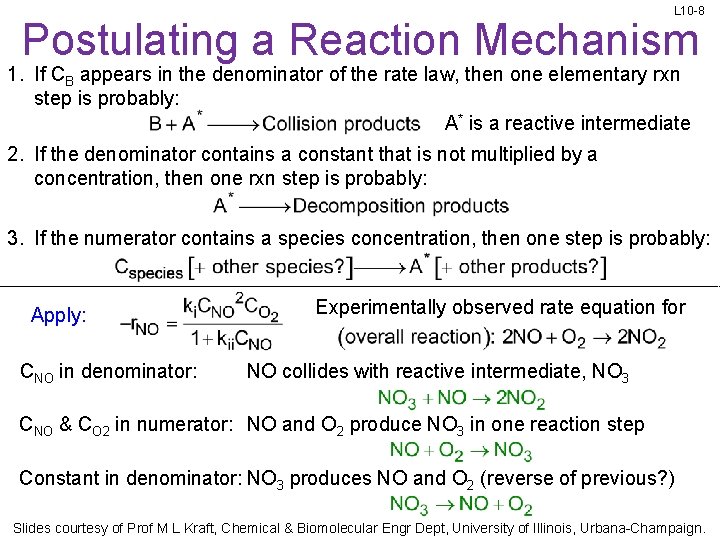
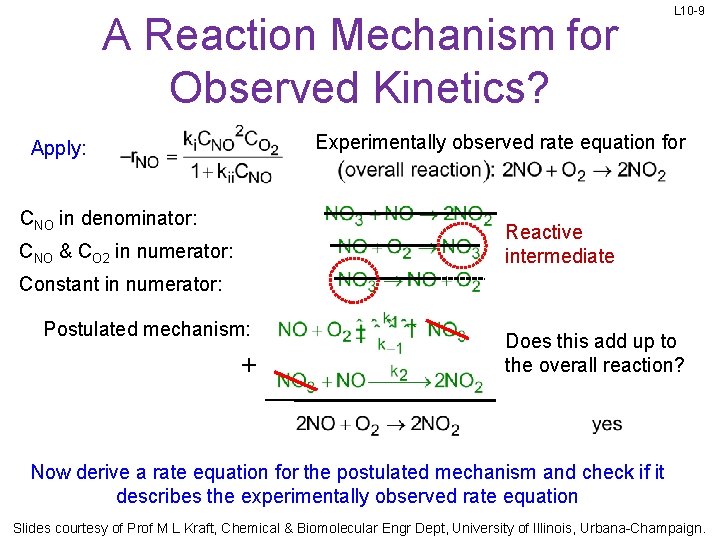
L 10 -8 Postulating a Reaction Mechanism 1. If CB appears in the denominator of the rate law, then one elementary rxn step is probably: A* is a reactive intermediate 2. If the denominator contains a constant that is not multiplied by a concentration, then one rxn step is probably: 3. If the numerator contains a species concentration, then one step is probably: Apply: CNO in denominator: Experimentally observed rate equation for NO collides with reactive intermediate, NO 3 CNO & CO 2 in numerator: NO and O 2 produce NO 3 in one reaction step Constant in denominator: NO 3 produces NO and O 2 (reverse of previous? ) Slides courtesy of Prof M L Kraft, Chemical & Biomolecular Engr Dept, University of Illinois, Urbana-Champaign.
A Reaction Mechanism for Observed Kinetics? L 10 -9 Experimentally observed rate equation for Apply: CNO in denominator: Reactive intermediate CNO & CO 2 in numerator: Constant in numerator: Postulated mechanism: + Does this add up to the overall reaction? Now derive a rate equation for the postulated mechanism and check if it describes the experimentally observed rate equation Slides courtesy of Prof M L Kraft, Chemical & Biomolecular Engr Dept, University of Illinois, Urbana-Champaign.
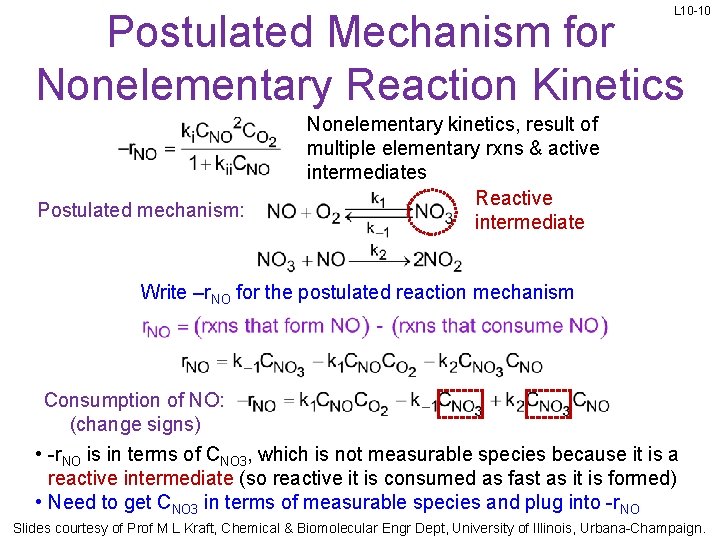
L 10 -10 Postulated Mechanism for Nonelementary Reaction Kinetics Postulated mechanism: Nonelementary kinetics, result of multiple elementary rxns & active intermediates Reactive intermediate Write –r. NO for the postulated reaction mechanism Consumption of NO: (change signs) • -r. NO is in terms of CNO 3, which is not measurable species because it is a reactive intermediate (so reactive it is consumed as fast as it is formed) • Need to get CNO 3 in terms of measurable species and plug into -r. NO Slides courtesy of Prof M L Kraft, Chemical & Biomolecular Engr Dept, University of Illinois, Urbana-Champaign.
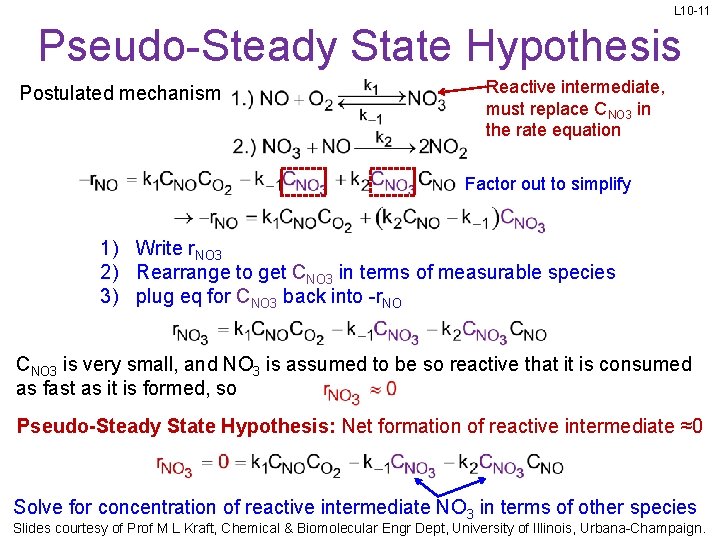
L 10 -11 Pseudo-Steady State Hypothesis Postulated mechanism Reactive intermediate, must replace CNO 3 in the rate equation Factor out to simplify 1) Write r. NO 3 2) Rearrange to get CNO 3 in terms of measurable species 3) plug eq for CNO 3 back into -r. NO CNO 3 is very small, and NO 3 is assumed to be so reactive that it is consumed as fast as it is formed, so Pseudo-Steady State Hypothesis: Net formation of reactive intermediate ≈0 Solve for concentration of reactive intermediate NO 3 in terms of other species Slides courtesy of Prof M L Kraft, Chemical & Biomolecular Engr Dept, University of Illinois, Urbana-Champaign.
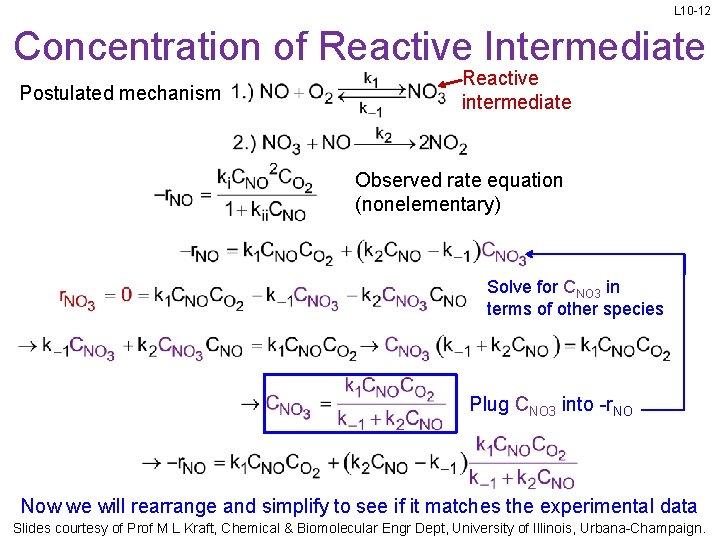
L 10 -12 Concentration of Reactive Intermediate Postulated mechanism Reactive intermediate Observed rate equation (nonelementary) Solve for CNO 3 in terms of other species Plug CNO 3 into -r. NO Now we will rearrange and simplify to see if it matches the experimental data Slides courtesy of Prof M L Kraft, Chemical & Biomolecular Engr Dept, University of Illinois, Urbana-Champaign.
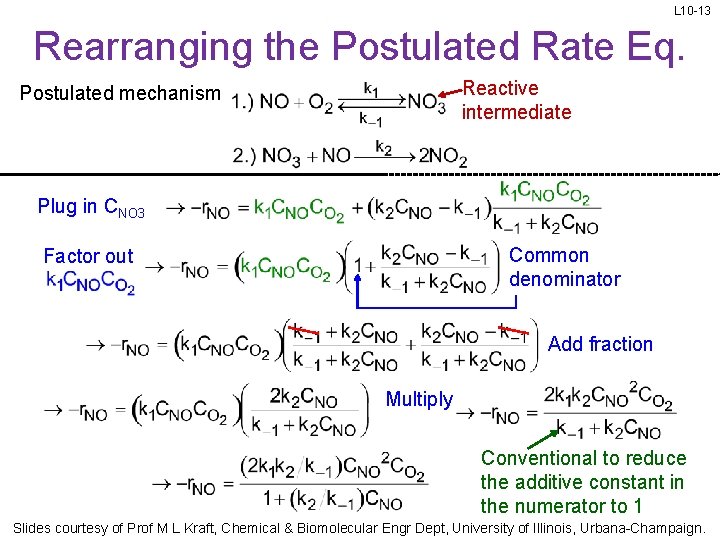
L 10 -13 Rearranging the Postulated Rate Eq. Reactive intermediate Postulated mechanism Plug in CNO 3 Common denominator Factor out Add fraction Multiply Conventional to reduce the additive constant in the numerator to 1 Slides courtesy of Prof M L Kraft, Chemical & Biomolecular Engr Dept, University of Illinois, Urbana-Champaign.
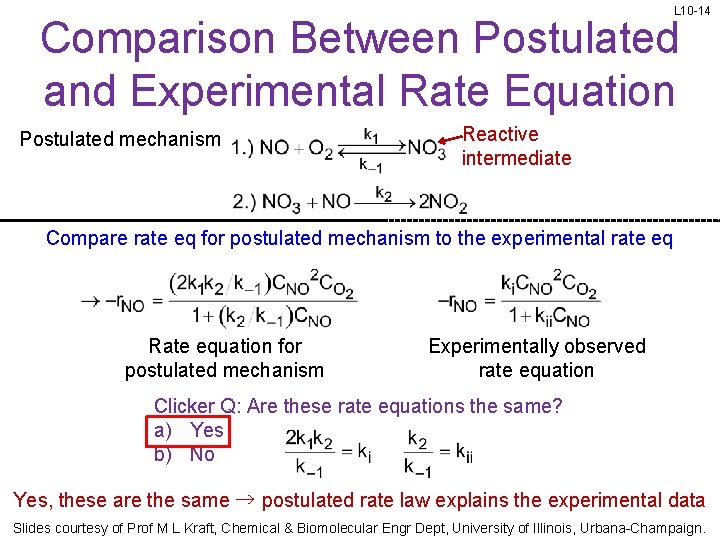
L 10 -14 Comparison Between Postulated and Experimental Rate Equation Postulated mechanism Reactive intermediate Compare rate eq for postulated mechanism to the experimental rate eq Rate equation for postulated mechanism Experimentally observed rate equation Clicker Q: Are these rate equations the same? a) Yes b) No Yes, these are the same → postulated rate law explains the experimental data Slides courtesy of Prof M L Kraft, Chemical & Biomolecular Engr Dept, University of Illinois, Urbana-Champaign.
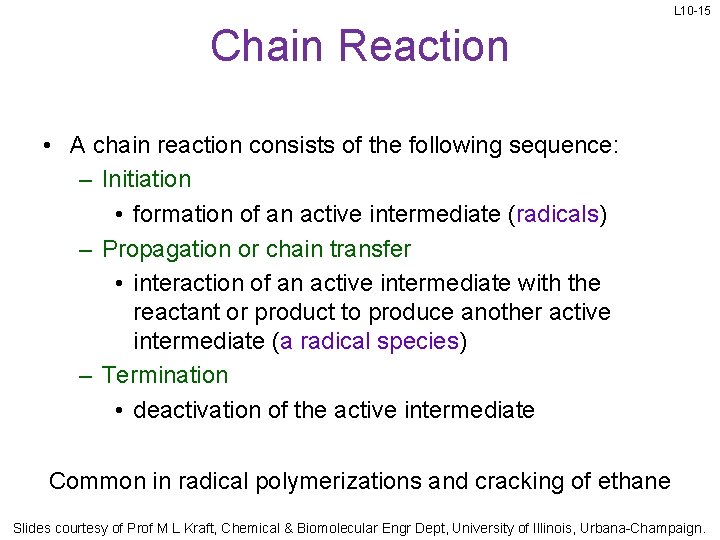
L 10 -15 Chain Reaction • A chain reaction consists of the following sequence: – Initiation • formation of an active intermediate (radicals) – Propagation or chain transfer • interaction of an active intermediate with the reactant or product to produce another active intermediate (a radical species) – Termination • deactivation of the active intermediate Common in radical polymerizations and cracking of ethane Slides courtesy of Prof M L Kraft, Chemical & Biomolecular Engr Dept, University of Illinois, Urbana-Champaign.
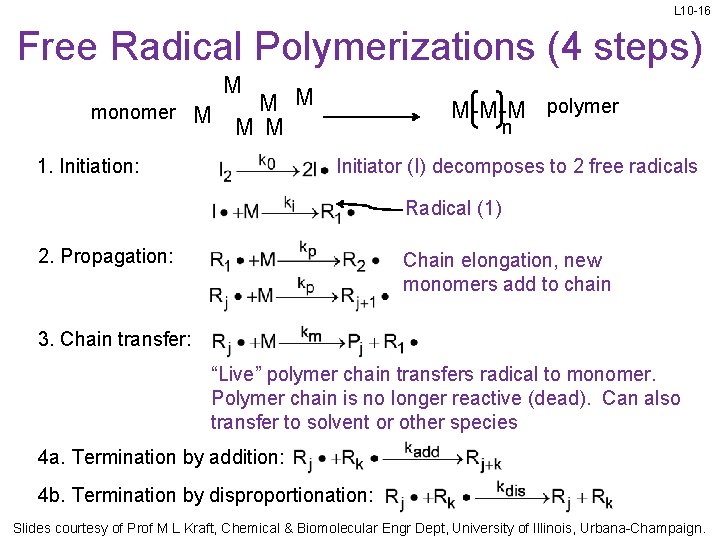
L 10 -16 Free Radical Polymerizations (4 steps) M monomer M M M 1. Initiation: M-M-M polymer n Initiator (I) decomposes to 2 free radicals Radical (1) 2. Propagation: Chain elongation, new monomers add to chain 3. Chain transfer: “Live” polymer chain transfers radical to monomer. Polymer chain is no longer reactive (dead). Can also transfer to solvent or other species 4 a. Termination by addition: 4 b. Termination by disproportionation: Slides courtesy of Prof M L Kraft, Chemical & Biomolecular Engr Dept, University of Illinois, Urbana-Champaign.
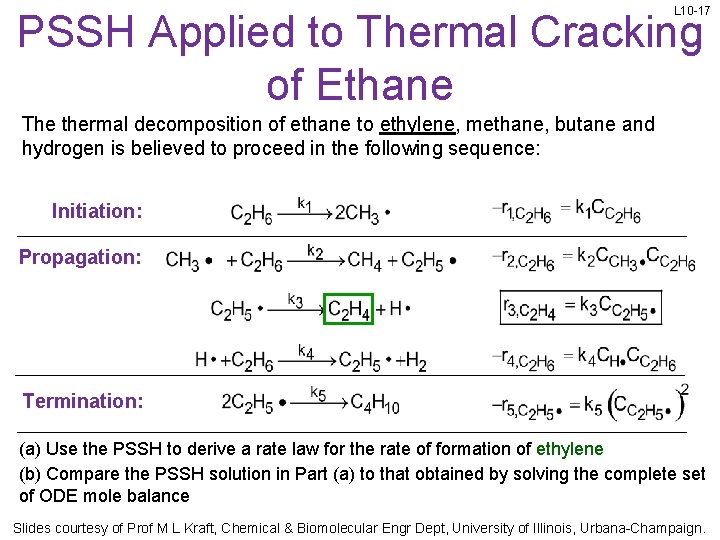
L 10 -17 PSSH Applied to Thermal Cracking of Ethane The thermal decomposition of ethane to ethylene, methane, butane and hydrogen is believed to proceed in the following sequence: Initiation: Propagation: Termination: (a) Use the PSSH to derive a rate law for the rate of formation of ethylene (b) Compare the PSSH solution in Part (a) to that obtained by solving the complete set of ODE mole balance Slides courtesy of Prof M L Kraft, Chemical & Biomolecular Engr Dept, University of Illinois, Urbana-Champaign.
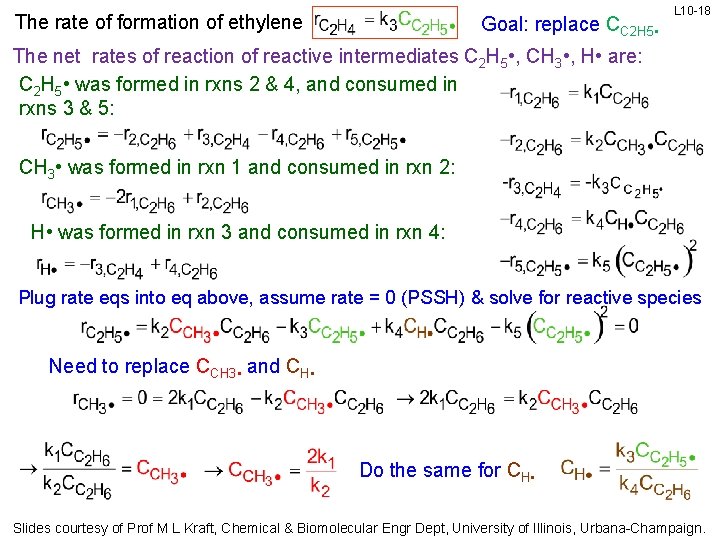
The rate of formation of ethylene Goal: replace CC 2 H 5 • L 10 -18 The net rates of reaction of reactive intermediates C 2 H 5 • , CH 3 • , H • are: C 2 H 5 • was formed in rxns 2 & 4, and consumed in rxns 3 & 5: CH 3 • was formed in rxn 1 and consumed in rxn 2: H • was formed in rxn 3 and consumed in rxn 4: Plug rate eqs into eq above, assume rate = 0 (PSSH) & solve for reactive species Need to replace CCH 3 • and CH • Do the same for CH • Slides courtesy of Prof M L Kraft, Chemical & Biomolecular Engr Dept, University of Illinois, Urbana-Champaign.
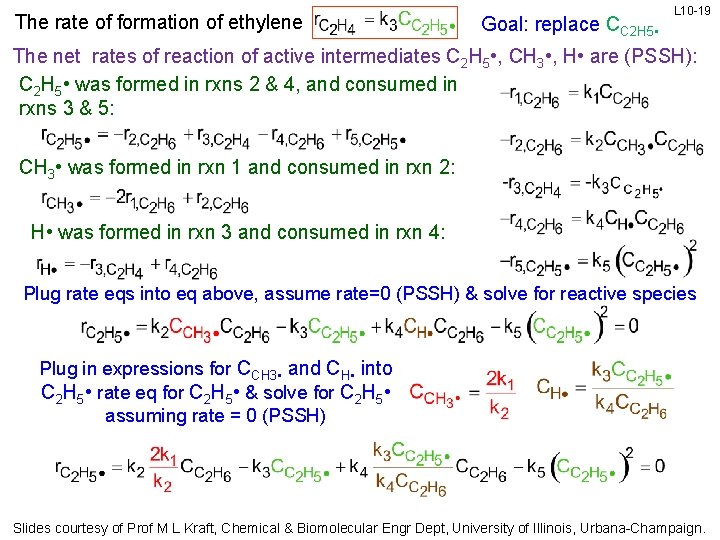
The rate of formation of ethylene Goal: replace CC 2 H 5 • L 10 -19 The net rates of reaction of active intermediates C 2 H 5 • , CH 3 • , H • are (PSSH): C 2 H 5 • was formed in rxns 2 & 4, and consumed in rxns 3 & 5: CH 3 • was formed in rxn 1 and consumed in rxn 2: H • was formed in rxn 3 and consumed in rxn 4: Plug rate eqs into eq above, assume rate=0 (PSSH) & solve for reactive species Plug in expressions for CCH 3 • and CH • into C 2 H 5 • rate eq for C 2 H 5 • & solve for C 2 H 5 • assuming rate = 0 (PSSH) Slides courtesy of Prof M L Kraft, Chemical & Biomolecular Engr Dept, University of Illinois, Urbana-Champaign.
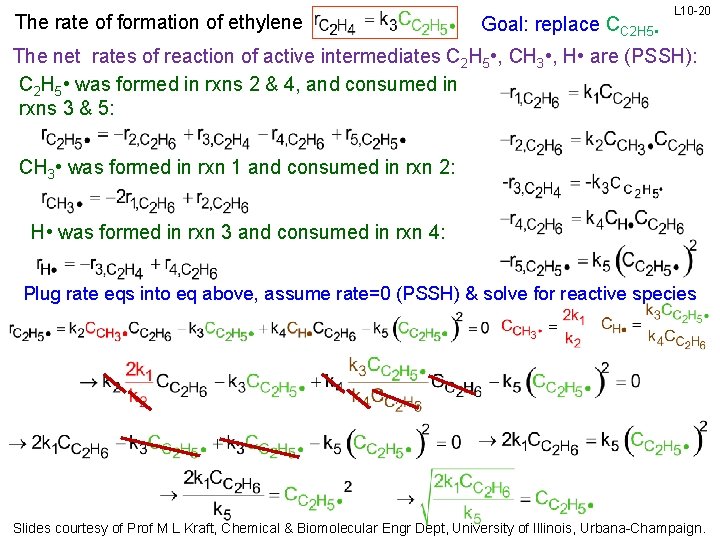
The rate of formation of ethylene Goal: replace CC 2 H 5 • L 10 -20 The net rates of reaction of active intermediates C 2 H 5 • , CH 3 • , H • are (PSSH): C 2 H 5 • was formed in rxns 2 & 4, and consumed in rxns 3 & 5: CH 3 • was formed in rxn 1 and consumed in rxn 2: H • was formed in rxn 3 and consumed in rxn 4: Plug rate eqs into eq above, assume rate=0 (PSSH) & solve for reactive species Slides courtesy of Prof M L Kraft, Chemical & Biomolecular Engr Dept, University of Illinois, Urbana-Champaign.
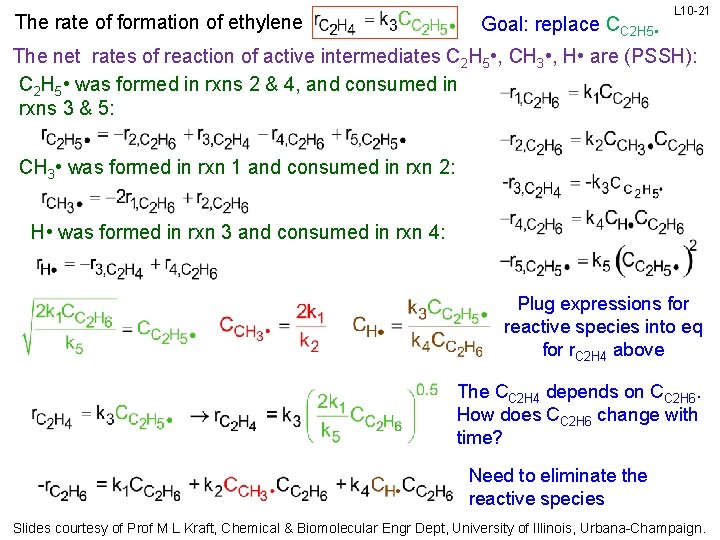
The rate of formation of ethylene Goal: replace CC 2 H 5 • L 10 -21 The net rates of reaction of active intermediates C 2 H 5 • , CH 3 • , H • are (PSSH): C 2 H 5 • was formed in rxns 2 & 4, and consumed in rxns 3 & 5: CH 3 • was formed in rxn 1 and consumed in rxn 2: H • was formed in rxn 3 and consumed in rxn 4: Plug expressions for reactive species into eq for r. C 2 H 4 above The CC 2 H 4 depends on CC 2 H 6. How does CC 2 H 6 change with time? Need to eliminate the reactive species Slides courtesy of Prof M L Kraft, Chemical & Biomolecular Engr Dept, University of Illinois, Urbana-Champaign.
Rate of disappearance of ethane: L 10 -22 Purpose: replace [CH 3 • ] and [H • ] The net rates of reaction of active intermediates CH 3 • , C 2 H 5 • , H • are (PSSH): From the previous slide: Slides courtesy of Prof M L Kraft, Chemical & Biomolecular Engr Dept, University of Illinois, Urbana-Champaign.
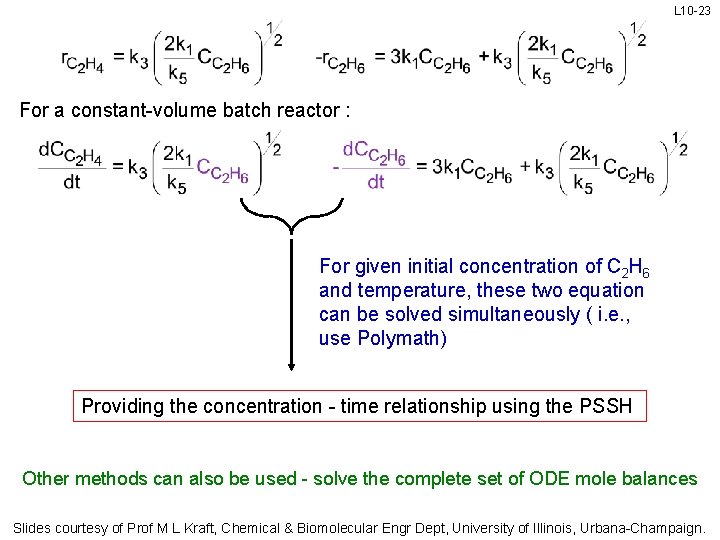
L 10 -23 For a constant-volume batch reactor : For given initial concentration of C 2 H 6 and temperature, these two equation can be solved simultaneously ( i. e. , use Polymath) Providing the concentration - time relationship using the PSSH Other methods can also be used - solve the complete set of ODE mole balances Slides courtesy of Prof M L Kraft, Chemical & Biomolecular Engr Dept, University of Illinois, Urbana-Champaign.
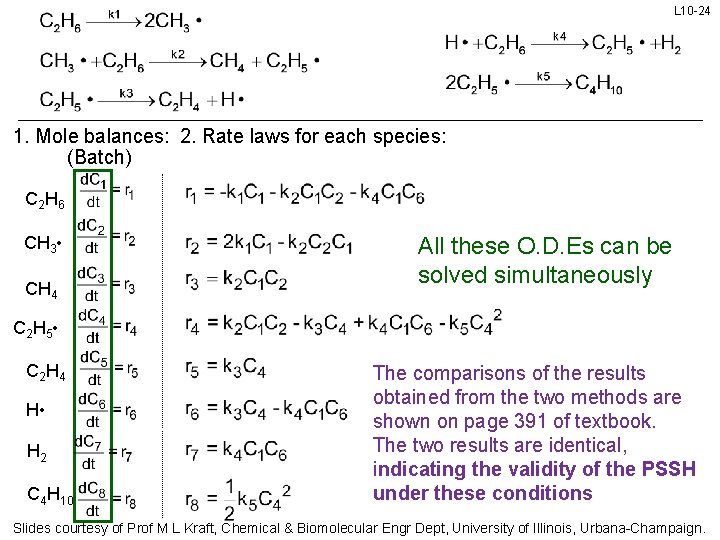
L 10 -24 1. Mole balances: 2. Rate laws for each species: (Batch) C 2 H 6 CH 3 • CH 4 All these O. D. Es can be solved simultaneously C 2 H 5 • C 2 H 4 H • H 2 C 4 H 10 The comparisons of the results obtained from the two methods are shown on page 391 of textbook. The two results are identical, indicating the validity of the PSSH under these conditions Slides courtesy of Prof M L Kraft, Chemical & Biomolecular Engr Dept, University of Illinois, Urbana-Champaign.
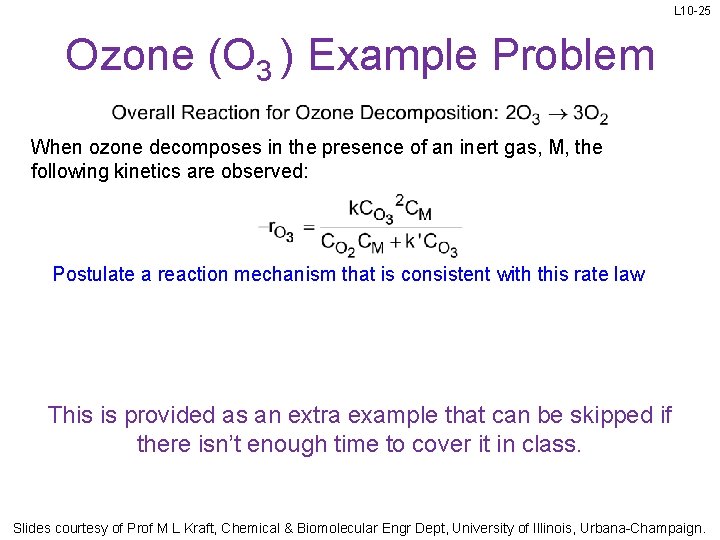
L 10 -25 Ozone (O 3 ) Example Problem When ozone decomposes in the presence of an inert gas, M, the following kinetics are observed: Postulate a reaction mechanism that is consistent with this rate law This is provided as an extra example that can be skipped if there isn’t enough time to cover it in class. Slides courtesy of Prof M L Kraft, Chemical & Biomolecular Engr Dept, University of Illinois, Urbana-Champaign.
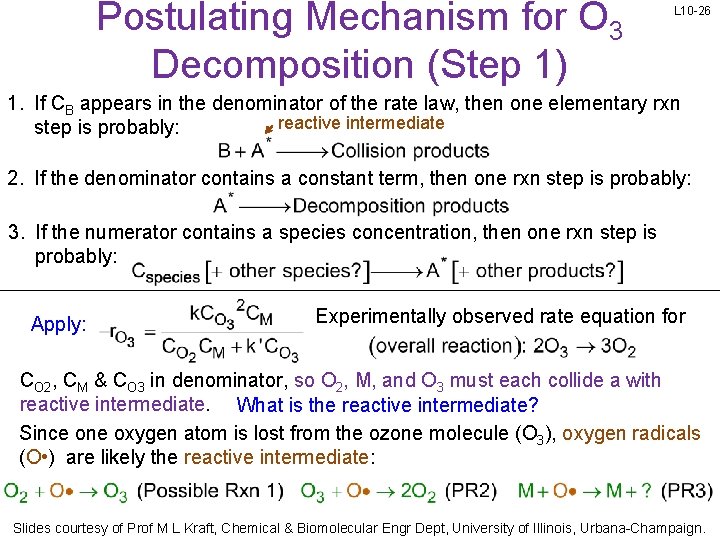
Postulating Mechanism for O 3 Decomposition (Step 1) L 10 -26 1. If CB appears in the denominator of the rate law, then one elementary rxn reactive intermediate step is probably: 2. If the denominator contains a constant term, then one rxn step is probably: 3. If the numerator contains a species concentration, then one rxn step is probably: Apply: Experimentally observed rate equation for CO 2, CM & CO 3 in denominator, so O 2, M, and O 3 must each collide a with reactive intermediate. What is the reactive intermediate? Since one oxygen atom is lost from the ozone molecule (O 3), oxygen radicals (O • ) are likely the reactive intermediate: Slides courtesy of Prof M L Kraft, Chemical & Biomolecular Engr Dept, University of Illinois, Urbana-Champaign.
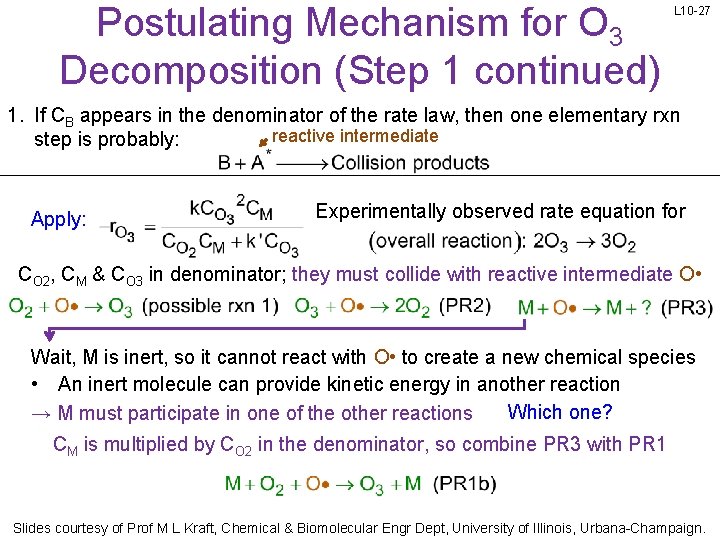
Postulating Mechanism for O 3 Decomposition (Step 1 continued) L 10 -27 1. If CB appears in the denominator of the rate law, then one elementary rxn reactive intermediate step is probably: Apply: Experimentally observed rate equation for CO 2, CM & CO 3 in denominator; they must collide with reactive intermediate O • Wait, M is inert, so it cannot react with O • to create a new chemical species • An inert molecule can provide kinetic energy in another reaction Which one? → M must participate in one of the other reactions CM is multiplied by CO 2 in the denominator, so combine PR 3 with PR 1 Slides courtesy of Prof M L Kraft, Chemical & Biomolecular Engr Dept, University of Illinois, Urbana-Champaign.
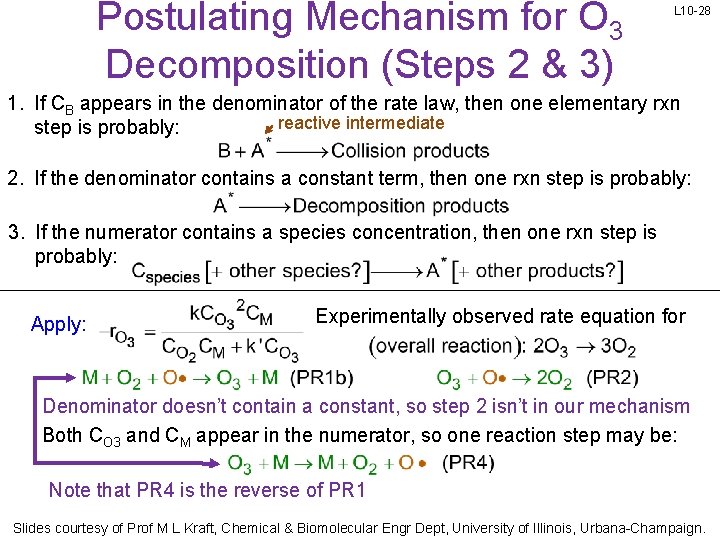
Postulating Mechanism for O 3 Decomposition (Steps 2 & 3) L 10 -28 1. If CB appears in the denominator of the rate law, then one elementary rxn reactive intermediate step is probably: 2. If the denominator contains a constant term, then one rxn step is probably: 3. If the numerator contains a species concentration, then one rxn step is probably: Apply: Experimentally observed rate equation for Denominator doesn’t contain a constant, so step 2 isn’t in our mechanism Both CO 3 and CM appear in the numerator, so one reaction step may be: Note that PR 4 is the reverse of PR 1 Slides courtesy of Prof M L Kraft, Chemical & Biomolecular Engr Dept, University of Illinois, Urbana-Champaign.
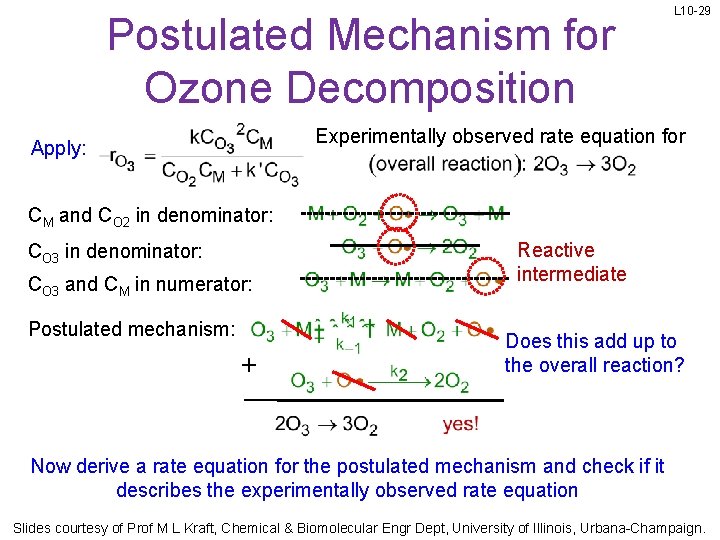
Postulated Mechanism for Ozone Decomposition L 10 -29 Experimentally observed rate equation for Apply: CM and CO 2 in denominator: CO 3 and CM in numerator: Postulated mechanism: + Reactive intermediate Does this add up to the overall reaction? Now derive a rate equation for the postulated mechanism and check if it describes the experimentally observed rate equation Slides courtesy of Prof M L Kraft, Chemical & Biomolecular Engr Dept, University of Illinois, Urbana-Champaign.
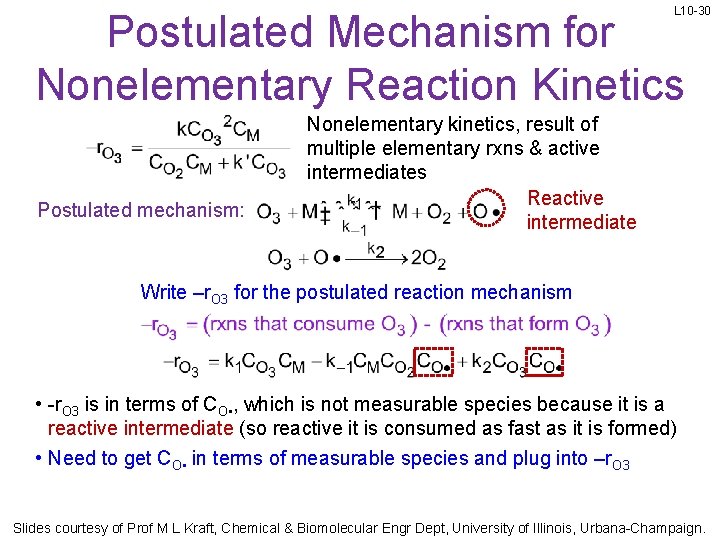
L 10 -30 Postulated Mechanism for Nonelementary Reaction Kinetics Postulated mechanism: Nonelementary kinetics, result of multiple elementary rxns & active intermediates Reactive intermediate Write –r. O 3 for the postulated reaction mechanism • -r. O 3 is in terms of CO • , which is not measurable species because it is a reactive intermediate (so reactive it is consumed as fast as it is formed) • Need to get CO • in terms of measurable species and plug into –r. O 3 Slides courtesy of Prof M L Kraft, Chemical & Biomolecular Engr Dept, University of Illinois, Urbana-Champaign.
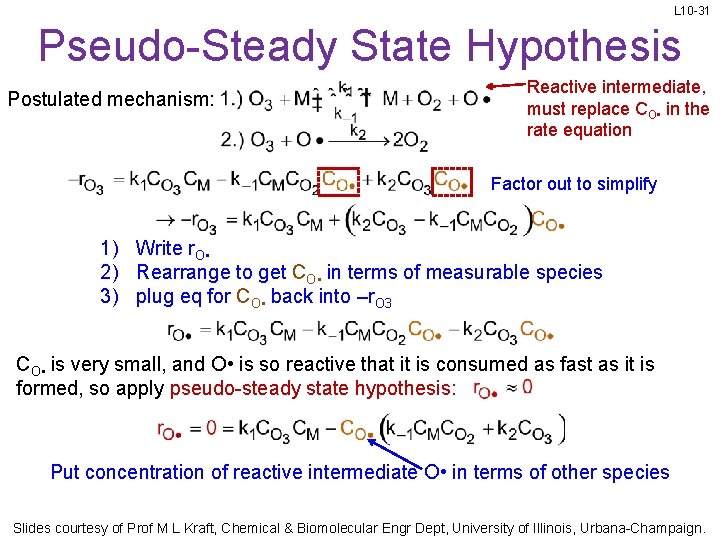
L 10 -31 Pseudo-Steady State Hypothesis Postulated mechanism: Reactive intermediate, must replace CO • in the rate equation Factor out to simplify 1) Write r. O • 2) Rearrange to get CO • in terms of measurable species 3) plug eq for CO • back into –r. O 3 CO • is very small, and O • is so reactive that it is consumed as fast as it is formed, so apply pseudo-steady state hypothesis: Put concentration of reactive intermediate O • in terms of other species Slides courtesy of Prof M L Kraft, Chemical & Biomolecular Engr Dept, University of Illinois, Urbana-Champaign.
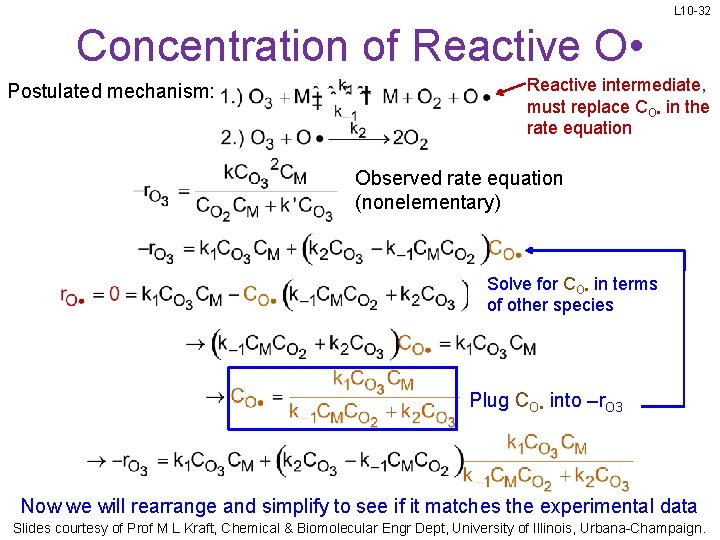
L 10 -32 Concentration of Reactive O • Postulated mechanism: Reactive intermediate, must replace CO • in the rate equation Observed rate equation (nonelementary) Solve for CO • in terms of other species Plug CO • into –r. O 3 Now we will rearrange and simplify to see if it matches the experimental data Slides courtesy of Prof M L Kraft, Chemical & Biomolecular Engr Dept, University of Illinois, Urbana-Champaign.
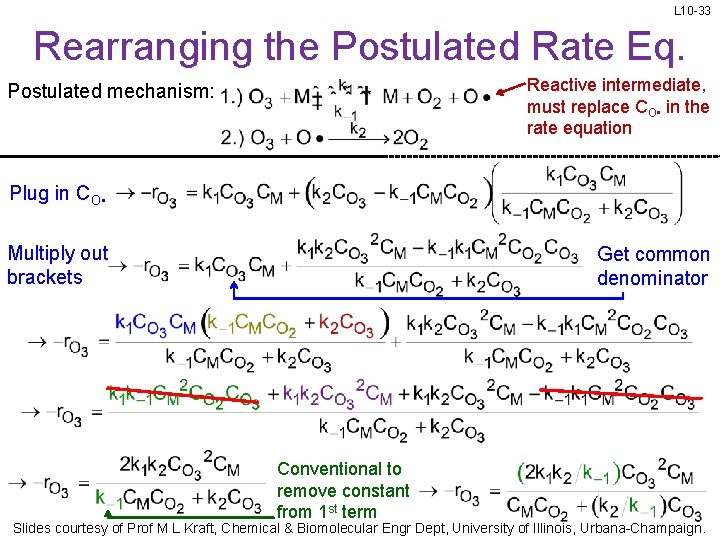
L 10 -33 Rearranging the Postulated Rate Eq. Reactive intermediate, must replace CO • in the rate equation Postulated mechanism: Plug in CO • Multiply out brackets Get common denominator Conventional to remove constant from 1 st term Slides courtesy of Prof M L Kraft, Chemical & Biomolecular Engr Dept, University of Illinois, Urbana-Champaign.
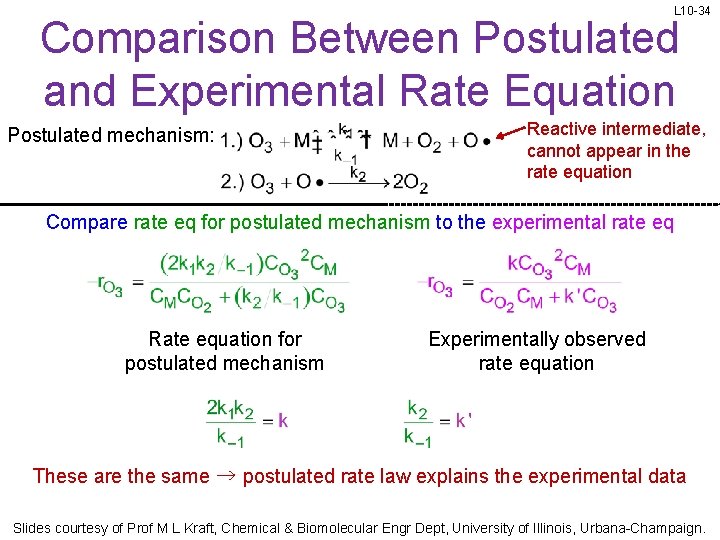
L 10 -34 Comparison Between Postulated and Experimental Rate Equation Postulated mechanism: Reactive intermediate, cannot appear in the rate equation Compare rate eq for postulated mechanism to the experimental rate eq Rate equation for postulated mechanism Experimentally observed rate equation These are the same → postulated rate law explains the experimental data Slides courtesy of Prof M L Kraft, Chemical & Biomolecular Engr Dept, University of Illinois, Urbana-Champaign.