
L 1 Circuit symbols L 12 National Grid
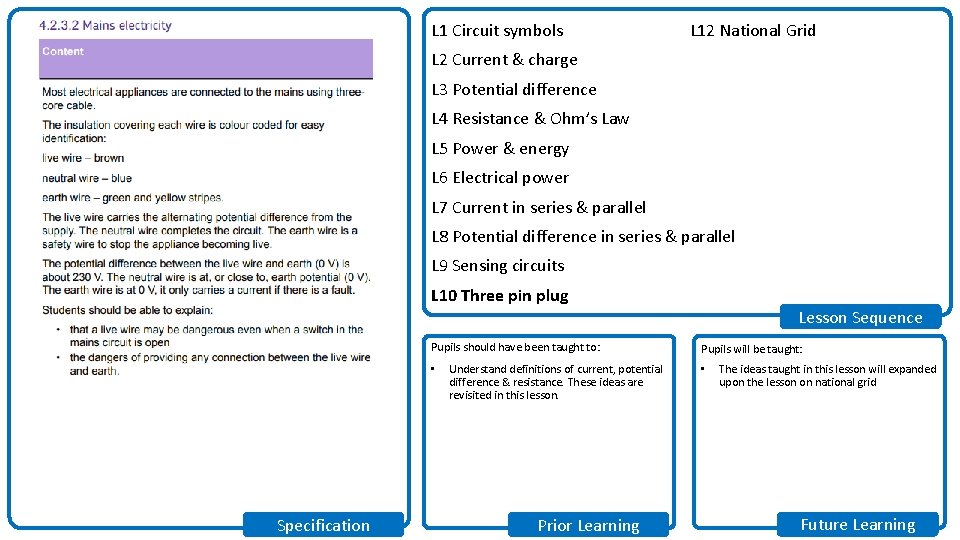
L 1 Circuit symbols L 12 National Grid L 2 Current & charge L 3 Potential difference L 4 Resistance & Ohm’s Law L 5 Power & energy L 6 Electrical power L 7 Current in series & parallel L 8 Potential difference in series & parallel L 9 Sensing circuits L 10 Three pin plug Pupils should have been taught to: • Specification Understand definitions of current, potential difference & resistance. These ideas are revisited in this lesson. Prior Learning Lesson Sequence Pupils will be taught: • The ideas taught in this lesson will expanded upon the lesson on national grid Future Learning
Sci. Doc Three pin plug Do Now Last Lesson Last Term Last Year Stretch & Challenge I do We do You do Test
Sci. Doc Learning Objectives Describe the difference between AC and DC. Recall the voltage and frequency of the mains supply. Recall the purpose & colour of the three mains wires. Do Now I do We do You do Keywords AC DC Voltage Frequency Earth Live Neutral Test
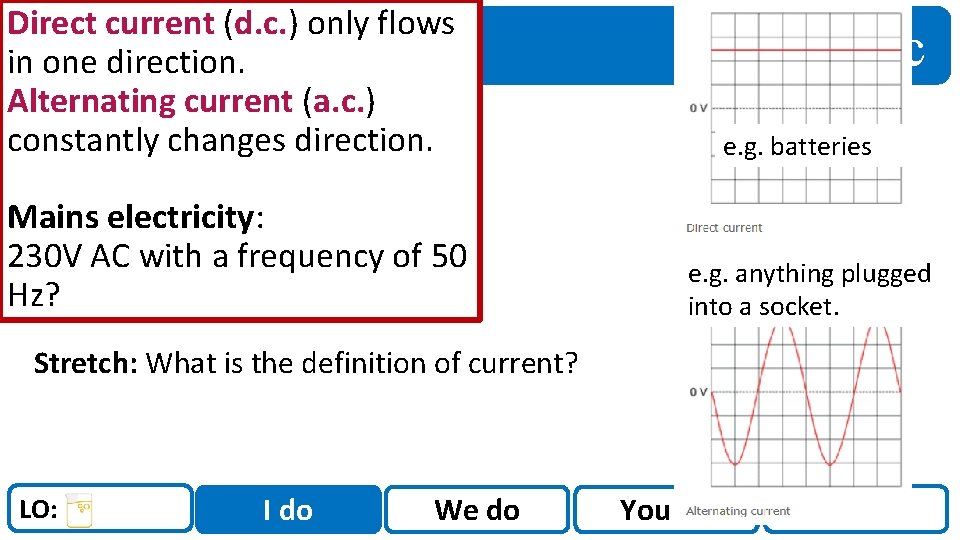
Direct current (d. c. ) only flows in one direction. Alternating current (a. c. ) constantly changes direction. Mains electricity: 230 V AC with a frequency of 50 Hz? Sci. Doc e. g. batteries e. g. anything plugged into a socket. Stretch: What is the definition of current? LO: I do We do You do Test
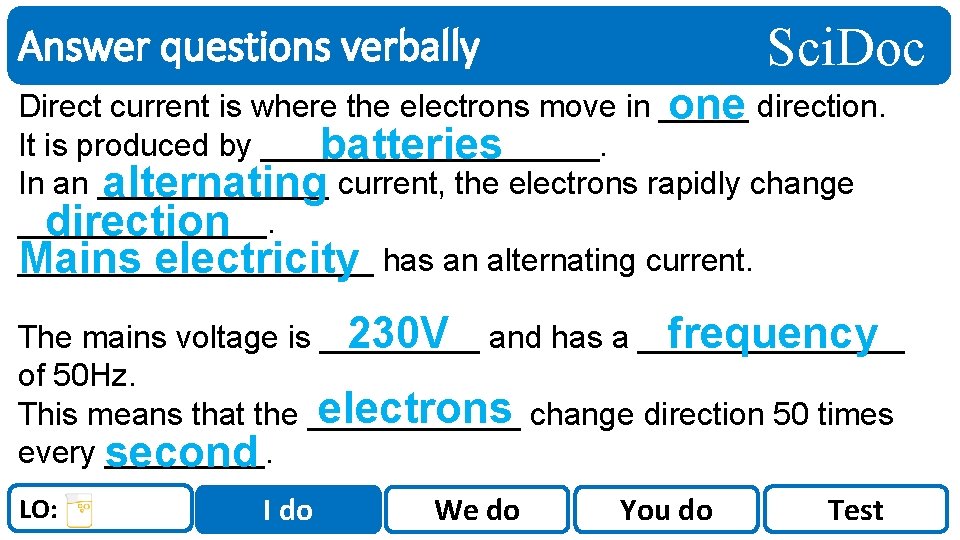
Sci. Doc Answer questions verbally Direct current is where the electrons move in _____ one direction. It is produced by __________. batteries In an _______ alternating current, the electrons rapidly change _______. direction __________ Mains electricity has an alternating current. The mains voltage is _____ frequency 230 V and has a ________ of 50 Hz. electrons change direction 50 times This means that the ______ every second _____. LO: I do We do You do Test
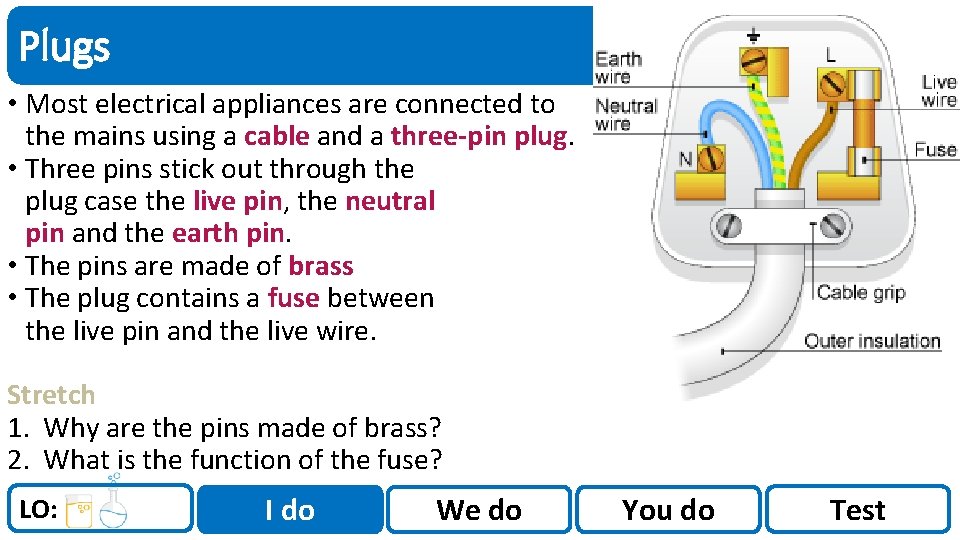
Sci. Doc Plugs • Most electrical appliances are connected to the mains using a cable and a three-pin plug. • Three pins stick out through the plug case the live pin, the neutral pin and the earth pin. • The pins are made of brass • The plug contains a fuse between the live pin and the live wire. Stretch 1. Why are the pins made of brass? 2. What is the function of the fuse? LO: I do We do You do Test
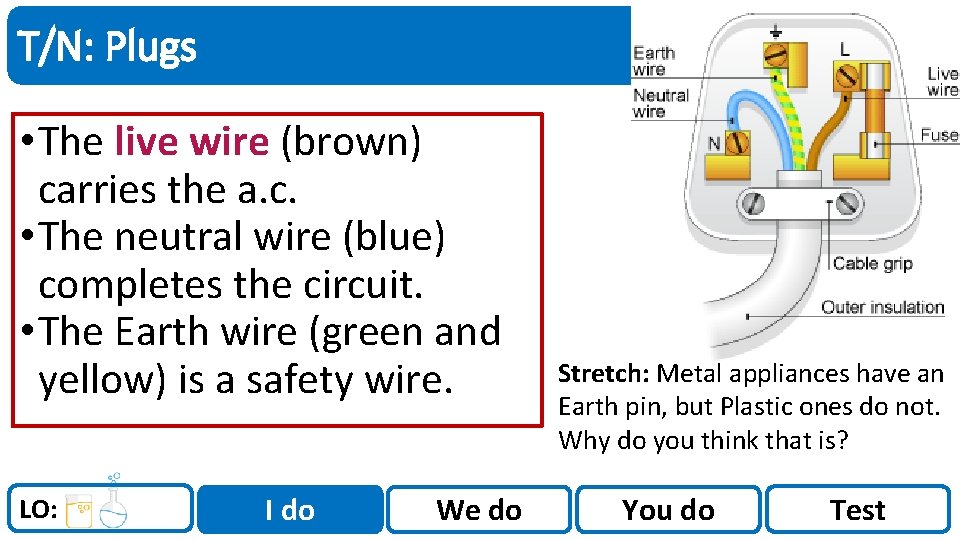
Sci. Doc T/N: Plugs • The live wire (brown) carries the a. c. • The neutral wire (blue) completes the circuit. • The Earth wire (green and yellow) is a safety wire. LO: I do We do Stretch: Metal appliances have an Earth pin, but Plastic ones do not. Why do you think that is? You do Test
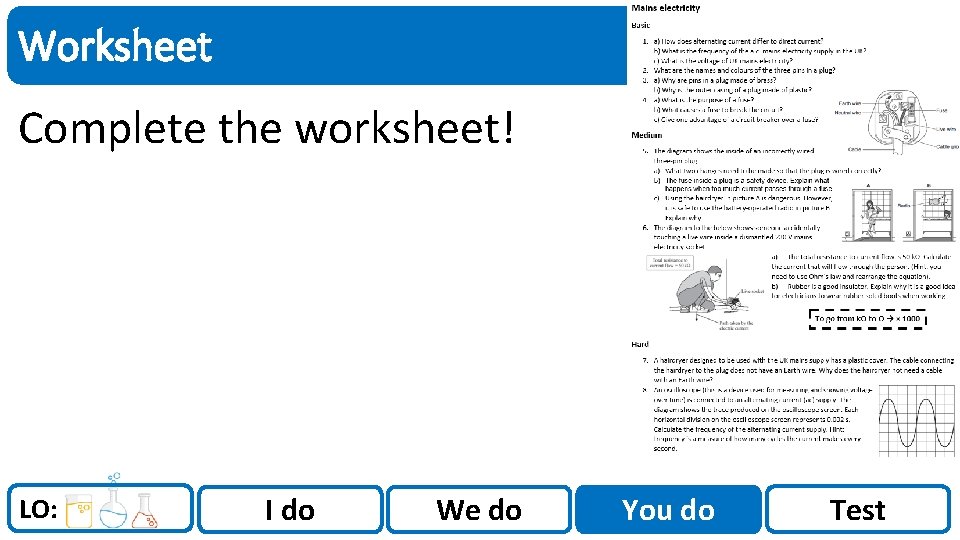
Sci. Doc Worksheet Complete the worksheet! LO: I do We do You do Test
Sci. Doc Basic answers 1. a) Alternating current constantly changes direction, whereas direct current only flows in one direction. b) 50 Hz c) 230 V 2. Earth: Yellow and Green Neutral: Blue Live: Brown 3. a) Brass is hard and a good conductor. b) Plastic is a good insulator. 4. a) For safety. If there’s a fault in the circuit and the current is too high then the fuse melts and breaks the circuit. b) The current being too high (for example from live wire touching metal case) c) It is resettable by a switch. LO: I do We do You do Test
Sci. Doc Medium answers 5. a) The Earth wire needs to be connected to the pin, and the cable grip needs to be connected properly. b) The fuse gets hot, melts and this breaks the circuit. c) Hairdryer plugged into mains (using 230 V). Water conducts electricity. Radio is low voltage and current, therefore much lower risk of electrocution. 6. a) I = V ÷ R = 230 ÷ 50, 000 = 0. 0046 A b) Rubber increases resistance. Therefore if a shock is given it will be of a lower current. LO: I do We do You do Test
Sci. Doc Hard answers 7. It has a plastic case and is therefore an insulator. 8. Time is 0. 002 × 4 = 0. 008 for one cycle. Frequency = 1 ÷ 0. 008 = 125 Hertz LO: I do We do You do Test
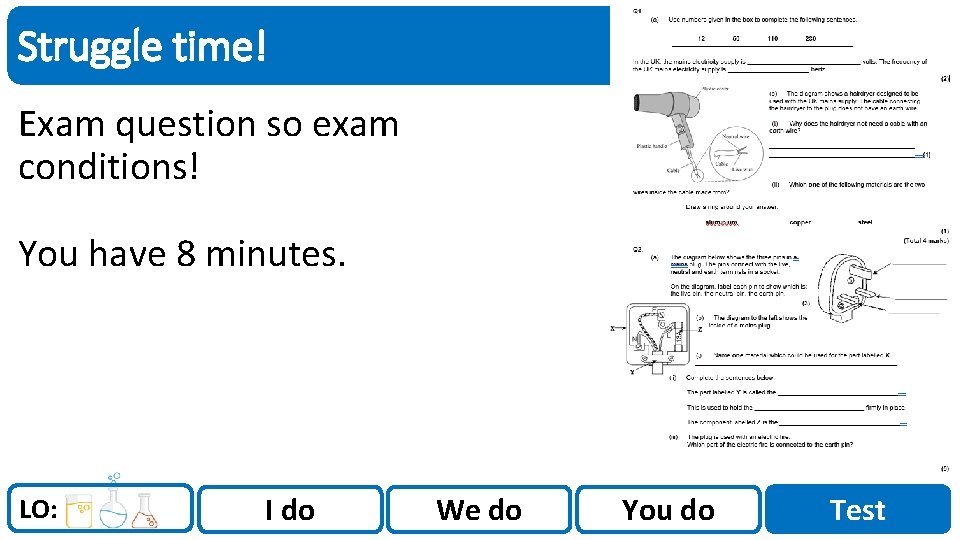
Sci. Doc Struggle time! Exam question so exam conditions! You have 8 minutes. LO: I do We do You do Test
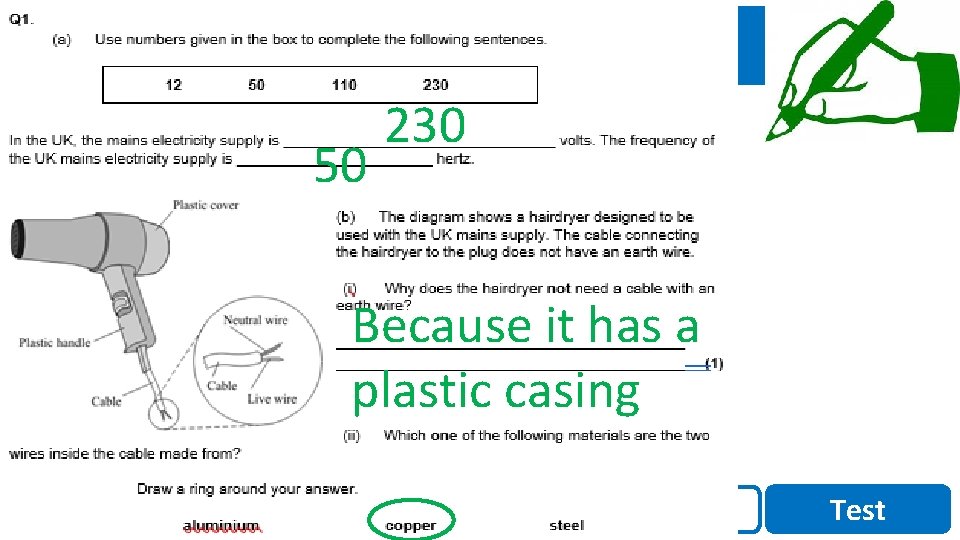
Sci. Doc 50 230 Because it has a plastic casing LO: I do We do You do Test
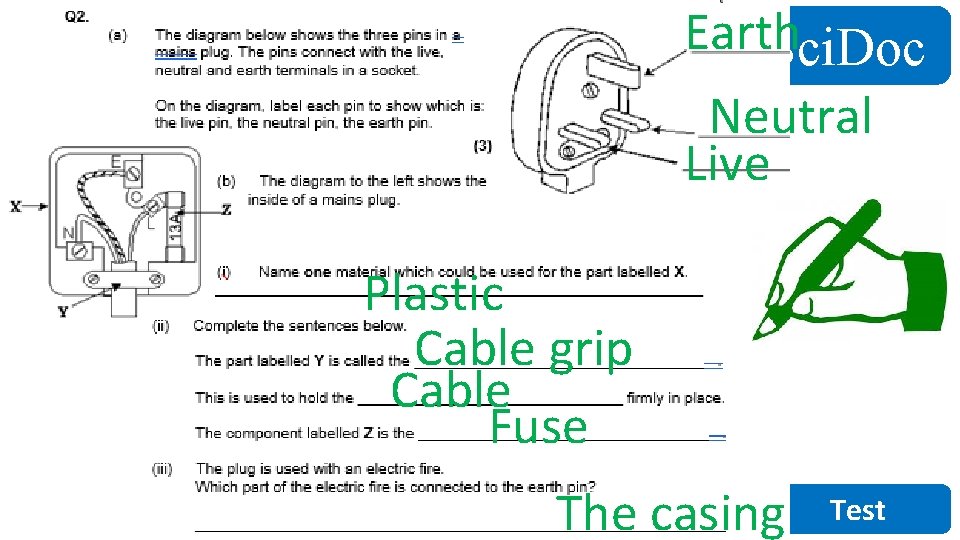
Earth Sci. Doc Neutral Live Plastic Cable grip Cable Fuse LO: I do We do do The. Youcasing Test
- Slides: 14