
L 07 RISC V Final CS 295 ACKNOWLEDGEMENT

![L 07 – RISC V Final 31 CS 295 I-Format Instructions (3/4) imm[11: 0]](https://slidetodoc.com/presentation_image_h2/978c90beae1d227b74dc6a369db566c4/image-20.jpg "L 07 – RISC V Final 31 CS 295 I-Format Instructions (3/4) imm[11: 0]")
![L 07 – RISC V Final 31 CS 295 I-Format Instructions (4/4) imm[11: 0]](https://slidetodoc.com/presentation_image_h2/978c90beae1d227b74dc6a369db566c4/image-21.jpg "L 07 – RISC V Final 31 CS 295 I-Format Instructions (4/4) imm[11: 0]")
![L 07 – RISC V Final CS 295 Uses of jalr 31 imm[11: 0]](https://slidetodoc.com/presentation_image_h2/978c90beae1d227b74dc6a369db566c4/image-60.jpg "L 07 – RISC V Final CS 295 Uses of jalr 31 imm[11: 0]")
- Slides: 61
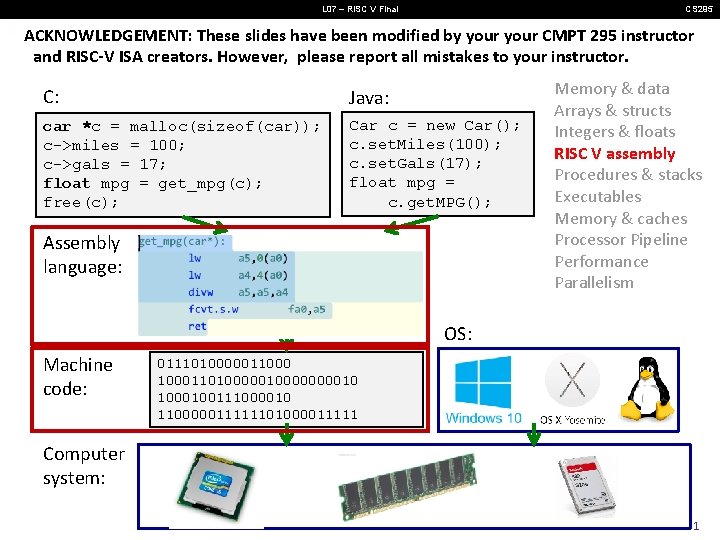
L 07 – RISC V Final CS 295 ACKNOWLEDGEMENT: These slides have been modified by your CMPT 295 instructor and RISC-V ISA creators. However, please report all mistakes to your instructor. C: Java: car *c = malloc(sizeof(car)); c->miles = 100; c->gals = 17; float mpg = get_mpg(c); free(c); Car c = new Car(); c. set. Miles(100); c. set. Gals(17); float mpg = c. get. MPG(); Assembly language: Memory & data Arrays & structs Integers & floats RISC V assembly Procedures & stacks Executables Memory & caches Processor Pipeline Performance Parallelism OS: Machine code: 011101000001100011010000000010 1000100111000010 110000011111101000011111 Computer system: 1
L 07 – RISC V Final CS 295 Agenda • • Stored-Program Concept R-Format I-Format SB-Format UJ-Format 2
L 07 – RISC V Final CS 295 So how do we represent instructions? Remember: Computer only understands 1 s and 0 s, so assembler string “add x 10, x 11, x 0” is meaningless to hardware
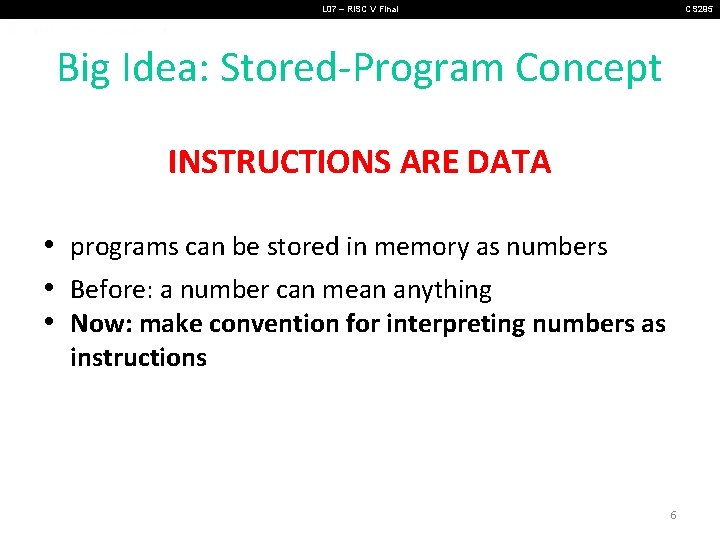
L 07 – RISC V Final CS 295 Big Idea: Stored-Program Concept INSTRUCTIONS ARE DATA • programs can be stored in memory as numbers • Before: a number can mean anything • Now: make convention for interpreting numbers as instructions 6
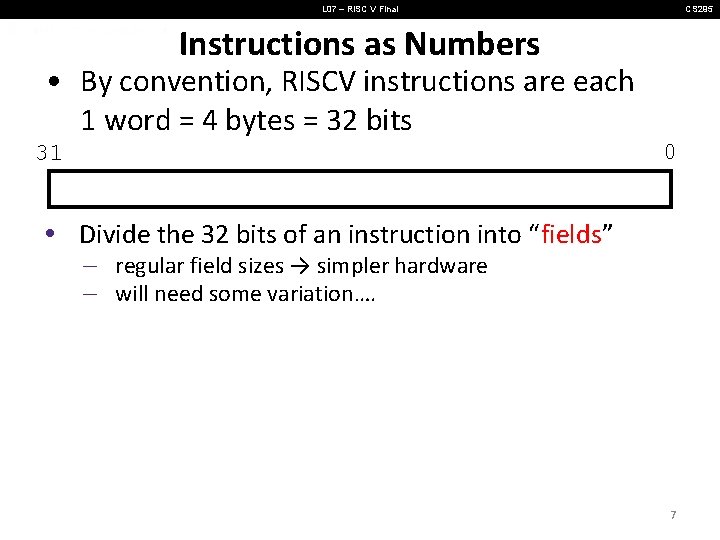
L 07 – RISC V Final CS 295 Instructions as Numbers • By convention, RISCV instructions are each 1 word = 4 bytes = 32 bits 0 31 • Divide the 32 bits of an instruction into “fields” – regular field sizes → simpler hardware – will need some variation…. 7
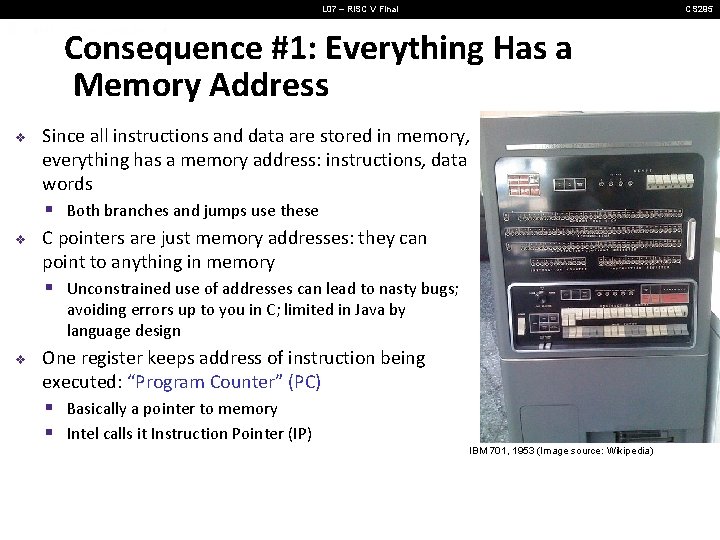
L 07 – RISC V Final CS 295 Consequence #1: Everything Has a Memory Address v v Since all instructions and data are stored in memory, everything has a memory address: instructions, data words § Both branches and jumps use these C pointers are just memory addresses: they can point to anything in memory § Unconstrained use of addresses can lead to nasty bugs; avoiding errors up to you in C; limited in Java by language design v One register keeps address of instruction being executed: “Program Counter” (PC) § Basically a pointer to memory § Intel calls it Instruction Pointer (IP) IBM 701, 1953 (Image source: Wikipedia)
L 07 – RISC V Final CS 295 Consequence #2: Binary Compatibility v v Programs are distributed in binary form § Programs bound to specific instruction set § Different version for phones and PCs New machines want to run old programs (“binaries”) as well as programs compiled to new instructions Leads to “backward-compatible” instruction set evolving over time Selection of Intel 8088 in 1981 for 1 st IBM PC is major reason latest PCs still use 80 x 86 instruction set; could still run program from 1981 PC today
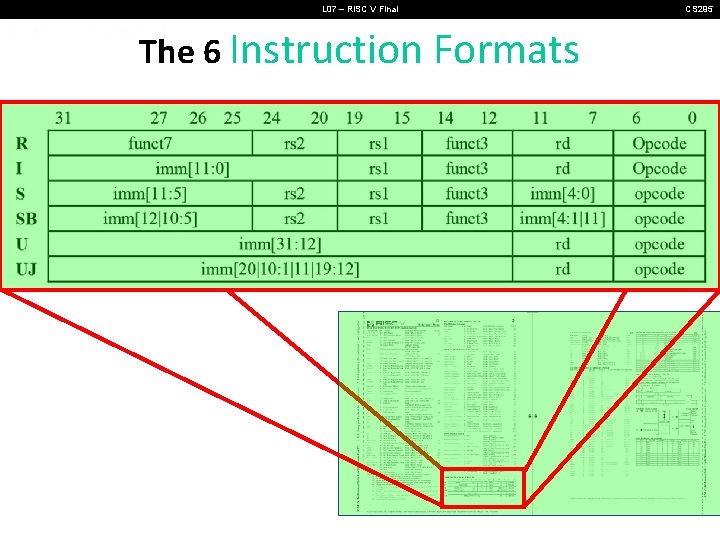
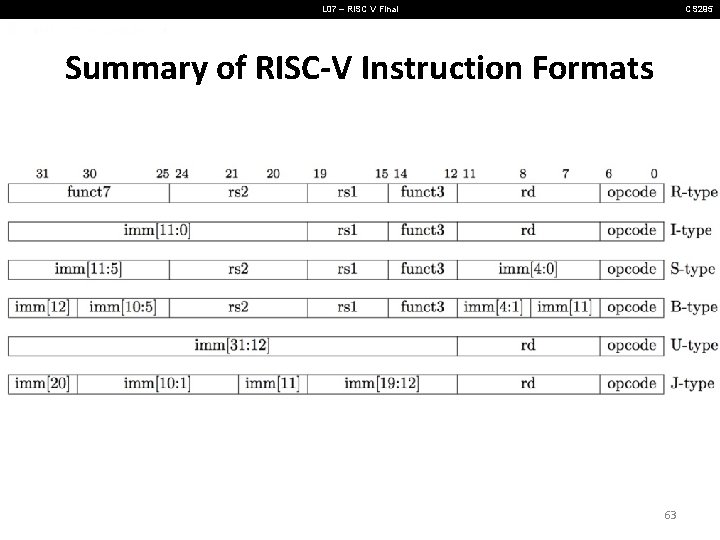
L 07 – RISC V Final The 6 Instruction Formats CS 295 • R-Format: instructions using 3 register inputs – add, xor, mul —arithmetic/logical ops • I-Format: instructions with immediates, loads – addi, lw, jalr, slli • S-Format: store instructions: sw, sb • SB-Format: branch instructions: beq, bge • U-Format: instructions with upper immediates – lui, auipc —upper immediate is 20 -bits • UJ-Format: the jump instruction: jal
L 07 – RISC V Final The 6 Instruction Formats CS 295
L 07 – RISC V Final CS 295 Agenda • • Stored-Program Concept R-Format I-Format Administrivia S-Format SB-Format UJ-Format 12
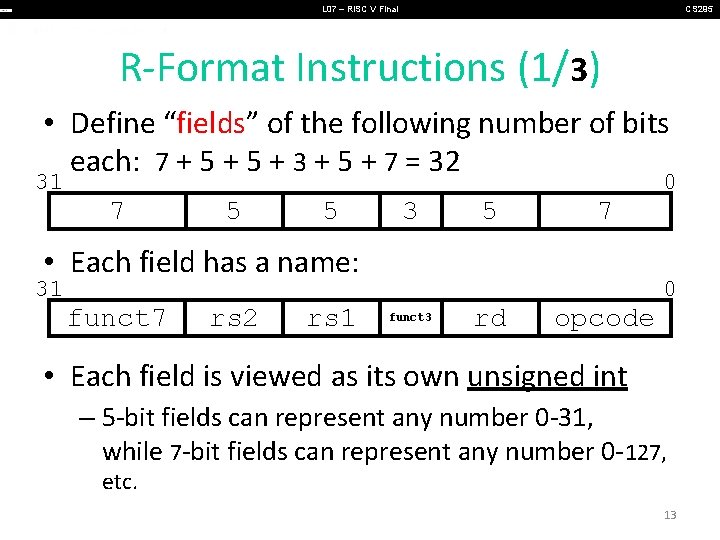
L 07 – RISC V Final CS 295 R-Format Instructions (1/3) • Define “fields” of the following number of bits each: 7 + 5 + 3 + 5 + 7 = 32 31 7 5 5 3 5 7 • Each field has a name: 31 funct 7 rs 2 rs 1 funct 3 rd opcode 0 0 • Each field is viewed as its own unsigned int – 5 -bit fields can represent any number 0 -31, while 7 -bit fields can represent any number 0 -127, etc. 13
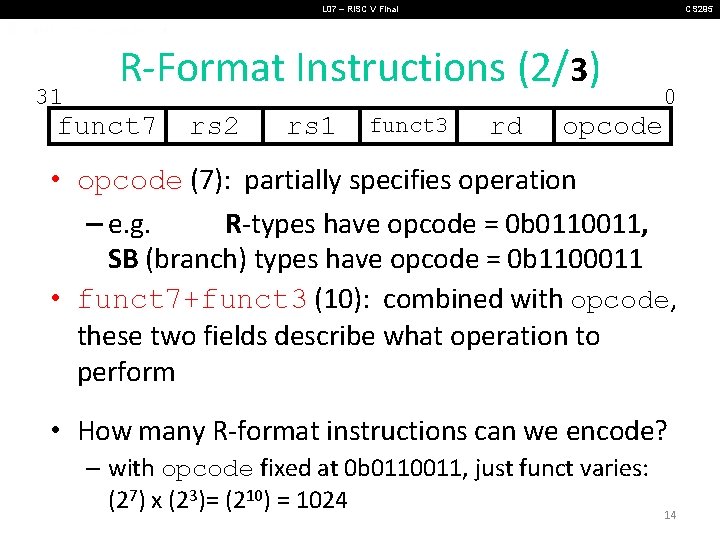
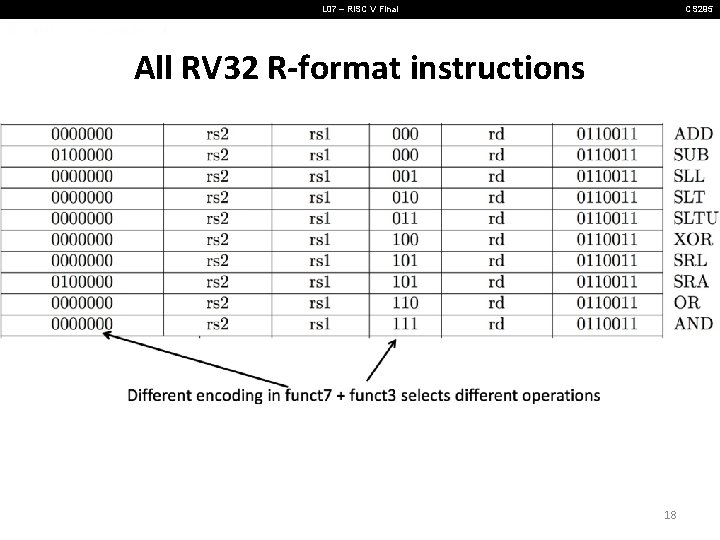
L 07 – RISC V Final 31 CS 295 R-Format Instructions (2/3) funct 7 rs 2 rs 1 funct 3 rd opcode 0 • opcode (7): partially specifies operation – e. g. R-types have opcode = 0 b 0110011, SB (branch) types have opcode = 0 b 1100011 • funct 7+funct 3 (10): combined with opcode, these two fields describe what operation to perform • How many R-format instructions can we encode? – with opcode fixed at 0 b 0110011, just funct varies: (27) x (23)= (210) = 1024 14
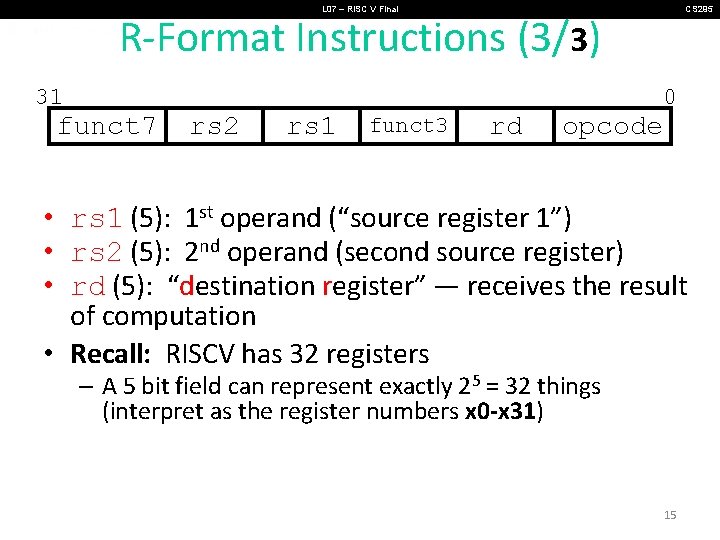
L 07 – RISC V Final CS 295 R-Format Instructions (3/3) 31 funct 7 rs 2 rs 1 funct 3 rd opcode 0 • rs 1 (5): 1 st operand (“source register 1”) • rs 2 (5): 2 nd operand (second source register) • rd (5): “destination register” — receives the result of computation • Recall: RISCV has 32 registers – A 5 bit field can represent exactly 25 = 32 things (interpret as the register numbers x 0 -x 31) 15
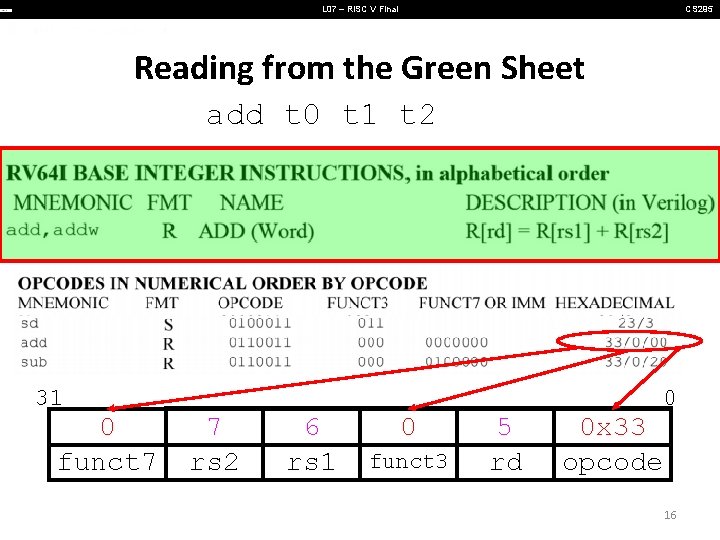
L 07 – RISC V Final CS 295 Reading from the Green Sheet add t 0 t 1 t 2 rd = t 0 = x 5 rs 1 = t 1 = x 6 rt 2 = x 7 31 ? ? ? 0 funct 7 ? ? ? 7 rs 2 ? ? ? 6 rs 1 ? ? ? 0 funct 3 ? ? ? 5 rd 0 x 33 ? ? ? opcode 0 16
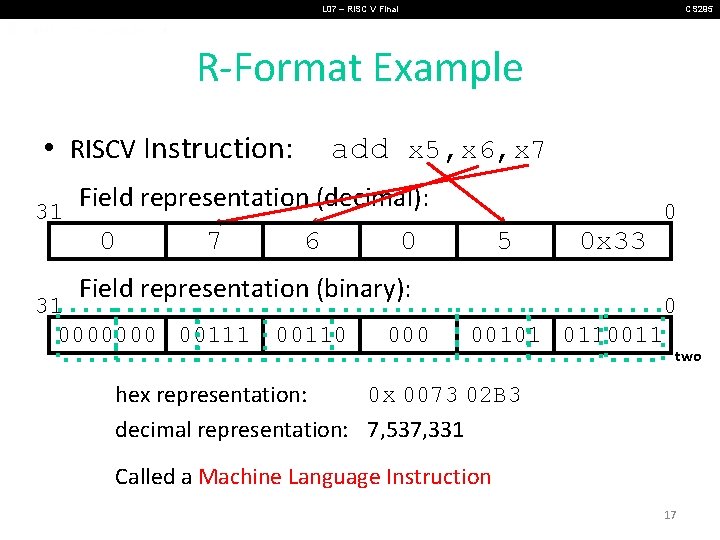
L 07 – RISC V Final CS 295 R-Format Example • RISCV Instruction: 31 add x 5, x 6, x 7 Field representation (decimal): 0 7 6 0 5 0 x 33 Field representation (binary): 31 0000000 00111 00110 000 0 0 00101 0110011 two hex representation: 0 x 0073 02 B 3 decimal representation: 7, 537, 331 Called a Machine Language Instruction 17
L 07 – RISC V Final CS 295 All RV 32 R-format instructions 18
L 07 – RISC V Final CS 295 Agenda • • Stored-Program Concept R-Format I-Format SB-Format UJ-Format 19
L 07 – RISC V Final CS 295 I-Format Instructions (1/4) • What about instructions with immediates? – 5 -bit field too small for most immediates • Ideally, RISCV would have only one instruction format (for simplicity) – Unfortunately here we need to compromise • Define new instruction format that is mostly consistent with R-Format – First notice that, if instruction has immediate, then it uses at most 2 registers (1 src, 1 dst) 20
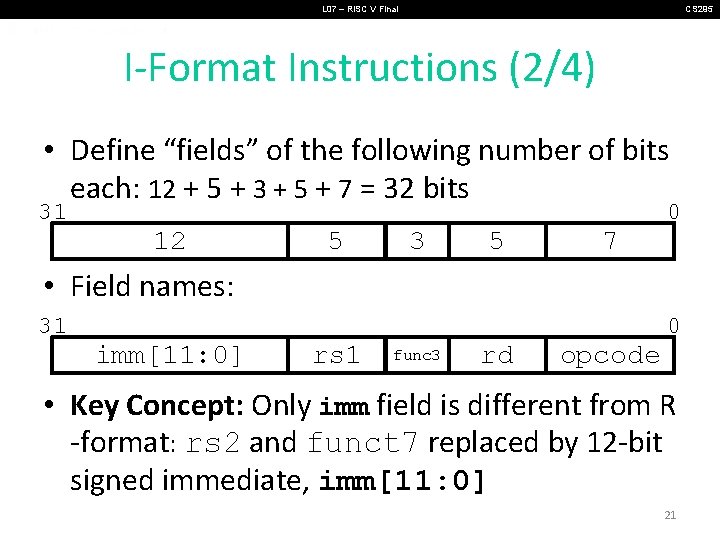
L 07 – RISC V Final CS 295 I-Format Instructions (2/4) • Define “fields” of the following number of bits each: 12 + 5 + 3 + 5 + 7 = 32 bits 31 12 5 3 5 7 0 • Field names: 31 imm[11: 0] rs 1 func 3 rd opcode 0 • Key Concept: Only imm field is different from R -format: rs 2 and funct 7 replaced by 12 -bit signed immediate, imm[11: 0] 21
L 07 – RISC V Final 31 CS 295 I-Format Instructions (3/4) imm[11: 0] rs 1 func 3 rd opcode 0 • opcode (7): uniquely specifies the instruction • rs 1 (5): specifies a register operand • rd (5): specifies destination register that receives result of computation 22
L 07 – RISC V Final 31 CS 295 I-Format Instructions (4/4) imm[11: 0] rs 1 func 3 rd opcode 0 • immediate (12): 12 bit number – All computations done in words, so 12 -bit immediate must be extended to 32 bits – always sign-extended to 32 -bits before use in an arithmetic operation • Can represent 212 different immediates – imm[11: 0] can hold values in range [-211 , +211) 23
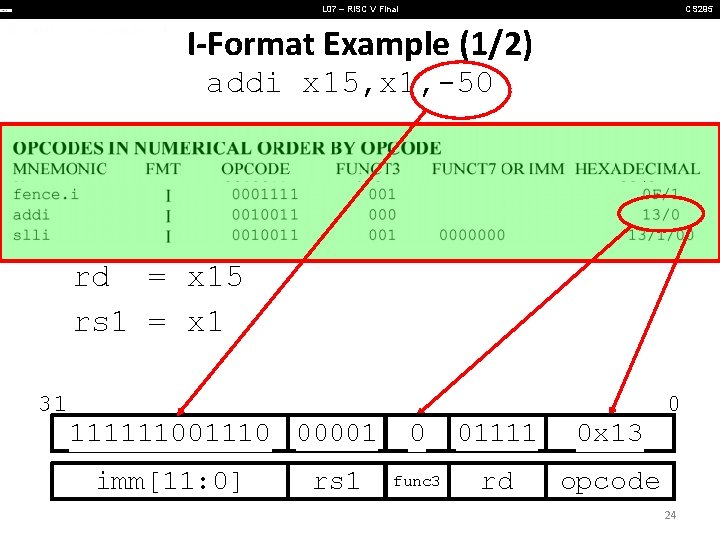
L 07 – RISC V Final CS 295 I-Format Example (1/2) addi x 15, x 1, -50 rd = x 15 rs 1 = x 1 31 00001 ? ? ? 111111001110 ? ? ? imm[11: 0] rs 1 0 ? 01111 ? ? ? 0 x 13 ? ? ? func 3 rd opcode 0 24
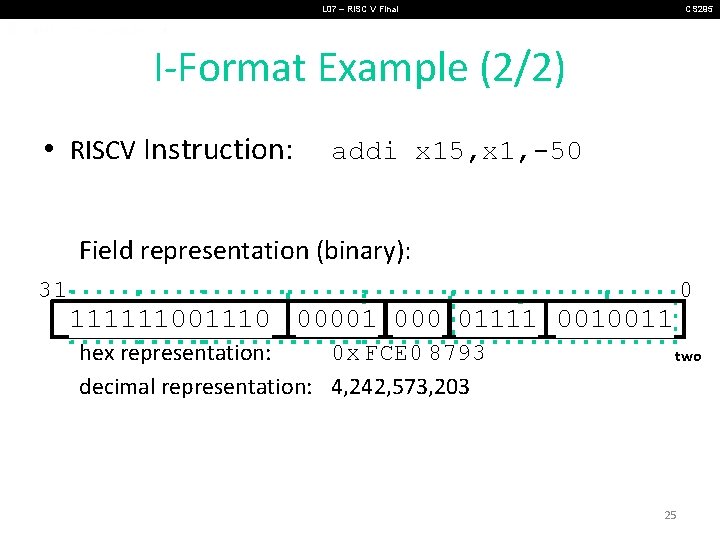
L 07 – RISC V Final CS 295 I-Format Example (2/2) • RISCV Instruction: addi x 15, x 1, -50 Field representation (binary): 31 0 00001 000 ? ? ? 0010011 111111001110 ? ? 01111 hex representation: 0 x FCE 0 8793 decimal representation: 4, 242, 573, 203 two Called a Machine Language Instruction 25
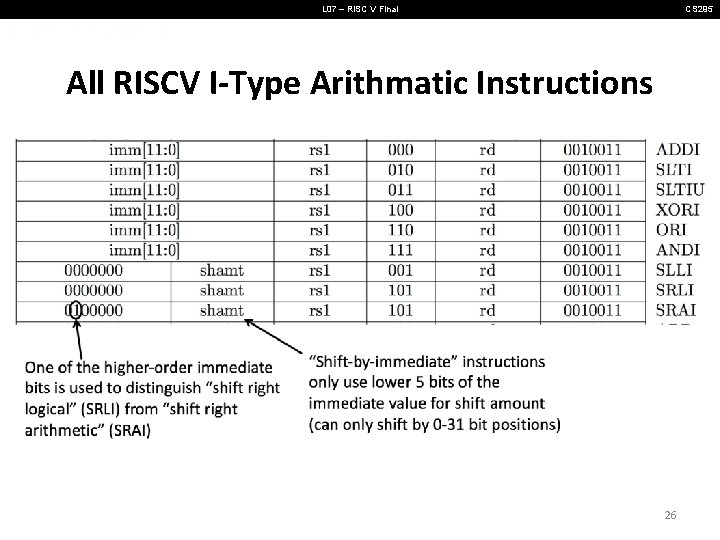
L 07 – RISC V Final CS 295 All RISCV I-Type Arithmatic Instructions 26
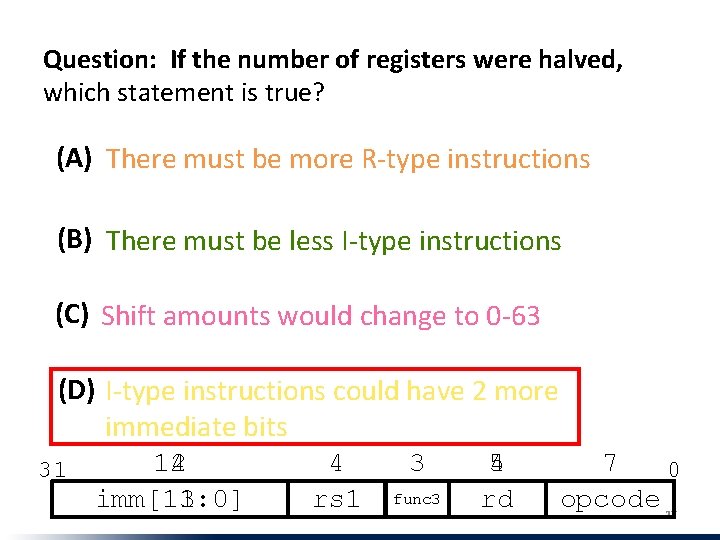
Question: If the number of registers were halved, which statement is true? (A) There must be more R-type instructions (B) There must be less I-type instructions (C) Shift amounts would change to 0 -63 (D) I-type instructions could have 2 more immediate bits 31 12 14 imm[11: 0] imm[13: 0] 4 5 rs 1 3 func 3 4 5 rd 7 0 opcode 27
L 07 – RISC V Final CS 295 Agenda • • Stored-Program Concept R-Format I-Format SB-Format UJ-Format 28
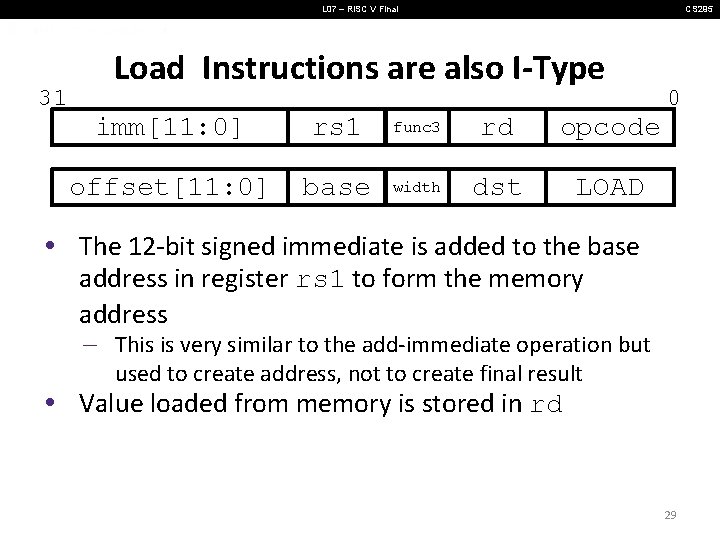
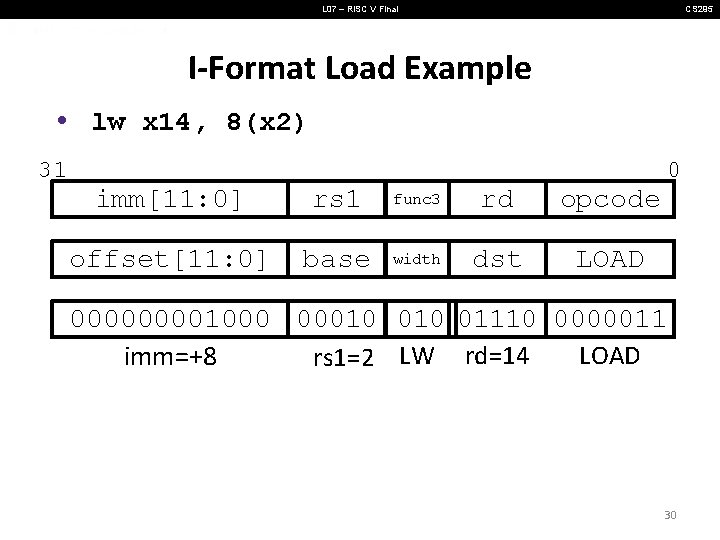
L 07 – RISC V Final 31 CS 295 Load Instructions are also I-Type imm[11: 0] rs 1 func 3 rd opcode offset[11: 0] base width dst LOAD 0 • The 12 -bit signed immediate is added to the base address in register rs 1 to form the memory address – This is very similar to the add-immediate operation but used to create address, not to create final result • Value loaded from memory is stored in rd 29
L 07 – RISC V Final CS 295 I-Format Load Example • lw x 14, 8(x 2) 31 imm[11: 0] rs 1 func 3 rd opcode offset[11: 0] base width dst LOAD 0 00001000 00010 01110 0000011 LOAD imm=+8 rs 1=2 LW rd=14 30
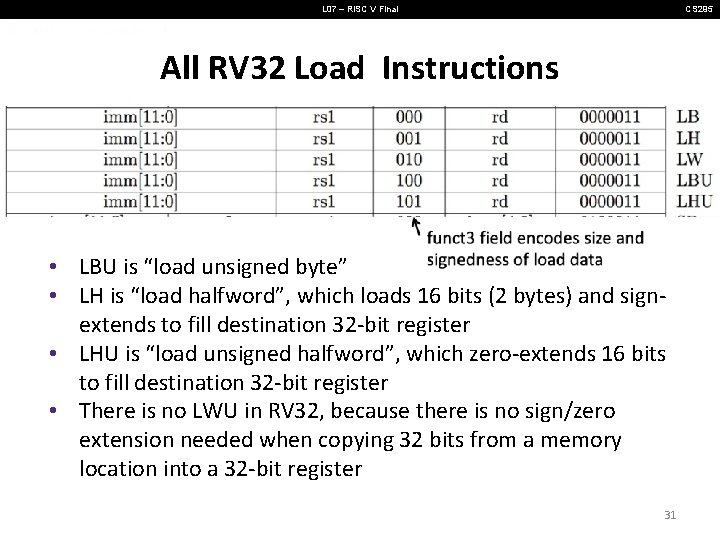
L 07 – RISC V Final CS 295 All RV 32 Load Instructions • LBU is “load unsigned byte” • LH is “load halfword”, which loads 16 bits (2 bytes) and signextends to fill destination 32 -bit register • LHU is “load unsigned halfword”, which zero-extends 16 bits to fill destination 32 -bit register • There is no LWU in RV 32, because there is no sign/zero extension needed when copying 32 bits from a memory location into a 32 -bit register 31
L 07 – RISC V Final CS 295 Agenda • • Stored-Program Concept R-Format I-Format SB-Format UJ-Format 32
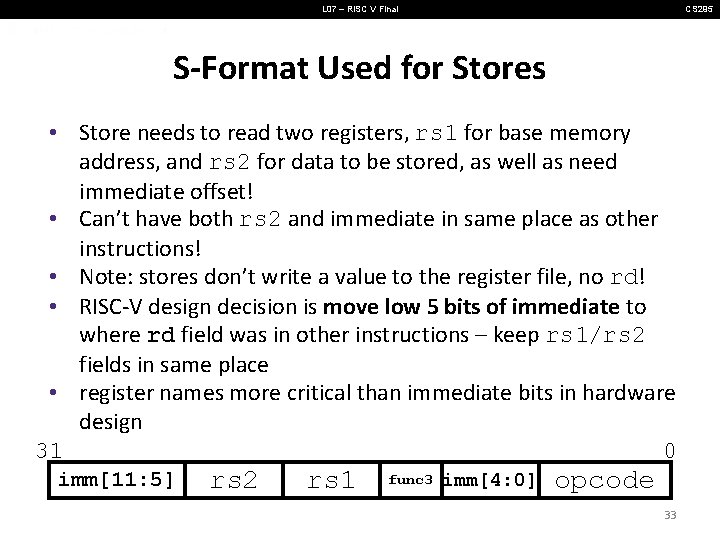
L 07 – RISC V Final CS 295 S-Format Used for Stores • Store needs to read two registers, rs 1 for base memory address, and rs 2 for data to be stored, as well as need immediate offset! • Can’t have both rs 2 and immediate in same place as other instructions! • Note: stores don’t write a value to the register file, no rd! • RISC-V design decision is move low 5 bits of immediate to where rd field was in other instructions – keep rs 1/rs 2 fields in same place • register names more critical than immediate bits in hardware design 31 0 imm[11: 5] rs 2 rs 1 func 3 imm[4: 0] opcode 33
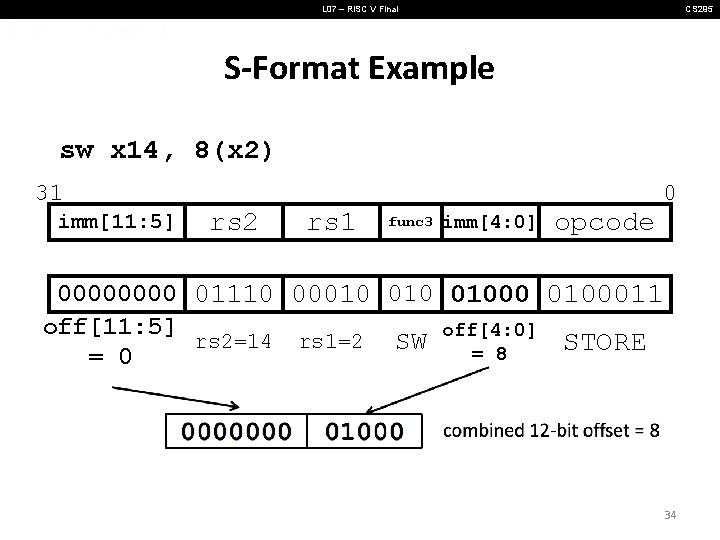
L 07 – RISC V Final CS 295 S-Format Example sw x 14, 8(x 2) 31 imm[11: 5] rs 2 rs 1 func 3 imm[4: 0] opcode 0 0000 01110 00010 0100011 off[11: 5] off[4: 0] rs 2=14 rs 1=2 SW STORE = 8 = 0 34
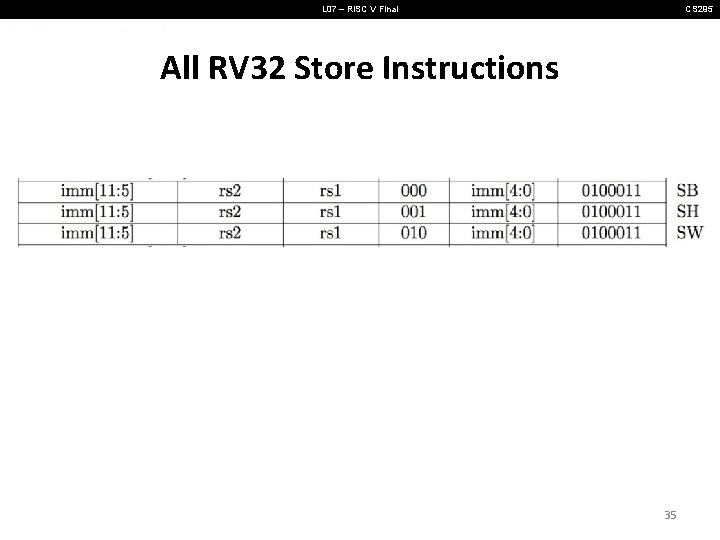
L 07 – RISC V Final CS 295 All RV 32 Store Instructions 35
L 07 – RISC V Final CS 295 Agenda • • Stored-Program Concept R-Format I-Format SB-Format UJ-Format 36
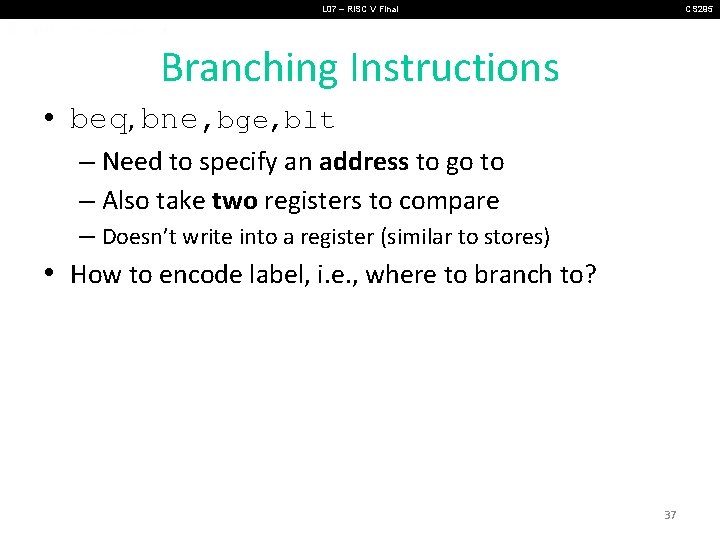
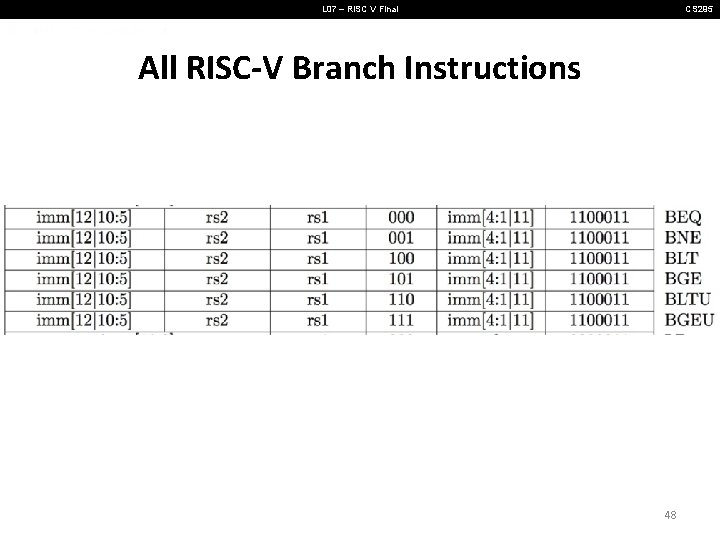
L 07 – RISC V Final CS 295 Branching Instructions • beq, bne, bge, blt – Need to specify an address to go to – Also take two registers to compare – Doesn’t write into a register (similar to stores) • How to encode label, i. e. , where to branch to? 37
L 07 – RISC V Final CS 295 Branching Instruction Usage • Branches typically used for loops (if-else, while, for) – Loops are generally small (< 50 instructions) • Recall: Instructions stored in a localized area of memory (Code/Text) – Largest branch distance limited by size of code – Address of current instruction stored in the program counter (PC) 38
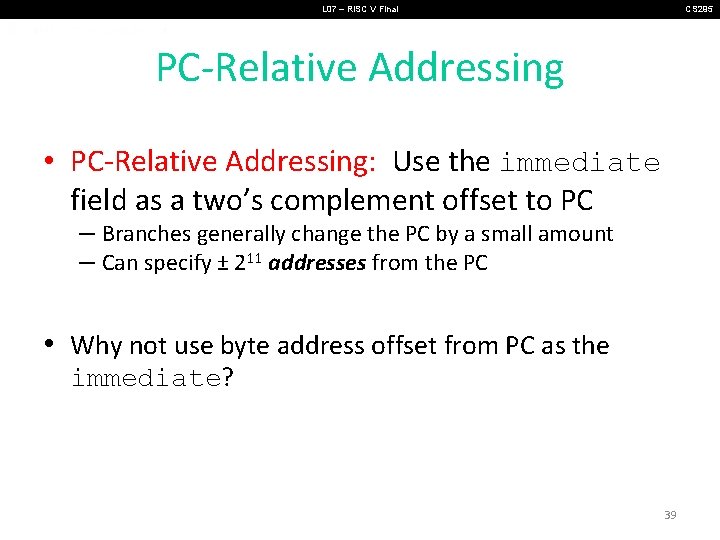
L 07 – RISC V Final CS 295 PC-Relative Addressing • PC-Relative Addressing: Use the immediate field as a two’s complement offset to PC – Branches generally change the PC by a small amount – Can specify ± 211 addresses from the PC • Why not use byte address offset from PC as the immediate? 39
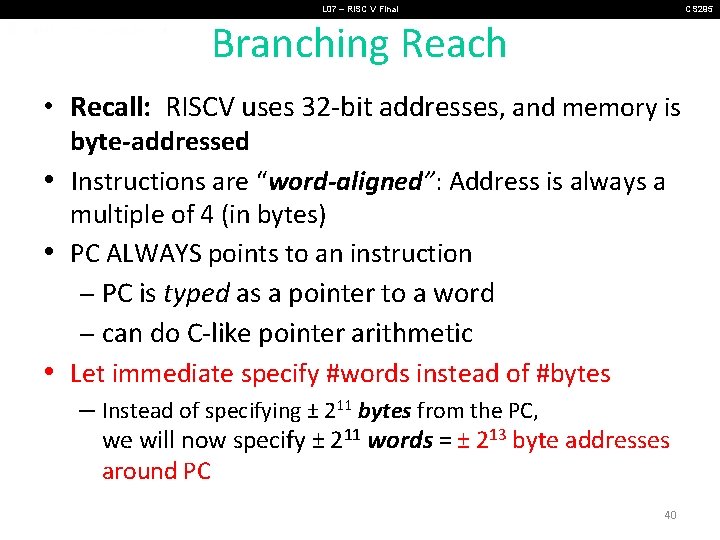
L 07 – RISC V Final CS 295 Branching Reach • Recall: RISCV uses 32 -bit addresses, and memory is byte-addressed • Instructions are “word-aligned”: Address is always a multiple of 4 (in bytes) • PC ALWAYS points to an instruction – PC is typed as a pointer to a word – can do C-like pointer arithmetic • Let immediate specify #words instead of #bytes – Instead of specifying ± 211 bytes from the PC, we will now specify ± 211 words = ± 213 byte addresses around PC 40
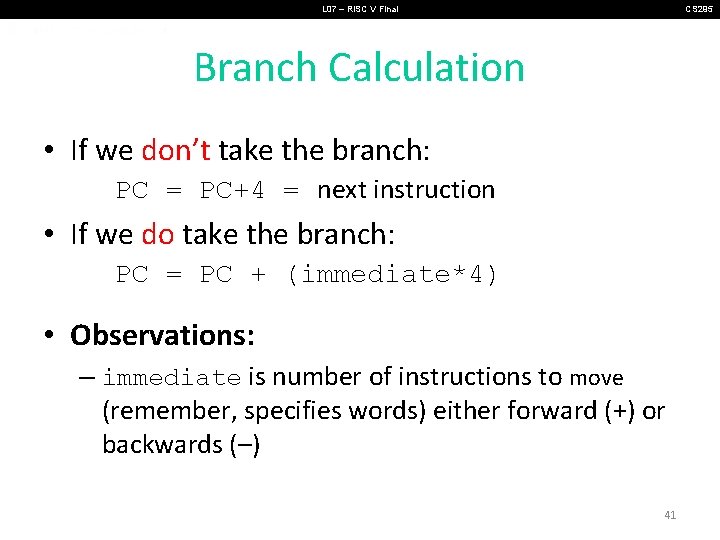
L 07 – RISC V Final CS 295 Branch Calculation • If we don’t take the branch: PC = PC+4 = next instruction • If we do take the branch: PC = PC + (immediate*4) • Observations: – immediate is number of instructions to move (remember, specifies words) either forward (+) or backwards (–) 41
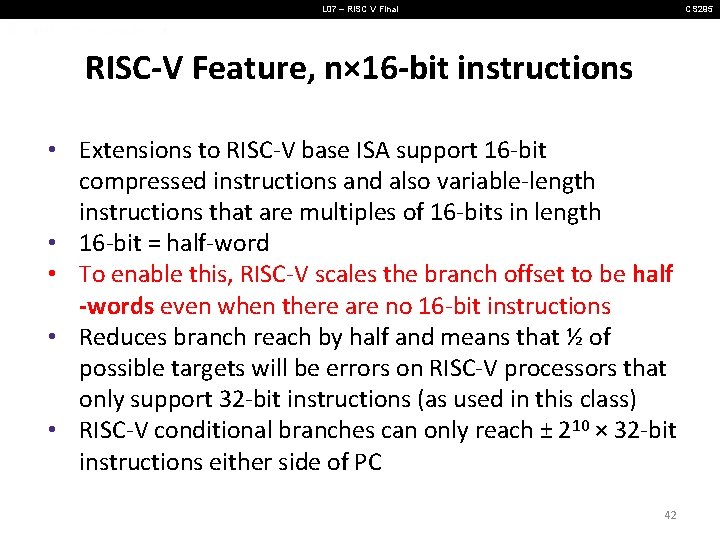
L 07 – RISC V Final CS 295 RISC-V Feature, n× 16 -bit instructions • Extensions to RISC-V base ISA support 16 -bit compressed instructions and also variable-length instructions that are multiples of 16 -bits in length • 16 -bit = half-word • To enable this, RISC-V scales the branch offset to be half -words even when there are no 16 -bit instructions • Reduces branch reach by half and means that ½ of possible targets will be errors on RISC-V processors that only support 32 -bit instructions (as used in this class) • RISC-V conditional branches can only reach ± 210 × 32 -bit instructions either side of PC 42
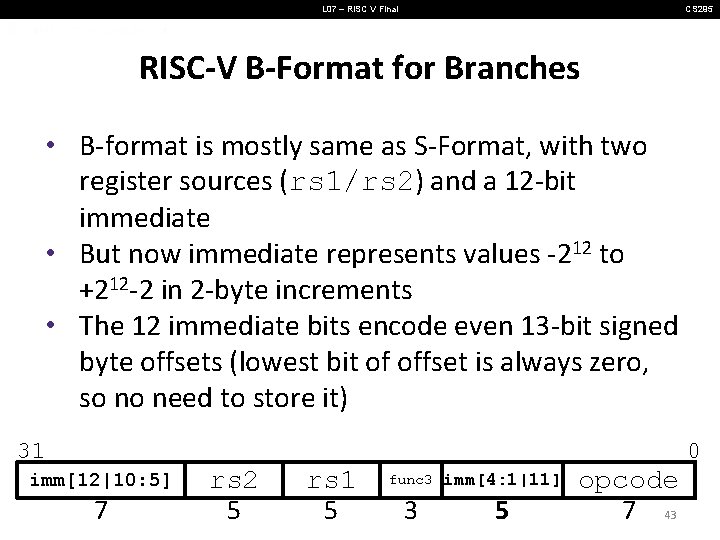
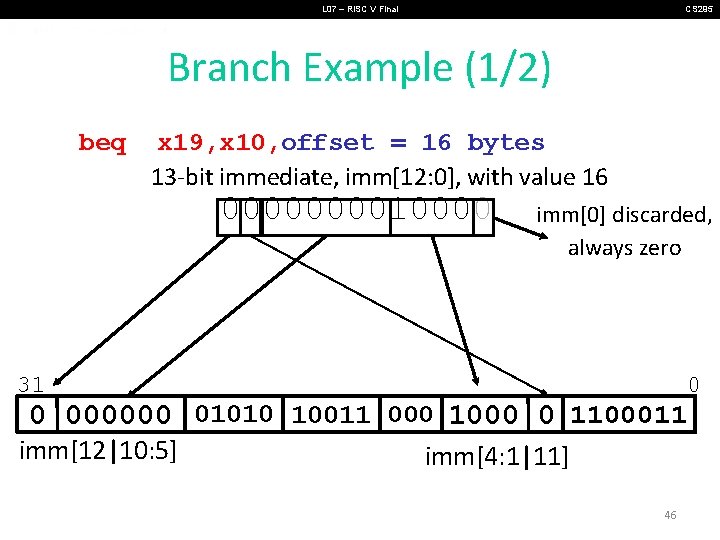
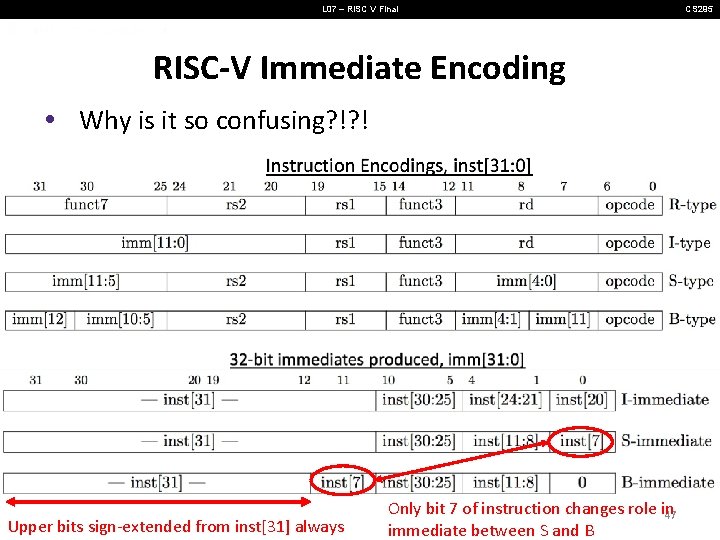
L 07 – RISC V Final CS 295 RISC-V B-Format for Branches • B-format is mostly same as S-Format, with two register sources (rs 1/rs 2) and a 12 -bit immediate • But now immediate represents values -212 to +212 -2 in 2 -byte increments • The 12 immediate bits encode even 13 -bit signed byte offsets (lowest bit of offset is always zero, so no need to store it) 31 imm[12|10: 5] 7 rs 2 5 rs 1 5 func 3 imm[4: 1|11] 3 5 opcode 7 43 0
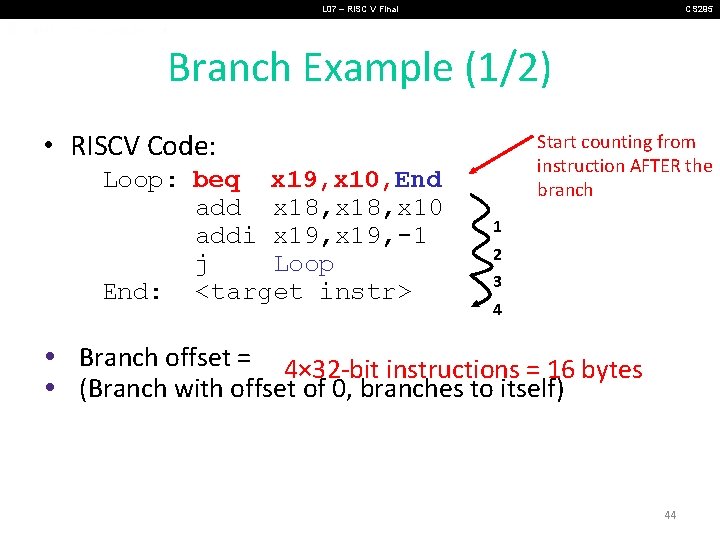
L 07 – RISC V Final CS 295 Branch Example (1/2) • RISCV Code: Loop: beq x 19, x 10, End add x 18, x 10 addi x 19, -1 j Loop End: <target instr> Start counting from instruction AFTER the branch 1 2 3 4 • Branch offset = 4× 32 -bit instructions = 16 bytes • (Branch with offset of 0, branches to itself) 44
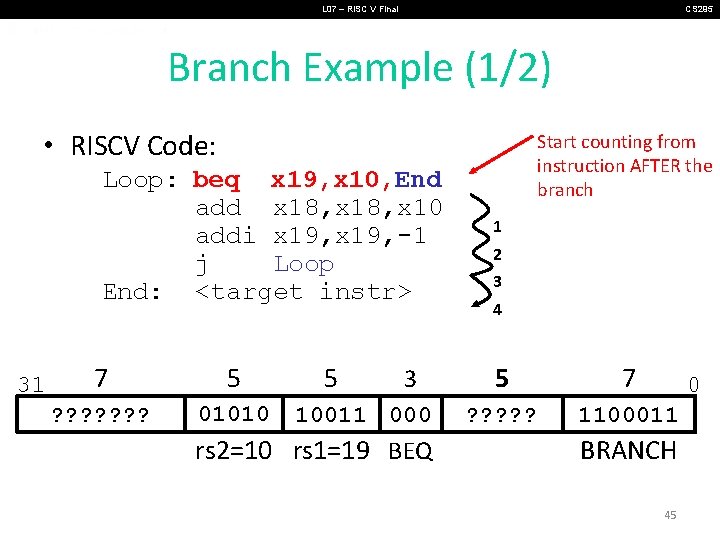
L 07 – RISC V Final CS 295 Branch Example (1/2) • RISCV Code: Loop: beq x 19, x 10, End add x 18, x 10 addi x 19, -1 j Loop End: <target instr> 31 7 5 ? ? ? ? 01010 5 3 10011 000 rs 2=10 rs 1=19 BEQ Start counting from instruction AFTER the branch 1 2 3 4 5 7 ? ? ? 1100011 0 BRANCH 45
L 07 – RISC V Final CS 295 Branch Example (1/2) beq x 19, x 10, offset = 16 bytes 13 -bit immediate, imm[12: 0], with value 16 000010000 imm[0] discarded, always zero 31 0 0 000000 01010 10011 000 1000 0 1100011 imm[12|10: 5] imm[4: 1|11] 46
L 07 – RISC V Final RISC-V Immediate Encoding • Why is it so confusing? !? ! Upper bits sign-extended from inst[31] always Only bit 7 of instruction changes role in 47 immediate between S and B CS 295
L 07 – RISC V Final CS 295 All RISC-V Branch Instructions 48
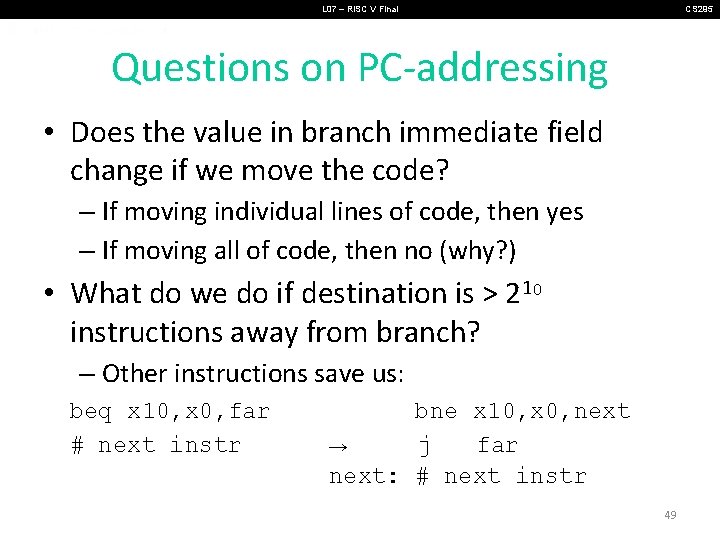
L 07 – RISC V Final CS 295 Questions on PC-addressing • Does the value in branch immediate field change if we move the code? – If moving individual lines of code, then yes – If moving all of code, then no (why? ) • What do we do if destination is > 210 instructions away from branch? – Other instructions save us: beq x 10, x 0, far # next instr bne x 10, x 0, next → j far next: # next instr 49
L 07 – RISC V Final CS 295 Agenda • • Stored-Program Concept R-Format I-Format SB-Format UJ-Format 50
L 07 – RISC V Final CS 295 Dealing With Large Immediates • How do we deal with 32 -bit immediates? – Our I-type instructions only give us 12 bits • Solution: Need a new instruction format for dealing with the rest of the 20 bits. • This instruction should deal with: – a destination register to put the 20 bits into – the immediate of 20 bits – the instruction opcode 51
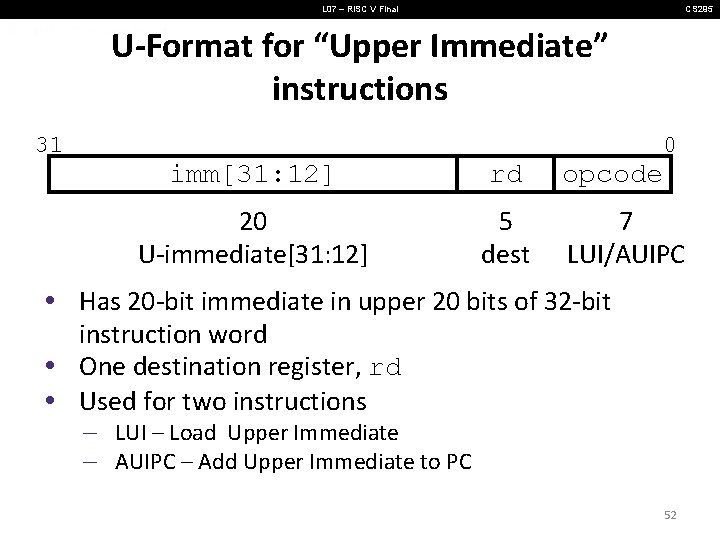
L 07 – RISC V Final CS 295 U-Format for “Upper Immediate” instructions 31 0 imm[31: 12] rd opcode 20 U-immediate[31: 12] 5 dest 7 LUI/AUIPC • Has 20 -bit immediate in upper 20 bits of 32 -bit instruction word • One destination register, rd • Used for two instructions – LUI – Load Upper Immediate – AUIPC – Add Upper Immediate to PC 52
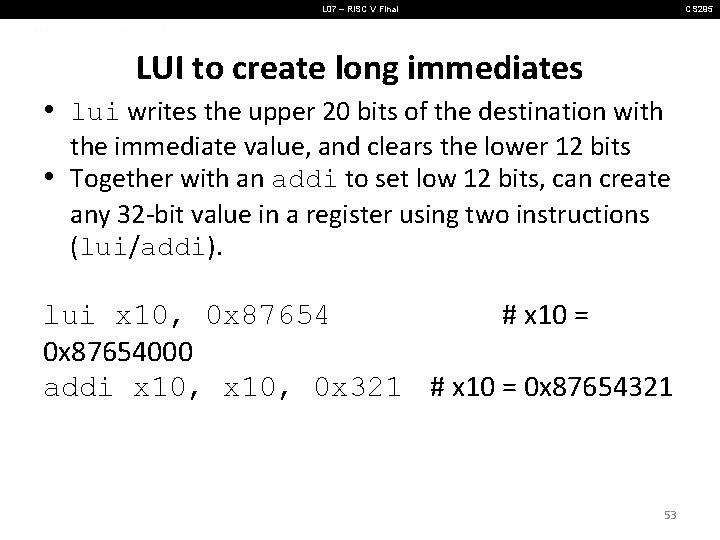
L 07 – RISC V Final CS 295 LUI to create long immediates • lui writes the upper 20 bits of the destination with the immediate value, and clears the lower 12 bits • Together with an addi to set low 12 bits, can create any 32 -bit value in a register using two instructions (lui/addi). lui x 10, 0 x 87654 # x 10 = 0 x 87654000 addi x 10, 0 x 321 # x 10 = 0 x 87654321 53
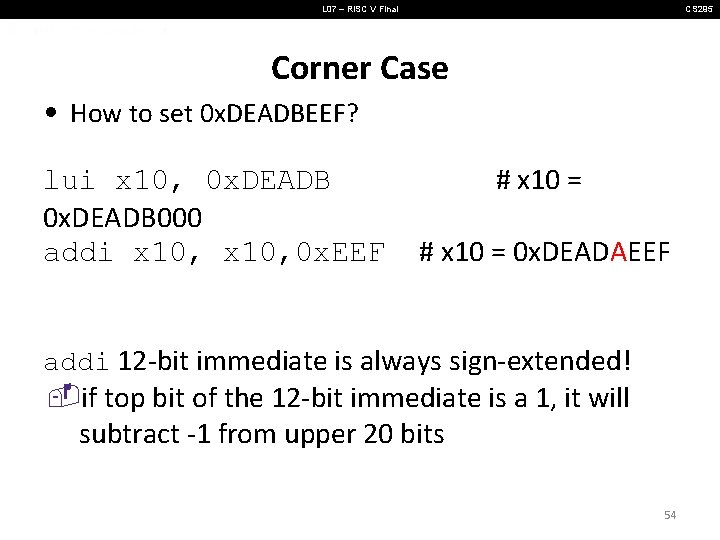
L 07 – RISC V Final CS 295 Corner Case • How to set 0 x. DEADBEEF? lui x 10, 0 x. DEADB 000 addi x 10, 0 x. EEF # x 10 = 0 x. DEADAEEF addi 12 -bit immediate is always sign-extended! -if top bit of the 12 -bit immediate is a 1, it will subtract -1 from upper 20 bits 54
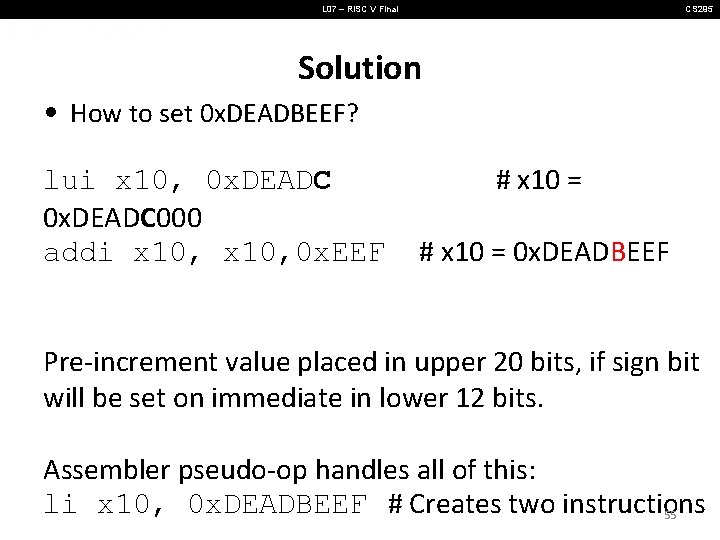
L 07 – RISC V Final CS 295 Solution • How to set 0 x. DEADBEEF? lui x 10, 0 x. DEADC 000 addi x 10, 0 x. EEF # x 10 = 0 x. DEADBEEF Pre-increment value placed in upper 20 bits, if sign bit will be set on immediate in lower 12 bits. Assembler pseudo-op handles all of this: li x 10, 0 x. DEADBEEF # Creates two instructions 55
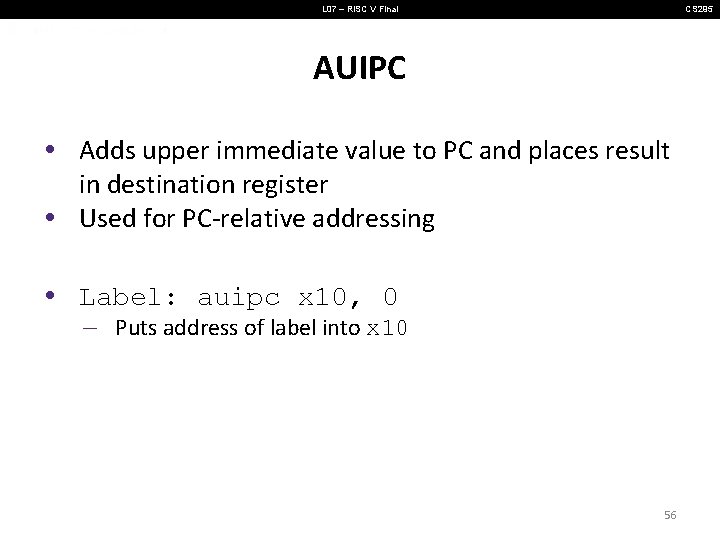
L 07 – RISC V Final CS 295 AUIPC • Adds upper immediate value to PC and places result in destination register • Used for PC-relative addressing • Label: auipc x 10, 0 – Puts address of label into x 10 56
L 07 – RISC V Final CS 295 Agenda • • Stored-Program Concept R-Format I-Format SB-Format UJ-Format 57
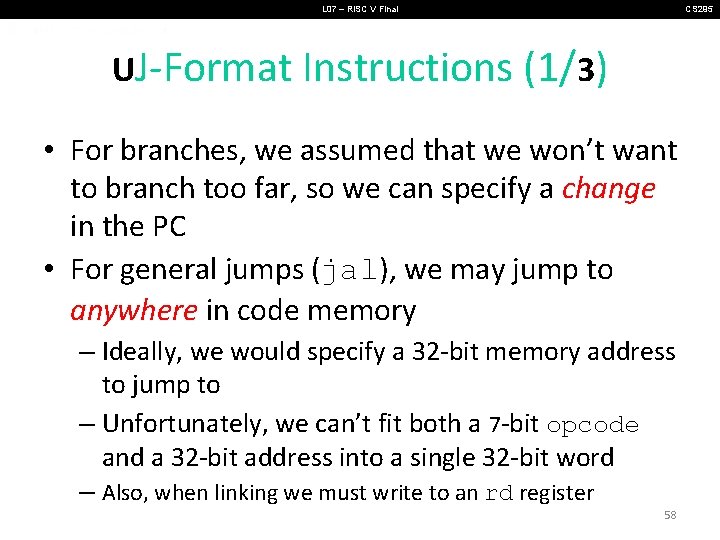
L 07 – RISC V Final CS 295 UJ-Format Instructions (1/3) • For branches, we assumed that we won’t want to branch too far, so we can specify a change in the PC • For general jumps (jal), we may jump to anywhere in code memory – Ideally, we would specify a 32 -bit memory address to jump to – Unfortunately, we can’t fit both a 7 -bit opcode and a 32 -bit address into a single 32 -bit word – Also, when linking we must write to an rd register 58
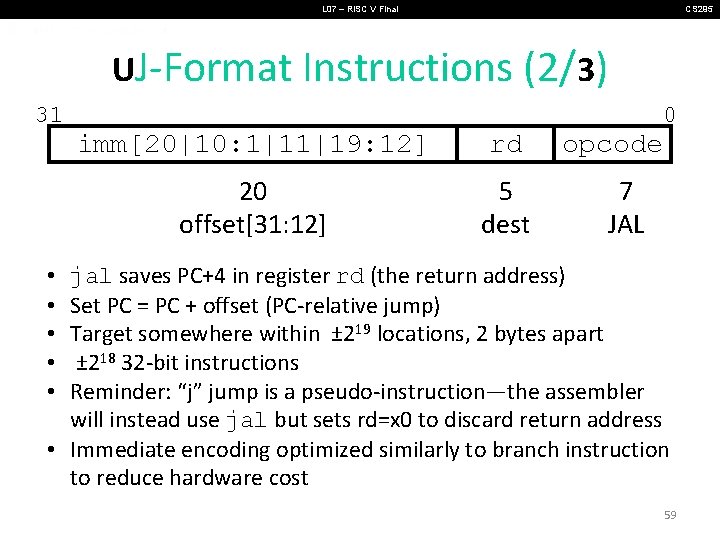
L 07 – RISC V Final CS 295 UJ-Format Instructions (2/3) 31 imm[20|10: 1|11|19: 12] rd 20 offset[31: 12] 5 dest opcode 0 7 JAL jal saves PC+4 in register rd (the return address) Set PC = PC + offset (PC-relative jump) Target somewhere within ± 219 locations, 2 bytes apart ± 218 32 -bit instructions Reminder: “j” jump is a pseudo-instruction—the assembler will instead use jal but sets rd=x 0 to discard return address • Immediate encoding optimized similarly to branch instruction to reduce hardware cost • • • 59
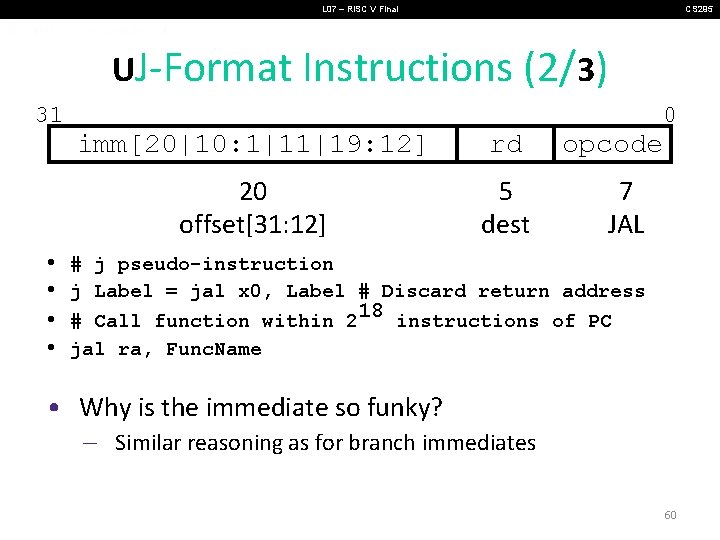
L 07 – RISC V Final CS 295 UJ-Format Instructions (2/3) 31 • • imm[20|10: 1|11|19: 12] rd 20 offset[31: 12] 5 dest opcode 0 7 JAL # j pseudo-instruction j Label = jal x 0, Label # Discard return address # Call function within 218 instructions of PC jal ra, Func. Name • Why is the immediate so funky? – Similar reasoning as for branch immediates 60
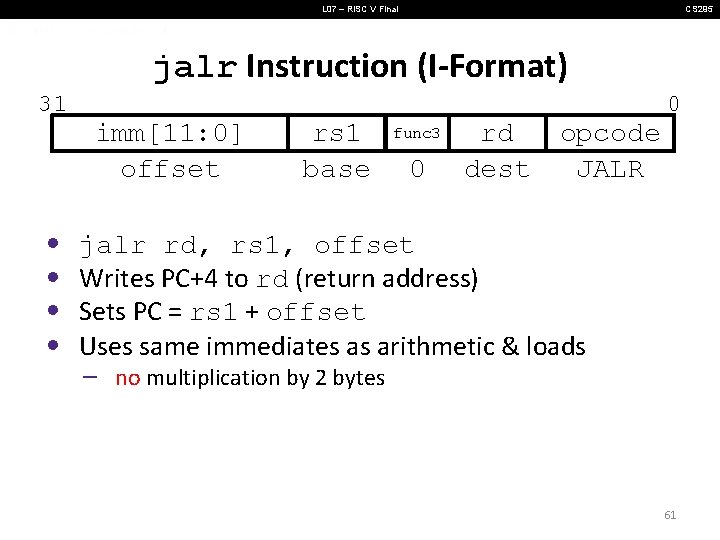
L 07 – RISC V Final CS 295 jalr Instruction (I-Format) 31 • • imm[11: 0] offset rs 1 base func 3 0 rd dest opcode JALR 0 jalr rd, rs 1, offset Writes PC+4 to rd (return address) Sets PC = rs 1 + offset Uses same immediates as arithmetic & loads – no multiplication by 2 bytes 61
L 07 – RISC V Final CS 295 Uses of jalr 31 imm[11: 0] offset rs 1 base func 3 0 rd dest opcode JALR 0 # ret and jr psuedo-instructions ret = jr ra = jalr x 0, ra, 0 # Call function at any 32 -bit absolute address lui x 1, <hi 20 bits> jalr ra, x 1, <lo 12 bits> # Jump PC-relative with 32 -bit offset auipc x 1, <hi 20 bits> jalr x 0, x 1, <lo 12 bits> 62
L 07 – RISC V Final CS 295 Summary of RISC-V Instruction Formats 63